DEVELOPMENT CORNER NM Ranching Summit a Success
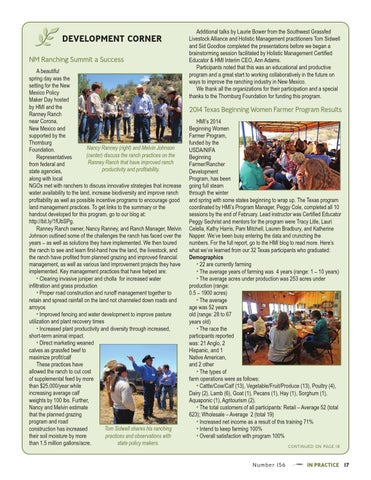
A beautiful spring day was the setting for the New Mexico Policy Maker Day hosted by HMI and the Ranney Ranch near Corona, New Mexico and supported by the Thornburg Nancy Ranney (right) and Melvin Johnson Foundation. (center) discuss the ranch practices on the Representatives Ranney Ranch that have improved ranch from federal and productivity and profitability. state agencies, along with local NGOs met with ranchers to discuss innovative strategies that increase water availability to the land, increase biodiversity and improve ranch profitability as well as possible incentive programs to encourage good land management practices. To get links to the summary or the handout developed for this program, go to our blog at: http://bit.ly/1fUbSPg. Ranney Ranch owner, Nancy Ranney, and Ranch Manager, Melvin Johnson outlined some of the challenges the ranch has faced over the years – as well as solutions they have implemented. We then toured the ranch to see and learn first-hand how the land, the livestock, and the ranch have profited from planned grazing and improved financial management, as well as various land improvement projects they have implemented. Key management practices that have helped are: • Clearing invasive juniper and cholla for increased water infiltration and grass production • Proper road construction and runoff management together to retain and spread rainfall on the land not channeled down roads and arroyos • Improved fencing and water development to improve pasture utilization and plant recovery times • Increased plant productivity and diversity through increased, short-term animal impact. • Direct marketing weaned calves as grassfed beef to maximize profit/calf These practices have allowed the ranch to cut cost of supplemental feed by more than $25,000/year while increasing average calf weights by 100 lbs. Further, Nancy and Melvin estimate that the planned grazing program and road Tom Sidwell shares his ranching construction has increased practices and observations with their soil moisture by more state policy makers. than 1.5 million gallons/acre.
Additional talks by Laurie Bower from the Southwest Grassfed Livestock Alliance and Holistic Management practitioners Tom Sidwell and Sid Goodloe completed the presentations before we began a brainstorming session facilitated by Holistic Management Certified Educator & HMI Interim CEO, Ann Adams. Participants noted that this was an educational and productive program and a great start to working collaboratively in the future on ways to improve the ranching industry in New Mexico. We thank all the organizations for their participation and a special thanks to the Thornburg Foundation for funding this program.
2014 Texas Beginning Women Farmer Program Results
HMI’s 2014 Beginning Women Farmer Program, funded by the USDA/NIFA Beginning Farmer/Rancher Development Program, has been going full steam through the winter and spring with some states beginning to wrap up. The Texas program coordinated by HMI’s Program Manager, Peggy Cole, completed all 10 sessions by the end of February. Lead instructor was Certified Educator Peggy Sechrist and mentors for the program were Tracy Litle, Lauri Celella, Kathy Harris, Pam Mitchell, Lauren Bradbury, and Katherine Napper. We’ve been busy entering the data and crunching the numbers. For the full report, go to the HMI blog to read more. Here’s what we’ve learned from our 32 Texas participants who graduated: Demographics • 22 are currently farming • The average years of farming was 4 years (range: 1 – 10 years) • The average acres under production was 253 acres under production (range: 0.5 – 1900 acres) • The average age was 52 years old (range: 28 to 67 years old) • The race the participants reported was: 21 Anglo, 2 Hispanic, and 1 Native American, and 2 other • The types of farm operations were as follows: • Cattle/Cow/Calf (13), Vegetable/Fruit/Produce (13), Poultry (4), Dairy (2), Lamb (6), Goat (1), Pecans (1), Hay (1), Sorghum (1), Aquaponic (1), Agritourism (2). • The total customers of all participants: Retail – Average 52 (total 623); Wholesale – Average 2 (total 19) • Increased net income as a result of this training 71% • Intend to keep farming 100% • Overall satisfaction with program 100% CONTINUED ON PAGE 18
Number 156
IN PRACTICE 17