CAMPUS CURRENT
FAC U LT Y NE WS
NSF Grants CS/Math
A shortage of highly effective mathematics and computer science teachers in secondary schools is a major factor contributing to unequal access to quality mathematics and computer science education in high-need school districts. Computer science professors Colleen Lewis (McGregor-Girand Associate Professor) and Zach Dodds (Leonhard-Johnson-Rae Professor), mathematics professor Darryl Yong ’96 and Karen Gallagher (USC) believe they have an answer to this issue, in the form of meaningful support and training for secondary school math and CS teachers. The team’s project “Math for America Los Angeles: Elevating Mathematics and Computer Science Instruction through Teacher Leadership,” recently received National Science Foundation (NSF) funding and seeks to accomplish three goals: Improve access to high-quality mathematics and computer science instruction in secondary schools in the greater Los Angeles area; cultivate teacher leaders through intensive professional development; and conduct research on the relationship between teachers’ participation in communities of practice and their development of teacher leadership.
12
HARVEY MUDD COLLEGE
Biology Fans of the HMC Bee Lab Blog (hmcbee.blogspot.com), produced by biology professor Matina Donaldson-Matasci and her students, will have an exciting project to read about over the next several years. Donaldson-Matasci and collaborators in England and at George Washington University have received NSF funding for their project “Dynamic Ant Networks.” The central objective of the project is to develop a general theory for how environmental constraints and opportunities shape dynamic transport networks. This theory will emphasize how network structure and function dynamically influence one another and how ecological context shapes this process. Potentially, the research will illuminate the rules by which ant colonies operate to dynamically change their networks in response to disturbance, generating better and more generally applicable advice on control and elimination of these
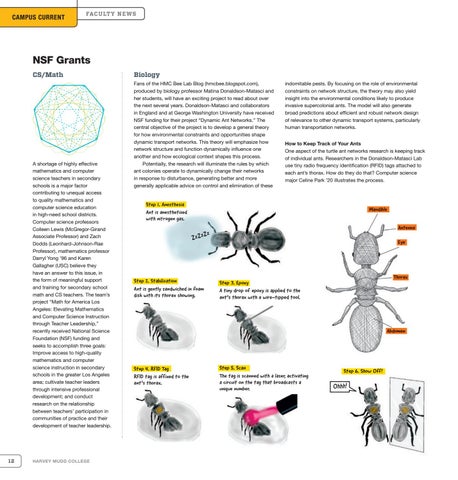
indomitable pests. By focusing on the role of environmental constraints on network structure, the theory may also yield insight into the environmental conditions likely to produce invasive supercolonial ants. The model will also generate broad predictions about efficient and robust network design of relevance to other dynamic transport systems, particularly human transportation networks. How to Keep Track of Your Ants One aspect of the turtle ant networks research is keeping track of individual ants. Researchers in the Donaldson-Matasci Lab use tiny radio frequency identification (RFID) tags attached to each ant’s thorax. How do they do that? Computer science major Celine Park ’20 illustrates the process.
Step 1. Anesthesia Ant is anesthetized with nitrogen gas.
Mandible Antenna Eye
Step 2. Stabilization Ant is gently sandwiched in foam disk with its thorax showing.
Thorax
Step 3. Epoxy A tiny drop of epoxy is applied to the ant’s thorax with a wire-tipped tool.
Abdomen
Step 4. RFID Tag RFID tag is affixed to the ant’s thorax.
Step 5. Scan The tag is scanned with a laser, activating a circuit on the tag that broadcasts a unique number.
Step 6. Show Off!