“MANY BIOLOGISTS EVENTUALLY WILL BE COMPUTATIONAL BIOLOGISTS. AND THAT’S HOW WE TRAIN OUR STUDENTS.” - ROBERT DREWELL
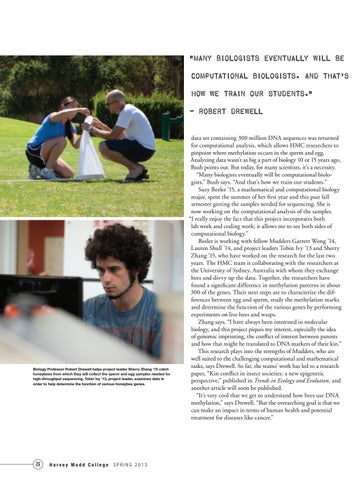
Biology Professor Robert Drewell helps project leader Sherry Zhang ’15 catch honeybees from which they will collect the sperm and egg samples needed for high-throughput sequencing. Tobin Ivy ’13, project leader, examines data in order to help determine the function of various honeybee genes.
26
Harvey Mudd College
SPRING 2013
data set containing 300 million DNA sequences was returned for computational analysis, which allows HMC researchers to pinpoint where methylation occurs in the sperm and egg. Analyzing data wasn’t as big a part of biology 10 or 15 years ago, Bush points out. But today, for many scientists, it’s a necessity. “Many biologists eventually will be computational biologists,” Bush says. “And that’s how we train our students.” Suzy Beeler ’15, a mathematical and computational biology major, spent the summer of her first year and this past fall semester getting the samples needed for sequencing. She is now working on the computational analysis of the samples. “I really enjoy the fact that this project incorporates both lab work and coding work; it allows me to see both sides of computational biology.” Beeler is working with fellow Mudders Garrett Wong ’14, Lauren Shull ’14, and project leaders Tobin Ivy ’13 and Sherry Zhang ’15, who have worked on the research for the last two years. The HMC team is collaborating with the researchers at the University of Sydney, Australia with whom they exchange bees and divvy up the data. Together, the researchers have found a significant difference in methylation patterns in about 300 of the genes. Their next steps are to characterize the differences between egg and sperm, study the methylation marks and determine the function of the various genes by performing experiments on live bees and wasps. Zhang says, “I have always been interested in molecular biology, and this project piques my interest, especially the idea of genomic imprinting, the conflict of interest between parents and how that might be translated to DNA markers of their kin.” This research plays into the strengths of Mudders, who are well suited to the challenging computational and mathematical tasks, says Drewell. So far, the teams’ work has led to a research paper, “Kin conflict in insect societies: a new epigenetic perspective,” published in Trends in Ecology and Evolution, and another article will soon be published. “It’s very cool that we get to understand how bees use DNA methylation,” says Drewell. “But the overarching goal is that we can make an impact in terms of human health and potential treatment for diseases like cancer.”