Cockburn was appointed SolicitorGeneral for Scotland in 1830 in the same year as his friend and fellow judge Francis Jeffrey (1773-1850) was appointed Lord Advocate by the Whig Prime Minister, Earl Grey. In 1831 he was elected Lord Rector of Glasgow University and in 1834 he was elevated to the Bench as Lord Cockburn. Cockburn and Jeffrey were strong supporters of Parliamentary reform and drafted the First Scottish Reform Bill which was enacted in 1834. For Whigs it meant the enfranchisement for those of ‘property and intelligence’ – householders who paid £10 rates or landowners. It increased the Scottish electorate from 5000 to 60,000 but excluded the working class and, fearing a step too far towards democracy, Cockburn said: ‘It is impossible to exaggerate the ecstasy of Scotland where to be sure it is like liberty given to slaves’. However, in his old age and looking back to these halcyon days he cautioned against a future which would bring Reform Bills ‘every twenty years or less’ and: ‘I wish I could believe that any people who have obtained the means of engrossing supreme power can be induced by education to refrain from grasping it.’ In his later years he wrote Life of Jeffrey (published posthumously in 1856). His Journal, 1831-44 in two volumes in 1874 and his autobiographical, Memorials of his Time give a highly descriptive and humorous descriptions of Edinburgh and the numerous ‘intelligentsia’ of its ‘Golden Age’. He died peacefully at his country retreat Bonaly Tower on 26th April 1854 soon after returning home from Ayr where he had been engaged in the Justiciary Court. He was buried in Dean Cemetery. His statue, by William Brodie in 1863 is in the north-east corner of Parliament Hall in Edinburgh. In addition to his strong support of parliamentary reform Cockburn’s legacy to Edinburgh was his intense dedication to the preservation of medieval Edinburgh. He saved John Knox’s House from destruction in 1816 during the road-widening proposals @KonectMagazines
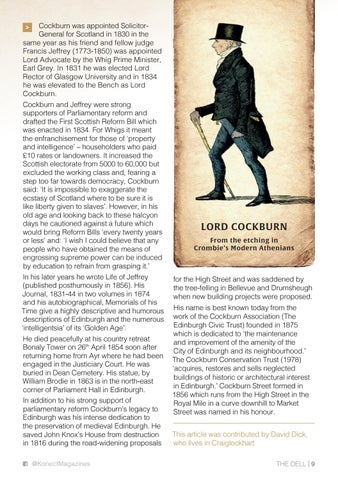
LORD COCKBURN From the etching in Crombie’s Modern Athenians
for the High Street and was saddened by the tree-felling in Bellevue and Drumsheugh when new building projects were proposed.
His name is best known today from the work of the Cockburn Association (The Edinburgh Civic Trust) founded in 1875 which is dedicated to ‘the maintenance and improvement of the amenity of the City of Edinburgh and its neighbourhood.’ The Cockburn Conservation Trust (1978) ‘acquires, restores and sells neglected buildings of historic or architectural interest in Edinburgh.’ Cockburn Street formed in 1856 which runs from the High Street in the Royal Mile in a curve downhill to Market Street was named in his honour. This article was contributed by David Dick, who lives in Craiglockhart
THE DELL | 9