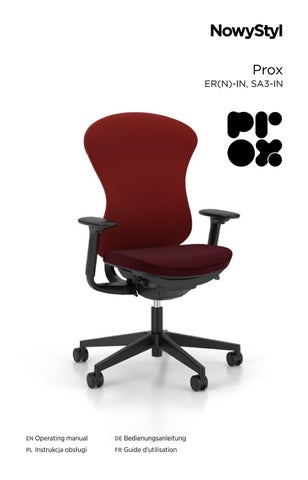
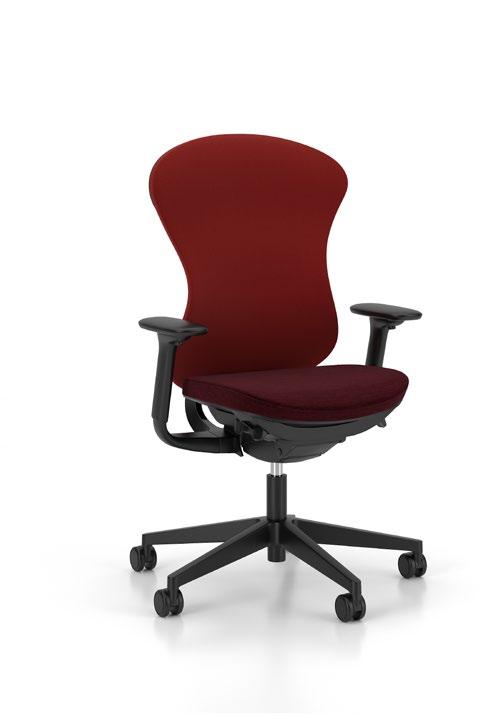
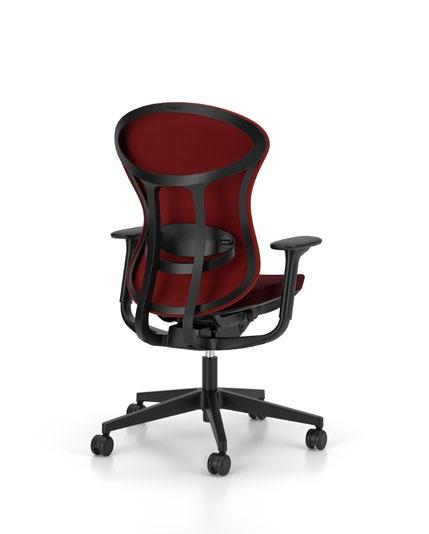
In order to simplify the handling of Prox chair, we have created a brief summary of the functions for you. Warning! All regulations should be provided while sitting.
pl
W celu ułatwienia obsługi krzesła Prox, przygotowaliśmy krótkie omówienie dostępnych funkcji. Uwaga! Wszystkie regulacje krzesła należy wykonywać z pozycji siedzącej.
de
Die Funktionen von Prox sind in dieser Bedienungsanleitung zusammengefasst. Achtung! Jede Einstellung des Stuhles sollte in sitzender Position ausgeführt werden.
fr
Afin de rendre l’utilisation de Prox plus facile, nous avons préparé un bref résumé de ses fonctionnalités. Attention ! Tous les réglages du siège doivent être effectués en position assise.
Seat height
pl Wysokość siedziska de Sitzhöhe fr Hauteur de l'assise
pl Głębokość siedziska
de Sitztiefe
fr Profondeur de l'assise
Adjustable backrest tilt force
pl Regulacja siły oporu oparcia de Rückenlehnen – Gewichtsverstellung fr Réglage de tension de retour de dossier
Forward seat tilt adjustment (option only for ERN-IN mechanism)
pl Regulacja pochylenia siedziska do przodu (opcja tylko dla mechanizmu ERN-IN) de Verstellung der Sitzneigung nach vorne (Option nur für ERN-IN Mechanismus)
fr Reglage de l'inclinaison d'assise vers l'avant (option seulement pour le mécanisme ERN-IN)
Backrest locking
pl Blokada oparcia
de Arretierung der Ruckenlehne
fr Blocage du dossier
pl Podparcie lędźwi
de Lumbalstützenhöhe
fr Hauteur du support lombaire
Lumbar support
Armrests 4D
pl Podłokietniki 4D
de Armlehnen 4D
fr Accoudoirs 4D
SA3-IN
pl Wysokość siedziska de Sitzhöhe
fr Hauteur de l'assise
Seat height
Seat depth
pl Głębokość siedziska
de Sitztiefe
fr Profondeur de l'assise
Additional adjustment of backrest tilt force
pl Dodatkowa regulacja siły oporu oparcia de Zusätzliche Rückenlehnen-Gewichtsverstellung
fr Réglage supplémentaire de tension de retour de dossier
Backrest locking
pl Blokada oparcia
de Arretierung der Ruckenlehne
fr Blocage du dossier
pl Podparcie lędźwi
de Lumbalstützenhöhe
fr Hauteur du support lombaire
Lumbar support
Armrests 4D
pl Podłokietniki 4D
de Armlehnen 4D
fr Accoudoirs 4D
EN
Use
This office swivel chair may only be used as intended and with general due diligence. If used in any other way (e.g. as a climbing aid or if you sit on the armrests), there is a risk of accidents.
A chair designed for persons weighing up to 130 kg and work for 8 hours.
Castors
Castors as per EN 12 5 29 – with a loadcontrolled braking mechanism. For soft floors: one-colour castors. For hard floors: soft castor cover in a different colour.
Cleaning
The upholstery can be cleaned with appropriate upholstery cleaning agents available for sale.
Recommendations for use
The chair may be used only for its intended purpose and with the observance of safety rules (for use when working in the office). You should not stand on the chair or sit on its armrests, since the improper use of the chair may pose a threat to the user or cause an accident.
Repair or replacement of a gas lift can only be carried out by specially trained staff.
PL
Użytkowanie
Krzesła należy używać zgodnie z jego przeznaczeniem, przestrzegając zasad bezpieczeństwa. Nie należy stawać na krześle, siadać na podłokietnikach, gdyż niewłaściwe użytkowanie krzesła stanowi zagrożenie użytkownika i grozi wypadkiem.
Krzesło przeznaczone dla osób o wadze do 130 kg i do pracy przez 8h.
Kółka
Kółka zgodne z EN 12 5 29 –z mechanizmem automatycznego hamowania bez obciążenia. Do miękkich powierzchni: kółka są jednokolorowe na całej powierzchni. Do twardych powierzchni: miękka osłona kółka jest innego koloru.
Czyszczenie
Tapicerka może być czyszczona odpowiednimi detergentami do tapicerki dostępnymi w sprzedaży.
Zalecenia dotyczące użytkowania
Krzesło należy używać zgodnie z jego przeznaczeniem, przestrzegając zasad bezpieczeństwa (do użytku podczas pracy w biurze). Nie należy stawać na krześle, siadać na podłokietnikach, gdyż niewłaściwe użytkowanie krzesła stanowi zagrożenie użytkownika i grozi wypadkiem.
Naprawę lub wymianę podnośnika gazowego może przeprowadzić wyłącznie specjalnie przeszkolony personel.
DE
Anwendung
Dieser Bürodrehstuhl darf nur bestimmungsgemäß unter Beachtung der allgemeinen Sorgfaltspflicht benutzt werden. Bei anderweitiger Verwendung (z. B. als Aufstiegshilfe oder beim Sitzen auf den Armlehnen) besteht Unfallgefahr.
Der Stuhl ist auf ein Körpergewicht von bis zu 130 kg und eine tägliche Nutzungszeit von acht Stunden ausgelegt
Rollen
Rollen nach EN 12 5 29 – mit automatischer Bremsmechanik ohne Belastung. Für weiche Fußböden: die Rollen weisen nur eine Farbe auf der gesamten Oberfläche auf. Für harte Fußböden: die weiche Rollenverkleidung hat eine andere Farbe.
Reinigung
Die Polsterung kann mit geeigneten handelsüblichen Polsterreinigungsmitteln gereinigt werden.
Nutzungsempfehlungen
Der Stuhl ist bestimmungsgemäß zu verwenden, wobei die Sicherheitsregeln zu beachten sind (Zum Verwenden bei Arbeiten im Büro). Stellen Sie sich nicht auf den Stuhl und setzen Sie sich nicht auf die Armlehne, weil eine falsche Nutzung des Stuhls eine Gefahr für den Benutzer verursachen und einen Unfall herbeiführen kann.
Der Austausch oder Arbeiten an den Komponenten zur Höhenverstellung mit Energiespeichern dürfen nur von geschultem Personal durchgeführt werden.
FR
Utilisation
Il convient de faire preuve de diligence lors de l’utilisation de ce fauteuil pivotant de bureau. Toute utilisation non conforme implique un risque de chute (comme le fait de l’utiliser pour monter sur quelque chose ou de s’asseoir sur l’accoudoir).
La chaise est conçue pour des personnes pesant jusqu'à 130 kg et pour travailler pendant 8 heures.
Roulettes
Les roulettes conformes à la norme EN 12 5 29, auto-freinées. Pour moquette : les roulettes sont unicolores sur toute la surface. Pour sols durs : la bande de protection souple de la roulette est d'une couleur différente.
Nettoyage
Afin de nettoyer les tissus, utiliser les produits de nettoyage pour mobilier tapissé disponibles dans le commerce.
Conseils d'exploitation
Le siège doit être utilisé conformément à sa destination, en respectant les règles de sécurité (pour une utilisation pendant le travail au bureau). Il ne faut pas se tenir debout sur le siège ou s'asseoir sur les accoudoirs, car suite à un usage non conforme, l'utilisateur se met en danger et risque un accident.
Le remplacement ou les travaux sur les éléments de réglage en hauteur des réservoirs de stockage d'énergie ne doivent être effectués que par du personnel qualifié.
How to adjust a chair
EN
Setting height of the seat
Set the seat height to ensure your thighs are at 90° angle to your calf and the front edge is located right beneath your knees.
PL
Ustawianie wysokości siedziska
Wysokość siedziska należy ustawić tak, aby kąt pomiędzy udami a łydkami wynosił 90°. Przednia krawędź siedziska powinna znajdować się bezpośrednio pod kolanami użytkownika.
DE
Einstellung der Sitzhöhe.
Stellen Sie die Höhe des Sitzes so ein, dass Ihre Ober- und Unterschenkel einen 90°-Winkel bilden und die Vorderkante der Sitzfläche unterhalb Ihrer Knie positioniert ist.
FR
Réglage de hauteur d’assise.
La hauteur d’assise doit être réglée de manière à ce que les cuisses et les mollets forment l'angle de 90°. Le bord avant de l’assise doit se trouver directement sous les genoux de l'utilisateur.
EN
Setting depth of the seat
While sitting ensure you have a gap the thickness of your hand, from the front edge of the chair seat and the back of knees. Optimal depth of the seat – about 50 cm – provides support of ⅔ up to ¾ length of thighs.
PL
Ustawianie głębokości siedziska
Aby właściwie ustawić głębokość siedziska należy upewnić się czy jest odstęp o grubości dłoni pomiędzy przednią krawędzią siedziska a kolanami. Optymalna głębokość siedziska to ok. 50 cm. Zapewnia ona podparcie na ⅔ do ¾ długości uda.
How to adjust a chair
DE
Einstellung der Sitztiefe.
Achten Sie beim Sitzen darauf, dass zwischen der Vorderkante der Sitzfläche und Ihren Kniekehlen eine Handbreit Abstand besteht. Die optimale Sitztiefe – etwa 50 cm – stützt ⅔ bis ¾ der Oberschänkellänge.
FR
Réglage de profondeur d’assise. Afin de régler correctement la profondeur de l’assise, assurez-vous qu'il y ait une distance équivalente à l’épaisseur d’une main entre le bord avant de l’assise et vos genoux. La profondeur optimale de l'assise est d'environ 50 cm. Elle assure un soutien sur ⅔ à ¾ de la longueur de vos cuisses.
How to adjust a chair
EN
Setting height of the backrest
Sit on the chair and adjust height of the backrest so that its shape fits your back and provides a comfortable support.
PL
Ustawianie wysokości oparcia
Aby ustawić wysokość oparcia należy usiąść na krześle i ustawić oparcie tak, aby jego kształt pasował do pleców użytkownika i zapewniał komfortowe podparcie.
DE
Einstellung der Rückenlehnenhöhe.
Setzen Sie sich auf den Stuhl und stellen Sie die Höhe der Rückenlehne so ein, dass sie zu Ihrem Rücken passt und eine komfortable Unterstützung bietet.
FR
Réglage de hauteur de dossier.
Afin de régler la hauteur du dossier, asseyezvous dans le siège et réglez le dossier de manière à ce que sa forme s'adapte à votre dos et vous procure un soutien confortable.
EN
Setting armrests
Remember, angle between the forearm and the arm should be min. 90°. If you work on a computer, it is important that the armrests support your forearms. This will create one line with the wrists, allowing them to remain in a neutral position.
PL
Ustawianie podłokietników
Należy pamiętać o tym, aby kąt pomiędzy przedramieniem a ramieniem wynosił co najmniej 90°. Jeśli użytkownik pracuje przy komputerze, ważne jest, aby podłokietniki zapewniały podparcie przedramionom. Dzięki temu utworzą one jedną linię z nadgarstkami, co pozwoli pozostać im w pozycji neutralnej.
How to adjust a chair
DE
Einstellung der Armlehnen.
Beachten Sie, dass der Winkel zwischen Unter- und Oberarm mindestens 90° betragen sollte. Bei der Arbeit am Computer ist die Unterstützung der Armlehnen für Ihre Unterarme von großer Bedeutung. So bilden sie eine Linie mit den Handgelenken und bleiben in einer natürlichen Haltung.
FR
Réglage d’accoudoirs. N'oubliez pas que l'angle entre l'avant-bras et le bras doit être d'au moins 90°. Si vous travaillez sur un ordinateur, il est important que les accoudoirs soutiennent vos avantbras. Cela les alignera avec les poignets, leur permettant de rester dans une position neutre.
How to adjust a chair
EN
Setting an inclination angle of the backrest
Adjust an inclination angle of the backrest to the type of work. Remember that the backrest should always adhere to the back providing an appropriate support of the spine, particularly in the lumbar section.
PL
Ustawianie kąta nachylenia oparcia Kąt nachylenia oparcia należy dopasować do stylu pracy. Należy pamiętać o tym, aby oparcie zawsze przylegało do pleców użytkownika, zapewniając właściwe podparcie kręgosłupa, a w szczególności jego części lędźwiowej.
DE
Einstellung des Neigungswinkels der Rückenlehne. Passen Sie den Neigungswinkel der Rückenlehne an Ihre Arbeitsweise an. Dabei ist zu beachten, dass die Rückenlehne immer an Ihrem Rücken anliegen sollte, um eine optimale Unterstützung der Wirbelsäule, insbesondere im Lendenbereich, zu gewährleisten.
FR
Réglage d’angle d’inclinaison de dossier. L’angle d’inclinaison du dossier doit être adapté au type de travail. N'oubliez pas que le dossier doit toujours adhérer au dos de l’utilisateur, en assurant le soutien approprié de la colonne vertébrale, et tout particulièrement de sa partie lombaire.
EN
Setting height of the desk
Sit at the desk on the adjusted chair. Desktop height should enable comfortable work with the provision of the minimal angle of 90° between the forearm and shoulders (most often 68 cm – 76 cm).
PL
Ustawianie wysokości biurka
Należy usiąść przy biurku na odpowiednio ustawionym krześle. Wysokość blatu powinna umożliwiać użytkownikowi wygodną pracę, zapewniając minimalny kąt 90° pomiędzy przedramieniem a ramieniem (najczęściej wysokość ta wynosi 68 – 76 cm).
How to adjust a chair
DE
Einstellung der Schreibtischhöhe.
Setzen Sie sich am Schreibtisch auf den für Sie passend eingestellten Stuhl. Die Höhe des Schreibtisches sollte ein komfortables Arbeiten ermöglichen, wobei der Winkel zwischen Unterarm und Oberarm mindestens 90° betragen sollte (Die optimale Tischhöhe beträgt meist 68 cm – 76 cm).
FR
Réglage de hauteur de bureau. Asseyez-vous devant le bureau dans un siège correctement réglé. La hauteur du plateau doit permettre à l’utilisateur un travail confortable, tout en assurant un angle d’au moins 90° entre l'avant-bras et le bras (le plus souvent, c’est une hauteur entre 68 et 76 cm).
Nowy Styl sp. z o.o. ul. Pużaka 49, 38 – 400 Krosno