BIG NIGHT FOR SNOB FILM FEST BOOZE P. 40 P. 51 LOCAL NEWS, FOOD, ARTS AND ENTERTAINMENT
FREE
NOVEMBER 5 - 11, 2015
Why dealers travel from Mass., NY and beyond to sell in NH
INSIDE: NH OPEN DOORS
GRANITE VIEWS JODY REESE
Drug dealers’ paradise?
Sales . Service . Sincerity 1 Range Rd Salem, NH 603.890.3212
450 Second Street 603.669.7993
098403
Grand Opening Here, you will find a fun and unique selection of brands with a reputation for status and quality.
103799
Please contact us to make an appointment to review the items you’d like to consign.
Located inside Consignment Gallery.
294 South River Road, Bedford 603.674.9569 Tues-Sat- 10-5:30 Sun 12-5
Local food from local farms
Every Saturday
Starting Nov. 7th From 10am-2pm
430 Loudon Rd (East of Rt. 106 on Rt. 9) Concord, NH • 229-0655 ConcordWinterMarket.com 103668 HIPPO | NOVEMBER 5 - 11, 2015 | PAGE 2
Is New Hampshire really a drug dealer’s paradise? That’s the provocative title of our cover story this week beginning on page 12. The story delves into the economics of dealing drugs in New Hampshire. It turns out that for several reasons, New Hampshire is a good place to be a drug dealer. This is no knock on our law enforcement or even our political leaders. It’s more a function of our geographic location and that we’re a safe place. In our story we go through some of the pricing of drugs — just by bringing drugs into New Hampshire, dealers can get a much higher street price than they can in places like Boston or New York. By virtue of our smaller population, territorial gangs never developed here. Most of us view jail as the big danger in drug dealing, but really it’s other criminal enterprises. It’s the possibility of being robbed or shot. The threat of going to jail is the same in one place as another, but if profits are higher and violence less likely, coming to deal in New Hampshire makes a lot of sense. This brings us to the natural next question: What can we as a state do about this? We’re already doing quite a bit. This story came out of a recent Manchester police bust of a group of suspected dealers from the New York City area. In Manchester and Nashua, police are aggressively tackling street dealers. As you would expect, because the money earned here is so much greater than back at home, other street-level dealers are happy to take their place and risk incarceration. On the policing front, our local departments could use more financial support, more state support and definitely more federal aid. This isn’t a Manchester or Nashua problem — it’s a statewide problem. The larger cities are natural hubs of commerce, and that includes illegal drugs. That does mean that the cost of confronting these problems tends to fall hardest on Manchester and Nashua, and that’s not fair. The state should be stepping in to make sure that the rest of New Hampshire is helping cover the cost of enforcement and treatment in our two largest cities. We as citizens can also help. When we see or hear about dealers in our neighborhoods, we can call the police or Crimeline to report the activity anonymously. We’re not going to wish this problem away, and to be frank the economics of it aren’t going to change either. Fighting this is a process, and it’s a process that’s already begun.
NOV. 5 - 11, 2015 VOL 15 NO 44
News and culture weekly serving Metro southern New Hampshire Published every Thursday (1st copy free; 2nd $1). 49 Hollis St., Manchester, N.H. 03101 P 603-625-1855 F 603-625-2422 www.hippopress.com e-mail: news@hippopress.com
EDITORIAL Executive Editor Amy Diaz, adiaz@hippopress.com Managing Editor Meghan Siegler, msiegler@hippopress.com, ext. 13 Editorial Design Ashley McCarty, hippolayout@gmail.com Copy Editor Lisa Parsons, lparsons@hippopress.com Staff Writers Kelly Sennott ksennott@hippopress.com, ext. 12 Allie Ginwala aginwala@hippopress.com, ext. 52 Angie Sykeny asykeny@hippopress.com, ext. 30 Ryan Lessard rlessard@hippopress.com, ext. 36 Contributors Sid Ceaser, Allison Willson Dudas, Jennifer Graham, Henry Homeyer, Dave Long, Lauren Mifsud, Stefanie Phillips, Eric W. Saeger, Michael Witthaus. To reach the newsroom call 625-1855, ext. 13.
ON THE COVER 12 DRUG DEALERS’ PARADISE The high demand, relatively higher retail prices and less risk of violent competition make New Hampshire a veritable paradise for drug dealers from outof-state areas already saturated with street gangs and drug sales. The Hippo takes a look at the trend, and at what police are doing about it. ALSO ON THE COVER, Local businesses that make their own food, art and more are once again opening their doors to showcase their goods during NH Open Doors, p. 42. Get into the spirits at the Distiller’s Showcase p. 40. And the SNOB Film Festival returns, p. 51.
INSIDE THIS WEEK
NEWS & NOTES 4 Walkable downtowns; bobcats making a comeback; Primary Update; PLUS News in Brief. 8 Q&A 9 QUALITY OF LIFE INDEX 10 SPORTS THIS WEEK 20 THE ARTS: 22 THEATER The Majestic turns 25. 24 CLASSICAL Judy Teehan. 24 ART Listings for events around town
INSIDE/OUTSIDE: 29 KIDDIE POOL Family fun events this weekend. Listings 30 GARDENING GUY Arts listings: arts@hippopress.com Inside/Outside listings: listings@hippopress.com Henry Homeyer offers advice on your outdoors. Food & Drink listings: food@hippopress.com 31 TREASURE HUNT Music listings: music@hippopress.com There’s gold in your attic. 34 CAR TALK BUSINESS Automotive advice. Publisher OTHER LISTINGS: Crafts p. 28; Dance p. 28; Festivals & Fairs Jody Reese, Ext. 21 p. 30; Health & Wellness p. 30; Languages p. 31; Misc. p. 32; jreese@hippopress.com Museums & Tours p. 32; Nature & Gardening p. 32; Over 50 Associate Publisher p. 35; Sports & Recreation p. 35 Dan Szczesny
Associate Publisher Jeff Rapsis, Ext. 23 jrapsis@hippopress.com Production Katie DeRosa, Kristen Lochhead, Meredith Connolly, Emma Contic Circulation Manager Doug Ladd, Ext. 35 dladd@hippopress.com Advertising Manager Charlene Cesarini, Ext. 26 ccesarini@hippopress.com Account Executives Alyse Savage, 603-493-2026 asavage@hippopress.com Katharine Stickney, Ext. 44 kstickney@hippopress.com Roxanne Macaig, Ext. 27 rmacaig@hippopress.com Tammie Boucher, support staff, Ext. 50 Reception & Bookkeeping Gloria Zogopoulos To place an ad call 625-1855, Ext. 26 For Classifieds dial Ext. 25 or e-mail classifieds@hippopress.com. Unsolicited submissions are not accepted and will not be returned or acknowledged. Unsolicited submissions will be destroyed.
CAREERS: 37 ON THE JOB What it’s like to be a... FOOD: 40 DISTILLERS SHOW Seacoast Restaurant Week; NH Open Doors; In the Kitchen; Weekly Dish; Wine; Perishables. POP CULTURE: 50 REVIEWS CDs, books, TV and more. Amy Diaz should have liked this week’s movies about food (Burnt), politics (Our Brand Is Crisis) and journalism (Truth) but very much did not. NITE: 58 BANDS, CLUBS, NIGHTLIFE Gilbert Gottfried; Nightlife, music & comedy listings and more. 61 ROCK AND ROLL CROSSWORD A puzzle for the music-lover. 62 MUSIC THIS WEEK Live music at your favorite bars and restaurants. ODDS & ENDS: 68 CROSSWORD 69 SIGNS OF LIFE 69 SUDOKU 70 NEWS OF THE WEIRD 70 THIS MODERN WORLD
103789
103493
103837
HIPPO | NOVEMBER 5 - 11, 2015 | PAGE 3
NEWS & NOTES
School aid cap
In an unexpected twist amid one of the state’s school funding battles, the Attorney General’s Office has declared it will not defend the constitutionality of the cap on state aid based on funding received the year before. The AP reported the City of Dover is suing the state over the cap because it limits their per-student funding despite the growing enrollment in their district and is calling for $14 million in back payments. The AG contests the payments but will not defend the cap on principle. This places the executive branch at odds with the Republican-led legislature. Legislative leaders like Senate President Chuck Morse and House Speaker Shawn Jasper have intervened and said the AG’s actions set a bad precedent. Andru Volinsky, the lawyer who won the Claremont case about 20 years ago that set off the school funding battles that followed, is representing Dover in the case.
CD1 race
The Republican primary is taking shape for the 1st Congressional District with challengers for incumbent Rep. Frank Guinta. NHPR reported former Dean of the UNH business school Dan Innis has announced his candidacy. Innis, a Portsmouth resident and former hotel owner, describes himself as fiscally conservative and moderate on social issues. He came in a close second behind Guinta in the 2014 Republican primary. Meanwhile, the AP reported State Rep. Pam Tucker of Greenland is also exploring a bid for the seat. Tucker has been a representative for four terms. She says she wants to rein in federal spending and end congressional gridlock. Former Democratic Congresswoman Carol Shea-Porter is seeking her party’s nomination against Bedford businessman Shawn O’Connor.
Drug crisis bills
monitoring program, streamline insurance for addiction treatment and expand Manchester’s criminal hot-spot policing program to the rest of the state. She also wants to make penalties for distributing fentanyl as strong as those for selling heroin. Republicans support the latter law enforcement programs. Republicans are also sponsoring a bill to provide $2.5 million in state funding for drug courts, which divert qualified addicts to treatment over incarceration. While Hassan has been calling for urgency and a special session to pass these bills, Republicans have called for caution and favor the regular legislative process.
Dispensary hearing
Public comments at a recent hearing for a medical marijuana dispensary proposed in Dover deviated from the concerns expressed in similar hearings in other parts of the state. NHPR reported most of the folks who spoke at the hearing expressed eagerness about seeing a dispensary open sooner rather than later. A representative of the New Hampshire Department of Health and Human Services announced during the meeting that the state will allow patients and providers to begin registering for the medical marijuana program on Nov. 2.
Sununu center
Several options have been floated for what to do with the underutilized Sununu Youth Services Center. The facility is a 156-acre campus with 144 beds but has only serviced about 40 to 50 youth for the past several years. One plan to split the campus between its existing services and a new section for treating youth with mental health or substance abuse disorders is favored by the state’s health department. Another plan, favored by state Sen. David Boutin, whose district includes the campus, would sell the facility to a consortium of organizations that provide inpatient and outpatient services to youth. If a new purpose isn’t decided upon, the facility will likely close.
A number of bills are in the works to address the state’s drug and crime crisis, and some proposals have broad support. The Union Leader reported Gov. Maggie Hassan would like to see an over- College layoffs haul to prescriber practices, limit Due to reduced enrollment in emergency room prescriptions for Manchester Community College opioids, improve the prescription and Nashua Community College, HIPPO | NOVEMBER 5 - 11, 2015 | PAGE 4
the institutions are laying off staff and faculty. The Union Leader reported MCC eliminated eight positions. It laid off three full-time staff members, two full-time faculty members and one part-time staffer. It also eliminated two other part-time positions and downgraded three full-timers to part time. MCC had a big enrollment year in 2014 but has seen a 3-percent decrease this fall. At NCC, two full-time staffers were laid off while two fulltime faculty members were offered part-time positions.
Grading concerns
Rick Panzieri, known as Muskrat, left his home at the Circle 9 Ranch campground in Epsom after living there for nearly a decade, the Concord Monitor reported. He and nine other campground residents were living there in violation of local law and were given eviction notices Oct. 20. Panzieri originally said he wouldn’t leave, according to the Monitor. CONCORD
A church in Pembroke is suing the town for its right to place an electronic sign on its roadside, the Concord Monitor reported. Hillside Baptist Church was unanimously denied a zoningHooksett variance at a rehearing, but it argues Pembroke Academy has a similar sign. Goffstown
A meeting to discuss plans by Eversource Energy and National Grid to build an overhead power line between Londonderry and Tewksbury, Mass., took place in WindMANCHESTER ham, the Union Leader reported. Utility reps said the project would shore up the New England grid’s reliability.
A new grading system in Nashua schools has left many teachers feeling frustrated and confused. The Telegraph of Nashua reported the new scale grades students Bedford across 11 points instead of the traA forum for Republican ditional 100 points, but can be Derry presidential candidates has Merrimack Amherst converted into letter grades still, been scheduled in Nashua and is meant to better measure a for Jan. 22 and Jan. 23. Londonderry Milford student’s proficiency in specifThe Telegraph of Nashua ic courses. Administrators told the reported it would give candidates a chance to give one Education Council during a recent last pitch to residents before meeting that the transition was NASHUA the primary. further complicated by technical problems with the grading software. The grading system is linked to a new push for competencybased learning in the district. Lifting the cap has bipartisan sup- The Concord Monitor reportport. Republican Senate Majority ed the state is looking to replace Leader Jeb Bradley is introducing a Toumpas to lead the largest state Van Ostern on solar Democratic candidate for gover- bill to raise the cap. Eversource and agency with an annual budget of nor and Executive Councilor Colin other big utilities aren’t likely to sup- $2.24 billion. The salary is set at $132,572 by statute. ToumpVan Ostern has signaled his support port eliminating the cap altogether. as has headed DHHS since 2007, for raising or eliminating the state’s when he became acting commisnet metering cap, which limits how Health chief much renewable power consumers The commissioner of the sioner before being officially can sell to utilities. The AP report- Department of Health and Human appointed the following year. He ed the state’s utilities are quickly Services, Nick Toumpas, is not was reappointed for a second approaching the 50-megawatt cap. seeking another four-year term. term in 2011.
CONSERVATIONISTS
BANK BANDITS
Eight separate projects in as many New Hampshire communities are receiving large grants from the federal Land and Water Conservation fund totaling $930,000. NHPR reported five of the projects in Milford, Dover, Nelson, Wolfeboro and Durham will receive $150,000 each. Concord is getting $100,000 to develop trails and a boardwalk at Terrill Park. Bedford will develop its Pulpit Rock Conservation Area Trails with a grant of $42,500 while Raymond will use $37,500 to buy 1.4 acres of land on the Lamprey river to develop a kayak launch.
Eight months after getting released from a 12year stint in prison, a Manchester man and his alleged accomplices have been indicted for the same type of crime that landed him in prison in 2003. The Union Leader reported Joseph Richards was originally convicted of a Hooksett bank robbery. Now, he’s being charged with robbing three banks in Maine this past September with the help of two others. Richards allegedly put on a wig, makeup and a costume before entering banks in Portland and Lewiston with a woman armed with a black pellet gun. A getaway driver allegedly waited outside. The trio netted about $22,000 from their spree, according to police.
N ew HampsHire H i m ealtH NsuraNce
arketplace
O pen enrOllment
!
is here
Nov. 1, 2015 – Jan. 31, 2016
It’s time to select or change your health insurance plan. 103258
Concord Hospital and Concord Hospital Medical Group (CHMG) practices are now accepting the following insurance plans currently available on the New Hampshire Health Insurance Marketplace: • Ambetter (from NH Healthy Families); • Community Health Options; • Harvard Pilgrim Elevate Health; • Harvard Pilgrim NH Network. If you are currently enrolled in a Marketplace plan, your plan may automatically renew unless you take action! Concord Hospital and CHMG are not participating in: • Anthem Pathways*; • Minuteman Health.
We can help you decide which plan is right for you! How to apply? Concord Hospital Financial Assistance Program Call: (603) 227-7101 E-mail: financialcounseling@crhc.org Website: healthcare.gov
*Cardiac services (office visits and consultations) provided by a CHMG provider at Lakes Region General Hospital, Franklin Hospital or Concord Hospital Cardiac Associates in Laconia are considered in-network for the Anthem Pathways plan. 103719
103681
HIPPO | NOVEMBER 5 - 11, 2015 | PAGE 5
NEWS
By Ryan Lessard
news@hippopress.com
Candidate filing The filing period for presidential candidates opened Nov. 4 and will close on Nov. 20. The Union Leader reported the traditional waypoint for presidential hopefuls is expected to see well over 30 or 40 Republican candidates and 10 to 20 Democratic candidates file, most of them longshots the public has never heard of. 3rd GOP debate The top Republican candidates for president sparred in Colorado Oct. 28 over economic policy and chafed against CNBC debate moderators. The AP reported it was also a chance for the establishment candidates to step into the foreground as billionaire Donald Trump and neurosurgeon Ben Carson faded into the background. Gov. Jeb Bush tussled with his friend Sen. Marco Rubio, criticizing his low voting record, and Rubio accused Bush of bowing to political pressure to attack him. Frustration with the moderators, specifically their framing of questions and management of speaking times, led the Republican National Committee to suspend its partnership with NBC. Bush struggles? Bush returned to New Hampshire the day after the debate to campaign in Portsmouth. NHPR reported he told the crowd there his campaign is not failing, despite a recent culling of campaign staff. Bush also downplayed his poor debate performances, emphasizing the need for “leadership” over “personalities.” Unions and students feel the Bern Three New Hampshire unions have endorsed Vermont Sen. Bernie Sanders, according to the Union Leader. They are the statewide American Postal Workers Union, the International Brotherhood of Electrical Workers Local 490 and Service Employees International Union Local 560 of Hanover. Meanwhile Sanders won a straw poll by college students at Saint Anselm College with 60 percent to Clinton’s 35 percent. Rubio edged Trump with 27 percent on the Republican side.
Walkable downtowns
NHIA hosts city planner, author, architectural designer Jeff Speck By Kelly Sennott
ksennott@hippopress.com
Making downtowns more walkable benefits entire communities, from businesses and employees to residents and visitors. It’s why, for example, the Concord Main Street Project is in full swing — according to the project website, the city’s new Main Street “will enhance opportunities for cultural events, social gatherings and doing business” — and it’s why Manchester is welcoming ideas for improving its own downtown. Hosting a series of speakers about how to do this seemed like a no-brainer to New Hampshire Institute of Art President Kent Devereaux, who’s also a member of the Manchester Cultural District Coalition, a nonpolitical group looking to create a cultural corridor in the city. The first presenter is architectural designer and city planner Jeff Speck, author of Walkable City: How Downtown Can Save America, One Step at a Time, who visits the school Monday, Nov. 9, from 6:30 to 9 p.m. Devereaux said via phone last week he’s been following Speck’s work for years. Speck was director of design for the National Endowment for the Arts from 2003 to 2007, oversaw the Mayors’ Institute on City Design and created the Governors’ Institute on Community Design, a federal program that helps state governors fight suburban sprawl. He’s provided plans and suggestions for downtowns Attend the event Where: New Hampshire Institute of Art, 148 Concord St., Manchester When: Monday, Nov. 9, from 6:30 to 9 p.m. Admission: Free; includes book signing, Q&A and reception Contact: nhia.edu
across the country, including mid-sized cities like Lowell, Mass., Des Moines, Iowa, and Boise, Idaho. “He’s since become the preeminent advocate and expert on … making downtowns more walkable and liveable,” Devereaux said. “Many of his ideas have to do with, how can we make our streets safer and more conducive for businesses?” Speck said via phone that what makes a city walkable is consistent across the board. “If we’re going to get people to walk [downtown], the walk has to be as good as the drive. It has to simultaneously do four things: be useful, safe, comfortable and interesting,” Speck said. To make it useful, Speck suggested providing more affordable downtown living options. To make it safer, look at the size of city blocks and streets and adjust accordingly. Generally, the smaller the block, the safer the roads; more intersections force people to drive slower. And consider traffic patterns; are streets one-way? Two-way? Multi-laned? “If a one-way has one lane, it’s not dangerous. What’s dangerous is giving people the opportunity to jockey,” Speck said. Where many downtowns fail walkability-wise is in parking and drug stores. People hate looking at parking lots and boarded-up windows, which is often what happens in these shops to make way for shelving units. Speck said people prefer seeing downtown living spaces with definitive edges and interesting angles. They like city walls that are covered with windows, doors, stoops, porches and benches. Cars should be hidden away or lining main streets, not filling up large pieces of no man’s land. “We humans are among the social primates. Nothing interests us more than other humans. If there are no signs of humanity — if the only signs are parked cars — then it’s not a place we want to walk around,”
Speck said. Better yet, Speck said, make it easier to not drive at all. Make it bike-friendly, and you’ll attract millennials from all over, since fewer and fewer young people are obtaining driver’s licenses. “They’re more interested in having choices in transit. Seventy-seven percent of American millennials polled plan on living in America’s urban cores, but they want to live in urban cores that can provide a real city experience while not being tied to the automobile,” Speck said. “The cities that have made the greatest [walkability] gains are biking cities.” How do you create a biking culture? Speck says it’s as easy as installing safe bike facilities. He cited Minneapolis as an example. Walkability has become incredibly important to downtown economies, Speck said, because the way millennials decide to live has changed. No longer do they find jobs before re-locating. More important is a city’s quality of life. “Sixty-four percent of millennials decide first where they want to live, then they move there and look for a job. It’s very different from my generation,” Speck said. Speck said to start small. Make one block absolutely perfect and move outward from there, rather than making a whole city decent or mediocre. Determine, what are the easy wins? What can you do with the smallest amount of effort? Gather grassroots support. “Most of the changes I recommend in cities only happen because of active citizens,” Speck said. Devereaux said he hopes for a full crowd and lots of implementable ideas for Manchester. “I’m hoping he has lots of ideas and observations about what other communities are doing, and hopefully we can borrow or steal the best ideas,” Devereaux said.
Over 25 varieties of harvested apples Farm stand open every day through Nov 25th
Stock up now on Apples & Potatoes for your winter baking
Now taking orders for Thanksgiving Pies
Apple Hill Farm
580 Mountain Rd., Concord, NH Call for availability & apple varieties 224-8862 • applehillfarmnh.com
HIPPO | NOVEMBER 5 - 11, 2015 | PAGE 6
103782
New Fall Hours: Tue-Sat 10am-6pm
30 End of%S off! ea Sale son 103387
NEWS
Bobcats making comeback NH considering hunting and trapping season
103509
YOUR SMILE IS YOUR BEST ACCESSORY!
A rebound in the bobcat population has prompted New Hampshire Fish and Game to consider lifting the ban that has kept the animal from being hunted since 1989, while local activists are trying to keep that ban in place. The North American lynx, unlike the cougar, has a short tail, spotted fur and long hair on the sides of its face. For the past couple decades, it was a face very few Granite Staters ever saw. But bobcats are starting to make a comeback. According to UNH, New Hampshire put an end to the bobcat hunt in 1989 when the cat population was estimated to have dwindled to 200. But recent studies by biologists suggest the number is now between 1,400 and 2,200. Just last year the estimates were between 800 and 1,400. So, in January, Fish and Game requested its wildlife experts draw up a conceptual guideline for a bobcat season. When she heard of the plans, activist Linda Dionne began coordinating a group of about 15 people who were against a bobcat hunt and formed Voices of Wildlife in New Hampshire. She’s in the process of filing the non-profit paperwork now. “We’ve been going to Fish and Game meetings ever since January,” Dionne said. So far, Dionne has collected more than 9,800 signatures from New Hampshire residents on an online petition and more than 22,000 signatures nationwide on a separate petition.
ADULTS & CHILDREN WELCOMING NEW PATIENTS FINANCING AVAILABLE
103517
news@hippopress.com
“People do not like the idea of the bobcat being hunted and trapped,” Dionne said. “They don’t want bobcats to be hounded, baited and trapped or hunted in any way. They believe, like we do, that bobcats provide us with an important service: they keep prey populations in check.” Dionne says bobcats are not a nuisance to anybody. Mark Ellingwood, the chief of the wildlife division at Fish and Game, says the original guideline he helped draft recommended 75 licenses for a bobcat hunt distributed in a lottery. He said the conceptual hunt and trap season would be between December and January and was modeled closely after the fisher cat hunt and trap season. By the time the commission voted to move forward with rulemaking on Oct. 14, the plan had changed to a lottery of 50 licenses. “They’re taking a conservative approach,” Ellingwood said. Dionne, whose group protested outside the Oct. 14 meeting, says she’s afraid a conservative lottery at first would open the door to more licenses down the road. “The moose hunt lottery, it began with 75 permits. In subsequent years, it went up to 675 permits, 500 permits in one year,” Dionne said. Ellingwood says the rulemaking process will involve public hearings and a public input period, though they haven’t been scheduled yet. While nothing is set in stone, the commission’s decision to enter into rulemaking implies the department’s intent to start a bobcat hunt. Dionne plans on attending every hearing and encouraging residents to submit written comment during the input period.
PLEASE CALL FOR DETAILS
Jennifer Chen, DMD Dental Hygienist, Nancy Schalk 61 Amherst Street Nashua, NH | 603.521.7739 crowndentalnashua.com
WIN A GIFT BASKET!
ANY NEW PATIENTS THAT BOOK AN APPOINTMENT BEFORE NOVEMBER 30TH WILL BE ENTERED INTO A DRAWING TO WIN A FALL GIFT BASKET!
GUNSTOCK SKI CLUB
ANNUAL SKI & SNOWBOARD SALE November 7th • 9am – 3pm
Gunstock Mountain Resort
Your new local jeweler
Route 11A, Gilford OVER A MILLION DOLLARS of NEW inventory from area ski shops spread out over three floors.
Open Tuesday-Saturday! Free parking on Saturdays
Consignment Drop Off
November 6 from 4 – 7:30 at the Gunstock Main Lodge th
pm
Then Stay to Shop!
Get your skis, poles, snowboards, helmets, boots, jackets, and more... Cash, Check, and Charge Accepted.
GunstockSkiClub.com
Find us on Facebook!
Gunstock Ski Club
1356 Elm St, Manchester Phone:(603) 935-8613 Steve Larochelle Trusted Jeweler for 25 Years
103758 103757
By Ryan Lessard
103282
Members of Voices of Wildlife in NH protest outside a NH Fish and Game meeting. Courtesy photo.
General & Cosmetic Dentistry Cleanings & Fillings Professional Whitening Extractions & Restorative Implants
HIPPO | NOVEMBER 5 - 11, 2015 | PAGE 7
NEWS & NOTES Q&A
Amoskeag Fishways presents
From foster kid to advocate
Eyes on Owls
DCYF poster boy planning for college
Live Owls
Corey Green is a former “youth in care” in New Hampshire’s foster care system. Now 20, he’s been reunited with his mother and shares his experience to help kids still in the system and improve how services are delivered. He was the keynote speaker at the Department of Children, Youth and Families Teen Conference in August.
In Manchester!
Nov. 7 11am & 1pm th
$10/person or $25/family
(Family rate does not include extended family)
Preregistration Required
Call 626.FISH
Eversource - NH Audubon NH Fish & Game - US Fish & Wildlife
103568
www.AmoskeagFishways.org | 4 Fletcher St. Manchester NH 103391
QUEEN CITY QUEEN DENTAL QUEENCITY CITY DENTAL DENTAL DR. MARINA E. BECKER DR. MARINA E. DR. MARINA E. BECKER BECKER Caring Caringand andgentle gentlefamily familydentistry dentistry
Offering: Offering: Full FullRange RangeofofQuality QualityDental DentalCare Care Mercury-Free Mercury-FreeDentistry Dentistry White WhiteFillings FillingsOnly! Only!
60 60Rogers RogersSt. St.Suite Suite#1-A #1-A Manchester, Manchester,NH NH03103 03103
603-669-3680 603-669-3680 Hours: Hours:M-Tu-Th-Fr M-Tu-Th-Fr8:30 8:30–5:30 –5:30 Closed ClosedWednesdays Wednesdays
Accepting AcceptingNew NewPatients Patients Most MostDental DentalInsurances InsurancesAccepted! Accepted! 5% 5%Senior SeniorDiscount Discount
••Repair RepairofofChipped/Broken Chipped/BrokenTeeth Teeth ••Porcelain PorcelainVeneers Veneers ••Teeth whitening • Bondings Teeth whitening • Bondings ••Crowns • •Implants Crowns Implants ••Bridges • •Dentures Bridges Dentures ••Root Rootcanals canals&&extractions extractions
Specials
Extractions $ 160 Crowns $990 Veneers $750
Same Day Emergency Service Available* *In Most Cases 097411
Picture-perfect convenience. Just tap and snap to deposit checks with our Merrimack24 app for your mobile device. For convenience that’ll leave you smiling, you can’t beat Merrimack Style. Download the Merrimack24 app free* from your app store today, or call 603-225-2793 for details.
*Message and data rates may apply from your wireless carrier. Mobile Deposit is available as part of the latest version of the Merrimack24 mobile app. To use the app, you must first be a Merrimack County Savings Bank Online Banking customer. Visit your app store to download today.
HIPPO | NOVEMBER 5 - 11, 2015 | PAGE 8
103272
How did you end up in the fosfinishing up soon, ter care system? and then I’ll be I was 7, and we had just moved looking at some from Florida and left my father, kind of college, who was quite abusive. My mom wanted to probably starting get us therapy to make sure we were all right at [NHTI] and in the head, so I ended up going to the Anna moving up from Philbrook Center for an evaluation and stuff there. like that. I ended up having a stay for some reason. It’s all kind of blurry. I don’t know a Corey Green. Ryan Lessard photo. Any jobs? lot of the details there, how it happened. But Not right now. I ended up being involved in the system from I do get stipends for speaking on panels and there. I went to a group home after a couple stuff that I do through DCYF. foster homes. What are you future aspirations? Can you describe your experience in the I’m really into geology and anthropolosystem? gy. Like, archeology stuff. So, I want to take I had good experiences and I had bad ones, courses in that. And I love botany, so somejust because I moved around a lot and a lot of thing along those lines too. What I do for fun the newer policy wasn’t in place yet when I is I go out and find plants that I don’t know was in care. A lot of the things that happened and bring them home to identify them. to me are no longer allowed to happen at all. Do you know which colleges you’d like to Things like what? go to? My case ran on for quite a long time under When I was younger, I looked at Darta classification that it shouldn’t have been, mouth and Brown ... and I kind of gave up which is not reunification. I ended up in two on that because I ended up really depressed group homes and three foster homes [in 10 as a teenager. Now, I’m seeing that I can do years]. … I came back to my home in 2011. these things again. [But] I haven’t given any thought beyond starting at the tech. What was your takeaway from that experience? Do you think you would have been What are the life lessons that you’re sharbetter off outside the system? ing at events like the Teen Conference? I’ve been asked this before and I kind of I do a lot of things. Sometimes I’m training think of it as, I wouldn’t be who I am today if newer workers how to handle teens. SomeI hadn’t met [the people I met] and had all the times I’m on panels and I’m having questions experiences with people over time that I did asked about me, about my experience, which have. I’ve come to terms with the experienc- will help develop policy later. And sometimes es that I had where I’m comfortable and kind I’m actually working in committees to develop of grateful for most of them, even the ones policy that will help their alumni and youth. … that weren’t exactly beneficial at the time, I try to put something hopeful in [my speechbecause they kind of shaped who I am. es] because a lot of times youth in care kind of feel hopeless, stuck and trapped. Like they What are you up to now? don’t mean anything. I try to make them realRight now, I’m finishing high school, after ize they can advocate and they can change how a long struggle. I actually have Wednesday they feel about themselves and their situation. night ... classes and a computer class that I go into the high school and do now. I should be What do you think is the biggest challenge that DCYF is facing right now? Five favorites First thing that comes to mind is funding because there’s so much that we should be Favorite Book: Walden Pond by Henry doing for youth in care that we can’t because David Thoreau we don’t have all the resources. I’m lucky Favorite Movie: The Life and Times of enough that I’ve been singled out as having Grizzly Adams (1974) really good potential and skills that I’ve been Favorite Music: Folk punk Favorite Food: Pizza able to get special trainings to help forward Favorite thing about NH: I love hiking me on my kind of career. in New Hampshire and I love the fall. — Ryan Lessard
NEWS & NOTES
QUALITY OF LIFE INDEX
Energy inefficiency?
New Hampshire is lagging behind its New England neighbors in energy efficiency and ranks in the middle compared to the rest of the country. NHPR reported the State Energy Efficiency Scorecard released by the American Council for an Energy-Efficient Economy places the Granite State 20th in the nation. Massachusetts holds the No. 1 spot while Vermont is third, Rhode Island is fourth, Connecticut is sixth and Maine is 14th. While it says New Hampshire has incentives in place for reducing energy use in state buildings, it has no reporting requirements and no public research centers focusing on efficiency. QOL Score: -1 Comment: Massachusetts has been at the top of the list for five years in a row.
75
High test scores
Students in New Hampshire scored among the highest in a national assessment of math and reading skills. The AP reported the 2015 National Assessment of Educational Progress showed high grades for both fourth-graders and eighth-graders. The numbers are similar to the 2013 assessment. The eighth-graders were tied with four other states for the top spot in reading while the fourth-graders scored the second-highest in the country. In math, fourth-graders were tied with five states for the top despite the average math score for fourth-graders being slightly lower than in 2013. Eighth-graders were tied with three other states at the top in math. QOL Score: +1 Comment: Along with being more energy-efficient, Massachusetts is also scoring better academic grades; it ranked higher than New Hampshire in every category except eighth-grade reading.
Daylight savings
Sure, the extra sleep is nice, but daylight saving is always a downer for QOL, who much prefers enjoying light in the afternoon and evening. When it’s dark at quitting time, QOL loses all motivation to do things like work out, cook or food shop and just wants to take a nap. QOL Score: -1 Comment: Counting down until Sunday, March 13, when it’s time to spring ahead.
50
Online Promo Code:
SWL10
Valid for 11/7/15 only. Must present coupon at time of purchase. Valid up to 4 people. Cannot be combined with any other offers or discounts. Expires 11/8/15.
Fiery weekend
Many New Hampshire residents were displaced this weekend because of apartment building fires. The biggest number came from a flame in Manchester, which displaced 20 early Friday morning, including six children, according to WMUR. Firefighters arrived at 12:50 a.m. and took an hour to get the blaze under control, with an estimated damage of $100,000 but no casualties. WMUR also reported that a Rochester apartment building fire displaced five people. Nobody was hurt, but residents were devastated at losing their belongings. QOL Score: -2 Comment: Investigators suspect the Manchester fire occurred on the third-floor porch, sparked by careless smoking disposal; the Rochester fire is still under investigation. QOL score: 84 Net change: -3 QOL this week: 81
What’s affecting your Quality of Life here in New Hampshire? Let us know at news@hippopress.com.
103462
HIPPO | NOVEMBER 5 - 11, 2015 | PAGE 9
We Want to What if these things hadn’t happened? Jewelry, Buy Your SPORTS DAVE LONG’S LONGSHOTS
and Coins!
Jewelry
and Coins!
926 Elm Street • Manchester
(Next to City Hall) 926 Elm Street, Manchester, NH 603-625-8442 800-457-8539 (Next to •City Hall) Watches, Jewelry, Diamonds & Precious Stones
603-625-8442 • 800-457-6539 Watches, Jewelry, Diamonds www.pearsonsjewelry.com and Precious Stones 094812
www.pearsonsjewelry.com
HIPPO | NOVEMBER 5 - 11, 2015 | PAGE 10
The SiTe of
B. The best fit probably was ex-BC coach Tom Coughlin, who has a winning record head-to-head over him, but he’s still no Coach B. Would the Jets have become what the Patriots did? With Tuna running the team, Coach B wouldn’t have picked the groceries like here and that leads to power issues, so I don’t think so. What If Bob Kraft Didn’t Own the Stadium? James Orthwein bought the Patriots to move them to St. Louis and only stayed because Foxboro Stadium owner Bob Kraft wouldn’t let him out of his lease. If that hadn’t happened, they’d be the St. Louis Patriots today and maybe the Rams would have come here after splitting from L.A. But that only would have happened with a new stadium, which proved so prickly to get the Pats almost wound up in Hartford. So that’s no lock. And given that L.A. remains without a team 20 years later, that might have been our fate instead. What if the Redskins Had Never Left Boston? Well for one thing I’m betting they change the nickname. Second, it’s doubtful the AFL would’ve have tried to compete with an NFL team in Boston. Only L.A. and New York tried that, and the Chargers quickly moved to San Diego and New York was only saved after the Titans went bust by Joe Namath and becoming the Jets. That probably means no Patriots today, erasing 15 great years here. Phewww! What If The Braves Had Stayed Here? If so, Boston sees the great careers of Warren Spahn, Eddie Mathews and Henry Aaron unfold. They won the World Series in 1957, went again in ’58 and lost a playoff to L.A. in ’59 to go again as the Red Sox were going in the toilet. So if they had hung in until then, would the Red Sox have been the ones to move from a city that couldn’t support two teams? You can make a case that baseball would’ve been better the next 20 years, but it would’ve caused a monumental re-write of history. No Curse of the Bambino, Bucky Dent, Grady Little,
2004, 2007, 2013 and no rivalry with the Yankees. Yikes! What If Wilt and Russell Swapped Teams? Wilt had the stats, Russell the rings, and the myth says that’s because Russell always had more talented teams. Not true, though, as in Russell’s last four years Wilt had the younger, more talented teams and the aging Celtics still won three times. The only way Wilt could ever be judged better than Russell is if he’s a Celtic and wins 12 times to better Russell’s 11 as winning is all that counts in pro sports. I doubt that happens as Russell would have won probably three times with the late ’60s Sixers and definitely with West and Baylor in L.A. But it also would’ve changed Russell’s story because if he’s not in Boston it’s doubtful he wins 11 times elsewhere. Brady Goes to Indy and Peyton Plays Here: Wouldn’t it have been interesting to see Coach B defend against a Brady throwing to Marvin Harrison and Reggie Wayne? Would it have been Brady with the four picks in 2003 instead of Manning, or was that less a product of coaching and more of Peyton flinching in the big moment? I suspect it’s more the latter. So the Pats have two SB wins at most and Indy probably has a couple more at least. What Happens If Tom Brady’s Gone Already At 199? You can make a case the last 15 years are a function of pure luck. Even the biggest “In Bill We Trust”-ers can’t say there was a master plan to wait until 199. He was just there and they acted. Pure luck. Chances are Coach B might have gotten someone good after that draft in 2000, or maybe he gets a veteran like maybe Doug Flutie, who was ending his run in Buffalo. Interesting, but no one would’ve been as good as TB-12, which means the whole story here is in re-write. 103159 Now do you have a little more appreciation for how lucky we’ve had it? Email Dave Long at dlong@hippopress.com.
Great Events in Manchester
Behind Russett and Philistin Central Completes Dream 2004 Season John Lynch had just been elected governor, the Iraq war was in its 18th month, the Patriots were three months away from their third Super Bowl win in four years and Curse of the Bambino had been lifted days earlier when the Red Sox beat St. Louis in the World Series. It was November of 2004 and the brilliant Central football team was trying to complete a dream season with a fourth straight State Football Championship and the state’s first ever 13-0 season. Number 11 came in Round One of the playoffs by thumping Salem 42-12 as Sloan Russett ran for 245 yards and 5 TD’s on just 15 carries. After upsetting Concord 23-14 to reach the finals, tradition rich Pinkerton Academy stood in the way of number 12. Before the 3,000 on hand at Gill Stadium had settled in their seats Central was up 14-0 after just seven plays on a pair of Russett TD runs. It grew to 28-3 on another Russett TD run and one by Maryland bound running mate Dave Philistin. A two yard TD plunge by QB Josh Ratacik made it 34-10 after three. Russett hit pay dirt a fourth time early in the final period and Philistin closed out the scoring with a 36 yard run for the 47-18 final and fourth straight state title. The duo had 310 combined yards as Central ran for 420 overall to cap a remarkable season where Russett ran for 1917 yards and 28 TD’s while for Philistin it was 811 and 11. Five days later they were back at Gill for number 13 in a 32-12 win over Memorial in the Turkey Bowl to complete a dream season that provided a series of 13 great events for Manchester.
103780
Watches!
Bob Ryan wrote a column in Sunday’s Boston Globe imploring all to appreciate the amazing run of championships we have enjoyed so far in the 21st century. He also reminded readers that there’s been an unbroken string of first ballot Hall of Famers playing here since Eddie Shore joined the Bruins in 1926. But you can take it even further if you don’t mind a minor little gap between Shore’s arrival and Babe Ruth’s departure in 1920. Then you can go all the way back to the origin of professional sports as we know it when Cy Young was closing in on his 500th win going 33-10, 32-11 and 28-9 in Boston after the American League was formed in 1901. Even greater in my view, however, was seeing two real dynasties evolve: the Celtics for 30 years after Bill Russell became the final piece to a great team in 1956, to the John Havlicek-Dave Cowens C’s of the ’70s, to Larry Bird and company into the early ’90s; and the Patriots, who are still one title away by my personal dynasty definition, but they’ve been something to count on for 15 years, so I bet they’ll get there. If you’re taking all that for granted, shame on you. So here’s a little Ebenezer Scrooge-like trip back to make what we’ve had here a little vivid by showing what it might’ve been like if some monumental local sports things had never happened. What if Coach B Had Stayed HC of NYJs? I must admit, he seemed deranged that day he bailed on the Jets. That notion lingered until he came out of the bunker for a radio interview before his first draft where he was himself — smart and clearly focused. But if he stays in NYC, who replaces Pete Carroll as HC of the trending down NEPs? No one picked anywhere since is in the same solar system as Coach
SPORTS DAVE LONG’S PEOPLE, PLACES & OTHER STUFF
Eight is enough for Brummett Player of the Week and One-Man Band Award: To Derryfield’s Gabi Brummett, who scored eight of Derryfield School’s 10 goals in a 10-0 whitewash of Concord Christian in the opening round of the Division IV soccer playoffs. It gave her an astonishing 79 goals on the year. She had another as D-field advanced to the semifinal with a 4-0 win over Lisbon on Sunday. Sports 101: Name the only four pitchers to strike out the side on nine pitches twice in their career. Game of the Week: It’s the instant classic double-OT 2-1 Central win over Memorial in the NHIAA Soccer Tournament. Zach Elliot’s second goal won it off a feed from Heran Rai with 6:43 left. Memorial’s goal came from Mbambi Mbungu in the definition of a short-lived lead, which Elliot tied 47 seconds later with his first goal. Hot Ticket: It’s the Granite State Baseball Dinner headlined by Jackie Bradley on Nov. 21 at the Radisson Hotel and Expo Center to benefit the Fisher Cats Foundation, Children’s Hospital at Dartmouth and
The Numbers
4 & 5 – place the SNHU and Saint Anselm men’s basketball teams were voted to finish in the NE-20 standings in the coaches poll taken last week. 6 – saves by Lindsay St. Pierre as Central shut out Exeter in a 2-0 win to open the NHIAA soccer playoffs when Devin LaCroix and Paige LaBerge scored for the Green. 8 – laterals used by the University of Miami to snatch
the Ted Williams Museum. Tickets on sale at nhfishercats.com. Knick of Tyme Award: To Nico Buccieri and the offensive line that opened the hole he plowed through to score six yards out with 33 seconds for a 13-12 win over Exeter that sent the Astros into the playoffs instead of home for the holidays. What A Stupid I Yam Award: To me, for forgetting in Sports 101 that Tom Glavine joined Carlton Fisk this past summer as the only New England natives elected to Baseball’s Hall since World War II. Thanks to my always right sports knowledge friend Bob Mongan for pointing that out. Sports 101 Answer: Nolan Ryan, Sandy Koufax, Randy Johnson and Lefty Grove each struck out the side on 9 pitches twice. On This Date: Nov. 5: 1955 – Montreal’s Jean Beliveau takes just 44 seconds to record the second-fastest hat trick in NHL history. 1978 – Oakland’s John Madden becomes 13th coach to win 100 NFL games. 1994 – George Foreman KOs Michael Moorer to become the oldest
victory from the jaws of defeat with a miracle TD on a squib kick to turn the 27-23 deficit it faced after giving up a TD to Duke with less than 10 seconds left into a miraculous 3-27 win. 24 – goals scored by (hey) Saylor Clark so far this year with the last two coming when Bedford advanced in the division soccer playoffs with a 2-0 win over Merrimack. 62 – points scored by the 8-1 Bedford blitzkrieg
offense as the Bulldogs knocked Central out of the playoff hunt, walloping them 62-14 on Friday night while Nick Lahey and Connor Roberts accounted for four TDs each with six coming on the ground and two more on TD passes by Roberts. 1,000 – yard rushing mark for the season passed by Connor Bourque as he ran for three TDs as undefeated Goffstown held on to its topranked status with a 42-12 thumping of Memorial.
PLEASE JOIN US FOR OUR 9TH ANNUAL Keller Williams Realty Metropolitan’s One winner of a raffle for $2,500 in cash One winner of a raffle for 100 bottles of wine Hoops for Heroes
Silent Auction Items: Weekend Get-A-Ways Sports Events & Memorabilia Art Gift Baskets
Raffle and Auction Fundraiser (Proceeds to benefit local children’s charities)
Thursday, November 5, 2015 Fratello’s Restaurant 155 Dow Street, Manchester
5:00pm-9:00pm
$50 for 2
Keller Williams Realty Metropolitan
Includes: Chance to win $2,500 in CASH, 2 wine or beer drink tickets and appetizers
For more info contact Kristi Whitten 603-836-2747 or Mark Mulcahy 603-836-2620
Tickets
103621
Universal Decor Paint | Remodeling | Kitchen & Bath Flooring | Wall & Window Coverings
Sports Glossary
Tris Speaker: Played on World Series winners in 1912 and 1915. Probably was even better in Cleveland, but overall the lifetime average was .344 and he’s the all-time leader in doubles with 792. Warren Spahn: 13 seasons of 20-plus wins and 363 lifetime. Eddie Matthews: Slugging third baseman with four 40-homer seasons in the ’50s and 512 overall. Hank Aaron: He’d have been the greatest ever to play here, though without that launching pad in Atlanta it’s doubtful he reaches 755 homers. Babe Ruth’s Pitching Record: In his only three full seasons as a starter, all before turning 23, he was 18-8, 23-12, 24-13. It was 13-7 in 1918 during a season shortened to 126 games due to World War I and 9-5 as a part-time hurler a year later. He also was 5-0 in cameos with the Yankees including complete game wins in 1930 and 1933, a full 11 and 14 years after he stopped being a pitcher. The final numbers: 94-46, 2.28 ERA, 3-0 playing on three World Series winners between 1915 and 1918, where he threw 29.1 scoreless innings. Any doubt he’d have won 300? How about 350? Red Ruffing: Owns the most lopsidedly opposite career records playing for two different teams in history. When all was said and done, he’d won 273 games, but in Boston through the ’20s he was 39-96 and after being the latest Hall of Fame hurler sent to the Yanks in that era it was 231-124 on Broadway.
Nashua Wallpaper 129 W Pearl St. Nashua | 882-9491 Deans Carpet One 895 Hanover St. Manchester| 668-0200 Queen City Paint 777 Lake Ave Manchester| 668-4155 Nashua Wallpaper Bargain Outlet 55 High St. Nashua| 880-3445 universaldecor.com/nashuawallpaper 103506
HIPPO | NOVEMBER 5 - 11, 2015 | PAGE 11
Why dealers travel from Mass., NY and beyond to sell in NH By Ryan Lessard
news@hippopress.com
The sun has gone down in the Queen City, and the smell of cigarette smoke and the cries of small children fill the hallways of a Lake Avenue apartment building. Walls are scuffed, dirty and, in some places, vandalized with holes or writing. Stairways are poorly lit, and scraps of garbage litter the corners. Smeared on a wall at the top floor is what appears to be feces. Officer Steve Duquette says bed bugs are a problem here. This building is one of a half-dozen places in Manchester that Duquette points to as regular trouble spots. Some even have gang ties. On Sept. 3, 144 Lake Ave. — the building we’re walking through on this late-October evening — was one of three addresses raided by police, who arrested nine men and charged them with dealing drugs. Police seized about $15,000 worth of drugs. Also raided that day was 452 Pine St., the inside of which is in similar shape to the Lake Avenue building. “That place is an absolute hellhole,” Duquette said. “452 Pine has a ton of drugs. Like, a ridiculous amount of drugs.” Duquette drives on to 137 Orange St., HIPPO | NOVEMBER 5 - 11, 2015 | PAGE 12
the site of a separate drug bust in June. Why New Hampshire? “This area over here, there’s always New Hampshire has long been seen as been issues,” Duquette said. “I’ve been an alluring market to drug dealers based here for domestics, drunks, unwanted in Massachusetts. They see the state as people, kids, people smelling weed. A lot a relatively safe place to distribute narof times, no one even answers the doors cotics, with less competition and higher when you knock on them.” profit margins. The thing this The high apartment building demand, relatively has in common with higher retail pricthe building on Pine es and less risk of Street? Police say violent competithe men arrested are tion make New from the Bronx and Hampshire a veriwere all charged table paradise for with allegedly selldrug dealers from ing crack cocaine. out-of-state areas Police have made already saturated even more arrests with street gangs recently, of men and drug sales. who have ties to the Law enforceOFFICER STEVE DUQUETTE group arrested at ment officials in the Orange Street, and Manchester Police police say they are affiliated with street Department, the FBI and the DEA say the gangs in the Bronx. bulk of the drugs entering the state have Brett Harpster, an attorney for Hillsbor- come through Lawrence, Mass., where ough County, is prosecuting the case. “Drug Trafficking Organizations,” or “Things are getting much, much worse in DTOs, have driven the influx of opioids Manchester. It continues to get worse, sad- and other drugs northward to cities like ly, and I’m continually at a loss as to why, in Nashua and Manchester. such a small, little city.” Harpster said.
That place is an absolute hellhole. 452 Pine has a ton of drugs. Like, a ridiculous amount of drugs.
Now, it seems, dealers from as far as New York have taken notice of the lucrative opportunity the Granite State presents. Not only can they obtain the drug supply at a lower wholesale price in New York — essentially cutting out the middle-man in Lawrence — they can also trade drugs for guns, a commodity that can be either used by gangs or resold in New York or Massachusetts for three or four times the New Hampshire price, according to Manchester police. And, at least in one case, police allege that’s exactly what these New York gang members have done. Gangs have had a presence in Manchester, Nashua and other cities in New Hampshire for years. But gangs from New York establishing a route to the Granite State to sell crack and, wherever possible, obtain guns, is a new development, according to FBI resident agent in charge Scott O’Donnell. “This is a fairly new scheme that we saw,” O’Donnell said. “We know that it was an opportunity for some individuals to come up, sell drugs and get some guns. That is not something that we’ve seen since I’ve been here over the last two years [or that] my predecessor saw before me over his three-year stint, either. So that is something new.”
Police have made several recent arrests of drug dealers selling crack cocaine believed to be from New York. Some are alleged to have gang ties. • On June 10, at 3:30 a.m., the Manchester police SWAT team descended upon 137 Orange St.’s apartment 5. They arrested Danzelle Robinson, Gregory Reynoso and Majestis Adams, each in their early 20s, for selling crack cocaine. At the apartment, police say they found four handguns, 48 grams of crack and more than $5,000 in cash. Police believe the men had occasionally exchanged the drugs for stolen guns, though they have not said what evidence they have to support that. • Nearly three months after they were arrested, the raids on Sept. 3 took place. One of the nine people arrested that afternoon was a man from the Bronx named Khamin Todd. He was found at the Pine Street apartment building. Police say they found the bulk of the drugs seized that night (76 grams of crack cocaine) in his unit and charged Todd with possession of a controlled substance with intent to distribute. • On the night of Sept. 28, just before eight o’clock, police pulled over a vehicle near the Manchester Wal-Mart based on information they received that the occupants of the car were selling crack. They arrested Rayshawn Wallace and Michael Irving, whom police said were both from the Bronx. A cavity search by police found Wallace was allegedly hiding nearly 10 grams of crack (in 29 separate baggies) in his buttocks, while Irving was allegedly hiding nearly 30 grams (in 79 baggies) in his buttocks. Police have confirmed that the three men from the June raid and the two men arrested on Sept. 28 were part of the same Bronx-based gang, and records show they all operated out of the same Orange Street address. According to court documents, police worked with a confidential informant, referred to in the affidavit as “IT,” to buy $200 worth of crack from the men with marked bills. IT told his police handler that he’d known two of the men, Reynoso and Robinson, for about two months. Robinson went by the nickname “Digs,” while Reynoso was known as “Dirk.” According to IT, Adams, who went by “Fatboy,” was a new addition to the group. He had arrived on June 4, just a week before his arrest. Robinson, or Digs, allegedly took the marked bills from IT and distributed it among the others. He then allegedly supplied IT with two baggies of crack while the other two men each supplied one baggie. The four baggies later weighed in at 1.3 grams. All three have been indicted on drug and
S & T E
Heroin or crack? Police say heroin (a former Bayer brand name for diacetylmorphine) and other opioids like oxycodone, morphine and fentanyl are powerful depressants that slow the body down and produce extreme euphoria by triggering the pleasure centers of the brain. Heroin and fentanyl are often available in powder form, melted and then injected with a syringe. They can also be snorted through the nose. Overdose occurs when individuals have taken enough of the drug to essentially stop their own involuntary breathing. A finger of heroin (10 grams) sells for $350 in New Hampshire, according to police. Users can buy a portion for as low as $2. A single “hit” of heroin is about .2 grams on average. The Drug Enforcement Administration lists heroin as a Schedule I drug (the most dangerous drugs), while fentanyl and oxycodone are Schedule II drugs. Conversely, cocaine and crack are both euphoria-inducing stimulants. Cocaine in powder form is snorted while crack, a rocky chemical base of cocaine, is smoked in a straight glass pipe. The high from crack is more intense but shorter-lived, making it potentially more addictive. Individuals rarely overdose on cocaine, unless the stimulant triggers a cardiac arrest. A rock of crack (usually about .3 grams) sells for about $30-$80 in New Hampshire, according to the DEA. A gram of powder cocaine sells for about $70-$100. The DEA lists cocaine as a Schedule II drug. Penalties for possessing either heroin or cocaine (both Class B felonies) include 3.5 to 7 years in prison and up to a $25,000 fine for a first offense. If you’re convicted a second time for possession, it becomes a Class A felony with 7.5 to 15 years in prison and up to a $50,000 fine. The penalties for sale and distribution of these drugs is far higher, with a maximum sentence of 30 years in prison.
gun charges in Hillsborough County Superior Court. Robinson is out on bail while Adams and Reynoso remain incarcerated at Hillsborough County Jail. Adams’ trial is scheduled for January 2016 while Reynoso and Robinson have dispositional hearings scheduled for Nov. 10. According to court documents related to Wallace’s case, MPD’s narcotics unit was already investigating Wallace, who went by the alias “Reggae.” Nearly three weeks before his arrest, police had arranged for IT to buy a quantity of crack from Wallace. Police say that purchase took place at 137 Orange St., the same address where Robinson, Reynoso and Adams had been arrested. IT told police he had known Wallace for months. “We’re talking [about] just a couple instances where kids who were identified
A N H S & T E
A N H S & T E
November 7-8, 2015
Anyone can learn this unique easy to learn art form. Fun, easy, and mindful!
November 7-8, 2015
Take the Open Doors TakeNH the NH Open Doors tourtour
and experience the best New Hampshire has to offer. and experience the best New 7-8, Hampshire November 2015 has to offer.
Take the NH Open Doors&tour AandDozen + Artists Craftsmen experience the best New Hampshire has to offer. Sat. 9-5 Sun. 10 -4
Check out our website for all the classes
103572
from the Bronx
775 Canal St., Manchester | www.EWPOORE.com | 603.622.3802 Tues, Wed, Fri 10am-5pm | Thurs 10am- 8pm | Sat 10am-2:30pm
- 250 Commercial St Historic Waumbec Mill - Manchester, NH Fused Glass, Paintings, Furniture, Jewelry For more informationQuilts, and to start Ayour Delightful Shopping Experience! tour visit, NHopendoors.com. For more information and to start tour visit, NHopendoors.com. Foryour more information and to start your tour visit, NHopendoors.com.
103435
Designer Outerwear
$29-69 VALUES TO $299 ON REVERSIBLES, FAUX, & NEOPRENE
Rain
Vests
Fleece
Coats
814 Elm Street | Manchester, NH (603) 644-2550 | bentonshoeco.com
103862
We’re built on the tradition of being there for our customers. Call today...we’ll match anyone’s price.
Heating Oil Supplier - Since 1936
3rd Generation Business
www.lemayoilservices.com • 264 Wilson St, Manchester, NH • 625-9231 • Accepting all major credit cards! • Senior/Veteran discounts
103487
HIPPO | NOVEMBER 5 - 11, 2015 | PAGE 13
Crack cocaine seizures by MPD
We have all your vintage gift and collectible needs!
Police say crack is on the rise this year and seizure numbers reflect this. Seizures are not a perfect representation of black market supply, but it sheds some light on drug trends.
141 NH 101-A, Amherst, NH
Open Daily 10 am - 5 pm | Sun 9 am - 5 pm | Thurs until 8 pm | (603) 880-8422103666
statement
34 Hanover Street . Manchester NH (603) 315-7627 . StatementSE.com SEStatement StatementSE
Perfect Pairings Layered Fall Style From Head to Toe
0
50
100
150
200
250
300
350
Source: Manchester Police Department
103773
clothing . jewelry . accessories . shoes
Real Wood
Furniture & Gifts & The Complete line of
WOOD ‘N THINGS
103788
EVERYTHING MUST GO! 1523 Turnpike Rd. New Ipswich, NH (on the Sharon Line) 603.924.6381 • mywoodsandthings.com
HIPPO | NOVEMBER 5 - 11, 2015 | PAGE 14
Start Here . . .Go Anywhere!
Wings of Knowledge
Randy Pierce
Tuesday, December 1, 6 pm Sweeney Auditorium FREE, open to the public
Randy Pierce transitioned from fully sighted to completely blind, and initially was inclined to allow feelings of inability to dominate his life. Now an author, National Champion, founder of 2020 Vision Quest and renowned mountain climber, he will share how and why he believes we all should strive to reach our own versions of ‘Peak Potential.’ Along the journey his personal anecdotes will guide you through a range of emotions to a pinnacle of inspiration.
nhti.edu
103577
Z34011261518
GOING OUT OF BUSINESS SALE 30-60% OFF STOREWIDE!
as New York gang members were arrested,” said Captain Mark Sanclemente, the head of Manchester’s Special Enforcement Division. He downplays the phenomenon, saying the biggest issue is still opioids from Lawrence. “It’s very minute in comparison to everything else that’s going on. It’s not really as big of an issue,” Sanclemente said. As for Todd, police say he’s not connected to the other five men. He had been a fugitive from New York on charges of second degree assault. Todd has a long criminal record, with several stints in New York state prisons since 2006 for selling and possessing crack, attempted assaults and an assault that NYDOC says involved slashing someone’s face. He’s currently incarcerated in Hillsborough County and is facing three drug-related felonies. Repeated calls and emails to NYPD’s public information office were not returned. Sanclemente said these men saw an opportunity to make money in New Hampshire. Scott O’Donnell with the FBI echoes that, saying that while these men are gang members, their movement into the state is not an indication of some top-down directive by the gang at-large. Which gang they represent remains a topic police are hesitant to discuss. Julio Defigueiredo, the vice president of the East Coast Gang Investigators Association, says the Bloods are the most prominent street gang in the Bronx.
“Everybody in New York knows who these people are when they come out of prison. What gangs they’re affiliated with. So, technically, you can’t do your business in the street because you’re gonna have a target on you,” Defigueiredo said. “So what do they do? They drive north.” While Concord police report no presence of crack cocaine or drug dealers from New York, Lt. Kevin Rourke, the head of Nashua police’s narcotics unit, says there was a recent case of two men allegedly selling crack. On Oct. 1, Andre Mckinney and Nasah Johnson were arrested in Nashua during a motor vehicle stop. Police said they found 50 grams of crack, 20 grams of MDMA, or ecstasy, and a .45 caliber handgun. Narcotics detectives believe they were operating in both Nashua and Manchester for at least two months prior to their arrest. Rourke says the crack was believed to be sourced from New York, however, the addresses supplied by the suspects were for New Jersey and Pennsylvania, respectively. Nashua police don’t know of any connection in the case either with street gangs or with the Bronx crew arrested in Manchester.
Criminal calculus
Sergeant Chris Sanders, the head of Manchester’s Street Crime Unit, says dealers are motivated by profit and direct access to a large supply is easy. “Drug dealing is an open market,” Sanders said. “Anybody can get into it.” Basic math helps explain why these gang
members are coming up here. IT told Manchester police that the Bronx crew was selling crack for $50 to $100. Looking at the purchases IT made, described by police in affidavits, it appears individual baggies contained about .3 grams that sold for $50 individually. Such was apparently the case when IT spent $200 to get four baggies. Later, when IT spent $100 to allegedly buy crack from Wallace, IT obtained enough baggies to total .9 grams — so there were likely three baggies of .3 grams each (a “rock” of crack is usually between .1 and .5 grams). This might suggest either that the price had gone down between June and September, or the dealers started a buy-two-get-one-free deal. Either way, the drug dealers are likely making a profit and their profit margin will largely be determined by where they source their drugs. While Sanclemente doesn’t know for sure, he believes the guys from the Bronx were getting the crack in New York. “[The drugs are] probably from New York. Probably sourced out of New York and it’s coming up here,” Sanclemente said. If that’s true, it would have given these guys an economic edge over drug traffickers getting their supply from Lawrence. According to Timothy Desmond at the Drug Enforcement Agency, a kilogram of cocaine sells for $32,000 wholesale in New York. That’s compared to about $40,000 in Lawrence. Even if the guys from the Bronx bought their drug supply from the retail market, it would be profitable. The DEA says a rock can retail for $5 to $50 in New York, depending on a number of factors. In Lawrence, a rock would sell for $20 to $80, prices only slightly higher than what’s seen in New Hampshire. The prices in New Hampshire are $30 to $80, so trafficking crack from Massachusetts to New Hampshire would have little to no chance for profit. Given those margins, the alleged sale of all the crack seized from the guys from the Bronx plus the two guys arrested in Nashua (214 grams — enough to barely fill a cereal bowl) would’ve probably netted about $28,400 to $31,700, more than the median annual salary of a worker in the U.S.
Pipelines and crack pipes
So what makes the prices in New Hampshire so much higher? “When we get up to New Hampshire, this is an end distribution and use point,” Scott O’Donnell with the FBI said. In this sense, the pipeline for illicit narcotics is not dissimilar to the home heating oil distribution network. New Hampshire’s heating oil cost ranks the fourth most expensive in the country at $79.64 per month, according to the New Hampshire Business Review. This is caused by a combination of high demand and the cost of distribution. The
Gun Trafficking The National Crime Information Center database is for guns that were lost, stolen, recovered or used in the commission of a crime. Of the 6,150 New Hampshire guns registered in the NCIC, 252 have been reported stolen so far in 2015. According to New Hampshire State Police, 373 guns were stolen in 2014. Police say stolen guns are a valuable commodity to take in trade when selling drugs. Defigueiredo says guns are useful to gangs in particular. “A criminal street gang, for example, they may buy half a kilo of cocaine and they’ll spread it between their guys just to make a profit. … At the same time, they may steal guns. They may sell them or use them for their protection,” Defigueiredo said. Plus, getting guns in New Hampshire is far easier than it is in New York or Massachusetts. “The laws [in New Hampshire] are not like they are in Massachusetts. … They’re more lax,” Defigueiredo said. This has driven up the black market resale value in the states where guns are harder to come by. Police say a gun obtained in New Hampshire can sell for three or four times the original price in Massachusetts or New York. And that interstate trafficking may be increasing. “I have seen more cases where you see gang members from larger cities going to smaller cities or even towns to exchange drugs for firearms and usually stolen firearms. We’ve seen that in a few different cases,” said crime analyst Matthew Barter, referring to cases in the Northeast. Barter points to a recent case when police and federal agents cracked down on a violent street gang based in New Haven, Connecticut called the Red Side Guerilla Brims. Authorities say the RSGB had traded narcotics for firearms in Maine and distributed the guns to its members in New Haven.
FALL CLEAN UP • Removal of Leaves • Lime • Shrub Trimming • Fall & Winter Fertilization • Debris & Fallen Limb Removal
ECK Worship Service The ECK worship Service offers an opportunity to open your heart to more of God’s love. It consists of a discussion of the current theme and a short HU chant. Music is often included. Spiritual experiences and questions are welcomed. We respect the spiritual freedom of every seeker. This month’s topic is How to Live a Life of Gratitude and Joy Even in Tough Times
Free Estimates Senior Discounts
Sunday, November 8th at 10:30am
Holiday Inn, 2280 Brown Ave, Manchester
Sunday, November 8th at 11:00am
Hampton Inn, 9 Hotel Drive, Dover Note: video of Harold Klemp’s talk at the 2015 Eckankar Worldwide seminar will follow worship service.
H
S
enault’ L•A•N•D•S•C•A•P•I•N•G
Office: 622-7400 Scott Direct: 494-0320
103831
Community HU Chant Sunday, November 8th at 9:40am
Holiday Inn, 2280 Brown Ave, Manchester
Sunday, November 8th at 10:00am
Hampton Inn, 9 Hotel Drive, Dover
Thursday, November 12th at 7:00pm
Keene Public Library, 60 Winter St., Keene Note: video of Harold Klemp’s talk at the 2015 Eckankar Worldwide seminar will follow HU chant.
Would you drive 20 miles to save $1,000 or more?
Wednesday, November 18th at 7:00pm
Exeter Public Library, 4 Chestnut St., Exeter
Thursday, November 19th at 7:30pm
Holiday Inn, 2280 Brown Ave, Manchester
ECKANKAR Spiritual Chat Saturday, November 14th at 10:00am
Cafe Expresso, 471 Central Ave., Dover Have YOU Had a Spiritual Experience
Tuesday, November 17th at 10:30am
Keene Public Library, 60 Winter St., Keene Spiritual Wisdom on Conquering Fear
Diagnostic Test: MRI Derry Imaging – $900 Local Hospital – $3500
Saturday, November 28th at 10:00am Me & Ollie’s Cafe, 64 Water St., Exeter What is a Spiritual Relationship?
(hospital costs may vary)
603-537-1363 • www.DerryImaging.com Now two locations– Overlook Medical Park 6 Tsienneto Rd., Suite LL100 Derry, NH 03038
Castle Commons 49 Range Rd., Suite 103 Windham, NH 03087
FREE and open to the public. SPONSORED BY: ECKANKAR OF NH
099791
ECKANKAR-NH.ORG
103495
HIPPO | NOVEMBER 5 - 11, 2015 | PAGE 15
U.S. Energy Information Administration says that in 2013, nearly half of New Hampshire households relied on heating oil. That’s compared to only about 6 percent nationally. New Hampshire does not produce any of the fossil fuels it burns for energy or heat, so by the time the oil has traveled across multiple state lines, the price has risen tremendously. The DEA says cocaine and heroin in the Northeast come predominantly from Mexico. They’re driven up through the Southwestern border and travel across the interstate highway system before ending up in large cities like New York. From New York, the drugs make their way to the North Shore of Massachusetts, where cities like Lawrence act as another hub for drug distribution. Police say that the retail price of heroin in New Hampshire is about twice what it costs to buy in Lawrence, so even if suppliers aren’t buying wholesale, there’s a reliable return on investment from just driving 30 miles north of Lawrence.
Fracking fentanyl
Much like natural gas, the price of heroin is dropping rapidly. In just two years, the price has more than halved. A “finger” of heroin, which looks like a roll of coins and contains 10 grams, now sells for between $350 to $500 in Manchester, according to police and county prosecutor Brett Harpster. The retail price in Lawrence is as low as $180 for a finger, according to police. Two years ago a finger sold for up to $1,000 in Manchester, $400 in Lawrence. All too often, the heroin has been “cut” with an even more powerful opioid called fentanyl and this has made shooting up the drug far more deadly. The state medical examiner says the plurality of drug-related deaths (of which there were 321 statewide) involved fentanyl — about 44 percent — in 2014. So far this year, there have been more than 540 opioid overdoses in Manches-
Gang Landscape The cities of Manchester and Nashua are no strangers to gangs. Even Concord and Rochester have been known to have gang activity, according to the FBI. But the FBI Safe Streets Task Force, which has helped fight gang-related crime since 2008, is only mandated to operate in Hillsborough County, where most of the gangs are concentrated. “There certainly is the presence of gangs and gang activity throughout the state of New Hampshire. It is not the same as you would find in cities like New York, L.A., Chicago, Detroit,” O’Donnell said. The FBI breaks down street gangs into a few categories like “neighborhood” street gangs, “national”
these people,” Defigueiredo said. O’Donnell says gangs in New Hampshire are not carving out turf. Instead, they mostly operate as drug traffickers here, whereas in their home city, they may be involved in nightclubs and prostitution as well. This is why, despite maintaining their gang identity so often defined by rivalry with other gangs and the violence that ensues between them, police say none of the shootings or violence taking place in the city has been linked back to these New York gangs so far. “They’ll fight the territory in New York, but up here it’s just a business. You do your thing, I do my thing, don’t bother me,” Defigueiredo said.
Crack comeback
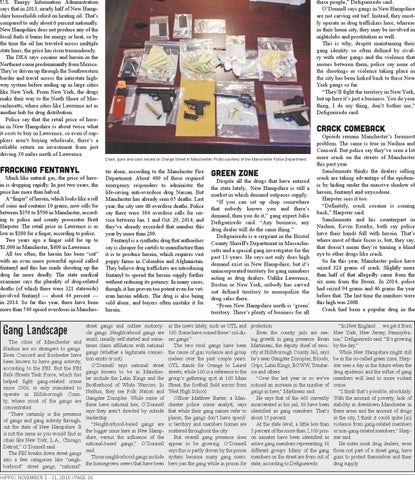
Crack, guns and cash seized on Orange Street in Manchester. Photo courtesy of the Manchester Police Department.
ter alone, according to the Manchester Fire Department. About 400 of those required emergency responders to administer the life-saving anti-overdose drug Narcan. But Manchester has already seen 65 deaths. Last year, the city saw 48 overdose deaths. Police say there were 304 overdose calls for service between Jan. 1 and Oct. 29, 2014, and they’ve already exceeded that number this year by more than 200. Fentanyl is a synthetic drug that authorities say is cheaper for cartels to manufacture than it is to produce heroin, which requires vast poppy farms in Colombia and Afghanistan. They believe drug traffickers are introducing fentanyl to spread the heroin supply further without reducing its potency. In many cases, though, it has proven too potent even for veteran heroin addicts. The drug is also being sold alone, and buyers often mistake it for heroin.
street gangs and outlaw motorcycle gangs. Neighborhood gangs are small, usually self-started and sometimes claim affiliation with national gangs (whether a legitimate connection exists or not). O’Donnell says national street gangs known to be in Manchester include the Latin Kings and the Brotherhood of White Warriors. In Nashua, they see Folk Nation and Gangster Disciples. While some of these have national ties, O’Donnell says they aren’t directed by outside leadership. “Neighborhood-based gangs are the bigger issue here in New Hampshire, versus the influence of the national-based gangs,” O’Donnell said. Those neighborhood gangs include the homegrown crews that have been
HIPPO | NOVEMBER 5 - 11, 2015 | PAGE 16
Green Zone
Despite all the drugs that have entered the state lately, New Hampshire is still a market in which demand outpaces supply. “If you can set up shop somewhere that nobody knows you and there’s demand, then you do it,” gang expert Julio Defigueiredo said. “Any business, any drug dealer will do the same thing.” Defigueiredo is a sergeant in the Bristol County Sheriff's Department in Massachusetts and a special gang investigator for the past 13 years. He says not only does high demand exist in New Hampshire, but it’s unincorporated territory for gang members acting as drug dealers. Unlike Lawrence, Boston or New York, nobody has carved out defined territory to monopolize the drug sales there. “From New Hampshire north is ‘green’ territory. There’s plenty of business for all
in the news lately, such as OTL and 180. Some have coined these “cul-dusac gangs.” The two rival gangs have been the cause of gun violence and group melees over the past couple years. OTL stands for Orange to Laurel streets, while 180 is a reference to the group’s gathering spot at 180 Main Street, the football field across from West High School. Officer Matthew Barter, a Manchester police crime analyst, says that while their gang names refer to places, the gangs don’t have specific territory and members homes are scattered throughout the city. But overall gang presence does appear to be growing. O’Donnell says this is partly driven by the prison system because many gang members join the gang while in prison for
Opioids remain Manchester’s foremost problem. The same is true in Nashua and Concord. But police say they’ve seen a lot more crack on the streets of Manchester this past year. Sanclemente thinks the dealers selling crack are taking advantage of the epidemic by hiding under the massive shadow of heroin, fentanyl and oxycodone. Harpster sees it too. “Definitely, crack cocaine is coming back,” Harpster said. Sanclemente and his counterpart in Nashua, Kevin Rourke, both say police have their hands full with heroin. That’s where most of their focus is, but, they say, that doesn’t mean they’re turning a blind eye to other drugs like crack. So far this year, Manchester police have seized 324 grams of crack. Slightly more than half of that allegedly came from the six men from the Bronx. In 2014, police had seized 94 grams and 46 grams the year before that. The last time the numbers were this high was 2008. Crack had been a popular drug in the
protection. Even the county jails are seeing growth in gang presence. Brian Martineau, the deputy chief of security at Hillsborough County Jail, says he’s seen Gangster Disciples, Bloods, Crips, Latin Kings, BOWW, Trinitarios and others. “Over the last year or so we’ve noticed an increase in the number of gangs in here,” Martineau said. He says that of the 463 currently incarcerated in his jail, 68 have been identified as gang members. That’s about 15 percent. At the state level, a little less than 5 percent of the more than 2,100 prison inmates have been identified as active gang members representing 16 different groups. Many of the gang members on the street are from out of state, according to Defigueiredo.
“In New England … we get it from New York, New Jersey, Pennsylvania,” Defigueiredo said. “It’s growing by the day.” While New Hampshire might still be in the so-called green zone, Harpster sees a day in the future when the drug epidemic and the influx of gang members will lead to more violent crime. “I think that’s possible, absolutely. With the amount of poverty, lack of stability in downtown Manchester in these areas and the amount of drugs in the city, I think it could spike [in] violence from gang-related members or non-gang-related members,” Harpster said. He notes most drug dealers, even those not part of a street gang, have guns to protect themselves and their drug supply.
MEMBERSHIP MEANS MORE AT THE GRANITE YMCA YMCA Allard Center of Goffstown | YMCA of Downtown Manchester YMCA of Greater Londonderry At the Y, families are getting closer and living better so they can learn, grow, and thrive. Everyone from youth to seniors are engaging in physical activity, learning new skills, and building self-confidence through programs like: • PiYo • Gymnastics • Tennis • Youth sports • Water aerobics • Small group training • Indoor archery • Swimming lessons, and more! Activities vary by location. Call for more information.
Register today for Fall II classes! | Nov. 2 – Dec. 20, 2015 Goffstown 603.497.4663 | Londonderry 603.437.9622 | Manchester 603.623.3558 103696
101872
103771
HIPPO | NOVEMBER 5 - 11, 2015 | PAGE 17
AUTO RESTORATION
CUSTOM FURNISHING & ARTWORK paint, drink wine, Good Times!
NOW OPEN! 603.856.7766
Private Events/ Parties
84 N. Main Street, Concord, NH www.concordpaintandsip.com
103088
269 PROCTOR HILL RD, HOLLIS NH 603.465.7270 | rmrrestorations.com
101570
r Full Ba & Menu
Adoptable Puppies & Dogs on-site
Manchester Police Officer Steve Duquette in the halls of 144 Lake Ave. Ryan Lessard photo.
New Arrivals Weekly
city in the 1990s, but it had taken a back seat as more residents got hooked on prescription opioids and heroin. Sanclemente speculates that the dealers of crack might perceive a market for a less deadly narcotic, since heroin has been confused for or laced with the more-potent fentanyl in hundreds of overdose cases.
Call to schedule an appointment • Boarding • Doggie Daycare • Training
098456
Granite Hammer
Open Fri, Sat & Sun 10am-7pm | Mon-Thurs appointment only 113 Dover Rd. Chichester, NH | 961-0234 | HomesForHappyDogs.org New Homes!!
“Another LaMontagne Builders Community”
$20 off Your 1st exam
Two Furnished Model Homes Now Open for Viewing
for new clients
South Willow Animal Hospital Full Service Small Animal Hospital
Thursday-Monday 12-3pm or anytime by appointment
Dr. Elizabeth Greeson, DVM Dr. Jessica Neveu, DVM
Moe Marketing Realty & Webber Associates Realty (603) 722-2742
Hours: M, W, Th, F: 8am-6pm • Tu: 1pm-6pm • Sat: 8am-3pm 373 S. Willow St. Manchester, NH 641-6252 | SouthWillowAH.com
Directions: Mammoth Rd or Bodwell Rd to GPS 441 Cohas Ave.
101121
HIPPO | NOVEMBER 5 - 11, 2015 | PAGE 18
103740
Looking for a Brand New Home? Tired of seeing old worn-out Homes? Then stop by and tour our newest community of New Homes at Brookfield of Manchester. Affordable new homes at Brookfield offer all the benefits of living and enjoying the City of Manchester and owning a quality personalized new home by LaMontagne Builders with over 50 years of building reputation. An exciting new neighborhood with city water, sewer, natural gas, granite curbing, sidewalks and LED street lights. Just minutes from easy commuting routes, Manchester Airport and the dynamic cultural & entertainment venues which the city has to offer. Whether you are a first time home buyer, upgrading your current home or looking to downsize, we have many unique floorplans to fit your current lifestyle! Priced from $299,990 to the low $400’s.
Arrest efforts have ramped up in recent months. Earlier this year, Manchester Police Chief Nick Willard, Director of the New Hampshire State Police Colonel Robert Quinn and Assistant Special Agent of the DEA Jon DeLena got together to figure out how to bring the fight to the drug dealers. What they came up with was a pooling of agency resources for a system of rapid investigations and quick arrests called Operation Granite Hammer. Manchester police had begun a series of “sweep” operations under past Chief David Mara in 2014. They were the product of months-long investigations where warrants were obtained and alleged low-level drug dealers were rounded up, sometimes 30 at a time. They had catchy names like “Operation Fall Cleanup,” and “Operation Clean Sweep.” But Captain Sanclemente says Granite Hammer is a different animal. “This is a little bit more involved,” Sanclemente said. Instead of taking months to collect evidence and warrants, city and state police along with federal agents are acting on tips they learn at morning briefings, go out to investigate the suspects and arrest them as quickly as possible. And while they continue to target the low-level dealers, they’ve widened the net to include more mid-level sellers. Granite Hammer operations began with a dragnet of 14 alleged dealers on Sept. 24 and followed up with roundups of 16 individuals on Oct. 1, seven individuals on
Oct. 8 and four more on Oct. 20. That’s 41 arrests in less than 30 days. Narcotics officers are working “nonstop” and police hope this new partnership, which has no expiration date, will make it more difficult for dealers to do business in the Queen City. Now, the state wants to replicate Manchester’s successes statewide as part of a laundry list of bills getting drafted in the legislature with bipartisan support. Another bill with broad support would increase the penalties for selling fentanyl to be more in line with the penalties for selling heroin. Efforts to prevent addiction focus on changing rules for prescribing opioids. Meanwhile, in August, the White House announced $13.4 million in funding for High Intensity Drug Trafficking Areas, $5 million of which will target heroin specifically. New England HIDTA has partnered with local police for most of the major drug dealer sweeps. And it seems greater emphasis is being placed on treatment, prevention and recovery as $2.5 million is going toward the White House’s new Heroin Response Strategy, which will create partnerships between public safety officials and public health officials. Recently in Manchester, local developers and business leaders announced they joined forces with the non-profit HOPE for NH Recovery to buy the old Hoitt’s Furniture building on Wilson Street. The recovery center would be located on the first floor and they plan to have a treatment provider like Serenity Place move into other parts of the building. Police in New Hampshire have long said the state can’t arrest its way out of the drug epidemic. In economic terms, police can only focus on limiting supply. Observers say it’s up to the healthcare infrastructure to stem the demand. While treatment options remain limited, the state is moving to fund drug courts with a new bill that would set aside $2.5 million.
Smiles by Design Raman & Thompson
Welcoming new patients!
There’s so much more to quality dentistry than a great smile. Dr. Paul Thompson, Dr. Sree Raman, and our compassionate, dedicated team provide the highest quality family and cosmetic dental services:
• Zoom® Whitening • One-visit Crowns • Invisalign® Clear Braces • Sedation Dentistry We invite you to see why we have been named a Top Dentist in New Hampshire Magazine since 2005 & ‘Friendliest Dentist’ in the Hippo Press since 2012.
SMILES by DESIGN &
THOMPSON
103783
102881
222 River Road, Manchester • NewHampshireSmileDentistry.com
Local Favorite our
s
Call us: 603-669-6131
Y
R A M A N
Hippo Best of 2015
Read
ers Picks
103613
HIPPO | NOVEMBER 5 - 11, 2015 | PAGE 19
THIS WEEK Great news! EVENTS TO CHECK OUT NOVEMBER 5 - 11, 2015, AND BEYOND
Due to popular demand, we are extending our promotion through Thanksgiving!
Saturday, Nov. 7
$20 OFF
1-Hour Ashiatsu Massage
944 Elm St. in Manchester, NH 603-627-6678 | AbsoluteRelief.com
102392 102182
Absolute Relief
New Hampshire’s largest business expo, the Southern NH Expo, will be open from 10 a.m. to 3 p.m. at the Hampshire Dome (50 Emerson Road, Milford). There will be nearly 200 local businesses and services, from restaurants and food producers offering samples of their signature dishes to products and services for both home and business. There will also be live entertainment, including barbershop quartet Perfect Fourth, Wildlife Encounters animal show and more. Admission costs $6 for adults and is free for kids under 12. For more information, call 673-4360 or visit southernnhexpo.com.
Saturday, Nov. 7
Don’t miss the Cat Fanciers Association’s cat show competition on Saturday, Nov. 7, from 10 a.m. to 5 p.m., and Sunday, Nov. 8, from 9 a.m. to 4 p.m., at Dover Middle School (16 Daley Drive, Dover). Spectators are invited to cheer on over 100 pedigreed and household pet kittens and cats as they compete for top honors. Cats will run an obstacle course of stairs, hurdles, hoops, tunnels and weave poles. Admission costs $8 for adults, $6 for seniors and kids 6 to 14, and is free for kids under 6. Visit nhff.org. Eat: Baked potatoes
Studio 550 (550 Elm St., Manchester) will host the New Hampshire Potter’s Guild for a Potter’s Market on Saturday, Nov. 7, from 10 a.m. to 4 p.m., and Sunday, Nov. 8, from noon to 3 p.m. More than a dozen functional or sculptural ceramic artists will be represented. The studio will also host the 3rd Annual Cup Show & Sale, beginning Friday, Nov. 6, and continuing through Jan. 16, with a reception on Friday, Nov. 6, from 6 to 8 p.m. Admission is free. Visit 550arts.com.
On Thursday, Nov. 12, from 4 to 7 p.m., the Breakfast Exchange of Nashua will host its first annual Baked PotatoFest at the Nashua Senior Activity Center (70 Temple St., Nashua). Enjoy baked potatoes with a wide selection of toppings, dessert and a beverage. Tickets cost $5 in advance or $7 at the door, and $5 for children under 12. Potatoes can also be packaged to take home. Email BXCNashua@gmail.com for more information. 103842
HIPPO | NOVEMBER 5 - 11, 2015 | PAGE 20
Sunday, Nov. 8
Saturday, Nov. 7
Drink: Bourbon
Sunday, Nov. 8
Singer-songwriter Anna Nalick will play at Tupelo Music Hall (2 Young Road, Londonderry) at 7 p.m., with opening act Ryanhood. Nalick is perhaps best-known for her 2005 hit single “Breathe (2 a.m.),” which has sold nearly 3 million copies and was featured on Grey’s Anatomy and other TV and film soundtracks. Ticket costs range from $25 to $35. Visit tupelohalllondonderry.com.
Don’t forget your dancing shoes for the Bourbon Release Party and Country Hoedown at Flag Hill Winery & Distillery (297 N. River Road, Lee) on Saturday, Nov. 7, from 4 to 9 p.m. Celebrate the release of the state’s first Straight Bourbon Whiskey with dinner, a Bluegrass and Bourbon hoedown and other entertainment. Reserve your seat by calling 659-2949.
Get moving and get creative at the Paint Your Way 5K, starting at 10 a.m. at Stellos Stadium (7 Stadium Drive, Nashua). This is a familyfriendly, professionally timed race. Along the course, participants are invited to contribute to a group painting. Registration costs $30 for adults, with free tech shirts for the first 100 registrants. Youth registration costs $10, and it’s an additional $10 for a T-shirt. Proceeds benefit the Gate City Charter School for the Arts. Visit g2racereg. webconnex.com/PaintYourWay5K2015 to register.
Be Merry: With 24-hour gaming
Join NeonBomb (710 Somerville St., Manchester) for the Extra Life 24-hour gaming marathon to raise money for children battling serious illnesses. From Saturday, Nov. 7, at 8 a.m., to Sunday, Nov. 8, at 8 a.m., there will be free play of video games, card games, board games and tabletop games, as well as some tournaments, demonstrations and other activities. Find NeonBomb on extra-life.org or call 505-8098 to learn how you can donate or join a team.
Looking for more stuff to do this week? Check out Hippo Scout, available via the Apple App Store, Google Play and online at hipposcout.com.
at
Modern day fusion of music and movement using RipStix, ™ weighted drumsticks engineered for exercise, POUND transforms drumming into an effective full-body workout. 259 Hanover Street, Manchester 603-341-4851 Also offering Zumba, TRX, Yoga, Body Conditioning and many more! | Full Schedule: vldfitness.com
103239
103756
Live - Love - Lift ULTHERAPY
Ultrasound energy will tighten and form new collagen, lifting loose or sagging skin of the face, neck and/or chest with a single procedure. Long lasting results-
No Downtime! Limited time
20% Off Special Call today.
Renew Medispa Laser Resurfacing • Spider Vein Treatment • Vampire Face Lift • Tattoo Removal Skin Treatments • Lash Extension • Cosmetic Facials • Skin Tightening Hair Removal • Botulinum Toxin • Dermal Filler • Cellulite Treatment • and More
Dr. Lisa Vuich | 603-894-0070 | RenewMediSpa.com The Windham Towne Shoppes | 29 Indian Rock Rd. Open Monday through Saturday
102955
100869
HIPPO | NOVEMBER 5 - 11, 2015 | PAGE 21
ARTS Theater nourishment The Majestic Theatre turns 25 By Kelly Sennott
ksennott@hippopress.com
When Robert Dionne founded the Majestic Theatre in 1990 with a few other Manchester West High School alumni, the local community theater scene was kind of bare. “There was a lot less theater then than there is now,” Dionne said via phone Monday. “But now it seems like there’s a theater company on every corner, which is a great thing.” The major players in Manchester at the time, he said, were the Palace Theatre and the New Thalian Players, but there were few other opportunities in the city, particularly for non-professionals. Early projects consisted of putting on original works and curating a historic Manchester theater museum. He was 21 when they produced their first show, a piece he’d written called School Days. Twenty-five years later, the Majestic’s still pumping out 15 to 20 shows a year, more than any other community theater in the state. Members celebrate with an event and auction Friday, Nov. 13, at Manchester Community College. In addition to raffles and a live and silent auction, there will be musical performances from a cast of about 50 children, teens and adults, with appearances from the Forever Plaid Majestic Theatre 25th Anniversary auction Where: Manchester Community College, 1066 Front St., Manchester When: Friday, Nov. 13, at 7 p.m. Tickets: $20 Contact: 669-7469, majestictheatre.net
Marc Willis, Ross Brown, Robert Dionne and Michael Gallagan. Courtesy photo.
quartet (which Dionne performs in) and the Nunsense nuns. Current and past Majestic regulars will perform ensemble, duet and solo acts from a variety of Broadway shows, and the event ends with an audience sing-along. Eric Skoglund will emcee. Skoglund has a special place in his heart for the theater; he auditioned for The Magic of Crime on the eve of his 26th birthday in 2002, his first play since high school. He earned the lead role, and it gave him confidence to step back into the New Hampshire theater scene. Majestic audiences will know him from Cabaret in 2014. “I’ve since worked with dozens of companies in New Hampshire and Massachusetts, but it all started with the Majestic,” Skoglund said via phone. “The
22 Theater
Includes listings, shows, auditions, workshops and more. To get listed, e-mail arts@hippopress.com.
Majestic is a great launching pad for people interested in the stage and acting, and the audiences are very kind. They want you to succeed, and they always applaud. … Patrons who come and see the shows … are fiercely loyal, which is very nice as an actor.” Dionne also credited community support for the theater’s 25-year life, which has gone through ups and downs. In 2013, he received the “Matt Award” for Vision and Tenacity at the New Hampshire Theatre Awards for his work rebuilding the company after being forced to move from the former Ste. Marie School building, where it had been since 1995, to the 1,800-square-foot rented space in the Ted Herbert building, in 2011, due to stricter fire codes that required a sprinkler system, which the company couldn’t afford.
24 Art
It’s here where Majestic offices, rehearsals and educational programs take place today, while productions happen at the the Executive Court Banquet Facility and the Derry Opera House. Dionne said he’d love to be able to own a theater again — the Ste. Marie School building had a theater space, while Ted Herbert does not — but he said he’s incredibly thankful to patrons, some of whom have been attending Majestic productions for 25 years. “Our biggest challenge moving forward is the financial piece,” Dionne said. “We’re not a multi-million-dollar company. We do a tremendous amount of community productions with the support of our community, our patrons and our sponsors.” Today, he and Development Director Karen Bessette are the only full-time employees. Of the original staff, it’s just him and technical director and executive board member Matthew Morin. Dionne never thought this would become his full-time job, but it became necessary, if the company was to grow, in 2001, which is when he left his music teaching job in Hampstead. “[In the beginning], the Majestic, pretty much, was just a bunch of friends who would come together during the summer to put on productions,” Dionne said. “But I felt that what the Majestic Theatre was doing for the community was a very important thing. … Theater is not a fringe benefit. It’s a necessity. You could give someone a place to live, but if there’s nothing else that helps nourish their soul — whether it be theater, a sports team, whatever — they’re empty inside. We kind of give that nourishment that makes life that much better.”
27 Classical
Includes listings for gallery events, ongoing exhibits and classes. Includes symphony and orchestral performances. To get listed, e-mail arts@hippopress.com. To get listed, e-mail arts@hippopress.com.
Looking for more art, theater and classical music? Check out Hippo Scout, available via the Apple App Store or Google Play. Theater Productions • THE PRICE IS RIGHT LIVE! To register to be a chance to be a contestant, visit registration area or near venue box office 3 hours prior to showtime. Thurs., Nov. 5, at 7:30 p.m. Capitol Center for the Arts, 44 S. Main St., Concord. $59. Call 225-1111, visit ccanh.com. • OUR TOWN Merrimack High School Theatre Department production. Thurs., Nov. 5, at 7 p.m.; Fri., Nov. 6, at 7 p.m.; Sat.,
Nov. 7, at 7 p.m. Merrimack High School, 38 McElwain St., Merrimack. $12. • THE LOVE OF THREE ORANGES Production by the Anselmian Abbey Players. Play by Hillary DePiano. Thurs., Nov. 5, at 7:30 p.m.; Fri., Nov. 6, at 7:30 p.m.; Sat., Nov. 7, at 7:30 p.m. Dana Center for the Humanities, 100 Saint Anselm Drive, Manchester. $13. Visit anselm.edu/dana, call 641-7700. • MACBETH Theatre KAPOW three-person production. Fri.,
HIPPO | NOVEMBER 5 - 11, 2015 | PAGE 22
Nov. 6, at 8 p.m. Capitol Center for the Arts, 44 S. Main St., Concord. $25-$35. Call 2251111, visit ccanh.com. • SHREK: THE MUSICAL, JR. Garrison Players Youth Education production. Nov. 6-21, Fridays and Saturdays at 7 p.m., Sundays at 2 p.m. Garrison Players Arts Center, Route 4, Dover. $13. Visit garrisonplayers.org. • THE MUSIC MAN Rochester Opera House production. Oct. 15 through Nov. 15. Rochester
Opera House, 31 Wakefield St., Rochester. $22. Call 335-1992. • THE ADDAMS FAMILY Palace Theatre production. Fri., Oct. 23, through Sat., Nov. 14. Palace Theatre, 80 Hanover St., Manchester. $25-$45. Call 6685588, visit palacetheatre.org. • CHARLOTTE'S WEB Leddy Center production. Oct. 23 through Nov. 11. Shows Fridays at 7:30 p.m., Saturdays, Sundays and one Wednesday (Nov. 11) at 2 p.m. Leddy Center for the Performing Arts, 38 Ladds Lane,
Epping. $18. Call 679-2781, visit leddycenter.org. • INTO THE WOODS Nashua Actorsingers production. Fri., Nov. 6, at 8 p.m.; Sat., Nov. 7, at 8 p.m.; Sun., Nov. 8, at 2 p.m. Keefe Center for the Arts, 117 Elm St., Nashua. Visit actorsingers.org. • I COULD JUST DIARY Teen angst live onstage. Fifth installment featuring more than 15 actors, writers, notable personality reading their worst, most embarrassing, most awkward
journal and diary entries. Proceeds support Seacoast Rep. Fri., Nov. 6, at 8 p.m. Seacoast Repertory Theatre, 125 Bow St., Portsmouth. $15. Call 433-4472, visit seacoastrep.org. • BIG FISH Stagecoach Productions show. Fri., Nov. 6, at 8 p.m.; Sat., Nov. 7, at 8 p.m.; Sat., Nov. 8, at 2 p.m. StageCoach Productions, 14 Court St., Nashua. $20. Visit stagecoachproductions.org. • YOU CAN'T TAKE IT WITH YOU Bedford Off Broadway
ARTS Fall is in the air. It’s time to turn your attention indoors and get your home ready for the holidays! Let us help… Creative Custom Framing
Notes from the theater scene
• Epic fairy tale: The Actorsingers’ big fall musical is Into the Woods, an epic fairy tale about wishes, family and the choices we make, and it happens this Friday, Nov. 6, at 8 p.m.; Saturday, Nov. 7, at 8 p.m.; and Sunday, Nov. 8, at 2 p.m. The Tony awardwinning play is directed by Dan Pelletier, musically directed by Amanda Morgan and highlights locals like Tony Breen (narrator), Mia Berardi (Cinderella), Bailey Jamieson (Jack), Joel and Laura Iwaskiewicz (the baker and the baker’s wife), Brittany Cardoza (Little Red) and Jessica Dee (witch). The show occurs at the Edmund Keefe Auditorium, 117 Elm St., Nashua, and tickets are $18-$20. • Locally written play: The New Hampshire Theatre Factory hosts a New Works stage reading, The Warmth of the Cold by Lowell Williams, on Friday, Nov. 13, at 7:30 p.m., at the XO Bistro, 827 Elm St., Manchester. The play is about a family’s struggle to find its place after loss and tragedy, and the reading, performed by five local actors, including three teen performers, will be surrounded by discussions and talk-backs with the director, author and actors, giving audiences a “behind-thescenes” look at the creation of a play from multiple perspectives. It’s the first of what Artistic Director Joel Mercier and Producing Director Walter Pineault hope will be an ongoing series. “Sometimes readings can be very stark, so our goal was to break down the formality of it,” Pineault said in a press release. “We believe it will create a laid-back atmosphere
production. Fri., Nov. 6, at 8 p.m.; Sat., Nov. 7, at 8 p.m.; Sun., Nov. 8, at 2 p.m.; Fri., Nov. 13, at 8 p.m.; Sat., Nov. 14, at 8 p.m. Bedford Olde Town Hall, 3 Meetinghouse Road, Bedford. $12. Visit brownpapertickets. com. • PETERBOROUGH PLAYERS AUCTION/FUNDRAISER/GALA Sat., Nov. 7, at 5:30 p.m. Peterborough Players, 55 Hadley Road, Peterborough. $75. Visit peterboroughplayers. org/auction. • AIDA Franklin Footlight Theatre production. Thurs., Nov. 12, at 7:30 p.m.; Fri., Nov. 13, at 7:30 p.m.; Sat., Nov. 14, at 7:30 p.m.; Sun., Nov. 15, at 2 p.m. Franklin Opera House, 316 Central St., Franklin. $14. • PAUL TAYLOR 2 DANCE COMPANY UNH Celebrity series show. Thurs., Nov. 12, at
Full Service Frame Shop Exceptional Customer Service Friendly, Knowledgeable Staff Convenient Parking
Visit our gallery Featuring Local Artists 1301 Elm Street, Manchester
603.668.6989
●
framersmarketnh.com
Tuesday – Friday 9:30 – 6:00 Saturday 9:30 – 4:00
103382
Brittany Cardoza as Little Red. Arthur Taylor photo.
and help our audience feel more comfortable opening up about what they felt during the reading. We want feedback on the show, but we also want to spark a lively discussion on the social aspects represented in the play.” Admission is a $5 suggested donation. Visit nhtheatrefactory.org. • Chaotic dinner: Bedford Off Broadway presents You Can’t Take it With You, a comedy by Moss Hart and George S. Kaufman, at the Bedford Olde Town Hall, 3 Meetinghouse Road, Bedford, with shows on Fridays and Saturdays, Nov. 6 through Nov. 14, at 8 p.m., and Sunday, Nov. 8, at 2 p.m. The play, which won the 1937 Pulitzer Prize for Drama and is directed by Victor Bennison and Joe Pelonzi, follows a couple whose families are meeting and dining together for the first time. Tickets are $12. Visit brownpapertickets.com, call 6472864. — Kelly Sennott
7 p.m. UNH Paul Creative Arts Center, 30 Academic Way, Durham. $30. Visit unharts.com. • ALICE IN WONDERLAND Pinkerton Academy production. Thurs., Nov. 12, at 7 p.m.; Fri., Nov. 13, at 7 p.m.; Sat., Nov. 14, at 7 p.m.; Sun., Nov. 15, at 2 p.m. Stockbridge Theatre, 5 Pinkerton St., Derry. $10. Visit stockbridgetheatre.com. • THE BURIAL AT THEBES New England College Theatre Department production. Thurs., Nov. 12, at 7 p.m.; Fri., Nov. 13, at 7 p.m.; Sat., Nov. 14, at 7 p.m.; Sun., Nov. 15, at 2:30 p.m. Live music followed by production. New England College, 58 Depot Hill Road, Henniker. $7. Call 428-2382, visit nec.edu/ events/the-burial-at-thebes/. • MARY POPPINS Kids Coop Theatre production. Fri., Nov. 13, at 7 p.m.; Sat., Nov. 14, at 1
and 7 p.m.; Derry Opera House, 29 W. Broadway, Derry. $12. Visit kids-coop-theatre.org. • STEEL MAGNOLIAS Windham Actors' Guild production. Fri., Nov. 13, at 7:30 p.m.; Sat., Nov. 14, at 7:30 p.m.; Sun., Nov. 15, at 2 p.m. Searles Chapel, 35 Range Road, Windham. $10$12. Call 247-8634. Visit windhamactorsguild.com. • STAGE READING:THE WARMTH OF THE COLD NH Theatre Factory New Works reading of play by Lowell Williams, about a family's struggle to find their place after loss and tragedy. PG-13. Fri., Nov. 13, at 7:30 p.m. XO on Elm, 827 Elm St., Manchester. $5 suggested donation. Visit nhtheatrefactory. org. • CHICAGO Peacock Players production. Fri., Nov. 13, at 7 p.m.; Sat., Nov. 14, at 2 and 7
since 1997
Call for our initial exam offer
603-624-8000
55 Amoskeag St, Manchester 103163
103667
NOV. 27TH-NOV. 29TH
PERFORMED WITH A
LIVE ORCHESTRA A Classical Ballet Performed by Southern New Hampshire Dance Theater Patricia Lavoie, Artistic Director
Call for tickets 603.668.5588 PalaceTheatre.org 103589 103691 103691
HIPPO | NOVEMBER 5 - 11, 2015 | PAGE 23
ARTS
New old blood at MCMS Judy Teehan steps up as executive director By Kelly Sennott
ksennott@hippopress.com
When Manchester Community Music School CEO Billie Tooley announced her resignation due to family matters in September, the school’s former education director, Judy Teehan, stepped up, bringing with her 11 years of MCMS experience. Teehan’s new position is executive director, a “more appropriate title” for the institution, Board of Directors Chair Dan Scanlon said via phone last week. The board liked that Teehan had been with the school for so long, and Teehan said she was in a good place to give the job the attention it deserved. “I didn’t feel that way before. My kids were younger,” she said during a recent interview at an empty school recital hall a day after the news went public. “To lead the school, it’s like being on call all the time. Even though the hours aren’t a whole lot different, the commitment is very different.” Teehan studied music therapy as an p.m.; Sun., Nov. 15, at 2 p.m.; Fri., Nov. 20, at 7 p.m.; Sat., Nov. 21, at 2 and 7 p.m.; Sun., Nov. 22, at 2 p.m. Janice B. Streeter Theater, 14 Court St., Nashua. $12-$17. Call 8867000, visit peacockplayers.org. • ELEEMOSYNARY NH Theatre Project production by Lee Blessing. Nov. 13 through Nov. 29, Fridays and Saturdays at 8 p.m., Sundays at 2 p.m. West End Studio Theatre, 959 Islington St., Portsmouth. $26, reservations recommended. Call 431-6644, ext. 5, email reservations@nhtheatreproject.org. • PETER PAN Manchester Community Theatre Players production. Nov. 13 through Nov. 22. North End Montessori School, 698 Beech St., Manchester. $20. Visit mctp.info. • OLIVER! Seacoast Rep production directed by Miles Burns, designed by Ben Hart and Brandon James. Nov. 13 through Dec. 20. Seacoast Repertory Theatre, 125 Bow St., Portsmouth. Tickets start at $22. Visit seacoastrep.org, call 4334472. • THE MAJESTIC THEATRE'S 25TH ANNIVERSARY AUCTION/PERFORMANCE Selections of Broadway musicals performed by children, teens, adults. Fri., Nov. 13, at 7 p.m. Manchester Community College, 1066 Front St.,
Judy Teehan. Courtesy photo.
undergrad, education as a graduate, and started with the MCMS as a part-time summer educator before moving into the education director’s role seven years ago. The time, she said, has enabled her to build
Manchester. $20. Visit majestictheatre.net. • DOG LOVES BOOKS ArtsPower production. Fri., Nov. 13, at 9:30 and 11:30 a.m. Dana Center for the Humanities, 100 Saint Anselm Drive, Manchester. $8.75. Visit anselm.edu/ dana, call 641-7700. • THE EVENT: A 1940'S OFFICER'S CLUB Featuring performances by Patrick Dorow Productions' The Summer of '42, gourmet food from UNH Conferences and Catering, swing band, all staged as a live radio broadcast. Guests should come in '40s garb. Sat., Nov. 14, at 6:30 p.m. The Music Hall, 28 Chestnut St., Portsmouth. $150. Call 436-2400, visit themusichall.org. • LET'S DANCE! Hybrid dance party and performance event. Delve into sounds of 1980's. Choreography/showcase by Neoteric Dance Collaborative. Sat., Nov. 14, 8 p.m.-midnight. 3S Artspace, 319 Vaughan St., Portsmouth. $18. Visit 3Sarts. org. • 101 DALMATIANS Music Theatre International production, performed by kids ages 8 to 18. Thurs., Nov. 19, at 7 p.m.; Fri., Nov. 20, at 7 p.m. Palace Theatre, 80 Hanover St., Manchester. $11-$14. Call 668-5588, visit palacetheatre.org. • FLAMENCO VIVO/CARLO-
HIPPO | NOVEMBER 5 - 11, 2015 | PAGE 24
TA SANTANA Dance production. Thurs., Nov. 19, at 7 p.m. Stockbridge Theatre, 5 Pinkerton St., Derry. $15-$25. Visit stockbridgetheatre.com. • AN EVENING OF FROST Interactive performance that begins with biographical introduction of poet's life, includes discussion of poems. Featuring Stephen Collins. Thurs., Nov. 19, at 7 p.m. Hollis Social Library, 2 Monument Square, Hollis. Free. Registration required. Call 465-7721, visit hollislibrary.org. • THE EIGHT On Sat., Nov. 7, producer hides 16 gold reindeer ornaments, 8 in downtown Derry on W. Broadway, 8 on Elm St., Manchester to promote show about eight reindeer. Fri., Nov. 20, at 8 p.m.; Sat., Nov. 21, at 8 p.m. Derry VFW, 18 Railroad Ave., Derry. $15. Visit facebook.com/neptunesushiproductions. • KORESH DANCE COMPANY Dance performance. Fri., Nov. 20, at 7:30 p.m. Dana Center for the Humanities, 100 Saint Anselm Drive, Manchester. $33.75. Visit anselm.edu/ dana, call 641-7700. • FRECKLEFACE STRAWBERRY: THE MUSICAL Rochester Opera House production. Through arrangement with Musical Theatre International. Sat., Nov. 21, at 11 a.m. and 2
relationships with staff, students and community families. She’s an Atkinson resident, suzuki flute teacher and a musician herself. Her background is different from past CEOs’ — more education-, less fundraisingbased — but she’s happy with the board’s decision because she feels she really understands the school’s mission. “Looking at what the school needs, now is not the time to bring in a new person. I think what the school needs is to capitalize on what we have, because what we have is good,” she said. The right people to further the school’s mission lie within the organization already, she said; she hopes to provide more professional development opportunities for staff and get feedback from them as well, in a more inclusionary model of working. She thinks it’s important to continue to grow what’s already proven successful, like the MCMS music therapy program and the youth ensemble program, which is the only one in the state, by relying on people on the inside. “We need to cultivate leadership from p.m.; Sun., Nov. 22, at 2 p.m. Rochester Opera House, 31 Wakefield St., Rochester. $12. Visit rochesteroperahouse.com, call 332-2211. • SOMETHING WONDERFUL I MISSED: THE MUSICALS OF 2005 Not Your Mom's Musical Theater production. Sun., Nov. 22, at 4 p.m. Derry Opera House, 29 W. Broadway, Derry. $10 suggested. Visit notyourmomsmusicaltheater.com. • THE NUTCRACKER Performed by Southern New Hampshire Dance Theatre. Accompanied by live orchestra. Fri., Nov. 27, at 7:30 p.m.; Sat., Nov. 28, at 11 a.m., 4 p.m. and 7:30 p.m.; Sun., Nov. 29, at 1 and 4:30 p.m. Palace Theatre, 80 Hanover St., Manchester. $25-$45. Call 6685588, visit palacetheatre.org. • GERALD CHARLES DICKENS:MR. DICKENS IS COMING Great-great-grandson of Charles Dickens presents look at the life of Charles Dickens as seen through the lens of his colorful characters, diary extracts and observations by the peopel who knew him. Mon., Nov. 30, at 12:30 p.m. Nashua Senior Activity Center, 70 Temple St., Nashua. $15. Call 816-2649. Auditions/open calls • AUDITIONS: ALMOST, MAINE Garrison Players Arts
within. That means in many capacities, not just administrative-wise, but within our faculty,” she said. “Our faculty is really the driving force of the school. It’s a matter of listening and collecting information from all kinds of sources.” She said she’s learned a lot from watching former CEOs Suzanne Barr, Jeanine Tousignant and Billie Tooley in action, each of whom brought in something different. “Suzanne … had a wonderful connection and warmth with the families here at the school,” she said. “Jeanine really brought a sense of strategy and … a very clean, organized, efficient manner of working. … And what Billie did in her short time here, she had a great energy for reaching out and connecting with other organizations.” Teehan plans to continue to practice, play and teach, even in this new high-demand position. “It’s like going to the gym. You know, certain things you have to make time for,” she said. “I always make time for practicing and teaching. I love surrounding myself with a music community for work.”
Center production. Sat., Nov. 7, at 2 p.m.; Tues., Nov. 10, at 7 p.m. Garrison Players Arts Center, Route 4, Dover. Visit garrisonplayers.org. • AUDITIONS:ELF: THE MUSICAL, JR. Palace Youth production, for ages 8 to 18. Sun., Nov. 8, 10 a.m., 11 a.m. or noon; Sat., Nov. 14, 10 a.m., 11 a.m. or noon. Palace Theatre, 80 Hanover St., Manchester. Call 668-5588 to schedule audition time and for more information. • AUDITIONS:IT RUNS IN THE FAMILY Garrison Players Arts Center production. Actors should be prepared to do coldreading of script. No appointment needed. Wed., Nov. 11, at 7 p.m.; Sat., Nov. 14, at 10 a.m. Garrison Players Arts Center, Route 4, Rollinsford. Visit garrisonplayers.org. Email elizabethwburr@gmail.com. • OPEN AUDITIONS:STAR SPANGLED GIRL Leddy Center show written by Neil Simon. Looking for men and women. Sat., Nov. 21. Call to reserve audition slot. Leddy Center, 38C Ladd's Lane, Epping. Call 679-2781, visit leddycenter.org, email info@leddycenter.org. Art Events • CURRIER AFTER HOURS: HOLIDAY EXTRAVAGANZA One-night only, artisans
sell handmade crafts through museum. Music from Boston folk band Cold Chocolate, holiday foods at winter cafe, holiday cocktails, paint-your-own glass ornament workshop ($35 extra). Thurs., Nov. 5, 6-9 p.m. Currier Museum of Art, 150 Ash St., Manchester. Free with museum admission. Call 669-6144, ext. 108. • MONT VERNON ARTISANS' 10TH ANNIVERSARY SHOW & SALE 18 artists showing work at two adjacent locations. Part of Open Doors tour, Nov. 6-Nov. 8. Preview night Fri., Nov. 6, 6-8 p.m. Mont Vernon Fire Dept., S. Main St., Mont Vernon. Mont Vernon Town Hall, 2 S. Main St., Mont Vernon. Visit mvartisans.wordpress.com/. • MOSAIC 250 Four completed Mosaic 250 community art project panels unveiled on main floor of library. Fri., Nov. 6, at 4:30 p.m. Concord Public Library, 45 Green St., Concord. Visit concordpubliclibrary.net, call 225-8670. • THE ART AND SPIRIT OF LEADERSHIP Conference focused on arts in education. Keynote speaker is Jerome Meadows. Fri., Nov. 6, 8:15 a.m.-6 p.m. 3S Artspace, 319 Vaughan St., Portsmouth. Advanced registration required, $50, includes refreshments
A handful of Seacoast actors, writers and notable personalities are doing what your high school self would rather die than do: they’re reading their worst, most embarrassing and awkward diary and journal entries onstage on Friday, Nov. 6, at 8 p.m., at the Seacoast Repertory Theatre, 125 Bow St., Portsmouth, in round 5 of I Could Just Diary: Teen Angst, Live Onstage! The show highlights 15 locals and is part of the company’s Red Light alternative performing series. All proceeds go to the Rep. “The notion of reading your most personal writings as a youth intimidates most, but it’s all in good fun,” said Knate Higgins, special series curator for The Rep in a press release. “Every round, more and more hilarious entries come to us. This round we have some new faces, and some familiar ones. This really is my favorite event to produce. It give us a chance to see people we think we know in a whole new light.” Tickets are $15. Visit seacoastrep.org, call 433-4472.
and lunch. Visit nh.gov/nharts, aannh.org. • NH OPEN DOORS 10th annual weekend-long event showcasing local farms, wineries, retail shops, restaurants, artisans and more. Sat., Nov. 7, and Sun., Nov. 8. Plan your weekend at nhopendoors.com. • POTTER'S MARKET More than a dozen functional or sculptural ceramic artists represented. Sat., Nov. 7, 10 a.m.-4 p.m.; Sun., Nov. 8, noon-3 p.m. Studio 550, 550 Elm St., Manchester. Free to attend. Call 232-5597, visit 550arts.com. • PHOTO EXPO 1 Nine photographers display work, discuss experiences and tools of the trade. Workshops, presentations, etc. Sat., Nov. 7, 10 a.m.-2 p.m. Highalnd Lake Grange Hall, Corner of Route 11 and Chase Hill Road, East Andover. Free. Email jall@tds.net. • SECOND SUNDAY JAZZ BRUNCH Brunch with musical entertainment by local jazz musicians. Sun., Nov. 8, 10 a.m.-2 p.m. Currier Museum of Art, 150 Ash St., Manchester. $19.95, $8.95 for children 10 and younger or for continental only. Call 669-6144, ext. 108. • WALKABLE CITY: HOW DOWNTOWN CAN SAVE AMERICA Presentation by author/city planner Jeff Speck. Mon., Nov. 9, 6:30-9 p.m. New Hampshire Institute of Art French Building, 148 Concord St., Manchester. Free. Visit nhia. edu, call 836-2157. • WEDNESDAY'S WISDOM POTLUCK Featuring Rob Fried and others, who will discuss Shakespeare's Hamlet. Wed., Nov. 11, at 6 p.m. Kimball Jenkins Estate, 266 N. Main St., Concord. Free, potluck, BYO wine, beer, other drinks. Visit kimballjenkins.com, call 2253932. • ALZHEIMER'S CAFE People with Alzheimer's and
dementia can come and enjoy good art and company in safe space. Wed., Nov. 11, 2-4 p.m. Currier Museum of Art, 150 Ash St., Manchester. Free, no RSVP required. Visit currier.org. • CURRIER SUPER SATURDAY: FREEDOM IN ART Music and ideas that reformed America's definition of freedom in performance by Hardtacks. Guests invited to create holiday cards for troops serving overseas. Sat., Nov. 14, 10 a.m.-1 p.m. Currier Museum of Art, 150 Ash St., Manchester. Free with museum admission. Visit currier.org. • NHIA ILLUSTRATOR LECTURES Presentation by Alyssa Nassner Fri., Nov. 20, 11:30 a.m.-1 p.m. New Hampshire Institute of Art, 148 Concord St., Manchester. Free, open to public. Call 836-2157. • "MAXFIELD PARRISH: THE POWER OF THE PRINT" Highlight of work by Parrish displayed in the form of vintage art prints, calendar illustrations, advertisements, magazine covers, etc. Tour with docent educator. On view Oct. 9 through Jan. 10. Tour on Sat., Nov. 21, at 11:30 a.m. Currier Museum of Art, 150 Ash St., Manchester. Free with museum admission. (Admission free for NH residents 10 a.m. to noon Saturdays.) Visit currier.org. • CURRIER ART CENTER 2015 STUDENT EXHIBITION & OPEN HOUSE Sat., Nov. 21, noon-4 p.m. Currier Art Center, 180 Pearl St., Manchester. Free. Visit currier.org. • WHAT DO YOU DO WITH AN IDEA? Hear librarian read book by Kobi Yamada, then create own work of art. Recommended for kids ages 2 to 5. Mon., Nov. 23, at 11:30 a.m. Currier Museum of Art, 150 Ash St., Manchester. Free with museum admission. Visit currier.org, call 669-6144, ext. 108.
• "WITNESS TO HISTORY: JAMES NACHTWEY -AFGHANISTAN, GROUND ZERO, IRAQ" Photography show depicting Sept. 11 attacks and the Afghanistan and Iraqi wars. On view Sept. 11 through Dec. 14. Docent-led tour Sat., Nov. 28, at 11:30 a.m. Currier Museum of Art, 150 Ash St., Manchester. Visit currier.org, call 669-6144, ext. 108. Openings • EAST COLONY FINE ART POP-UP GALLERY Featuring 24 artists' work for sale. On view Nov. 5 through Dec. 24. Opening Sat., Nov. 7, 10 a.m.-5 p.m., and Sun., Nov. 8, 10 a.m.-5 p.m. Salzburg Square Shopping Center, 292 State Route 101, Amherst. Visit eastcolony.com. • "ORDER-DISORDER: NEW PRINTS" Exhibition with artwork by Erika Radich. On view Nov. 6 through Nov. 28. Reception Fri., Nov. 6, 5-7 p.m. Sharon Arts Center, 457 NH-123, Peterborough. Visit nhia.edu. • "THE RABBIT HOLE" Art exhibition that focuses on work that challenges and comments on perception through mixed media, video, GIFS, paintings. On view Nov. 6 through Dec. 26. Reception Fri., Nov. 6, 5-7 p.m. Sharon Arts Center, 30 Grove St., Peterborough. Email katelenahan@nhia.edu. • "FLORA & FAUNA" Artwork inspired by nature, work by Steffen Poltak and Colleen Pearce. On view Sept. 3 through Nov. 9. Reception Fri., Nov. 6, 5:30-7 p.m. The Derryfield School, 2108 River Road, Manchester. Visit derryfield.org. • "HIDDEN TREASURES 4" Exhibit that celebrates creative work by more than 50 employees of Phillips Exeter Academy. Nov. 2 through Dec. 12. Reception Fri., Nov. 6, 5-7 p.m. Lamont Gallery, Exeter, 11 Tan
Vacation Lay-a-Way Are you thinking, “How can I take control of things, and go on an all inclusive vacation next year with my family”?
Bored? Bored? Bored? Keep calm and read TheHippo Hippo Yep, has
We can help plan, book and set up payments to help make your dream come true!
Yep, hast Yep, Hippo tuHippo ocsfor opphas iHthat an app ppiHthat tuapp otcusoocpsfor poiH anan app tut tuocfor soppthat iH
Don’t Wait - Call today 603-594-9874
ppiH tut tuotcusoocpspoiH tuocsoppiH tu ppiH tu tuotcusoocpspoiH t
084265
COULD JUST DIE(ARY)
HippoScout
Vacation Bound
HippoScout HippoScout
353 Main St. Nashua
VacationBoundTravel.com
t u o c s o ttuuooccssoo o p ooptpup
tutuo
103721
HIPPO | NOVEMBER 5 - 11, 2015 | PAGE 25
y a d i l o H Pies NOW!
We take orders online, phone and in person
ARTS
– BUYING -
Antiques, Collectibles Estates, Single items Also looking for: Work Benches, Old Factory Pieces, Wooden Sitting Benches, Butcher Blocks etc
NH art world news
From Out of the Woods Antique Center
624-8668
465 Mast Rd Goffstown NH 099308
50 Emerson Road, Milford, NH
Every Sunday, 8:30 am to Noon October 18, 2015 to March 20, 2016 Preview Admission $5 - 8:30 am to 9:30 am
FREE ADMISSION - 9:30 am to Noon 75 dealers in quality antiques and collectibles at great prices with free parking and a good cafe. www.milfordantiqueshow.com
103762
AS SEEN IN:
Come try our delicious desserts today!
Now accepting winter merchandise and furniture
Manchester: 603.626.1118 Milford: 603.249.9222 Londonderry: 603.552.3091
All consignment is by appointment
113 Storrs St, Concord (Across from Marshalls & BOA)
175 Rockingham Rd, Londonderry , NH
715-2009 | liliseresale.com Mon-Fri 10-6, Sat 10-5, Closed Sunday
814 Elm St. Manchester, NH • 603.935.5401
off your entire order! Spend $50 or more Now until December 31st. Some Restrictions Apply
103189
103764
63 Union Square, Milford, NH • 603.249.9222
HIPPO | NOVEMBER 5 - 11, 2015 | PAGE 26
Lilise has the most current designer labels at a discount, as well as furniture and decor for sale.
• East Colony pops up again: East Colony Fine Art comes into existence for a short time this holiday season with a pop-up gallery show at the Salzburg Square Shopping Center, 292 Route 101, Amherst, Nov. 5 through Dec. 24. Here visitors can shop from 24 artists’ works, which have been made with holiday gift-giving in mind. There’s an opening celebration Saturday, Nov. 7, from 10 a.m. to 5 p.m., and Sunday, Nov. 8, from 10 a.m. to 5 p.m., and artists will be on hand to demonstrate techniques in paint, colored pencil, pastel, fused glass and mixed media. Regular hours are Thursday from 10 a.m. to 7 p.m., Friday from 10 a.m. to 6 p.m. and Saturday and Sunday 10 a.m. to 5 p.m. • More holiday shopping: The holidays start Thursday, Nov. 5, at the Currier Museum of Art, 150 Ash St., Manchester, during its Currier After Hours: Holiday Extravaganza event from 6 to 9 p.m. On this night, regional artists not typically represented in the museum shop will be selling handmade crafts. Boston folk band Cold Chocolate will provide music, and Chef Joseph Sylvester will cook up holiday foods in the Winter Garden Cafe. There’s a paint-your-own glass ornament workshop ($25) and a focus tour of the Currier’s collection. Currier After Hours events are free with museum admission; visit currier.org. Lane, Exeter. Visit exeter.edu/ lamontgallery. • "THIS IS WHAT ARTISTS LOOK LIKE" Portraits of 33 artists and their work. Photos by Jay Goldsmith. On view Oct. 23 through Dec. 24. Opening Fri., Nov. 6, 5-8 p.m. Discover Portsmouth Center, 10 Middle St., Portsmouth. Call 436-8433, email info@portsmouthhistory.org. • SEACOAST ARTIST ASSOCIATION MEMBERS SHOW Art exhibition. On view through Nov. 21. Reception Fri., Nov. 6, 5-8 p.m. Prizes, refreshments. Historic Old Town Hall, Exeter. Call 778-8856. • NATURE PHOTOGRAPHY SHOW Featuring work by Tom Zack. On view Nov. 2 through Dec. 28. Reception Sat., Nov. 7, noon-2 p.m. Hampstead Public Library, 9 Mary E. Clark Drive, Hampstead. • NANCY TOBEY Art exhibition. On view Nov. 2 through Jan. 2. Reception Sun., Nov. 8, 4-6 p.m. Mandarin Asian Bistro, 24 Market St., Lowell. Call 941350-6347.
Courtesy photo.
• New art gallery in downtown Portsmouth: It’s called Valerie’s Gallery, and if it sounds familiar, it’s because its older sister lives in Newburyport, Mass. Both showcase functional and decorative hand-crafted artful objects made by more than 90 different American (though mostly New England) artists, from artisan-made jewelry and functional pottery to blown glass and fine art. Owner Valerie Stainton opens the New Hampshire shop, 117 Market St., Portsmouth, officially on Friday, Nov. 6, during Portsmouth’s monthly Art Round Town, from 5 to 8 p.m. During this grand-opening event, Rosemary Conroy of Weare is the featured artist and will present her paintings showcasing wild animals in all their beauty. “Growing up in New Hampshire, Portsmouth has been on my mind since opening our first shop, so it is great to grow our business with a second shop here. I’m looking forward to being part of the community in Portsmouth. We have a beautiful spot with a river view,” Stainton said in a press release. Visit valeriesgalleries.com. — Kelly Sennott
• "REFLECTIONS: FIVE VISIONS" Featuring work by Sean Beavers, Judith Cooper, Sydney Bella Sparrow, David Preston Wells, Lindley Briggs. On view Oct. 23 through Dec. 24. Reception Sun., Nov. 8, 3-5 p.m. Mill Brook Gallery, 236 Hopkinton Road, Concord. Visit themillbrookgallery.com, call 226-2046. • "GOOD THINGS COME IN SMALL PACKAGES" Wild Salamander art show. On view Nov. 13 through Dec. 23. Reception Fri., Nov. 13, 6-8 p.m. Wild Salamander Art Center, 30 Ash St., Hollis. Visit wildsalamander.com, call 465-WILD. Workshops/classes • ARTS ALLIANCE OF NORTHERN NH EARLY LEARNING CONFERENCE Theme is "My, My Friends and Family." For early childhood educators, librarians, teaching artists, pre-school and childcare administrators, care providers, parents, godparents, etc. About how arts can help young children express and learn. Sat., Nov. 7, 9
a.m.-3 p.m. The Goddard School, 12 Tsienneto Road, Derry. $40 for first registrant from school, library, child-care center, reduced rates for each additional registrant. Visit aannh.org, email programs@ aannh.org. • MINI ERRAND TOTE WORKSHOP League of NH Craftsmen class, open to adults 14 and older. Sun., Nov. 8, 12:303:30 p.m. League of NH Craftsmen Retail Gallery, 98 Main St., Nashua. $30, plus $15 for materials. Call 595-8233. • STUDIOVERNE WORKSHOPS Taught by fused glass art instructor Verne Orlosk "Holiday Ornaments" Wed., Nov. 11, 6-8 p.m.; Sat., Nov. 14, 10 a.m.-noon or 2-4 p.m.; Wed., Dec. 2, 6-8 p.m.; Sat., Dec. 5, 10 a.m.-noon or 2-4 p.m. StudioVerne, 81 Hanover St., Manchester. $60 for two hours. Email verne@studioverne. com, call 490-4321. • THE LAW AND ITS EFFECT ON SMALL MUSEUMS, HISTORIC HOUSES AND HISTORICAL SOCIETIES Informative presentation by Peter and
FIVE VISIONS For the final seasonal gallery exhibition of 2015, Mill Brook Gallery & Sculpture Garden (236 Hopkinton Road, Concord, 226-2046, themillbrookgallery.com) curator Pam Tarbell invited five artists to be part of a show, “Reflections: Five Visions,” on view now through Dec. 24. Work on view is by David Preston Wells, Sean Beavers, Judith Copper, Sydney Bella Sparrow and Lindley Briggs, according to the press release, and there’s a reception on Sunday, Nov. 8, from 3 to 5 p.m. Pictured, a painting by Sparrow. Kate McGovern. Fri., Nov. 13, 9 a.m.-4 p.m. Mt. Kearsarge Indian Museum, 18 Highlawn Road, Warner. $30, includes light lunch, snacks. $10 for students. Register by emailing mkim.director@tds. net. • SANTA NEEDLE FELTING For adults and teens 15 and older taught by Lynda Petropolus. Sat., Nov. 14, 10:30 a.m.-3:30 p.m. League of NH Craftsmen Nashua Fine Craft Gallery, 93 Main St., Nashua. $45, plus $45 for materials. Call 595-8233. • ALCOHOL INK TILES League of NH Craftsmen workshop taught by Alene SirottCope. Sun., Nov. 15, 11:30 a.m.2:30 p.m.; Sat., Dec. 5, 10:30 a.m.-1:30 p.m. League of NH Craftsmen Nashua Retail Gallery, 98 Main St., Nashua. $30, plus $10 for materials. Call 5958233. • ARTIST'S LEGAL SERIES All events are presented by Kimberly Peaslee, Intellectual Property lawyer at Upton & Hatfield. "Copyright 101" is Tues., Nov. 17, 5:30-7 p.m. McGowan Fine Art, 10 Hills Ave., Concord. Free, registration requested. Call 2252515. Email gallery@mcgowanfineart.com, visit mcgowanfineart.com. Open calls • CRAFT VENDORS NEEDED For Nashua Senior Activity Center Holiday Gingerbread Craft Fair Sat., Dec. 5, 9 a.m.-2 p.m. Deadline is Wed., Nov. 25. Nashua Senior Activity Center, 70 Temple St., Nashua. 8-foot tables available for $35-$40. Email mbell@nashuaseniorcenter.org. • CALL FOR ARTISTS: 3RD ANNUAL HOMEMADE HOLIDAY MARKET Applications accepted until full. Market day is Sat., Nov. 21. Studio 550, 550 Elm St., Manchester. Visit 550arts.com, call 232-5597. Classical Music Events • "FOLKS, BLUES AND BEYOND: EXOTIC INFLUENCES ON THE MUSICAL CAULDRON OF THE
1960'S" Presentation by David Surrette. Part of Concord Community Music School's Bach Lunch Series. Thurs., Nov. 5, 12:10-12:50 p.m. Concord Community Music School, 23 Wall St., Concord. Free. Visit ccmusicschool.org, call 228-1196. • MATTHEW MARSIT CLARINET TRIO Performance of Brahms' Late Chamber Works for Clarinet. Joining include Emily Taubl on cello, Sally Pinkas on piano. Fri., Nov. 6, at 7 p.m. Southern New Hampshire University, 2500 N. River Road, Manchester. Free. Visit snhucalendar.snhu.edu, call 629-4626, email ksavage@ snhu.edu. • NASHUA CHAMBER ORCHESTRA CONCERT "War and Remembrance" featuring work by von Suppe, Dittersdorf, Haydn and Faure. Featuring soloist Joseph Quer Agusti. Sat., Nov. 7, at 7:30 p.m. Nashua Community College, Judd Gregg Auditorium, 505 Amherst St., Nashua. $18. Visit nco-music.org. Call 582-5211. • ASTRID SCHWEEN Internationally-acclaimed cellist, accompanied by pianist Michael Gurt. Concert. Featuring works by Debussy, Saint-Saens and Rachmaninoff. Sat., Nov. 7, at 7:30 p.m. Concord City Auditorium, 2 Prince St., Concord. $18. Visit concordcommunityconcerts.org. • NASHUA CHAMBER ORCHESTRA CONCERT "War and Remembrance" featuring work by von Suppe, Dittersdorf, Haydn and Faure. Featuring soloist Joseph Quer Agusti. Sat., Nov. 7, at 7:30 p.m. Nashua Community College, Judd Gregg Auditorium, 505 Amherst St., Nashua. $18. Visit nco-music.org. Call 582-5211. • CAMERATA NEW ENGLAND PIANO TRIO Free concert. Sun., Nov. 8, at 3 p.m. Taylor Community, 435 Union Ave., Laconia. Visit taylorcommunity.org. • NASHUA CHAMBER ORCHESTRA CONCERT "War and Remembrance" featuring work by von Suppe, Ditters-
dorf, Haydn and Faure. Featuring soloist Joseph Quer Agusti. Sun., Nov. 8, at 3 p.m. Milford Town Hall, 1 Union Square, Milford. $18. Visit nco-music. org. Call 582-5211. • NORTH MAIN MUSIC SCHOOL FALL CONCERTS Featuring music by students ages 6 to 70. Sun., Nov. 8, 9 a.m.-1:15 p.m.; Sun., Nov. 15, 9 a.m.-1:15 p.m. Concerts occur throughout the day; call or visit the sites for specifics. Tupelo Music Hall, 2 Young Road, Londonderry. $15. Call 505-4282, visit northmainmusic.com. • "SONGS AND STORIES FROM THE WAR YEARS" Presentation/concert by Richard Kruppa in honor of Veteran's Day. Wed., Nov. 11, 7-8:30 p.m. Amherst Town Library, 14 Main St., Amherst. Visit amherstlibrary.org, email library@amherstlibrary.org. • LUCIE THERRIEN Artist performs music of French Canadian heritage, singing in Quebcios and English. Thurs., Nov. 12, at 2:30 p.m. NH Veterans Home, 139 Winter St., Tilton. Free. Funded through Arts in Health grant from NH State Council on the Arts. Visit nh.gov/nharts, call 527-4425. • "I LIT A FIRE, ISN'T IT GOOD: MUSIC FROM THE SWINGING SIXTIES" Concert featuring music by David Surrette and fiddler Jordan Tirrell-Wysocki. Thurs., Nov. 12, 12:10-12:50 p.m. Concord Community Music School, 23 Wall St., Concord. Free. Visit ccmusicschool.org, call 228-1196. • MANCHESTER CHORAL SOCIETY'SCABARET FOR A CAUSE Annual fundraiser. Dinner, silent auction, live performance. Fri., Nov. 13, at 6 p.m. Fratello's Italian Grille, 155 Dow St., Manchester. $60. Visit mcsnh.org. • SYMPHONY NEW HAMPSHIRE Concert featuring work by Mendelssohn, Dvorak, Bartok, highlighting Jennifer Koh on violin. Sat., Nov. 14, at 8 p.m. Keefe Center for the Arts, 117 Elm St., Nashua. $18-$49. Visit symphonynh.org.
Fall Into a warmer shade! Cut. Color. Style Only
65
*
$
BARBERING
Tues–Fri ‘til 8pm
C O S M E T O LO G Y
603-627-4301
w w w. H a i r p o c a l y p s e . c o m
103154
904 Hanover Street, Manchester NH
CAMPO (gathering place)
*Single process color
ENOTECA (wine bar)
LUNCH DINNER
Where friends meet for Italian wine, fresh pasta and engaging conversation 969 Elm Street
Manchester, NH CampoEnoteca.com
603.625.0256 101971
101292
HIPPO | NOVEMBER 5 - 11, 2015 | PAGE 27
LISTINGS 28 Crafts Fairs, workshops... 28 Dance Ballroom, folk... 30 Festivals & Fairs Seasonal, expos... 30 Health & Wellness Workshops, exercises... 31 Languages Classes, clubs... 32 Miscellaneous Fairs, festivals, yard sales... 32 Museums & Tours Exhibits, events... 32 Nature & Gardening Hikes, animal events... 35 Over 50 Social outings, sports... 35 Sports & Rec. Spectator sports, runs...
FEATURES 29 Kiddie pool Family activities this week. 30 The Gardening Guy Advice on your outdoors. 31 Treasure Hunt There’s gold in your attic. 34 Car Talk Click and Clack give you car advice. Get Listed From yoga to pilates, cooking to languages to activities for the kids, Hippo’s weekly listing offers a rundown of all area events and classes. Get your program listed by sending information to listings@hippopress.com at least three weeks before the event. Looking for more events for the kids, nature-lovers and more? Check out Hippo Scout, available via the Apple App Store, Google Play or online at hipposcout.com.
INSIDE/OUTSIDE A day on the runway
Race and aviation activities at the airport By Angie Sykeny
asykeny@hippopress.com
Concord Municipal Airport is giving runners, walkers and aviation enthusiasts run of the runways for the first annual 5K On the Runway & Aviation Day on Saturday, Nov. 7. The event, hosted by the Granite State Airport Management Association, will feature a 5K race, food vendors, exhibitors and aviation activities for all ages. “It’s a controlled space a lot of people don’t have access to, so it’s very rare that the general public gets to go on the runway,” said Erik Strand, GSAMA event chairman. “It’s kind of a once-ina-lifetime opportunity to run a 5K at an airport.” Runway 5K races are held at airports all over the country, but this will be the first one held in New Hampshire. The Aviation Day ongoing festivities, including food vendors, exhibitors, demonstrations and interactive aviation activities hosted by various groups, will begin at 9 a.m. and continue until 3 p.m. For kids, there will be handson projects like building wooden GSAMA’s First Annual 5K On the Runway & Aviation Day Where: Concord Municipal Airport, 71 Airport Road, Concord When: Saturday, Nov. 7, 9 a.m. to 3 p.m., 5K at 10 a.m. Cost: Free admission. 5K registration is $30 in advance, $35 race day Visit: gsama.org
Crafts Events • MINI ERRAND TOTE Turn an old pair of jeans and some fabric scraps into a handy little errand tote, project bag or kindle carrier. Learn or re-kindle the art of hand sewing as you make traditional fabric yo-yos to embellish your bag. Some machine work and hand sewing. Machines and all materials will be supplied. Sun., Nov. 8, 12:30 to 3:30 p.m. League of NH Craftsmen Nashua Gallery, 98 Main St., Nashua. $30 registration, $15 materials fee. Call 595-8233.
HIPPO | NOVEMBER 5 - 11, 2015 | PAGE 28
The Concord Municipal Airport runway, where the 5K and activities will take place. Courtesy photo.
helicopters with the Home Depot and designing paper airplanes, then flying them through hoops with the Aviation Museum of New Hampshire. The New Hampshire Young Eagles group will have a flight rally and offer free 10- to 15-minute airplane rides to kids ages 8 to 17. There will be helicopter rides available for purchase as well. At noon and 2 p.m., the Plymouth State University Traveling Planetarium will be doing free shows inside the hangar. Weather permitting, members of the New Hampshire Astronomical Society will be onsite with telescopes, hosting a daytime skywatch to observe the sun. There will be demonstrations happening throughout the day such as how avionics, the elec-
Workshops • TRY IT! CLAY WORKSHOP One-day workshop lets you try a class before signing up for a full 10-week program. Register by calling the studio. every Sat. from 3-6 p.m. and 6-9 p.m. Studio 550 Art Center, 550 Elm St., Manchester. $45.00. Visit 550arts. com. Call 232-5597. • BASKET WEAVING Ongoing classes with Ruth Bolan. Beginner to advanced students welcome. Students choose from a number of projects. Call or email to register. Thurs. from 6:15-9:15 p.m. or Fri. 9:30 a.m.-12:30 p.m. League of NH Craftsmen Nashua
tronic systems for things like communication and navigation, function in an aircraft, as well as static displays of aircraft and emergency equipment. “The whole idea is to just get people to the airport, show them what it’s all about … and [encourage] more interest in aviation and STEM [Science, Technology, Engineering and Math] education,” Strand said. A kids’ fun run for ages 10 and under will held at 9:45 a.m., followed by the 5K at 10 a.m. The race course consists entirely of runways and taxiways. Awards will be given for the top three male and female runners in each 10-year age category. The Runway 5K is a unique opportunity for runners, Strand said, because the terrain is com-
Fine Craft Gallery , 98 Main St., Nashua. Monthly sessions are $60, individual classes are $20. Call 595-8233. Visit nhcrafts.org. • JEWELRY WORKSHOPS Various jewelry workshops and classes. Registration required. Call for scheduling. Sussy-Rose Shields Jewelry Studio , Riverview Mill, 33 Howard St., Wilton. Enrollment and materials fees can vary. Call 654-5310. Email nashuarg@nhcrafts.org. Visit sussyroseshields.com. • BEGINNING BOOK & PAPER ARTS Learn the basics of bookbinding and book arts. Class meets 2 hours each week
pletely level for the whole race. “It’s unlike your traditional course where there are many ups and downs,” he said. “The runway has, I would say, less than a 1-percent gradient, so it’s very, very flat and wide open. It’s going to be a very fast race.” Registration costs $30 online in advance and $35 the day of the race. T-shirts are available for all participants. The kids’ fun run is free, but registration is required. While admission to the Aviation Day activities is free, attendees are asked to bring a nonperishable food item for the Capital Region Food Program’s 42nd Annual Holiday Food Basket Project, which helps provide Concord-area families with food for holiday meals.
for 10 weeks. See website to register and to find other arts classes. Wed., 6-8 p.m. Studio 550 Art Center, 550 Elm St., Manchester. $225.00. Call 232-5597. Visit 550arts.com. Dance Belly dance classes • BELLY DANCE Held at the YMCA of Greater Nashua, instructor Ayla Cengi teaches beginner and intermediate belly dance classes. Beginner class teaches basic moves and some choreography. Intermediate class teaches the culture of the dances and different styles of choreogra-
phy. Intermediate students may join Troup Tulay, the YMCA's belly dance troupe. Mon. from 7:45-8:45 p.m. (intermediate); Fri. from 6:30-7:30 p.m. (beginner). YMCA of Greater Nashua, 24 Stadium Dr., Nashua. Contact aylabellydancer@gmail.com. • HOLISTIC SELF CARE CENTER Taught at the beginner level. Sat. from 12-1 p.m. 12 Murphy Dr., Nashua. Drop-in costs $15. Call 883-1490 or visit thehsccenter.com. • MAIA SOLANA'S DANCE STUDIO Belly dance classes for women of all ages, beginner to advanced. Hula classes also
IN/OUT
Attention Small Business owners, entrepreneurs, and creative people Products and Services with the customer service you deserve.
• • • • • •
Family fun for the weekend
Gettin’ groovy
Bring the family for an evening of far out fun at the Hippy Dippy Coffee House on Saturday, Nov. 7, from 6 to 8 p.m., at Auburn Village School (11 Eaton Hill Road, Auburn). There will be entertainment, refreshments, raffles, coloring and more. If you dress like a hippy, you may win a prize. This event is free. Call 345-9161.
It’s owl fun & games
Amoskeag Fishways (4 Fletcher St., Manchester) will host a family fun night program on owls on Friday, Nov. 6, from 6:30 to 8 p.m. Learn about owl eating habits and dissect a real owl pellet. The cost is $5 per family, and advance registration is required. Visit amoskeagfishways.org. On Saturday, Nov. 7, at 11 a.m. and 1 p.m., the Eyes on Owls program will be at Eversource Five Rivers Auditorium (780 Commercial St., Manchester). Learn about New Hampshire’s owls, what they look like and where they might be found. Then, see live owls up close and learn some of their hooting calls. The cost is $10 per person or $25 per family. Advance registration is required. Visit amoskeagfishways.org.
Soup-er bowls
Parents and kids are invited to the Currier Art Center (180 Pearl St., Manchester) for a Day to Play in Clay workshop on Saturday, Nov. 7, from 1 to 3 p.m. Make a soup bowl with fall-themed colors and designs. This activity is for children ages 5 and older and costs $25 per child. Visit currier.org.
It’s showtime
Join Nini Bambini maternal wellness center for a family concert at Tupelo Music Hall (2 Young Road, Londonderry)
offered. See website for schedule. Salem, NH Salem., Contact 661-3083 or hulabellydancer@ hotmail.com for details. Ballroom dances • SMOOTH NIGHT Featuring Foxtrot and American Waltz. Mon. Foxtrot at 7 p.m., American waltz at 7:45 p.m. Royal Palace Dance Studio, 373 S. Willow St., D2-2, Manchester. Group class drop-in cost $15. Call 621-9119. Visit royalpalacedance.com. • RHYTHM NIGHT Featuring Rumba and American Tango. Every Tues. Rumba at 7 p.m.,
15% off 3 D Printing 20% off Banners and Posters
You now have access to 3D printing technology and wide format printing at your local UP store
Printing services Certified Packing Experts Mailbox services Document finishing Shipping services Fax, notary and more 15% off
3 D Printing
Manchester store4236@theupsstore.com Nashua store0509@theupsstore.com Hillsboro store6528@theupsstore.com 102499
on Saturday, Nov. 7, from 10 a.m. to noon. Nini’s owner Nina Cullen and friends will be singing songs with lots of opportunities to get up and dance. Tickets cost $7.50, and babies under 9 months are free. Visit ninibambini.com to buy tickets. See the 1990 classic Home Alone (PG) on the big screen at a 25th anniversary showing on Sunday, Nov. 8, at 7 p.m., at all Chunky’s Cinema locations. When his family goes on vacation and leaves him behind, a mischievous 8-year-old must protect his home from burglars. Tickets cost $3. Chunky’s has locations in Nashua (151 Coliseum Ave.) and Pelham (150 Bridge St.). Visit chunkys.com.
Play like the pros
Learn from the best at the 2nd Annual Ball for a Cause basketball clinic on Saturday, Nov. 7. Kids will receive coaching from Malcolm Huckaby, ESPN basketball analyst and former NBA player, and Danya Abrams, a former player for Boston College. The Small Ball Fundamentals clinic for grades 1 to 5 will be at the Boys & Girls Club of Nashua (1 Positive Place) with registration at 12:30 p.m. The ACE Academy Full Potential clinic for grades 6 to 9 will be at at Bishop Guertin High School (194 Lund Road, Nashua) with registration at 3 p.m. The cost is $20. Register at tnotgroup. com/ace/fundraisers.
American tango at 7:45 p.m., Bolero workshop 8:30-9:15 p.m. on select Tues. Royal Palace Dance Studio, 373 S. Willow St., D2-2, Manchester. Call 621-9119. Visit royalpalacedance.com. • SWING NIGHT Featuring West Coast Swing and East Coast Swing. Wed. West Coast Swing at 6:15 p.m., advanced East Coast swing and beginner East Coast swing at 7 p.m. Royal Palace Dance • LATIN NIGHT Featuring Bachata and Cha Cha. Sat., Bachata at 6:15 p.m., Cha Cha at 7 p.m. Royal Palace Dance Studio, 373 S. Willow St., D2-2, Manchester. Second
and fourth Sat. of the month is Ladies Movement & Performing Arts Workshop. Call 621-9119 or visit royalpalacedance.com. Folk dances • INTERMEDIATE LINE DANCING/OPEN DANCE Drop-in and pay at beginning of program. Thurs. at 7 p.m. Bedford Town Hall, 24 N. Amherst Road, Bedford. $7 per class. Contact instructor Ginger (apljacker@gmail.com, 5681437) for details. • SACRED CIRCLE DANCE First and third Thur. of every month at 7 p.m. Unitarian Uni-
20% off Banners and Posters
The UPS Store 12/31/15
11th Annual
Food Drive Save % Food Drive Food Drive 1 5 Food Drive
103800
11thAnnual Annualon your Serendipity Day Spa 11th Services when you donate a small
12th Annual bag filled with non-perishable
food items to benefit Friends of Forgotten Children located in Concord, NH
Save Save Save %
on your Serendipity Day Spa on your Serendipity Day Spa Help those in need with a donation and we Services when you donate a small on your Serendipity Day Spa Services Services when donate a small will pay it forward to you withyou 15% off any bag filled with you donate a small bag filled with servicewhen through 11/26/14. bag filled withnon-perishable non-perishable food items to benefit Friends of of non-perishable food items toapply. benefit food items to benefit Friends Some restrictions Can Forgotten Children located in not be combined with other Friends of Forgotten Children located Forgotten Children located in offers, please mention this ad Concord, inConcord, Concord,NH NH NH when booking.
15 5 1 15
% %
Helpthose those in need with Help those in needin with a donation and we willand pay itweforward Help need withaadonation donation and we will pay it forward to you with 15% off any willwith pay15% it forward to you with 15% off any to you off any service now through Thanksgiving. service through 11/26/14. service through 11/26/14.
Some restrictions apply. Can Some restrictions not be combined withapply. other Can not be combined other offers, please mentionwith this ad offers,when please mention this ad booking. when booking. 1129730
1129730 1129730
23 Sheep Davis Rd (Rte. 106) Concord | 229-0400 | SerendipityDaySpa.com
103840
HIPPO | NOVEMBER 5 - 11, 2015 | PAGE 29
IN/OUT THE GARDENING GUY
What I learned this summer Lessons in corn, watermelon and more
lots of plants. I won’t bother to do it again. This past winter I read that tomatoes produce better if you grow them without added fertilizer. In the past I’ve always added both compost and bagged organic fertilizer in each planting hole. This year I did not add fertilizer and, as predicted, did not get those 6-foot-tall plants I am used to. I got smaller plants, but they produced smaller loads of tomatoes, too. Next year I will use fertilizer again but maybe less than the handful I usually toss in the planting hole. I don’t normally grow celery. It tends to be tough and stringy and attracts slugs. Instead I grow celery root, which is also called celeriac. Celeriac is a related plant that produces a big bulb-like root that tastes like celery when grated into soups and stews. I start it by seed in March, and grow it in full sun in soil that does not dry out. This year I forgot to plant any seeds, so I bought two six-packs of started plants. But one of the six-packs was celery, not celeriac. I didn’t notice the difference until mid-summer, as the leaves are similar. The celery was better than I had remembered: not the big stalks one finds at the grocery store, but reasonably sized and not too stringy. And the slugs? They ate some, but were not awful. What did I learn from this? Always start your own seeds if you want to be sure to get what you want. Every year is different, and every year I learn from my mistakes and experiments.
By Henry Homeyer
listings@hippopress.com
As I calculate it, I’ve been gardening for 66 years — or at least hanging out in gardens. I have memories of being in the garden with my grandfather when I was 3. Technically I was “helping” Grampy, though my role was probably limited to things like tossing weeds into his wheelbarrow. Still, I’ve spent a lot of time in the garden since then. And each year I still learn plenty in the garden. Let’s look at what I learned this year. I haven’t grown sweet corn often, but these last two years I’ve had the use of a farmer’s field to grow corn, potatoes, watermelons, pumpkins and more. Farmers say corn is a “heavy feeder” and they give it plenty of nitrogen, one of the three nutrients found in chemical fertilizers. Nitrogen drives green growth and makes plants get big, fast. Inadvertently I did an experiment with my corn: half got supplemental nitrogen, half did not. It wasn’t a planned experiment: I had some bagged organic fertilizer, one called Pro-Gro, and gave it to half my corn. Then I ran out of fertilizer and said to myself, “This is good rich soil, I’m not going to go back home (6 miles from the field) to get more fertilizer. It’ll be fine.” The difference was dramatic: the corn that got fertilizer was big and produced nice corn. The other? Scrawny with small ears barely worth picking. Even those dang raccoons ignored it, mostly. I had not grown watermelon in 30 years, as I had decided that I live too far north to make versalist Church, 20 Elm St., Milford. See uucm.org. Email uucm1870@gmail.com. • NEW ENGLAND CONTRA DANCE Enjoy old and new contra dances. No partner necessary. All dances taught, with a welcoming review at 7:30 pm. Dance to the English, Scottish, Irish and other New England traditions, in a friendly and welcoming gathering. Wear comfortable, clean-soled shoes. Second Fri., of the month, 8 to 11 p.m. Londonderry Senior Center, 535 Mammoth Road, Londonderry. $8 adult/$3 12 and under. Call 529-1586. Festivals & Fairs Events • SEMI ANNUAL PSYCHIC FAIR Several psychics, with a variety of skills and talents will be in attendance. Readings are individual and are 15-20 minutes long. Arrive early to set
Celeriac with carrots and Brussels sprouts.
it worthwhile. But our local farmstand grows nice small watermelons, and since I had the space, I decided to give some a try. I bought a four-pack of plants in May, planted them in early June, and got a couple of watermelons from each plant. Here’s what I learned: watermelons don’t take up much space, at least not the mini-melons. My melon sent out two vines each, and I directed them in opposite directions, running down the row. They grew up to 20 feet, but the leaves were relatively small, and they just went by other plants in the row without troubling them. That meant that I found melons in with the summer squash, but I didn’t mind. Deciding when to pick the watermelons was, at first, challenging. The variety I grew (probably one called Sugar Baby) produced nice 6- to 8-inch watermelons. I was told by
your appointment time(s). In addition to the psychics, numerous vendors will be on site. Sat., Nov. 7, 10 a.m. to 4 p.m. Hudson Community Center, 12 Lions Ave. , Hudson . Call 8838565. Expos • THE NOT-AT-HOME HOUSE PARTY Shop House Party vendors such as Norwex, Tupperwear, Discovery Toys, Pampered Chef, Stampin Up, Traveling Vineyard, Mary Kay and more. Sat., Nov. 7, 9 a.m. to 3 p.m. Deering Town Hall , 762 Deering Center Road, Deering. Contact Marie at mariemogovaro@comcast.net or 464-4726. Health & Wellness Childbirth & parenting • IMPORTANCE OF SPEECH Kim Snyder-Vine, a Waldorf-trained speech expert, is offering an evening event
HIPPO | NOVEMBER 5 - 11, 2015 | PAGE 30
for parents and anyone interested in learning more about the importance of speech in Waldorf schools. Kim has been teaching, performing and consulting in creative speech, drama and hygienic speech for children and adults in Waldorf and Waldorfinspired charter schools, Waldorf teacher training institutes, artistic training centers, as well as private and public venues worldwide since 1983. Thurs., Nov. 5, 7 p.m. Pine Hill Waldorf School Auditorium, 77 Pine Hill Drive, Wilton. Free. Visit pinehill.org. Disease-focused workshops & seminars • DIABETES AWARENESS EVENT Featuring a cooking demo and tasting with Cake Boss winner Dana Herbert, Mediterranean meal ideas, olive oil sampling and Q&A session. Thurs., Nov. 12, from 5:30 to
a local farmer that ripe watermelons should sound hollow when tapped. The first one I picked was pink inside, not red, and clearly needed more time on the vine. We ate it anyway. But I learned to be patient. Watermelons don’t go mushy if you don’t pick them, or get tough and bitter. They just get sweeter, and wait patiently for you. The rest were all wonderful, and I shall grow them again. A friend visited Monticello last year and bought me some seeds, including sesame seeds. I planted some indoors last spring, and planted them in the ground in early June. I remember from my Peace Corps days in West Africa that sesame was a big plant, so I left plenty of space for these. I didn’t need to. Henry is a UNH Master Gardener living in Mine got no taller than 2 feet tall, and each Cornish Flat. Reach him at henry.homeyer@ plant produced perhaps 50 small seed pods. If comcast.net. His website is Gardening-Guy. you want a supply of sesame seeds, you need com. 7:30 p.m. St. Joseph Hospital, 172 Kinsley St., Nashua. Free. $5 donation requested to be donated to American Diabetes Association. See stjosephhospital.com or call 595-3168. Events • SEACOAST HOLISTIC HEALTH FEST Wellness and Healing Arts Fair. 30+ healing arts practitioners, presentations, raffles. Proceeds to benefit Annie's Angels Memorial Fund. Sponsored by Seacoast Holistic & Integrative Practitioners. Sat., Nov. 7, 10 a.m. to 4 p.m. Project Walk, 20 Portsmouth Ave. , Stratham . $5 per person, $10 per family. For more info email mariehall326@gmail.com. One-time blood drives • HILLSBOROUGH COUNTY BLOOD DRIVES St. Anselm College Carr Center, 87 St. Anselm Drive, Goff-
stown, Tues., Nov. 10, noon to 5 p.m.; Griffin Memorial School, 229 Charles Bancroft Highway, Litchfield, Sat., Nov. 7, 10 a.m. to 2 p.m.; St. James Methodist Church, 646 Daniel Webster Highway, Merrimack, Wed., Nov. 11, 2 to 7 p.m.; VFW Post 4368, 1 VFW Way, Milford, Thurs., Nov. 12, 1:30 to 6:30 p.m.; Liberty Travel, 314 Daniel Webster Highway, Nashua, Tues., Nov. 10, 10 a.m. to 3 p.m.; Greenbriar Terrace, 55 Harris Road, Nashua, Thurs., Nov. 12, 2 to 7 p.m.; South Meadow School, 108 Hancock Road, Peterborough, Sat., Nov. 7, 10 a.m. to 3 p.m. Visit redcrossblood.org. • ROCKINGHAM COUNTY BLOOD DRIVES RiverWoods at Exeter, 5 Timber Lane, Wed., Nov. 11, noon to 5; Hannaford Supermarket, 141 Portsmouth Ave, Exeter, Thurs., Nov. 12, 10 a.m. to 3 p.m.; Beyond Vanilla
Ice Cream Parlor, 10 Main St., Hampstead, Fri., Nov. 6, noon to 5 p.m.; Londonderry Lions Hall, 256 Mammoth Road, Tues., Nov. 10, 1 to 6 p.m.; Knights of Columbus Hall, 37 Main St., Salem, Thurs., Nov. 12, 1 to 7 p.m.; Windham Presbyterian Church, 1 Church Rd., Windham, Wed., Nov. 11, 1 to 6 p.m.; First Parish Congregational Church, 47 East Derry Road, Derry, Fri., Nov. 6, 2 to 7 p.m.; Great Bay Community College, 320 Corporate Drive, Portsmouth, Fri., Nov. 6, 10 a.m. to 3 p.m.; Middle Street Baptist Church, 18 Court St., Portsmouth, Fri., Nov. 6, noon to 5 p.m. Visit redcrossblood.org.
One-time screenings • WELLNESS CLINICS The Nashua Senior Activity Center will host a series of free, confidential clinics. Nurse Practitioner students from Rivier
IN/OUT TREASURE HUNT
Recycling Works!
Dear Donna,
Join us in our localized effort to prevent the waste of usable clothing, shoes & household textiles and earn money for your nonprofit by hosting an Ecosmith Bin. Ecosmith is proud to have contributed over $700k to local non profit partners!
I recently acquired this gift and thought with the Old Man in the Mountain being no longer around that maybe you could let me know of its value. It’s a pin that is 1 1/2” x 1” and is in really nice shape for its age. Can you give me any information? Karen from Hooksett Dear Karen, What a nice pin and piece of New Hampshire history as well. Your pin is one of many different souvenirs of the Old Man that have been produced from when it was first discovered in the early 1800s to present day. There are pictures, figures, postcards, pins (like yours) and more. Your pin is an older souvenir, but even now, though the Old Man has been gone since 2003, souvenirs are still being produced. Values on Old Man memorabilia depend on whether they are common, easy-to-find pieces or more rare. What the item is and its condition matters too. Your pin (early 1900s) in the condition it’s in is in the $100 range. Even though it was probably a mass-produced item at the time, it’s in good condition and is now probably a harder item to find. I have seen hundreds of different pieces of the Old Man in the Mountain memoraUniversity under the supervision of faculty will perform the following tests free of charge: body mass index, blood pressure check, lab work review, glucose, A1C, cholesterol, skin cancer check, pulmonary function and medication reconciliation. Mon., Oct. 5, Nov. 2 and Dec. 7, 9 a.m. to 2 p.m. Nashua Senior Activity Center, 70 Temple St. , Nashua. Free. Call 889-6155. Screenings • STD/HIV/HCV CLINIC See Public Health Community Services public health calendar on website. Every Thurs. from 3-6 p.m. Division of Public Health and Community Services, 18 Mulberry St., Nashua. Suggested fee is $25. See gonashua. com. • BLOOD PRESSURE CLINIC Walk-ins by Concord Regional Visiting Nurse Association for those 50 and older. First Fri. every month from 9:30-11 a.m. Concord Parks and Rec, 14 Canterbury Road, Concord. Call 224-4093 ext. 5815. See crvna.org. • HEARING SCREENING Free basic hearing screenings offered through Audiology Department for adults 18+ who
25t
hA nni
ver s
ary
!
Find your local Ecosmith container 103839
bilia but never get tired of seeing any of them and I am grateful that I lived in his time and got to appreciate his magnificence while passing through the notches. Donna Welch has spent more than 20 years in the antiques and collectibles field and owns From Out Of The Woods Antique Center in Goffstown (fromoutofthewoodsantiques.com). She is an antiques appraiser and instructor. To find out about your antique or collectible, send a clear photo of the object and information about it to Donna Welch, From Out Of The Woods Antique Center, 465 Mast Road, Goffstown, N.H., 03045. Or email her at footwdw@ aol.com. Or drop by the shop (call first, 624-8668).
have not had a screening in past year and don’t have a hearing aid(s). By appointment only. Second Mon. of every month 9 a.m.12 p.m. Southern NH Rehabilitation Center, 460 Amherst St., Nashua. Free. By appointment only. Call 557-8400 to register. Wellness workshops • SELF-EMPOWERMENT LIVING FROM A PLACE OF INNER CALM AND VITALITY In a safe and nurturing environment, this four-part workshop series will give you a set of empowerment tools for bringing yourself back into balance. Nov.: Mandalas – returning to wholeness; Dec.: Yoga nidra – deep sleep with a trace of awareness. Time for tea and talk will offer support for each participant in their journey for more balanced living. Dress in layers and bring a throw blanket or shawl and a journal. Tues., Nov. 17 and Dec. 1, 6:30 to 8 p.m. YCD Holistic Healing, 1 Prospect St., Nashua. $99 for series. Email sandy@ peaceablepathways.com. • OPEN MEDITATION SESSIONS Open meditation sessions, followed by time for discussion. Tues., and Thurs., 9 to 10 a.m., and Mon., 7 to 8 a.m.
Fall Allergies? • • •
164 N. State St., Concord, NH (1 mile N. of Main St.) • Open Everyday 224-9341 • www.GraniteStateNaturals.com
103445
and 8:30 to 10 a.m. Aryaloka Buddhist Center, 14 Heartwood Circle, Newmarket. Free. Call 659-5456. Language Classes • AMERICAN SIGN LANGUAGE Six-week class focuses on basic signing techniques and interpretation, as well as deaf cultural awareness. Levels 1 and 2 available. Lake Street Center, 4 Lake St., Nashua. Arlington Street Center, 40 Arlington St., Nashua. Cost is $90. See adultlearningcenter.org. • ENGLISH AS A SECOND LANGUAGE One-on-one tutoring classes. Wilton Public & Gregg Free Library, 7 Forest Road, Wilton. See wiltonlibrarynh.org or call 654-2581. Contact Bevan Buffum at 6545811 for details and scheduling. • ESPERANTO International language courses and tracing French-Canadian and Acadian ancestors. American-Canadian Genealogical Society, 4 Elm. St., Manchester. Contact 6221554 or visit acgs.org and facebook.com/ACGS.Society. Register by email to Jack Stanton at cw3jack_stan@mindspring. com.
103420
HIPPO | NOVEMBER 5 - 11, 2015 | PAGE 31
Deluxe Tabletop Photo Studio
No additional discounts apply.
One coupon per day. Cannot combine with other offers. Excludes all sale items. Expires 11/30/15 - Fall Saftey & Poyple
(603) 881-8351 14 Celina Ave, #4, Nashua
Medical products, travel, kitchen, and bath all under one roof. 102606
5
.9 $24
Hippo
20% off your most expensive item
(603) 782-5766 373 S. Willow St, Manchester
NORTH END For Home & Health
Montessori School
NORTH END NORTH END School NORTH END Now accepting Montessori registration Montessori School NORTH END NORTH END Montessori School NORTH END for Fall 2015! 698 Beech Street Manchester NH 03104
698 Beech Street Manchester NH 03104
Montessori School Montessori School Montessori School Now accepting registration
698 Beech Street Manchester NH 03104
698 Beech Street Manchester NH 03104
registration Now accepting registration Preschool - Elementary forforFall 2015! Fall 2015! NEW Toddler Program, Now accepting registration for Fall 2015! Now accepting registration Now accepting registration 698Beech Beech Street Manchester 03104 698 Street NH 03104 698 Beech StreetManchester Manchester NHNH 03104 Now accepting
Elementary starting at 12 months ofPreschool age! Qualified, experienced and-- Elementary for Fall 2015!Preschool for Fall 2015! for Fall 2015! Qualified, experienced and Preschool - Elementary dedicated teaching faculty Preschool - Elementary Qualified, experienced and Focusing on childcare,
dedicated teaching faculty Preschool - Elementary dedicated faculty Preschool and Kindergarten Qualified, experienced and Qualified, experienced and - Friday Preschool - Elementary Monday Friday 7am - 6pm Monday 7am - 6pm-teaching dedicated teaching Tuition: faculty $195/week Before and after school care included
Qualified, experienced and care included dedicated teaching faculty Monday 7am - 6pm Tuition: $195/week Before and after school- Friday Qualified, Mondayexperienced - Friday 7am - 6pm and
dedicated teaching faculty Tuition: $195/week Before and after school care included Tuition: Before and after 603.621.9011 school care includedfor more information Monday - Friday 7am - $195/week 6pm Call dedicated teaching faculty 103841 Monday Friday 7am 6pm n: $195/week Before and after school care included $195/week and after school care included MondayBefore - Friday 7am - 6pm Call Tuition: 603.621.9011 for more information Call 603.621.9011 for more information Call 603.621.9011 for more information Tuition: $195/week Before and after school care included
603.621.9011 for more information Call 603.621.9011 for more information Call 603.621.9011 for more information
FREE! Childrens’ in tro duction to Coin N ovember 13th & 14th Co lle ct ing Program, REE APPRAISALS - CASH BUYERS ON SITE!
Friday & Saturday FREE APPRAISALS
Saturday 10:30AM
Radisson Hotel Center of New Hampshire 700 Elm Street, Downtown Manchester
COINS • CURRENCY GOLD • SILVER Buy - Sell - Trade Fri 10 to 7, Sat 9 to 6
More than 75 dealers from
New England, NY, NJ, PA, FL, MD, NE, CO and CA
Guest Speakers Saturday 12:30-2PM Coin Grading
Saturday 2:30-3:30PM Civil War Strategies & Tactics Admissions $3/day, $5/weekend, FREE for kids under 12. Door Prizes. For more info (978) 658-0160 • www.nhcoinexpo.com
One 1-Day Admission only $1 with this Ad!
0160 HIPPO | NOVEMBER 5 - 11, 2015 | PAGE 32
103496
TRENDY TOTES The League of NH Craftsmen Nashua Fine Craft Gallery (98 Main St., Nashua) is offering a Mini Errand Tote workshop on Sunday, Nov. 8, from 12:30 to 3:30 p.m., open to adults and teens ages 14 and up. Learn how to turn an old pair of jeans into a cute denim tote bag and embellish it with traditional fabric yo-yos. This craft involves some machine work and hand-sewing, but no experience is necessary. Registration costs $30, and materials cost $15. Call 595-8233 or e-mail nashuarg@nhcrafts.org. Pictured: Completed mini errand totes. Courtesy photo. • FREE ESL CLASSES Classes focus on conversational English, reading, writing, and citizenship preparation. Student must meet with coordinator for initial assessment then commit to 2-4 hours weekly to attend class. 64 East Broadway, Derry. Course is free. See greaterderryliteracy.org for schedule. Call 432-1907 or email als.greaterderry@yahoo.com. Conversation groups • SPANISH CONVERSATION GROUP Conversation group practices Spanish language skills. Meets every Tues. at 7 p.m. Wadleigh Memorial Library, 49 Nashua St., Milford. Group meets in the conference room. Call 249-0645. Visit wadleighlibrary.org. • ITALIAN CONVERSATION GROUP Conversation group practices Italian language skills. Meets every Wed. at 2 p.m. Nashua Public Library, 2 Court St., Nashua. Group meets in the Hunt Room. Contact 5894600. Visit nashualibrary.org. • FRENCH CONVERSATION GROUP Conversation group to practice French language skills. Meets the third Thurs. of the month at 1 p.m. Merrimack Public Library, 470 Daniel Webster Highway, Merrimack. Group meets in the Lowell Room. Contact 424-5021. Visit merrimacklibrary.org. Miscellaneous Card, board & dice games • MAH JONGG Beginners to established players welcome. every Tues. and Thurs. from 12:30-2:30 p.m. Rye Public Library, 581 Washington Road, Rye. Call 964-8401. Visit ryepubliclibrary.org. • WEEKLY CRIBBAGE LEAGUE Weekly Cribbage League in Merrimack. Alcohol and smoking is not permitted. Also looking for substitutes. Wednesday nights. Starts between 5:15 and 5:45 p.m. League runs through April. VFW, 282 Daniel Webster Highway, Merrimack. Cost $5/week
with weekly payouts for top teams. For more info, contact Scott at 429-9521 or mortimer@ gmail.com. • SCRABBLE NIGHT Bring a board, a friend, or a snack. All ages welcome to play. Held in the Richmond Room. second Wed. of every month, 6:30-8:30 p.m. Bedford Public Library, 3 Meetinghouse Road, Bedford. Call 472-2300. Visit bedfordnhlibrary.org. Pet events • PET ADOPTION DAY Shelters from across New England bring pets available for adoption. fourth Sat. of every month at 11 a.m. First Congregational Church, 3 Main St., Pelham. Visit arnne.org. Call 233-4801. Religion-related events • TUESDAY NIGHT FRIENDS Gather to meditate and explore aspects of Buddhism through workshops, talks, study, ritual, or discussion. The emphasis is on practical application of Buddhist principles in our own lives. Tues., 6:45 to 9 p.m. Aryaloka Buddhist Center, 14 Heartwood Circle, Newmarket. Free, donations accepted. Visit aryaloka.org. • COMMUNITY HU CHANT Second Sun., 10 a.m. Hampton Inn, 9 Hotel Dr., Dover. Free. For more information call 800713-8944 or visit eckankar-nh. org. • ECKANKER WORSHIP SERVICE Second Sun., 11 a.m. to noon. Hampton Inn , 9 Hotel Drive, Dover. Free. Call 800-713-8944 or visit eckankarnh.org. Yard sales/fundraisers • COUNTRY STORE AND YARD SALE Pick up homemade breads and pies, enjoy a luncheon (11 a.m.) of soup, hot dogs and dessert. Yard sale includes multiple vendors, estate sale and donations. Proceeds benefit church outreach projects. Sat., Nov. 7, from 9 a.m. to 2 p.m. St. Paul's United Methodist Church, 335 Smyth
Road, Manchester. Priced per item. Call 647-7322.
Museums & Tours Events • VETERANS EVENT Displays of military vehicles, weapon, period costumes, equipment and the USO-style refreshment tent. Sun., Nov. 8, noon to 4 p.m. Woodman Museum, 182 Central Ave., Dover. Included with regular museum admission. Free transportation provided for Veterans by Tasker Funeral Home and Dupont's Service Center. To schedule transportation or for more information, call 7421038.
Nature & Gardening Animals/insects • SNAKE AND RAVEN FEEDING Watch the center’s ball python and raven as they are fed. Contact 668-2045, nhaudubon. org. Every Sun. from 11 a.m. to 1 p.m. Join NH Audubon for a program on golden eagles. Learn more about these raptors and see amazing images of them. Donations are accepted. Thurs., Nov. 5, 7 to 8:30 p.m. McLane Audubon Center, 84 Silk Farm Road, Concord. Call 648-2045 or visit nhaudubon.org. • COASTAL BIRDING Enjoy a day birding on the coast. Meet at the Yankee Co-op parking lot or meet at the NH Audubon Massabesic Center at 7:45 a.m. to carpool with other participants. Wed., Sept. 16, Oct. 21 and Nov. 18, from 9 a.m. to 2:30 p.m. Yankee Co-op, Ocean Blvd., Seabrook. NH Audubon Massabesic Center , 26 Deerneck Road, Auburn. The cost is $9 per trip. Call 648-2045 or visit nhaudubon.org.
Nature hikes & walks • GUIDED HIKE Join Beaver Brook Association at their nature center for a free leisurely guided hike around the property. Sun., 1 to 2:30 p.m., Sept. 13, Oct. 11, Nov. 8 and Dec. 6. Beaver Brook Association, 117 Ridge Road, Hollis. Free. Call 465-7787 or visit beaverbrook.org.
IN/OUT
Crafty shopping By Angie Sykeny
asykeny@hippopress.com
If you’re on the hunt for unique Christmas gifts this year, it’s not too early to start perusing craft fairs. There are dozens of them happening throughout November. Most just have vendors, but some feature extras like refreshments, kids’ activities and raffles and more. One such fair is the Snowman Craft Fair put on by Bow Mills United Methodist Church in Bow. There, each guest is welcomed with a free Christmas ornament (as long as they last). Rooms throughout the church are filled with handmade items like crocheted baby blankets, catnip-filled cat toys and beds, decorated snow-measuring sticks and more. The themed gift baskets are especially
popular. “We’re up to 82 baskets this year,” fair coordinator Joan Day said. “There’s pet baskets, New Hampshire baskets, Frozen baskets. … There’s one with two plush animals — a donkey and an elephant. We called it the bipartisan basket.” The fair also features a cookie walk, silent auction, kids’ ornament-decorating station and cookie decorating table. Breakfast refreshments are available from 9 to 10:30 a.m., and lunch from 11 a.m. to 1 p.m. If you decide to attend, Day says don’t underestimate the crowds. “It’s mobbed first thing in the morning,” she said. “There’ll be a line of people at the door waiting for nine o’clock because they want to be the first to look at the items. … I’d say we get close to 400 people for the day.”
Upcoming Craft Fairs BMUMC Snowman Craft Fair Where: The Bow Mills United Methodist Church, 505 South St., Bow When: Saturday, Nov. 7, 9 a.m. to 2 p.m.
First Church Christmas Craft Fair Where: First Church, 1 Concord St., Nashua When: Friday, Nov. 6, 4 to 8 p.m., and Saturday, Nov. 7, 9 a.m. to 2 p.m. Handmade ornaments, wreaths, knitted items, Mother’s Club Holiday Craft Fair jewelry; silent auction; chili dinner (Fri., 5-7 Where: Hampstead Middle School, 28 School p.m.); luncheon (Sat., 11 a.m. to 1:30 p.m); and St., Hampstead thrift shop (Sat., 9 a.m. to noon). When: Saturday, Nov. 7, 9 a.m. to 3 p.m. Features 80+ juried crafters, a raffle table and The Goffstown Lions Club Craft Fair refreshments. Where: Mountain View Middle School, 41 Lauren Lane, Goffstown Mount Saint Mary Ho Ho Holidays When: Saturday, Nov. 7, 9 a.m. to 4 p.m., and Craft Fair Sunday, Nov. 8, 10 a.m. to 3 p.m. Where: Mount Saint Mary Academy, 2291 Cost: $3. Children under 12 are free. Elm St., Manchester When: Saturday, Nov. 7, 9 a.m. to 3 p.m. Derry Village Holiday Fair Features local crafters with handmade pottery, Where: Derry Village School, 28 S. Main St., wreaths, jewelry and more; lunch at the Candy Derry Cane Cafe; a bake sale and a visit from Santa. When: Saturday, Nov. 7, 9 a.m. to 3 p.m. Thorntons Ferry’s Holiday Craft Fair & Silent Auction Where: Thorntons Ferry School, 134 Camp Sargent Road, Merrimack When: Saturday, Nov. 7, 9 a.m. to 3 p.m. Features 70+ crafters; 100+ raffle and silent auction items; bake sale and refreshments; book fair; family portraits; pictures with Santa; kid’s games; ornament painting, cake walk; scavenger hunt; and “Santa’s Store,” where kids can gift shop with help from Santa’s elves.
East Congregational Church Holiday Fair Where: East Congregational Church, 51 Mountain Road, Concord When: Saturday, Nov. 7, 10 a.m. to 1 p.m. Crafts, collectibles and attic treasures, gently used clothes, candy and bake sale, raffles and a lunch with chowder, hot dogs and pie.
Saint Jude Parish Country Christmas Fair Where: Saint Jude Parish Community, 435 Mammoth Road, Londonderry When: Saturday, Nov. 7, 9 a.m. to 5 p.m. Bedford High School Holiday Craft Fair Crafts, jams and jellies, baked goods, kid’s Where: Bedford High School, 47B Nashua activities, cookie walk, raffles and lunch. Road, Bedford When: Saturday, Nov. 7, 9 a.m. to 3 p.m. Our Lady of the Holy Rosary/St. Leo Christmas Fair Raymond Boy Scout Craft Fair Where: Our Lady of the Holy Rosary Church, Where: Raymond High School, 45 Harriman 189 N. Main St., Rochester Hill Road, Raymond When: Saturday, Nov. 7, 9 a.m. to 5 p.m. When: Saturday, Nov. 7, 9 a.m. to 3 p.m. Crafts, penny sale, cash raffle, theme baskets, Features jewelry, hats, scarves, jams, maple baked goods and more. Roast pork dinner at 5 products and more. p.m., costs $9 for adults and $5 for kids.
Define success Define on your success own terms.
on your own terms.
Advancing your career? Pursuing your passion? Either way, we’re committed to helping you succeed when you earn your Advancing your career? Pursuing your Master of Arts online at SNHU. Choose passion? Either way, we’re committed to Communication, Creative Writing, English helping you succeed when you earn your orMaster History of and get the education you’re Arts online at SNHU. Choose looking for with theCreative supportWriting, you need to Communication, You take care of everyone else. It’sEnglish time to take care of you. At Southern New succeed. Find your MAeducation program and or History and get the you’re Hampshire University, we know the pressures nurses face, and we’re committed to looking forthe withkind the of support you need to you need to succeed at your educational enroll today. giving you real-world support
Take care of your future.
succeed. your and goals. OurFind online RNMA to program BSN, Advanced Pathway RN to MSN and MSN programs enroll today. to accommodate your busy life. are designed The next undergraduate term starts October 27. The next graduate term starts November 17. Find your nursing program and enroll today.
See Yourself Succeed See Yourself Succeed See Yourself Succeed
| 1.888.387.0861 | nh.snhu.edu || 800.224.3856 1.888.387.0861 | | nh.snhu.edu nh.snhu.edu
Flexible Student Support Support | | Private Private&&Nonprofit Nonprofit Flexible&&Affordable Affordable || Dedicated Dedicated Student
??????
Find one-of-a-kind gifts at local fairs
Flexible & Affordable | Dedicated Student Support | Private & Nonprofit
100’s of used Steelcase® Criterion office chairs now in stock!
New list price: $1,100 and up Our pre-owned price: $179 Stop in while the selection is great!
Formerly Surplus Office Equipment
NH’s largest selection of new and used office furniture at unheard of prices. 668-9230 • 186 Granite St. Manchester • Office-Alternatives.com
100402
HIPPO | NOVEMBER 5 - 11, 2015 | PAGE 33
IN/OUT CAR TALK
High-mileage Subaru versus lower-mileage Jeep Dear Car Talk: I love, love, love your show and column. I just inherited a 2006 Jeep Commander with 60,000 miles on it. It’s in almost mint By Ray Magliozzi condition. But I have been driving a 2003 Subaru Forester since buying it new in 2002. It has 150,000 miles. It’s had expensive repairs in the past couple of years, but it seems OK now. Would you sell the Subaru and keep the Jeep, or keep the Subaru and sell the Jeep? Someone told me that after 1995, Jeep finally got its act together and made good cars. Is that true? The gas mileage on the Jeep is pretty disgusting, but I don’t drive more than 5,000 miles per year. I would so appreciate your advice. Thanks. — Cherie Keep the Jeep, Cherie. Jeeps are better than they were, even though they’re still not great in terms of reliability. However, that Subaru with 150,000
HIPPO | NOVEMBER 5 - 11, 2015 | PAGE 34
miles is almost certain to become unreliable in the near future; 150,000 is a lot of miles. And the fact that it “seems OK now” means it’s the perfect time to sell it! At 150,000 or perhaps a bit earlier, most Subarus have engine seals that are leaking oil, leaking head gaskets, a water pump that needs replacing, and certainly a timing belt that has to be changed. If you haven’t done all of that stuff yet, you’re looking at $2,500 in the near future. Plus, at that age, lots of stuff can go wrong, unpredictably. Your transmission may develop issues. Your suspension, exhaust and brake components will be rusting out or failing. And this is the age at which a car tries to send its owner little SOS messages. Like when the rearview mirror falls off, or the glove box stops closing. While the Jeep is not the most reliable car built, it has only 60,000 miles on it. So it’s far more likely to last you many years. And you’re right that the Jeep’s mileage is awful. But since you’re driving only 5,000 miles a year, it’s less of an issue, and an expense, than if you drove
20,000 miles a year. If you want another opinion (and after writing to Car Talk, I don’t blame you), take both cars to a mechanic you trust, and ask him to check them out as if they were used cars that you were thinking of purchasing. He’ll check everything and give you a full report on what he finds. Then you can use that information to make an informed decision. I can tell you’re emotionally attached to your old Subaru. But based on mileage alone, I’m guessing judges would pick the Jeep in a unanimous decision. But whatever you decide, put aside the proceeds from the sale of one car to pay for future repairs on the other. Then you’ll be covered no matter what you do. Dear Car Talk: I have a ‘97 VW Jetta that doesn’t require the key to be in the ignition for the radio and CD player to work, or for the seatbelt alarm to go off. When it was newer, nothing would turn on without the key in the ignition. Why all the laxness now? — Lisa
VWs were famous for that in the old days, Lisa. They were designed so you could play the radio without having the key in the ignition. I think the head of VW’s replacementbattery sales division came up with that idea. I can’t remember when they finally changed it — it might have been prior to 1997. But in any case, your seat-belt warning chime shouldn’t be coming on with the ignition off. That tells me that the problem is your ignition switch, which is worn out. VWs also were famous for needing ignition switches. It’s not the ignition lock, where you insert your key; it’s the switch behind the lock that gets turned. It’s easy and relatively inexpensive to replace: It’ll probably cost you $100 or less. And then you can sit in your car for hours, contemplating the sheer beauty of the 1997 Jetta, without having to listen to that darn ding-ding-ding anymore. Good luck, Lisa. Visit cartalk.com.
103717
Over 50 Events • CONNECTING VETERANS TO RESOURCES AND SUPPORT Free workshop for seniors. Mon., Nov. 9, 1 p.m. Nashua Senior Activity Center, 70 Temple St. , Nashua. Call 889-3440.
Learning • AARP DRIVING SAFETY CLASS AARP's 6 hour state certified drivers’ safety class teaches drivers how to boost safety awareness, increase confidence, and minimize crash risk. Persons of any age may attend. Monthly, 9 a.m. to 4 p.m. Call for dates. Community Health Services of CMS, 195 McGregor St. Lower level Suite LL 22, Manchester. $20, $5 discount to current AARP members. Call 626-2626.
Social Activities • SENIOR WALKS The Manchester Police Department is inviting AARP members and their guests to join their weekly Senior Walks this October and November. You’ll cover 2 to 3 miles in about an hour. Come
out and join your friends, neighbors and other AARP members as you wander the parks, rivers and rails of Manchester. Oct.: Manchester/Goffstown Rail Trail (Meet in the front of the West Side Ice Arena). Nov.: Livingston Park (Meet in the parking lot near the playground. Mon., Oct. 26, and Mon., Nov. 2, 9 a.m. Livingston Park , Hooksett Road at Redcoat Lane, Manchester. Manchester/Goffstown Rail Trail, Electric St. , Manchester. In case of inclement weather, contact Office Mark Ampuja between 7:30 and 8:30 am the day of the walk for cancellation information at 7925431. • SENIOR VISITS VIA SENIOR SERVE VAN Visit the library for refreshments and conversation. Transportation is available for door to door drop off and pickup.Supported by the Friends of Rye Public Library Mon. at 2 p.m. (weekly gathering except for winter months, which are once a month) Rye Public Library, 581 Washington Pitchfork Road, Rye. Call 964-8401 or visitrecords ryepubliclibrary.org. & stereo • SENIOR HOUR 2 South Main StreetThere will NH 03301 be Concord, free coffee and tea before doors open and seniors can read the newspaper and visit with friends. No registration required. Every Wed. from 9:30 to 10:30 a.m. Hollis Social Library, 2 Monument Square, Hollis. Group meets in the Library Meeting Room. See 465-7721, hollislibrary.org. • ART ALLIANCE OF NORTHERN NH Provides workshops for seniors. Littleton, NH, 03561 Littleton., See 8372275, 323-7302, eileen@aannh. org, aannh.org. Sports & Recreation Biking clubs & rides • COMMUNITY BICYCLE RIDES Each week, cyclists will meet, enjoy live music, then ride all over downtown. All skill levels and bike styles are welcome. Fri., music from 6 to 7:30 p.m., ride at 7:30 p.m. A&E Coffee & Tea, Brady Sullivan Plaza, Manchester. Free. Call 578-3338. • GRANITE STATE WHEELMEN Active adult recreational
bicycling club that promotes safety, education and camaraderie. Ride are year round; see calendar on website for monthly details. 215 S. Broadway, Salem. Membership $15 a year. 898-5479, granitestatewheelmen.org. GSWOffice@comcast.net to try a ride. • NEW ENGLAND MOUNTAIN BIKE ASSOCIATION Holds group rides and focuses on trail building and maintaining land throughout Southern NH. See facebook.com/RideTheTrails for weekly group rides and activities. See nemba.org/chapters/snhnemba. • NH CYCLING CLUB Central NH based cycling club for people interested in competing in cycling races. Annual events include NH Motor Speedway Thursday Night Training Series, White Park Cyclocross, and the Kearsarge Klassic. Membership costs $25. See nhcyclingclub.com. Runs/walks/races • MUTT STRUT & 5K-9 5K race and dog-friendly walk to benefit Manchester Animal Shelter. Sat., Nov. 7. 5K-9 starts at 9 a.m., Mutt Strut dog walk starts at 11 a.m. Derryfield Park, Louis Israel Martel Drive, Manchester. Advance registration for Mutt Strut is $15. Kids 5K (ages 8 to 12) is $15. Adult 5K (ages 13+) is $25. Visit manchesteranimalshelter.org. Team/competition sports • FOOSBALL TOURNAMENT Tues. & Fri., 7:30 p.m. Boston Billiard Club, 55 Northeastern Blvd., Nashua. Call 3215996. • ADULT DROP-IN BASKETBALL Offered through Concord Parks & Recreation. Tues. and Thurs. from 12-1:30 p.m., year round. Green Street Community Center, 39 Green St., Concord. Cost is $3 per person. Call 2058690. • CONCORD FENCING CLUB Offers individual and group lessons for for beginner to experienced fencers, children to adult. Sabre and Epee clinics also offered. See concordfencingclub@hotmail.com, 224-3560, concordfencingclub.org. 126D Hall St., Concord.
Ladies of Saint Anne Sodality 34th Annual Christmas Fair Nov. 7th • 9am-7pm Nov. 8th • 8am-1pm
Variety Baskets • Penny Sale • Pot of Gold • Ham & Turkey Raffles • White Elephant Table • Bake Sale • Craft Tables
St. Anthony of Padua Parish | 148 Belmont St., Manchester, NH
103541
Enjoy a fun night out while supporting a good cause at the Nashua Soup Kitchen & Shelter 15th Annual Dinner Auction Fundraiser, happening Saturday, Nov. 7, at 5:30 p.m., at Crowne Plaza (2 Somerset Pkwy., Nashua). There will be a silent, super silent and live auctions with vacation packages, sporting event tickets, wine tastings and more up for bid. Tickets cost $100. Visit nsks.org for more information.
A brighter, whiter smile
in about an hour at half the price.
$199
Limited time only! Two Convenient Locations:
182 Rockingham Rd, Londonderry, NH | 437-8204
MilesOfSmilesNH.com
26 W. Webster St, Manchester | 624-4147
ManchesterCityDental.com
099062
103774
• NATURE WALKS Maintained by the Audubon Society of NH’s Nashaway Chapter, the public is invited to join for morning adventure walks. Ponemah Bog Wildlife Sanctuary, Rhodora Dr., Route 122, Amherst. Bring binoculars, bug spray, and shoes you don’t mind getting wet. Free outing starts at bog entrance off Stearns Road, which runs between Boston Post Road and Route 122, just north of Route 101A in Amherst. Contact 224-9909 or membership@ nhaudubon.org for chapter activities. See nhaudubon.org. • STORY WALKS Children and families invited to take selfguided tours and read featured stories page-by-page posted along Gregg and Dutton Brook trail. Trails open 30 minutes after sunrise and closes 30 minutes before sunset. Story walks conclude at the first snow. See 547-3311, info@crotchedmountain.org. Crotched Mountain rehabilitation Center, 1 Verney Dr., Greenfield.
DINNER & AUCTION
PITCHFORK RECORDS & STEREO Pitchfork
A REAL records & stereo
2 South Main Street store. CD/Record Concord, NH 03301
40 Years Strong!
2 South Main St. Concord, NH 603-224-6700
A truly unique shopping experience.
Capitol Craftsman & Romance Jewelers 16 North Main St. Concord
224-6166 • CapitolCraftsman.com The Best Styles, Comfort, Selection & Price!
* 18 Jewelry cases * Fabulous Fashions * Whimsical Gifts! 86 No. Main St., Concord 603-228-8434
www.FabulousLooksBoutique.com
Luxurious Bath & Body Products Jane Iredale Mineral Makeup Therapeutic Spa Services Dr. Hauschka Skin Care OPEN SEVEN DAYS 25 N. Main St, Concord, NH 603.226.8883 LOTIONSNPOTIONSNH.COM
45 N. Main Street • Concord, NH • joekings.com
New Art Classes Gift
Starting in January
Idea 225-3932
See class listings @ kimballjenkins.com HIPPO | NOVEMBER 5 - 11, 2015 | PAGE 35
IN THIS SECTION
37 On The Job
JOBS/CAREERS Bringing job seekers and companies together Looking for work? Trying to hire people? Use Hippo’s Jobs/Careers section. ► TWO WAYS TO USE HIPPO’S JOBS/CAREERS PAGES: 1. SEND IN A JOB LISTING
This week, meet Karen Massahos, administrator at Pine Hill Retirement Home in Windham.
Hippo’s weekly job listings are a great way to get info about your opening in front of our audience of 205,000 people in southern N.H. They’re textonly, maximum 35 words—and best of all, they’re FREE. :) See this week’s Job Listings page for details on how to submit your info for publication.
OL X SCHO ITION TA tra FREE TUoved. Earn ex urse. IRS apprafter taking convenient income schedules, co Flexible . locations now! 5 Registers star t 9/14/1 Course 6-871-1040 86 1e ll ic Ca Tax Serv Liberty rtytax.com www.libe R Ice AIRY BA BUZA D New Gourmet Exciting
2. RUN A KICK-ASS DISPLAY AD
Work for a Great Com Having a job fair or open house? Not getting quality pany! • Sign-o n bonus! candidates from look-alike online job postings? Dis- • • Attend our job fa ir! Ping-pon g • Bring yo in break room! play ads can drive attendance at recruiting events, ur pet to work! • We pay cash! and grab the attention of great people—even those GRE COMPA AT who aren’t actively looking, but would NY, IN C. consider a good opportunity if they come across it.
For more about how to use Hippo to recruit great employees in New Hampshire, call Jeff Rapsis at (603) 236-9237.
Wanted: Great People!
good to know you TM
Hiring Immediately Production Assemblers! Full time, temp to perm positions with a biomedical manufacturer in a clean room environment.
Work for a family dealership that still believes in integrity, honesty, trust, and customer satisfaction.
Courses in • Oil heat • Gas heat • HVAC • Electrical • Plumbing
Volvo Auto Salesperson
Looking for a full-time new car salesperson for a family owned dealership. Commissions and benefits. Computer experience a plus!
Pay rates start at $12/HR with additional shift differentials. Call Michell at 603.532.2301 or apply online at www.randstadstaffing.com, job reference #: S_362714.
Please contact Human Resources at 603-623-8015 or send your resume to:
EOE
MERRIMACK STREET VOLVO
NHTradeSchool.com
103869
39 JOB LISTINGS Looking for work? Need employees? Check out Hippo’s free job postings, available for a limited time only.
CTION ONLY N.H. JOB FACTS: 15 Local unemployment rates: 0-IN24746 S • Concord.....................2.9% • Dover......................... 2.9% 5.3” • Laconia..................... 3.2% Ladouceur v.1 3.5% • Manchester...............
• Nashua......................4.1% • Portsmouth...............2.4% • Rochester..................3.2% • Statewide.................. 3.4% Source: N.H. Department of Employment Security statistics for August 2015.
56 Merrimack Street Manchester, NH 03101 ATTN: Human Resources or email: officemgr@merrimackstvolvo.com 103436
For more classes and information
103812
ENROLL TODAY
622-6544 | 7 PERIMETER RD • MANCHESTER
103371
THIS WEEK IN JOBS / CAREERS This week’s Hippo includes a bumper crop of job openings and career-building activities: • Randstad (Page 36), is seeking employees for opportunities in production assembly. • Want to get skills and increase your earning power? Check out the School of Mechanical Trades.
HIPPO | NOVEMBER 5 - 11, 2015 | PAGE 36
(Page 36). • Wayne J. Griffin Electric, Inc. (Page 36) is seeking Electricians and Forepersons with valid NH and MA licensing. • Merrimack Street Volvo (Page 36), a family-owned dealership, is seeking their next great salesperson.
• SM | SMX at Amazon (Page 37) is recruiting for warehouse jobs in Nashua.
• The Town of Merrimack (Page 38) is hiring for several positions, including Public Works Director.
• Summit Packaging (Page 37) is hiring fulltime manufacturing help (with benefits) at its Manchester plant.
• With the holiday crunch looming, UPS (Page 38) continues to recruit parttime package handlers.
• FedEx (Page 38) is hiring part-time help for its new facility in Londonderry.
• Holloway Motor Cars of Manchester (Page 38) is recruiting auto technicians as well as a Mercedes-
Benz service advisor. • Pine Rock Manor (Page 39), an eldercare community in Warner, is seeking healthcare professionals for all shifts. • The local American Red Cross (Page 39) chapter is offering scholarships for a Nurse Assistant Training program.
CAREERS
Karen Massahos
Administrator at Pine Hill Retirement Home Karen Massahos was a nurse for 40 years before taking on the role of administra- and an assessment course so you can keep tor at Pine Hill Retirement Home in Windham one month ago. She and her staff track of the residents’ progress, or lack of, provide residents with medication supervision, town trips and transportation to as they age. doctors’ appointments, healthy meals and social activities.
What was the first job you ever had? How did you find your current job? In a bank, doing audits on car insurance. How did you get interested in I played golf with the previous owner — Angie Sykeny this field? and found out she was selling, so that’s how I’ve been a nurse for 40 years, I acquired this business. and I’ve worked with long-term Five favorites care, so this was right up my alley. What’s the best piece of work-related Favorite book: The Pillars of the Earth
Explain in one sentence what your current job is. Managing the dayto-day operations of assisted living. How long have you worked there? One month.
What is your typical at-work uniform? Casual, I would say.
Karen Massahos. Courtesy photo.
advice anyone’s ever given you? What kind of education or One of the nuns I used to work with [told training did you need for this me] not to let people color my day. job? You have to have experience What do you wish you’d known at the with long-term care, and I had beginning of your career? plenty of that. You have to take Nothing. I was very comfortable with it a couple classes the state requires right from the beginning.
and the sequel, World Without End. Favorite movie: Recently, it’s American Sniper. Favorite type of music: Modern, today’s hits. Favorite food: Italian. Favorite thing about NH: All the green, the trees and the mountains.
NOW HIRING! Let our success be your success! Full-time jobs, Great benefits at Manchester Manufacturer Come to work at the country’s largest aerosol valve proceducer. Summit Packaging Systems located in Manchester, NH is looking for talented and energetic Manufacturing Professionals to contribute to our growing success. No college degree required to apply, we will train on site. We have several full-time positions that are available immediately.
We offer:
• A competitve benifits package • Medical, dental and life insurance • Employee referral program • 401(k) • Generous profit sharing
bonuses twice a year
Located close to Manchester transit bus route. No phone calls please.
Apply within at the address listed below or email resume to:
103838
400 Gay Street, Manchester NH 03103 Email: mcoleman@summitpkg.com
103701
HIPPO | NOVEMBER 5 - 11, 2015 | PAGE 37
CAREERS
Work for a Great Community The town of
Merrimack wants
YOU!
Current openings for town positions include: • Public Works Director Full-time management position, supervising 50+ employees. • Police Department Prosecutor Responsible for handling all criminal cases brought by or on behalf of the town at the District Court level. Law degree required. • Camp Director Summer day camp management for 120 children, June-September. • Full-time Police Officer Join one of the state’s top municipal law enforcement agencies. • Mechanic II - Equipment Maintenance Put your knowledge to work on a wide-ranging vehicle fleet. • Daytime EMS Attendant Join our team of progressive Emergency Medical Service Providers Why work for the Town of Merrimack? Steady hours, competitive pay, good benefits, great work environment. More info on all positions available online at www.merrimacknh.gov/positionopenings 103467
Join the FedEx Ground team at our Join FedEx newthe facility Join the FedEx
102365
Join our winning team!
Ground team at our Ground team at our Now Hiring: Jointhe theFedEx FedEx Join the FedExGround team Join new facility new facility at our new facility Join the FedEx • Mercedes-Benz Service Advisor Ground team our Ground team atatour • Experienced Automotive Join our Winning Team! Technicians newfacility facility new Ground team at our• Car WashersMercedes‐Benz Service Advisor new facility Experience Automo�ve Technicians Candidates must be motivated, dependable and detail oriented NOW HIRING
44 Industrial Drive Londonderry, NH 03053 (603) 621.2700
EXC E BEN LL EFIT S
Now hiring:
PACKAGE HANDLERS
44 Industrial Drive Earn up to Londonderry, NH 03053 (603) 621.2700
Now hiring:
PACKAGE HANDLERS
$12.05/hour
Now hiring:
hiring: 44 Industrial Earn up to NowNow hiring: 44 DriveDrive 44Industrial Industrial Drive to start Londonderry, NH 03053 Londonderry, NH 03053 PACKAGE HANDLERS PACKAGE HANDLERS Londonderry, 621.2700 NH 03053 (603) (603) 621.2700 to start Earn (603) 621.2700 Earn up to up to
$12.05/hour PACKAGE HANDLERS
with a cleanCar Washers driving record. You will need to present us with a current copy of your driving record and submit to drug screening Candidate must be mo�vated, dependable and detail orie (employer provided) prior to employment. with a clean driving record. You will need to present us w We offer excellent benefits!
Think Fast. Think FedEx Ground. $12.05/hour $12.05/hour Earn up to
to start Fast. Think Ground. Start at the Ground and work your way up. All FedEx package handlers are to Think start Start at the Ground and work your way up. All package handlers are eligible to receive up to three pay increases in the first six months! eligible to receive up to three pay increases in the first six months! Full-time and44 flexible schedules available in specific start Nowinhiring: Industrial Drive Full-time andto flexible schedules locations. available specific locations. Think Fast. Think FedEx Ground. Think Fast. Think FedEx Ground.
$12.05/hour
current copy of your driving record and submit to a drug s Email resumes to: ing (employer provided) prior to employment. Email resu hmcbenz@comcast.net hmcbenz@comcast.net Please apply in person, no phone calls. Please apply in person, no phone calls please.
PACKAGE HANDLERS
Start the Ground and work yourup. way All package handlers Londonderry, NH 03053 Start at theatGround and work your way Allup. package handlers are are All interested must attend prior a sort to observation prior to applying eligible to receive up to three pay increases the first six months! All interested must attend aindividuals sort observation applying eligible to receive up toindividuals three pay increases in theinfirst six months! for the in package handler position. For more information, register for a sort (603) 621.2700 Full-time and flexible schedules available specific locations. W O Full-time and flexible schedules available in specific locations. N for the package handler position. For atmore information, register for a sort observation www.WatchASort.com.
Think Fast.atThink FedEx Ground. observation www.WatchASort.com.
Earn up to
IRING
H All interested individuals must attend aobservation sort observation prior to applying All interested individuals must attend a sort priorAll to applying Start atthethe Ground and work your way up. package handlers are forpackage package handler position. For register for a sort FedExmore Ground is information, an equal opportunity/affirmative employer (Minorities/Females/Disability/Veterans) committed to a diverse workforce. for the handler position. For more information, register foraction a sort eligible toat receive up to three pay increases in the first six months! observation at www.WatchASort.com. observation www.WatchASort.com.
$12.05/hour
start Full-time and flexible schedules available in specific to locations.
Authorized Mercedes‐Benz Dealer
875 Gold Street • www.benzcars.com Manchester, NH 03103 Join our Winning Team! 875 Gold Street Manchester, NH 03103
FedEx Ground is an equal opportunity/affirmative action employer (Minorities/Females/Disability/Veterans) committed to a diverse workforce.
FedEx Ground is an equal opportunity/affirmative action employer (Minorities/Females/Disability/Veterans) committed to a diverse workforce. FedEx Ground is an equal opportunity/affirmative action employer (Minorities/Females/Disability/Veterans) committed to a diverse workforce.
HIPPO | NOVEMBER 5 - 11, 2015 | PAGE 38
103700
103675
ne Rock Manor Pine Rock Manor
Let them be free Free job postings now available for a limited time!
A Specialized Elder Care and Assisted Living Community
Careers, Jobs & Gigs
d Elder Care and Assisted Living Community 3
3 Denny Hill Rd. Warner, NH Denny Hill Rd. for: Warner, is looking
NH
Is looking for:
LPN Assistant LNA/Resident Full and part time ALL shifts
LPN
Ask about our benefit package! 401K available!!
ENTREPRENEURIAL INTERNS Milford NH-based entrepreneur seeks several college interns to work on multiple projects. Chance to work with accomplished start-up expert part time 15 hours @$15 hr. Email resume and availability to theexchangecollectionvillas @gmail.com HANDY MAN NEEDED Looking for a Retired individual. Have many projects around house.Must have carpentry experience. Work to be paid per each job’s completion . Must LOVE animals . No pressure job, do one job a week or 2,3. Email - mowli457@aol.com
/Resident Assistant Come work for one of the newest Blue Harbor Senior Living Communities today! Please contact Brittany via email with your resume at pinerock.bom@blueharborsl.com or via phone at 603-456-3181
FLEET TRUCK WASHER PT Weekdays, after 4pm or Saturday mornings. Responsible for providing exceptional interior & exterior cleaning of our fleet of 15 trucks. Must have high standards. Please Contact: Nancy at 623.0412 or jobs@ LeBlancHVAC.com
ull and Part Time ALL shi�s
Compassionate People,
MASIS STAFFING SOLUTIONS has several openings in the Manchester and Milford, NH areas.All shifts & positions available vary from Entry Level, General Laborer, Assembly, Forklift Drivers and Material Handlers. Please submit resumes to manchester@ masisstaffing.com or call 603-782-3355
� ab��� ��� be�e�i� �a��a�e! Exceptional Service 103466
401K available !!
PART TIME RETAIL OPENINGS Like craft beverages? Flexible hours, must be able to lift 50 pounds, starts immediately, 21 or older please. Multiple opportunities.Contact Bert at bert@bertsbetterbeers.com
COOK AND EXPO PERSON work for one of the newest Blue Harbor Seeking full time breakfast
lunch cook and part time expo.
preferred contact Senior Living Communities today!Experience sbwal75@gmail.com or stop by Chez Vachon 136 Kelley street Job Training Opportunity se contact Brittany via email with Manchester your GOOD AFTER SCHOOL JOB
For a pair of teens to help wash ASSISTANT TRAINING meNURSE at pinerock.bom@blueharborsl.com interior walls, sweep garage,
SCHOLARSHIPS AVAILABLE
Or via phone at 603-456-3181 SIGN UP NOW
Course features:
ect. in south end home. $8 per hour each, must meet your parents.Call Jan 716-1304
JOB COACH-CONCORD Body-Work Opportunities Unlimited is looking for a caring, compassionate person as a Job Coach in the Concord area for people with challenges for employment. Part-time M-F about 25 hours 9-3 availability. Email resume to careers@ workopportunities.net 603-609-7080
business.Contact Northpoint Roofing Inc.at 603-497-9500 or customerservice@ northpointroofing.com
HAIR STYLIST No Clientele Needed Join the busiest Salons in NH as part of our team in Bedford area.. Our Stylists are employees-not booth renters-earn base, bonuses & commissions. Full time or Immediate clientele. Call Kara 432-8268
RESIDENTIAL SUPPORT SPECIALIST Community Bridges in Concord, NHworks with people with disabilities in residential homes; Provides - quality of life; daily living skills; community connection; build natural supports; Follow support plans; work flexible schedule; personal care; understand medical issues. Please submit resume online-hr@ communitybridgesnh.org
EXPERIENCED LIVE-IN CAREGIVER Experienced caring, compassionate, Christian live-in caregiver for elderly or handicapped in the Manchester area. Just returned after 19 years missions in South Africa. Med in Special Ed. Please call Pat 603-674-8889. NURSE AIDE FOR HIRE Trustworthy Christian, single mom, seeking work. Caregiver with 20 years experience for families from newborn to Elders. Will travel 25 miles of Manchester -Seacoast area - Rye, Portsmouth,Hampton, Seabrook, Exeter, Kingston. Please email peace4everyone96@gmail.com HOOKSETT VILLAGE WATER PRECINCT Looking for Laborer. Full time. No calls. Employment applications may be picked up in person at 7 Riverside Street, Hooksett, NH, 8 a.m. to 4 p.m. MondayFriday.
nate People, Exceptional Service • CPR & First Aid Certification • • • •
Course Books Lab Books Life Skills for the Professional Career Planning
CALL TODAY TO REGISTER! American Red Cross 603-225-6697 extension 215
103385
BAKERY SEASONAL PART TIME. Counter help and sandwich making, some pastry prep. Tues thru Fri, 10 to 2. Apply at Michelle’s bakery, 819 Union St. michelle@ michellespastries.com FULL/PART-TIME BOOTH RENTAL Available at salon Ame in Nashua. $625.00 FT, $350.00 PT. PRIVATE ROOMS AVAILABLE. For more info contact Janette @ 603-8979451 or amesalon@ymail.com
CORPORATE FOODSERVICE Interviewing for FOH and BOH positions. Located in Merrimack, NH. Monday thru Friday.Potential candidates must past background check. Email michael.taranto@ compass-usa.com or call 603 791 6503 HEAVY EQUIPMENT OPERATOR/CDL-A DRIVER The Town of Hooksett is hiring a Heavy Equipment Operator/ CDL-A Driver. Starting pay $17.00. Please check the website for full job description and application at www. hooksett.org. EXP. ROOFER NEEDED ASAP, drivers license a must, year round work, great pay for the right person, family run
(Please include a contact name, address, phone number and job title or it will not be published.)
Deadline is FRIDAY AT NOON for the following week’s issue. Job ads will be published in Hippo and online at hippopress.com full paper app. Only local job ads placed by local companies will be published for free. Job ads to be published at the discretion of staff. Job ads must be e-mailed to classifieds@hippopress.com to qualify for free promotion.
EMPLOYMENT SPECIALISTMANCHESTER Body-Work Opportunities Unlimited is looking for an Employment Specialist in the Manchester area to assist people with challenges for employment. PT, M-F about 30 hours Email resume to careers@workopportunities.net 603-609-7080
SEEKING HOME CARE LNA WORK Looking to care for your loved one $17 a hour bathing, cooking, cleaning, appointments and companionship.18 years experience and references. I am available from 1 to 20 hours a week. Please contact me at : Misty Rodriguez manchester nh (603) 661 5420 mistyrodriguez930@ gmail.com thank you in advance
• 35 words or less • Ad will run two weeks • E-mail your ad listing to classifieds@hippopress.com
BREAKFAST/ LUNCH COOK Experience preferred. Southside Diner 127 Rockingham Rd. Derry, NH Call Danielle at 603-818-8880
MANUFACTURING POSITIONS Kelly Services has a variety of opportunities in Manchester, Londonderry, Portsmouth, Dover & Stratham NH. All levels of experience and all shifts available. Please submit your resume to 4065@kellyservices.com Or call 603 625 6457. FT PERM 1st Shift Precision Grinder at small, high quality machine shop in Milford NH. Flat and rotary grinding to high tolerance · print to part · Grinding fundamentals, manual milling machines and lathes. Great working environment, pay & benefits to match. Hr.us@pi-usa.us ALENE CANDLES Milford, NH in partnership with Coworx Staffing Service is hiring for all shifts!! $50.00 Incentive Bonus for Perfect Attendance! Entry Level positions $8.50-$10.00. Over time Offered! Earn some extra holiday money! Call us at 603-644-0085 or send your resume to snhrecruiting@ coworxstaffing.com ADMINISTRATIVE OPPORTUNITIES Full-time and part-time positions available on the Seacoast. Pay range: $12.00 - $15.00/hr. (DOE). Requirements: 1-2+ years office experience, MS Office. Apply at www.staffingsense. com or send resume to info@ staffingsense.com. ACCOUNTING/ADMIN ASSISTANTS Part-time opportunities located on the Seacoast. Pay range: $15.00 - $20.00/hr. (DOE). Requirements: 5+ years relevant experience in A/P, A/R, payroll, etc., QuickBooks and accounting degree preferred. Send resume to info@staffingsense.com. LNA/PCA Needed in Milford, NH Available immediately. 2 openings 29.5 hours per week. Hours are 8:00AM to 6:00PM $12.00 per hour to start. Mon, Tues, every other Wed and every other Sat. Thurs, Fri, every other Wed and every other Sat Please contact Sherrie 603-769-9357
PASSPORT SUPPORT ASSOCIATES Plentiful opportunities available at the National Passport Center in Portsmouth. Up to $14.21/ hr. plus 100% employer-paid benefits. Requirements: U.S. citizenship and high school diploma/GED equivalent. Send resume to jobs-nh@alliedgov.com. ADMINISTRATIVE OPPORTUNITIES Positions available at prominent federal government facility on Seacoast. Up to $13.54/hr. plus 100% employer-paid benefits. Requirements: high school diploma/GED equivalent. Send resume to jobs-nh@alliedgov. com. EXPERIENCED TAX PREPARER Seasonal CPA firm looking for an experienced tax preparer. Seasonal position Jan 15- April 15 Proficiency with Microsoft office required. Lacerte experience preferred and Quickbooks experience a plus. Please submit resumes to: nhtaxprepjob@gmail.com. VINTAGE SPORTS CAR RESTORATION Looking for one energetic person to complete our team in the vintage sports car restoration and fabrication field. Must be neat and organized with a basic mechanical skill set. Experience in welding/ fabrication helpful. A very unique opportunity for the right person to work in a clean & neat shop working on very interesting cars. Call Rainer 509-2225 Ctr. Barnstead PART-TIME SOLDER/ ASSEMBLER 20 hours per week. Do you like to solder electrical components? Have experience in manufacturing? Looking for a great company? We want to hear from you! Please send us your resume: astuart@securecare.com BAKERY ASSISTANT Part time. Must have leadership qualities, baking experience and excellent customer service skills. Tues. & Wed. 11:00 to 5:30 & Sat. 7:30 to 12:30. Also looking for seasonal counter help for Oct., Nov., & Dec. Apply in person at Michelle’s Gourmet Pastries, 819 Union St. michelle@michellespastries. com FLAGGERS/TRAFFIC CONTROLLERS PROJECT FLAGGING INC., is currently accepting applications for FLAGGERS/ TRAFFIC CONTROLLERS. Must be able to stand for long hours in every climate condition, follow directives and communicate well. Immediate needs in the Portsmouth/Somersworth/ Dover/Seacoast areas and Manchester. • Seasonal, working through the end of November • No Previous Experience necessary • Reliable Transportation and
DL Required Please call 603-622-9302 or apply at 21 Londonderry Turnpike, Hooksett NH. Email: Recruiter@NHStaff.com VOLUNTEERS NEEDED Exeter based alternative education program is looking for tutors interested in working with high school aged students in their area of interest (and your area of expertise). If you are able to donate 1-5 hours per week to help young people learn about topics they are passionate about, please email: thepennprogram@gmail. com EXPERIENCED PRESSER FOR DRY CLEANER NEEDED Mon. thru Fri. mornings part time. Must have experience. Paid holidays and summer vacation.$12 an hour starting pay. Call 6256055 and ask for Marcia. DIRECT SUPPORT PROFESSIONALS Full or part-time positions available near Concord. Support clients with daily living & assist with Day Program. Prefer experienced DSPs although training provided. Criminal, driving checks, and driver’s license required. Email resume to CVien@ granitebayconnections.org. For information visit: www.gbcinc. org. MODELS WANTED Seacoast photographer looking for models to team up with to mutually build portfolios. Your level of experience isn’t important, just be dedicated and reliable. I’ve been a photographer for several years now, and am finally at a point where I’m building a professional portfolio (with your help). Be in touch: francredhews@gmail.com CNA/HHA SEEKING EMPLOYMENT Available immediately. Can work up to 12 hours daily. Over 15 years work experience. References and credentials available. Please call 603-366-6822 LIGHTING SALES ASSOCIATE 35.75 hours per week in Concord. Set schedule. Saturdays required. Please email - lightingpl@aol. com HAIR STYLIST OR NAIL TECH Nashua booth rental. Beautiful, bright salon with a relaxed atmosphere. Easy to find central Nashua private home. Make your own schedule. Rent negotiable! Call 603-889-0075 DIETARY AIDES Warde Rehabilitation and Nursing Center offers PT positions working 3-7 p.m. with competitive wages. Experience preferred but will train. We offer a home-like setting, some flexibility and great staffing ratios. Please email hr@wardehealth.com
HIPPO | NOVEMBER 5 - 11, 2015 | PAGE 39
FOOD Destination: spirits
Rare spirits showcase draws connoisseurs to NH By Allie Ginwala
News from the local food scene
aginwala@hippopress.com
By Allie Ginwala
Reaching just shy of the mark last year, the New Hampshire Liquor Commission hopes to surpass 1,000 attendees at the third annual Distiller’s Showcase in Manchester on Thursday, Nov. 12. “We had 375 the first year, last year 950 and [we’re] hoping to break 1,000 this year,” NHLC spirits specialist Mark Roy said in a phone interview. The showcase, inspired by the annual winter wine spectacular during the NHLC’s annual Wine Week, gives guests the chance to sample from over 400 premium spirits from local, national and international distilleries. The focus is on premium products, which they set as anything priced above $15.99. “Our highest product this year is $299.99,” Roy said. The showcase in Manchester is one of the largest of its kind in New England, becoming a regional destination for spirits connoisseurs. “We certainly had people that have traveled from outside the state to come to this event,” Roy said. Before Andy Harthcock, owner/distiller of Djinn Spirits in Nashua, became one of the faces behind the tables, he attended the showcase as a regular participant. “This is certainly the highlight of the year because it’s all about spirits, and there is such a huge array of high-quality spirits. … It’s a whole lot of fun to see what’s going on in the industry and check out trends and taste things that you would never have an opportunity to taste,” he said in a phone interview. Now as one of the spirits producers — showcasing his white whiskey, reserve whiskey, vapor-infused gin, Krupnik spiced honey liqueur and perhaps an early taster
food@hippopress.com
• Farewell to Florence’s: After 26 years of business, Florence’s Restaurant (456 D.W. Hwy., Merrimack, 424-4010, florencesitalian.com) will close its doors on Saturday, Nov. 7. “I’ve done almost 19 years where I am, and this is my choice to close,” owner Florence Foti-Smokler told the Hippo. She first opened the casual Italian dining restaurant at another location on D.W. Highway in 1989. “It’s been a great turn, and I really appreciate the people,” she said. “It’s been a great family restaurant. I’ve had mothers, daughters, sons. I’ve gone through generations of [families] as regular customers.” Discussions about another restaurant filling the soon-to-bevacant space are in the works but are yet to be confirmed. • Cupcake champ: For the second year in a row, Benson’s Bakery of Hudson was named “best cupcake” at Clash of the Cupcakes, an annual event that supports Southern New Hampshire Services’ Retired and Senior Volunteer Program. The winning cupcake was a bourbon butterbeer cupcake, made with a honey bourbon chocolate cake, butterscotch ganache filling and caramel bourbon buttercream. • Beverage releases: Djinn Spirits (2 Townsend West, Suite 9, Nashua, djinnspirits.com) celebrates its second anniversary on Saturday, Nov. 21, with the release of its first single malt whiskey, the third installment of the Beat 3 line. Fermented and distilled in small batches, it was aged for one year in small charred oak barrels. Single malt whiskey is a small release, available for tasting and purchase at the distillery starting Nov. 21. Stoneface Brewing Co. (436 Shattuck Way, Unit 6, Newington) announced in a press release that Mozaccalypse Double IPA is now available for growlers and bottles. Full of tropical and fruity notes, the double dry-hopped beer is made with Mosaic and Azzaca hops. See stonefacebrewing.com. • A different way of dining: Learn what it’s like to dine without sight at the New Hampshire Association for the Blind’s Dining in the Dark, a unique dinner experience hosted by The Grotto at Giuseppe’s Ristorante (312 D.W. Hwy., Meredith) on Monday, Nov. 9. Let your senses of taste and smell guide you through the meal of insalata verdi, seafood stuffed haddock, 46
Looking for more food and drink fun? Check out Hippo Scout, available via the Apple App Store, Google Play and hipposcout.com. HIPPO | NOVEMBER 5 - 11, 2015 | PAGE 40
Distiller’s Showcase of Premium Spirits When: Thursday, Nov. 12, from 6 to 8:30 p.m. Where: Radisson Hotel, 700 Elm St., Manchester Cost: $60. Visit: distillersshowcase.com
Food Chef events/special meals • TRADITIONAL FOODS DINNER Featuring traditional Native American foods and a silent auction. Proceeds benefit Walking With Our Sisters art installation. Sat., Nov. 7, from 4 to 8 p.m. Mt. Kearsarge Indian Museum, 18 Highlawn Road,
Whistlepig Whiskey at the Distiller’s Showcase. Courtesy photo.
bottle of Djinn’s new single malt whiskey — Harthcock sees it almost as a homecoming and chance to interact with the other New Hampshire distilleries. This year’s showcase will have a strong Granite State presence with Sea Hagg Distillery, Flag Hill Distillery, Tall Ship Distillery and Smoky Quartz Distillery attending. “There has been a huge increase in craft and local distilleries, and it definitely has an effect on the market,” Roy said. “There’s quite a range even here in New Hampshire and [people] think it’s a small market, but with the distilleries we do have [everything] from rums and liqueurs to aged whiskey and vodka, so we’ve got the gamut of products priced right here.” Roy anticipates that, as in previous years, brown spirits will be the most popular category, since this time of year lends itself well to sipping bourbon or whiskey, and there’s been a trend in customers seeking out limited, small batches. Many of the brands will be instantly recognizable, like Tito’s Handmade Vodka and Crown Royale, but given the sheer volume, guests will stumble upon brands they’ve never heard of too. “[It’s] certainly the best opportunity to get out and taste some products you might not typically take off the shelf,” Roy said. For example, maybe you’ve been eyeing a
Warner. Suggested donation is $10. See indianmuseum.org. • SECOND SUNDAY JAZZ BRUNCH Brunch with jazz music. Sun., Nov. 8, from 10 a.m. to 2 p.m. Currier Museum of Art, 150 Ash St., Manchester. $19.95, $8.95 for children 10 and younger or for continental only. Call 669-6144.
particular scotch but haven’t taken the plunge and made the $125-a-bottle investment. At the showcase you can taste and compare to make more informed purchases in the future. “There are certain people who are very well-educated and have a well-developed palate,” Harthcock said. “The people that come to the show are definitely interested in the back story and what goes into the making of different [products].” Aiding the angle of a well-rounded spirits event, half hour seminars with classroomstyle tables and open doors will be held throughout the evening covering everything from mixology to product education. This year’s presenters include mixologist Lexi Leguerre, John O’Conell of West Cork Distillers from West Cork Irish Whiskey, Eve Alintuck of Barrow’s Intense Ginger Liqueur and Parker Reed, lead blender from High West Distillery. Other features include the chance to bid on three bottles of 23-year Pappy Van Winkle bourbon, a silent auction and raffles, and menu samples from Campo Enoteca, Wild Rover Pub, Amphora, Triolo’s Bakery, Coffee by Design, Fresh Market and more. Using a mobile app, guests can purchase products with a 15-percent discount the night of the showcase and pick them up at a state liquor store. The event benefits the Animal Rescue League of New Hampshire.
• DINNER IN THE DARK Reception and silent auction. Experience first-hand what it is like to be blind and dine with your senses of smell, taste and touch. Mon., Nov. 9, from 5:30 to 9 p.m. The Grotto at Giuseppe's Ristorante, 312 Daniel Webster Hwy., Meredith. Tickets cost $35. Registration required. Visit sightcenter.org.
• FARM BRUNCH BUFFETS At Moulton Farm. Outdoor brunch featuring dishes made with ingredients grown on the farm. Buffet includes seasonal fruit, baked goods, egg and meat dishes. Sun., Nov. 15, from 9 a.m. to noon. Moulton Farm, 18 Quarry Road, Meredith. Cost is $14.99 per adult, $9.99 for children
FOOD
Business or Pleasure?
Dipping your toes in
From intimate family affairs to corporate events and holiday parties. Seating up to 38. Exceptional attention to your details with custom menu planning.
A week of dining on the Seacoast
488-5629 |170 Rt. 101 Bedford | RestaurantTeknique.com 4–Close, Tuesday–Sunday | Sunday Brunch: 10am–2pm | Closed Monday
103442
Thanksgiving Breakfast Thanksgiving Day November 26th 7-11am
Courtesy photo.
Restaurant Week Portsmouth & the Seacoast When: Thursday, Nov. 5, through Saturday, Nov. 14 Where: Greater Portsmouth area See restaurantweekportsmouth.com Reservations are recommended.
able Avail Now ordering e Onlin 5% off 097625
Go on a culinary adventure without spending a fortune during Restaurant Week Portsmouth & the Seacoast, beginning Thursday, Nov. 5, and continuing through Saturday, Nov. 14. “I think for some folks it’s the opportunity to kind of do a little litmus test or dip a toe in with an [abridged] menu at a fantastic price point,” Row 34 General Manager Molly Woodhouse said in a phone interview. “It’s a nice way to test ride a dinner experience.” Row 34 in Portsmouth is one of the new restaurants joining in this year, along with Louie’s, Margaritas Mexican Restaurant, Franklin Oyster House and Paddy’s American Grille. Row 34 opened in May and will participate for lunch, offering selections like butternut squash soup, bibb salad, grilled shrimp toast, tuna melt, fish tacos with mango salsa and fresno chili, butterscotch pudding and chocolate mousse. Woodhouse said their Restaurant Week lunch menu was inspired by dishes one would normally find at Row 34, the idea being that as a new restaurant they want folks to see what they can enjoy if they were to come back. “It’s a great way for people that aren’t really Portsmouth residents … to experience a lot of new places,” she said. Each year the Greater Portsmouth Chamber of Commerce hosts two Restaurant Weeks, one in the spring and one in the fall, to encourage residents and out-of-towners to eat out. “After summer has ended [and] before Thanksgiving and the holiday season it’s really slow for restaurants and shops downtown so we get people to eat and spend the
night,” Amanda Beaulieu, events coordinator for the Greater Portsmouth Chamber of Commerce, said in a phone interview. “We decided it was so successful for one time a year we made it twice.” This fall 47 restaurants from Portsmouth, Dover, Hampton, Rye, New Castle, Exeter, Kittery, Maine, and York, Maine, will participate. “We’ve never hit that 50 mark, but we’re always so close,” she said. “We’ll definitely celebrate when that happens.” Each restaurant elects to participate for lunch, dinner or both and presents a threecourse meal that’s $16.95 for lunch or $29.95 for dinner. As to what you’ll find on each menu, Beaulieu said that’s left to the restaurants. “We leave it in the restaurant’s hands because every restaurant is so different and it’s fun to see what they come up with,” she said. One place may do a traditional salad, entree and dessert for the three courses, while another may have five small drink samples for an appetizer and a fishcake sandwich for an entree — though it seems many of the restaurants are adhering to the season, serving dishes with pumpkin and butternut squash. The menus are uploaded in advance so diners can plot out their meals. “There are over 70,000 people coming into Portsmouth for the week,” Beaulieu said. “People really look forward to it. We have a lot of followers, which is great.”
1 der! 1st or your
Hours: M–W: 6a-9p | TH: 6a-10p | F–SAT: 6a-11p | SUN: 7a-3p
323 Derry Rd, Hudson | 886-3663
www. HudsonNorthSideGrille.com
103662
CREATIVE
We’re already famous for our pulled pork.
Check out our fresh Fall menu! House made soups daily.
Serving Lunch Tues-Sat 11am-3pm
Creative Lunch | Shareable plates for dinner Relaxing and Enjoyable happy hour 931 Elm Street Manchester, NH 782-5365 FunktionSpirits.com
103500
By Allie Ginwala
aginwala@hippopress.com
103500
HIPPO | NOVEMBER 5 - 11, 2015 | PAGE 41
FOOD
theCman.com
Foody, artsy fun
Businesses welcome early holiday shoppers
Now taking Thanksgiving orders!
*
s of Wine!
095563
ottle Half Price B
Try our Cronuts or some of our delicious Apple Cider Doughnuts! www.thebakeshoponkelleystreet.com
ays at on Wednesd After 5 p.m. Italian d an r Room Foster’s Boile 4 Diner 10 , th ou ym Pl our Farmhouse in of l al d an pton, in New Ham nts. ra au st named re Common Man rchase. s not inc. With
*Reserve wine
food pu
171 Kelley St., Manchester • 624.3500 Mon 7:30–2 • Tue–Fri 7:30–6 • Sat 8–5 • Sun 9–1
Praise
088541
Serving Lunch, Dinner, Happy Hour & Late Night!
for the
Braise!
Braised monk fish in a tomato broth with feta cheese, sun dried tomato polenta, along with green beans, topped with stewed spinach, finished with tomatoes and olives. Johnson Golden Harvest farmstand in Hooksett. Courtesy photo.
110 Hanover St. Manchester 606-1189 | hookedonignite.com 103094
By Allie Ginwala
aginwala@hippopress.com
For businesses like Johnson Golden Harvest in Hooksett, NH Open Doors comes at exactly the right time. “People do assume that we’re going to close [or] that we are closed already, so it’s a great way to get our name out there,” owner Karen Johnson said in a phone interview. Johnson Golden Harvest is open year round selling local produce, meats and oth-
Now offering family style dinners. Authentic Italian cuisine prepared for you by Chef Pasquale himself, who grew up and received culinary training in Italy.
Ristorante
Just 15 minutes from Manchester! 143 Raymond Rd, Candia, NH 603-483-5005 | PasqualeInCandia.com 103134 HIPPO | NOVEMBER 5 - 11, 2015 | PAGE 42
Other food and drink participants Canterbury Aleworks 305 Baptist Hill Road, Canterbury From the Kitchen of Annie 14 Terrace St., Marlborough Johnson Golden Harvest 412 West River Road, Hooksett Vicuna Chocolate 15 Main St., Peterborough Maple Nut Kitchen 43 Darling Road, Keene Poocham Hill Winery 226 Poocham Road, Westmoreland Hermit Woods Winery 72 Main St., Meredith 151 Main Street Grill 151 Main St., Suite 1, Berlin Ben’s Pure Maple Products 83 Webster Highway, Temple Black Moose Country Store 4 Cobbetts Pond Road, Windham
er items one might find at a farmers market. Participating in NH Open Doors for the first time this year, Johnson is excited by the prospect of meeting new customers and spreading the word about what they do. Throughout the weekend they’ll have a selection of samples of things like maple syrup, honey and salsa. But the timing of NH Open Doors is good for all 300 participants (among 160 locations statewide), which include winemakers, brewers, farmers, artisans and craftspeople. The idea is to hold the two-day event after foliage has passed its peak and Halloween madness has died down, but before the Thanksgiving rush sets in. That way people can get a jump on holiday shopping and still have time to interact with local producers. “It’s a shopping and a touring event ... and it’s also a great way for people to explore,” Carol Fusaro, VP at Sullivan Creative, said in a phone interview. “You maybe lived in New Hampshire for a long time but haven’t explored some … parts, so it gives you a reason to go and explore.” Guests can come at the weekend in one of two ways. One is to pick a region, say Dartmouth-Sunapee, and visit all of the participating venues. That way folks can explore regions of the state they may be less familiar with and have a varied weekend of shopping. Another option is to tour by category. If pottery and ceramics or maple syrup
Some standout NH Open Doors events When: Saturday, Nov. 7, and Sunday, Nov. 8 JLWilliams Glass Art (465 Turnpike Road, Where: Statewide. See nhopendoors.com Jaffrey) will demonstrate cutting and shapfor venues and open hours ing glass for animal figures and sun catchers.
Good thing can never have too much of a
www.cottonfood.com
“What we’re trying to do is showcase … all the great things [in the state],” Fusaro said. “You get to meet New Hampshire people doing what they do best … it’s a nice way to interact directly with the makers or producers.” Presented by the League of New Hampshire Craftsmen, the event began as an open studio tour of juried league members in 2005, but was renamed to NH Open Doors when NH Made became a partner to help encompass a broader range of products.
6 03 .622.5488
75 Arms Street. In Manchester’s Historic Millyard District
082174
are high on the list, map out the towns with those venues and hit the road. “We have a website that lists all the participants and the activities and people can go online and create their own self-guided tour,” Fusaro said. “One thing we do offer is suggested itineraries and these are submitted by the participants themselves. Each of the locations will offer something.” Wine tastings, jam and jelly making demos and smokehouse tours, for example, will all be listed so guests can get to certain venues at the right time.
Flat Breads, Pasta Bowls,
Flat Breads
Pasta Bowls
& so much more! Serving Breakfast & Lunch | M-F | 7:30-3pm
Jefferson Mill, Lower Level
Fine Crafted Teas
670 N. Commercial Street, Manchester, NH
603.782.3450 | www.bayonacafe.com
103340
Walpole Mountain View Winery at Bar- Gibson Pewter (18 East Washington Road, nett Hill Vineyard (114 Barnett Hill Road, Hillsborough) will have metal spinning Walpole) Try samples and take a video and demos. production room tour. Flat Breads, Pasta Bowls, North Road Guitars (234 North Road, FreNannie’s Canning Pantry (586 Atwell Hill mont) will show All how Natural guitarsSmoothies, are made and Road, Wentworth) Sample artisan jams, jel- have opportunities Gourmet to play. Coffees, lies, pie fillings and mustards with demos Hand Crafted Lattes... Stoneware Candle Houses (39 Main Street, and much more! each day at 10 a.m. and 2 p.m. Wilton) demos of clay used in handbuilding Fox Country Smoke House (164 Briar Bush New England-style houses. Road, Canterbury) Walk into the 2,000-pound smokehouse and sample smoked cheese, Hannah Phelps Fine Art (250 Commercial St., Manchester) see woodblock prints being bacon, kielbasa, jerky and nuts. made on a press. Petals in the Pines (126 Baptist Road, Canterbury) invites guests to visit the Nature Meredith Sculpture Walk (Mill Falls MarExplore Outdoor Classroom, build a fairy ketplace, Meredith) is a self-guided tour of house and roast marshmallows at the 31 pieces of public sculpture. campfire. Art Anderson Folk Art (124 Washington Someday Farm (65 Pickard Road, Canter- Pond Road, Marlow) See woodworking and bury) offers NH-made products and a chance carving demos. to feed alpacas. Peter Bloch (26 Otterville Road, New LonWindhover Farm (28 Riverside Drive, don) offers hands-on woodturning at 11 Contoocook) has samples of varietal honey a.m., 1 p.m. and 3 p.m. and an observational beehive. Seacoast Artist Association Gallery (225 LaBelle Winery (345 Route 101, Amherst) Water St., Exeter) will offer quick, free art Dine at The Bistro, tour the winery and try projects. samples. Mill Brook Gallery & Sculpture Garden Newfound Lake Vineyards (567 West (236 Hopkinton Road, Concord) Stroll the Shore Road, Bristol) offers a free wine tast- outdoor sculpture exhibit. Kids welcome. ing with cheese pairing, wine education and Cackleberries Garden & Gift Shop (419 chance to meet the winemaker. Daniel Webster Highway, Meredith) See a Hundelrut Studio (584 Tenney Mountain pottery throwing demo. Hwy, Plymouth) see Paul Hubert perform Birchtree Studio (3 Spruce St., Exeter) will Saturday at 1 p.m. host a children’s book author signing and Sage & Twine (214 Stumpfield Road, Hop- sketching birds from life. kinton) will offer a paint demo, weather WREN Works Maker Studio (117 Main permitting. St., Berlin) Take a maker studio tour, see Alex Kalish Glass Design (35 Old Carr potter demos, open studio wood carving Road, Antrim) will have glassblowing with carve your own instruction from 2 to 4 p.m., stained glass demo and make an apron demos. workshop. Hot Glass Art Center (99 Main Street, Marlborough) will offer demos and blow- Rumney Country Gifts (9 Kelly Lane, Route 25, Rumney) offers free chair massagyour-own-glass opportunities. es Saturday from 11 a.m. to 2 p.m.
Smoothies, Gourmet Coffees, Hand Crafted Lattes
Large Holiday Tower Large LargeHoliday HolidayTower Tower
Granite GraniteState StateCandy CandyShoppe Shoppefeatures features aawide widevariety varietyofofCorporate CorporateGift Giftideas. ideas. Gourmet GourmetChocolates, Chocolates,Freshly FreshlyRoasted RoastedNuts Nuts and andother otherdelights delightsare arethe theperfect perfectway waytoto show showyour yourappreciation appreciationthis thisholiday holidayseason. season. Visit Visitour ourwebsite websitetotosee seeour ourfine fineselection selection or call us for more information. or call us for more information.
www.GraniteStateCandyShoppe.com Discounts available based on quantity
$5.00 flat rate ground shipping
e t a t S e t i Gran y Shoppe Cand Since 1927
13 13 Warren Warren Street Street Concord, Concord, New New Hampshire Hampshire 603-225-2591 603-225-2591 832 832 Elm Elm Street Street Manchester, Manchester, New New Hampshire Hampshire 603-218-3885 603-218-3885
103712
TerrapinAll Glassblowing Studio (79 Hadley Natural Smoothies, Road, Jaffrey) will have Coffees, live glassblowing Gourmet Willow Creek Sugarhouse (137 Willow and flamework demo. Hand Crafted Lattes... Road, East Kingston) will sweeten the evap- Bead It! (146 and much N. Main St.,more! Concord) will orator to make it smell like boiling maple. hold bead weaving demos. Demos & tours & tastings, oh my!
HIPPO | NOVEMBER 5 - 11, 2015 | PAGE 43
IN THE
Kitchen
WITH MICHAEL ARDAGNA
Unique dry to lightly sweet fruit wines
Booking now
Visit us for
for all your Holiday & Corporate parties!
locally made award winning wines Open the first and last weekend every month.
(603) 622-7786 or Toll-Free 1-800-564-7786
700 Lucas Road. ManchesteR, nh
D WITH A CRE AT OO TF
T WIS ET IV
COM FO R
CopperBeechWinery.com
101400
(603) 400-2595
103335
castLe cateReRs
146 Londonderry Turnpike, Building 3, Unit 23, Hooksett NH
S
CE
M
19 88.
FRO CR AT CH.
. BY HAND
SIN
603.672.0500 Route 101, Amherst Open Daily Serving lunch, dinner and Sunday brunch TheBlackForestCafe.com
HIPPO | NOVEMBER 5 - 11, 2015 | PAGE 44
Now Takin
g Orders
103690
Since Michael Ardagna started at The Flying Butcher (124 Route 101A, Amherst, 598-6328, theflyingbutcher.com) about five years ago, he’s acquired a passion for butchery and the hospitality industry. A graduate of Johnson and Wales’ culinary school, Ardagna enjoys interacting with the customers, helping them make or pick out a meal, and he takes immense gratification from knowing that many families will sit down for their holiday dinners and appreciate his work.
What is your must-have kitchen item? a meal with? I would say a sharp knife. A knife is used That would be celebrity chef Tyler Florfor everything … from cutting [to] using it ence. I think he’s a genius. to scoop or move items. What is the most uncommon meat What would you choose for your last you’ve ever eaten or prepared? meal? I’m planning on cooking rabbit soon. I would do dry-aged rib-eye. Rib-eye is my favorite cut, and the reason is the strong What is your favorite meal to cook at flavor that you get from the high marbling home? of the fat. And then with it being dry-aged, I really enjoy making roasts, but what I it’s just even more flavor. Basically dry- really enjoy is the sauces. Making a sauce, aged has less moisture to it so it’ll translate building a sauce, I think that’s really the to a lot more flavor. heart of cooking. Developing that flavor over a couple of hours. Favorite dish at a local restaurant? Honestly I’m a big fan of … the Texas What is your favorite cut of meat? Roadhouse. And pulled pork. The rib-eye, definitely. — Allie Ginwala What celebrity would you like to share Roasted rack of lamb From the kitchen of The Flying Butcher One rack, serves 1-2 people 2 tablespoons chopped garlic 1 count Frenched rack of lamb 3 tablespoons olive oil 1 teaspoon rosemary 2 teaspoons thyme Preheat oven to 400 degrees. Coat the rack of lamb with the wet rub (olive oil, thyme, 10 and under. Visit moultonfarm.com or facebook.com/ MoultonFarm. • BEAUJOLAIS NOUVEAU WINE PAIRING DINNER Annual celebration of Georges Duboeuf's Beaujolais Nouveau wine. Four course dinner and wine pairings introduced by chef Frederick Reeser. Sat., Nov. 21. Drumlins Restaurant at Stonebridge Country Club, 161 Gorham Pond Road, Goffstown. Tickets cost $85 for members, $95 for nonmembers. Reservations required before Nov. 11 deadline. See facnh.com.
103316
Church & charity suppers/bake sales • WINTER FAIRE Enjoy three days of crafts and food vendors. Beef stew supper (Fri. at 4:30
rosemary and chopped garlic). Sprinkle kosher salt and black pepper over the top and place in a roasting pan fat side up. If cooking more than one rack, stand them up by interlocking the bones. Bake at 400 degrees for first 10 minutes. This will help to create a nice crust. Reduce oven to 300 degrees and continue to cook for 10 to 20 minutes. Use an internal thermometer to reach desired temperature (120 degrees for rare, 130 degrees for medium rare). Let the lamb rest for about 5 minutes before cutting.
p.m.), blueberry pancake breakfast (Sat. at 8 a.m.), Fri., Nov. 6, from 3 to 7 p.m., Sat., Nov. 7, from 8 a.m. to 1 p.m., Sun., Nov. 8, from 11 a.m. to 1 p.m. First Church Congregational, 63 South Main Street, Rochester. See first-ucc.net. • ONCE UPON A PIE BAKING AUCTION COMPETITION Winning pies will be sold to the highest bidder. Guests enjoy samples and can taste entries. Sat., Nov. 7, at 6:30 p.m. Stark Hall, 3 Church St., Goffstown. Slice of pie and drink costs $2. To enter, deliver pie to Stark Hall day of the competition between 11 a.m. and 1 p.m. Must be accompanied by entry form. See goffstownfriends. com.
• COUNTRY STORE AND YARD SALE Pick up homemade breads and pies, enjoy a luncheon (11 a.m.) of soup, hot dogs and dessert. Yard sale includes multiple vendors, estate sale and donations. Proceeds benefit church outreach projects. Sat., Nov. 7, from 9 a.m. to 2 p.m. St. Paul's United Methodist Church, 335 Smyth Road, Manchester. Priced per item. Call 647-7322. • CHARITY BREAKFAST Enjoy a breakfast, silent auction, raffle and door prizes. Proceeds benefit Muscular Dystrophy Association of NH and Windham Helping Hands. Sun., Nov. 8, from 9 a.m. to noon. Common Man, 88 Range Road, Windham. Cost is $12 for adults, $6 children under 10. See thecman.com.
For the very best Thanksgiving Candy
New Lunch Menu
Choose from a Delightful Selection of Your Favorite Holiday Confections Made by Our Master Candy Makers Locally made, delicious hand dipped chocolates make perfect hostess gifts-stock up now!
e t a t S e t i n a r G y Shoppe Cand
Reservations Recommended
Book your table with us now.
103441
22 Concord Street. Manchester, NH 603.935.9740 | www.fireflynh.com
$5.00 flat rate ground shipping
Since 1927
Save Time...Order On-line: www.GraniteStateCandyShoppe.com
103711
Peanut Brittle • Salted Nuts • Maple Syrup Marzipan • Filled Hard Candies Chocolate Turkeys • Almond Butter Crunch • Snowflakes Creamy Fudge • Truffles
13 Warren Street • Concord • 603-225-2591 | 832 Elm Street • Manchester • 603-218-3885
Now Available at the Bedford Village Inn
La Mere Marianne, a single batch culinary beer by Able Ebenezer Brewing Company + BVI kitchen Back in the spring, Able Ebenezer Brewing Company and the Bedford Village Inn began to work on a project. The idea was to combine the culinary expertise of an award-winning kitchen with the art & science of beer design into a single product; an ale unlike anything tasted before. The final design brings malts and hops together with fresh, locally harvested apples, brown butter and select spices prepared in BVI's kitchen. What results is a fragrant, smooth, creamy and savory ale that is well-balanced on all fronts, and sits at a sessionable 5% ABV. As you would expect, she pairs beautifully with a wide range of meals. One batch - and one batch only - of La Mére Marianne has been produced; she is sure to go quickly. With that, we give our thanks to the fine people at BVI for the opportunity. We all look forward sharing this endeavor with you. Cheers.
Exclusively at the Bedford Village Inn Two Olde Bedford Way, Bedford, NH | 603.472.2001 | BedfordVillageInn.com | 1.866.350.1660
103784
HIPPO | NOVEMBER 5 - 11, 2015 | PAGE 45
Weekly Dish
Early Bird Special
Continued from page 36
2 eggs, home fries, toast and choice of bacon, ham or sausage
It’s time to order your fresh
Mon-Fri $3.99
Holiday Pies!
7am - 9am
Cafe Restaurant 363 Chestnut street | ManChester, nh | 232-3368 103025
819 Union St., Manchester • 647-7150 Michellespastries.com
102763
Chestnut’s Mon 7:30a-2p • Tues-Fri 7:30a - 5:30p • Sat 8a-12p
happy holidays Milford 524 Nashua Street | 603-673-3939 Merrimack/Nashua Pennichuck Square | 603-883-7333 www.giorgios.com
HOLIDAY PARTIES GIFT CARDS
NEW YEAR'S
EVE BASH 103763
Spend Thanksgiving With us! Make Your Reservations Now! We accommodate any size party. Serving 12 Noon to 6pm
Traditional Thanksgiving Dinner or..Our Grand Thanksgiving Buffet
Senior discount are availabls e!
To include: Fresh Fruit, Assorted Domestic & Imported Cheeses, Crackers, Vegetable Crudite, Peel & Eat Shrimp, Turkey Orzo, Creamy Pumpkin Soup, Garden & Pasta Salad, Homemade Mashed Potatoes & Gravy, Fresh Yams, Peas & Onions, Fresh Butternut Squash, Assorted Rolls, Tortellini Alfredo, Baked Stuffed Haddock, Stuffing, Turkey, Ham, Prime Rib, and of course Our Luscious Desserts!
Alan’s
of Boscawen
Kids 1/2 price
Complete Meals to take home. Call for details 603-753-6631 | N. Main St., Boscawen | AlansofBoscawen.com
103859
With all the fixings: Turkey, Stuffing, Mashed Potatoes & Gravy, Fresh Yams, Peas & Onions, Fresh Butternut Squash, Rolls, Soup or Salad, Cranberry Sauce and your choice of dessert.
Xander loves Julien’s Eggs Benedict,
You will too!
Available all day, everyday! 150 Bridge St. Manchester 622-4044
Tues-Fri | Breakfast 7a-11a | Lunch 11a-2p | Sat Breakfast only 7a-1:30p | Sun Breakfast only 7a-Noon 099910 HIPPO | NOVEMBER 5 - 11, 2015 | PAGE 46
vegetable primavera or chicken parmigiana. The dinner will benefit the Association’s vision rehabilitation programs. Cost is $35. Visit sightcenter.org. • Thinking Thanksgiving thoughts: It’s never too early to start thinking about Thanksgiving dinner, which is why LaBelle Winery (345 Route 101 Amherst, labellewineryevents.com) is holding Preparing for Thanksgiving cooking, part of the Winemaker’s Kitchen Cooking Series. On Wednesday, Nov. 11, from 6 to 7:30 p.m., guests will learn how to make some notso-boring side dishes to bring to the feast. Cost is $25 per person. Visit the website to register. • Traditional dinner: Mt. Kearsarge Indian Museum (18 Highlawn Road, Warner, indianmuseum.org) will host a traditional foods dinner on Saturday, Nov. 7, from 4 to 8 p.m. to raise funds for Walking With • ROBIE'S OPEN HOUSE Enjoy egg mcRobies, French toast, lasagna, chicken broccoli alfredo, steamed hot dogs and desserts. Hosted by Robie's Country Store Historic Preservation group. Sat., Nov. 14, from 8 a.m. to 2 p.m. Robie's Country Store, 9 Riverside St., Hooksett. • THANKSGIVING LUNCHEON Manchester and Bedford residents over 65 are invited to the annual event for senior citizens. Thurs., Nov. 19, at 11:30 a.m. The Salvation Army, 121 Cedar St., Manchester. Call 627-7013 for reservations by Nov. 12. • CHURCH SUPPER Enjoy a pot roast supper plus a beverage and dessert. Sat., Nov. 21, from 5 to 6:30 p.m. St. James United Methodist Church, 646 D.W. Hwy., Merrimack. Cost is $10 for adults, $8 for seniors, $6 for children under age 12. Call 424-7459 or visit stjames-umchurch.org. • THANKSGIVING BREAKFAST Join for the annual breakfast, silent auction, raffle and donation period. Tues., Nov. 24, from 7:15 to 9 a.m. Radisson Hotel, 650 Elm St., Manchester. See newhorizonsfornh.org. • LEGION SUNDAY BREAKFAST Menu includes eggs, bacon, beans, pancakes, sausage, toast, potatoes, juice, coffee, milk, tea and hot chocolate. Sun. from 8 a.m. to 11 a.m. Philbrick-Clement Post 65 American Legion, 12 N. Stark Hwy., Weare. Prices range from $.50 to $7.75. Call 529-2722 or visit nhpost65.us. • COMMUNITY SUPPER Monthly community supper. On the third Wed. of the month from 5:30 to 6:30 p.m. Unitarian Universalist Congregation in Milford, 20 Elm St., Milford. Visit uucm.org.
Our Sisters commemorative art installation for missing and murdered indigenous women. Walking With Our Sisters N’dakinna committee members will prepare the feast, served buffet style. The suggested donation is $10 per person. • Flavors of fall: 110 Grill (27 Trafalgar Square, Nashua, 110grill.com) has made the switch to a fall/winter menu featuring new appetizers like crispy fried pickle chips, short rib fritters and baked brie; entrees like scallop and butternut squash risotto and barbecue chicken mac n’ cheese; and seasonal cocktails like warm mulled sangria (Grenache red wine, Apple Jack brandy, cinnamon, sugar, mulling spices). “What we have tried to create with this new menu is trendy, unique dishes that are hearty and flavorful for the fall and winter seasons,” Food & Beverage Director Adam Dorey said in a press release.
Fairs/festivals/expos • DIABETES AWARENESS EVENT Featuring a cooking demo and tasting with Cake Boss winner Dana Herbert, Mediterranean meal ideas, olive oil sampling and Q&A session. Thurs., Nov. 12, from 5:30 to 7:30 p.m. St. Joseph Hospital, 172 Kinsley St., Nashua. Free. $5 donation requested to be donated to American Diabetes Association. See stjosephhospital.com or call 595-3168. • COFFEE ROAST DEMO The cafe's long time roaster Mark Small will use a sample roaster and discuss the roasting process and his approach. Held in the courtyard at Brady Sullivan Plaza. Thurs., Nov. 19, from noon to 1 p.m. A&E Coffee and Tea, 1000 Elm St., Manchester. Free and open to the public. Visit aeroastery.com. • OLD FASHIONED THANKSGIVING Enjoy living history farmhouse tours with costumed role-players, hot cider, pumpkin pie, horse-drawn wagon rides and popcorn over the campfire. Sat., Nov. 21, from 10 a.m. to 3 p.m. New Hampshire Farm Museum, Rt. 125 White Mountain Hwy., Milton. Admission is $10 for adults, $5 for children. Visit farmmuseum.org. Classes/workshops • CROQUEMBOUCHE Make a cream puff tower from scratch. Thurs., Nov. 5, from 6 to 9 p.m. at Finesse Pastries, 968 Elm St., Manchester. Cost $75. Call 2326592 or visit finessepastries. com. • INTRODUCTION TO CHOCOLATE CLASS Learn the history of cacao and chocolate, make chocolate "the old way" by grinding beans, and taste four chocolates and a Danc-
ing Lion Chocolate bonbon. Thurs., Nov. 5, from 6 to 7:30 p.m. Dancing Lion Chocolate, 917 Elm St., Manchester. Cost is $45 per person. Call 625-4043 to register. Visit dancinglion.us. • THE WINEMAKER'S KITCHEN COOKING SERIES: PREPARING FOR THANKSGIVING Cooking with wine demonstration features not-so-boring side dishes for Thanksgiving. Wed., Nov. 11, from 6 to 7:30 p.m. LaBelle Winery, 345 Route 101, Amherst. Cost is $25. Call 672-9898 or visit labellewineryevents.com. • ARTISAN BREADS Learn the basics of bread baking, including leavening, kneading and shaping. Make and shape Country Loaf, sweet Challah bread and Herb Ciabatta from scratch. Fri., Nov. 13, from 6 to 9:30 p.m. at Finesse Pastries, 968 Elm St., Manchester. Cost is $75 per class. Visit finessepastries.com. • COUPLES COOKING Three hour class teaches how to create a meal from start to finish. Upcoming themes include grown up pizza party and kicked up comfort foods. Bring tupperware for leftovers. Event is BYOB. Fri., Nov. 13 and Sat., Nov. 14, Fri., Dec. 11 and Sun., Dec. 12, from 6:30 to 9:30 p.m. The Culinary Playground, 16 Manning Street, Suite 105, Derry. Cost is $155 per couple. Visit culinary-playground.com.
Kids cooking classes • L'IL CHEF'S CLUB Children will make edible kitchen creations that they’ll be able to take home. For ages 3 to 5. Tues., Nov. 10, 17, 24, Dec. 1, 8, 15. New Heights Community Center, 14 Canterbury Road, Concord. Visit concordparksandrec.com or call 225-8690.
FOOD
perishables
NOVEMBER
Tasty food from fresh ingredients
Freshly Cut Family Buys
Almond milk My new thing is almond milk. I’d seen it and heard about it but had never tried it until this summer. Now, I use it every single day. Almond milk has 50 percent more calcium per serving than skim milk, half the calories and no sneaky added sugars (if you buy unsweetened original). It’s a fantastic alternative to dairy milk for those who are sensitive to lactose or just looking for a healthier option. It’s even better than most soy milks, since it’s challenging to find soy milk that’s made from unprocessed soybeans. Yet, as with practically everything on our shelves, there are hidden things to look for. Carrageenan, a binding protein derived from seaweed, is often present and should be avoided by people with digestive or gut issues. A popular brand, Almond Breeze, Almond Milk
Soak almonds in bowl (cover with an inch of water) overnight or up to 2 days. Cover with cloth. Drain and rinse the almonds. Place almonds and 2 cups of water in blender and blend at high speed for 2 minutes. Strain the mixture by placing a cheesecloth or a nut bag over a strainer and pouring mixture through it. Then gather or bag the almond milk and twist, straining out last cups of the milk. Store almond milk for up to two days in your fridge. • KIDS CAN COOK Kids ages 8 to 12 make a healthy and modified holiday good. Fri., Nov. 13, 20, Dec. 4, 11, from 6 to 7:30 p.m. Heights Community Center, 14 Canterbury Road, Concord. $70 for residents. Visit concordnh.gov. Author events/lectures • LARRY CULTRERA Author talks about New Hampshire Diners: Classic Granite State Eateries. Fri., Nov. 6, at 5:30 p.m. Gibson's Bookstore, 45 S. Main St., Concord. Call 224-0562. Visit gibsonsbookstore.com. • BAKED BEANS AND FRIED CLAMS: HOW FOOD DEFINES A REGION Presented by Edie Clark. Sponsored by the NH Humanities Council. Thurs., Nov. 12, at 7 p.m. Rochester Historical Society Museum, 58 Hanson St., Rochester. Free and open to the public. See rochesterhistoricalnh.org.
Now taking orders for FRESH Turkeys! was recently sued for containing little to no almonds and misleading the public. Basically, almond milk can be mostly water and seaweed filler if you’re not careful. A tried and true way to avoid this is to make your own almond milk! It’s simple and delicious and gives you the peace of mind of knowing that what you’re putting in your body is real. And that is a feeling worth working for these days. Below are step-by-step instructions for making your own almond milk and one of my favorite smoothie recipes. — Allison Willson Dudas My Favorite Smoothie
8 ounces almond milk 1 big handful of fresh spinach ¼ cup peanut butter (all natural, organic) ½ banana 1 cup frozen blueberries Throw almond milk and spinach in a blender and blend until smooth. This ensures the greens get properly pureed. Then, add remaining ingredients and blend. Enjoy!
Drink Festivals & events • BOURBON RELEASE PARTY Celebrating the release of the state's first Straight Bourbon Whiskey with a Bluegrass and Bourbon Hoedown. Sat., Nov. 7, from 4 to 9 p.m. Flag Hill Winery & Distillery, 279 North River Road, Lee. Limited tickets available. See flaghill. com. • DISTILLER'S SHOWCASE Third annual event features premium and ultra-premium spirits samples, local cuisine and brand ambassadors and distillers from across the globe. Thurs., Nov. 12, from 6 to 8:30 p.m. Radisson Hotel, 700 Elm St., Manchester. Tickets cost $60. See distillersshowcase.com. • TWO FUNGI WALK INTO A BAR: BEER SOCIAL Head brewer and mushroom forager Matt Gallagher will lead a discussion on the art of foraging and prepare wild mushrooms.
Wed., Nov. 18, from 6 to 8 p.m. The Portsmouth Brewery, 56 Market St., Portsmouth. Tickets cost $40. See portsmouthbrewery.com. • GRAND TASTING With WineNot Boutique. Event features 70 wines, vendors, special guests, music and food. Thurs., Nov. 19, from 6 to 9 p.m. Searles Castle, 21 Searles Road, Windham. Cost is $35 per person. See winenotboutique.com. • PINT NITE Thurs. at 7 p.m. Holy Grail Restaurant and Pub, 64 Main St., Epping. Pints cost $4 for special brew and includes glass. Call 679-9559 or visit holygrailrestaurantandpub.com for upcoming beers. • SCIENCE ON TAP Lecture and presentation on a different month topic presented by SEE Science Center. Second Tues. of the month at 5:30 p.m. The Foundry, 50 Commercial St., Manchester. Visit see-sciencecenter.org.
NEVER FROZEN k Economy Pac ck
2 lb s G ro un d C hu 2 lb s D ru m st ic ks il $ 9 00 4 2 lb s Lo nd on B ro ig hs Th en ck hi C s lb 2 ho ps 2 lb s B nl s P or k C on ac B 2 lb s Sh ur fi ne D og s 2 lb s Sh ur fi ne H otnd er s Te 2 lb s C hi ck en
$ 64 B u n n y ’s M e a t P a c k ast
99
3 lbs Bnl s Chi cke n Bre 3 lbs Gro und Chu ck 2.5 lbs Sch onl and Fra nks 3 lbs Ny Sirl oin 2 lbs Shu rfin e Bac on
P ak c k 0 0 o b m o C Ground Chuc $ 8 9 3 lb s Sirloin 3 lb s N y i c k e n Te n d e r s a s t lb s C h en Bre
k ls Chic cks 3 lb s B n i c k e n D r u m s t i h s C 3 lb s i c k e n T h i g h 3 lb s C h n d o n B r o i l 3 lb s L o l s P o r k C h o p s 2 lb s B n u r f i n e B a c o n lb s S h
3
New!
Hamburger $ 4 9 99 Pack 4 lbs Gro und Chu ck 4 lbs Gro und Rou nd 4 lbs Gro und Sirl oin
ack P n e k c i reast Ch h ic k e n B C
4 lb s B n ls k e n Te n d e r s $ 90 0 3 4 lb s C h ic k e n T h ig h s ic h s C k s t ic 4 lb en Drums 4 lb s C h ic k
Fall Pack
$
00
49
2 lbs Si rlo in St ea k 2 lbs London Broil Shou 2 lbs Gr ou nd Ch uc k Halder Roast 2 lbs Bo ne - in Po rk Chmb ur g
op s 1 W ho le (a px .3 lb s) Ch ic ke n
2
Bunny’s SUPERETTE
Call for our weekly specials and weekly family buys!
Bunny’s is the ideal place for all your shopping needs. 75 Webster Street • Manchester, NH 03104 •(603) 622-5080 HOURS Mon-Sat 7am-10pm / Sun 8am-9pm
103692
HIPPO | NOVEMBER 5 - 11, 2015 | PAGE 47
DRINK
HOME OF THE REAL
Ease into winter
HOLIDAY PIES!
Wine events for brighter days
Cream Pies
By Stefanie Phillips food@hippopress.com
Meat Pies Fruit Pies Baklava • Spanakopeta • Fruit Pies • Meat Pies Pastry Trays • Cookies • Butter Twists • Eclairs & More
Thanksgiving is Nov. 26th!
BRUNCH
If you’re feeling a little bit down about the colder weather and diminishing hours of daylight, there are a lot of great wine events happening soon that might help brighten your days. Some are this week and weekend, while others are ongoing to help ease you into winter.
Full Breakfast Menu, Made to Order Available.
Lakes Region Uncorked
Sunday • 10am-2pm Introducing
Order your pies by Saturday, Nov. 21st
“NEW”
make your own r a Bloody Mary B Hot Buffet | Salad Bar Pastries | Desserts Chocolate Fountain | Meats | Fruits | & more!
Kids love our
BIG SCREEN CARTOONS!
HIPPO | NOVEMBER 5 - 11, 2015 | PAGE 48
103540
443 Lake Avenue (corner of Hall St.)Manchester Tuesday–Friday 7am–5pm, Saturday 7am–1pm Closed Thurs. Nov. 26 – Mon. Nov. 30
o Hipp
Best
of
2014
ks
603-669-9460
625-1132
E NN R
WI
Free Off-Street Parking Available
Greek & American Baked Specialties
Readers Pi
c
62 Lowell St, Manchester, NH
www.gauchosbraziliansteakhouse.com
097126
Hopefully you have bought a ticket already for Lakes Region Uncorked 2015, happening on Thursday, Nov. 5, at Church Landing in Meredith. This event has grown significantly in the last few years and supports a great cause: Lakes Region Community Services. It brings together some of the best from the Lakes Region, from wineries and breweries to restaurants and other products. Some of the tasting room participants include Coffin Cellars, Gilmanton Winery & Vineyard, Moonlight Meadery, LaBelle Winery, Newfound Lake Vineyards, Hermit Woods Winery and many more. If you need another reason to attend, chief wine educator Carla Snow will also be on hand to host some wine and chocolate tasting sessions. For more information and to purchase tickets, visit Eventbrite.com and search for “Lakes Region Uncorked.”
Wine Tourism Day
Wine Tourism Day is Saturday, Nov. 7, for businesses that choose to participate. LaBelle Winery in Amherst, for example, will be donating a portion of the proceeds from every tasting on Saturday to Amherst families in need.
NH Open Doors
New Hampshire Open Doors is a “statewide shopping and touring event,” and it’s happening Saturday, Nov. 7, and Sunday, Nov. 8. Some wineries are participating, including Hermit Woods Winery in Meredith, Newfound Lake Vineyards in Bristol, LaBelle Winery, and Poocham Hill Winery in Westmoreland. For more information, see the story on page 42 or visit nhopendoors.com.
103518
Hermit Woods. Courtesy photo.
like LaBelle’s adopt a vine program or Jewell Towne Vineyard’s WSA (wine-supported agriculture) program. Hermit Woods Winery is introducing their very own Wine Club and inviting anyone interested to get signed up to “share your love and passion for hand-crafted, avant garde wines.” There is no cost to join the wine club; the only requirement is a mutual interest in fine wines. Hermit Woods is offering two options: fall and spring. Members will get the opportunity to purchase six bottles of wine hand selected by the winemaker at 20 percent off. Other perks include a discount on club releases and wine purchases in the tasting room and online; first access to all wine releases and an opportunity to purchase limited-release and library wines; complimentary tasting and tour for member and guest; discounts on tastings and tours for two additional people; a discount on admission to events at the winery, and exclusive invitations to other events like dinner parties, wine tastings and barrel tastings. Sounds pretty great, right? If you are interested in being a founding member, you can email Sara at sara@hermitwoods.com.
Bourbon Release Party
Flag Hill Winery and Distillery is having a bourbon release party on Saturday, Nov. 7, from 4 to 9 p.m. This event includes an old country hoedown, live entertainment, square dancing, a costume contest and more. Flag Hill’s events typically sell out, so call the winery to make reservations (required) at Local’s Weekend Hermit Woods is celebrating its local 659-2949. customers on Saturday, Nov. 7, and Sunday, Nov. 8, as well. In addition to wine Grand Tasting WineNot Boutique is presenting their sectastings, they are offering two-for-one tours on the hour, live music, mulled ond annual Grand Tasting on Thursday, Nov. cider and a discount on wine purchases. 19, from 6 to 9 p.m. This event includes exclusive, collectible and the “most exciting wines of 2015” along with food and a charity raffle. Hermit Woods Wine Club Some New Hampshire wineries already An estimated 70 wines will be available for have their own ways for enthusiasts to get tasting from countries all over the world. This better-connected to their favorite winery, event sells out, so advance tickets are encouraged. Call 204-5569 to reserve tickets.
bite-sized lessons Grab-and-go breakfast Make ahead and freeze these heart healthy, protein-rich muffins that are the Match flavors, thethesecalories perfect “go to” forthe busy mornings. Unlike most drop prepared muffins, are made Withwholesome easy and simple swaps, you can the flavors of your with zucchini,ingredient whole wheat flower and eggrecreate white, which turns them from a “sometimes” food dishes, into an “everyday” favorite higher calorie like cheesyoption! pizza or creamy pasta, in lower
calorie salads. Swap a Reuben Sandwich for this Fresh Express Turkey Reuben Salad without sacrificing taste.
your store dietitians Hannah Millon-Garvey, RD, LD
Craving more? Concord Hannaford
Join your Hannaford dietitians 73 Fort Eddy Rd. for FREE available demos. nutrition classesHannah and isin-store Tuesday, 1 p.m. – 6:30 p.m. Go to hannaford.com/dietitians Friday, 8 a.m. - 3:30 p.m. for upcoming FREE events and a Marilyn Mills, monthly schedule.
MS, RD, LD, CDE Jean Bottillo-Faulis MS, RD Marilyn is available at the following locations and times:
Niskayuna Hannaford Hooksett Hannaford 79 Bicentennial Dr. 3333 Consaul Rd.
® Kashi TurkeyZucchini Reuben Salad Nutmeg Serves: 4 Muffins
Serves: 12 muffins Ingredients: 1 1/2 cups Kashi® GOLEAN® Crisp!® Toasted Berry Crumble cereal Salad Ingredients: 1/2 cups nonfat milk ® ® Iceberg 13package Fresh Express egg whites, beater until watery Shreds in texture 2 slices of rye bread 1 cup shredded organic zucchini 2/3Taste cup molasses 1/2 of Inspirations sliced turkey breast Tbsp sauerkraut, canola oil rinsed and drained 2 cups ® 1 tsp grated lemon 1/2 bag Cabot Lightpeel shredded cheddar 12 cup whole wheat dill pickles, sliced flour down the middle and 2 1/2 diced tsp baking powdersizes then into medium 1/2 tsp McCormick® ground nutmeg 1/2 tsp McCormick® salt Dressing: 1/2 cup chopped walnuts 1/2 cup low fat Thousand Island Dressing Directions: To make croutons: 1. Preheat oven to 400o F and lightly oil or line a 12-cup muffin tin 1. Cut bread into 1/2-inch cubes. 2. In a large mixing bowl, stir together cereal and milk. Let stand for 5 minutes. 2. Bake 15 minutes on a baking sheet at 300° F. Set aside. Stir in egg whites, zucchini, molasses, oil and lemon peel just until combined. To make salad: 3. In a small bowl stir together whole wheat flour, baking powder, nutmeg and salt. togreens, zucchinipickles mixture. only untilwith drydressing. ingredients are moistened. Fold in 1.Add Toss andMix sauerkraut walnuts. twelve muffin pan cups. Bake 19-23 minutes or until toothpick 2. PortionSpoon onto 4into plates. inserted in the center of a muffin comes out clean. 3. Top with turkey and cheese. Then, top each salad with rye croutons. Nutrition Facts per serving:
Simple Swap: more nutrition to your by choosing dark greens, Calories 170; Fat 6Add g; Cholesterol 0 mg; Sodium 160 place mg; Carbohydrate 26 g; Fiberleafy 3 g; Protein 5 g; ® like Fresh Sugar 14 g Express Baby Spinach and Arugula Blend! Recipe adapted from Kashi.com
Reuben: 657 Calories Turkey Reuben Salad: 300 Calories Recipe courtesy of Fresh Express
Mondays, 10:30 a.m. - 6:30 p.m. Jean is available: Mondays, 10 a.m. - 2 p.m. Manchester Hannaford Select Fridays, 2 p.m. –Dr. 6 p.m. 201 John E. Devine Select Saturdays, a.m. – 1 p.m Thursdays, 10 a.m. - 710 p.m.; some Saturdays
East Side Hannaford 859 Hanover St.
Fridays, 10:30 a.m. - 5 p.m.
Marianne Romano, HeidiRD, Kerman, MPA, CDN RD Colonie Hannaford Heidi is available at the following 96 Wolflocations Rd. and times:
Londonderry Hannaford Marianne is available: 6 Hampton Drive Tuesdays, 9 a.m. - 4:30 p.m. Mondays, 9 a.m. – 7 p.m. some Tuesdays, 9 a.m. – 12 p.m. One Saturday per month
Bedford Hannaford 4 Jenkins Road
Tuesdays, 12 p.m. – 6 p.m.
or 1 p.m. – 7Wukitsch, p.m. Patty
MS, RD, CDN
Jessica O’Connell Delmar Hannaford MBA, RD, LD 180 Delaware Ave.
Exeter Hannaford Patty is available: 141 Portsmouth Ave. Mondays & Fridays
To check Jessica’s availability, 10 a.m. - 2 p.m. please review her schedule at the Select Saturdays store or on our website.
10 a.m. - 2 p.m.
Laura Halupowski, RD Patty DelmonicoNashua Hannaford 175 Coliseum Ave. Schardt,
Thursdays, a.m. - 5 p.m. MS, RD,10 CDN Fridays 10 a.m. - 5 p.m. Some Saturdays
Albany Hannaford
097450 HIPPO | NOVEMBER 5 - 11, 2015 | PAGE 49 900 Central Ave.
Index CDs
pg50
• Chapin Sisters, Today’s Not Yesterday A • Enya, Dark Sky Island A BOOKS
pg52
• How Bad Do You Want It? Mastering the Psychology of Mind Over Muscle A • Children’s Room • Out Next Week Includes listings for lectures, author events, book clubs, writers’ workshops and other literary events. To let us know about your book or event, e-mail Kelly Sennott at ksennott@ hippopress.com. To get author events, library events and more listed, send information to listings@hippopress.com. FILM
pg54
• Truth C• Burnt D • Our Brand Is Crisis CLooking for more book, film and pop culture events? Check out Hippo Scout, available via the Apple App Store, Google Play or hipposcout.com.
POP CULTURE
MUSIC, BOOKS, GAMES, COMICS, MOVIES, DVDS, TV AND MORE Chapin Sisters, Today’s Not Yesterday (Lake Bottom Records)
These privileged Brooklyn girls (their dad is Tom Chapin and their uncle was the Harry of “Cat’s in the Cradle” fame) are back to their easy-listening quirk-cowpunk-folk formula after their curious all-covers A Date With the Everly Brothers album of 2013. Their initially nondescript songs can be growers, such as this album’s “Chasing the Rain,” comprised of familiar hook lines that have been sewn together from old pop tunes you know you’ve heard somewhere; it’s the same sort of songwriting ability KT Tunstall used to have, though intended for country-fied hipsters. The Napoleon Dynamite-style organ on “Child” is particularly annoying if you’re not a big fan of wimp-rock, while “Trees Fall Around” sounds like an abandoned Lady Antebellum outtake until the hooky ending comes in to salvage it. Fans of Indigo Girls and Nanci Griffith alike will find plenty to like about this stuff. A — Eric W. Saeger Enya, Dark Sky Island (Warner Records)
I have to be honest that it’s a real ego-jack to preview this one, being that I’ve spent a lot of time in both halves of the world that could be considered Enya’s bread-and-butter crossover market, comprising that odd marriage of the wicca/ren-faire space and the yoga/ new-age people. I suppose everyone has their impressions of this ridiculously private Irish lady, as do I (most, but not all, of her music is welcome when I’m downward-dogging or debating the usefulness of pyramids and crystals with people who need that stuff to hang on to in this often crappy world). The stuff I don’t like is her po-faced, mawkish bum-outs, such as this album’s minor-key lullaby waltz “So I Could Find My Way,” but it’s part of the brand, and mostly, yeah, her stuff is astounding, slowmo carousels of incredibly dreamlike sounds (here, “The Forge of the Angels” will make you think of steady-as-she-goes downtime on Baron Munchausen’s airship) laid next to uniquely angelic hymns (“Sancta Maria”). The lady isn’t infallible these days — “I Could Never Say Goodbye” is an embarrassing mishmash of familiar pop melodies, mostly Elvis’ “I Can’t Help Falling in Love With You.” It’s troubling that she let that one slip past, but aside from that — well, jeez, it’s another fantastic Enya record full of depthlessly spiritual music for agnostics and evangelicals alike. A — Eric W. Saeger
A Room With A View, Inside & Out Crafting America’s Luxury Gas Fireplaces
PLAYLIST A seriously abridged compendium of recent and future CD releases
• Ha ha, look, it’s blues legend and reality TV grifter Cee Lo Green with Heart Blanche, his new LP for holiday greed — see what he did with that title there? Now that he’s been exposed as someone who’s as big a buffoonish dingbat as Hulk Hogan and Seinfeld’s Kramer after power-tweeting his stupidity for the universe to see, you and I can laugh over a sixer of Red Bull, because TBS enjoys canceling TV shows put out by dingbats, and all that’s left on the subject of Cee Lo, a.k.a. Gnarls, is making fun of his new album. Should we? Sure, let’s. “Music To My Soul” is the single, a down-tempo chill single with a Smoky Robinson feel. The video looks like it’s supposed to be sexy footage of a New Orleans funeral, even though Gnarls here is from Atlanta. A coffin, a hearse and then Cee Lo singing about what a tough life he’s had or whatever. This song doesn’t suck, but neener, Cee Lo, you’re canceled by TBS. • Wizened old Gandalf lookalikes One Direction were able to find a few drunken-bum songwriters laying around the Tin Pan Alley who were willing to sell their tunes cheap, and so One Direction has a new album, Made in the A.M. Are all the 10-yearold kids still rockin’ out to these boys, or has this band become your running joke as a parent, like when you drive little Marisaamisspelled-on-purpose and her friends to soccer in the minivan and you threaten to play One Direction on the radio just to watch them flip out in peer-pressure terror? Do I even want to know what this disposable bubble-pop rubbish sounds like? No, I do not. I will not go to Google, Sam I Am, I will not. (At this writing, the new as-yet-untitled Christian-pop LP from the Biebs is due out too, and I expect high comedy.) • No way would I ever pass up the chance to discover a new band called King Gizzard and the Lizard Wizard and make them famous; come on, you know me. Oh wait, their forthcoming album, Paper Mâché Dream Balloon, is their seventh? Okay, how was I supposed to know that, especially when they’re putting out albums faster than Geico’s making stupid new commercials? Besides, this psyche-garage band is from Australia — do I look like the Outback to you? Let’s listen to this koala poop. This single is called “Trapdoor;” let’s see if I can stand it for a minute or two. Wow, cool, it’s joke music, like Frank Zappa doing a moron dance while sounding like LCD Soundsystem. What, you hate it? Why? • American producer Boots loves making sexy-time hip-hop. He contributed a Beyonce re-rub to some trailer for Fifty Shades of Grey, and the title track of his third record, Aquaria, is sexytime chill with sex and hip-hop, very sexy and whatnot. — Eric W. Saeger
Accomando Family Dentistry Natalie Accomando, DMD Lynn Brennan DDS
We will create a dental experience that you will enjoy! Call us today
603.645.8510
Kingston, NH • Hearthworks Fireplace • 23, Route 125 • (603) 642-6888 • hearth-works.com Hooksett, NH • Hearth Works Fireside Systems, Inc. • 77 Londonderry Turnpike - 28 Bypass • (603) 634-4242 HIPPO | NOVEMBER 5 - 11, 2015 | PAGE 50
103372
085634
It’s Mendota Month! Mention this ad & and receive 10% off your Mendota purchase this month!
Accomando Family Dentistry
1361 Elm St., Suite 330 Manchester, NH www.accomandofamilydentistry.com 603.645.8510 We accept most insurance, including Delta Dental, MetLife, Guardian & Healthy Kids
Natalie Accomando DMD • Lynn Brennan DDS
POP
Film fan festival Despite the name, what characterizes the SNOB Film Festival is its un-snobbiness, according to New Hampshire filmmaker Mark Battle. “The people at SNOB are incredibly approachable,” Battle said via phone last week. “There’s no pretentiousness at all. They’re just filmmakers like myself, or they’re big fans of films.” This is the first time in a couple years Battle doesn’t have a film at the festival, which turns 14 this year and runs Thursday, Nov. 12, through Sunday, Nov. 15, at Red River Theatres. His most recent project, Here Lies Joe, is in post-production, not yet ready for viewing, but that doesn’t mean he’s not going. His past films, Victim and The Janitor and The Convict, have done well there, and this year he volunteered to act in a 15-minute psychological thriller called What Goes Around by Lakes Region Community College student David Clark. SNOB has lots of regulars like Battle, and being approachable is kind of what SNOB (Somewhat North of Boston) event organizers are going for. It’s taken on this uber-local, super-celebratory identity, being one of the few festivals that boasts not only local flicks but also local beer and local music. (Plus, this year said festival co-director Derek Obrey, there’s craft beer tastings all three nights.) The films are the glue that holds it together, but organizers said via phone that SNOB’s becoming more a conglomerate of many independent arts. “We’re coming into our own. As the years have gone by, we’re slowly developing that identity and showing people we are something different in the community. We always wanted to be a grassroots festival. We want to have the feel of that hometown experience when people come out,” Obrey said. The films that make up the 2015 festival were announced weeks before printing. Submissions contained a good chunk of foreign flicks, mobster movies and feature-length documentaries, but as always, the selection committee was impressed with the increased quality and total number of submissions, which came from around the world — Ireland, Singapore, Brazil, Scotland, Cuba, Eastern Europe, etc. “Six, seven years ago, we were lucky if we maybe got 150 entries. Now we’re pushing the 300 range,” Obrey said. “It gets harder and harder to judge every year.” Around 75 flicks made the cut this year, including a handful of short films from the 2015 New Hampshire High School Short
Film Festival. Fourteen films are by filmmakers with strong New Hampshire ties, but SNOB Executive Director Jay Doherty and Obrey said they often find most films end up having some sort of New Hampshire link, either because they were screened here, they have cast members that grew up here or the filmmakers studied here. Many filmmakers will be making the trek to Concord for movie presentations and Q&As. Doherty and Obrey said they were excited to show Brew Hampshire Thursday night, timed directly after the craft brew tasting, and the annual Friday Night Twisted Tales slot made up of short spooky horror flicks. They also thought audiences would get a kick out of the documentary How to Be a Man, directed by Ray Harrington. It’s about a comedian, raised by his mother, grandmother and sister, who is about to become a father. It screens Saturday. Doherty said film buffs or lovers of 1980s flicks may be into Back in Time, directed by Jason Aron, a documentary about the making of Back to the Future, which during its run was a risky, uncertain venture, breaking all the rules of traditional storylines. Attend the SNOB Film Festival Where: Screenings are at Red River Theatres, 11 S. Main St., Concord Thursday, Nov. 12: Screenings are from 6:30 to 10:30 p.m. Friday, Nov. 13: Screenings from noon to 5 p.m., then from 6:30 to about 11 p.m. Saturday, Nov. 15: At 10 a.m. there’s a kids film program and filmmaker meet-up with the New Hampshire Film & Television Office, followed by 30-minute movies at noon, student screenings at 1:30 p.m. and feature film and short screenings until 5 p.m. and then from 6:30 to 10:30 p.m. Sunday, Nov. 15: At 1 p.m. there’s an encore of the 603 Short Films. Craft brews: At 5 p.m. Thursday through Saturday there’s craft beer tasting at the theater from 5 to 6:30 p.m., free with film ticket. Local breweries represented include Ale Ebenezer Brewing Company, 603 Brewing Company, Tuckerman Brewing Company, Smuttynose Brewing Company, Canterbury Aleworks, Rockingham Brewing etc. Different beer is highlighted each night. Music: Mandaila and Tuna Fish Discrepancy perform on Friday at True Brew Barista, 3 Bicentennial Square, Concord, at 10:30 p.m.; Will Hatch, Walker Smith, Diamond Joe (and more) perform on Saturday at the Barley House, 132 N. Main St., Concord, at 10:30 p.m. Admission: $30 Friday pass, $40 Saturday pass, $70 fest pass, all other tickets $7.50 Updates: For a list of films, details and updates, visit snobfilmfestival.com.
BUY A MEAL FOR A VETERAN November 11th, 2015 Add a $5 meal certificate to your tab and thank a Veteran by purchasing their lunch. Pay it forward!
Tues–Thu 11 am – 11 pm | Fri & Sat 11 am - 12am | Sun 11 am – 10 pm
1292 Hooksett Rd, Hooksett, NH | 603-782-5137 | www.taphousenh.com
103647
By Kelly Sennott
ksennott@hippopress.com
103628
SNOB returns to Concord, friendly as ever
103781
HIPPO | NOVEMBER 5 - 11, 2015 | PAGE 51
POP CULTURE BOOKS
Meet the Authors! Fri, Nov 6th• 5:30pm
Larry Cultrera
Diner historian Larry Cultrera brings more than thirty-three years of research and his own flavor of storytelling to this classic slice of Granite State cuisine.
Mon, Nov 9th• 5pm
Tomie dePaola Tomie’s brand-new introductions to each story take readers behind the scenes to see how Strega Nona’s world has developed through the years.
103475
Concord’s Indie Bookstore since 1898. 45 South Main St., Concord, NH 603-224-0562 • gibsonsbookstore.com
IRS
tRoubleS?
How Bad Do You Want It? Mastering the Psychology of Mind Over Muscle, by Matt Fitzgerald (Velo Press, 265 pages) Matt Fitzgerald’s running life began at Oyster River Elementary School in Durham, N.H., where he took off to run two laps on Field Day and won, despite panicked bewilderment at his dead legs and an esophagus “that burned like an open wound dunked in saltwater.” In high school, he became a championship cross-country runner, and at one point he writes, “I was on a path to become the best high school runner in the Granite State before I graduated.” That path ended rudely at Manchester’s Derryfield Park, “the toughest high school cross country course in America.” In a duel there with a rival sophomore, Fitzgerald bonked. Worse, his body didn’t quit, but his mind did. “A part of me seemed to ask, How bad do you really want this? And another part answered, Not as much as that guy.” That day, Fitzgerald realized there exists a “comfort zone within discomfort,” a misery threshold that even highly trained athletes resist. It is a barrier of the mind, not the body. In his new book, How Bad Do You Want It?, Fitzgerald, a writer, coach and triathlete who now lives in California, explores the role of mental fitness in physical endeavors. He examines the pivotal races of a dozen athletes such as cyclist Greg LeMond, racing legend Steve Prefontaine and back-of-
the-pack hero and author John Bingham to probe into how the athletes collapsed when they should have prevailed and triumphed when they should have been eclipsed by superior competitors. As Fitzgerald personally attests, it’s mostly in their minds. “Hard physical limits do exist, of course, but no athlete ever reaches them,” he writes, because they are always stopped first by their psychological limits — which is all a matter of perception. Think you’re tired, or thirsty? Likely you’re not. You just think you’re tired or thirsty. Your body could most likely continue apace; your brain is the slacker. Fitzgerald proposes to exorcise these mental demons by exposing them for the shysters they are. Among his revelations: The brain, like the body, can become fatigued, and a tired brain affects performance. People given a mental task to do before a workout performed more poorly on an endurance test that followed. Humans can only sustain maximum intensity at any form of exercise for about 30 seconds. People can withstand discomfort for a longer period of time when working as a team than when working alone. Anger can work for us; “ … there is an element of healthy wrath in the fedup mind state that fuels positive change.” These revelations, and others, apply to any endeavor, not just those on the field or track, making How Bad Do You Want
It? a compelling guide to human performance for even those who have never heard of Siri Lindley. She’s the professional triathlete who could barely run, bike or swim when the International Olympic Committee announced in 1994 that the triathlon would be an Olympic sport beginning in 2000 in Sydney. Her story leads Matt Fitzgerald to discuss the phenomenon of “choking,” how otherwise gifted and disciplined people falter once they’re in sight of the finish line. Similarly, Fitzgerald’s telling of cyclist Greg LeMond’s recovery from neardeath after his chest was pumped full of buckshot in a hunting accident and his improbable victory in the 1989 Tour de France is interspersed with smart analysis about the perception of effort and how it influences outcome. (Interesting nugget: The bulk of marathon finish times correspond with round numbers — 4 hours, or 4 hours, 30 minutes — because these time-related goals seem to enhance performance. Also, as generations of motivational speakers have told us, belief matters: “If the goal seems to fall out of reach at any point during the race, the athlete is likely to back off her effort.”) The author, or co-author, of more than 20 books about sport and physiology, Fitzgerald is a master at his craft, writing from both personal knowledge and meticulous research and interviews. Ignore the pop motivational title: How Bad Do You Want It? is a compendium of gorgeous writing (for him, runners are not covered in mud, they are “basted”), performance science and poignant human experience that is a must-read for any athlete, a should-read for anyone interested in getting the most out of his or herself. A — Jennifer Graham
CHILDREN’S ROOM A weekly recommendation from the Concord Public Library
• Tax Preparation • IRS Representation • Offers in Compromise Past due tax returns or lost records no problem
Saving Taxpayers Hundreds of Thousands of Dollars
CPA-MBA Certified Tax Resolution Specialist The best compliment you can give me is a referral
95 Eddy Rd., Suite #617, Manchester 836-5001
www.RodgerWWolfCPA.biz Rodger@wolfcpa.comcastbiz.net
101490
HIPPO | NOVEMBER 5 - 11, 2015 | PAGE 52
Imaginary Fred Written by Eoin Colfer, illustrated by Oliver Jeffers, 2015 (Picture book, 4-8 years)
The Magic Strings of Frankie Presto by Mitch Albom Hits shelves: Nov. 10
Author best known for: Tuesdays with Morrie and The Five People You Meet in Heaven
One-sentence review: “‘All lonely roads lead back to Music’ in this sentimental journey that might be a mashup of the lives of shooting stars like Bobby Darin or Ricky Nelson.” — Kirkus Reviews
POP CULTURE BOOKS
Book Report
Hipposcout
Be thankful... you don’t have to cook all day
Enroll in the PHARMACY TECH CERTIFICATION PROGRAM
Delicious Soups, Stuffings, Side dishes, Gravy, Pies, Desserts, and more for your Thanksgiving Day Feast! Visit our website or Facebook for the entire menu
The Workforce Development Center at Manchester Community College offers non-credit courses and training in many fields, including allied health, business, computer skills and more! For more information, visit www.mccnh.edu/wdc or call Kathy DesRoches at (603) 206-8161 101994
waterworkscafe.com
250 Commercial St. Manchester | Waumbec Mill
103813
603-782-5088
Manchester Community College
Our Pre-Christmas 20% Off Everything* Sale is Nov 9-15 at all 3 stores!!
Catherynne Valente
TONIGHT! Nov 5th 6:30pm
The best-selling author of ‘The Girl in Fairyland’ series visits to talk about and sign her books, including the latest, RADIANCE, in which a young woman is determined to make her own way in a fantastical world.
Adam Christopher Mon, Nov 9th 5:30pm
Visiting from the UK, it’s drinks and food with the award-winning author of SF/Fantasy, here to sign MADE TO KILL, in which a robot detective (think Raymond Chandler noir) uncovers a sinister plot in Tinseltown.
Ellen Stimson
Fri, Nov 13th 6:00pm
Come meet the VT author (Mud Season) and sample treats from her new book, An Old-Fashioned Christmas: Sweet Traditions for Hearth and Home. Thanks to our Bookside Café!
Visit the Bookside Café at 12 Depot Sq, Peterborough, NH 03458 M-F 10-6; Sat. 10-5, Sun. 10-4. 924-3543
our store in Milford, NH Colony Mill Marketplace, Keene, NH 03431 M-S 10-9; Sun. 11-6. 352-8815 103412
Gibson's Bookstore, 45 S. Main St., Concord. Call 224-0562, visit gibsonsbookstore.com. • Lady detectives: • MICHAEL WINTERS Book Alexander McCall Smith launch party for Friends and visits The Music Hall, 28 Muses, self-published antholChestnut St., Portsmouth, ogy of best and most beloved work. Sat., Nov. 7, 5-8 p.m. 3S 436-2400, with the newest Artspace, 319 Vaughan St., Portsinstallment of his bestsell- mouth. Visit 3Sarts.org. ing No. 1 Ladies’ Detective • NH POETRY ANTHOLAgency series, The Woman OGY Book launch event for Who Walked in Sunshine, on Poet Showcase: An Anthology of New Hampshire Poets. Sat., Nov. Wednesday, Nov. 11, at 7:30 7, 5-7 p.m. The Barley House, p.m. Smith is the author of 132 N. Main St., Concord. Visit more than 100 books, and hobblebush.com, email info@ his event includes a pre- hobblebush.com. sentation followed by an • PATTI SMITH Author talks about memoir, M Train. Sat., onstage interview with Virginia Prescott, host of New Nov. 7, at 7:30 p.m. The Music Hampshire Public Radio’s Word of Mouth. Tickets are Hall Loft, 131 Congress St., $13.25, and for each one to two tickets sold, the purchase Portsmouth. $35, includes voucher and copy of book. Email of a book voucher ($24.95) is required. • National Book Award finalist: New Hampshire mtalcott@themusichall.org, call author Sy Montgomery’s critically acclaimed mem- 433-3100. • ASHBY HISTORICAL SOCIoir, The Soul of an Octopus, is a top-five finalist for the ETY Group discusses new book National Book Award for nonfiction. The book chron- about town, part of Arcadia Pubicles Montgomery’s journey into discovering the real lishing's Images of America series. intelligence and personality of the octopuses she met Sat., Nov. 7, at 11 a.m. Toadstool in the New England Aquarium and while deep sea div- Bookshop, 12 Depot Square, Peterborough. Call 924-3543. ing in Mexico and French Polynesia. Winners for each • EDIE CLARK Author talks category (fiction, nonfiction, poetry, youth) will be about newest collection of writings announced at an awards ceremony and benefit dinner on from Yankee Magazine. Sun., Nov. 8, at 2 p.m. MainStreet BookEnds, Nov. 18. Visit symontgomery.com or nationalbook.org. • New Hampshire poetry anthology: It’s called 16 E. Main St., Warner. Visit mainstreetbookends.com. Poet Showcase: An Anthology of New Hampshire Poets • QAIS AKBAR OMAR Author and it includes work by 117 writers, from Donald Hall of A Fort of Nine Towers: An and Maxine Kumin to Alice Fogel and W.E. Butts. The Afghan Family Story. Presentabook, edited by Fogel and Sidney Hall and published tion about growing up in Afghanby Hobblebush Books, will be celebrated with a launch istan. Sun., Nov. 8, at 2 p.m. Curparty at The Barley House, 132 N. Main St., Concord, rier Museum of Art, 150 Ash St., Manchester. Free with museum on Saturday, Nov. 7, from 5 to 7 p.m. Visit hobblebush. admission. Visit currier.org. com, email info@hobblebush.com or call 672-4317. • RICHARD CAREY Author • Harry Potter science: UNH chemistry professor talks about In the Evil Day: VioDr. Arthur Greenberg presents “Harry Potter’s World: lence Comes to One Small Town. Renaissance Science, Magic and Medicine” on Thurs- Sun., Nov. 8, at 2 p.m. MainStreet BookEnds, 16 E. Main St., Warday, Nov. 5, at 7 p.m., at the Durham Public Library ner. Visit waterstreetbooks.com. (49 Madbury Road, Durham, 868-6699). The lecture • KEVIN FLYNN Author talks coincides with an exhibit displayed at the library this about latest novel American November that contains materials from the National Sweepstakes. Mon., Nov. 9, at 7 Library of Medicine. The show explores Harry’s world, p.m. Hopkinton Town Library, 61 Houston Drive, Contoocook. the story’s roots in Renaissance science (alchemy, astrol- • TOMIE DEPAOLA Author ogy, natural philosophy) and the ethical questions that talks about new treasury of Strega affected the story’s wizards and also the historic think- Nona stories, The Magical World of Strega Nona: A Treasury. ers featured in the series. — Kelly Sennott Mon., Nov. 9, at 5 p.m. Gibson's Bookstore, 45 S. Main St., ConER Author talks about latest Books cord. Visit gibsonsbookstore. novel, God's Kingdom. Thurs., Author Events com, email gibsons@gibsons• ROBERT BEGIEBING Nov. 5, 7 p.m. Gibson's Book- bookstore.com. Author talks about The Terri- store, 45 S. Main St., Concord. tory Around Us: Collected Lit- Call 224-0562, visit gibsonserary and Political Journalism, bookstore.com. 1982-2015. Thurs., Nov. 5, at 7 • LEONA PALMER Author of p.m. Southern New Hampshire Diary of a Ghost. Thurs., Nov. 5, University, 2500 N. River Road, at 4 p.m. Nashua Public Library, Looking for more book, 2 Court St., Nashua. Visit nashManchester. Call 770-5282. film and pop culture • CATHERYNNE VALENTE ualibrary.org/visit/directions. Call events? Check out Hip589-4630. Author talks about Radiance. po Scout, available via Thurs., Nov. 5, at 6:30 p.m. Toad- • LARRY CULTRERA Author the Apple App Store, stool Bookshop, 614 Nashua St., talks about New Hampshire DinGoogle Play and online ers: Classic Granite State EatMilford. Call 673-1734. at hipposcout.com • HOWARD FRANK MOSH- eries. Fri., Nov. 6, at 5:30 p.m.
Lorden Plaza, Milford, NH 03055 • (603) 673-1734 • M-T-W 9-7, Th-Fr. 9-8, Sat. 9-6, Sun. 11-5
HIPPO | NOVEMBER 5 - 11, 2015 | PAGE 53
POP CULTURE FILM REVIEWS BY AMY DIAZ
Truth (R)
Dan Rather and producers bungle a story about George W. Bush’s military service during the Vietnam War in Truth, a movie based on the true story of the CBS report and subsequent scandal.
So, as the movie tells it, in 2004, a few months before the election, producer Mary Mapes (Cate Blanchett) and Dan Rather (Robert Redford) delivered via 60 Minutes a report about then-president Bush’s military service. Mapes’ team gathered sources and documents that seemed to back up the idea that Bush had wiggled out of his term of service in the Texas National Guard. Most of the information on Bush’s service is backed up by an official paper trail but the last mile, the stuff that painted Bush as a shirker, comes primarily from what feels like shaky sources and some copies of documents that are alleged to be part of a now-deceased general’s personal files. Mapes and her team — Mike Smith (Topher Grace), Roger Charles (Dennis Quaid) and Lucy Scott (Elisabeth Moss) — do what they appear to believe to be their due diligence with the information, even having four independent analysts look at the memos. Though, because of programming schedules, the report seems to be pushed on air faster than Mapes would like, Mapes, Rather and the team believe they’ve broken an important piece of news. At first. Soon — the next day, it appears — questions start to arise about the memos. Bloggers and then the conservative media and then the media in general start to make the case that the memos are fake. They point to fonts and type style more familiar in modern PCs than 1970s military typewriters. Mapes and Rather hang on, with the network sort of supporting them, but then sources start to change their statements. The network retracts the story with
AT THE MULTIPLEX
Coming soon Nov. 6: Spectre (PG-13) Bond! James Bond. The Peanuts Movie (G) Animated and available in 3D, it’s a new story for Charlie Brown and company. Reviewlets * Indicates movies worth seeing. *Bridge of Spies (PG-13) Tom Hanks, Mark Rylance. Steven Spielberg directs this traditional but solid Cold War legal and spy thriller. Hanks performance is good; Rylance’s performance is great. A-
Truth.
Rather delivering an on-air apology and Mapes becomes the focus of an independent investigation and a media firestorm that suggests her reporting was politically motivated. There’s a moment early in the movie where members of Mapes’ team are discussing what drives Mapes. She almost had the story in 2000, one person says, but had to drop it because her mother died. And her journalistic doggedness and dislike of bullies has its roots in her childhood, when her drunken father would physically abuse her. “She would get beat up for asking questions?” says Elisabeth Moss’s character, with such brazenness that I thought she might turn to the camera and wink. It is bad form, I think, to throw something at the screen in a public theater but I very nearly did. The completely artless scene exhibits oh-so-many of the movie’s worst sins: the movie’s self-importance (Mapes’ story could have swung the election for Gore! we’re told), its tendency to present everything as loudly and nuance-free as possible,
Black Mass (R) Johnny Depp, Joel Edgerton. Interesting story bits, a somewhat-better-than-average Depp performance and a sprinkling of Benedict Cumberbatch are all not enough to give this James “Whitey” Bulger biopic (sorta) a story that pulls together into something bigger than the sum of its parts. C+ * Crimson Peak (R) Mia Wasikowska, Tom Hiddleston. Guillermo del Toro wrote and directed this top notch gothic horror movie that is Halloween fun for lovers of
HIPPO | NOVEMBER 5 - 11, 2015 | PAGE 54
old fashioned, Victorian-style creepiness. A woman who sees ghosts finds herself in a crumbling ghost-filled English manor with a husband who has a dark secret. A The Intern (PG-13) Anne Hathaway, Robert De Niro. This Nancy Meyers’ joint features De Niro reentering the workforce at age 70 as an intern at an internet company. OK-ish chemistry between Hathaway and De Niro and a few interesting ideas about the modern workforce do not add up to a movie’s worth of fun. C
its use of talented actors solely as conduits for making an argument and its seemingly inconsistent position on whether this specific story was a crusade for Mapes. On the one hand, the movie seems to argue, Mapes is a consummate professional just following a lead; on the other hand, she is an obsessive pursuer of anything and anyone she views as bullying. Though Rather is the big name, Mapes is really the center of this movie. While the movie starts off showing her as a woman who is highly competent at her job, the movie ends up showing her as a person who is shoved around by forces outside her control. And while that may be true to some extent, Mapes’ transition from journalistic alpha dog to lone lady weeping in the wilderness is rather abrupt and filled with a lot more speechifying than I had the patience for. The situation, a huge story that quickly implodes, is the ultimate nightmare for a reporter. It is the thing that keeps you up at night and I feel like more could have been made of that, of how it feels to watch *The Martian (PG-13) Matt Damon, Jeff Daniels. An astronaut is stranded on Mars and has to science the heck out of the situation in order to survive the years until NASA can organize a rescue. Not just a fun movie that nicely blends humor and tension, The Martian is also an ode to science and how cool it can be. Perfect proSTEM propoganda for your middle-schooler. A Maze Runner: The Scorch Trials (PG-13) Dylan O’Brien, Giancarlo Esposito. This second outing of the
small screw-ups snowball into the destruction of your career. Instead, I feel like the movie goes to this place where it’s just the small woman being beat up on by Big Conservatives and also The Internet and also Corporate Interests. The movie acknowledges that the reporting staff messed up their story in the same moment that it also suggests that Viacom’s financial dealings are the real reason CBS is investigating the report. And, whatever your opinion about the overall point of the story about Bush’s military service, it’s fair to say that the team, at least the way they’re shown here, did mess up in the reporting of it. Much like a court case where untainted evidence needs to prove guilt, a story like this needs reliable sources to make its case and in the end the sources, as shown here, turned out not to be reliable. The distinction is one of the rare points the movie doesn’t underline and would have made for a more interesting look at the episode. (Side note about smug journalism stories: The Newsroom, a TV show which I admit I mostly just hate-watched, also had a “big story gone wrong” storyline, culminating in possibly its best scene of the series where characters played by Sam Waterston, Jeff Daniels and Emily Mortimer attempted to resign to the network owner, played by Jane Fonda. The three were the president of the news network, news show anchor and show producer, respectively, who worked on a story that turned out to be blatantly fake, not just poorly sourced. The scene ends with Waterston shouting that they have to go, they’ve lost the public’s trust. Fonda’s character responds “Get it back!” Underneath all the Sorkinness, it actually is a pretty good examination of the way newspeople feel about what they report and the different ways of coming back from a serious mistake. Truth never gets this close to the
Maze Runner YA dystopia series is a more energetic, enjoyable movie than the first thanks in part to the addition of grown-ups and locations that aren’t the overly complicated Maze. C+ Pan (PG) Hugh Jackman, Rooney Mara. Just because nobody wanted a Peter Pan origin story, doesn’t mean we won’t get one though perhaps this movie’s crummy box office performance will mean that at least we don’t get a sequel to this strange Star Wars rip off whose only interesting
character was the pre-Capt. Hook played by Garrett Hedlund. Sure, his character was a Han Solo knock-off with a Yosemite Sam voice but that makes no less sense than the rest of this dull affair. D Pawn Sacrifice (PG-13) Tobey Maguire, Peter Sarsgaard. Liev Schreiber also shows up as Boris Spassky, the Russian chess master American Bobby Fischer is determined to face and beat. Maguire’s Fischer is interesting but not fully fleshed out. B-
Burnt (R)
Bradley Cooper conveys chefiness via yelling in Burnt, a movie about a chef looking for his three Michelin stars that might just be the least food-porny food movie I’ve ever seen.
What’s the opposite of the near erotic beautification of food that we think of as food porn? Food autopsy? Food clinical examination? Whatever it is, this movie does it, with its unappetizing-looking piles of food cubes and discussion of whether or not searing something is so 2007. Adam Jones (Cooper) was once a big noise in the Paris food scene, but an overabundance of drugs, alcohol and the ladies caused him to lose it all. After spending some time getting himself clean, he goes to London on a mission to revamp the restaurant of old friend Tony (Daniel Bruhl) and earn himself three Michelin stars. One star makes you cooking’s Luke Skywalker, young chef David (Sam Keeley) explains, two stars makes you whoever Alec Guinness played and three stars makes you Yoda. And here we have my first problem with this movie: a guy who is Star Wars-literate enough to use it to make an expositionary analogy to his girlfriend knows Alec Guinness’ name but not Obi-Wan. Sure, it’s cute dialogue but it doesn’t make a lot of sense on a character level and while this seems nitpicky, this movie is full of lazy moments like this that give it an overall inauthentic feel. But, back to the plot: Adam gathers a gang of worthy cooks to fill out his kitchen, including old friends Michel (Omar Sy) and Max (Riccardo Scamarcio) and new talents like Helene (Sienna Miller). When, on opening night, Adam starts yelling at the
WILTON TOWN HALL THEATRE (603) 654-FILM (3456)
www.wiltontownhalltheatre.com
Based on the true story Tom Hanks “BRIDGE OF SPIES”
Our
A film by Steven Spielberg Every evening 7:30 & Sun mats. 2:00
is now available in-store or on our website
Area Premiere “THE NEW GIRLFRIEND”
Thanksgiving Menu
French with subtitles Every evening 7:30 & Sun mats. 2:00 & 4:30
Complimentary Wine Tasting Friday 11/6 3-6pm
SATURDAY AFTERNOON LIBRARY CLASSIC FILM Richard Burton Cold War espionage thriller
815 Chestnut St. Manchester
“THE SPY WHO CAME IN FROM THE COLD” (1965)
625•9544
Mon–Fri: 9–6 • Sat: 9-4 AngelasPastaAndCheese.com
Sat 4:30 pm – Free Admission – Donations to Charity
Admission Prices: All Shows • Adults $7.00
Children (under 12) and Seniors (65 and over) $5.00 | Active Military FREE
STADIUM SEATING DOLBY SURROUND SOUND, WINE & BEER
103204
kitchen for their overall poor performance, Helene takes his criticism to heart but she also stands up to him and even forces him to update some of his food preparation techniques. Even though Adam tries to keep the old vices at bay, consequences from his former naughtiness continue to plague him, whether it’s the drug dealers looking to collect on an old bill or a rivalry with former friend Reece (Matthew Rhys) that is driving him nuts. This movie should totally be my jam. Not only am I just generally down for food movies, but situated, as we are at the moment, in the middle of a season of The Great British Baking Show on PBS (my current favorite TV show) and new cookbook season, I’m on kind of a cooking tear right now. I should be counting the minutes until Burnt is available for home viewing, the way I was with 2014’s Chef, which actually had me attempting my own cubano, like, the next day. But nothing about the overly fussy food that Adam serves in his quest to make diners filled with longing — or whatever pretentious nonsense he said when describing his cooking goals — made me hungry or even the least bit interested in him as a chef. (Only one moment in the movie comes close, when Helene, who had messed up the fish on Adam’s opening night, cooks what we’re led to believe is the manyteenth plate of fish for her young daughter. There is exactly the mix of humanity and recognition of what food is for while still striving for perfection in that scene that the entire rest of the movie lacks.) Of no interest as a chef, Adam is even less interesting as a person. I mean, I liked the cranky drug addict when he was solving medical mysteries on House (or, you know, mystery mysteries in the Sherlock Holmes stories because that’s how long this character has been kicking around). And, yes, I like Anthony Bourdain, both in his raucous incarnation in 2000’s memoir Kitchen Confidential and his kicked-back traveler in his current CNN show Anthony Bourdain: Parts Unknown (best retroactive engineering of a TV show from an expense account ever), who I sort of feel like was the sourdough starter this movie used to build its character. But Adam is just such a lifeless retread of so many similar characters that even Cooper seems uninterested in injecting any energy into him. So add to a blah central character some very well-worn story developments (I so wanted Adam and Helene to just stay colleagues, just to keep the movie from indulging in all the cliches, but, spoiler alert, nope). Burnt isn’t just a good meal, inexpertly cooked; it’s lousy ingredients thrown together in a way that makes you lose your appetite altogether. D Rated R for language throughout. Directed by John Wells with a screenplay
103416
different layers of emotion reporters might have in such a situation.) This movie, whose story really has only unhappy endings, ends on what feels like a weird triumphant note, with the last CBS Evening News broadcast of Rather (Redford’s Rather is a whole extra layer of smug that sees all previous Redford smugness and raises it; I have no idea what we’re meant to feel about Rather because I couldn’t stop being annoyed with Redford). The ending felt so out of tune with the movie that I was left not knowing what I was supposed to think or what the movie felt it had just proved. In the end Truth feels like a movie held hostage by the facts of the Bush story — and trying to Say Something about it — when really what it should have been about was the people and the process of the reporting. CRated R for language and a brief nude photo. Directed by James Vanderbilt from the memoir by Mary Mapes, Truth is two hours and one minute long and distributed by Sony Pictures Classic.
AVAILABLE FOR EVENT RENTAL & PRIVATE SCREENING
New Hampshire’s best non-profit cinema showing independent and foreign films, classics, documentaries and cult favorites. 11 South Main St • (Downtown) Concord, NH
603-224-4600 www.redrivertheatres.org
103627
Hanover St. Manchester • EastSidePlazaNH.com
DRY CLEANERS
ALOHA RESTAURANT • DRY CLEANERS • GNC •HANNAFORD • HANOVER STREET DR. DENTAL • H&R BLOCK NH NAILS & SPA • NH LIQUOR &WINE OUTLET • ST. MARY’S BANK • BILL’S PET & AQUARIUM • PIZZA MARKET POSTAL CENTER USA •RENT-A-CENTER • SUBWAY • 1/2 OFF CARDS 098611
HIPPO | NOVEMBER 5 - 11, 2015 | PAGE 55
TURKEY TIME! Order your fresh turkey now!
Bison • Emu • Ostrich • Alligator • Elk • Wild Boar Duck • Kangaroo • Rabbit • Turtle • Camel • Guinea Hen Venison • Quail Lamb • Pheasant• Grass Fed Beef • Frog Legs • Free Range Turkey & Chicken & more
Your Specialty Store For Authentic German Sourdough Breads, Soft Pretzels, Crusty Rolls, Pastries & Seasonal Specialties!
by Steven Knight and a story by Michael Kalesniko, Burnt is an hour and 41 minutes long and distributed by The Weinstein Company.
Our Brand Is Crisis (R)
Time to order your
American political consultants do battle via the Bolivian presidential election in Our Brand Is Crisis, a murky stew of moralizing and wacky campaign antics starring Sandra Bullock.
Thanksgiving Bread Pumpkins!
Jane Bodine (Sandra Bullock) is, allegedly, some kind of political genius who has also had some kind of a mental breakdown and now spends her time making pottery in an out-of-the-way cabin. But Nell (Ann Dowd) and Ben (Anthony Mackie), Americans working to make the former Bolivian president Castillo (Joaquim de Almeida) the future Bolivian president, think she still has at least one good campaign left in her. They go to see her and urge her to come to Bolivia to work on Castillo’s campaign. Their lure? Castillo’s most popular opponent, Rivera (Louis Arcella), is being advised by Pat Candy (Billy Bob Sample tastings every Calenders and Advent Thornton), Jane’s nemesis. They’ve gone Saturday and Sunday Calenders from Germany are in! up against each other three or four times before and, as she explains to Ben, Pat’s Tues: 11-330 Weds-Thurs: 930-330 Fri-saT: 930-5 candidate has won three or four times. She www.GermanJohnsBakery.net 5 West Main St., Hillsborough 258 Dover Rd (Rt 4) • Chichester, NH agrees to come out of retirement and isoM–F: 12–6 pm • Sat & Sun: 10 am –4:30 pm lation, fly to Bolivia (she does not speak Call for orders: 464-5079 603-369-3611 * www.HealthyBuffalo.com Spanish) and attempt to make the unlikable Castillo a winner. Whereas Rivera, the current leader in WEDNESDAY IS polls, is a man of the people whose rhetoric PRIME RIB NIGHT is filled with promises to the country’s rural Starting at: population who are largely of indigenous ancestry, the wealthy, American-educated Castillo comes across as a disinterested ! 4 p.m. ‘til it’s gone man of the oligarchs. Attempts to humanize him — including a couple of hilarious TV ads — have not worked, so Jane’s plan is to lean in to his strong-man persona. Our Family-Style Turkey Dinner brand is crisis, she explains. Bolivia is in .95each a crisis and needs experienced leadership, not, as we might say in an American elecIncludes full turkey, potatoes, stuffing, gravy, butternut squash, tion, someone we want to have a beer with. mixed seasonal vegetables, salad, Of course, Pat Candy won’t go down dinner rolls and coffee or tea, and you without a fight, so for every whisper camcan take home the leftovers! paign she starts, Pat has his own dirty trick Turkey Dinner Plate – $22.95 in response. Lost in all of this, so says on the hour from 11:00am-4:00pm Seniors 65+ – $20.95 Seatings are Reservations Strongly Suggested the movie, are people like young idealisChildren [under 12] – $17.95 tic Eddie (Reynaldo Pacheco), who want a (18% Gratuity added for parties of 6 or more) [All White Meat add $2.00] leader that will save their country and who Truly Believe in their politicians. Like Eddie with his culturally infantilizing political naivete, I made a rookie “SPIN THE WHEEL” Prizes & Giveaways! mistake with Our Brand Is Crisis — I was looking forward to it. The combination ¢ OR of Sandra Bullock (in a role created for a dude!), the promise of political zaniness and Billy Bob Thornton’s apparent $ .99 $ .25 Buffalo, Plain, BBQ or Honey Chipotle Pitchers Drafts second go at playing James Carville (he also played a Carville-ish political stratLive Entertainment on the deck every night (weather permitting) • WIFI • FREE PARKING egist in Primary Colors) had me excited, 200 SEAT BANQUET FACILITY • OFF-SITE CATERING • SPECIALIZING IN WEDDINGS & CORPORATE MEETINGS and high expectations did this movie no
(see them online) Pick Up Saturday, Nov. 21st, or Wednesday, Nov. 25th
101086
103713
HEALTHY BUFFALO
11.99
$
Thanksgiving Dinner $25
5
COORS LIGHT BUD LIGHT
2
625 MAMMOTH RD., MANCHESTER, NH • (603) 623-2880 • DerryfieldRestaurant.com
HIPPO | NOVEMBER 5 - 11, 2015 | PAGE 56
096482
.39 WINGS! ANY FLAVOR!
favors. I’m not sure what this movie was ever supposed to be — something about political cynicism versus the real-world consequences of politics? Or a bit of finger-wagging about how American political consultants export our insincere brand of campaigning around the world? Whatever flawed idea formed this movie’s core is further muddled by a story that tries to do too much and none of it well. The Jane character is, by herself, too much, though Bullock tries gamely to make her some kind of a real person. (Bullock has hit that amazing spot in her career where even cruddy movies like this don’t make her seem like a less substantial talent.) The character could have just been a hotshot who lost a big election, but the movie piles on some mental illness that may or may not have some origin in an early campaign against Candy. The movie then can’t seem to decide if she’s all about the game, lost her fire for campaigning or a woman on the verge of a nervous breakdown. Or maybe all three! But she’s definitely a political campaign consultant who has never apparently considered that the politicians she helps get elected then go on to make decisions that affect, and even hurt, everyday citizens. Yes, this seems believable. The movie seems to argue that all people in politics start off idealistic, have their hearts broken and then become just about Sun Tzu quotes or violent revolution. It also maybe suggests that Bolivians are too stupid to understand positioning. This seems insulting and overly simplistic on all counts — all people in a political system (voters, candidates, campaign workers, etc.) have a variety of motivations for what they do with a constantly changing set of priorities. I know this because people in a political system are people. The movie treats them like at best they are Ideas and at worst they are sheep. But maybe you are willing to ignore the unevenness of Jane’s not-fully-formed character and the movie’s strange, possibly paternalistic message for some good political chicanery. Sorry, none here. The movie has some gags about commercials and a few war room scenes but not nearly enough of the workplace process/absurdity-juxtaposed-with-seriousness stuff that makes this kind of story fun. Veep, The West Wing, Hulu’s Battleground, the movie In the Loop — you get different blends of loftiness and comedy in each of these. Watch these instead and let Our Brand Is Crisis slowly sink in the box office polls. CRated R for language including some sexual references. Directed by David Gordon Green with a screenplay by Peter Straughan (based on the documentary from Rachel Boynton), Our Brand Is Crisis is an hour and 47 minutes long and distributed by Warner Bros.
Bored Bored? Bored?
POP CULTURE FILMS 644-4629, cinemagicmovies.com Cinemagic Merrimack 12 11 Executive Park Dr., Merrimack, 423-0240, cinemagicmovies.com Flagship Cinemas Derry 10 Ashleigh Dr., Derry, 437-8800 AMC at The Loop 90 Pleasant Valley St., Methuen, Mass., 978-738-8942
O’Neil Cinema 12 Apple Tree Mall, Londonderry, 434-8633 Regal Concord 282 Loudon Road, Concord, 226-3800 Regal Hooksett 8 100 Technology Drive, Hooksett Showcase Cinemas Lowell 32 Reiss Ave., Lowell, Mass., 978-551-0055
MOVIES OUTSIDE THE CINEPLEX RED RIVER THEATRES 11 S. Main St., Concord, 2244600, redrivertheatres.org • When Animals Dream (R, 2015) Thurs., Nov. 5, at 2:10, 5:45 & 7:30 p.m. • Truth (R, 2015) Thurs., Nov. 5, at 2, 5:25 & 8 p.m.; Fri., Nov. 6, at 12:50 & 8:35 p.m.; Sat., Nov. 7, at 12:50 & 8:35 p.m.; Sun., Nov. 8, at 12:50 p.m.; Mon., Nov. 9, at 2:05 & 8:05 p.m.; Tues., Nov. 10, at 2:05 p.m.; Wed., Nov. 11, at 2:05 p.m.; & Thurs., Nov. 12, at 2:05 p.m. • Sicario (R, 2015) Thurs., Nov. 5, at 8:05 p.m.; Fri., Nov. 6, at 3:25 & 6 p.m.; Sat., Nov. 7, at 3:25 & 6 p.m.; Sun., Nov. 8, at 3:25 & 6 p.m.; & Mon., Nov. 9, at 5:30 p.m. • Suffragette (PG-13, 2015) Fri., Nov. 6, at 1, 3:20, 5:40 & 8 p.m.; Sat., Nov. 7, at 1, 3:20, 5:40 & 8 p.m.; Sun., Nov. 8, at 1, 3:20 & 5:40 p.m.; Mon., Nov. 9, at 2, 5:40 & 8 p.m.; Tues., Nov. 10, at 2, 5:40 & 8 p.m.; Wed., Nov. 11, at 2, 5:40 & 8 p.m.; Thurs., Nov. 12, at 2 p.m. • Time Out of Mind (NR, 2015) Fri., Nov. 6, at 2, 5:30 & 7:45 p.m.; Sat., Nov. 7, at 3, 5:30 & 7:45 p.m.; Sun., Nov. 8, at 3 & 5:30 p.m.; Mon., Nov. 9, at 2:10 & 7:45 p.m.; Tues., Nov. 10, at 2:10 p.m.; Wed., Nov. 11, at 2:10 & 5:30 p.m.; Thurs., Nov. 12, at 2:10 p.m. • Mimi and Dona (NR, 2015) Tues., Nov. 10, at 6:30 p.m. • SNOB Film Festival Thurs., Nov. 12, through Sat., Nov. 14 WILTON TOWN HALL 40 Main St., Wilton, 654-3456, wiltontownhalltheatre.com • The Intern (PG-13, 2015) Thurs., Nov. 5, at 7:30 p.m. • Steve Jobs: The Man in the Machine (documentary, 2015) Thurs., Nov. 5, at 7:30 p.m. • Bridge of Spies (PG-13, 2015) Fri., Nov. 6, through Thurs., Nov. 12, at 7:30 p.m. Additional screening Sun., Nov. 8, at 2 p.m. • The New Girlfriend (R, 2014) Fri., Nov. 6, through Thurs., Nov. 12, at 7:30 p.m. Additional screening Sun., Nov. 8, at 2 & 4:30 p.m. • The Spy Who Came in From the Cold (1965) Sat., Nov. 7, at 4:30 p.m.
CAPITOL CENTER FOR THE ARTS 44 S. Main St., Concord, 2251111, ccanh.com • National Theatre Live: Hamlet Tues., Nov. 17, at 6 p.m.
DERRY FIVE STAR CINEMA 5 Ashleigh Drive, Derry • Most Likely Thurs., Nov. 12, at 7:30 p.m., banfilmsnh@gmail. com
PALACE THEATRE 80 Hanover St., Manchester, , 668-5588, palacetheatre.org • Chasing Shadows Warren Miller film, Sun., Nov. 15, at 2 p.m.
RODGERS MEMORIAL LIBRARY 194 Derry Road, Route 102, Hudson, rodgerslibrary.org. 8866030 • Cinema Celebration second Thursday of the month at 6:30 p.m.
MANCHESTER CITY LIBRARY 405 Pine St., Manchester, 6246550, manchester.lib.nh.us • Bark Ranger (PG, 2015) Fri., Nov. 6, at 3 p.m. • My Friend from India (1927) Tues., Nov. 10, at 6 p.m., silent film with musical accompaniment by Jeff Rapsis • Hot Pursuit (PG-13, 2015) Fri., Nov. 13, at 3 p.m. NEW HAMPSHIRE TECHNICAL INSTITUTE 31 College Drive, Sweeney Auditorium, Concord, 2716484, ext. 4115, nhti.edu, nhstudentfilm.com • A Tale of Winter (1992) Fri., Nov. 13, at 7 p.m. CONCORD PUBLIC LIBRARY 45 Green St., Concord, onconcord.com/library, 225-9670, call 230-3682 for titles • Head Games (documentary) Mon., Nov. 9, at 6 p.m., about concussion crisis in American sports NASHUA PUBLIC LIBRARY NPL Theater, 2 Court St., Nashua, 589-4611, nashualibrary. org. Call 589-4646 for a movie schedule. • Inside Out (PG, 2015) Sat., Nov. 7, at 2 p.m. • LArgent de Poche (Small Change) Tues., Nov. 10, at 3 p.m. • Mr. Holmes (PG, 2015) Tues., Nov. 10, at 7 p.m. • Tomorrowland (PG, 2015) Sat., Nov. 14, at 2 p.m. • Jurassic World (PG-13, 2015) Tues., Nov. 17, at 7 p.m.
PETERBOROUGH PLAYERS THEATER 55 Hadley Road, Peterborough, 924-9344, peterboroughplayers. org • BOLSHOI: Jewels Sun., Nov. 15, at 1 p.m. THE MUSIC HALL 28 Chestnut St., Portsmouth, 436-2400, themusichall.org, some films screened at Music Hall Loft, 131 Congress St., Portsmouth • Casablanca (PG, 1942) Thurs., Nov. 5, at 7 p.m. • Beltracchi: The Art of Forgery (documentary, 2014) Sun., Nov. 8, at 3 p.m.; Tues., Nov. 10, at 7 p.m. • Phoenix (PG-13, 2014) Sun., Nov. 8, at 7 p.m.; Wed., Nov. 11, at 7 p.m.; Thurs., Nov. 12, at 7 p.m.; Sun., Nov. 15, at 7 p.m.; Wed., Nov. 18, at 7 p.m.; Thurs., Nov. 19, at 7 p.m. THE FLYING MONKEY 39 S. Main St., Plymouth, 5362551, flyingmonkeynh.com • Really Big Stars: An Elephant Double Feature Thurs., Nov. 12, at 6:30 p.m., silent film with musical accompaniment by Jeff Rapsis • Chasing Shadows Fri., Nov. 27, at 4 & 8 p.m.
Buffalo Trace Burger: Bison Burger topped with Bourbon Tomato Jam, Lettuce and Bacon. Make it a combo by adding a shot of Buffalo Trace Bourbon and a 10 year UPA (Unfiltered Pale Ale)
Yep, Hippo Yep, Hippo has New Seacoast Location Yep, Hippo othat csfor op tuan ohas csfor oapp ptpuiH an app Opening Soon tuocsfor opp•ithebarleyhouse.com Ho an app that ucoscospop o csoptputiH 132 N Main St, Concord, NH 03301 • (603) 228-6363tu 097216
AMC Tyngsboro 440 Middlesex St., Tyngsborough, Mass., 978-649-4158. Chunky’s Cinema & Pub 151 Coliseum Ave., Nashua, chunkys.com Chunky’s Cinema & Pub 150 Bridge St., Pelham, 635-7499 Cinemagic Hooksett 1226 Hooksett Road, Hooksett,
Lazy Sunday mornings? Yep, Hippo has an app for that
tuocso tuocsoppiH o tuocsotputpu oiH cc ss tuocsoppiH tuocs tuocs
HippoScout HippoScout HippoScout
Come see us for all your holiday needs!
t u o c t u o c s o tuocsopp
Call today to consign your gently used furniture and accessories!
o p o p p i H t u Nacho average Visit our new dealer spaces in the basement.
56 N. Main St., Concord NH | 603-856-0110 | www.hilltopconsignmentgallery.com
Mexican Restaurant
103110
tuoc
Hipposcout Looking for more book, film and pop culture events? Check out Hippo Scout, available via the Apple App Store, Google Play and online at hipposcout.com
24 Calef HWY, Epping • 603-734-2725 | 595 D.W. HWY, Merrimack • 603-424-4479
103569
HIPPO | NOVEMBER 5 - 11, 2015 | PAGE 57
NITE Unfiltered Local music news & events
By Michael Witthaus
mwitthaus@hippopress.com
• Showcase: An early all-acoustic show features the reliably raucous Carissa Johnson and singer-songwriter Lauren Hurley at a downtown space that’s become a haven for the local music scene. Also appearing at the free all-ages event are Matt Mingell, a Boston rocker with his soul firmly in the 1990s, cellist turned guitarist Emma Ruddock and Gustan Joseph. The show is Thursday, Nov. 5, at 7 p.m., at Modern Gypsy, 396 Chestnut St., Manchester. See facebook.com/ events/153573224993518. • Rock-off: With the World Series over, the competitive focus shifts to Last Band Standing, as seven New Hampshire groups square off for a chance to compete with New England’s best later this month. Taking the stage are Best Not Broken, Potsy, April Cushman Band, Santa Croce, Epic Season, 3 Rivers and People Like You. Local radio host and scene maven Chris DeSimone hosts, Friday, Nov. 6, at 8 p.m., at Milly’s Tavern, 500 Commercial St., Manchester. Tickets are $10 at ticketleap.com. • Twofer: A double CD release show with a Celtic twist features Joe Deleault and Jordan Tirrell-Wysocki. Deleault is a pianist whose latest Native Land draws from New England and Cape Breton traditions; TirrellWysocki is a versatile fiddler whose aptly titled Return to the Castle focuses on his Irish roots. Matthew Jensen joins him on guitar with bassist Chris Noyes. See them Saturday, Nov. 7, at 8 p.m. at Amoskeag Studio, 250 Commercial St., Suite 2007, Manchester. See amoskeagstudio.com. • Breathtaking: The last few local Anna Nalick shows have sold out, but good seats remain to see the singer who vaulted to fame with “Breathe (2 AM)” and its fortuitous placement in the CBS series Grey’s Anatomy. Like many artists, she’s fan-funding and self-producing these days. Her current work in progress At Now is unfolding on PledgeMusic. See Anna Nalick on Sunday, Nov. 8, at 7 p.m. at Tupelo Music Hall, 2 Young Road, Londonderry. Tickets are $25-$35 at tupelohall.com. • Well-rounded: Playing solo Storytellers style is a unique way to experience Charlie Farren. The rocker known for stints in Joe Perry Project and Farrenheit will perform songs from his deep catalog and share stories about a long career in the Boston and regional music scene. Space is limited for the brunch-hour show, Sunday, Nov. 8, at 11 a.m. at Nelson’s Candies/Local’s Café, 65 Main St., Wilton. Tickets are $10 in advance or $15 at the door. See nelsonscandieswilton.com. Want more ideas for a fun night out? Check out Hippo Scout, available via the Apple App Store, Google Play and online at hipposcout.com. HIPPO | NOVEMBER 5 - 11, 2015 | PAGE 58
Edgy comic Gottfried plays two NH shows By Michael Witthaus
mwitthaus@hippopress.com
The surest way go to make Gilbert Gottfried say something provocative is telling him not to go there. Gottfried is a comic known for promising that at least once during a show, someone in the audience will wonder whose idea it was to see him. Usually, this happens as the shocked patron is exiting the venue. However, Gottfried found himself toying with self-censorship while performing at a recent benefit for the school his two young children attend in New York City. Wondering if he should hold back considering the crowd “makes it even worse,” he said from a recent tour stop in Philadelphia. “If I feel like I have to tone it down, that gives me more of an urge to do it.” Typically, he takes the well-traveled path. “At a show the other day, this couple got up to leave,” Gottfried said. “The guy says out loud, ‘That’s offensive!’ The only thing that could go through my mind was, ‘Gee, it took too long. I must be slipping.’” Last year, Gottfried wrote a Playboy piece bemoaning the current culture of apology and its negative effect on comedy. Conversely, he believes reality actor turned candidate Donald Trump is benefiting from a political correctness backlash by refusing to apologize for anything. “It certainly has been helping him,” Gottfried said. “There are enough people that are just tired of it [and] he doesn’t care what he says or who he offends. I think people Gilbert Gottfried with Paul Landwehr When: Thursday, Nov. 5, 8 p.m. Where: Chunky’s Cinema Pub, 151 Coliseum Ave, Nashua Tickets: $30 at headlinerscomedyclub. com Also appearing Sunday, Nov. 8, 8 p.m. at Mountain Meadow Event Center, 478 Route 4, Canaan (Tickets $25-$30) Night Life Music, Comedy & Parties • FRANK WALLACE at Amoskeag Studio (250 Commercial St. #2007, Manchester 315-9320) on Friday, Nov. 6, 8 p.m. $15/advance - CD release concert for celebrated composer, guitarist, and baritone. Three Spanish Guitars is a vibrant and sensual experience of rare guitars in the hands of a master. • CHICAGO TRIBUTE at Exeter High School (1 Blue Hawk
Gilbert Gottfried. Courtesy photo.
like that and are relieved by it.” In addition to standup, Gottfried works as a film and voice actor. He played Abraham Lincoln in Seth McFarlane’s 2014 movie A Million Ways to Die in the West and has a continuing role in the PBS animated series Cyberchase. Gottfried enjoyed working with the Family Guy creator. “The makeup man said that Seth McFarlane wanted me look as much like Daniel Day Lewis as possible,” he said with a laugh. “The idea of playing Lincoln and being in a movie with Liam Neeson and Charlize Theron is certainly something. I don’t know that most people would cast me like that.” Asked if he prefers live acting to voice work, Gottfried demurs. “It always jumps back and forth. … If I get a check at the end of the night it all evens out,” he said in 2014. “But once I was in a bad mood about a job I was doing, and I saw these guys in the freezing cold
Drive, Exeter 395-2400) on Friday, Nov. 6, 8 p.m. $17 - Fans have compared Introduction's musical replication and energy level to the early days of Terry Kath and the now infamous albums Chicago I through X. • PATTI SMITH at Music Hall Loft (28 Chestnut Street, Portsmouth 433-3100) on Saturday, Nov. 7, 7 p.m. $35 ticket includes book - he legendary artist and the National Book Award-winning author of Just Kids will discuss her latest memoir, M Train.
pushing these big metal dumpsters and I stopped and said, ‘Wait a second — these people are actually working.’ These are things you have to remind yourself.” Gottfried is perhaps best known for voicing Iago in Disney’s Aladdin. A cast reunion at a recent Broadway party prompted questions about his memories of working with late comic Robin Williams during the film. “I don’t know how many times I have heard stories about the insanity that was happening when me and Robin were together [but] most of the time, you’re recording by yourself,” he said. “I met Robin Williams a bunch of times at comedy clubs and even went on stage a few times with him, but I never worked once with him during Aladdin.” Now 60, Gottfried has two elementary-age kids. Being a dad late in life is a novel experience. “Sometimes I feel like I’m waking up in the Twilight Zone … but I enjoy it,” he said. “They come out with odd things; like when my son was in preschool the teacher said to us, ‘He doesn’t pay attention in class and he is always trying to crack jokes.’ I figure, ‘Gee, where does he get that from?’ She said to him, ‘Where did you learn how to be funny?’ He said, ‘From my daddy,’ and she said, ‘Oh, your daddy’s funny?’ He said, ‘He’s funny at home — not at work.’” Provoking outrage is part of Gottfried’s job description. He called Twitter “an expensive hobby” after losing his Aflac gig in 2011 following tweets about the Japanese tsunami. Later, a new voice sounding suspiciously like his turned up in commercials for the insurance company. Was he traded in on a bargain basement duck? “Yeah, that’s pretty much it,” he said. Though not much is off limits in his act, the Middle East refugee crisis hasn’t made an appearance. “I don’t have a Syrian one yet,” Gottfried said. “You’ll know I do when it’s in the news that I’ve been fired from some job.”
• BOXCAR LILIES at Simple Gifts Coffeehouse (UU Church 58 Lowell St., Nashua 320-7751) on Saturday, Nov. 7, 7 p.m. $16/advance, $18/DOS -bluegrass-roots trio in a special “Knockout Rose” CD-release show. • GIRLS AT WORK BENEFIT at New Hampshire Institute of Art (148 Concord St., Manchester 3450392) on Saturday, Nov. 7, 6 p.m. $40-$100 under 12 free - 6th annual MusicFest with Endless Tricks, Ethan Ian and Alli Beaudry.
• JOE DELEAULT & THE JORDAN TIRRELL-WYSOCKI TRIO at Amoskeag Studio (250 Commercial Street, Suite 2007, Manchester 281-315-9320) on Saturday, Nov. 7, 8 p.m. $15 - Deleault is an award winning international performer, composer, and session pianist. Tirrell-Wysocki is a New Hampshire-based fiddler who has traversed the New England contra dance and Celtic music scenes.
The Quill Restaurant
Dinner
Lunch
Happy Hours! – Tues - Wed - Thurs 3 - 7 pm
November 4: A Night of Tapas - $20 November 5: Far East - $28 November 11: Media of Culinary Artistry - $20 November 12: Classical French - $28
$4 Beers, $2 Off Wines by the Glass
Live Music! – Thurs - Fri - Sat Tuesday $5 Burgers all day. Happy Hour 3 - 7.
November 6: Northern Italian November 10: Northern Italian November 17: Southern Italian
Wednesday $5 Appetizers all day. Happy Hour 3 - 7. Thursday Live Music 6 - 9 pm. Happy Hour 3 - 7.
Reservations
Friday & Saturday Live Music 7:30 pm. $5 Apps & Burgers after 9 pm
Phone: 603-629-4608 Email: finedine@snhu.edu
Sunday Brunch Buffet served 10 am - 2 pm See Our Monthly Calendar & Music Schedule at CountryTavern.org
The Quill Restaurant 2500 North River Road Manchester, NH 03106
103864
452 Amherst St. Nashua NH • (603) 889-5871
103471
Everyday Should Be A Fiesta! SUNDAYS:
Buy 1, Get 1 1/2 Price, Combo Meals #1-#30!
(Dine in only, cannot combine with any other offers or coupons)
16oz House Margarita $4.99
(2pm-7pm, Dine in only, beverage not included. 2 kids per 1 adult entree order.)
$
Mon–Fri, 11–2pm
Mon–Thurs 2–5pm
*Manchester locations only. Not to be combined with other offers. Limit 1 coupon per table. Dine in only.
*Manchester locations only. Not to be combined with other offers. Limit 1 coupon per table
Local Favorite our
s
* 5 OFF Your check of $25 or more
3 OFF*LUNCH
$
with this coupon
TUESDAYS: Kids Eat Free! Y
MONDAYS:
Hippo Best of 2015
Read
ers Picks
Real MEXICAN FOOD and a Real GOOD TIME Receive a $5 bonus certificate for every $25 Gift Card Purchase 545 Hooksett Rd., Manchester 628-6899 1875 South Willow St., Manchester 623-7705 w w w.lacarretamex.com
103658
Holiday Gift Card Purchases will start Black Friday!
103482
HIPPO | NOVEMBER 5 - 11, 2015 | PAGE 59
LATE BLOOMERS You’ve just cleared 40, are settled into family life and career, and you happen to meet your musical soul-mates, the people you’ve been subconsciously searching for since you wrote and sang your first song – what to do? For the members of Americana harmony trio The Boxcar Lilies, performing Saturday, Nov. 7, 7:30 p.m. at Simple Gifts Coffeehouse (58 Lowell St., Nashua 320-7751) the answer was easy - you start a band and figure out a way to make it work … even if it means carving out a somewhat unconventional artistic path. $16/advance.
Come see our new homes in beautiful, serene Epsom, NH • 55+ Adult living • Conveniently located between Manchester and Concord Call today for more information!
1A Parkwood Dr. Allenstown | kingstownmgr@hynesnet.com | 603-485-5547
102159
Packed with thousands of gift ideas... come and treasure hunt!
CDs • DVDs • RECORDS • COMICS • MUSIC GEAR ELECTRONICS • HOME & OFFICE STUFF! “Best second hand store in NH!” -NH Magazine
1015 CANDIA RD (rear) MANCHESTER, NH • 93 Exit #6, Candia Road, 1/4 Mile on right
(603) 518-5413• facebook.com/ThriftysSecondHandStuff
102692
Live Entertainment, Bands & Open Mic every Saturday 2-5pm Mon, Tue: 10-6pm, | Weds, Thurs, Fri: 10-8pm | Sat: 10-6pm, Sun: 12-6pm
Thank You!
Thanks to all of our generous friends & family for walking with us and contributing. We reached our goal in less than 3 weeks! Special thanks to Bedford Nutrition, LLC, Full Circle Yoga & Super Suds Carwash for donating to our Ladies Night!
Much love to all, Molly
Hours: Tues-Fri 9am-8pm • Sat 9am-3pm 38 South River Rd. Bedford NH 03110 098134
HIPPO | NOVEMBER 5 - 11, 2015 | PAGE 60
Call 603.232.1773 Or Book online at www. vibenh.com
103715
• GUY: A GUY CAPAECELATRO III TRIBUTE CONCERT at 3S Artspace (319 Vaughan St., Portsmouth 7663330) on Sunday, Nov. 8, 7 p.m. $5 - Performers include: Jason Anderson and the Best, Eastern Mountain Time & Wren Kitz, Elroy, Mara Flynn, Seth Gooby, House Sitter, Jocelyn Mackenzie, Dylan & Mandy Metrano, Gregg Porter, Peter Squires, Twin Disciples, Mike Wolstat, plus special guests! • NORTH MAIN MUSIC SCHOOL CONCERT at Tupelo Music Hall (2 Young Road, Londonderry 505-4282) on Sunday, Nov. 8, 12 p.m. $12 - held over 2 Sundays and will feature performances by students and instructors ranging in ages from 6 to 70, and showcasing North Main Music’s bands: Drawing a Blank, Aquatoxic, Polite in Public, and Fever Pitch, North Main Music’s teen acapella group. • CHARLIE FARREN at Nelson's Candies (65 Main St., Wilton 654-5030) on Sunday, Nov. 8, 12 p.m. An intimate, storytellers style concert. Charlie will play songs and share stories spanning his career, including his work with Joe Perry in The Joe Perry Project, Farrenheit, and his solo career. Space is limited. • BRAM WIJNANDS TRIO at Paul Creative Arts Center (30 Academic Way, Durham 8627222) on Monday, Nov. 9, 8 p.m. $8 - His technical expertise, dexterity, swing timing and knowledge of the swing-genre of music is certainly unsurpassed in this day and age. • WINDHAM SWING BAND at Keefe Auditorium (117 Elm St., Nashua 5790603) on Monday, Nov. 9, 8 p.m. $25 - Playing music from the Big Band era to the present day including familiar standards such as Benny Goodman’s ‘Sing, Sing, Sing’ and Glen Miller’s ‘In the Mood’. • LUCIE THERRIEN at New Hampshire Veterans Home (139 Winter St., Tilton 5274425) on Thursday, Nov. 12, 2:30 p.m. Free. Singer performs the music of her French Canadian heritage, singing in both
Quebcois and English. She has presented culturally diverse programs on five continents. • SINKANE W/ STEVEN A CLARK at 3S Artspace (319 Vaughan St., Portsmouth 7663330) on Friday, Nov. 13, 8:30 p.m. $12 - It’s soul music! And truly universal; uniting rhythm and styles from our world over to help you move, relate and be, • BC BOP! at Winnipesaukee Playhouse (50 Reservoir Road, Meredith 279-0333) on Saturday, Nov. 14, 7:45 p.m. $25 BC bOp! is an award winning ensemble which performs an extensive repertoire of instrumental and vocal jazz music from the 40’s, 50’s, 60’s, and 70’s – all designed to appeal to a variety of musical tastes. • BALLROOM DANCE PARTY at Lion's Club Hall (246 Mammoth Road, Londonderry 622-1500) on Saturday, Nov. 14, 6 p.m. $12 - Hardwood floor, recorded music, friendly crowd, smoke and alcohol free. Singles and couples welcome. Dance hosts. Mixer dances. Potluck. Door prizes. Harvest Dance will feature a brief showcase. • LET’S DANCE! 80S EDITION at 3S Artspace (319 Vaughan St., Portsmouth 7663330) on Saturday, Nov. 14, 8 p.m. $18 - Neoteric Dance Collaborative hosts a hybrid dance party and performance crafted around a musical era and spun live by a guest DJ. • NORTH MAIN MUSIC SCHOOL CONCERT at Tupelo Music Hall (2 Young Road, Londonderry 505-4282) on Sunday, Nov. 15, 12 p.m. $12 - held over 2 Sundays and will feature performances by students and instructors ranging in ages from 6 to 70, and showcasing North Main Music’s bands: Drawing a Blank, Aquatoxic, Polite in Public, and Fever Pitch, North Main Music’s teen acapella group. • MAIL THE HORSE at 3S Artspace (319 Vaughan St., Portsmouth 766-3330) on Sunday, Nov. 15, 8 p.m. $10 NYC band has spent the past four years honing in decades of influences, from Gram Parsons to Nick Cave, into viscerally
executed folk-–rock.With , Soft Eyes, Rick Rude, and Footings • CAMERON ESPOSITO at 3S Artspace (319 Vaughan St., Portsmouth 766-3330) on Tuesday, Nov. 17, 8 p.m. $20 - Called “the future of comedy” by Jay Leno, Cameron Esposito is a fast rising Los Angeles-based standup comic, actor and writer. • AZTEC TWO-STEP at Flying Goose (40 Andover Road, New London 526-6899) on Thursday, Nov. 19, 8 p.m. Four decades in, they continue to impress audiences with intelligent songwriting, dazzling acoustic lead guitar and soaring two-part harmonies. • FOLK OUT at Sleepy Hollow Homestead Music (Derr & Sandown Roads, Chester 2248222) on Saturday, Nov. 21, 7 p.m. $25 - NH Sierra Club benefit; Tom Neilson is a multiaward winning folk musician who combines art with activism. He writes and performs songs about protecting our natural resources and wildlife from environmental destruction. • OURBIGBAND at 3S Artspace (319 Vaughan St., Portsmouth 766-3330) on Saturday, Nov. 21, 8 p.m. $12 - Featuring Curtis Hasselbring, it's an almagamation of the region's finest musical talent. Whether performing music new or old, classic compositions or original music, delivers a fresh and incisive sound. • JACK KID at Spireside Coffee Housee (6 Stark Highway North, Dunbarton 744-4601) on Saturday, Nov. 21, 7:30 p.m. $5 suggested donation - Kid likes to call his original blend of acoustic music "a brew-ha-ha of edgy urban folk, blues and fingerstyle guitar." Doors & Open Mic signups at 7. • ELLIS PAUL at Flying Goose (40 Andover Road, New London 526-6899) on Thursday, Dec. 3, 8 p.m. A singular storyteller, a musician whose words reach out from inside and yet also express the feelings, thoughts and sensibilities that most people can relate to in one way or another, regardless of age or upbringing.
ROCKANDROLLCROSSWORDS.com BY TODD SANTOS
Bring a nickel, tap your feet Across 1. Styx “In fear from my life from the long __ of the law” 4. Frank Sinatra ‘__ __ To The Moon’ (3,2) 9. Rage Against The Machine album ‘The Battle __ __ Angeles’ (2,3) 14. CCR “Just got home from Illinois, locked the front door oh __!” 15. Brother Cane ‘I __ __ The Bed I
Make’ (3,2) 16. Country singer Hill 17. Popular Isley Brother 18. Depeche Mode ‘__ __ Good’ (3,2) 19. Like overly sentimental song 20. David Bowie ‘__ __ Of Americans’ (2,6) 22. Mumford & Sons ‘Not With __’ 23. Ace Frehley band Frehley’s __ 24. Some are “treatment” ones
TAP YOUR FEET 1
2
3
4
5
6
7
8
9
14
15
16
17
18
19
20
10
11
12
22
21
23
24 27
26 31 35
13
28
25
29
30
32
33
36
1
S
13
41
42
43
44
47
D
E
45
51
52
55
56
57
58
59 62
A
R
L
J
A M E
23
N E
E
R
A
27
46
T 40
37
32
29
D
24
30
R
W A
T
E 41
N
E
D
A
N
D
E
H
12
G
S
I
A
S
U G
C
11
A
O D
R
L
E
19 22
10
H
38
J
L 33
R O
A 34
B M
Y 35
I
A
Y
S
L
A
M O N
T
H
C
A
R
S
O N G
S
Y O U
K
N O W
42
C
E
N
T
A
T
Y
A
A
I
N
T
K
N
E
E
E
A
S
E
61
T
M A
W H
58
28
T
O
C
16
E
R
C
9
S
21
N
15
O M M Y
E
45
I
T
H
48
8
N
20
18
C O U
44
S
W E
S
G
A
14
L
O
26
53
61
E
7
A
E
A
60
6
N
39
54
V
5
I
31
53
L
E
4
L
36
50
3
A
A
49
48
O D
25
46
2
I
17
39
40
I SAY YEAH
10/29
34
37
38
26. Nik Kershaw gets on a ‘Wounded’ one before proposing, perhaps 27. Albino saxist Winter 30. They were ‘Straight Outta Compton’ 31. Multitude of fans 33. ‘92 Peter Gabriel hit opening w/”Stand Back!” 35. ‘70 ‘Travelin’ Band’ CCR album (6,7) 38. ‘88 Cheap Trick album ‘__ __ Luxury’ (3,2) 39. Pink Floyd ‘Green Is The __’ 40. CCR ‘Suzie Q, Pt. __’ 41. ‘99 Lit hit ‘My Own __ Enemy’ 42. Bruce Hornsby ‘The Way __ __’ (2,2) 46. ‘The Hardest Button To Button’ The White __ 49. Tina Turner ‘__ __ Wanna Fight’ (1,4)
54
49
S
50
T
47
51
A
N
E
I
L
A
N
N
A
T
A
N
59
62
43
U
S
E
R
T
E
A
L
I
R
E
V
I
S
D
E
E
D
A
55 60 63
52
D
56
B
57
I
50. DVD button for seeing show over & over 51. Smashing Pumpkin ‘Adore’ opener (2,6) 54. Chanter in Michael Jackson’s ‘Liberian Girl’ Mbulu 55. Live ‘__ __ The Water’ (3,2) 56. CCR “Pumped a __ of pane down in New Orleans” 57. Star item hitching post 58. Royalty distribution company 59. Metal band Hallows __ 60. What Willie does ‘Down On The Corner’ 61. Bluegrass soundtrack ‘O Brother, ___ Art Thou?’ 62. ‘Craveman’ Nugent
13. Timid Ani DiFranco song? 21. ‘01 Rob Zombie ‘__ __ Numb’ (4,2) 22. Indie band Uh Huh __ 24. Serenades happen on Venice ones 25. ‘Cupid’ Cooke 27. It’s bruisable, by critics 28. Clubs that used to play ‘That’s The Way (I Like It)’ 29. We Are Scientists “If you want to use my body __ __ it” (2,3) 32. ‘Unbelievable’ dance-band 33. Stones keyman Ian (abbr) 34. Beatles “She’s got a ticket __ __” (2,4) 35. Jerry of Alice In Chains 36. Short, light opera 37. Camp bed for packed hotel room 38. ‘Donna’ coverers __ Lobos 41. Chris Brown “I’m gonna make you Down __ the bed” 1. Ben Folds Five “She’s __ __ and I’m 43. Mid-show need for full bladder drowning slowly” (1,5) 44. Can’t Help Falling __ __ (2,4) 2. ‘03 Strokes album ‘__ __ Fire’ (4,2) 45. Said, in interview (YEAH) 3. ‘00 Pantera hit ‘Revolution Is __ __’ 47. Should __ __ Or Should I Go (1,4) (2,4) 48. What Presidents Of The Unit4. Groupie will do this w/security ed States Of America eat besides 5. Sexy 80s rocker Ford ‘Peaches’? 6. Melissa Etheridge ‘__ __ Am’ (3,1) 49. Green Day “__ __ you had the time 7. “Heard it through the grapevine & of your life” (1,4) I’m just about to lose my __” 51. ZZ Top “Lord take me downtown, 8. Producing icon Brian I’m just lookin’ for some __” 9. Neil Young ‘War __ __’ (2,3) 52. Pearl Jam ‘Ten’ opener53. Chris 10. 70s German rockers Bell band Big __ 11. ‘99 live Dave Matthews album ‘__ 54. Type of dance for Bloodhound Gang Supported’ 55. Like green player 12. Blur ‘There’s No __ __’ (5,3)
New Hampshire’s #1 Smoke Shop.
33. Stones keyman Ian (abbr) 34. Beatles "She's got a ticket __ __" (2,4)
_ __ and I'm Fire' (4,2)
35. Jerry of Alice In Chains
36. Short, light opera SIMULCAST WAGERING ON THOROUGHBRED, 37. Camp bedAND for packed hotel room HARNESS GREYHOUND RACING
Daily
on Is __ __' (2,4)
ecurity
Vapes & Smoking Accessories All New E-Vapes Huge Selection! Loyalty Great Prices! E-Juice Program MODS
'Donna'AROUND coverers __ Lobos -38.FROM THE COUNTRY -
3
41. Chris Brown "I'm gonna make you __ the bed"
Cash Poker, Poker 43. Mid-show need for full bladder Tournaments and Am' (3,1) 44. Can't Help Falling __ __ (2,4) Casino Table games pevine & I'm just 45. Said, in interview
47. Should __ __ Or Should I Go (1,4)
BINGO Nights a week
Go to rockinghampark.com for more information.
Box Mods
(You must be 10 or older and have positive I.D. to make a wager)
7 48. What Presidents Of The United States Of OpenweAmerica k! eat besides 'Peaches'? e a 49. Green Day "__ __ you had the time of da'__ys your life" (1,4) album
(2,3)
(5,3)
51. ZZ Top "Lord take me downtown, I'm just lookin' for some __"
ng?
52. Pearl Jam 'Ten' opener
Numb' (4,2)
53. Chris Bell band Big __
Hookahs Shisha CBD Juice
Hookah.
Smoking Accessories
54. Type of dance for Bloodhound Gang 55. Like green player © 2015 Todd Santos Written By: Todd Santos
Text “Haven” to 51660
Rockingham Park & The Poker Room at Rockingham Park
'That's The Way (I
ou want to use my
Exit 1 off Route 93 • 603-898-2311
102827
101495
enice ones
Hours: 9am-10pm
433 Amherst St. Nashua | 105 S. Willow St. Manchester | 1092 Suncook Valley HWY. Epsom NH | 518-8872 | smokershaveninc.com HIPPO | NOVEMBER 5 - 11, 2015 | PAGE 61
Want more music, comedy or big-name concerts? Check out Hippo Scout, available via the Apple App Store or Google Play.
Capri Pizza 76 Derry St 880-8676 JD Chaser’s 2B Burnham Rd 886-0792 Nan King 222 Central St. 882-1911 SoHo 49 Lowell Rd 889-6889
Manchester A&E Cafe 1000 Elm St. 578-3338 Amoskeag Studio 250 Commercial St. 315-9320 Breezeway Pub 14 Pearl St. 621-9111 Penuche’s Ale House Amherst East Hampstead Millie’s Tavern British Beer Company 6 Pleasant St. 228-9833 Pasta Loft LaBelle Winery 17 L St. 967-4777 Laconia 1071 S. Willow St. Pit Road Lounge 345 Rte 101 672-9898 220 E. Main St. 378-0092 North Beach Bar & Anthony’s Pier 232-0677 388 Loudon Road Grille 931 Ocean Blvd. 263 Lakeside Ave. Cactus Jack’s 226-0533 Auburn Epping 967-4884 366-5855 782 South Willow St. Red Blazer Auburn Pitts Holy Grail Old Salt Baja Beach Club 627-8600 72 Manchester St. 167 Rockingham Road 64 Main St. 679-9559 409 Lafayette Rd. 89 Lake St. 524-0008 Central Ale House 224-4101 622-6564 Telly’s 926-8322 Broken Spoke Saloon 23 Central St. 660-2241 Tandy’s Top Shelf 235 Calef Hwy 679-8225 Ron’s Landing City Sports Grille 1 Eagle Sq. 856-7614 Bedford Tortilla Flat 379 Ocean Blvd 929-2122 1072 Watson Rd 866-754-2526 216 Maple St. 625-9656 True Brew Barista Bedford Village Inn 1-11 Brickyard Sq Savory Square Bistro Faro Italian Grille 72 Club ManchVegas 3 Bicentennial Sq. 2 Olde Bedford Way 734-2725 32 Depot Sq 926-2202 Endicott St. 527-8073 50 Old Granite St. 225-2776 472-2001 Popovers Sea Ketch 127 Ocean Fratello’s 222-1677 Copper Door 11 Brickyard Sq 734-4724 Blvd. 926-0324 799 Union Ave. 528-2022 Crazy Camel Hookah 15 Leavy Drive 488-2677 Contoocook Stacy Jane’s Covered Bridge Shorty’s Epsom 9 Ocean Blvd. 929-9005 Holy Grail of the Lakes and Cigar Lounge 12 Veterans Square 245 Maple St. 518-5273 Cedar St. 746-5191 206 Rte 101 488-5706 Circle 9 Ranch The Goat 737-3000 Derryfield Country Club Farmer’s Market 39 Windymere 736-9656 20 L St. 601-6928 Margate Resort 625 Mammoth Rd 896 Main St. Belmont Hilltop Pizzeria Wally’s Pub 76 Lake St. 524-5210 623-2880 746-3018 Lakes Region Casino 1724 Dover Rd 736-0027 144 Ashworth Ave. Naswa Resort Drynk 1265 Laconia Road 926-6954 1086 Weirs Blvd. 20 Old Granite St. Claremont 267-7778 Exeter 366-4341 641-2583 New Socials Shooters Tavern Pimentos Hanover Paradise Beach Club Fratello’s Rt. 3 DW Hwy 528-2444 2 Pleasant St. 287-4416 69 Water St. 583-4501 Salt Hill Pub 155 Dow St. 624-2022 Shooter’s Pub 7 Lebanon St. 676-7855 322 Lakeside Ave. 366-2665 Ignite Bar & Grille Deerfield Boscawen 6 Columbus Ave. Canoe Club 100 Hanover St. 494-6225 Nine Lions Tavern Alan’s 772-3856 27 S. Main St. 643-9660 Patio Garden Lakeside Ave. Imago Dei 133 N. Main St. 753-6631 4 North Rd 463-7374 Pitman’s Freight Room 123 Hanove St. Francestown Henniker 94 New Salem St. Jewel Derry Bow Toll Booth Tavern Country Spirit 61 Canal St. 836-1152 Drae Chen Yang Li 740 2nd NH Tpke 262 Maple St. 428-7007 527-0043 Tower Hill Tavern Karma Hookah & 520 South St. 228-8508 14 E Broadway #A 588-1800 Pat’s Peak Sled Pub 264 Lakeside Ave. Cigar Bar 216-2713 24 Flander’s Road 366-9100 1077 Elm St. 647-6653 Halligan Tavern Bristol Gilford 888-728-7732 Weirs Beach Lobster KC’s Rib Shack Back Room at the Mill 32 W. Broadway Ellacoya Barn & Grille Pound 837 Second St. 627-RIBS 965-3490 2 Central St. 744-0405 2667 Lakeshore Road Hillsborough 72 Endicott St. 366-2255 Midnight Rodeo (Yard) Purple Pit 293-8700 Mama McDonough’s 1211 S. Mammoth Rd 28 Central Sq. 744-7800 Dover Patrick’s 5 Depot St. 680-4148 Lebanon 623-3545 7th Settlement Brewery 18 Weirs Road 293-0841 Tooky Mills Rumor Mill Salt Hill Pub Milly’s Tavern 50 S Main St, 217-0971 47 Washington St. 9 Depot St. 2 West Park St. 448-4532 500 Commercial St. 373-1001 Goffstown 464-6700 625-4444 Asia Concord Village Trestle Turismo Modern Gypsy 42 Third St. 742-9816 Barley House 25 Main St. 497-8230 55 Henniker St. 680-4440 Londonderry Coach Stop Tavern 383 Chestnut st. Cara Irish Pub 132 N. Main 228-6363 176 Mammoth Rd Murphy’s Taproom 11 Fourth St. 343-4390 Hampton CC Tomatoes Hooksett 437-2022 494 Elm St. 644-3535 Dover Brick House 209 Fisherville Rd Ashworth By The Sea Asian Breeze Stumble Inn N’awlins Grille 2 Orchard St. 749-3838 295 Ocean Blvd. 753-4450 1328 Hooksett Rd 20 Rockingham Rd 860 Elm St. 606-2488 Fury’s Publick House Cheers 926-6762 621-9298 432-3210 Penuche’s 1 Washington St. 17 Depot St. 228-0180 Bernie’s Beach Bar New England’s Tap Whippersnappers 96 Hanover St. 626-9830 617-3633 Granite 73 Ocean Blvd 926-5050 House Grille 44 Nashua Rd 434-2660 Portland Pie Company 96 Pleasant St. 227-9000 Sonny’s Tavern Boardwalk Inn & Cafe 1292 Hooksett Rd 786 Elm St. 622-7437 83 Washington St. Hermanos 139 Ocean Blvd. 929-7400 782-5137 Loudon Salona Bar & Grill 742-4226 11 Hills Ave. 224-5669 Breakers at Ashworth Hungry Buffalo 128 Maple St. Top of the Chop Makris 295 Ocean Blvd. 926-6762 Hudson 58 Rte 129 798-3737 624-4020 1 Orchard St. 740-0006 Breakers By the Sea 354 Sheep Davis Road AJ’s Sports Bar Shaskeen 225-7665 409 Ocean Blvd 926-7702 11 Tracy Lane 718-1102 909 Elm St. 625-0246
Thursday, Nov. 5 Bedford Copper Door: Jim Devlin Boscawen Alan's: John Pratt in Lounge
Cara: Bluegrass w/ Steve Roy Dover Brickhouse: Skinbound, EA Indigo Fury's Publick House: Erin's Guild Epping Telly's: Brad Bosse
Hanover Canoe Club: Ed Eastridge Salt hill Pub: Irish Trad' Session Randy Miller/Roger Kahle Lebanon Salt hill Pub: Celtic Open Session
Concord Granite: CJ Poole & The Exeter Sophisticated Approach Londonderry Pimentos: Thursday Night Coach Stop: Paul Luff Hermanos: Joe Gattuso Live Dover Manchester Gilford 7th Settlement Brewery: Central Ale House: Jonny Patrick's: Paul Warnick Taylor O'Donnell Friday Blues HIPPO | NOVEMBER 5 - 11, 2015 | PAGE 62
City Sports Grille: DJ Dave Fratello's: Jazz Night Karma: DJ Midas, SP1 & Reed on drums Milly's: Lakes Region Big Band Modern Gypsy: Carissa Johnson/Matt Minigell/Emma Ruddock/Gustan Joseph/ Lauren Hurley Penuche's: Red Sky Mary Portland Pie: Acoustic Series Shaskeen: Badfellows/Jake McKelvie & the Countertops
Shorty’s 1050 Bicentennial Drive 625-1730 South Side Tavern 1279 S Willow St. 935-9947 Strange Brew Tavern 88 Market St. 666-4292 Thrifty’s Soundstage 1015 Candia Road 603-518-5413 Tin Roof Tavern 333 Valley St. 792-1110 Wild Rover 21 Kosciuszko St. 669-7722 Zaboo 24 Depot St. 782-8489
Moultonborough Castle in the Clouds 455 Old Mountain Road 478-5900
Nashua 110 Grill 27 Trafalgar Sq. 943-7443 5 Dragons 29 Railroad Sq. 578-0702 Arena 53 High St. 881-9060 Boston Billiard Club 55 Northeastern Blvd. 943-5630 Burton’s Grill 310 Daniel Webster Highway 888-4880 Mason Country Tavern Marty’s Driving Range 452 Amherst St. 889-5871 96 Old Turnpike Rd Dolly Shakers 878-1324 38 East Hollis St. 577-1718 Meredith Fody’s Tavern Giuseppe’s Ristorante 9 Clinton St. 577-9015 312 DW Hwy 279-3313 Fratello’s Italian Grille 194 Main St. Merrimack 889-2022 Homestead Haluwa Lounge 641 DW Hwy 429-2022 Nashua Mall 883-6662 Jade Dragon Killarney’s Irish Pub 515 DW Hwy 424-2280 9 Northeastern Blvd. Pacific Fusion 888-1551 356 DW Hwy 424-6320 O’Shea’s Tortilla Flat 449 Amherst St. 943-7089 594 Daniel Webster Peddler’s Daughter Hwy 262-1693 48 Main St. 821-7535 Portland Pie Company Milford 14 Railroad Sq 882-7437 Aden China Riverwalk 437 Nashua St. 35 Railroad Sq 578-0200 672-2388 Shorty’s Chapanga’s 48 Gusabel Ave. 882-4070 168 Elm St. 249-5214 Stella Blu Clark’s on the Corner 70 E. Pearl St. 578-5557 40 Nashua St. 769-3119 Thirsty Turtle J’s Tavern 8 Temple St. 402-4136 63 Union Square 554-1433 Lefty’s Lanes New Boston 244 Elm St. 554-8300 Molly’s Tavern Pasta Loft 35 Mont Vernon Rd 241 Union Square 487-2011 672-2270 Shaka’s Bar & Grill Newbury 11 Wilton Rd 554-1224 Goosefeathers Pub Tiebreakers at Mt. Sunapee 763-3500 Hampshire Hills Salt Hill Pub 50 Emerson Rd 673-7123 1407 Rt 103 763-2667 Union Coffee Co. 42 South St. 554-8879 New Castle Valentino’s Wentworth By The Sea 28 Jones Rd. 672-2333 588 Wentworth Rd 422-7322
Strange Brew: Michael Fioretti Wild Rover: Jimmy & Marcelle Zaboo: Ryan Nichols/DJ Harry Merrimack Homestead: Ted Solovicos Milford Aden China: DJ Brian Chapanga's: Joe McDonald
Country Tavern: Jimmy D Fratello's Italian Grille: Doug Thompson Portland Pie: Acoustic Series Riverwalk Cafe: C Dub Trois
Newmarket Stone Church: Irish Music w/ Jordan Tirrell-Wysocki & Jim Prendergast
Peterborough Harlow's: Bluegrass Night Nashua Arena: College Night with DJ Hizzy
New London Flying Goose 40 Andover Road 526-6899 Newington Paddy’s 27 International Drive 430-9450 Newmarket Riverworks 164 Main St. 659-6119 Stone Church 5 Granite St. 659-7700 Three Chimneys 17 Newmarket Rd. 868-7800 Newport Salt Hill Pub 58 Main St. 863-7774 Peterborough Harlow’s Pub 3 School St. 924-6365 Pelham Shooters 116 Bridge St. 635-3577 Pittsfield Molly’s Tavern 32 Main St. 487-2011 Plaistow Crow’s Nest 181 Plaistow Road 974-1686 Racks Bar & Grill 20 Plaistow Road 974-2406 Portsmouth Blue Mermaid Island 409 The Hill 427-2583
British Beer Company 103 Hanover St. 5010515 Cafe Nostimo 72 Mirona Rd. 436-3100 Demeters Steakhouse 3612 Lafayette Rd. 766-0001 Dolphin Striker 15 Bow St. 431-5222 Fat Belly’s 2 Bow St. 610-4227 Grill 28 200 Grafton Road 433-1331 Hilton Garden Inn 100 High St. 431-1499 Lazy Jacks 58 Ceres St. 294-0111 Martingale Wharf 99 Bow St. 431-0901 Oar House 55 Ceres St. 436-4025 Portsmouth Book & Bar 40 Pleasant St. 427-9197 Portsmouth Gas Light 64 Market St. 430-9122 Press Room 77 Daniel St. 431-5186 Red Door 107 State St. 373-6827 Redhook Brewery 1 Redhook Way 430-8600 Ri Ra Irish Pub 22 Market Sq 319-1680 Rudi’s 20 High St. 430-7834 Rusty Hammer 49 Pleasant St. 319-6981 Thirsty Moose 21 Congress St. 427-8645
Raymond Cork n’ Keg 4 Essex Drive 244-1573 Rochester Gary’s 38 Milton Rd 335-4279 Governor’s Inn 78 Wakefield St. 332-0107 Lilac City Grille 103 N. Main St. 3323984 Revolution Tap Room 61 N Main St. 244-3022 Radloff’s 38 N. Main St. 948-1073 Smokey’s Tavern 11 Farmington 330-3100 Salem Barking Bean 163 Main St. 458-2885 Black Water Grill 43 Pelham Rd 328-9013 Jocelyn’s Lounge 355 S Broadway 870-0045 Sayde’s Restaurant 136 Cluff Crossing 890-1032 Seabrook Castaways 209 Ocean Blvd 760-7500 Chop Shop 920 Lafayette Rd 760-7706 Somersworth Hideout Grill at the Oaks 100 Hide Away Place 692-6257
Dover Brickhouse: Superfrog, Plaistow Racks: Blues Jam w/ Steve Fiesta Melon Top of the Chop: Funkadelic Devine Fridays Portsmouth Epping Fat Belly's: DJ Flex Press Room: Juanito Pascual Holy Grail: Chris O'Neil + Gina New Flamenco Trio Rudi's: Jeff Auger And Jim Telly's: MB Padfield Lyden Thirsty Moose: Pat & The Epsom Hilltop Pizzeria: Nicole Knox Hats/Hot Like Fire Murphy Seabrook Gilford Chop Shop: Artty Raynes Patrick's: Joel Cage Weare Stark House: Lisa Guyer Solo Hampton Savory Square: Chris Hayes Friday, Nov. 6 Hanover Belmont Lakes Region Casino: DJ Canoe Club: Nick Scalera Russ Londonderry Coach Stop: Jeff Mrozek Concord Makris: Classic Invasion Band Tandy's: DJ Iceman Streetz Manchester Amoskeag Studio: Frank (105.5 JYY) Wallace True Brew: Funkwagon City Sports Grille: DJ Dave Derryfield: Last Kid Picked Dover Cara: Jordan Tirrell-Wysocki Drynk: DJs Jason Spivak & Sammy Smoove w/ DJ upstairs
Kelley’s Row 417 Route 108 692-2200 Old Rail Pizza Co. 6 Main St. 841-7152 Sunapee One Mile West Tavern 6 Brook Road 863-7500 Sunapee Coffee House Rte. 11 Lower Main St. 229-1859 Suncook Olympus Pizza 42 Allenstwon Rd. 485-5288 Tilton Black Swan Inn 354 W Main St. 286-4524 Warner Local 2 E Main St. 456-6066
A Paw Above The Rest Located inside the American K9 Country facility we provide top notch care and primping for your pet
• Full Service Grooming Salon for Cats and for Dogs • Over 60 Yrs Combined Experience! • Pet & Show Clips • Hydro Spa Bathing System Call and set up at time to pamper your pet
(603) 472-7282
American K9 Country, Inc. 336 Rt. 101 • Amherst, NH
www.AmericanK9Country.com
098095
Voted #1 in People’s choice and #2 in Judge’s Choice at the Exeter Powder Keg, Beer & Chili Fest!
• 35 Craft & Domestic Beers on Tap
Weare Stark House Tavern 487 S Stark Hwy 529-7747
• Weekend entertainment • Breakfast Sat & Sun 8-12
West Lebanon Seven Barrel Brewery 5 Airport Rd 298-5566 Windham Common Man 88 Range Rd 898-0088 Jonathon’s Lounge Park Place Lanes, Route 28 800-892-0568 Red’s Tavern 22 Haverhill Dr. 437-7251
Fratello's: Ted Solovicos Funktion: Kim Riley Jewel: Amaranthe/Butcher Babies ManchVegas: Walking The Line Milly's: Last Band Standing NH Finals Murphy's Taproom: Among The Living N'awlins: Jared Steer Trio Penuche's: Teddy Midnight Shaskeen: Nappy Roots/Cyhi the Prynce Strange Brew: Matthew Stubbs Band featuring Dennis Brennan Tin Roof: Fridays With Frydae Wild Rover: D-Comp Duo Zaboo: Dueling Pianos Merrimack Homestead: Steve Sibulkin Milford Aden China: DJ Brian Pasta Loft: Annie Brobst Nashua Country Tavern: Brian Kellett Dolly Shakers: Darren Bessette
• Monday: All you can eat Fish N’ Chips
• Sunday: • $9.99 Beer pitcher special & Food specials 4 Essex Dr. Raymond, NH • 603-244-1573
103553
You’ll Never Forget Your First Love... Even if She Was a Pig! Fall in love all over again at the Shack
627-7427 | 837 Second St, Manchester | ribshack.net
100845
The New Loft Event Center & Music Hall Comic Hypnotist Presents
Frank Santos Jr. th Thurs. Nov 5 8pm
$15 Tickets on sale now at Eventbrite.com & www.franksantosjr.com at Pasta Loft Go to Pastaloft.com for all even listings. Live Music in the Country Strong Saloon Twin Lobster Dinner Fri. Nov 6th- Annie Brobst Band $19.99 Sat. Nov 7th - Colin Axxxwell Pasta Loft Restaurant 241 Union Sq. Milford NH 603-672-2270
103805
HIPPO | NOVEMBER 5 - 11, 2015 | PAGE 63
NITE MUSIC THIS WEEK
Are you interested in quitting mArijuAnA?
Fratello's Italian Grille: Malcolm Sails Peddler's Daughter: Bob Pratte Band Riverwalk Cafe: Nick Goumas Quintet
do you also smoke tobacco?
Dartmouth has a new treatment research program that might help,
All cAlls And pArticipAtion Are confidentiAl. The program involves:
• Persons age 18 to 65 • comPrehensive assessment • incentive Program for quitting marijuana
Newmarket Stone Church: Consider the Source Peterborough Harlow's: Raging Brass Band
Please call ( 855) 290-2822 if you are interested in learning more about this study.
HIPPO | NOVEMBER 5 - 11, 2015 | PAGE 64
103181
• individual and comPuter-assisted counseling • Program for tobacco smoking if interested
Portsmouth Blue Mermaid: Pork Low Mainers Demeters: Wendy Nottonson Fat Belly's: DJ Cootz Martingale Wharf: Retroactivists Portsmouth Book & Bar: New England Bluegrass Band Portsmouth Gaslight: DJ Koko P Press Room: Lonesome Lunch with Dave Talmage Rudi's: Duke & John Hunter Rochester Radloff's: Dancing Madly Backwards Duo Smokey's Tavern: Jimmy D Seabrook Chop Shop: Angry Bees Saturday, Nov. 7 Belmont Lakes Region Casino: Red Sky Mary Concord Hermanos: Eugene Durkee Pit Road Lounge: Positive Negative Man Tandy's: DJ Iceman Streetz (105.5 JYY) True Brew: Them in the Hive Derry Drae: Joel Cage Dover Cara: Club Night w/ DJ Shawnny O Dover Brickhouse: The Feel Goods, Mrs Skannatto Fury's Publick House: Whiskey Kill/Red Pennys
Epping Holy Grail: Max Sullivan Telly's: Jimmy & Marcelle Tortilla Flat: Peter Higgins Gilford Patrick's: Justin Jaymes Goffstown Village Trestle: Boneshakerz Hampton Savory Square: Mel & John Hanover Canoe Club: Party Crashers Hooksett Tap House Grille: Wooden Soul Londonderry Coach Stop: Chris Cavanaugh Manchester Amoskeag Studio: Joe Delault/Jordan TirrellWysocki City Sports Grille: JoyRide Project w/ JC Underhill Band Derryfield: Soundtrack to Monday Fratello's: Rick Watson Funktion: Justin Cohn Jewel: Plain White T's ManchVegas: Tigerlily Midnight Rodeo: The Dan Morgan Band Murphy's Taproom: Jimmy's Down N'awlins: Rob Wolfe Trio Salona: Songs With Molly Shaskeen: Pat & The Hats Strange Brew: Lisa Marie & All Shook Up Wild Rover: Brothers Way Zaboo: Dueling Pianos Merrimack Homestead: Jeff Mrozek Milford Aden China: DJ Brian Pasta Loft: Colin Axxxwell Nashua Boston Billiard Club: DJ Anthem Throwback Dolly Shakers: Hypercane
COMEDY THIS WEEK AND BEYOND
Fody's: Milk Street Station Fratello's Italian Grille: Ted Solovicos Peddler's Daughter: Chris Hawk & Kenny Sukari Riverwalk Cafe: Anna Egge Newmarket Stone Church: The Serfs/ Rustic Overtones
Peterborough Harlow's: Will Kindler Plaistow Crow's Nest: Casual Gravity & Eden's Lie
Portsmouth Blue Mermaid: Gretchen & the Pickpockets Demeters: Chris O'Neill & Gina Alibrio Fat Belly's: DJ Provo Hilton Garden: Ed And Lou Martingale Wharf: Brandon Lapere Portsmouth Book & Bar: Catie Curtis/Phil Madeira Portsmouth Gaslight: All Male Review/DJ Koko P Press Room: Upstairs Dance Party ft. Select Product Rudi's: Mike Effenberger Thirsty Moose: Honey Train Rochester Smokey's Tavern: Jimmy D
Salem Barking Bean: Dave LaCroix
Seabrook Chop Shop: Herland Brothers Sunday, Nov. 8 Bedford Copper Door: Don Campbell Concord Hermanos: Combo
State
Street
Dover Cara: Irish Session w/ Carol Coronis & Ramona Connelly Dover Brickhouse: Jazz Brunch Sonny's: Sonny's Jazz
Thursday, Nov. 5 Sunday, Nov. 8 Shaskeen: Ryan DonaNashua Canaan hue/Jordan H. Seavey Chunky's Pub: Gilbert Events Center: Gilbert Gottfried Gottfried Nashua Arena: Comedy on Friday, Nov. 6 Portsmouth Purpose - Alana Susko Newmarket Sheraton: Wendy Stone Church: Josh Liebman/Steve Scarfo Friday, Nov. 13 Day hosts Claremont Wednesday, Nov. 11 Claremont Opera Saturday, Nov. 7 Manchester House: Bob Marley Manchester Murphy's Taproom: Elks Lodge: Mike Laugh Free Or Die Koutrobis/Drew Dunn/ Open Mic Tim Hoffman
Rochester Governor's Inn: Duelinig Pianos (Headliners) Saturday, Nov. 14 Manchester Headliners: Mick Thomas Tuesday, Nov. 17 Portsmouth 3S Artspace: Cameron Esposito
Black Friday Wildside Sale
Our Biggest Sale Of The Year! FRIDAY, NOV. 27TH
30%- 50% off Store Wide All Day!
Door10Buster Sale TILL 2PM CLEAR SIMBA HOLY MOLEY $200 FIRST COME FIRST SERVE ALL HITMAN GLASS 42% OFF
103138
WHILE SUPPLIES LAST
Give Thanks and Gobble on!
ANY OIL ACCESSORIES 50% OFF ALL INFAMOUS GLASS 30% OFF
NFL Burger Specials - Sun. Mon. Thur. Tues- $2 Tacos, Beer + Select Drinks Wed- Italian Night Open Thanksgiving Thur- Barbecue Night 7:30am-1pm Fri- Fish Fry Night for Pre-game Brunch. Breakfast Served Sat 9am-1pm Sun 7:30am-12pm Bloody Mary Bar + Mimosa pitchers till 4pm
30R%E WOFIFDE
S TO A L L DAY !
SATURDAY, NOV. 28TH
SUNDAY, NOV. 29TH
T ONE E G , E N BUY O .20 ON ALL RIES FOR $4 NG ACCESSO OKI M S S GL AS E AT L F F A R PM!!! WE WILL MATCH OR BEAT ANY 4:20
Local Produce. Gluten Free Bread options
Sunday Nov 8th Bud Lite Pats Promo 4-6pm
OF OUR COMPETITORS PRICES!!!
Wild Side Smoke Shop R
NN WI E
Hippo
Best of 201
5
Re
ade
rs P icks
Open daily 10-10pm
095305
BillysSportsBar.com • 622 3644 • 34 Tarrytown Rd. Manchester Visit us on Facebook Veterans recieve 10 %off • Open Everday to see daily specials! *we are not a gluten free kitchen
1346 Elm St, Manchester, NH | 603-621-5160 103760 Facebook.com/wildsideNH HIPPO | NOVEMBER 5 - 11, 2015 | PAGE 65
PLEAD THE FIRST For the last three years, Voices United has put on musical events to celebrate - and defend - the vital principle of church-state separation. Catie Curtis and Phil Madeira perform at this year’s event on Saturday, Nov. 7, 8 p.m. at Book and Bar (40 Pleasant St., Portsmouth 427-9197). Curtis was at the forefront of the singer-songwriter movement in the mid-90s; she’s a veteran artist and past Grand Prize winner in the International Songwriting Competition. Madeira is a Nashville-based musician, artist, songwriter, and producer. $20. Goffstown Village Trestle: Blues Jam Hanover Canoe Club: La Guinguette Parisian Cafe Music Hillsborough Mama McDonough's: Brad Bosse
103803
HIPPO
625-1855 x25
CLASSIFIEDS
BUY NEW ENGLAND 877-423-6399 • 860-423-6391 • communitypapersne.com FOR SALE VIAGRA VIAGRA!! 52 Pills for Only KILL BED BUGS! $99.00. Your #1 trusted Buy Harris Bed Bug Killers/ provider for 10 years. Insured KIT Complete Treatment System. Available: Hardware and Guaranteed Delivery. Call today 1-877-560-0675. Stores, The Home Depot, homedepot.com WARM WEATHER IS YEAR ROUND IN ARUBA The water is safe, and the dining is fantastic. Walk out to the beach. 3-Bedroom. Weeks available. Sleeps 8. $3500. Email: carolaction@aol.com for more information. DELIVERY VEHICLE
CAUTION WARNING!
THIS VEHICLE MAKES
FREQUENT STOPS TO OFFLOAD HIPPOS! HIPPO
...AND OTHER FINE FREE PUBLICATIONS!
603-625-1855 X35 EARN EXTRA CA$H!!!
FUN! EASY & REWARDING! DELIVERY CONTRACTORS NEEDED! YOU WILL NEED: The following routes • Reliable van, are available: minivan or Wed/Thurs - Hippo Runs Portsmouth / Durham Exeter / Seacoast Area
truck with cap • Proof of insurance • Flexible and Friendly personality Mon/Tues/Fri - Special Runs • Honest work ethic Greater Manchester Area
Contact Doug Ladd, CIrculation Director 603-625-1855 Ext 135 or email resume/cover letter to
dladd@hippopress.com
HIPPO | NOVEMBER 5 - 11, 2015 | PAGE 66
Realtors® and Vacation Rental Agents
Advertise Your Properties For Sale or Vacation Rentals throughout New England in free distribution newspapers with over 700,000 circulation
99
FOR $ ONLY
FOR A 25 - WORD CLASSIFIED
Community Papers of New England Call June at 877-423-6399 to place your ad today
FOR RENT MANCHESTER - WEST SIDE 1 Bedroom - New carpets and paint. Off Street Parking - $700/mo + utils. Available now, please call 603-540-4167
AFFORDABLE 2 & 3 BEDROOM APARTMENTS IN HISTORIC MILL BUILDING!
394 Second Street, Manchester Includes: Utilities & Parking! Apartment is fully applianced - including a dishwasher! Laundry on site. Convenient to shopping centers, highway & downtown.
Families in Transition
Applications available at 122 Market St. Call 641-9441 with questions Apartment is income eligible. Section 8 welcome! Equal Housing Opportunity.
Manchester Central Ale House: Peter Fogerty/Phil Jacques/On2 Drynk: Beach Bash w/ Sammy Smoove Funktion: Alli Beaudry Shaskeen: Rap night Lynguistic Civilians Strange Brew: One Big Soul - Sit Session Meredith Giuseppe's: Open Stage with Lou Porrazzo Nashua Burton's Grill: Aaron Chase Thirsty Turtle: Rob Benton Newmarket Stone Church: BBQ Boys Portsmouth Press Room: Sunday Night Jazz Series ft. Charlie Jennison Quartet Red Door: Green Lion Crew Rudi's: Jazz Brunch With Jim Dozet Rochester Lilac City Grille: Brunch Music at 9:30am Radloff's: James McGarvey Monday, Nov. 9 Concord Hermanos: State Street Combo Hanover Canoe: Marko The Magician
Manchester Central Ale House: Jonny Friday Duo Fratello's: Rob Wolfe or Phil Jacques Merrimack Homestead: Chris Cavanaugh Nashua Fratello's Italian Grille: Kim Riley Newmarket Stone Church: Blues Jam w/ Wild Eagles Blues Band Portsmouth Press Room: Ken Ormes Red Door: Hush Hush Sweet Harlot Ri Ra: Oran Mor Tuesday, Nov. 10 Concord Hermanos: Dan Walker Dover Fury's Publick House: Tim Theriault Sonny's: Soggy Po' Boys Hanover Canoe Club: Bruce Gregori Manchester Drynk: Sammy Smoove & DJ Gera Fratello's: Kim Riley Milly's: Manchuka Shaskeen: Brett Wilson Strange Brew: All Stars Nashua Fratello's Italian Amanda McCarthy
Grille:
Newmarket Stone Church: Bluegrass Jam w/ Dave Talmage
Peterborough Harlow's: Celtic Music Night Portsmouth Press Room: Jazz Jam w/ Larry Garland & Friends & Hoot w/Chad Verbeck Wednesday, Nov. 11 Concord Hermanos: Dave Gerard
Dover Fury's Publick House: Red Sky Mary Gilford Patrick's: DJ Megan Hanover Canoe Club: Ted Mortimer Manchester Fratello's: Phil Jacques Tin Roof: DJ Vicious Zaboo: Dance Music Guest DJs
w/
Merrimack Homestead: Nate Comp Tortilla Flat: Chelsey Carter Nashua Country Tavern: Chronopolous Jam Fratello's Italian Chris Cavanaugh
Charlie
Grille:
Portsmouth Demeters: Dennis Coraccio Press Room: The Silver Linings Red Door: Red On Red w/ Evaredy (Ladies Night) Ri Ra: Erin's Guild Rudi's: Dimitri Solo Piano
Rochester Lilac City Grille: Ladies Night Music Radloff's: Tony Santesse Ladies Night
Get the crowds at your gig Want to get your show listed in the Music This Week? Let us know all about your upcoming show, comedy show, open mike night or multi-band event by sending all the information to music@hippopress.com. Send information by 9 a.m. on Friday to have the event considered for the next Thursday’s paper.
NITE CONCERTS Bank of New Hampshire Pavilion at Meadowbrook 72 Meadowbrook Lane, Gilford, 293-4700, meadowbrook.net Capitol Center for the Performing Arts 44 S. Main St., Concord, 225-1111, ccanh.com The Colonial Theatre 95 Main St., Keene, 352-2033, thecolonial.org Dana Humanities Center at Saint Anselm College 100 Saint Anselm Drive, Manchester, 6417700, anselm.edu/dana The Flying Monkey 39 S. Main St., Plymouth, 5362551, flyingmonkeynh.com Hampton Beach Casino Ballroom 169 Ocean Blvd., Hampton Beach, 929-4100, casinoballroom.com
Leddy Center 38c Ladd’s Lane, Epping, 679-2781, leddycenter.org Lowell Boarding House Park 40 French St., Lowell, Mass., lowellsummermusic.org Lowell Memorial Auditorium East Merrimack Street, Lowell, Mass., 978-454-2299, lowellauditorium.com The Middle Arts & Entertainment Center 316 Central St., Franklin, 934-1901, themiddlenh.org The Music Hall 28 Chestnut St., Portsmouth, 436-2400, themusichall.org The Old Meeting House, 1 New Boston Road, Francestown Palace Theatre, 80 Hanover St., Manchester, 668-5588, palacetheatre.org
Prescott Park Arts Festival 105 Marcy St., Portsmouth, prescottpark.org, 436-2848 Rochester Opera House 31 Wakefield St., Rochester, 335-1992, rochesteroperahouse.com Stockbridge Theatre Pinkerton Academy, Route 28, Derry, 437-5210, stockbridgetheatre.com Tupelo Music Hall 2 Young Road, Londonderry, 437-5100, tupelohall.com Verizon Wireless Arena 555 Elm St., Manchester, 644-5000, verizonwirelessarena.com Whittemore Center Arena, UNH 128 Main St., Durham, 8624000, whittcenter.com
• David Cook Thursday, Nov. 5, 8 p.m. Tupelo • Amy Black And Liz Frame Friday, Nov. 6, 8 p.m. Tupelo • Acoustic Alchemy Saturday, Nov. 7, 8 p.m. Tupelo • The Blue Ribbons Saturday, Nov. 7, 8 p.m. Music Hall Loft • Anna Nalick Sunday, Nov. 8, 8 p.m. Tupelo • Solid Soul - Mavis Staples & Joan Osborne Thursday, Nov. 12, 8 p.m. Music Hall • PSU Jazz Ensemble & Combo Thursday, Nov. 12, 7 p.m. Silver Center • Bob Marley Friday, Nov. 13, 7 p.m. Claremont Opera House • Smithereens (also 11/14) Friday, Nov. 13, 8 p.m. Tupelo • Lee Ann Womack Friday, Nov. 13, 7:30 p.m. Flying Monkey • Rodney Carrington Friday, Nov. 13, 8 p.m. Music Hall • Dear Criminals Friday, Nov. 13, 8 p.m. Music Hall • Mary Gauthier Friday, Nov. 13, 7 p.m. Silver Center • Joseph Arthur Saturday, Nov. 14, 8 p.m. Music Hall • Trace Adkins Saturday, Nov. 14, 8 p.m. Casino Ballroom • Bob Marley Saturday, Nov. 14, 6:30 p.m. Cap Center • Dirty Deeds AC/DC Tribute Saturday, Nov. 14, 8 p.m. Rochester Opera House • The Weight (Songs of The Band) Sunday, Nov. 15, 8 p.m.
Tupelo • Gordon Lightfoot Sunday, Nov. 15, 8 p.m. Cap Center • All Time Low/Sleepin With Sirens Thursday, Nov. 19, 8 p.m. Tsongas Center • Whitford/St. Holmes Friday, Nov. 20, 8 p.m. Tupelo • Colin Hay Friday, Nov. 20, 8 p.m. Cap Center • Yardbirds Saturday, Nov. 21, 7:30 p.m. Flying Monkey • Cheryl Wheeler Saturday, Nov. 21, 8 p.m. Tupelo • Jennifer Nettles Saturday, Nov. 21, 8 p.m. Casino Ballroom • BJ Thomas Monday, Nov. 23, 8 p.m. Flying Monkey • Dark Star Orchestra Monday, Nov. 23, 7 p.m. Cap Center • Alllman, Neville, Pitchell, King & Charles Monday, Nov. 23, 8 p.m. Tupelo • Little River Band Friday, Nov. 27, 8 p.m. Rochester Opera House • Corey Rodrigues/Jody Sloane Friday, Nov. 27, 8 p.m. Tupelo • Carbon Leaf (also 12/4) Thursday, Dec. 3, 8 p.m. Tupelo • Wizards of Winter Thursday, Dec. 3, 7:30 p.m. Cap Center • Kashmir / Led Zeppelin Tribute Saturday, Dec. 5, 8 p.m. Rochester Opera House • Entrain Saturday, Dec. 5, 8 p.m. Tupelo • Matisyahu Sunday, Dec. 6, 7:30 p.m. Cap Center
• Delta Rae Sunday, Dec. 6, 8 p.m. Tupelo • Judy Collins Tuesday, Dec. 8, 8 p.m. Tupelo • Slambovian Circus Of Dreams Friday, Dec. 11, 8 p.m. Tupelo • Phil Vassar Saturday, Dec. 12, 7:30 p.m. Flying Monkey • Iron Butterfly Saturday, Dec. 12, 8 p.m. Tupelo • The Security Project Sunday, Dec. 13, 8 p.m. Tupelo • Buzz Ball Thursday, Dec. 17, 7 p.m. Cap Center • James McMurtry Friday, Dec. 18, 8 p.m. Tupelo • Eric Hutchinson Saturday, Dec. 19, 7:30 p.m. Tupelo • Rocking Horse Christmas Saturday, Dec. 19, 7:30 p.m. Cap Center • Kenny Rogers Christmas and Hits Sunday, Dec. 20, 7:30 p.m. Cap Center • Stephen Kellogg Tuesday, Dec. 29, 8 p.m. Tupelo • Adam Ezra Group Thursday, Dec. 31, 8 p.m. Tupelo • Beatlejuice Saturday, Jan. 9, 8 p.m. Tupelo • Cherry Poppin' Daddies Friday, Jan. 15, 8 p.m. Tupelo • Get the Led Out Friday, Jan. 15, 8 p.m. Cap Center • John Cafferty & Beaver Brown Band Saturday, Jan. 16, 8 p.m. Tupelo • Ryan Montbleau Saturday, Jan. 23, 8 p.m. Tupelo
Leave the Wicked Wednesdays! cooking to us! Dont Miss
Featuring:
• Made from scratch soups • Decadent home made desserts
Wicked Food & Drink Specials All Day every Wednesday.
ia TearimdaysT• 9priv m F
Live Music Friday, November 6th
Rose Kula’s
(Acoustic Open Mic/Jam)
Saturday, November 7th
Boneshakerz
HAPPY HOUR 4-6PM DAILY, 1/2 PRICE DRAFTS & APPS NN WI E
Hippo Best
ade
UPCOMING EVENTS
R
of 20
15
rs P icks
(Classic Rock)
120 Beers
Every Sunday
on Tap!
The Biggest
Blues Jam 3pm-7pm
Selection in NH!
11/6 AMONG THE LIVING 9:30 PM 11/7 JIMMY’S DOWN 9:30 PM
Taverntainment Texas Hold Em’ League
11/13 FACEDOWN 9:30PM
Play for Free-Every Thursday Night
11/14 MUGSY 9:30PM
2 Games Nightly 6:30 and 8:30
s On: Join U
TS DAY NIGH WEDNESr: KICK THE KEG SPECIALS, For Ou
& LIVE COMEDY! STARTS 9 PM TRIVIA THURSDAY NIGHTS! STARTS 8 PM MON- ALL DRAFTS 1/2 PRICE 4-CL TUES - ALL DRAFTS 1/2 PRICE 4-CL WED - $1 KICK THE KEG DRAFTS 9-CL THURS - 1/2 PRICE DRINKS & DRAFTS FRI - 1/2 PRICE DRAFTS TILL 9 SUN - HOSPITALITY NIGHT- 1/2 PRICE DRAFTS & DRINKS 6-CL FOR INDUSTRY WORKERS
MURPHY’S DINER OPEN UNTIL 3am FRI & SAT
098778
2015 is a special year for legendary artist Gordon Lightfoot. His cross-country 50 Years On The Carefree Highway tour stops Sunday, Nov. 15, 8 p.m. at Capitol Center for the Arts (44 South Main St., Concord 225-1111). The show features well-known hits and deep album cuts for die-hard fanatics woven together with some of Lightfoot’s own behind the scenes stories and personal anecdotes about his historic 50-year musical career. It’s a thrill for fans of great music, and a chance to see a living legend in person ($39.50-$59.50).
103801
Re
CAREFREE HIGHWAY
17 Depot St., Concord, NH • 228-0180
494 Elm St. Manchester • 644-353 • MurphysTaproom.net
25 Main St. Goffstown Village • villagetrestle.com • 497-8230
102543
HIPPO | NOVEMBER 5 - 11, 2015 | PAGE 67
JONESIN’ CROSSWORDS BY MATT JONES
“Go for It” — and don’t stop solving Across 1 Longtime “American Top 40” host Casey 6 “Electric Avenue” singer Grant 10 Baby horse 14 Fuji, e.g. 15 Medieval address
16 “Yikes!” 17 Comic ___ C.K. 18 Stir-fry vegetables 19 Sticker word on an avocado, maybe 20 Paid athletes visiting two similarly-named African countries?
23 Prom rental 24 Cookie with a seasonal Pumpkin Spice variety 25 Grads-to-be, briefly 28 Mountain top 31 Actor Fillion 35 E! News host Sadler 37 Faucet stealer’s job? 39 “Dies ___” (“Day of Wrath”) 40 Pharmaceutical purveyor ___ Lilly 41 Brickell with the New Bohemians 42 “Them” versus “Arachnophobia” showdown? 46 Anyone able to rattle off more than 10 digits of pi, probably 47 Ballpoint relative 48 Five-card game 50 Bit of sunshine
10/29
Sunday Funday!
Monday Madness
$10 per person (includes shoes)
$10 per person (includes shoes)
Unlimited Bowling 8pm - 11pm
Live Music
51 “Free Willy” creature 53 Rapper with the 2008 hit “Paper Planes” 55 Chopping weapon for Ares or Mars? 61 One of the Three Bears 62 Craft some try to reverse-engineer, in the movies 63 Breakfast order with a hole in it 65 Walkie-talkie message ender 66 Billion : giga :: trillion : ___ 67 Former “Weekend Edition” host Hansen 68 Refuse to believe 69 Word with rash or lamp 70 “Here we are as in ___ days ...”
13 Caustic compound 21 Firefighters’ tools 22 Sans ice, at the bar 25 “Blade Runner” genre 26 ___ to go (stoked) 27 Follow way too closely 29 Take down ___ (demote) 30 Drug bust amounts 32 Schumer’s “Trainwreck” costar 33 Film director Kurosawa 34 Clingy, in a way 36 Not here to stay 38 Partygoer’s purchase 43 Icy North Atlantic hazard 44 Vulgar 45 Show irritation 49 Don Quixote’s devil Down 52 Charge to appear in a magazine 1 Actor Penn of the “Harold & 54 Serve a purpose Kumar” films 55 Silent greeting 2 Each 56 Sitcom in which Sherman Hems3 Boot jangler ley played a deacon 4 “Cats” lyricist T.S. 57 “Downton Abbey” countess 5 Make a mistake 58 Aspiring D.A.’s exam 6 “SportsCenter” channel 59 “Yikes!” 7 Went out 60 Lacoste of tennis and fashion 8 Harry Potter’s nemesis Malfoy 61 “The ___ Squad” (‘60s-’70s TV 9 Uncomplicated kind of question drama) 10 Out of one’s mind? 64 “Funeral in Berlin” novelist 11 Its state drink is tomato juice, for Deighton some reason ©2015 Jonesin’ Crosswords 12 Gear for gigs (editor@jonesincrosswords.com)
Unlimited Bowling 9pm - 12am
Thursday’s & Fridays Karaoke With DJ DAVE
102024
Saturday 11/7 The J.C. Underhill Band
216 Maple St., Manchester • 625-9656 • sparetimemanchester.com HIPPO | NOVEMBER 5 - 11, 2015 | PAGE 68
102194
All quotes are from songs written or co- tom and I can’t find the end / And there’s a written by Miranda Lambert, born Nov. 10, wall standing here between us — “There’s 1983. a Wall” You can ease up on the digging in. Taurus (April 20 – May 20) Maybe Scorpio (Oct. 23 – Nov. 21) Sometimes I you’re just jaded from some nobody’s unforwish I lived by a pier / In a lighthouse with gotten words / Maybe you’re just faded, a a chandelier / I’d watch everybody’s ships little gray from every time that you’ve been come in / And then I’d sail away with them / hurt / So you’re looking for your skin that Unanchored in the storm / Or safely on the you never did fit in / You can’t hide when shore / If this is all I need, why do I want you’re turned inside out / Love is looking more — “Airstream Song” If you find a for you now — “Love is Looking for You” lighthouse with a chandelier, snap it up. Don’t hide. Sagittarius (Nov. 22 – Dec. 21) And I’ll Gemini (May 21 – June 20) He ain’t grab the wheel and I’ll point it west / Pack feeling anything / My love, my hurt, or the the good and leave the rest / And drive until sting of this rain / And I’m living in a hurriI find the missing piece / You said I wouldn’t cane / All he can say is “Man, ain’t it such a get too far on a tank of gas / And an emp- nice day” / Yeah — “Dead Flowers” Dress ty heart / But I got everything I’ll ever need for rain. / I got this old guitar and a brand new set Cancer (June 21 – July 22) If I wasn’t of strings — “New Strings” Focus on the by your side / I’d never be satisfied / Nothbasics. ing would feel just right / If I wasn’t by your Capricorn (Dec. 22 – Jan. 19) They say side / ‘Cause I’m not easy to understand / life is so much sweeter / Through the tele- But you know me like the back of your hand photo lens of fame / Around here you get / I’m your girl and you’re my man / And just as much attention / Cheering at the we’re making plans — “Makin’ Plans” Be high school football game — “Famous in a clear about your goals. Small Town” Cheer on your friends. Leo (July 23 – Aug. 22) Pretty little Aquarius (Jan. 20 – Feb. 18) So let’s thing, sometimes you gotta look up / And shake hands and reach across those party let the world see all the beauty that you’re lines / You’ve got your friends just like I’ve made of — “Virginia Bluebell” It’s OK to got mine / We might think a little differently show off a little. / But we got a lot in common you will see / Virgo (Aug. 23 – Sept. 22) You’ve broWe’re just like you / Only prettier — “Only ken my heart for the last time / You promised Prettier” Be humble. the truth and you told lies / You really made Pisces (Feb. 19 – March 20) Did you me believe / That love was supposed to be find all you thought you’d find out in the free — “Love Letters” Free love isn’t free. wild, wild west / You took a little piece Libra (Sept. 23 – Oct. 22) What’s the of home and you threw away the rest — use in making all the plans that we made “What About Georgia” Take a bigger if you weren’t gonna go / What’s the use of piece of home. slapping on a smile for a face if your eyes Aries (March 21 – April 19) There’s don’t wanna show — “Desperation” Don’t nothing wrong with letting go and you’re fall for a fake smile. still digging in / We’re racing to the bot-
9 1
5
2 4 8
4 7 6
3 2 9
3 8 7 6
2 8 5 Difficulty Level
4 4 8
7
2 1 11/05
2015 Conceptis Puzzles, Dist. by King Features Syndicate, Inc.
By Dave Green
We have everything but the deer!
Wildlife taxidermy & Sports Center
2188 Candia Road, Manchester, NH • 625-9958
103786
Amazing selection, unmat ch service & prices ed friendly, educat encouraging, exional, pert knowledge!
Tired of Spending $100’s a Month on Smokes? OVER 300 E-LIQUID FLAVORS! 341 Amherst St, Nashua | 402-2115 Join the Revolution facebook.com/madvapesnashua Make the Switch! Mon-Sat 10am-9pm | Sun 12-6pm
1
OVER 250 E-LIQUID FLAVORS! $ Off all 15ml Bottles 341 Amherst St, Nashua | 402-2115 $2Off all 30ml Bottles
SU DO KU
facebook.com/madvapesnashua
M-Wed 10-8 • Thurs-Sat 10-9 • Sun 12-6pm
Premium E-Liquid
With this Spectrum coupon. One coupon per customer. Cannot be combined with other offers. Expires 12/3/14
Fill in the grid so that every row, every column, and every 3x3 box contains the digits 1 through 9. Last week's puzzle answers are below
10/29 3 2 9 5 7 8 1 6 4
1 4 8 6 2 3 5 7 9
Difficulty Level
6 7 5 9 1 4 3 2 8
9 8 3 7 5 6 4 1 2
4 1 7 2 3 9 6 8 5
5 6 2 4 8 1 9 3 7
7 5 4 3 6 2 8 9 1
2 3 1 8 9 5 7 4 6
8 9 6 1 4 7 2 5 3 10/29
2015 Conceptis Puzzles, Dist. by King Features Syndicate, Inc.
NITE SUDOKU
Get the Gear to hunt your deer Firearms & Ammunition Archery & Crossbows Tree Stands Scents & Scent Control Clothing & Accessories
103020
SIGNS OF LIFE
090218
HIPPO | NOVEMBER 5 - 11, 2015 | PAGE 69
FREE JUNK CAR REMOVAL! We will pay up to $500 for some cars and trucks.
Please mention this Hippo ad
425-2562
099626
55 Hall Rd. Londonderry
W E S E L L PA R T S ! n!
o ati oc L w
Ne
Jewelry
Is this really a “problem”?
Among those struggling with psychological issues in modern America are the rich “one-percenters” (especially the mega-rich “one-percent of one-percenters”), according to counselors specializing in assuaging guilt and moderating class hatred. London’s The Guardian, reporting from New York, found three such counselors, including two who barely stopped short of comparing the plight of the rich-rich with the struggles of “people of color” or out-of-closet gays. Sample worries: isolation (so few richrich); stress, caused by political hubbub over “inequality”; and insecurity (is my “friend” really just a friend of my money?).
Can’t possibly be true
Bought & Sold
Diamonds, Gold, Electronics Money to Loan
361 Elm Street, Manchester 622-7296 102695
At The
NEWS OF THE WEIRD BY CHUCK SHEPHERD
Rover
Saturdays
$3 pints and Bloodys 10am-4pm!
Sunday Brunch
The continuing crisis
$3 pints and Bloodys all day! The holidays are coming! Which means...office parties! Book your party by November 6th and get "no room fee" plus receive an early registration bonus! Call and inquire for details today! (603) 669-7722
November 5th Jimmy & Marcelle
November 6th D-Comp Duo
November 7th Brothers Way
103682
Smuttynose Promo 7pm-9pm • Nov. 9th
Wild Rover Pub
21 Kosciuszko St. Manchester | WildRoverPub.com | 669-7722
HIPPO | NOVEMBER 5 - 11, 2015 | PAGE 70
Stories surface regularly about a hospital patient declared dead but who then revives briefly before once again dying. However, Tammy Cleveland’s recent lawsuit against doctors and DeGraff Memorial Hospital near Buffalo, New York, reveals an incident more startling. She alleges that her late husband Michael displayed multiple signs of life (breathing, eyes open, legs kicking, attempted hugs, struggles against the tube in his throat) for nearly two hours, but with two doctors all the while assuring her that he was gone. (The coroner came and went twice, concluding that calling him had been premature.) The lawsuit alleges that only upon the fourth examination did the doctor exclaim, “My God, he has a pulse!” Michael Cleveland died shortly after that of a punctured lung from CPR following his initial heart attack, an injury for which he could have been treated. • For an October report, Vice Media located the half-dozen most-dedicated collectors of those AOL giveaway CDs from the Internet’s dial-up years (“50 Hours Free!”). Sparky Haufle wrote a definitive AOL-CD collector’s guide; Lydia Sloan Cline has 4,000 unique disks; Bustam Halim at one point had 20,000 total, before weeding to 3,000. (The AOL connoisseurs file disks by color, by the hundreds of packaging styles, by number of free hours, and especially by the co-brands the rare pearls, like AOL’s deals with Frisbee and Spider Man. Their collections, said both Halim and Brian Larkin, are simply “beautiful.” • In 20th-century Chicago, according to legend, one did not have to be among the living to vote on election day, and a 2013 policy of the city’s community colleges has seemingly extended rights of the dead to receive unearned degrees. City Colleges of Chicago, aiming to increase graduation numbers, has awarded a slew of posthumous degrees to former students who died with at least three-fourths of the necessary
credits to graduate. (The policy also now automatically awards degrees by “reverse transfer” of credits to students who went on to four-year colleges, where they added enough credits, hypothetically, to meet City Colleges’ standards.)
People different from us
reaching only to secure or to push back the packet of heroin he felt was oozing out of its hiding place in his buttocks.
Bright ideas
In September, village officials in Uzbekistan’s town of Shahartepeppa, alarmed that Prime Minister Shavkat Mirziyoyev would drive through and notice barren fields (since the cotton crop had already been harvested), ordered about 500 people into the fields to attach cotton capsules onto the front-row stalks to impress Mirziyoyev with the village’s prosperity.
The driver’s license of the woman born Carolyn Clay, 82, of Chattooga County, Georgia, identifies her as Ms. Serpentfoot Serpentfoot. In October, she filed to change that name to one with 69 words, 68 hyphens, an ellipsis and the infinity sign. One judge has already turned her down on the ground that she cannot recite the name (though she Undignified death promised to shorten it on legal papers to A woman was killed in an accidental “Nofoot Allfoot Serpentfoot”). head-on collision in Houston on June 18 as she was racing after another car. She was Police report angrily chasing her estranged husband, • A Jacksonville, Florida, sheriff’s SWAT who was with another woman, but neither team surrounded a mobile home on Oct. of those two were hurt. (The driver of the 14 to arrest Ryan Bautista, 34, and Leanne crashed-into SUV was severely injured.) Hunn, 30, on armed burglary and other charges, but since two other women were Least competent criminals being held inside, officers remained in a Jorge Vasconcelos, 25, was trafficstand-off. Hunn subsequently announced by stopped in El Reno, Oklahoma, in October phone that the couple would surrender after because he was reportedly weaving on the having sex one final time. Deputies entered road, but deputies detected no impairment the home around 4 a.m. on the 15th and except possibly for a lack of sleep. Then, made the post-coital arrest without incident. “out of nowhere,” according to a KFOR• A 27-year-old owner of the Hookah TV report, Vasconcelos, instead of quietly House in Akron, Ohio, was fatally shot by driving off, insisted that he was doing nothan Akron narcotics officer during an Octo- ing wrong and that deputies could check his ber raid for suspected drugs. The man had truck if they thought otherwise. They did his arms raised, according to the police and found an elaborately rigged metal box report, but dropped one hand behind him, in the engine, containing 17 pounds of herprovoking an officer to shoot. Only after- oin, worth over $3 million. He was charged ward did they learn that the man was with aggravated trafficking. unarmed; they concluded that he was Visit weirduniverse.net.
Here YeE - The Queen has Arrived!
Grand Opening CelebrAtion November 7th
Queen’s
Pub & Grille Food, Libations, & Events 18 Beers on tap! Beer cave has domestic, craft and UK Beers by the bottle! Entertainment
Friday: Jimmy& the Jesters
Saturday: Help! Beatles Tribute band • 7-9pm Sheddlane • 10pm-12:30AM Live Broadcast rock 101 • 8-10pm Sunday: Joy Ride
641 Elm St, Manchester, NH | (603) 622-2979 | thequeenspub.com 103806
Limited Edition Beers
Available now in select stores!
Flora & Biota A Wild American Saison available state wide and at our brew pub! 6.8% ABV.
YIN G G O FL
NH’s First Solar Powered Brewery
Aztec Two Step 11/19
E
RI
LL
E
BR
W
OS
T HE
Ask for it today at your local store!
PUB & G
Mon-Sun 11:30-9pm Serving up amazing lunches and dinners. 40 Andover Rd, New London, NH 603.526.6899 www.FlyingGoose.com
102835 103735
HIPPO | NOVEMBER 5 - 11, 2015 | PAGE 71
HIPPO | NOVEMBER 5 - 11, 2015 | PAGE 72
103284