The Future of Architecture is Here by Marc Margulies
Design of the built environment is changing radically for three fundamental reasons: improved technologies, improved products, and improved processes. These transformative drivers have revolutionized all facets of the construction industry and every aspect of how and what we build.
Improved technologies
Gone are the days of delivering a set of drawings to a contractor who builds according to the plans and specifications. The distinction between design and delivery has progressively been dissolved. Contractors and subcontractors now participate in the design phase through a variety of delivery methods and contract types, including design-build, design-assist, and component-assist. Previously, architects and engineers illustrated their intent in 2D representation. Now, all design documents are in 3D, and most components are downloaded in 3D from product manufacturers, complete with parametric data on performance, maintenance programs, and infrastructure requirements. While this allows designers to take advantage of the detailed expertise of product manufacturers, it can
Through the collaboration of architects with contractors, subcontractors, and manufacturers, buildings and interiors can now be fully constructed virtually.
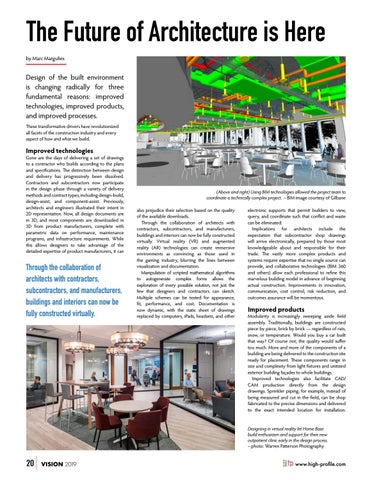
(Above and right) Using BIM technologies allowed the project team to coordinate a technically complex project. – BIM image courtesy of Gilbane also prejudice their selection based on the quality of the available downloads. Through the collaboration of architects with contractors, subcontractors, and manufacturers, buildings and interiors can now be fully constructed virtually. Virtual reality (VR) and augmented reality (AR) technologies can create immersive environments as convincing as those used in the gaming industry, blurring the lines between visualization and documentation. Manipulation of scripted mathematical algorithms to autogenerate complex forms allows the exploration of every possible solution, not just the few that designers and contractors can sketch. Multiple schemes can be tested for appearance, fit, performance, and cost. Documentation is now dynamic, with the static sheet of drawings replaced by computers, iPads, headsets, and other
electronic supports that permit builders to view, query, and coordinate such that conflict and waste can be eliminated. Implications for architects include the expectation that subcontractor shop drawings will arrive electronically, prepared by those most knowledgeable about and responsible for their trade. The vastly more complex products and systems require expertise that no single source can provide, and collaborative technologies (BIM 360 and others) allow each professional to refine this marvelous building model in advance of beginning actual construction. Improvements in innovation, communication, cost control, risk reduction, and outcomes assurance will be momentous.
Improved products
Modularity is increasingly sweeping aside field assembly. Traditionally, buildings are constructed piece by piece, brick by brick — regardless of rain, snow, or temperature. Would you buy a car built that way? Of course not; the quality would suffer too much. More and more of the components of a building are being delivered to the construction site ready for placement. These components range in size and complexity from light fixtures and unitized exterior building façades to whole buildings. Improved technologies also facilitate CAD/ CAM production directly from the design drawings. Sprinkler piping, for example, instead of being measured and cut in the field, can be shop fabricated to the precise dimensions and delivered to the exact intended location for installation.
Designing in virtual reality let Home Base build enthusiasm and support for their new outpatient clinic early in the design process. – photo: Warren Patterson Photography
20 VISION 2019
www.high-profile.com