July, 2012
3
High-Profile Special Supplement: 60th Anniversary CBC Desire To Combine Knowledge and Learn From Other Building Professionals was
Impetus from the Beginning
by Jim Elmasry Recognizing the wealth of knowledge inherent throughout various facets of the design and construction industry and understanding the benefits of bringing team members together to take advantage of that knowledge, several prominent
leaders of the Connecticut construction industry founded the Connecticut Building Congress in 1952. Sixty years later, it has become the premier organization for Connecticut's building professionals to develop strong industry connections. The sharing of knowledge and ideas across professions
and trades has influenced the development of our industry and allowed our members to evolve together while fostering strong and long-lasting relationships. Through open forum discussions and structured programs, our members share their experiences, thoughts, and ideas,
allowing members and colleagues to benefit from the broad wealth of knowledge. By providing a forum for collegiality and collaboration, CBC is an industry compass in a market of ever-changing forces, economic demands, new technologies, and teaming opportunities.
Project Team Awards and Scholarship Banquet
by Jim Fuda For the past 16 years, June has been the month for CBC to celebrate successful teamwork and rising stars in design and construction. The annual Project Team Awards and Scholarship banquet is CBC’s signature event recognizing winning teams of projects completed in the previous year. CBC’s tradition has been to focus less on style, luxury and exposure, but rather to recognize project teams that demonstrate exceptionally close collaboration while overcoming peculiar challenges, while delivering successful projects. CBC’s commitment to fostering a successful building community is reinforced by the longstanding dedica-
tion and giving of the CBC Scholarship Fund. Countless scholarship recipients have benefitted from the work of Clif Cotter, who recently retired as president of the Scholarship Fund after 39 years on its board. Clif joins CBC every year at the Project Team Awards banquet to award scholarships to promising high school seniors pursuing degrees as design and construction professionals. The well-attended event brings full representation of building owners, architects, engineers, constructors, subcontractors, and sub- consultants together celebrating the award-winning projects and highlighting the value of collaboration of the design and construction community.
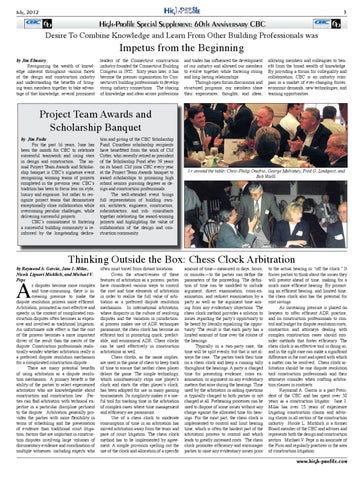
l-r around the table: Chris-Philip Onofrio, George Mulvaney, Fred G. Lindquist, and Bob Vitelli
Thinking Outside the Box: Chess Clock Arbitration
by Raymond A. Garcia, Jane I. Milas, Nicole Liguori Micklich, and Michael V. Pepe s disputes become more complex and time-consuming, there is increasing pressure to make the dispute resolution process more efficient. Arbitration, promoted as cost-effective and speedy, in the context of complicated construction disputes often becomes as expensive and involved as traditional litigation. An unfortunate side effect is that the cost of the process becomes a more important driver of the result than the merits of the dispute. Construction professionals realistically wonder whether arbitration really is a preferred dispute resolution mechanism for a complicated construction dispute. There are many potential benefits of using arbitration as a dispute resolution mechanism. A primary benefit is the ability of the parties to select experienced arbitrators who are knowledgeable about construction and construction law. Parties can find arbitrators with technical expertise in a particular discipline pertinent to the dispute. Arbitration generally provides the parties with more flexibility in terms of scheduling and the presentation of evidence than traditional court litigation, factors that are important in construction disputes involving large volumes of documentary evidence and coordination of multiple witnesses, including experts who
A
often must travel from distant locations. Given the attractiveness of these features of arbitration as a process, parties have considered various ways to control the cost and time elements of arbitration in order to realize the full value of arbitration as a preferred dispute resolution mechanism. In international arbitration, where disparity in the culture of resolving disputes and the variation in jurisdictional process makes use of ADR techniques paramount, the chess clock has become an efficient tool in promoting quick, predictable, and economical ADR. Chess clocks can be used effectively in construction arbitrations as well. Chess clocks, as the name implies, are used in the game of chess to keep track of time to ensure that neither chess player delays the game. The simple technology, which simultaneously stops one player’s clock and starts the other player’s clock, has been adopted for use in many gaming tournaments. Its simplicity makes it a useful tool for tracking time in the arbitration of complex cases where time management and efficiency are paramount. Use of a chess clock to moderate consumption of time in an arbitration has moved arbitration away from the tenor and pace of court litigation. The chess clock method has to be implemented by agreement. A simple provision spelling out the use of the clock and allocation of a specific
amount of time—measured in days, hours, or minutes—to the parties can define the parameters of the proceeding. The definition of time can be modified to include argument, direct examination, cross-examination, and redirect examination by a party as well as the argument time arising from any evidentiary objections. The chess clock method provides a solution to issues regarding the party’s opportunity to be heard by literally equalizing the opportunity. The result is that each party has a limited amount of time over the course of the hearings. Typically in a two-party case, the time will be split evenly, but that is not always the case. The parties track their time on a chess clock and keep a running tally throughout the hearings. A party is charged time for presenting evidence, cross examination, or argument on any evidentiary matters that arise during the hearings. Time used by the arbitrators in asking questions is typically charged to both parties or not charged at all. Prehearing processes can be used to dispose of some issues without any charge against the allocated time for hearings. For the most part, the chess clock is implemented to control and limit hearing time, which is often the hardest part of the arbitration process to control and which leads to greatly increased costs. The chess clock promotes efficiency and encourages parties to raise any evidentiary issues prior
to the actual hearing or “off the clock.” It forces parties to think about the issues they will present ahead of time, making for a much more efficient hearing. By promoting an efficient hearing, and limited time, the chess clock also has the potential for cost savings As increasing pressure is placed on lawyers to offer efficient ADR practice, and on construction professionals to control and budget for dispute resolution costs, contractors and attorneys dealing with complex construction cases should consider methods that foster efficiency. The chess clock is an effective tool in doing so, and in the right case can make a significant difference in the cost and speed with which a matter can be resolved. Chess clock arbitration should be one dispute resolution tool construction professionals and their attorneys consider when crafting arbitration clauses in contracts. Raymond A. Garcia is a past President of the CBC and has spent over 30 years as a construction litigator. Jane I. Milas has over 25 years of experience litigating construction claims and advising clients in all sectors of the construction industry. Nicole L. Micklich is a former Board member of the CBC and advises and represents both the design and construction sectors. Michael V. Pepe is an associate of the Firm and regularly practices in the area of construction litigation.
www.high-profile.com