March 2022
1
March 2022
Schools and Institutions
The costume shop at UMass Amherst’s Bromery Fine Arts Center Bridge was part of the university’s recent renovations. The building is an example of the Brutalist architecture that the institution is known for. Read more on page 26. / Photo by Chodos Photos
INDUSTRY EXPERT ARTICLES:
13
23
Abdullah Khaliqi Jacqueline A. Falla
Rick Jones
25
30
James E. LaPosta, Jr.
INSIDE THIS ISSUE:
Jen Luoni
37
Cheri Ruane
44
46
Susan Shelby
FEATURING:
JCJ Promotes Muscolino to Principal
Scholarship Fosters Diversity in Design Williams College to Expand Davis Center
PLUS:
March 2022
WOMEN in CONSTRUCTION Women in Construction
1
WOMEN IN CONSTRUCTION
Providence School Designated LEED Gold Suffolk Selected for Gillette Stadium Renovation Ayesca Machado, apprentice with Pipefitters Local 537
AGC MA Releases Case Study on BAE Program
Read her story on page 20
Annual Supplement
P.O. Box 7, Pembroke, MA 02359 Change Service Requested
page 22
Achieving Equitable Outcomes in the Long Term with Barry Reaves of the BPDA
www.high-profile.com
IBEW Local 103, NECA Contractors Support Vocational Students March 2022 www.high-profile.com
March 2022
2
Helping to Build Boston for Over 35 Years. www.high-profile.com
•
HVAC
March 2022
Architectural Building & Landscape Products
Introducing
MIX
3
™
THE LOW CARBON FORMULA FOR CONCRETE BLOCKS thinner webs reduce overall thermal bridging = better energy efficiency
larger cores reduce the amount of concrete used per block
Ask About Improving Your Leeds Points By Adding upto 50% Expanded Recycled Glass Into G-Mix!
4lbs lighter
50% Less Cement & 8% Less Concrete While Exceeding Strength Requirements
Since 1985, Genest has been using less cement in concrete block production than most block producers and now after years of experience and development, we are proud to introduce G-mix™. This formula uses at least 5% recycled content and half of the cement traditionally used to produce concrete blocks. You can be sure that when you buy from Genest, you will have a low carbon footprint for your project. Contact us for specification details. AVAILABLE IN ALL OUR ARCHITECTURAL FINISHES, SHAPES & SIZES - LET US QUOTE YOUR NEXT PROJECT!
FMI: CALL RAY AT (207) 284-0441 OR INFO@GENEST-CONCRETE.COM
www.GenestConcrete.com
www.high-profile.com
March 2022
4
Featuring:
On the Cover:
UMass Amherst Embraces its Brutalist Heritage
26
ADVERTISERS INDEX
Achieving Equitable Outcomes in the Long Term
36
Scholarship Fosters Diversity in Design
39
AGC MA Releases Case Study on BAE Program
49
JCJ Promotes Muscolino to Principal
53
Sections: Publisher’s Message...................................6 Up-Front.......................................................7 Schools and Institutions............................13 Multi-Residential...................................... 32 Mixed-Use................................................ 33 Life Sciences............................................. 34 Build Better Podcast................................. 36 Trends & Hot Topics....................37, 44, 46 Cannabis.................................................. 38 J.E.D.I........................................................ 39 Corporate................................................. 40 Green........................................................ 42 Technology and Innovation.................... 43 Training and Recruitment......................... 49 Philanthropy............................................. 50 People....................................................... 52 Calendar.................................................. 54
SUBSCRIBE ONLINE: www.High-Profile.com/subscribe
PUBLISHER: Anastasia Barnes EDITOR: Emily Langner ASSOCIATE EDITOR, OUTREACH COORDINATOR: Kira Kusakavitch CONSULTING EDITORS: Ralph Barnes and Marion Barnes VICE PRESIDENT OF SALES: Elizabeth Finance ACCOUNT EXECUTIVES: Mark Kelly, Betsy Gorman ART DIRECTOR: Yvonne Lauzière, Stark Creative Cotting School
MEDIA MANAGER: Alisar Awwad SOCIAL MEDIA COORDINATOR: Emma Gottschalk FOUNDERS: Michael and Kathy Barnes
Send news releases, advertising queries, articles, announcements, and calendar listings, to: editor@high-profile.com. P.O. Box 7, Pembroke, MA 02359 (781) 294-4530 The Val
EMD Serono
Celebrating 25 Years 1997 - 2022
Erland Construction, Inc. / www.erland.com
High-Profile will be turning 25 next September! Join us as we look at the teams that are designing and building facilities in New England and the trends and hot topics that will be the focus of the next 25 years!
www.high-profile.com
Be a part of HP25, our special 25th Anniversary edition! Contact Anastasia@high-profile.com Thank you for being part of HP’s success! high-profile.com
AET LABS............................................................ 29 Alpine Environmental........................................... 8 American Energy Management........................21 American Plumbing & Heating........................... 2 Arden Building Companies...............................55 Associated Subcontractors of Mass................. 10 Barnes Building Management.......................... 41 Bluezone Products Inc........................................31 Boston Plasterers & Cement Masons Local 534......20 Bowdoin Construction ........................................ 6 BVH Integrated/Salas O’Brien........................ 28 CT Temperature Controls....................................21 Connolly Brothers.............................................. 18 Copley Wolff Design Group............................. 16 Dacon..................................................................51 designLAB architects.......................................... 27 Dietz & Co.......................................................... 20 E2 Engineers.......................................................12 Eastern States Insurance...................................... 8 Elaine Construction............................................ 24 Erland Construction, Inc...................................... 4 Genest.................................................................. 3 Glynn Electric.....................................................43 GT Wilkinson...................................................... 10 Hampshire Fire Protection.................................38 Heat & Frost Insulators Local 6........................... 9 IBEW 103........................................................... 35 Interstate Electrical Contractors........................ 39 J&M Brown.........................................................40 Jandris Block......................................................45 JCJ Architecture.................................................. 24 Jewett Construction............................................ 19 JM Electrical Company, Inc..............................36 Jones Architecture.............................................. 28 Kaplan Construction.......................................... 29 Kaydon............................................................... 34 Key Resin Terrazzo............................................. 15 Lockheed Architectural Solutions........................ 7 Marr Scaffolding............................................... 19 Matz Collaborative........................................... 23 Metro Walls.......................................................... 6 NEMCA..............................................................50 Norgate Metal, Inc............................................ 14 O’Reilly, Talbot & Okun Assoc..........................13 Phase Zero.......................................................... 22 Procon................................................................... 5 Raken App.......................................................... 32 ReArch Company............................................... 17 Savage Law........................................................30 Silver Tiger Consulting........................................12 SL Chasse........................................................... 33 SLAM.................................................................. 14 Sprinkler Fitters 550.......................................... 47 STEM Solutions, LLC.......................................... 16 Tecta America.................................................... 49 TFMoran............................................................. 18 Topaz Engineering............................................. 42 Unilock.................................................................11 W.L. French.........................................................56 Weston & Sampson........................................... 25 Windover Construction..................................... 23
WOMEN IN CONSTRUCTION Associated Subcontractors of Mass................. 20 Bald Hill Builders.................................................. 7 Brennan Consulting........................................... 19 BW Kennedy...................................................... 22 Colantonio, Inc.................................................. 15 Cranshaw Construction..................................... 23 Dellbrook/JKS.................................................... .5 Dimeo Construction........................................... 17 Ebbrell Architecture and Design......................... 9 Florence Electric..................................................21 Folan Waterproofing and Construction Co. ... 23 Gaston Electric..................................................... 6 IBEW 103........................................................... 24 Integrated at Work............................................ 20 Interstate Electrical Contractors........................ 16 KBE Building Corporation..................................12 O’Reilly, Talbot & Okun Assoc........................... 8 ReArch Company................................................11 Silver Tiger Consulting....................................... 22 TF Moran............................................................ 18 Wayne J. Griffin Electrical, Inc............................ 4 Weston & Sampson........................................... 14
March 2022
5
www.high-profile.com
March 2022
6
Publisher’s Message
Anastasia Barnes This issue marks the 15th consecutive year we have highlighted the North Atlantic region of SCUP and its members. This year’s conference is taking place at my alma mater, UMass Amherst, from March 16-18. I’ll be there for all three days. Will you?
The university has transformed dramatically over the past 11 years, by upgrading existing facilities and adding new buildings to its growing campus. The article on page 26, written by Lincoln Nemetz-Carlson, is not just a respectful ode to Brutalist architecture; it’s also a commitment to adaptive reuse. Lincoln says, “Given the embodied energy and materials in concrete buildings and landscapes, the investment in renovating rather than demolishing Brutalist structures speaks to the priority of carbon mitigation strategies at UMass Amherst.” Since we’re on the subject of schools and green buildings, I want to specifically highlight two schools that
Do you like this month’s cover? I have such fond memories of my time spent at UMass Amherst’s Fine Arts building, only we didn’t have the solar panels or the beautifully renovated classrooms. It’s exciting to see a building I spent so much time in being preserved and restored so thoughtfully for the next generation of UMass students.
Saugus Middle High School / Photo by Robert Benson Photography
recently achieved LEED certification. Saugus Middle High School was recently designated LEED Platinum (pg. 20) and The Little School in Providence, R.I. was recently designated LEED Gold (pg. 18).
The Little School’s expansion actually produces zero carbon emissions! Barry Reaves, the Boston Planning and Development Agency’s first ever director of diversity, equity, and inclusion, is this month’s featured guest on the Build Better Podcast. Barry is also a member of High-Profile’s J.E.D.I. (justice, equity, diversity, and inclusion) editorial committee. He believes that it is our industry’s responsibility as a whole to be accountable, and to measure outcomes and course correct when a specific strategy is not working. Learn what Barry and his team are doing to make real estate more accessible and equitable for underrepresented groups in Boston (pg. 36). Spring equinox is less than three weeks away. I’m ready for some in-person events! As always, enjoy the read!
The Little School in Providence, R.I.
▪ ▪ ▪ ▪
Let us frame your future... Let us frame your future...
Pre-Construction Planning Construction Management General Contracting Design Build
Market Sectors: Academic/Cultural Corporate/Industrial/Lab Medical/Healthcare Residential/Hospitality Retail/Restaurant
Morse High School, Bath, ME - Framing & Drywall Morse High School, Bath, ME - Framing & Drywall
MetroWalls.net MetroWalls.net Metro Walls is one of the leading commercial Metro Walls is one of the drywall, framing and leading commercial acoustical ceiling drywall, framing and companiesceiling in New acoustical England. With the area’s companies in New largest workforce, we England. With the area’s provide outstanding largest workforce, we service outstanding to some of provide the biggest andofbest service to some contractors in the region. the biggest and best contractors in the region.
Manchester, NH 603-668-2648 Manchester, NH 603-668-2648
www.high-profile.com
Westport, MA Portland, ME 508-938-9708 Westport, MA 207-887-9065 Portland, ME 207-887-9065 508-938-9708
The Revers Center for Science & Visual Arts at The Rivers School, Weston, MA ABC Excellence in Construction Award Winner, 2020
Providing Creative Solutions for Your Building Needs Since 1973 220-1 Reservoir Street Needham Heights, MA 67 Millbrook Street Suite 209 Worcester, MA 1224 Mill Street Building B Suite 212 East Berlin, CT
781.444.6302
BowdoinConstruction.com
March 2022
7
Up-Front Suffolk Selected for Gillette Stadium Renovation Foxborough, MA – Suffolk has been chosen by the Kraft Group as its construction partner for a major renovation project at Gillette Stadium in Foxborough, home of the New England Patriots and New England Revolution. The transformation of the north end of Gillette Stadium will be defined by 75,000sf of glass-enclosed, year-round hospitality and function spaces that bridge the gap between the East and West Putnam Clubs, the Dell Technologies Suite Levels and the upper concourse. All levels of the stadium will have 360-degree connectivity, a feature that is currently only available on the main concourse. The renovation of the stadium, opened in 2002, will also include the largest outdoor stadium high-definition video board in the country, measuring 370 feet by 60 feet. The 22,200sf of video board
landscaped staircase will lead guests up to the main concourse, where fans will have a view of the field looking toward the south end zone video board and the New England Patriots’ six Super Bowl banners. The project will also include improved concession locations. Construction of the Gillette Stadium improvements began recently in the north end of the stadium. The construction is scheduled for completion prior to the 2023 NFL season.
Gillette Stadium / Renderings courtesy of Gillette Stadium
space will be nearly double the size of the new south end zone video board. The curved radius HD video board will provide game action, replays, statistics and fantasy football updates. The architectural bridge and lighthouse have served as two of the stadium’s signature characteristics. The new development will feature a larger, more prominent lighthouse that will stand 218 feet high, complete with a 360-degree
observation deck at the top that will provide sweeping views of the stadium, game field, Patriot Place and beyond. The observation deck will be accessible to fans visiting Gillette Stadium year-round and available for private events. The fan entrance into the north end of Gillette Stadium will also be revitalized. Plans for this area include relocating the entry gates to create a new fan-activation area upon entry to the lower plaza. A
Pre-Construction | Design Build Expertise | In-House Engineering | Shop Drawing | Project Management | Production | Fabrication | On-Site Execution of Installations | Site Management | General Contracting Lockheed technicians are experienced and skilled in fabrication and installation, regularly executing complex projects throughout New England. Products we work with include:
Cabot Elementary School - Newton, MA
Fiber Cement and Composite Panel Systems
Hollow Metal Openings
Traditional and Unitized Curtain Wall Systems
Terracotta Cladding Systems
Storefront Systems
Window and Structural Glass Systems
Sun Shading Devices and Skylights
Glass Floors and Railings
Door and Hardware Systems
Equipment and Rooftop Screens
Sacred Heart Business & Communications Center - Fairfield, CT
Safety
•
Quality
•
Innovation
•
Reliability
Eden Park School - Cranston, RI
•
Cost-Efficiency
P.O. Box 166, Pascoag, RI 02859 • 800-537-3061 • lockheedsolutions.com www.high-profile.com
High-Profile: Up-Front
8
March 2022
Nauset Breaks Ground on Senior Development
Hager Homestead / Rendering courtesy of Sheldon Pennoyer Architects
Littleton, MA – Nauset Construction has broken ground and foundation work is now underway for Hager Homestead, a five-building, 24-unit, 55+ cohousing development that will be built in two phases. Located on the 15-acre site on King Street, the new community is a short walk from Littleton Center, the Town Hall and public library, and a five-minute drive to the commuter rail station. Hager Homestead will be the first cohousing development for seniors in New England. “Cohousing consists of privatelyowned homes clustered around shared open space and a common house with shared amenities,” said Matthew Blackham of Massachusetts Cohousing, LLC, which is developing the project
in conjunction with the residents of the community. Designed by Concord, NH-based Sheldon Pennoyer Architects, the project centers around a historic, 3-story, 2,500sf farmhouse built in 1795 in the Federal style. The building, which features several original masonry fireplaces, will be thoughtfully reimagined as the Hager Homestead’s Common House, and serve as the social center for the community. The Common House will include a large dining room and kitchen, community space, living room, library, and other amenities, including an exercise room. Nauset will also raze an adjacent single-story building (formerly home to a dental office) to make way for a 3-story, 15-unit building to be constructed in the
Federal style to remain in harmony with the historic character of the Common House. Three additional “cottages” will be constructed from the ground up, two with two units and a third with three units, and Nauset will also renovate a singlefamily home located on the property into two housing units to create the fourth cottage in the second phase. Eight of the units will be designated as affordable or workforce housing. A modern post and beam barn, originally sited next to the Federal house, will be relocated intact to the northeast corner of the development. The barn will house woodworking tools and serve as a storage area for large equipment and supplies for the development’s planned community garden.
Hager Homestead also features approximately 12 acres of open space, which will be protected in perpetuity by a conservation restriction. The open space consists of a meadow, a pond, and wetlands bounded by Beaver Brook. A walking path at the rear of the property will also be designated as a public amenity for the residents of Littleton. Eighty percent of the total acreage of the development will be green, open space. Challenges for the construction team include providing structural reinforcement to the Common House to ensure support during the excavation process for the new buildings, maintaining erosion control, and protecting the wetlands from materials runoff during the simultaneous construction of four separate buildings.
ENVIRONMENTAL
We can take care of all your environmental issues – big and small.
Insurance
Handling environmental hazards
•
Building strong relationships based on honesty and experience
•
Employee Benefits
Risk Management
INSURANCE ANDSURETY SURETY BONDS FOR INSURANCE AND AND BONDS FOR INSURANCE SURETY BONDS FOR
Over 30 years’ experience: •
Bonds
General Contractors
Building Owners and Managers Building Owners and Managers TradeProperty Subcontractors Building Developers Property Developers General Contractors Owners and Managers General Contractors Trade Subcontractors Property Developers Trade Subcontractors
Providing start-to-finish, tailored solutions for a variety of challenges
Property Liability Insurance Property and Liability Insurance Propertyand and Liability Insurance Coastal Coastal Property Insurance Coastal Property Insurance Builders Risk Insurance Builders Builders Insurance SuretyRisk Bonds Surety Bonds
Oscar B. Johnson
Surety Bonds
Oscar Vice B. Johnson Executive President OscarSURETY B. Johnson INSURANCE AND BONDS FOR Executive Vice President Executive Vice President
Proud Partners with
Proud Partners with
States Insurance Agency,and Inc.Liability Insurance Building OwnersEastern and Managers Property Eastern States Insurance Agency, Property Developers Coastal Property Eastern States Insurance Agency, Inc.Inc.Insurance General Contractors Builders Risk Insurance Trade Subcontractors Surety Bonds 50 Prospect Street | Waltham, Massachusetts 02453 | (781) 642-9000 | (781) 647-3670 fax | esia.com
LEAD PAINT
•
MOLD
•
ASBESTOS
87 7- 527- 4040 | alpine @alpine-environment al.com
www.high-profile.com
ProudPartners Partners with Proud with 50 Prospect Street50| Prospect Waltham,Street Massachusetts | (781) 642-9000 | (781) 647-3670 fax | esia.com Oscar B. Johnson | Waltham,02453 Massachusetts 02453
Executive Vice President
(781) 642-9000 | (781) 647-3670 fax | esia.com Eastern States Insurance Agency, Inc.
50 Prospect Street | Waltham, Massachusetts 02453 | (781) 642-9000 | (781) 647-3670 fax | esia.com
High-Profile: Up-Front
March 2022
9
I Heat & Frost
LOC
rker d Wo s lie
ators and Al l u ns
AL 6 – B O STON
Are you missing the mark in your Value Engineering? If you're cutting corners on mechanical insulation, the answer is YES! Installing the right mechanical insulation is critical to effective value engineering in any construction project. The immediate and longterm costs for cutting corners on insulation are significant — if you're overlooking high-quality mechanical insulation for your systems in your project planning, your so-called "value engineering" attempts are pinching pennies that will cost up to millions of dollars in the future. Insulation allows mechanical systems working 24/7 to optimize efficiency, requiring less energy to perform and saving on maintenance and repairs down the road. In most situations, real "value engineering" means more insulation, not less, to achieve a higher Return On Investment, often times accomplished in as little as a year. Don't sacrifice millions of dollars over the lifespan of a building to cut minimal costs during construction.
Don't be penny wise, dollar foolish! Call the mechanical insulation professionals for a free consultation today: Insulators6.org | 617-436-4666
www.high-profile.com
High-Profile: Up-Front
10
Erland to Build Apartments in Waltham
March 2022
Construction Begins at 149 Newbury St.
Broadstone 305 rendering
Waltham, MA – Alliance Residential has selected Erland Construction, in collaboration with CUBE 3, to construct a new 314-unit apartment building in Waltham. The 547,000sf residence will house one-, two-, and three-bedroom units. Perched above the tree line along Winter Street, Broadstone 305 will offer views of the nearby Cambridge Reservoir as well as Boston’s skyline. The triangular-shaped building will feature a large interior courtyard, resortstyle pool deck, 2-story fitness facility, speakeasy lounge, dog park and extensive work-from-home facilities. It will consist of five and a half stories of wood frame over a two and a half story post tension
garage. Broadstone 305 will have surface spaces and parking under the building for 472 cars as well as a wide array of amenities designed to offer a balanced, modern lifestyle. “We’re very excited to continue our great partnership with Alliance Residential,” said Eric Greene, vice president/residential group manager, Erland. “A lot of planning and thought has gone into this new apartment community, recognizing the many benefits this type of development will offer Waltham residents.” The project is estimated to take 30 months to construct. Erland completed Broadstone 305’s sister property, The Val, in the fall of 2021.
149 Newbury Street / Rendering courtesy of Nelson Worldwide
Boston – Shawmut Design and Construction recently announced that it has started construction on L3 Capital’s mixed-use commercial development at 149 Newbury Street in Boston’s Back Bay neighborhood. In partnership with architecture firm Nelson Worldwide, the former parking lot at the corner of Newbury Street and Dartmouth Street will be redeveloped into a 5-story mixed-use retail and office building totaling 43,500sf. The state-ofthe-art structure will feature 130 feet of frontage on Newbury Street, dedicated flagship retail space, exclusive office entrance, as well as a rooftop penthouse
and outdoor terrace. The development will offer up to 16,000sf of retail space on the first two levels and 27,500sf of office space, and is slated for completion in 2023. “Partnering with L3 Capital on this redevelopment is immensely exciting,” said Kevin Sullivan, executive vice president of Shawmut Design and Construction’s New England Region. “With its prime location in the heart of Boston’s coveted Back Bay neighborhood, our team will leverage decades of local market expertise completing complex urban projects and create a building that will strengthen the iconic pedestrian corridor.”
Only one association represents the interests of every subcontractor in the state of Massachusetts:
Since 1950 we have represented companies of all trades, large and small, union and open shop, who work on major building projects across the commonwealth, in both the public and private sector.
COMMERCIAL/INDUSTRIAL
HEATING & MOBILE BOILERS Founded in 1951, the third generation of the Wilkinson family continues to provide the highest standards of installation, service, and maintenance for all your boiler room needs. We have New England’s largest fleet of mobile boilers. Steam, hot water, domestic hot water—you’re covered. Need one that fires oil or natural gas? We have those too. Our dependable mobile boilers, available in many sizes, will get you up and running with a minimum of disruption.
Call our 24/7 emergency hotline: 800.777.1629
Visit www.associatedsubs.com to join. www.high-profile.com
www.gtwilkinson.com
March 2022
High-Profile Focus: Cannabis Facilities
11
PROJECT Minuteman High School. Lexington, MA. DESIGN Kaestle Boos Associates, Inc. PRODUCT Rectangles with Umbriano® finish.
Your
CREATION Our
TEAMWORK Our team of Commercial Design Consultants are ready to support your next unit paving project from start to finish. Combine our technical expertise with a vast array of Unilock colors, shapes and textures, to bring your unique vision to life. Contact for samples, product information and Lunch & Learns. UNILOCK.COM | 1-800-UNILOCK
www.high-profile.com
High-Profile: Up-Front
12
March 2022
Construction Underway on Endicott College Building Beverly, MA – Windover Construction announced that it broke ground on Endicott College’s new Cummings School of Nursing and Health Sciences in October 2021. Along with a new state-of-the-art educational space for nursing students, the building will house the Sport Science program, providing students with interactive lab spaces, traditional classrooms and community spaces. This facility will be the final piece of the college’s emerging academic quad in the heart of campus and will connect via aboveground bridges to the recently completed Hempstead Commons, Samuel C. Wax Academic Center, and Gerrish School of Business and Ginger Judge Science Center. The Cummings School of Nursing and Health Sciences, designed by Derck
Endicott College’s Nursing and Health Sciences Building / Renderings courtesy of Derck & Edson
& Edson, is a continuation of Windover Construction’s long and collaborative partnership with Endicott College. Since
New England’s leader in PR, Crisis Management, and Marketing Services for Construction Firms Silver Tiger Consulting helps CEOs, COOs and business owners grow their enterprises in the most efficient and profitable way possible: • PR, crisis management and marketing services, including fractional CMOs • Human resource outsourcing • Operations consulting
silvertigerconsulting.com / (781) 214-3808 www.high-profile.com
2008, Windover has completed over 20 projects on campus that have allowed the college to grow its community, including
new classrooms, laboratories, residence halls, auditoriums, student centers, and the main dining hall.
March 2022
13
Focus: Schools and Institutions Navigating In-Person Learning in a Post-COVID World
by Abdullah Khaliqi
The benefits of in-person learning seem clear to most people, especially after the extensive remote learning sessions of the past two years. As schools return students to campus, the importance of ensuring in-classroom health and safety in the changing landscape has been paramount. Since the pandemic began, much has been learned about COVID-19 transmission and the importance of ventilation that maximizes outdoor air. Most people have heard about government relief for school improvements, but what is not as clear is how to obtain the funding and where to spend it across an entire school district. Starting early in the pandemic, Fitzemeyer & Tocci Associates (F&T) created criteria to aid in COVID evaluations of existing buildings. F&T drew upon extensive experience in the healthcare market to come up with multiple
illness transmission aspects to consider, including airflow patterns, filtration, and humidity. Proprietary evaluations result in a number score for each building, allowing for a districtwide ranking that identifies the best/worst performers and detailing which aspects could be improved in each building. The Framingham School District was excited to get students back in schools and is working toward creating the best environments possible with the assistance of F&T.
Framingham school during COVID-19 lockdown
Having been in business for over 60 years, F&T has seen the evolution of priorities in educational facilities. Energy considerations must be balanced to save costs while allowing HVAC systems enough runtime to keep occupants safe.
While building code provides for operable windows to check the box of a room having ventilation, a window remaining open during winter months or inclement weather may not be the best approach for a school building in New England. In Framingham’s case, after evaluations occurred, approximately $7 million was granted to the district for COVID-19 mitigation efforts. F&T has been working with the district to review improvements in 12 buildings and get input from cost estimator Leher Cummings. Working closely with a cost estimator allows for an in-depth understanding of costs associated with potential work. The goal is for the district to apply funds fairly across the district buildings while maximizing efforts to keep students and staff safe. Bringing facilities back up and running safely is a priority for our clients. The MEP/FP engineers at F&T can help you determine risk to occupants, offer suggestions on areas that could be improved, and help determine how to best apply funding to get the most significant impact possible. Individual risk can come in almost
Fitzemeyer & Tocci engineers performing COVID-19 evaluations of existing buildings
endless forms, and now those threats include simply being indoors with other people. With careful planning, participants can feel comfortable entering buildings that have safety in mind. The enrichment gained by in-person learning and interaction is undeniable, and thanks to the efforts of the Framingham School District and others applying new research and consideration, the risk is consistently being lessened, allowing us to plan the best methods to educate the next generation safely. Abdullah Khaliqi, PE, CPQ is academic market leader and senior associate at Fitzemeyer & Tocci Associates, Inc.
www.high-profile.com
High-Profile Focus: Schools and Institutions
14
March 2022
Dellbrook|JKS Cuts Ribbon at Charter School
Alma del Mar Charter School’s Frederick Douglass Campus ribbon cutting
New Bedford, MA – Dellbrook|JKS celebrated the ribbon cutting of Alma del Mar Charter School’s Frederick Douglass Campus on Jan. 28, alongside the OPM, Compass Project Management, and Arrowstreet Architects, Inc. The Frederick Douglass Campus, totaling 52,000sf, is located just off Church Street in New Bedford. The structure, comprised of pre-engineered metal buildings, sits on four acres that hold a parking lot, pickup/drop off area, playground, and an outdoor classroom space. The interior of the building has classrooms, a gymnasium, a cafeteria
with servery, offices, and support spaces. Features of the new space include colorful panels, environmental graphics, encouraging words, and murals about the school’s namesake. The building also has extensive sound control measures to minimize ambient city noise. “It’s been an absolute honor to partner with the teams from Compass Project Management (again!) and Arrowstreet on the Frederick Douglass Campus,” said Dellbrook|JKS project manager, Carolyn Kimball. “Alma’s tireless dedication to their scholars and the local New Bedford community helped inspire the team the
(l-r) Domenic Tiberi, senior project manager, Compass Project Management; and, from Dellbrook|JKS, Jerry Edmond, superintendent; Carolyn Kimball; and Greg Inman
whole way through!” This is Dellbrook|JKS’s second project with Alma del Mar. In winter of 2016, the firm completed the Sara D. Ottiwell Campus, where Kimball also served as assistant project manager. “It was a pleasure working with Alma del Mar Charter School and Compass Project Management for the construction of the Frederick Douglass Campus,” said Dellbrook|JKS project executive, Greg Inman. “The high level of collaboration that occurred amongst this project team is something to celebrate. Together we
Carolyn Kimball holds thank-you cards from the “scholars” at Alma del Mar.
maintained a tight construction schedule and created a wonderful space that will most definitely make a difference for the surrounding community.”
Creativity in Design to Enrich Lives
LOOKING FOR PEACE OF MIN LET NORGATE TAKE CARE OF We will serve you the best.
Groton Consolidated Middle School Groton, CT
We will meet our commitments. We will provide competitive pricing.
You will benefit from the expertise of our knowledgab
Visit us at www.norgatemetal.com for more information. 791, 8e Rue, La Guadeloupe QC GOM 1G0, Canada T : 418 459-6988 | F : 418 459-3493
SUPERIOR QUALITY STEELWORK NORGATEMETAL.COM CA CO CT FL GA IA MA NY PA RI
www.high-profile.com
860 657.8077 www.slamcoll.com
791, 8 e Rue, La Guadeloupe QC GOM 1G0, Canada • 418.459.6988
High-Profile Focus: Schools and Institutions
March 2022
ADVERTORIAL
15
Epoxy Terrazzo in Massachusetts Public Schools Sustainability, LEED benefits, unlimited design capabilities, custom logos, and affordability: These are the main reasons why epoxy terrazzo has become the No. 1 choice for interior flooring designers working on Massachusetts schools over the last 5-10 years. Always a popular choice at private schools and local universities, it is now being used for some portion of almost every public school being designed or built in Massachusetts. Cement terrazzo (which uses portland cement as the matrix) was used for years and, up until the 1980s, was considered as “standard terrazzo.” The introduction of “VOC-friendly” epoxy resin as a matrix option has been a game changer in the terrazzo world. Epoxy terrazzo is now used almost exclusively in all terrazzo flooring in schools and many other high traffic interior flooring projects. A decade ago, epoxy terrazzo was in the $50$60/sq. ft. range. Today’s cost, with increased competition, is closer to $35/sq. ft. which includes all prep, material and installation. With epoxy terrazzo, there is no need to recess the slab. In addition, epoxy terrazzo has opened up a myriad of possibilities with design options and it is faster to install.
KR C Te r r a z zo
Custom logos, “theme” projects, and only being “limited by your imagination” in what you can create, has added to the popularity of epoxy terrazzo as a viable cost effective option. Being able to exactly match the floor color and mix design and incorporate that into any precast tread/riser/landings, bench seating, wall base or wall panels has expanded the design options for many school clients. There are standard mix designs that give designers a starting point, but part of the allure of epoxy terrazzo is the ability to create a custom color and mix design that becomes unique to a specific project. It also has much better “adhesion promoters” built in which has opened up the possibility of adding premium aggregates like colored glass, mother of pearl, and silver coated glass. By using smaller percentages of the premium aggregates, it allows the designer and their clients to work into the budget different aggregate combinations. So, when looking at your next school design, or any sustainable project where you want to “create something unique that will last,” take a look at all epoxy terrazzo can do for you and your client.
Key Resin Terrazzo, their architectural reps, and all their employees would like to congratulate Leslie Carrio of DePaoli Mosaic. Leslie is president of the only woman-owned terrazzo company in the U.S. In addition, she is the first woman to be named president of the National Terrazzo Mosaic Association (NTMA). At a recent NTMA meeting, she was elected to a two-year term. Congratulations on this great accomplishment and thanks for all you do for the terrazzo industry!
Key Resin Epoxy Terrazzo
CASE HISTORY: Massachusetts Public Schools Recent Key Resin Epoxy Terrazzo Flooring Projects [ Total over 500,000 sq feet ] Beverly Middle School.....................80,000 feet Danvers High School........................24,000 feet Peabody Public Schools.................31,000 feet Cambridge Schools ..........................40,000 feet Cape Cod Regional ...........................24,000 feet Somerville HS........................................40,000 feet Wareham Schools..............................35,000 feet
Billerica High School.........................90,000 feet Newburyport Schools .....................26,000 feet Hanover High School........................35,000 feet Brookline High School.....................54,000 feet Middleboro HS.....................................29,000 feet MLK School - Cambridge..............35,000 feet Arlington High School......................20,000 feet
Maximize the Value of Your School Project or Any Flooring Project… • Cost Effectiveness of Design • Mitigation Products & Solutions • Custom Samples & Revisions • Key Resin Epoxy Terrazzo
• • • •
Maximizing Resin & Aggregate Mixes Specifying the Right Mitigation System 7-10 Day Turnaround, NO CHARGE! Less Costly + Value = Lower Cost Floor
Michael McBride CSI, ICRI ABINGTON ASSOCIATES, INC. (617) 901-9982 | cell • (781) 878-0025 | office • keyresin.com/terrazzo • michmcbride@hotmail.com New England Architectural Reps – Key Resin Terrazzo & Wausau Tile
www.high-profile.com
High-Profile Focus: Schools and Institutions
16
March 2022
Bowdoin Completes Classroom Renovations Weston, MA – Bowdoin Construction has been managing campus improvement projects at The Rivers School in Weston for more than 10 years, and is currently completing a series of three middle school classroom building renovations. The 2021 summer renovation of the 6,282sf Prince building created three new classrooms, two breakout rooms for private meetings and small group work, and a large gathering space supporting collaboration and the sense of community. Office space and restrooms were refinished, windows were replaced using high-performance glass, and finishes were upgraded throughout the building. Following the Prince renovation was the 12,074sf Lewis building renovation. These updates created dramatic, lightfilled open spaces with pond views, new state-of-the-art science classrooms, breakout and maker spaces, renovated humanities and math classrooms, and a new IT office. The third building renovation is just getting underway at Haynes Hall and involves select demolition and overall facility improvements and upgrades. Dario Designs was the architect for all three projects.
Lewis Building - community space
Prince building
Prince Building – classroom
King Open/Cambridge Street Upper Schools and Community Complex, Cambridge, MA
making places memorable
Need help with your next LabFitOut? Invite us to bid, itb@LabFitOut.com
Copley Wolff Design Group Landscape Architects & Plan ners www.copley-wolff.com
www.high-profile.com
617 654 9000
STEM Solutions LLC., is a national provider of laboratory equipment and casework for your LabFitOut. We can help you with your laboratory equipment, casework, flexible casework, design, project management, equipment, and installation.
www.labfitout.com • 617-826-6111
March 2022
17
Improving Lives Through The Built Environment Early Childhood
Choose ReArch Company for your next education project! K-12
Higher Education
WWW.REARCHCOMPANY.COM | SO. BURLINGTON, VT | 802-863-8727 www.high-profile.com Untitled-4 1
2/14/2022 10:43:19 AM
High-Profile Focus: Schools and Institutions
18
March 2022
Providence School Designated LEED Gold Providence, RI – Lincoln School’s coeducational early childhood program, Little School, located in Providence, has achieved LEED Gold certification. The Little School project provided additional capacity and created indoor and outdoor spaces fully aligned with the Reggio-Emilia-influenced curriculum and Quaker values. At site scale, the LEED Gold certified, net-zero energy project was designed to improve the campus connection to the neighborhood, support the school curriculum with biophilic interventions, and be energy efficient. The team at studioMLA Architects worked hand-in-hand with the educators to ensure that the built environment supported emergent curriculum goals, child autonomy, and the connection to the natural world. When selecting materials and textures, studioMLA made sure they adhered to the Reggio-Emilia principle of considering the classroom environment as crucially important, designing the space to be beautiful and reflective of the child’s learning, and using natural materials frame the child-centered spaces. The materials were sourced from products with no environmental off-gassing and were verified to contain nothing potentially harmful to the health of the occupants. Additionally, the Little School
has a green cleaning policy in place to reduce levels of chemical, biological, and particulate contaminants that would compromise air quality, human health, building finishes, building systems, and the environment.
Little School solar panels Photo courtesy of Josh Mitnick
The Little School in Providence, R.I.
The Little School maximizes natural ventilation and natural lighting while implementing renewable materials and energy. The floor-to-ceiling operable windows introduce natural light and allow views of flora, fauna, and the sky. The high-efficiency design integrates various energy conservation measures, providing energy savings. Notable contributors to cost savings include the high-performance building envelope, the high-efficiency HVAC system, abundant natural lighting, and on-site renewable solar energy. The building has an indoor LED lighting system and utilizes renewable energy outdoors via a photovoltaic array of 100 solar panels. In addition to the solar array on the roof, light-colored roofing and paving materials strategically reduce
Little School children in the classroom Photo courtesy of Josh Mitnick
heat island effect. Annually, the site generates roughly 128% of the electricity consumed. The Little School expansion produces zero carbon emissions.
Serving NH, MA & Northern New England since 1968
Strong Lines. Strong Ties.
Professional Services... Exceptional Results!
Engineering Services for Educational Institutions:
Photo courtesy of Stewart Associates Architects
RUSSELL ELEMENTARY SCHOOL ~ RUMNEY, NH
Connolly Brothers, Inc. is a construction commercial, industrial, and institutional established in 1880, Connolly is based in Beverly, Mass. and operates throughout the New England region. For more than a century, clients have turned to Connolly to handle all aspects of their construction projects, from planning and design to real estate development. More at ConnollyBrothers.com.
152 Conant St., Beverly, Mass. 01915
www.high-profile.com
■
Construction Management
SAINT ANSELM COLLEGE WELCOME CENTER ~ MANCHESTER, NH
Planning & Design Development
Voted BEST NH Engineering Fi 10 Years Runn rm ing! 978-927-0053
■
connollybrothers.com
Contact: Robert Duval, PE, LEED AP–President or Paul Sbacchi, PE–Chief Structural Engineer TFMoran, Inc. Bedford, NH and Portsmouth, NH (603) 472-4488 www.tfmoran.com
March 2022
High-Profile Focus: Schools and Institutions
19
Cotting School Campus Center Completed Lexington, MA – Erland Construction announced it has completed construction on Cotting School’s Campus Center of Excellence. In 2020, Erland, alongside ARC/ Architectural Resources Cambridge, kicked off the construction of Cotting’s new 25,000sf, 2-story addition to the school’s main building. Cotting School is a private, free-day school for children with physical disabilities. The facility was designed and constructed to meet the specialized needs of the Cotting student body, and to allow students to test their skills, boost their confidence, practice teamwork, and expand their imagination. The new addition was also designed to
Cotting School is a private, free-day school for children with physical disabilities. The facility was designed and constructed to meet the specialized needs of the Cotting student body, and to allow students to test their skills, boost their confidence, practice teamwork, and expand their imagination.
Cotting School
allow Cotting to update programs and unlock the full potential of its therapy and learning spaces by expanding them, enabling staff and students to continue to collaborate and inspire one another. The Campus Center of Excellence includes a full, regulation-sized gymnasium with room for all fans, including those in wheelchairs, and adjustable basketball hoops that can be lowered or raised depending on the type
of activity taking place. It also includes an adaptive indoor rock climbing wall with low ropes course elements designed to provide a safe, fun and supportive environment for students with disabilities to discover and enjoy the sport of climbing. Two candlepin bowling lanes give the school additional, year-round options for team-building, after-school programming, and recreation. Candlepin
bowling is a variation of bowling that is played with a handheld-sized ball and tall, narrow pins that resemble candles. Cotting’s lanes are two of the last of their kind installed in the New England area. The campus center features new media and visual arts classrooms that support performing arts programs, photography, filmmaking, painting, ceramics, and vocational workshops. An exterior landscaped courtyard was created between the new center and existing buildings where students will have the opportunity to plant and maintain the vegetation as part of the school’s curriculum. The center also houses a strength and conditioning fitness center with adaptive equipment to assist students in building muscle tone, muscle strength, and coordination; a school store/ concession space that provides students the opportunity for work experience during events in the gymnasium; and two new offices to support Cotting’s growing staff, giving them ample space to engage students. The project team also included Activitas and other subcontractor partners. The project was completed in December of 2021. 25 Spaulding Rd. Suite# 17-2 Fremont, NH 03044 603.895.2412 www.jewettconstruction.com
SINGLE SOURCE TRUSTED. • Athletic and Recreational Facilities • Industrial, Manufacturing and Warehousing Facilities • Educational , Institutional and Medical Facilities • Financial Institutions • Auto Dealerships
Haigh-Farr - Bedford, NH
• Retail Centers • Non-Profits
JOIN OUR TEAM WE’RE HIRING
Steel Erection I Cranes l Hoists Rigging I Scaffold l Shoring I Aerial Lifts I Mast Climbers l Bleachers Transportation I Warehousing
www.marrcompanies.com
617.269.7200
Project Managers Assistant Project Managers Estimators Superintendents
Nine-Zero - Salem, MA
Featuring Butler Metal Building Systems Upper Valley Honda White River Junction, VT
www.high-profile.com
High-Profile Focus: Schools and Institutions
20
March 2022
Saugus Middle High School Certified LEED Platinum Boston – Suffolk-built Saugus Middle High School, which was designed by HMFH Architects, has been awarded LEED Platinum certification by the U.S. Green Building Council, making it the first project publicly funded through the Massachusetts School Building Authority to reach the highest level of LEED certification. Working alongside PMA Consultants, HMFH and Suffolk both led a collaborative and comprehensive approach to achieving Saugus’ ambitious sustainability goals and realizing the town’s vision for an innovative, climateresilient and healthy building. Key sustainability elements of the building include:
Energy Efficiency: Saugus Middle High School uses a combined heating and power system known as tri-generation. Generating electricity on-site significantly reduces operational carbon emissions and eliminates emissions associated with regional source generation, while utilizing waste heat for space heating, domestic hot water heating and space cooling. Continuously running generators improve resiliency by ensuring emergency systems will be operational when they are needed most. Water Conservation: Three 30,000gallon underground cisterns collect water
DIETZ & COMPANY ARCHITECTS
Saugus Middle High School / Photo by Robert Benson Photography
for reuse while rain gardens throughout the school’s parking lots filter stormwater runoff from the site and mitigate heat island effects. Together with the use of low-flow fixtures, these measures reduce the building’s annual water consumption by 45%. Air Quality and Ventilation: Located less than 300 feet from a busy six-lane highway, the new facility responds to the challenge of providing optimal air quality with rooftop mechanical air handling units positioned with their intakes facing away
from the highway and prevailing winds. This enables displacement ventilation systems to distribute clean air throughout the interior, bringing 20% more fresh air into the spaces at low velocity without the typical costs and acoustical distractions associated with conventional mechanical systems. Equity: The new school represents a transformation of Saugus Public Schools to reflect the town’s vision for innovative, equitable facilities. Creating a welcoming, accessible and inclusive environment
for all was critical to the success of the design. All-gender toilet facilities are conveniently located and used by faculty and students. Special education spaces feature tunable LED fixtures, giving teachers flexibility to adjust light intensity and color temperature to help modulate behavior and respond to light sensitivity. A special classroom on the third floor provides a designated space for medically fragile community members and provides access to a rooftop classroom.
DESIGN THAT LOOKS GOOD, DOES GOOD Shirley Meadows - Devens , MA
Boston Plasterers’ & Cement Masons – Local 534 Labor Management Cooperation Trust
Boston Plasterers’& Cement Masons Local 534 serving: MA, NH, ME & VT AMERICA’S OLDEST BUILDING AND CONSTRUCTION TRADES INTERNATIONAL UNION SINCE 1864 Our trained and skilled craftsmen are just a phone call away. We offer reliable, responsible, highly qualified and competent personnel. State certified apprenticeship and training program. OSHA certified membership.
DIETZ
55 Frank B. Murray Street Suite 201 Springfield, MA 01103 (413) 733-6798 www.dietzarch.com
CO.
Architects
In addition to High-Profile Monthly’s print publication, selected stories are: • posted on our blog at www.high-profile.com • included in our weekly e-newsletter, FastFacts Friday • archived online using flip page technology
STAY CONNECTED! Send an email to us at previews@high-profile.com with the words “add to fastfacts” in the subject line.
www.high-profile.com
www.high-profile.com
SUB CONTRACTORS:
PLASTERERS:
Island Industries NE, LLC
Acoustical Plaster E.F.I.S. Fireproofing Historical Restoration & Preservation Intumescent Ornamental Plaster Portland Cement (Stucco) Three Coat Conventional Plaster Veneer Plaster Venetian Polished Plaster
H. Carr & Sons Hart Engineering Corp. A1 Concrete J.C.M. Concrete Contracting, Inc. AET Painting, Inc. J. L. Marshall & Sons, Inc. Angelini Plastering J R J Construction Co. Austin Ornamental, Inc. Kiewit Cherne Back Bay Concrete Corp. Bass Restoration & Waterproofing LBM Construction MacKay Concrete Construction Bidgood Associates Marguerite Concrete, Inc. Boston Building & Bridge Markus Tech Co., Inc. Boston Concrete Artisans, LLC. Mass Acoustics, Inc. Buonopane Inc. Mattison Concrete Construction Cavalieri Construction Co., Inc. McDonald Drywall Co. CDS New England N. E. Finish Systems Century Drywall, Inc. NESC Inc. Cherokee Construction, Inc. New England Decks & Floors, Inc. Coastal Marine Construction Northern Contracting Corp. Cooper Plastering Corp. Prime Concrete & Sitework Coviello Inc. Ricmor Construction, Inc. Custom Drywall, Inc. S & F Concrete Dandel Construction, Inc. Select Demo LLC. East Coast Fireproofing Select Spray Systems Esposito Construction Silverback Construction Evergreen Architectural Arts Skanska USA Civil Northeast G & C Concrete G & G Plastering, EIFS, & Drywall Stallion Concrete Gallagher Construction Triad Associates, Inc. Gleeson Powers Inc. Total Walsh Construction
CEMENT MASONS:
Flat Work Sidewalks Pool Decks Decorative Concrete Overlays Stamped Concrete Concrete Repair & Restoration Epoxy, Seamless and Composition Flooring *and much more* For more information please call William Redmond, Industry Analyst Office: (617)825-5200 Cell: (617) 901-5550 www.bostonlocal534.org Boston Plasterers & Cement Masons Local 534
March 2022
High-Profile Focus: Schools and Institutions
21
Bond Issued for Springfield College Project Springfield, MA – MassDevelopment has issued a $106,675,000 tax-exempt bond on behalf of Springfield College, which will use proceeds to fund several capital projects. The college will use $45,095,000 in proceeds to build and equip a new environmentally friendly and sustainable 76,000sf health sciences building; this portion of the financing received the Green Bond designation by Kestrel Verifiers, which are approved verifiers accredited by the Climate Bonds Initiative (CBI). The college will use the remaining proceeds to build an academic quad and campus pavilion; renovate classrooms, residence halls, administrative buildings, and the existing health sciences building; improve a steam plant facility; upgrade walking and running paths and outdoor seating; and refinance previously issued debt. The bond was sold through a public offering underwritten by Hilltop Securities Inc. “Institutions of higher education are important drivers of our state and local economies as they bring jobs, opportunities, and additional activity to communities across the Commonwealth,” said Housing and Economic Development Secretary Mike Kennealy, who serves as chair of MassDevelopment’s board of directors. “MassDevelopment is a valuable
Springfield College’s new health sciences building / Rendering courtesy of Springfield College
partner to those colleges and universities looking to modernize infrastructure and remain competitive hubs of innovation and intellectual exploration.” “This major investment represents Springfield College’s commitment to its students, staff, and the entire greater Springfield community,” said MassDevelopment president and CEO, Dan Rivera. “MassDevelopment is proud to lend a helping hand to support construction of a new health sciences building and significant upgrades to the college’s campus and academic facilities.”
“Springfield College is one of the first colleges or universities in Massachusetts to take the lead on issuing a Green Bond that reflects the convergence of environmental and financial principles for long term sustainability,” said Springfield College vice president for finance and administration, William Guerrero. “The new Springfield College Health Sciences Center will be a Leadership in Energy and Environmental Design (LEED) Silver building design, and the adjacent parking lot will include EV charging stations and solar canopies. This type of building de-
sign demonstrates the college’s commitment to environmental sustainability and Environmental, Social, and Governance (ESG) principles to be good stewards within our community.” Springfield College is comprised of four schools: arts and sciences; physical education, performance, and sport leadership; health sciences; and social work and behavioral sciences. It offers bachelor’s degrees in more than 40 majors, master’s degrees in a variety of fields, and doctoral programs in counseling psychology, physical therapy, and physical education.
IMPROVE THE AIR QUALITY IN YOUR SCHOOL WITH A STATE-OF-THE-ART BUILDING AUTOMATION SYSTEM FROM AEM & CTC!
200 Friberg Parkway, Suite 1004 Westborough, MA 01581 508-480-8200 aemsolutions.com
500 Corporate Row Cromwell, CT 06416 800-890-2022 cttempcontrols.com
www.high-profile.com
High-Profile Focus: Schools and Institutions
22
March 2022
Together Again: Reimagining the Future
by Heather Taylor The Society of College and University Planning (SCUP) is excited to invite you to our 37th Annual North Atlantic Regional Conference on March 16-18 at UMass Amherst. After two years of making the most of being virtual, we are more than ready to come together in person! Many in the SCUP community recall our last
The Society of College and University Planning (SCUP) is excited to invite you to our 37th Annual North Atlantic Regional Conference on March 16-18 at UMass Amherst.
regional meeting at UMass Amherst, 11 years ago! At the time, UMass Amherst was in the process of developing its 2012 Campus Master Plan. Fast forward to today: Millions of square feet have been added, renovated and expanded. The campus and its culture have transformed and the institution is now ranked 26th among top public universities by U.S. News and World Report.
Tilman Wolfe, senior vice provost for academic affairs, associate chancellor for space and capital planning, and professor of electrical and computer engineering, will open the conference on Wednesday evening. He will share the story of UMass Amherst’s transformation. This is a story of true integrated planning on all fronts and the success that has come from it. On March 17, we will celebrate St. Patrick’s Day by “going green.” The keynote for the day will be a moderated panel with experts from Smith College, Amherst College, Mount Holyoke College, UMass Amherst and UMass Lowell. They will share how each of their campuses are addressing the race toward carbon
THE FUTURE
of construction
IS FEMALE. Celebrating Women in Construction. This month, and every month.
JOIN THE CONVERSATION:
neutrality and implementing advanced sustainable initiatives to tackle climate change. Our closing keynote, Dr. Ricardo Azziz, educator, scientist, physician, and executive with over 25 years of leadership experience in higher education, research and academic healthcare, will address the issue of demographic shifts and changing enrollment at our institutions. What does the future hold; how do institutions survive and thrive? Strong institutional leadership is more important than ever before. The conference will host 25 additional concurrent sessions covering the topics of our day including a series insuring planning on campuses addresses issues of diversity, equity, and inclusion. Attendees will have the option to participate in tours on UMass Amherst’s campus to dig deeper into the issues of planning that were addressed in a number of the
A Letter from SCUP’s President
by Mike Moss The Society for College and University Planning (SCUP) unites university and higher education planners. Through a range of learning and networking opportunities, the SCUP community shares perspectives, resources, best practices, and fresh ideas that move challenges to solutions. As we come together for this year’s North Atlantic Regional Conference (in person), there are many reasons to be excited.
SCUP is pursuing a bold vision for the future expressed through four strategic themes: engagement, learning, value, and effectiveness. SCUP is pursuing a bold vision for the future expressed through four strategic themes: engagement, learning, value, and effectiveness. We envision a future with strengthened and expanded communities for planners of all kinds, from executives to specialists, to academics and beyond, advancing higher education.
www.high-profile.com
major projects that have been completed in recent years. Many of our professional members of SCUP have been involved in these projects in one way or another. Much anticipated, of course, will be the time for interaction with each other. Come to learn and share, be engaged and finally be in person! If you have not previously been involved in SCUP, now is a fabulous time to start. For institutional members, it is a great way to break away from your own campus and hear what others are doing. For professionals, this is a great opportunity to advance your knowledge both in specific areas of expertise and across a broad array of issues facing institutions of higher education. Check out more about the conference on the SCUP website and don’t forget to register! See you at UMass Amherst! Heather Taylor, AIA LEED AP BD+C is regional chair of SCUP North Atlantic.
Throughout the pandemic, our members shared their challenges and experiences through virtual connection. SCUP and the North Atlantic Regional Council hosted thought-provoking webinars focused on pandemic response, social and racial justice, and other critical topics in an effort to stay connected. In addition, the council is piloting a new member connection tool called SCUP Circles that provides a virtual platform for regional members to stay connected between events and to continue the ongoing collaborative work needed to address higher education challenges. Based on member feedback, SCUP developed a new learning product to serve institutions with their strategic pivots. The Integrated Planning Coaching Service connects members with a planning expert who can provide peer-to-peer support to help troubleshoot the challenges facing an institution. The program is designed to “meet you where you are” in the planning process and includes a fresh eyes approach to an institution’s integrated planning process. Ultimately, it is through the collaborative work between SCUP staff, volunteers, and university practitioners that the SCUP community will achieve success in developing a greater understanding of the integrated planning practice. We look forward to connecting with you at this year’s conference and to the good work we will accomplish together in the year ahead. Mike Moss is president of Society for College and University Planning.
High-Profile Focus: Schools and Institutions
March 2022
23
History Cemented:
MIT’s Hayden Library Reveals a Time Capsule in Concrete
by Jacqueline A. Falla Concrete, the solidity of the substance, and all its connotations seem to imply only that it is strong. We speak of it being firmly and permanently established, we have ideas that are concrete, bump up against the concrete ceiling, and pray we are never fitted with concrete shoes. We live in concrete jungles, or flee from them to surround ourselves in nature. In the world of construction we are forever pouring it, placing it, pricing it, forming it, and commenting on its artistic qualities, or lack thereof. Concrete is fundamental and foundational to all we build. The strength of the material is rarely questioned, though I learned that there is in fact, a low strength version, and interestingly, versions that are also light. This industry is endlessly fascinating,
a time capsule that upon opening, reveals archaic means and methods that take you on a historical romp through the Great Fires of Chicago and New York, and then deeper and further into the archives. Strength meets structure; structure is interwoven with geometry; ancient Greek Euclidean mathematics bring us back to the present in the form of modern day skyscrapers – all of these discoveries made
stone aggregate, its strength was obtained from the draping of wire mesh over steel. This formed a catenary, or curve, reminiscent of a suspension bridge. The cinder concrete was them poured onto the mesh, providing the necessary fire proofing material, and a walking surface. Interestingly, this construction methodology was not at all common in Boston. It had its hay day in Chicago and
sections, removing concrete in alternating sections while keeping the mesh intact, cutting and carefully welding the ends of the mesh to the steel beam, and repeating until the stair opening was complete. To ensure the viability of the structure, the team encased the welded ends in concrete, effectively resealing the time capsule for future generations. As I walked the site, my footsteps
Concrete is fundamental and foundational to all we build. The strength of the material is rarely questioned, though I learned that there is in fact, a low strength version, and interestingly, versions that are also light. possible with a few carefully executed saw cuts to the concrete floor at MIT’s Hayden Library. What to our wondering eyes did the Elaine Construction Team see? A short span, reinforced concrete system, known as Cinder Concrete, or Goulash Construction. In the wake of those great fires came reform, and ingenuity. Utilized for its fire proof properties, which were derived from the use of cinder as a low cost alternative to
New York from the 1920s to the 1940s. The original architectural firm for the Hayden Library, Voorhees, Walker, Foley & Smith, whose offices were in NYC, likely thought that if it was good enough for the Empire State Building, it was good enough for MIT. It did however pose a challenge for the team as they prepared to remove a large section of the slab to create an interconnecting stair within the space. The slab was saw cut in 2 foot
echoing on the concrete floor, and watched the crew lift the lightweight but sturdy concrete boards atop the steel structure to form the mezzanine floor, I considered the evolution of materials and methods, and came to the firm conclusion that concrete is here to stay. Jacqueline A. Falla serves as a member of Elaine Construction’s Leadership Team as director of client services.
CREATIVE SPACES FOR LEARNING, GROWING AND SUSTAINING
ENDICOTT COLLEGE SAMUEL C. WAX ACADEMIC CENTER
LEADING THROUGH INNOVATION Through teamwork, expertise, and leadingedge technology, we’re advancing the industry in developing practical, forwardthinking construction solutions. ARCHITECTURE | PLANNING | DESIGN INNOVATION 50 Speen Street, Ste 300, Framingham, MA 01701 617-467-3119 MATZCollaborative.com
www.windover.com
Photo: © Keitaro Yoshioka
www.high-profile.com
High-Profile Focus: Schools and Institutions
24
March 2022
Williams College to Expand Davis Center
Williams College Davis Center / Renderings courtesy of Leers Weinzapfel Associates
Williamstown, MA – Leers Weinzapfel Associates announced a new project for the Davis Center at Williams College in Williamstown. In collaboration with J. Garland Enterprises, Leers Weinzapfel Associates is expanding the current center to 26,350sf with a major new addition as well as comprehensive renovations of the adjacent 19th-century Rice and Jenness Houses, which currently house the Black Student Union and Multicultural Center. The resulting facility will feature universal access and increased space to accommodate Minority Coalition (MinCo) student gatherings, meetings, dialogue, classes, socializing, studying, and programming.
The new addition will reflect the domestic scale of the Rice and Jenness Houses with an open, glazed ground floor that acts as an invitation to broad campus engagement. A dynamic roofscape references the peaks and valleys of the mountain ranges that surround the college. The center will house a large new gathering and event space to host the wide range of Davis Center programs, student group meeting spaces at a variety of sizes, staff office space to accommodate program growth, and improved kitchens for cultural and student group use. Beyond the program itself, the college sought spaces that would be connected instead of siloed in separate buildings, that emphasized both physical and cultural boston hartford new york las vegas phoenix san diego tulsa
access, and that reflected the mission of the center. The new Davis Center will welcome everyone, with a particular focus on those from historically underrepresented identities, according to representatives of Leers Weinzapfel Associates. Comprising modernized space for current and future needs, it is being designed as a dynamic and effective hub for education, activism, community building, academic exploration, well-being, and celebration, providing space for student affinity groups to collaborate and convene in furtherance of a more inclusive Williams. The project is pursuing Living Building Challenge petal certification, and completion is expected in fall of 2023.
Aerial view
BUILDING
KNOWLEDGE
SINCE 1947
MIT HAYDEN MEMORIAL LIBRARY © JOHN HORNER
jcj.com
for more information, contact: peter bachmann, aia - institutional markets leader / 646.597.5401 / pbachmann@jcj.com photo: wesleyan university, jeanine basinger center for film studies - middletown, connecticut
www.high-profile.com
High Profile2.10.22.indd 1
2/11/2022 4:02:47 PM
High-Profile Focus: Schools and Institutions
March 2022
25
Planning Upholds and Transforms Traditions at Norwich University
by Rick Jones I’m nearing 20 years of planning and design with Norwich University. Since 2004, we’ve cycled through a 15-year masterplan and are now embarking on another. It’s interesting to note the similarities and the differences between these two efforts which reflect trends we’re seeing on other college campuses. Occupying a rural campus of 2,350 students in Northfield, Vt., Norwich is the nation’s oldest private military college. Cadets comprise two-thirds of the student body. As of fall 2021, the university has 200,000sf of revitalized or new space designed to fulfill classroom and other academic goals associated with the 30% growth in enrollment anticipated in 2004. When it comes to today’s planning effort, that expectation of enrollment growth hasn’t changed, nor has the institution’s focus on developing a more diverse and inclusive campus. In their case that means emphasizing female matriculation as well as promoting
campus updates
open spaces
Norwich University - the walk down from the Upper Parade to the White Chapel
Norwich University looking north. At left: the Upper Parade ground
of physical and social growth. Already, we’ve discovered at least one area that has compelling implications for tackling both issues. In analyzing classroom space and what it will take to accommodate 30% more students in the next 15 years,
wayfinding
infrastructure
we’ve found we can improve utilization by about 5%, which may be all that is needed (along with updated furniture and technology) when considering the continuation of asynchronized learning introduced during the pandemic. As in-person learning has resumed, many professors prefer a hybrid model that, for example, has students in class two days a week with a third-day module to complete on their own. This has obvious effects on classroom use, and also brings up intriguing implications related to time allocation, and thus other spaces. For example, do athletics need to be scheduled after hours if students don’t have class during the day? What possibilities open up on a residential campus when class time is anytime? Tradition is important, perhaps especially so on college campuses, and even more at one steeped in military culture. It brings security, rhythm, and a sense of identity to daily life, and in so doing, also strengthens the institution over time. But when traditions become sacred, it may be the perfect time to question them. As we plan for growth on college campuses, physical and otherwise, we are best when we remember that any given tradition started as a new idea. Rick Jones, AIA is the founder and director of Jones Architecture.
athletics
aquatics
UMass, Lowell
Boston College
capital projects
positive relations between the cadet and civilian populations, whose experiences differ along predictable lines: Cadets bunk, rise, march and eat together in uniform; civilians don’t. Such divergent lifestyles can cause friction; it can also be an opportunity to deepen learning and foster mutual respect. We look for ways to celebrate the areas where the students’ experiences converge – in classrooms and other common spaces – and provide a backdrop for shared experiences that reflect the school’s values and promote connection. It’s a tall order and we relish the challenge of finding and integrating new perspectives and strategies. It’s also key to current planning. Whereas the prior plan focused chiefly on creating more and better academic space, this one is about “the student in the round”: all the areas outside the classroom that support student success including physical and mental health, and financial aid. Based on our findings from discovery and analysis, we’ve divided these areas into “the three T’s” of student experience: Takeaway (retail-like activities such as the post office and bookstore), Transactional (financial aid, bursars office, admissions, etc.) and Transformational (counseling, wellness, and travel abroad). Now begins the exploration of addressing these spaces in the context
transform your environment design, engineering & environmental services for public and private entities
■ ■ ■ ■ ■ ■
master planning facility & aquatics design landscape architecture climate resiliency services site/civil engineering geotechnical/structural
■ ■ ■ ■ ■ ■
environmental consulting demo/hazardous material abatement energy & sustainability services gis & mapping construction services operations & maintenance
800.SAMPSON . westonandsampson.com Offices along the East Coast an employee-owned company
www.high-profile.com
High-Profile Focus: Schools and Institutions
26
March 2022
Concrete Foundations:
UMass Amherst Embraces its Brutalist Heritage as it Builds for the Future
by Lincoln Nemetz-Carlson It is no secret that Brutalist architecture is having a bit of a comeback. The architectural style, known for its use of raw concrete and its popularity in the 1960s and 70s, has seen renewed public interest as of late in articles, publications and, most of all, Instagram. Once considered harsh and unfriendly by some, Brutalism has recently been recast as cool, hip, and avant-garde, garnering a new generation of fans and admirers. Given the plethora of architecturally significant Brutalist buildings at the University of Massachusetts Amherst, perhaps there is no campus in North America better positioned to take advantage of this renewed enthusiasm in all-things-Brutalism. Following a campus master plan crafted in the early 1960s by legendary landscape architect, Hideo Sasaki in the early 1960s, UMass Amherst embarked on an ambitious building program, producing Brutalist masterpieces by some of the most revered architects in the world. Marcel Breuer himself designed both the bold Lincoln Campus Center and its parking garage; Edward Durell Stone was behind UMass’ iconic W.E.B. Du Bois Library; and Pritzker Prize laureate Kevin Roche
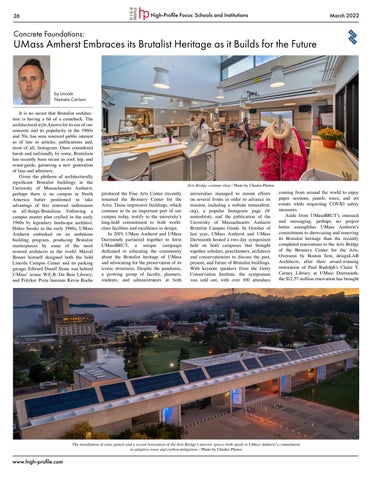
Arts Bridge costume shop / Photo by Chodos Photos
produced the Fine Arts Center (recently renamed the Bromery Center for the Arts). These impressive buildings, which continue to be an important part of our campus today, testify to the university’s long-held commitment to both worldclass facilities and excellence in design. In 2019, UMass Amherst and UMass Dartmouth partnered together to form UMassBRUT, a unique campaign dedicated to educating the community about the Brutalist heritage of UMass and advocating for the preservation of its iconic structures. Despite the pandemic, a growing group of faculty, planners, students, and administrators at both
universities managed to mount efforts on several fronts in order to advance its mission, including a website (umassbrut. org), a popular Instagram page (@ umassbrut), and the publication of the University of Massachusetts Amherst Brutalist Campus Guide. In October of last year, UMass Amherst and UMass Dartmouth hosted a two-day symposium held on both campuses that brought together scholars, practitioners, architects and conservationists to discuss the past, present, and future of Brutalist buildings. With keynote speakers from the Getty Conservation Institute, the symposium was sold out, with over 100 attendees
coming from around the world to enjoy paper sessions, panels, tours, and art events while respecting COVID safety measures. Aside from UMassBRUT’s outreach and messaging, perhaps no project better exemplifies UMass Amherst’s commitment to showcasing and renewing its Brutalist heritage than the recently completed renovations to the Arts Bridge of the Bromery Center for the Arts. Overseen by Boston firm, designLAB Architects, after their award-winning restoration of Paul Rudolph’s Claire T. Carney Library at UMass Dartmouth, the $12.57 million renovation has brought
The installation of solar panels and a recent renovation of the Arts Bridge’s interior spaces both speak to UMass Amherst’s commitment to adaptive reuse and carbon mitigation. / Photo by Chodos Photos
www.high-profile.com
March 2022
High-Profile Focus: Schools and Institutions
27
The entry lobby of the Arts Bridge uses bright pink color as a wayfinder, wood to soften the industrial feel of the space, and glass to give a view into the new theatrical rehearsal studio. Photo by Chodos Photos
new life and color into the 646-foot-long bridge space. The renovated Arts Bridge officially opened this fall with classroom and studio space that not only invokes the spirit of Roche’s original design, but also provides an exemplary model of how Brutalist architecture can still play an important role in providing fresh and invigorating spaces for students, faculty and staff. As the Arts Bridge renovation shows, this full-throttled embrace of our Brutalist built environment represents much more than nostalgia or an academic celebration of architectural history. These buildings play a vital role in the operation of the campus and will continue to do so into the near future. Given the embodied energy and materials in concrete buildings and landscapes, the investment in renovating rather than demolishing Brutalist structures speaks to the priority of carbon mitigation strategies at UMass Amherst. As Jean Carroon, principal at Goody Clancy in Boston, emphasized during her talk at the recent Brutalism & the Public University symposium, “adaptive reuse itself is climate action.” At a time when many campuses are eliminating 20th century structures, UMass Amherst has been investing heavily in retrofitting and renovating several midcentury campus facilities. Just last year, Shepley Bulfinch’s $64.2 million renovation of
the 1956 Student Union was completed and warmly received by the campus community; it is also on track to become the 19th LEED certified building on campus. As we embark on new ambitious building projects, such as the $100 million Sustainable Engineering Laboratories for the College of Engineering and a planned $125 million College of Information and Computer Science building, we hope to continue the campus’s post-war building program commitment to cutting-edge design. Although Brutalist architecture can be somewhat polarizing, we are excited that our buildings are once again being recognized for their bold designs and exceptional concrete construction. Through the efforts of UMassBRUT and the larger UMass Amherst community, we aspire to go beyond merely celebrating Brutalism. As we welcome the many attendees of the Society for College and University Planning 2022 North Atlantic Regional Conference this March, we hope to inspire other institutions to preserve, renovate, and celebrate their Brutalist buildings for future generations, whose appreciation of this architecture only continues to grow. Lincoln Nemetz-Carlson, Ph.D. is a graduate researcher, Office of Campus Planning, at University of Massachusetts Amherst.
Fine Arts Center Bridge | UMass Amherst
Claire T. Carney Library | UMass Dartmouth
Design that bridges past and present; preservatation and innovation; heritage and ingenuity. Our work focuses on the people served by each building above all else, creating spaces that transform and enhance the communities they serve.
designLAB architects
The view from the terrace of Marcel Breuer’s Brutalist Lincoln Campus Center (1970). In the distance, one can see the Student Union’s new glass ballroom.
a women-owned business www.designlabarch.com 617-350-3005 boston, ma
www.high-profile.com
28
High-Profile Focus: Schools and Institutions
March 2022
Suffolk Completes Boston College Project STEM Solutions Completes Lab Fit Out
Boston College’s integrated science facility / Photo courtesy of Caitlin Cunningham, Boston College
Boston – Suffolk announced it successfully delivered the 245 Beacon Street integrated science facility for Boston College. The $150 million building is the largest single investment in the sciences at Boston College. The new state-of-the-art science center will be home to the Schiller Institute for Integrated Science and Society and 150,000sf of classrooms, labs, faculty offices, and collaboration and maker spaces to teach and conduct research in computer science robotics, prototype research and nanotechnology research. “Suffolk is thrilled to have successfully delivered this incredible integrated science center to Boston College on schedule and
on budget,” said Jeffrey Gouveia, general manager of Suffolk Northeast. “We are proud to have played a role in managing construction of this state-of-the-art building for exploring the worlds of science, technology, entrepreneurship and innovation while developing solutions to address our greatest global challenges.” Suffolk managed construction of the building in the heart of an operational Boston College campus. As a result of early planning and close collaboration with Boston College and the trade partners, the project team was able to minimize risk and address challenges related to the heavy student traffic, campus location and accelerated schedule.
T6 benches installed at Harvard’s T.H. Chan School of Public Health
Boston – STEM Solutions LLC, based in Wakefield, Mass., recently completed a lab fit out for the Mina Lab inside the T.H. Chan School of Public Health at Harvard University. STEM installed sustainable bamboo wood fronted casework and custom T3 and T6 benches. STEM’s new modular T6 lab benches, custom made for Harvard, were designed to be an elegant solution to replace traditional fixed casework. With this design, services can be fed through the post as opposed to external to the bench. STEM Solutions LLC is a provider of commercial and educational lab fit outs in the U.S.
Sustainable bamboo wood fronted casework
Woods Hole Oceanographic Institution DSK Architects + Planners UConn Gant Science Complex Goody Clancy
© Anton Grassi
Civil
Site Utilities Structural
Mechanical Electrical
Plumbing
Fire Protection Technology
Building Envelope © Robert Benson Photography
Commissioning
www.salasobrien.com
www.high-profile.com
March 2022
High-Profile Focus: Schools and Institutions
ADVERTORIAL
29
Stand Out with Innovative STEM Labs With technology rapidly advancing, the skills companies need for their employees are evolving. In turn, educators are tasked with staying on top of the changes to attract top students to their schools and programs, and there are endless lab equipment choices for them to choose from for their labs. As an architect designing brand new labs, you can help by integrating technology that will be relevant to STEM programs for years to come. RobotLab and ZSpace are two tech solutions making a difference in cutting-edge STEM labs. AI Labs from RobotLAB teach students how to apply abstract AI concepts to real-life scenarios with turnkey, state-of-theart modular learning stations. ZSpace brings learning to life with immersive AR/VR solutions. Here’s more about what they offer: Forward-thinking Lab Technology RobotLAB AI Labs and ZSpace learning solutions teach students forwardthinking skills that will be increasingly relevant for jobs over the next decade. They learn about industry 4.0, advanced manufacturing, robotics, space exploration, smart cities, and more in a deeply engaging way. These
An AI lab by RobotLAB innovative topics contribute to the longevity of a new lab for a school. High-tech Design Configurations Schools want a lab that will stand out, and seeing RobotLAB AI Labs or ZSpace will stop people in their tracks. Their high-tech designs attract motivated
students who will make the school proud. The technology also comes in modular configurations to adapt to any lab layout and design. There are many options and factors to consider when selecting technology solutions for STEM labs, even among
the choices available from RobotLAB and ZSpace. It’s essential to ensure labs are outfitted with technology that will best fit the school’s curriculum goals, and AET Labs can partner with you in helping you make the optimal selections.
www.high-profile.com
High-Profile Focus: Schools and Institutions
30
March 2022
Architecture, Film, and the Chance Encounter:
The Power of Interdisciplinary Collaboration in Education
by James E. LaPosta, Jr. It’s not often that architects have the opportunity to work alongside a consistent client team over the course of decades. JCJ Architecture had the honor of doing just that, for the duration of a 20-year, three-phase project to expand the physical footprint for Wesleyan University’s School of Film Studies. Originally known as Wesleyan’s
Jeanine Basinger Center for Film Studies / Photos by Robert Benson Photography
Department of Film Studies and Cinema Archives, the program has been transformed over the last two decades to become the College for Film and the Moving Image. Under the guidance of the program’s founder, Jeanine Basinger, JCJ had the opportunity to engage in a deeply collaborative relationship with faculty and university leadership to create a unified facility worthy of Wesleyan Film’s status as a leader in its field. The power of interdisciplinary collaboration is reflected throughout this project, from the design process to the everyday student experience. Bridging Production and Study
The newly named Jeanine Basinger
Lobby
Center for Film Studies comprises two distinct programs, one for the historical, formal, and cultural study of film, and the other for the preservation of primary documents and artifacts. Our team worked with the client to ensure that the new center seamlessly unites these programs. Previously scattered across the campus in makeshift facilities, the project brought all components of the program together into a single facility. The building was designed to support the department’s unified approach to production and study, fostering students’ understanding of film theory, history, and the craft of filmmaking.
collaboration spaces throughout the entire center prioritize daylighting, in recognition of its importance to students and faculty who spend so many hours in the dark. Creative Encounters
The new center provides a recognizable home for the program and a gathering place for the larger Wesleyan community. The university recognized the importance of providing students with an environment for the kinds of serendipitous encounters that are so critical to the creative process. The new center’s public lobby acts as a cultural hub, inviting students from all areas of study to convene and find opportunities for spontaneous interaction and social cohesion. Creativity and Community
Construction Law Group
Unmatched Experience
Representing:
Owners, Developers, General Contractors, Construction Managers, Architects, Engineers, Sub-Contractors and Suppliers
Dealing With All Phases of the Construction Process Including: • Construction Consulting
• Contract Formation and Review
• Delay Claims, Extra Work Claims
Girard R. Visconti CO-CHAIR
• Change Orders, Mid Contract Disputes • Mediation, Arbitration, Litigation • Mechanic Liens
• Construction Documentation Including
• • • • •
Contracts, General Conditions and Requirements, etc. Bond Claims Surety Litigation Insolvency Issues Environmental and Siting Issues Real Estate Law
Mezzanine
The Kinship of Architecture and Film
David M. Campbell CO-CHAIR
Attorneys:
Joseph P. Carnevale IV Larissa B. DeLisi Christopher J. Fragomeni Douglas A. Giron Edward D. Pare Michael P. Robinson Jeremy B. Savage Jonathan N. Savage Dean J. Wagner
Early on in our work we began exploring the distinct kinship between architecture and film as art forms that similarly rely on the manipulation of light to reveal the depth of their craft. This relationship between light, film, and architecture ultimately became a guiding principle throughout all phases of the project. Learning and
Born from a true interdisciplinary collaboration, the Jeanine Basinger Center for Film Studies reaches beyond its defined programs and creates a learning space for students across all disciplines. Moreover, the building has become a front door to the local community, film industry luminaries, and a large contingent of Wesleyan alumni who regularly return to lecture and teach. It often serves as a venue for public events and film screenings. With phase 3 finally completed in August of 2020, the center will serve as a symbol of creativity, connection, and community for decades to come. James E. LaPosta, Jr., FAIA, LEED AP is principal and chief architectural officer at JCJ Architecture.
564 South Water Street, Providence, RI 02903 p. 401.238.8500 | f. 401.648.6748 SAVAGELAWPARTNERS.COM
Screening room
www.high-profile.com
March 2022
High-Profile Focus: Schools and Institutions
ADVERTORIAL
31
Bluezone Provides Critical Virus Protection when Masks are Removed
The Bluezone is engineered with an excess germicidal UV-C dose to ensure complete kill of viral aerosols. New York, Illinois, Massachusetts, and Rhode Island have joined New Jersey, Delaware, California, and Connecticut in announcing an end date for mask requirements and other Covid-19 restrictions. Given that coronavirus hasn’t gone away, what can be done to keep schools safe without masks? The answer is simple: Clean the air. Israel, which has gone through its own multiple waves of the virus and has a well vaccinated population, has mandated that schools have air cleaners. The Israel Ministry of Health certified air cleaning technologies that meet its criteria for safety. After extensive studies, Israel determined that air cleaning with germicidal UV-C
light provides the safety needed. Ionizers and other systems that introduce chemicals are not allowed, and HEPA filters alone are not sufficient to achieve MoH certification. Bluezone UV-C air cleaners are approved by the Israeli Ministry of Health and Ministry of Education to be highly effective and safe in mitigating Covid-19 transmission in Israeli schools. Bluezone air cleaners are the only U.S. product with approval from both ministries. Bluezone is currently participating in a pilot project where 200 units have been shipped to Israel for virus protection in school classrooms. Key criteria for selecting air
The PK-5220 can be unobtrusively installed into a 2×4 foot drop ceiling tile.
cleaners are efficacy, operational safety, air exchanges per hour, sound level, maintenance, and installation flexibility. For schools, Bluezone offers a new product specifically designed for classrooms that offers three air exchanges per hour and near-silent operation. A visible, illuminated Bluezone logo shines on the front of all air cleaners confirming the indoor air is being continuously and highly effectively cleaned. In schools, there are many indoor spaces that require highly effective air cleaning to maintain a low airborne viral load. Maintaining a low airborne viral load reduces the chances of transmission from person to person. Spaces with high occupancy and high aerosol generation are the highest risk. High risk spaces in schools are classrooms, cafeterias, music rooms and gymnasiums. Health experts agree that keeping schools open and removing masks are important for children’s development, but there is no need to ignore safety. Air cleaning provides a necessary layer of safety without compromising social or academic development.
The Bluezone PK-5220 is a plug and play virus mitigation device.
Protection When the Masks Come Off Germicidal UV-C Air Cleaning 3 3 3 3 3 3 3 3 3
High Efficacy High Capacity Whisper Quiet Wall, Ceiling, or Floor Install No Maintenance for 3 Years No Filters to Replace Self-Contained UV No Ozone No Chemicals
Kill the virus, don’t collect it
225 Wildwood Ave, Woburn, MA 01801 (781) 937-0202 | info@bluezonefresh.com BluezoneFresh.com All products made in the USA
www.high-profile.com
March 2022
32
Multi-Residential Marr Provides Access at The Robinson Revere, MA – The Marr Companies announced it is providing services for a new 200+ unit residential apartment complex named The Robinson, currently under construction on Ocean Avenue across from Revere Beach in Revere. This 12-story waterfront building marks the final project in Revere’s Waterfront Square, a development two decades in the making. Working for
Suspended scaffold work platforms were installed for work conducted in areas with a tight footprint.
www.high-profile.com
general contractor Plumb House, Marr Scaffolding Company and Marr Crane & Rigging are temporarily wrapping the building’s exterior facade with an elevator, mast climbing work platforms and suspended scaffold work platforms, all for use by multiple trades during construction. Both the mast climbing platforms and suspended scaffolds are being used to construct the facade consisting of metal panels and windows. Last December, Marr began the equipment installation on the waterfront side of the building with a single Champion elevator and the first of 12, F-200 mast climbing platforms. Using a tower crane, half of the mast climbing platforms were installed on a third-floor roof deck and courtyard area, where a pool and other amenities will eventually reside, while the remaining six units were installed at ground level at the rear of the building. Three of the 12 units are electric powered, producing zero emissions while enabling tradespeople to conveniently plug in and power their tools while working. The elevator will operate on site for nine months, and the mast climbing platforms for approximately six months.
Marr installed multiple mast climbing work platforms and a construction elevator on the waterfront side of The Robinson in Revere.
In February, Marr began the installation of 10 suspended scaffolds on the remaining sides of the building that closely abut other project buildings. The width of suspended scaffolds is narrower
than mast climbing platforms and allows for greater maneuverability required by tradespeople, particularly in tight spaces. They will be in use for approximately six months.
March 2022
33
Mixed-Use BPDA Approves Boston Life Sciences Hub Boston – The Boston Planning & Development Agency (BPDA) board of directors recently approved three new development projects in Boston. The project at 745 Atlantic Avenue will change the use of the existing building in Downtown Boston to allow for lab space, research and development,
and offices. The ground floor will also include food and beverage retail space. This change in use is estimated to bring more than 600 new permanent jobs to the area, in addition to approximately 300 construction jobs. The project also includes a life sciences workforce development program, enhanced accessibility and improved sidewalks, and a new Bluebike station. Renovations of this building will make it more energy efficient, and the project aims to reduce overall energy consumption.
38 Hichborn Street
804 East 7th Street
Located in Brighton, the 38 Hichborn Street project will build a new 5-story building with 24 residential
745 Atlantic Avenue
units, three of which will be incomerestricted. The first floor of the building will also include commercial space and a common area for residents. The project aims to be a zero net carbon building. This will be a transit-oriented project with close proximity to different MBTA lines. A former, now vacant, South Boston
nursing home at 804 East 7th Street will be renovated and converted to 21 new homes. All new units will be homeownership units, three of which will be incomerestricted. The project will partner with the City of Boston to improve the safety of the East Seventh and Columbia Road intersection, reconstruct sidewalks, and plant new street trees.
Structural Steel | Miscellaneous Metals | Fabrica�on | Erec�on www.slchassesteelfab.com Email: info@slchassesteelfab.com
Ph: 603-886-3436 Fax: 603-881-9953
AISC Cer�fied Fabricator & Erector
Proud Members of:
8 Chris�ne Drive, Hudson, NH 03051
www.high-profile.com
March 2022
34
Life Sciences Life Science Building Completed
MAKING TECHNOLOGY WORK FOR YOU
400 Wood Road (Exchange 93) / Photos courtesy of Elisif Photography
LEADING THE INDUSTRY IN ADVANCED BUILDING TECHNOLOGY SERVICES ACCESS CONTROL AUDIO VISUAL BUILDING AUTOMATION DESIGN/INSTALLATION FIBER OPTIC INTRUSION DETECTION SYSTEMS VIDEO SURVEILLANCE VOICE & DATA
Braintree, MA – Erland Construction announced it was selected by Hilco Redevelopment Partners to transform the former Haemonetics headquarters in Braintree. In collaboration with Balance Architects, Erland removed the building’s existing facade and roof down to its original structure and installed a new 2-story entry, complete building wrap, and a TPO roof. The new exterior envelope features a combination of insulated metal panels, terracotta rain screen with a 12-color gradation, granite cladding and wood composite eaves, and an expansive glass curtainwall system. Utility infrastructure for mechanical, fire protection, and electrical service also received enhancements. Originally built in 1975, the building has served multiple functions, including office, R&D, lab, manufacturing and distribution space, and it was the headquarters of Haemonetics for more than 40 years. Now the building has
transformed into a modern state-of-theart facility with 80,446sf of open lab space and 73,154sf of cGMP manufacturing space designed to meet the unique needs of today’s biomanufacturing companies. The building has been upgraded with power capabilities that can handle typical cGMP requirements; there are more than 30 watts per sq. ft. available at the property. Additionally, the parking area was completely overhauled with new bituminous asphalt paving, vertical granite curbing and landscaping. Construction took 11 months to complete. “We’re proud to be a part of transforming this building into a space that better serves the needs of its future tenants,” said Jay Sturdivant, advanced technology/life sciences group manager for Erland. “It’s been a great partnership from the start. The collective efforts of the entire project team immensely contributed to the success of creating an environment that will facilitate groundbreaking research and development.”
781.728.4100 SALES@KAYDONIT.COM 290 PINE STREET, CANTON, MA www.high-profile.com
The exterior envelope features a combination of insulated metal panels and terracotta rain screen with a 12-color gradation.
March 2022
35
Powering Greater Boston’s Minority and Women-Owned Business Enterprises The IBEW Local 103 and NECA Contractors Greater Boston Empower DEI Program offers current and aspiring Minority-owned Business Enterprise (MBE) and Women-owned Business Enterprise (WBE) electrical contractors in the union construction industry access to mentorship, professional support, training, and business growth opportunities.
Advancing Diversity, Equity, & Inclusion in the Construction Sector This program aims to significantly increase the number of MBE and WBE electrical signatory contractors across Greater Boston, while also working directly with existing WBE and MBE NECA Greater Boston contractors to ensure that they thrive. We aim to help advance diversity, equity, and inclusion within our sector for the benefit of all.
Participants will gain:
Sponsored by
• MENTORSHIP
• MARKETING SUPPORT
• TRAINING
• & MORE
NATIONAL ELECTRICAL CONTRACTORS ASSOCIATION
EmpowerDEI.com
GREATER BOSTON CHAPTER
www.high-profile.com
March 2022
36
Build Better Podcast Achieving Equitable Outcomes in the Long Term with Barry Reaves of the BPDA by Emily Langner On season 2, episode 12 of the Build Better podcast, Anastasia welcomed Barry Reaves, the Boston Planning & Development Agency’s (BPDA) first ever director of diversity, equity, and inclusion. The BPDA is the planning and economic development agency for the City of Boston. Its mission is to guide inclusive growth in the city, creating opportunities for everyone to live, work and connect. Reaves is responsible for the development and oversight of the BPDA’s racial equity and diversity priorities, and works to establish collaborative partnerships with internal and external stakeholders to foster a more inclusive, equitable, welcoming, supportive, and diverse agency. He says some of the factors that prevent minority- and women-owned companies from being able to secure a contract are not having access to capital or adequate technical and legal support, and not knowing about the opportunities available. He says one way to eliminate these barriers is to allow more time in the process to give smaller companies the time to put together a bid.
www.high-profile.com
Barry Reaves
The BPDA Office of Diversity, Equity, and Inclusion’s equitable procurement plan focuses on ways to demystify the process, ensure that the process to bid on goods and services that the agency is offering are not overly burdensome or cumbersome to small businesses, and demonstrate a commitment to reaching a more diverse pool of applicants. Reaves says the BPDA is not only promoting opportunities, but is doing
more aggressive outreach with advocacy groups to create relationships and better refine the process of creating a more level platform for small businesses. Reaves notes that the best ways to balance the risk/reward of a project while increasing diversity are to build more relationships, add more peer reviews, add different mechanisms to allow for emerging companies to get the necessary mentorship, and create outcomes that allow for sustainability and advancement to the next project. He says prioritizing a company’s growth and long-term success will mean for “a stronger, more profitable organization that is capable of doing bigger and better projects.” Reaves also says every project should have an equity framework, and should define specifically what success looks like. He says it is the industry’s responsibility as a whole to be accountable, and to
measure outcomes and course correct when a specific strategy is not working. He emphasizes the importance of long-term effort and commitment, and says success is dependent on all parties “going in the same direction.” Reaves concludes, “We all have to believe in the same thing, and we all have to want to see the same outcomes, and we all have to do our part and roll our sleeves up to actually put our money where our mouth is.”
Special thanks to this episode’s sponsor.
To listen to Build Better with Anastasia Barnes • •
visit: www.high-profile.com/build-better-podcast a vailable on itunes, SoundCloud, Stitcher, and Spotify
March 2022
37
Trends and Hot Topics
Design Build: Understanding the Internal Dynamic
by Jen Luoni Within traditional construction, architecture is positioned as the champion for idealistic design versus the pragmatic in-field execution of general contractors due to varying interests. This can leave the client feeling abandoned and solely responsible for overseeing the project through to final completion. However, design build creates a path for realistic synergy, something which, once experienced, leaves clients feeling incorporated into an overall process harmonizing successful design with expedient execution. Getting clients nascent to design build past this perception is a preeminent challenge. Conveying design build’s principles and attributes can be done as follows.
Design build creates a path for realistic synergy, something which, once experienced, leaves clients feeling incorporated into an overall process harmonizing successful design with expedient execution. Design Matters
The architectural function within design build is fully supported. A comprehensive execution of ideation, drafting and material selection is supported by a full department of registered architects, designers and drafters. Being located under one roof does not shortchange positions. In fact, this geographic closeness enables the ability to design with an understanding of cost and construction means and methods, which enhances the final product. Checks and Balances
Design build is a process of counterbalances, whereby the architect and pre-construction project planner act as a ballast against challenges which may prohibit project advancement. The architect focuses on layout and structural design, while the planner provides cost analysis and construction knowledge to tailor architectural efforts. As the project advances, project managers and field staff
(Before and after) The 54 Middlesex Turnpike transformational project exemplifies design build.
confirm feasibility of the design’s intent, eliminating potential issues and saving upfront design time. Doing Right, Not Wrong
Performance-based design doesn’t rely on a drawing specification; it relies on teamwork. All assigned to the project need to understand client goals and the interrelated dynamics between consultants, subcontractors and architects. The end result is greater pride, better productivity, less execution time and clear costs. All parties become one advocate, rather than the architect solely assuming this role. Today’s Relevance
In a society of increased technicality, Americans seek simplicity in everything from consumer products to services. Architectural design should be no different. Outside of design build, there exists an inherent conflict between architects and general contractors. In design build, that same variance in viewpoints exists, but it doesn’t slow progress; rather, it drives better solutions that maintain integrity from design and cost standpoints. Design build is the epitome of refining operations and streamlining costs. For a successful project, there cannot be one without the other. Jen Luoni is director of operations – architecture at Dacon Corporation.
(Before and after)
www.high-profile.com
March 2022
38
Cannabis MMJ BioPharma Completes Cannabis Research Lab Wakefield, MA – STEM Solutions, LLC, a nationwide provider of commercial and educational institution laboratory equipment and casework, announced it outfitted a federally authorized cannabis research lab for MMJ BioPharma. MMJ BioPharma Labs recently became one of the only federally authorized labs dedicated to cannabis extraction, research, and development with its approved DEA Analytical Lab Registration for schedule 1-4 drugs. MMJ BioPharma’s primary focus is on cannabis research and development. MMJ BioPharma Labs will be assisting MMJ International Holdings in the research and development of its proprietary gel cap medicine, for the eventual FDA approval of its medicines, MMJ 001 and MMJ 002, to treat multiple sclerosis and Huntington’s disease. Clinical trials will begin soon. Representatives of STEM Solutions say they were able to build the lab in record time amidst industry-wide supply shortages. “MMJ BioPharma Labs leveraged our in-stock program of laboratory casework and our partnerships with FunderMax and JHC Fabrication to expedite the phenolic tops to build
MMJ BioPharma’s cannabis research lab during construction
the lab in four weeks,” said Ed St. Peter, managing member at STEM. “Early in the process, STEM Solutions visited our facility and said if we do A, B, and C, we can get it up and running in your timeframe,” said Duane Boise, president of MMJ. “Now, through their commitment and hard work, we have an MMJ BioPharma Lab that is a true center
of excellence to advance the science of medical cannabis.” MMJ BioPharma Labs had to adhere to very strict DEA inspections and agreed upon guidelines for approval. With this DEA registration, MMJ BioPharma Labs can manufacture, transport, import, and export cannabis domestically and internationally to DEA registrants and
companies registered in their respective international jurisdictions. The MMJ BioPharma lab will foster and conduct scientific research, data analysis, education, and training on the health effects of cannabis. MMJ BioPharma Labs researchers and leaders could aid in policymaking and outreach as state programs emerge.
Sales • Design • Installation • Inspections • 24/7/365 Service
Monthly Membership Become a High-Profile monthly member today for only $99 a month!
www.hampshirefire.com
Main Office 8 North Wentworth Ave Londonderry, NH 03053 603.432.8221 603.434.3194 f
Service Department 55 Harvey Road Londonderry, NH 03053 603.432.8221 603.434.8128 f
Upper Valley Office 104 Etna Road Lebanon, NH 03766 603.448.5461 603.448.7334 f
Monadnock Office 277 Old Homestead Hwy Swanzey, NH 03446 603.358.6736 603.358.6832 f
High-Profile is specifically designed to assist professionals with business development, sales leads, and networking assistance for the facilities development industry throughout New England. High-Profile Members receive these benefits: •Preferred placement for your news, monthly, in our print and digital publications, and in our FastFacts Friday weekly newsletter •Your firm name hyperlinked to your company‘s website when it appears on High-Profile‘s newsfeed •Lowest rates offered for advertising
•Up to three individual mailed subscriptions of the monthly publication •A personal account executive assigned to your firm to assist with any content placement, ad reservations, or other PR matters •Your marketing team will receive e-previews, HP‘s monthly newsletter that keeps marketing professionals up-to-date on the next issue‘s theme and deadline
high-profile.com/hp-membership • 781-294-4530
www.high-profile.com
March 2022
39
J.E.D.I.
The J.E.D.I. section is designed to highlight the people, companies and organizations that are implementing principles to further justice, equity, diversity and inclusion in their workplaces and communities.
Scholarship Fosters Diversity in Design Cambridge, MA – HMFH Architects, in partnership with Boston Architectural College (BAC), announced the establishment of the HMFH Scholarship Fund, created to expand academic opportunities for students underrepresented in the architecture and design professions. This new scholarship aims to increase access to these professions for Black, Indigenous, and people of color; first-generation college students; students with disabilities; and other underrepresented populations. Creation of the scholarship continues a decades-long relationship between HMFH and BAC. “HMFH’s extraordinarily generous gift is a visible and inspiring message that will lead the way in furthering the BAC’s mission of diversifying the design professions and making design education accessible to all people,” said Dr. Mahesh Daas, BAC president. “This generous investment, which continues HMFH’s commitment to equity, diversity, and inclusion, will create sustainable and vital opportunities for underrepresented students.” The scholarship selection process will begin this spring, and the first recipients will be announced in the fall. The intent
of the scholarship is to advance diversity by providing critical financial support to encourage students not only to enroll in architecture studies, but also to achieve success in college and to graduate. Beyond their classroom experience, recipients will have opportunities to work
Boston Architectural College
on planning and design projects with HMFH team members. “With this HMFH scholarship, we are taking concrete steps to increase access to design education for minority students and thereby increase diversity within the architecture profession,” said Pip Lewis,
AIA, HMFH principal. HMFH president, Lori Cowles, herself a graduate of the BAC, notes, “This scholarship is a significant effort to bring greater equity and diversity to our profession, as we have been doing in our own practice.”
Interstate Celebrates Women in Construction
“ I feel like a lot of women don’t see the trades as a career choice, but if they had the opportunity to explore it they may fall in love with it. ” Sharon B. Join our diverse Team! Visit our website for career opportunities throughout all New England states.
855.500.IESC www.iesc1.com www.high-profile.com
March 2022
40
Corporate Timberline Completes PUMA’s North American HQ Somerville, MA – Timberline Construction Corporation announced the completion of the new PUMA North American headquarters located at Assembly Row in Somerville. This location was chosen to combine PUMA’s two offices, one in Westford and one in Downtown Boston, to accommodate approximately 450 of its employees.
This new 150,000sf facility features a collaborative, flexible work environment. The site includes state-of-the-art modern amenities designed to attract talent including on-site dining, a professionallevel fitness center, an on-location children’s room for visiting children, and Electrical Construction
◆
Fire Alarm
◆
PUMA’s new North America HQ / Photos by Greg M. Cooper, PUMA
access to a 19,000sf roof deck and 2,300sf roof balcony. The project was started in November 2020. Due to the pandemic, Timberline
Special Projects
◆
Tel-Data/Security Systems
RENDERING: PELLI CLARKE PELLI ARCHITECTS AND HYM GROUP
Building on 100 Years of Excellence in Electrical Construction
One Congress Bullfinch Crossing Boston, Massachusetts
Member of
Connecting Greater Boston to a Bright Future
GREATER BOSTON
20 Carematrix Drive, Suite 300, Dedham, MA 02026 Tel: 617.522.6800 info@jmbco.com www.jmbco.com
www.high-profile.com
was forced to adapt and modify the sequencing of the work, resulting from supply chain constraints, while incorporating onsite healthcare measures and social distancing limitations. The team completed the project in time for the originally targeted move-in date of September 2021. “The Timberline team was instrumental in completing our new headquarters during a challenging year,” said Bob Philion, president of PUMA North America. “Their ability to adapt and think outside the box to creatively problem solve played a critical role in the success of the project. We couldn’t be happier with our new home in Somerville.” The overall project partners included the owner’s project management team at Cushman & Wakefield, the architecture and design team at Gensler, engineering partners at NV5, property owner Federal Realty Investment Trust, and a team of subcontractors.
“Owners play a critical role in the success of every project. But during a global pandemic, timely decision-making makes or breaks a schedule. The PUMA team responded and drove to completion every critical facet of what our team needed to get the job done. We couldn’t be prouder to work with such a worldclass, responsive company and have this positive experience during such a challenging period,” said Steven Kelly, Timberline Construction’s CEO.
High-Profile: 42 Corporate
March 2022
DPS Group Opens Office in Kansas City Kansas City, KS – DPS Group announced the opening of a new project office in Kansas City and the addition of Mark Potts as a senior vice president of project operations for the office. The new office is located at 10851 Mastin Street, Suite 200 in Overland Park. “As part of our continued growth, we are excited to open our new office in Kansas City, offering specialized architectural, engineering, construction management, and commissioning, qualification, and validation (CQV) services. The provision of EPCMV services in the region further complements our existing operations,” said Werner Greyling, president of U.S. projects for DPS Group. Led by Potts, the Kansas City office features an expert team of multi-disciplinary professionals who will serve life sciences clients across the midwestern U.S. by delivering highly specialized design and project execution capability for large-scale biopharmaceutical, pharmaceutical, novel therapies, and animal health industries. Potts brings more than 30 years of professional experience in engineering, facility operations, construction, maintenance, and project management to his role at DPS Group. “The DPS team is built around people who value effective communication, share their expertise, and work on each client project with a
41
Organizations and Event PWC CT Welcomes New Board
Hartford, CT – The Professional Women in Construction Connecticut Chapter (PWC CT) recently welcomed its new board of directors for the 2021-2022 program year. Patricia Bilotto returns as chapter president. She is the manager of marketing and business development for van Zelm Matthew Gorton Sandra 30 Bachamp Engineers. She has nearly years of Vice President of Business Development Director of Engineering experience in marketing, communications, and business development in the AEC industry, and presently serves on the program, membership, and awards committees.
Jason O’Brien Director of Project Management
The 2021-2022 PWC CT board (l-r): Choity Kha Kyma Ganzer, and Jen Mark Potts Senior Vice President of Operations
Andrew WilkinsonLaurann Asklof, principal Gregoryof Slaybaugh Shipman Chief Technologist of CQV & Goodwin, LLP, will Director serve on the board
positive, ‘can do’ attitude,” said Potts. “I’m very excited to be taking on this new and very challenging role with DPS and look forward to working with the team to deliver on the group’s strategic
& Goodwin, LLP, will serve on the board as vice president. She has approximately plan in the Midwest.” 30 years of experience in the area of The management team for the Kansas construction law and litigation. She will City office includes Matthew Gorton, continue to participate in the chapter’s VP of business development; Sandra programs, mentorship, and scholarship Bachamp, director of engineering; Jason committees.
Carolyn Kurth, CPA, CFE, of CohnReznick, will return as treasurer. She serves on the scholarship committee. Dawn Meeker, director at Marcum, LLP, is returning for a second year as Tom CheekShe now serves as the chapter secretary. Director of Construction Management membership chair and will continue as a volunteer on the awards committee. O’Brien, director of project management; Kim Colapietro, partner of EDI Andy Wilkinson, chief technologist; Landscape, LLC, returns for her third year Gregory Slaybough, director of CQV; on the board. She serves as the awards and Tom Cheek, director of construction committee chair. management. Kyma Ganzer, project manager at
DECCO Announces new HQ, Expansion Nashua, NH – DECCO, Inc., a mechanical contractor supplying specialized construction, maintenance, and piping fabrication services throughout New England, has announced the relocation of its corporate headquarters to 1900 Southwood Drive in Nashua. DECCO’s new facility encompasses more than 20,000sf and houses corporate services including operations management, accounting, human resources, QA/QC, design, project engineering, and corporate administration. The new space features state-of-the-art meeting rooms, modern office spaces, collaborative workspaces, and a visitor’s center highlighting the company’s history and achievements. This relocation supported the expansion of DECCO’s existing Brookline location for its growing fabrication business, DECCOFab. The extensive renovation of the 40-year-old building also created added training space for its merit shop workforce in The Tim Barton Center for Craft Excellence Training Center. The 20,000sf fabrication facility encompasses dedicated space for utility and process piping systems and houses five overhead cranes in two separate high-bay areas. The Tim Barton Center for Craft Excellence Training Center features four dedicated training classrooms and a 2,000sf
..
Photo Credit: Credit: Pro Pro Con, Con, Inc. Inc. Marketing Marketing Dept Dept Photo
DECCO, Inc.’s new Nashua, N.H. headquarters
Alpha Flying Flying –– Pease Pease Air Air Force Force Base Base Alpha
Raymond J. J. Borque Borque Arena Arena at at Endicott Endicott College College –– Beverly, Beverly, MA MA Raymond
Put the BARNES Advantage to work on your next project! Fed Ex Distribution Center – Johnston, RI
Canton Ice House, House, Ice Arena Canton, MA Canton Ice Ice –– Canton, Boston Sports Institute –Arena Wellesley, MA MA
DECCO’s Tim Barton Center for Craft Excellence Training Center in Brookline, N.H.
practical training space for instruction in pipe welding and pipe assembly. Additionally, DECCO is expanding its footprint in Nashua on Tanguay Drive with 20,000sf dedicated to housing its multi-million-dollar tools and equipment inventory. This space will also support expanding services including Critical Equipment Handling Services and supply safe, secure, and tempered storage for critical equipment. DECCOServ, DECCO’s service group, will also use the space to support fabrication and shutdown support services.
Brewster Ambulance Ambulance –– Weymouth, Weymouth, MA MA Brewster
Fed Ex Ex Distribution Distribution Center Center –– Johnston, Johnston, RI RI Fed
Engineered Steel Building Systems •• Steel Fabricators – Structural and Misc Iron Metal Wall Panel Systems – Foam Insulated •• Metal Standing Seam and Architectural Roofing Professional Steel Erectors and Installers •• Complete Steel Packages Supplied and Installed Design-Build Professionals prepared to meet with your team
P.O. Box 890159 | Weymouth, MA 02189 | Phone: 781-337-5277 Sales@barnesbuildings.com | www.barnesbuildings.com
www.high-profile.com www.high-profile.com
www.high-profile.com
La he rec Ri me
Ro bo on
Co ye co
March 2022
42
Green ULI Receives $10M Gift to Support Sustainability Initiatives Washington – Real estate executive, Randall Lewis, has donated $10 million to the Urban Land Institute (ULI), the largest single donation in ULI’s 86-year history to date, to fund the organization’s efforts to make the built environment more sustainable. The gift is largely unrestricted, which allows ULI flexibility in funding sustainability programs to meet future needs in a rapidly changing environment.
the center is important to me,” explained Lewis. “Public health and climate action are very closely related, and many of the solutions will be linked as well. This gift is a way for me to make a personal impact upon one of the world’s most pressing problems and transform millions of lives, and I urge other real estate executives to consider supporting ULI’s far-reaching work.” “This gift will transform the center by providing near term resources to accelerate our work on climate adaptation
and mitigation while we continue our comprehensive work to build healthy communities,” said Ed Walter, ULI Global CEO. Lewis is a longtime ULI member as well as a governor of the ULI Foundation. He also supports the ULI/Randall Lewis Health Mentorship Program. His past gifts to ULI include a $1 million donation in support of the ULI Building Healthy Places Initiative, which focuses on shaping projects and places to improve the health of people and communities.
Randall Lewis
In honor of the historic contribution, ULI has renamed the former Center for Sustainability and Economic Performance the ULI Randall Lewis Center for Sustainability in Real Estate. The center, which focuses upon creating healthy, resilient, and high-performance communities around the world, houses ULI’s Building Healthy Places Initiative, the Urban Resilience program, and
the Greenprint Center for Building Performance. In supporting ULI’s sustainability center, Lewis, executive vice president and principal of the Lewis Management Corp., says he sees an opportunity to impact three crucial issues in a holistic way: building resilience against effects of climate change, creating healthier places for people to live and work, and reducing carbon emissions. “Synergy between the three parts of
“Synergy between the three parts of the center is important to me. Public health and climate action are very closely related, and many of the solutions will be linked as well. This gift is a way for me to make a personal impact upon one of the world’s most pressing problems and transform millions of lives, and I urge other real estate executives to consider supporting ULI’s far-reaching work.” – Randall Lewis
Let TOPAZ Transform Your Office and Improve Your Efficiency. We offer award winning products for printing, copying and scanning your small format office documents and wide format CAD and graphics.
ENGINEERING SUPPLY, INC 35 Pond Park Road, Hingham, MA 1.781.749.8687
www.high-profile.com
For over 41 Years, the Trusted Choice of Architects, Engineers and CAD Departments Throughout New England. 1.800.255.8012 • www.topazeng.com • sales@topazeng.com
March 2022
43
Technology and Innovation Construction Firm Becomes AIA Partner
Contract Awarded for MIT LL Facility
National – DIRTT Environmental Solutions Ltd., an interior construction company that uses proprietary software to design, manufacture and install fully customizable environments, has joined the American Institute of Architects (AIA) as a Cornerstone Partner. Commenting on the initiative, Luke Dawson, vice president, brand & strategic marketing, stated, “DIRTT and the AIA have a shared commitment to drive positive change through the power of design. The goal of this partnership is to grow awareness about how architects can harness the infinite design freedom provided by industrialized construction, creating experiences that stand the test of time and easily change with it.” As an AIA Cornerstone Partner, DIRTT will advocate for the integration and adoption of industrialized construction as part of design conversations to create workplaces focused on flexibility and adaptive functionality. Architecture, engineering, and construction software, like DIRTT’s ICE platform, enables stakeholders to connect to their designs from anywhere in the world, providing the
Boston – Gilbane, in a joint venture partnership with cleanroom constructor Exyte, has been awarded the firm fixed price construction of a new a $279 million Advanced Compound Semiconductor Laboratory/Microsystem Integration Facility (CSL-MIF) for the Massachusetts Institute of Technology Lincoln Laboratory (MIT LL), located at Hanscom Air Force Base (AFB) in Massachusetts. “Gilbane is extremely proud to play a part in moving this project forward and providing the Department of Defense with a new facility that will keep the Lincoln Laboratory at the forefront of advanced prototyping,” said Heidi DeBenedetti, executive vice president and Gilbane Federal division leader. “In order to deliver the best value to the government, Gilbane formed a JV with Exyte, the premier, leading-edge microelectronics facility construction firm. Together, we will build a modernized, state-of-the-art, laboratory allowing some of the best and brightest minds to tackle our nation’s most complex technological challenges. We look forward to working with our
opportunity to conceptualize a space before starting construction and make instant, accurate, and informed spatial modifications. “Technology continues to advance understanding within the design community of how people experience space and collaborate,” says Mark Greffen, DIRTT’s chief technology officer.
“Technology continues to advance understanding within the design community of how people experience space and collaborate,” says Mark Greffen, DIRTT’s chief technology officer. Representatives of DIRTT say the company has made significant investments in the architectural community including publishing the second issue of its Iconoclast magazine, focused on “Why Adaptable Design Matters” and featuring leading figures in research, industrial design, interior design and organizational strategy; and hosting and continuing to welcome national, regional, local firms and AIA chapters at its annual Connext event, corresponding with Chicago’s Neocon tradeshow in October.
federal partners, the U.S. Army Corps of Engineers and the team at Hanscom Air Force Base, to bring this very important project to fruition.” MIT LL is a federally funded research and development center chartered to apply advanced technology to problems of national security. The Advanced CSL-MIF consists of approximately 162,000sf of new laboratory and office space, including a cleanroom complex for use by the Advanced Technologies Division of MIT LL. The new CSL will consolidate MIT LL’s existing compound semiconductor materials growth, fabrication, and characterization facilities. The new MIF will consolidate and enhance MIT LL’s facilities for the fabrication and packaging of specialized advanced electronic prototypes. Representatives of Gilbane say these changes are necessary to effectively and efficiently ensure that MIT LL can continue to apply advanced technology to the realm of national security throughout the 21st century. Construction is slated for completion in 2025.
Commercial Construc on Electrical Services, Maintenance & Repair Fire Alarm Installa on & Fire Suppression Telcom & Data Networking Security Systems Generators & Emergency Power
Massachuse s Rhode Island New Hampshire
www.glynnelectric.com
800-371-0474
electric
Glynn Electric, a division of Interstate Electrical Services Corpora on
www.high-profile.com
March 2022
44
Trends and Hot Topics
Interdependent Design Can Be the Key to Project Success
by Cheri Ruane There are many terms that can describe the necessary collaboration in the design of a complicated project: interdisciplinary, multidisciplinary, and transdisciplinary. They all describe an approach that requires a diversity of expertise and a deep bench of knowledge. In the design and engineering (D&E) world, this typically includes landscape architects, a bevy of engineers and scientists, and a handful of supporting actors. The more complex the project, the more players on the stage. But how should you operate in a way that ensures collaboration, concurrent iterations that inform each other, and the most successful possible outcome? Often, with subject matter expertise comes a confidence that runs the risk of sideswiping, sidestepping, undermining, waylaying, and/or superseding the process of the collective. A well-functioning interdependent team understands that they are truly dependent on everyone else’s expertise
The interdependent design process for the Moakley Park redesign includes landscape architects, hydrogeologists, resiliency engineers, soil scientists, economic development specialists, operation and maintenance experts, and public engagement gurus. / Image courtesy of Stoss Landscape Urbanism
to create the best possible outcome to the problem. One firm or many, it doesn’t matter. It is critical however that the team have rapport and alignment of purpose in order to execute. This happens with intention, time, and experience, as with any relationship. One could liken it to dance partners who know when to step back, take the lead, or prepare for the lift from subtle cues.
Cresa Publishes Market Insight Reports Boston – Boston commercial real estate firm, Cresa, has released its annual Market Insight Reports. The reports synthesize client data and recent marketing activity into actionable strategies for Greater Boston tenants in 2022. For each market and geographic region, Cresa’s advisors summarize notable shifts since the start of the pandemic and forecast 2022 real estate activity as it relates to occupier planning and decision making. Some of the highlights include:
• Life sciences expansion continues to dominate the Greater Boston market, with several new lab-enabled developments scheduled for completion in the next two years. With Cambridge prices soaring and work styles evolving, tenants are more willing to consider the suburban space. • As landlords and developers race to keep up with tenant demand, occupiers who need space solutions in the near term have limited options. • Occupiers are eyeing spaces that can evolve with their business functions, support a variety of uses, and accommo-
www.high-profile.com
date future growth. As a result, flexible infrastructure is increasingly desirable. • With many organizations navigating their return to the workplace, downtown office tenants have focused on highquality, amenity-rich buildings. Each of the reports provides additional findings and context around these trends, as well as suggestions for tenants looking to restructure their short and long-term real estate strategies. Having closely monitored the market and its pandemicrelated shifts, Cresa offers data-driven insights and predictions for the future of real estate and the workplace in Greater Boston.
It starts with the formation of the team. True collaboration and agile design take a specific attitude and understanding along with an ability to yield way to any team member who may have an idea with merit. When identifying potential team members, it is important to understand what motivates them. Problem solvers are more likely to work than people that thrive on being right. Firms that invest in the softer side of D&E will know who’s who. Motivational assessment tools like Enneagram, Strength Deployment Inventory, or 360’s will not only help individuals understand themselves (which has far-reaching benefits itself) but will also allow the larger organization to know which members are most likely to work well together. The bottom line is that people on an interdependent team must be willing and able to check their egos at the door and be open to solutions that come from anyone around the table. A clear example of this type of teamwork can be seen in the redesign of Moakley Park in South Boston. Moakley Park started as a design competition and evolved into an RFP through the Boston Parks & Recreation Department, both of which were won by Stoss Landscape Urbanism (Stoss). The plan is an aspirational vision that goes beyond the redesign of a city park and extends to broader issues of social equity, environmental justice, and climate resilience. A former tideland turned park, the subsurface conditions are complex to say the least and riddled with significant aging infrastructure. For this project to be successful, it required the brain power of a large and diverse team. Led by the landscape architects at Stoss and Weston & Sampson, the collaborative
design unit includes landscape architects; hydrogeologists; geotechnical, structural, civil, traffic, and mechanical engineers; soil scientists; economic development specialists; operation and maintenance experts; and public engagement gurus. As the first phase of the project goes through design development and construction documentation, Weston & Sampson’s design studio will be leading the charge. We will be guiding the project leadership through an integrated and truly interdependent design process that seeks to provide a tightly coordinated solution to a wildly complicated and challenging site. As the project’s vision plan begins to be implemented, the results of interdependent thinking have already made themselves evident. Elements of flood protection, operations and maintenance facilities, and active recreation features have been located with precision and consideration that touches every single park element. Ecological systems are being consciously combined with stormwater management and earthwork strategies. The total park is truly greater than the sum of its multitude of parts, which leads to a compelling landscape that protects, enhances, and improves the quality of life for park users and nearby residents. We invite you to follow the website dedicated to Moakley Park at https:// www.boston.gov/parks/moakley-park to stay up to date on the design process as it progresses towards construction and completion and to see how a collaborative, interdependent design process can result in a multi-benefit solution that is both beautiful and effective. Cheri Ruane, FASLA is vice president of Weston & Sampson.
March 2022
45
Product B
TM
Breakthrough Technology Lowers Embodied Carbon in Concrete Masonry Units and Veneers CarbonX technology lowers carbon in CMU by up to 50%
Breakthrough Technology
Lowers Embodied Carbon in Concrete Masonry Units and Veneers
CarbonX™ Technology
Answering a Market Answering a Market NeedNeed
Implemented during the manufacturing process, CarbonX technology reduces embodied carbon in two ways:
In response to the overwhelming desire of In response to the overwhelming desire of designers to lower greenhouse gas emissions designers to lower greenhouse gas emission in the built environment, the Concrete Products Group, a group of market leaders in the in the built environment, theconcrete Concrete Produ products industry, has developed a technology Group, a CMU group of market – the CarbonX technology – to leaders lower the in the concr embodied carbon of concrete masonry units a technolog products industry, has developed (CMU) and select veneers.
CO2
– the CarbonX CMU technology — to lower th
embodied carbon of various concrete mason
Why Concrete Masonry Units? units (CMU) and select veneers.
Concrete Masonry Units are one of the most versati le products the construction industry. During the in manufacturing process, use of th They can provide the structure of a building, or CMU technology can CarbonX be the veneer system with options lowers such as the embod splitcarbon and ground polished andto weathered in face, a CMU by up 50%, compared wi (textured) polished and sculptured units.
Jandris turns 100! Lowered
Consumption
Technology increases the reactivity of the cement paste and other raw materials so that less cement can be used.
Increased
Sequestration
Heightened reactivity increases the rate of ambient carbon sequestration during and following the manufacturing process.
industry average mix design. With verified E
showing the lowered GWP, designers will h
Advantages new options to meet their targets, such as
Design flexibility Architecture 2030 Challenge. Lower initial and lifetime costs Lower maintenance requirements Safer structure: fire resistance, blast and bullet resistance That’s right, we’ve made it 100 years with 4resiliency: generations. Still local, still • High protects from high wind events and tornadoes, floods and hurricanes For more The CarbonX family technology is owned and operated, and still going strong! We’ve begun our • Long lasting and durable brought to you by the Concrete information contact: Energy efficiency: duecarbon to their heat Products Group (CPG), a100 group years by focusing on lowering • next our embodied bycapacity, cement mass walls off er thermal storage and aid with of regional market leaders in the Heidi Jandris Advantages concrete product industry. CPG is the passive a structure in our reduction and increased carbon sequestration. All survivability of this isof reflected Technical Services organized to provide consistent, • Sound insulating properties: STC ratings 40-63 ◆ Design flexibility top-quality products to regional heidi@jandris.com • Plus: environmental impact benefits with the product specific EPDs. and national customers. Overview ◆ Lower and lifetime costs (978) 632-0089 introducti on initial of CarbonX technology. • • • •
Why Concrete Masonry Units?
Concrete Masonry Units are one of the most versatile
◆
products in the construction industry. They can provide
◆
Lower maintenance requirements
Safer structure: fire resistance, blast and bullet resistance .com | www.jandrisblock 01440 MA MA Gardner, 632-0089 | | 202 (978) 978.632.0089 202High HIGHStreet, STREET, GARDNER, 01440 | WWW.JANDRISBLOCK.COM the structure of a building as single wythe walls or by ◆ High resiliency: protectswww.high-profile.com from high wind events providing a strong back up wall for many types of veneers. and tornadoes, floods and hurricanes Jandris-100 Years.indd 1 3/26/20 4:08 PM
Concrete masonry walls can even be the veneer system
◆
Long lasting and durable
March 2022
46
Trends and Hot Topics
The Difference Between Writing for PR and Marketing
by Susan Shelby Marketing and business development are about positioning your firm to win work through the pursuit of specific market sectors and clients, whereas public relations (PR) is about establishing your firm’s image, and then spreading the word to increase visibility. There’s a clear distinction in the style of writing that is appropriate to each. For marketing vehicles such as websites, proposals, project sheets, brochures, direct mail, social media, and paid advertising, the content is selfpromotional and typically written in the first person. Think pronouns like I, me, my, mine, myself, we, us, our, and ourselves. Plus, your firm has 100% control over the look, tone, messaging, and placement of marketing-related content. PR output, on the other hand, is
written in the third person, using the pronouns he, him, his, himself, she, her, hers, herself, it, its, itself, they, them, their, theirs, and themselves. Press releases, which may be distributed broadly or to niche publications, focus on facts: the “who, what, when, where, how, and why” of a newsworthy event or story. For a byline article, which identifies the author, the goal is to present a firm or author as an expert on a specific topic and to share useful information, tips, and tools with a publication’s readership.
Unlike marketing materials, PR output is hyperbole-free; it’s all fact, no fluff. Busy editors are not interested in receiving, let alone publishing, content that is wordy, unclear, incomplete,
PR Content Best Practices
Unlike marketing materials, PR output is hyperbole-free; it’s all fact, no fluff. Busy editors are not interested in receiving, let alone publishing, content that is wordy, unclear, incomplete, or self-promotional. But if an article tells a story that cites challenges, solutions, results, and client benefits, your firm’s expertise is inferred and its publication by a respected industry source confers a priceless – and free – third-party validation that lends instant credibility. In its published form, a byline article can also serve as a valuable piece of marketing collateral with the benefit of the publication’s masthead at the top.
or self-promotional. The following best practices are integral to creating a press release or byline article with a higher success rate of grabbing and holding an editor’s attention: • Is it newsworthy? Would you find it interesting and want to read about it? If the answer is no, then stop right there and wait until you have genuinely important news or a compelling, relevant story to share with receptive media outlets and their readers.
• Organization matters. Every good story has a beginning, a middle, an end, and more importantly, a point. • Be clear and concise. Avoid jargon. • Incorporate quotes, but don’t quote yourself if you are the author. • If you are writing about a project, obtain client permission to do so and be prepared to have them review the draft before finalizing and distributing to media outlets. • Remember that no one is an adept enough writer to judge their own work: even Stephen King has an editor. Plan to share your draft with someone with the expertise to catch and correct grammatical and punctuation errors, and who will provide candid feedback on structure and content. While PR is almost never a direct line to new business, it is integral to building a long-term presence in the industry and establishing and maintaining top-of-mind awareness among current and potential future clients. Susan Shelby, FSMPS, CPSM, is the president and CEO of Rhino Public Relations.
Discover High-Profile Networking
Subscribe Today!
March 202 1
1
July 2021
July 2021
includes:
Focus:
•
all 12 monthly issues featuring the local news and hot topics you need and enjoy the most
•
weekly Fastfacts Friday
•
FREE with your High-Profile ad campaign
W O in CONSTMEN RUCTION Women in
Life Sciences and Awards
Construction
Deb Cronin, me mber of Carpenters Lo cal 328, on site at the Tobin Bridge, working on the Chelsea Aqueduct pro ject in Chelsea, Mass . ased ng a major, multi-ph Science Complex is undergoi 23 useful life, the Gant page Operating beyond its programs. / Full story enrollment in STEM UConn’s rise in student
renovation to meet
ARTICLES: INDUSTRY EXPERT
23
Alan Vanags
25
Kevin Chronley
26
Kate Davis
DS FROM... FEATURING AWAR
: INSIDE THIS ISSUE
é Together’s Herby Duvern A Conversation with RISE pment ction on Mixed-use Develo Nauset Begins Constru ing Communications Awards SMPS CT Holds Market New Developments BPDA Board Approves Center on Science/Engineering Brennan Continues Work s B&M Caboose EnviroVantage Restore First DEI Scholarship Groom Construction Awards Paul & Niki Tsongas Award s Society Complex Receive The New Bedford Port
page 28
page 30
page 34
M ar ch 2 02 Annual Supp 1 lem
photo by Ga ry , MA 02359 P.O. Box 7, Pembroke d Change Service Requeste
19
Eddie Skellington
Barbosa
www.high-profile.com
ent
visit www.high-profile.com/subscribe/ www.high-profile.com
page 35
page 38
www.high-pr ofile.com
1
March 2022
47
SPRINKLER FITTERS LOCAL 550 Installing, Inspecting and Maintaining Fire Protection Systems Since 1916
sprinklerfitters550.org • 617-323-0474
Our sprinkler fitters learn their craft at our unrivaled Education Center, making them among the best trained in our industry. Our fitters and apprentices stand ready to tackle any sprinkler job that you put in front of them. Your project, big or small, will be done by our well-trained professionals, on-time and on-budget - safely, reliably and proudly.
Service work? No problem, our fitters hone their skills at our Training Center, not on YOUR JOBSITE! SPRINKLER FITTERS LOCAL 550 46 ROCKLAND STREET BOSTON, MA 02132 617-323-0474 PHONE 617-323-1373 FAX www.sprinklerfitters550.org
• FIRE SAFETY LAWS • COMMERCIAL / RESIDENTIAL • DESIGN / INSTALLATION / INSPECTION / REPAIR • FM200 / INERGEN • LICENSED & INSURED CONTRACTORS • 24 HOUR EMERGENCY SERVICE www.high-profile.com
NE_Inside Front Cover_Sprinkler Fitters & Local Union 500.indd 1
3/25/19 11:57 AM
March 2022
48
2022 EDITORIAL CALENDAR ISSUE
DEADLINE
FOCUS
April
March 25 Multi-Residential; Assisted Living
April SP
March 21
May
April 22 Landscaping & Civil Engineering; Innovation & Technology
June
May 23
Healthcare Facilities
July
June 24
Awards; Life Sciences
August
July 25
Retail; Hospitality
September
August 25
Schools & Institutions
September SP
August 19
HP25 — High-Profile’s 25th Anniversary Edition
October
September 23
Corporate; Interiors
October SP
September 23
J.E.D.I. — Justice, Equity, Diversity, and Inclusion Supplement
November
October 24
Life Sciences
November SP
October 24
Sustainable Design-Build: Annual Green Supplement
December
November 18
Award Winners; 2022 Year in Review
MEP: Mechanical, Engineering, Plumbing Supplement
PLUS EXTRA CIRCULATION AT THESE SPECIAL EVENTS: Extra circulation is provided through kiosks and/or at the High-Profile booth during industry trade shows including the following:
2022 SCUP NA Regional Conference
Women Who Build
March 16-18 www.scup.org
April 13&14 www.thewomenwhobuild.org
Northeast Buildings & Facilities Management Show & Conference
June 15&16 www.nebfm.com
22 ABX 2022
Dates TBD www.abxexpo.com
CONTACT US:
Send news or queries to editor@high-profile.com or call 781-294-4530.
www.high-profile.com
March 2022
49
Training and Recruitment AGC MA Releases Case Study on BAE Program Wellesley, MA – Associated General Contractors of Massachusetts (AGC MA) has released a new case study sharing the quantitative and qualitative data of the Building Advancement Externship (BAE) pilot program completed in August 2021. The program was developed by the AGC MA Workforce Development Task Force and will resume in summer of 2022. The purpose of the program is to enrich both Career Technical Education (CTE) teachers and core academic teachers in the understanding of the various career paths in commercial construction and relate core competencies in the industry to skills illustrated by their students. Through this program, AGC MA is leveraging the opportunity in developing lasting relationships with participating externs, which in turn will build awareness to the variety of commercial construction career paths available to their students. Through continued engagement AGC MA members will inform educators, parents, and students to the opportunities available for everyone through panel programs, site tours, career fairs, and job shadowing opportunities. The case study shares the numbers of active engagement
Participants of the BAE program receive firsthand experience on every aspect of the industry. / Photo courtesy of AGC MA
between schools and AGC member firms, the alliances built and student impact, and educator recommendations and AGC MA workforce development next steps. In tandem with this effort, AGC MA has redesigned the ConstructingMA.org website, a central resource on careers in
commercial construction for educators, parents and students and the Future Builders: Insight & News newsletter offering real-world insight to educators about how their students can break into the industry and provide resources on the many ways students can engage with
AGC MA member firms on realizing the opportunities of future employment. AGC MA is working to build a workforce pipeline to expand access and create a more diverse, equitable, and inclusive industry. BAE application submissions will reopen in May of 2022.
Detect moisture hidden in your roof before it causes structural damage! Roof leaks can trap moisture inside your roofing system, decreasing the insulation’s R-value and causing structural damage if left undetected. Tecta America’s certified thermographers find wet areas based on their thermal signature. Once completed, we’ll submit a report with thermal images and repair recommendations.
Call Tecta’s roofing experts today to schedule a thermal scan!
N. Billerica, MA Brockton, MA Portland, ME E. Hartford, CT 800-398-1380 866-583-9499 207-878-1732 860-828-0380 Tecta America WeatherGuard, Schenectady, NY 800-287-0442 Commercial/Industrial Roofing • Tecta America NE was formerly Delta Roofing • tectaamerica.com
www.high-profile.com
March 2022
50
Philanthropy IBEW Local 103, NECA Contractors Support Vocational Students
Madison Park students and staff, and representatives from IBEW Local 103 and NECA Greater Boston, stand with Madison Park’s new van and equipment.
Boston – The International Brotherhood of Electrical Workers (IBEW) Local 103 announced it donated a brand new van to the electrical department of Madison Park Technical Vocational High School in Roxbury. The van, complete with a Madison Park branded decorative wrap, was filled with new electrical equipment, tools, and supplies valued at $10,000 and was donated by NECA Greater Boston electrical contractors. The donations were given to Madison Park to support students preparing for careers in the trades.
At an event on Feb. 9, Madison Park students and staff greeted IBEW Local 103 and NECA representatives outside of the school to help usher in the donations. IBEW Local 103 purchased the van for Madison Park and decorated it in the school’s colors, with “Madison Park Electrical Dept.” printed along the side. Supply donations contributed by NECA included power tools, hard hats, PPE and branded merchandise. IBEW Local 103 and NECA, which connect many Madison Park graduates to careers in the construction industry through their own jointly-run electrical
apprenticeship programs, made the donation as part of their ongoing efforts to support public education, vocational education, and the future of the electrical construction industry. Local 103/NECA electrical contractor, McDonald Electric, which employs several Madison Park graduates, helped to coordinate the initiative which concluded with a formal transfer of the van title from Local 103 to the Madison Park school.
Promoting the Mechanical Contracting Industry for over
130 Years
Mechanical Contractors Association
New England MCA
www.high-profile.com
We offer membership within the Mechanical Contractors Association, Mechanical Service Contractors Association, and the National Certified Pipe Welding Bureau. We support our member contractors through our educational seminars, labor and government relations, industry news and marketing. Committed to the future of our industry, we sponsor MCA student chapter at Wentworth Institute of Technology in Boston. Our affiliation with the Mechanical Contractors Association of America and our strong, cooperative relationship with the United Association enable us to offer our members numerous opportunities to build lasting, beneficial relationships with peers while acquiring the business knowledge and tools to keep their company successful. 617.405.4221 www.nemca.org @NewEnglandMCA
Boston electrical contractors. “We hope this equipment serves the students well and that we’ll see many of them again soon coming through the doors for our apprenticeship program!” “As Boston’s premiere institution dedicated to technical and vocational education, Madison Park is absolutely critical to the fabric of public education in our city,” said IBEW Local 103 business manager/financial secretary, Lou Antonellis. “Local 103 and NECA are proud of our longstanding partnership with Madison Park, and we want to do anything we can to support its mission and to help further prepare the future of our industry. We’re very happy to donate this electrical equipment that students will be able to use for years to come.”
Lou Antonellis and Madison Park electrical instructor, Michael Norris, pose with the keys to the school’s new van.
“Giving back to the cities and towns we work in is a pillar of both the NECA and Local 103 organizations and truly all our partnerships,” said Kristen Gowin, executive manager of NECA Greater
New electrical equipment, tools, and supplies donated by NECA Greater Boston electrical contractors
Lou Antonellis; Renee Dozier, IBEW Local 103 business agent; and Kristen Gowin; stand with Madison Park electrical program students.
March 2022
51
To know where you are going, you need to know where to be. SIOR NORTHEAST REGIONAL CONFERENCE MARCH 24-25
www.high-profile.com
March 2022
52
People
SLAM Welcomes Three
North Branch Construction Welcomes Two Concord, NH – North Branch Construction announced the addition of Shrika Chikurty and Mark Condon to the company. Joining North Branch in the role of project engineer, Chikurty recently worked as an assistant project manager for a commercial construction company in California. She completed a Master of Construction Management degree at the University of Texas Arlington and also holds a Bachelor of Architecture degree from Jawaharlal Nehru Architecture and Fine Arts University in Hyderabad, India. Condon comes to North Branch Construction with over 16 years of experience in commercial construction, starting out as a laborer. Condon also held the posi-
Chikurty
Condon
tions of field engineer, project engineer, construction coordinator, assistant superintendent and project superintendent. He holds particular experience working in active health care environments performing clean work construction, as well as upgrades to educational facilities and numerous infrastructure projects.
Bleicken Joins The Wilkinson Companies industry. He holds his Master Rockland, MA – The Wilkinson Plumber License, Journey Companies announced that Doug Plumber License, Journeyman Bleicken has joined the firm as Pipefitter License, Medical Gas the new construction division Certification, and a Managemanager. ment Certificate from Curry His focus at Wilkinson is to College. manage and develop the Con“Doug has a vast amount of struction Division, from growing experience and I’m truly excitthe commercial plumbing staff to Bleicken ed about what he will bring to overseeing plumbing operations, this new chapter with our new Construcestimating and project management. tion Division,” said Geoff Wilkinson, Jr., Bleicken has extensive experience in president, The Wilkinson Companies. the commercial plumbing and heating
Spaulding Retires from Dellbrook|JKS Dellbrook|JKS where he took on Quincy, MA – Dellbrook|JKS recently announced that William a multitude of responsibilities “Billy” Spaulding has retired including employee onboarding, after over 40 years of service. apparel coordination, technology Spaulding’s relationship with support and his final position as the construction management office coordinator. firm’s founders began in DorchesMike Fish, who describes ter where he was childhood Spaulding as “as loyal as they friends with CEO Mike Fish’s Spaulding come,” says he will be missed father, Ed Fish. Years later, he beby the Dellbrook|JKS family who “with came a driver for Ed and assisted with the gratitude, congratulates him on this family’s businesses in a variety of ways. exciting new beginning.” Spaulding eventually joined
Remondi Joins Colantonio
public K-12 school projects in Holliston, MA – Colantonio Massachusetts. Inc. announced its recent hire “It’s great to have Mike on of Michael Remondi, RA as an board. His perspective as an assistant project manager. architect will help enhance A registered architect the services we provide as a with 14 years of architectural construction manager,” said experience, Remondi has worked President George Willwerth. as a draftsman, project architect, Remondi earned both a construction administrator, Remondi bachelor’s and a master’s degree and job captain/architectural designer in architecture from Wentworth Institute of Technology. in architectural firms, focusing on
www.high-profile.com
Glastonbury, CT – The Landscape Architecture and Planning practice of The S/L/A/M Collaborative (SLAM) welcomes the addition of Cynthia “Cyndy” Reynolds, ASLA, Reynolds landscape architect; Keith Whipple, PLA, landscape practice leader – Orlando; and Henry Withers, ASLA, senior landscape architect; to the firm, supporting national initiatives for the education, healthcare, corporate, sports and justice practices. Reynolds and Withers are based in Glastonbury and Whipple joins the Orlando, Fla. office. Reynolds is responsible for development design and documentation of projects, including support of business development initiatives focused on the independent education market. She brings more than 10 years of experience supporting multidisciplinary teams in corporate, municipal, and residential landscape architecture, where she applied her management, design, and technical skills to projects. With more than 25 years of experience as a licensed landscape architect, Whipple will leverage his creativity and technical
Whipple
Withers
skill to provide a full scope of services from planning, design and illustration to the implementation and delivery of complex and detailed developments. His focus is to integrate landscape architecture and civil engineering into a holistically managed site planning and design studio, bringing seamless integration of both the art and science of designing sites and outdoor spaces to clients. Withers’ focus at SLAM is on site planning, landscape architectural design services, managing the regulatory requirements and permitting, LID/ LEED compliance, and bidding and construction administration for corporate, educational, and municipal clients. He is currently managing services for the firm’s educational clients, Baylor College of Medicine, Torrington Middle/High School, and the University of Connecticut – Hartford Campus.
TFMoran Personnel Announcements Bedford, NH – TFMoran, Inc. announced that Julia Chartier has been named as the firm’s marketing coordinator. Chartier joined the company as an administrative and Chartier marketing assistant in 2020. Previously, she gained experience as a marketing intern at TFMoran in the summer of 2019, assisting with the creation of marketing materials, website and social media posts, and corporate event planning. TFMoran also announced that Landscape Designer Sophie Haddock has been named as treasurer of the New Hampshire chapter of the American Society of Landscape Architects (ASLA), the professional association for landscape architects in the U.S. Granite State Landscape Architects (GSLA) is
Haddock
Burns
dedicated to the advancement of landscape architecture in New Hampshire. Additionally, TFMoran senior project manager, Thomas Burns, PE, has joined the Greater Derry Londonderry Chamber of Commerce board of directors for 2022. He joins a diverse group of professionals from the eight communities that the chamber represents and says he looks forward to lending his support and sharing new ideas to help continue the growth and development of the more than 400 businesses that it supports. Burns officially took his seat in January.
Send your personnel announcements to editor@high-profile.com.
High-Profile: People
March 2022
Margulies Perruzzi Staff Promotions
Costello
Greenwood
Boston – Margulies Perruzzi (MP) announced the promotion of Jason Costello, AIA, LEED AP to principal; Caitlin Greenwood, AIA, IIDA and Jenna Meyers, IIDA, NCIDQ, LEED AP to senior associate; and Brittany Page to associate. Since joining Margulies Perruzzi in 2015, Costello has held a leadership role in the firm’s healthcare studio which has tripled its client base and revenue during that time. He has managed the design and construction of large multi-phase healthcare projects totaling over 2 million sq. ft., including projects for clients such as Southern Maine Health Care and Lahey Hospital & Medical Center. As an architect and project manager, Greenwood brings extensive design experience to the MP team through all phases of design and construction. She is a member of the Workplace, Real Estate, and Science studios, spanning both architecture and interiors with a
Meyers
Page
specialty in corporate re-stack. Several of her projects have focused on creating a rebranded space to attract young talent in the suburban market. As a senior interior designer, Meyers brings 15 years of extensive design experience to the MP team, contributing her strengths in design development, programming, project management, and coordination. As a Workplace studio leader, she specializes in working closely with clients to create custom-designed spaces, reflecting their unique brand, mission, and culture. Page is a designer with a humancentric design approach, focusing on creating not only functional spaces but elevated experiences. As a senior interior designer, she has spent over 10 years taking projects from concept through completion, with an ability to understand concerns and anticipate need, and provide customized, client-focused solutions.
Dietz Elected BBRS Chair Springfield, MA – Dietz & climate change imperatives, Company Architects announced on-premises electric battery that managing principal and storage systems, and the use of founder, Kerry L. Dietz, AIA has solar and wind power, just to been elected by the members of name a few, have had trementhe Board of Building Regulations dous impacts on our industry. and Standards (BBRS) to serve as My goal for the BBRS is to get its 2022 chairperson. the 10th Edition implemented by “Massachusetts is in the the end of the year, so that we Dietz process of developing and imare more in tune with the normal three plementing a new building code, the 10th year code cycle that we should be on,” Edition. A lot has changed in the world of said Dietz. design and construction; the use of cross Dietz was appointed to the BBRS laminated timber for high rise construction, the growth of the use of electric cars, board by Governor Baker in 2017.
Gilbane, Inc. Appoints Murray as CFO Providence, RI – Thomas F. investment and management, Gilbane, Jr., chairman and according to representatives CEO of Gilbane, Inc., recently of the firm. He has worked named Robert J. Murray as chief in financial and accounting financial officer of Gilbane, Inc. executive positions throughout To help ensure a seamless his career and led financial transition, Murray will work responsibility for a multibillionclosely with John Ruggieri, who dollar real estate portfolio. Murray brings extensive has served as CFO of Gilbane, Murray financial management expeInc. since 2005 and plans to retire rience working with public and private from Gilbane in April 2022. companies, as well as global consulting, Murray joins Gilbane, Inc. with a financial services, and “Big 4” accounting proven track record of results-driven firms. financial leadership in real estate
53
The Kaydon Group Promotes Souza Canton, MA – The Kaydon assistant project managers, and Group announced that Craig lead the project management Souza has been promoted to the team in strategic planning. position of project executive at Souza has spent the last seven Florence Electric, LLC. years with The Kaydon Group As the Florence Electric and, according to the firm’s division continues to grow, representatives, his advancement Souza will facilitate the comes not only as a result of project management processes his technical abilities, but his Souza to improve consistency and commitment to the company and coordination with the field, train new his team every day.
JCJ Promotes Muscolino to Principal Hartford, CT – JCJ Architecture Market Sector. In this position, announced the promotion of Muscolino has worked to Jeanne Muscolino, NCIDQ, develop, oversee, and execute LEED AP to principal. Muscolino the firm’s strategy for growth is one of four new principals across the hotel, resort, gaming, recognized for extraordinary and entertainment markets. commitment to design excellence According to the firm’s and client service. representatives, Muscolino Serving as both business has become a well-regarded Muscolino development manager and recognized part of the hospitality hospitality market sector leader, and gaming design communities Muscolino possesses a unique background throughout the nation, and is currently in both business and in design for the working on a number of key initiatives that are fundamentally shaping JCJ’s luxury hospitality market. Based in JCJ’s Hartford office, approach to the evolving gaming and she oversees the firm’s Hospitality hospitality landscape.
JM Coull Promotes Clark Maynard, MA – JM Coull senior estimator happens to announced the promotion of coincide with his recent 10-year Bryan Clark from estimator to anniversary at our company, senior estimator. however, this promotion is not Clark has been with the just about time. His promotion is firm for 10 years. In his new about his growth in the technical position, he will play a larger knowledge he has gained and the role in the support of JM Coull’s quality of his work product. We preconstruction efforts. He will can clearly see this in the details. Clark manage bidding and scheduling Bryan is always prepared for his details, including subcontractor site visits, always early, takes the time to prequalification, and prepare bid understand each assigned project, figures packages and quantity takeoffs for out where the big “issues” are and works estimating and scheduling purposes. to solve them. He gets along well with all Clark is also responsible for ensuring a his co-workers and interfaces with the strong subcontractor response. assigned JMC Operations personnel to “I am always delighted when we present a complete package to our existing are able to promote an employee as and potential clients. This promotion to part of their progression and growth senior estimator is well deserved, and I know I speak for the entire company here at JM Coull,” comments President when I say we are very happy for Bryan!” Andrew Coull. “Bryan’s promotion to
CUBE 3 Promotes Boyle to Principal Lawrence, MA – CUBE 3 announced that Keith Boyle has been promoted to principal, and will continue to be based at company headquarters in Lawrence. Boyle, who recently celebrated his 15th anniversary with the company, started his post-college career at CUBE 3, consistently
demonstrating his skills as a strategic leader, mentor, and driving force at the firm, according to CUBE 3 representatives. His leadership spans across the depth and breadth of the company, encompassing business development, marketing, graphics, office management and projects Boyle across all sectors.
www.high-profile.com
March 2022
54
Calendar SCUP
BE+
SMPS NNE
CBC CT
March 16-18 North Atlantic 2022 Regional Conference The Society for College and University Planning conference, now in its 37th year, will be held in person at UMass Amherst. Higher education planning leaders will share their stories of integrated planning solutions for solving today’s pressing problems, and explore innovative new ideas for reimagining the future of higher education.
March 22 at 3:00 PM Sustainable Acoustics This webinar is an overview of acoustic principles and ways in which sustainable design can be applied to acoustics to extend green design concepts. Acoustics is recognized by several building rating systems for sustainability and health including LEED, WELL, Fitwel, and Passive House.
April 6 at 8:00 AM
April 12 at 5:30 PM Connecticut Spreads its Wings for Flight In this webinar hosted by the Connecticut Building Congress, Bob Bruno and one other CAA speaker will present developing expansion plans and opportunity zones at Bradley Airport and Waterbury-Oxford Airport. They will discuss how infrastructure and federal spending is assisting the airports in bouncing back from COVID.
ULI Boston
March 24 at 4:00 PM Casual Conversations with Kick-ass Women in Construction Live The first of this series of events hosted by BWiC will feature Christine Mosholder, owner of Fort Point Project Management, and will be held at District Hall in Boston.
March 17 at 10:00 AM Life Science Conversions: Looking to the Past to Create the Future The demand for lab space remains a key driver of Boston’s commercial real estate market. In this webinar, experts in the field will discuss the advantages and challenges of remaking an existing building to meet today’s demand for scalability, flexibility and sustainability.
AGC MA March 18 at 9:00 AM Ski Day at Wachusett Mountain The Associated General Contractors of Massachusetts ski day includes a light lunch and a networking event with an open beer and wine bar and buffet dinner. The package includes private access to the Maple Room Suite to drop off gear and different ski options to suit the day.
AGC MA
ABC NH/VT March 24 at 5:00 PM YPG Irish Pub Party Registration is now open for the ABC New Hampshire/Vermont Young Professionals Group’s annual Irish Pub Party. The event will be held at Murphy’s Taproom in Manchester, N.H.
Send your calendar events to editor@high-profile.com.
Next Issue Multi-Residential & Senior/Assisted Living
WTS Maine and SMPS NNE Present Meet the Commissioners Join SMPS NNE in partnership with WTS Maine as the three transportation leaders of Maine, New Hampshire and Vermont participate in panel discussion of how each state is addressing infrastructure needs. The event will be held at the Courtyard Marriott in Portsmouth, N.H.
SIOR Northeast Conference Comes to Boston Boston – The Society of Industrial Office Realtors’ (SIOR) Northeast Regional Conference will be held in Boston on March 24-25. As a global network of 3,600 commercial real estate brokers and office professionals, SIOR accredits brokers for knowledge and ethical standards within the real estate industry. With two pivotal years of disruption and re-engagement, this year’s conference covers four sectors: office space, last mile industrial properties, Seaport District’s growth as a luxury market and the continuously ascending life science industry. This conference opens with perspectives on office solutions, leasing velocity and rental rates in New York, New Jersey and Massachusetts. The second session examines developer strategies, costs and pressures incurred by demand ve-
locity for large scale industrial space within Massachusetts, Connecticut and New Jersey markets. With over 5 million sq. ft. of space, the Seaport District has evolved from a WWII ammunitions manufacturing area to a luxury residential, retail and lab cluster. Session 3 explores the dynamics of this transformation and pertinent issues for the next 10 years of development. The conference concludes with the burgeoning life science market, with a comprehensive overview on lab facility criteria, bringing drug products to market and lab clustering. The conference is being held at the Boston Properties Building on the Atlantic Warf. Pending availability, tickets may be purchased by nonSIOR members after March 1.
APRIL Annual MEP & Building Energy Supplement
In our next issue, we’ll be featurings the multi-residential and senior and assisted living sectors. Send us your press or industry insight for these sectors!
Participate by submitting news of a current project or an article on your MEP expertise, or advertise your product(s) or services related to building energy and/or the mechanical, electrical and plumbing trades.
MassDevelopment has issued a $15.8 million tax-exempt bond on behalf of Dudley Crossing LLC, an affiliate of Nuestra Comunidad Development Corporation, which will use proceeds to build and preserve 47 units of affordable housing across three locations near Nubian Square in Boston’s Roxbury neighborhood.
Wayne J. Griffin Electric, Inc. is currently providing installation work on the Emblem 125 project on Parcel 28 in Providence, R.I., a new mixed-used development slated for completion in fall of 2022.
Deadline for the MEP Supplement: March 21• Deadline for the April 2022 issue: March 25 Editorial submissions are shared on HP’s daily newsfeed, weekly e-newsletter FastFacts Friday, as well as the High-Profile Monthly print and digital edition. Selected submissions are also posted to HP’s Facebook page, Twitter, and LinkedIn. To submit news, email: editor@high-profile.com. For advertising rates and information email: Elizabeth Finance at Elizabeth@high-profile.com
www.high-profile.com
March 2022
55
Providence | Hartford | Boston
Building Essential System Solutions > Virtual Design & Construction
> Plumbing
> Engineering
> Pipe Fabrication
> Mechanical Construction
> Sheet Metal/Duct Design, Fabrication & Installation
> HVAC
> Service & Maintenance
> Fire Protection
> Building Automation Control
> Electrical
(401) 727-3500
|
www.ardenbuildingcompanies.com www.high-profile.com
March 2022
56
SITE DEVELOPMENT
ENVIRONMENTAL REMEDIATION
W.L. French is a proud member of UCANE 2022
www.high-profile.com
SOIL MANAGEMENT