High-Profile Focus: Corporate and Interiors
22
October 2021
Three Keys to Designing an Office Employees Want to Return To
by John Kells It’s been close to 20 months since we began working remotely. While some companies have returned to the office, at least partially, many have not. Although widespread vaccination rates brought much-needed optimism in the early summer of 2021, the continued spread of the Delta variant has caused many companies to reconsider the practicality of returning to the office. The question on everyone’s mind is “How do we create a vibrant workplace that supports myriad working models that people want to be a part of?” Design for Flexibility
Employees have embraced the flexibility that working from home provides, but many executives are concerned about reduced engagement of a remote workforce. For those who work independently, the need to return to the office is more of a personal preference than a requirement. For others, the need to collaborate in-office
is a necessity. There are also concerns that employees that work remotely will be marginalized and that in-office employees will have more opportunities for spontaneous collaboration and advancement. Whatever the primary working model, your office design must inspire employees to willingly forgo the comfort and convenience of working from home. If it does not, they will look elsewhere.
important to review the types and number of collaboration and amenity spaces. A thorough understanding of the types of meetings, the meeting size and the mix of in-person and remote participants guides us to a solution that meets the specific needs of each client.
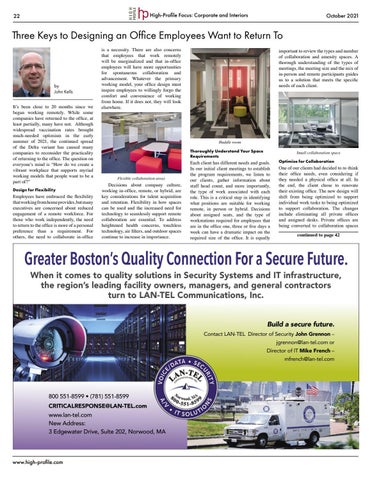
Huddle room
Thoroughly Understand Your Space Requirements
Flexible collaboration areas
Decisions about company culture, working in-office, remote, or hybrid, are key considerations for talent acquisition and retention. Flexibility in how spaces can be used and the increased need for technology to seamlessly support remote collaboration are essential. To address heightened health concerns, touchless technology, air filters, and outdoor spaces continue to increase in importance.
Small collaboration space
Each client has different needs and goals. In our initial client meetings to establish the program requirements, we listen to our clients, gather information about staff head count, and more importantly, the type of work associated with each role. This is a critical step in identifying what positions are suitable for working remote, in person or hybrid. Decisions about assigned seats, and the type of workstations required for employees that are in the office one, three or five days a week can have a dramatic impact on the required size of the office. It is equally
Optimize for Collaboration
One of our clients had decided to re-think their office needs, even considering if they needed a physical office at all. In the end, the client chose to renovate their existing office. The new design will shift from being optimized to support individual work tasks to being optimized to support collaboration. The changes include eliminating all private offices and assigned desks. Private offices are being converted to collaboration spaces continued to page 42
Greater Boston’s Quality Connection For a Secure Future. When it comes to quality solutions in Security Systems and IT infrastructure, the region’s leading facility owners, managers, and general contractors turn to LAN-TEL Communications, Inc. Build a secure future.
Contact LAN-TEL Director of Security John Grennon – jgrennon@lan-tel.com or
Director of IT Mike French – mfrench@lan-tel.com
800 551-8599 • (781) 551-8599 CRITICALRESPONSE@LAN-TEL.com www.lan-tel.com New Address: 3 Edgewater Drive, Suite 202, Norwood, MA
www.high-profile.com