December 2020
Annual Green Supplement
5
First CLT Building in Boston Under Construction Boston – Commodore Builders, along with Boston-based architect Margulies Perruzzi and structural engineer McNamara Salvia, is currently constructing the first cross-laminated timber (CLT) buildout in the city of Boston. The site, a five-story, 45,000sf multiuse space located at 69 A Street, utilizes 21,000sf of CLT in the floors, walls and ceilings of the historic buildout. Construction on the former rivet factory began in July 2019 and is set to be complete in early 2021. CLT, a carbon-negative material, is rapidly becoming the preferred choice in the industry. It is lightweight, easier to transport, erects more quickly, requires fewer additional materials, is more costefficient and emits less carbon dioxide than the production of steel or concrete. “Cross-laminated timber offers a lightweight, environmentally-friendly option that retrofits easily into the post and beam construction in older buildings,” said Dan Hudd, senior project manager, Commodore Builders. “CLT is rapidly becoming a popular option for construction due to its versatility, appearance, ease of construction, and sustainability.” A few fast facts about using CLT in this build over traditional building materials:
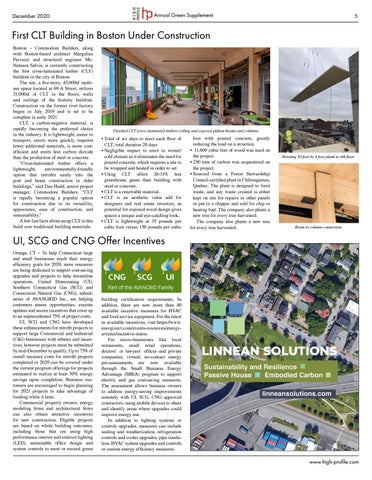
Finished CLT (cross laminated timber) ceiling and exposed glulam beams and columns
• Total of six days to erect each floor of CLT; total duration 20 days • Negligible impact to erect in winter/ cold climate as it eliminates the need for poured concrete, which requires a site to be wrapped and heated in order to set • Using CLT offers 26-31% less greenhouse gases than building with steel or concrete. • CLT is a renewable material. • CLT is an aesthetic value add for designers and real estate investors, as potential for exposed wood design gives spaces a unique and eye-catching look. • CLT is lightweight at 35 pounds per cubic foot versus 150 pounds per cubic
foot with poured concrete, greatly reducing the load on a structure. • 11,600 cubic feet of wood was used on the project. • 250 tons of carbon was sequestered on the project. • Sourced from a Forest Stewardship Council-certified plant in Chibougamau, Quebec. The plant is designed to limit waste, and any waste created is either kept on site for repairs in other panels or put in a chipper and sold for chip or heating fuel. The company also plants a new tree for every tree harvested. The company also plants a new tree for every tree harvested.
Hoisting 50 foot by 8 foot plank to 4th floor
Beam to column connection
UI, SCG and CNG Offer Incentives Orange, CT – To help Connecticut large and small businesses reach their energy efficiency goals for 2020, more resources are being dedicated to support cost-saving upgrades and projects to help streamline operations. United Illuminating (UI), Southern Connecticut Gas (SCG) and Connecticut Natural Gas (CNG), subsidiaries of AVANGRID Inc., are helping customers assess opportunities, execute updates and secure incentives that cover up to an unprecedented 75% of project costs. UI, SCG and CNG have developed these enhancements for retrofit projects to support large Commercial and Industrial (C&I) businesses with rebates and incentives, however projects must be submitted by mid-December to qualify. Up to 75% of install measure costs for retrofit projects completed in 2020 can be covered under the current program offerings for projects estimated to realize at least 30% energy savings upon completion. Business customers are encouraged to begin planning for 2021 projects to take advantage of funding while it lasts. Commercial property owners, energy modeling firms and architectural firms can also obtain attractive incentives for new construction. Eligible projects are based on whole building outcomes, including those that are using high performance interior and exterior lighting (LED), sustainable office design and system controls to meet or exceed green
building certification requirements. In addition, there are now more than 40 available incentive measures for HVAC and food service equipment. For the latest in available incentives, visit https://www. energizect.com/events-resources/energyarticles/incentive-status. For micro-businesses like local restaurants, small retail operations, doctors’ or lawyers’ offices and private companies; virtual, no-contact energy pre-assessments are now available through the Small Business Energy Advantage (SBEA) program to support electric and gas cost-saving measures. The assessment allows business owners to address energy-saving improvements remotely with UI, SCG, CNG approved contractors, using mobile devices to share and identify areas where upgrades could improve energy use. In addition to lighting systems or controls upgrades, measures can include sealing and weatherization, refrigeration controls and cooler upgrades, pipe insulation, HVAC system upgrades and controls or custom energy efficiency measures.
www.high-profile.com