100 Manuscripts Dr. Kevin Ford, associate professor of physical therapy and director of the Human Biomechanics and Physiology Laboratory, has published his 100th peerreviewed manuscript. Ford’s 100th article, “Real-Time Biofeedback to Target Risk of Anterior Cruciate Ligament Injury: A Technical Report,” was accepted in the Journal of Sport Rehabilitation for publication. The study details a new biofeedback technique that can be used to facilitate learning complex and safer sport movements. Ford’s research spans innovative studies that examine why devastating injuries occur and how they can be prevented. His publications have been referenced more than 1,800 times in leading medical journals such as New England Journal of Medicine, British Medical Journal and American Journal of Sports Medicine.
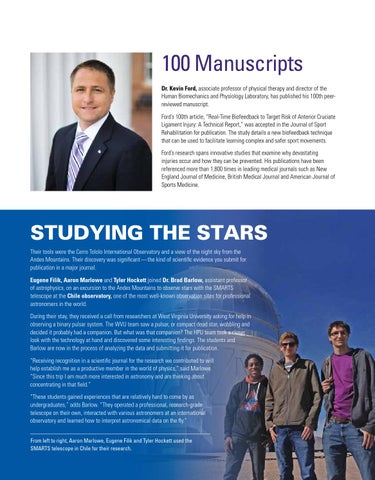
STUDYING THE STARS Their tools were the Cerro Tololo International Observatory and a view of the night sky from the Andes Mountains. Their discovery was significant — the kind of scientific evidence you submit for publication in a major journal. Eugene Filik, Aaron Marlowe and Tyler Hockett joined Dr. Brad Barlow, assistant professor of astrophysics, on an excursion to the Andes Mountains to observe stars with the SMARTS telescope at the Chile observatory, one of the most well-known observation sites for professional astronomers in the world. During their stay, they received a call from researchers at West Virginia University asking for help in observing a binary pulsar system. The WVU team saw a pulsar, or compact dead star, wobbling and decided it probably had a companion. But what was that companion? The HPU team took a closer look with the technology at hand and discovered some interesting findings. The students and Barlow are now in the process of analyzing the data and submitting it for publication. “Receiving recognition in a scientific journal for the research we contributed to will help establish me as a productive member in the world of physics,” said Marlowe. “Since this trip I am much more interested in astronomy and am thinking about concentrating in that field.” “These students gained experiences that are relatively hard to come by as undergraduates,” adds Barlow. “They operated a professional, research-grade telescope on their own, interacted with various astronomers at an international observatory and learned how to interpret astronomical data on the fly.” From left to right, Aaron Marlowe, Eugene Filik and Tyler Hockett used the SMARTS telescope in Chile for their research. highpoint.edu | 33