12 minute read
OPERATION


CHECK BEFORE STARTING ENGINE
WALK-AROUND CHECK
WARNING
Dirt, oil or fuel around the parts of the engine which reach high temperatures may cause fire and damage to the machine. Check carefully, and if any abnormality is found, always repair it or contact your Komatsu distributor.
Before starting the engine, look around the machine and under the machine to check for loose nut or bolts, or leakage of oil, fuel, or coolant, and check the condition of the work equipment and hydraulic system. Check also for loose wiring, play, and collection of dust at places which reach high temperatures.
Always carry out the items in this section before starting the engine each day.
9 1 1 1 5 8 6 4 4 5
1 1
5
1. Check for damage, wear, play in work equipment, cylinders, linkage, hoses.
Check that there are no cracks, excessive wear, or play in the work equipment, cylinders, linkage, or hoses. If any abnormality is found, repair it.
6 7 10 6 2 5 3
2. Remove dirt from around engine, radiator, battery
Check that there is no dirt accumulated around the engine, battery or radiator. If any dirt is found, remove it. Also check for flammable material (rags, leaves, twigs, grass etc.) and remove.
3. Check for leakage of water or oil around engine
Check that there is no leakage of oil from the engine or leakage of water from the cooling system. If any abnormality is found, repair it.
4. Check for oil leakage from hydraulic equipment, hydraulic tank, hoses, joints
Check that there is no oil leakage. If any abnormality is found, repair the place where the oil is leaking.
5. Check for damage to wheels and tyres
6. Check for damage to handrail and for loose bolts
Repair any damaged handrails and tighten any loose bolts.
7. Check for damage to gauges, monitor, loose bolts
Check that there is no damage to the gauges and monitor in the operator’s cab. If any abnormality is found, replace the parts. Clean off any dirt on the surface.
8. Clean rear view mirror, check for damage
Check that there is no damage to the rear view mirror. If it is damaged, replace it with a new mirror. Clean the surface of the mirror and adjust the angle so that the view to the rear can be seen from the operator’s seat.
9. Check lifting eye for damage
Check the lifting eye (or hook and safety latch) for damage. If damage is found, contact your Komatsu distributor for repair.
10. Check seat belt and mounting clamps.
Check there is no abnormality in the seat belt or mounting clamps. If there is any damage, replace with new parts
CHECK BEFORE STARTING
Always carry out the items in this section before starting the engine each day.
CHECK COOLANT LEVEL, ADD WATER
WARNING
Do not open the radiator cap unless necessary. When checking the coolant, always check the radiator reserve tank when the engine is cold. Immediately after the engine is stopped, the coolant is at a high temperature and the radiator is under high internal pressure. If the radiator cap is removed to drain the coolant in this condition, there is danger of burns. Wait for the temperature to go down, then turn the cap slowly to release the pressure before removing it.
1. Open the rear door on the left side of the machine and check that the cooling water level is between the FULL and LOW marks on radiator reserve tank (1) (shown in the diagram on the right). If the water level is low, add water through the water filler of reserve tank to the FULL level.
2. After adding water, tighten the cap securely.
3. If the reserve tank becomes empty, first inspect for water leaks and then fill the radiator and the reserve tank with water.
CHECK OIL LEVEL IN ENGINE OIL PAN, ADD OIL
1. Open the engine hood.
2. Remove dipstick (G) and wipe the oil off with a cloth.
3. Insert dipstick (G) fully in the oil filler pipe, then take it out again.
4. The oil level should be between the H and L marks on dipstick (K)
If the oil level is below the L mark, add engine oil through oil filler (F).
For details of the oil to use, see "USE FUEL, COOLANT AND LUBRICANTS ACCORDING TO AMBIENT TEMPERATURE (230)"
5. If the oil is above the H mark, drain the excess engine oil from drain plug (P), and check the oil level again.
6. If the oil level is correct, tighten the oil filler cap securely and close the engine hood.
REMARK
Ensure the machine is level when checking oil level and wait 15 minutes after stopping engine before checking the oil level. FULL
LOW
F G
P
K
WARNING
Allow the engine to cool before checking the oil level to avoid burns by touching hot engine parts.
CHECK FUEL LEVEL, ADD FUEL
WARNING
When adding fuel, never let the fuel overflow. This may cause a fire. If fuel is spilled, thoroughly clean up any spillage.
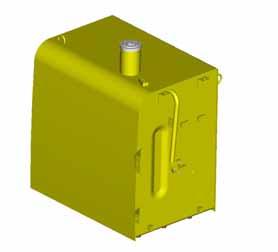
1. Check fuel level on monitor panel (D).
2. If fuel level is on the E marker you need to refill the tank.
3. Open fuel filler cap (F) on fuel tank.
4. When the fuel filler cap (F) is opened, float gauge within filler neck will rise according to fuel level. Check that the fuel tank is full by looking into tank and checking float gauge.
5. If the tank is not full, add fuel through the fuel filler until the float gauge (G) rises to the maximum position. Fuel tank capacity: 290 litres. Position of tip of float gauge (G) when tank is full: Approx. 50 mm from top of surface of fuel tank.
6. After adding fuel, push float gauge (G) straight down with fuel filler cap (F). Be careful not to get float gauge (G) caught in the tab of fuel filler cap (F), and tighten fuel filler cap (F) securely.
For details of the fuel to use, see "USE FUEL, COOLANT AND LUBRICANTS ACCORDING TO AMBIENT TEMPERATURE (230)"
D
F
Approx 50mm
REMARK
If breather holes (1) on the cap is clogged, the pressure in the tank will drop and fuel will not flow. Clean the holes from time to time.
CHECK OIL LEVEL IN HYDRAULIC TANK, ADD OIL
WARNING
When removing the oil filler cap, oil may spurt out, so turn the cap slowly to release the internal pressure before removing the cap.
If oil has been added to above the H mark, stop the engine and wait for the hydraulic oil to cool down, then drain the excess oil from the drain plug (P).
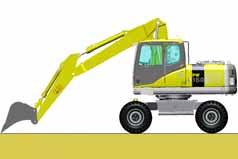
1. If the work equipment is not in the condition shown in the diagram on the right, start the engine, run the engine at low speed, retract the arm and bucket cylinders, then lower the boom, set the bucket teeth in contact with the ground, and stop the engine.
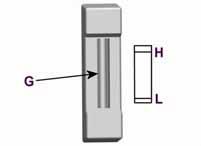
2. Check sight gauge (G). The oil level is normal if midway between the H and L marks.
NOTICE
Do not add oil if the level is above the H line. This will damage the hydraulic equipment and cause oil to spurt out.
3. If the level is below the L mark, remove cap (F) from the hydraulic tank and add oil.
For details of the oil to use, see "USE FUEL, COOLANT AND LUBRICANTS ACCORDING TO AMBIENT TEMPERATURE (230)"
REMARK
The oil level will vary depending upon the oil temperature
Accordingly, use the following as a guide:
Before operation: around midway between H and L (Oil temperature 10 to 30°C)
Normal operation: around H level (Oil temperature 50 to 80°C)
1
F
G
P
CHECK AIR CLEANER FOR CLOGGING
1. Confirm that the air cleaner clogging monitor is not lit
2. If lit, immediately clean or replace the element.
For details of the method of cleaning the element, see "CLEAN INSIDE OF COOLING SYSTEM (250)"
CHECK ELECTRIC WIRING
WARNING
If the fuses frequently blow, if there are traces of short circuits in the electrical wiring, locate the cause immediately and carry out repairs, or contact your Komatsu distributor for repairs.
Keep the top surface of the battery clean and check the breather hole in the battery cap. If it is clogged with dirt or dust, wash the battery cap to clean the breather hole.
Check for damage, wrong fuse capacity, and any sign of disconnection or short circuit in the electric wiring. Check for loose terminals and tighten any loose parts.
In particular check the wiring of the "battery", "starting motor" and "alternator" carefully.
When carrying out walk-around checks or checks before starting, always check if there is any accumulation of flammable material around the battery, and remove it.
Please contact your Komatsu distributor for investigation and correction of the cause.
CHECK FUNCTION OF HORN
1. Turn the starting switch to the ON position.
2. Confirm that the horn sounds without delay when the horn button is pressed. If the horn does not sound, ask your
Komatsu distributor for repair.
CHECK FOR WATER AND SEDIMENT IN WATER SEPARATOR, DRAIN WATER
Do not over tighten the valve. Over tightening can damage the threads.
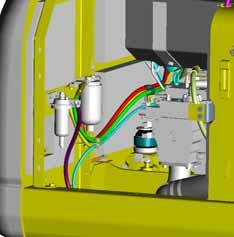
1. Open the door at the rear right of the machine.
2. Inspect the water separator (A), and check if the ring inside has risen to the marked line.
3. If the ring has risen to the marked line, carry out the procedure from Step 4.
A
4. Set a container under the water separator to catch the drained FUEL.
5. Secure fuel line to prevent leakage.
6. Remove air bleed plug (5) at the top of the water separator.
7. Loosen drain valve (1) at the bottom of the water separator, and drain the water and sediment into the container.
8. Loosen ring nut (2), then remove filter case (3).
9. Remove element (4) from the separator base.
10. Wash element (4) in clean diesel oil.
11. Check element (4), and replace it if it is damaged.
12. When installing element (4), perform Steps 9 and 8 in the opposite order.
Tightening torque of ring nut (2): 40 ± 3 N•m {4.1 ± 0.3 kgf•m}
13. Fill filter case (3) with fuel. When the fuel comes out from air bleed plug (5), tighten air bleed plug (5).
(A) Fore-and-aft adjustment of seat
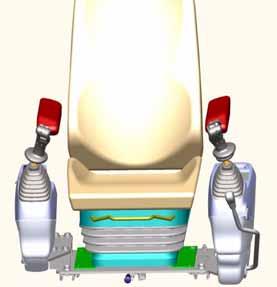
Pull lever (1) up. After the seat is set to the desired position, release the lever.
REMARK
This operation will affect relative position of seat and wrist control levers.
(B) Forward/aft adjustment of seat and base
Pull lever (2) sideways. After the seat is set to the desired position release the lever.
REMARK
This operation will not affect relative position of seat and wrist control levers.
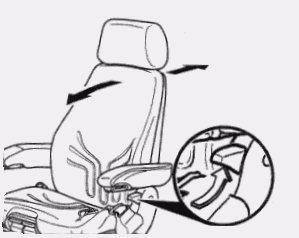
(C) Adjustment of reclining seat
The backrest is adjusted using the locking lever (3). Once locking lever (3) is in locked position it should not be possible to move onto another position.
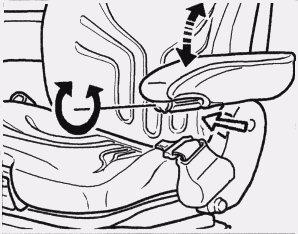
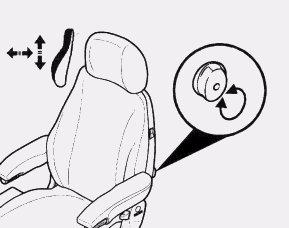
(D) Adjustment of arm rest height
The inclination of the armrests can be modified by turning the adjustment knob.
1
2
3
4
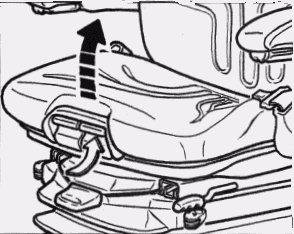
(E) Adjustment of tilting seat angle
To adjust the tilt of the seat lift left hand handle (5). By exerting pressure on or off the seat it can be moved to the desired angle position.
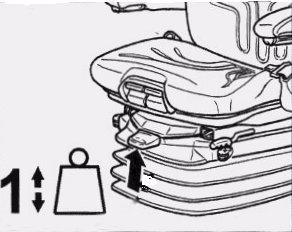
(F) Suspension adjustment
The seat should be adjusted for the drivers weight by briefly pulling the actuator lever of the automatic and height adjuster (6) with the vehicle at a standstill and the driver sitting on the seat, the driver must sit absolutely still during adjustment.
5
6
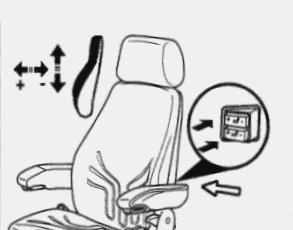
(G) Lumbar adjustment
The curve of the backrest cushion can be individually adjusted by pressing the upper and lower switches (7).
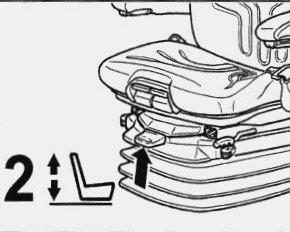
(H) Height adjustment
The height can be altered by pulling or pressing the actuator lever fully out or in (8) if the adjustment reaches the top or bottom end stop, the height is adjusted automatically in order to guarantee a minimum spring level.
8
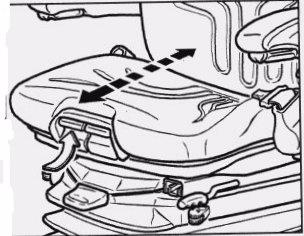
(I) Seat depth adjustment
To adjust the depth of the seat cushion, lift the right hand handle (9). By moving the seat cushion backwards or forwards the desired seating position can be reached.
9
SEAT BELT
Before fitting the seat belt, check that there is no abnormality in the belt or its mounting bracket. If it is worn or damaged, replace the seat belt.
Even if the seat belt appears normal, replace it every 3 years. The date of manufacture of the belt is shown on the back of the belt.
Always wear the seat belt during operations.
Fit the seat belt so that it is not twisted.
FASTENING AND REMOVING SEAT BELT
This seat belt has a retractor, so it is not necessary to adjust the length.
Fastening seat belt
Hold grip (2) and pull the belt out from the retractor (1), check that the belt is not twisted, then insert tongue (3) into buckle (4) securely. Pull the belt lightly to check that it is properly locked.
Removing belt
Press button (5) in buckle (4), and remove tongue (3) from the buckle (4). The belt is automatically spooled, hold grip (2) and return the belt slowly to the retractor (1).
ADJUSTMENT OF OPERATOR’S SEAT (MECHANICAL SEAT)
(A) Fore-and aft adjustment of seat
For details, see "(A) Fore-and-aft adjustment of seat (154)"
(B) Forward/aft adjustment of seat
For details, see "(B) Forward/aft adjustment of seat and base (154)"
(C) Adjusting of reclining seat
For details, see "(C) Adjustment of reclining seat (154)"
(D) Adjustment of arm rest height
For details, see "(D) Adjustment of arm rest height (154)"
(E) Adjustment of tilting seat angle
For details, see "(E) Adjustment of tilting seat angle (155)"
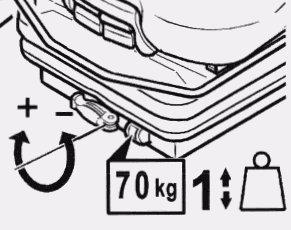
(F) Weight adjustment
The seat should be adjusted for the drivers weight by turning the weight adjuster lever (6) with the seat empty. The set weight can be read from the indicator.
6
(G) Lumbar adjustment
By turning the adjustment knob (7) to the left or right, both the height and curvature of the backrest cushion can be individually adjusted.
(H) Height adjustment
For details, see "(H) Height adjustment (155)"
(I) Seat depth adjustment
For details, see "(I) Seat depth adjustment (156)"
SEAT BELT
For details, see "SEAT BELT (156)"
7