HIGH SCHOOL CURRICULUM GUIDE 2024-2025
HIGH SCHOOL CURRICULUM GUIDE 2024-2025
The English program at Heschel is predicated on our core belief that students will live better, richer, and more meaningful lives if they do so in the company of great literature. People have always used storytelling to reflect upon and wrestle with experience. By putting our students in conversation with stories, as well as poems, plays, and essays - texts of all sorts, from the ancient to the modern - we help them to uncover the breadth of human experience and invite them to examine themselves and their world in ever new ways.
Classes are conducted as seminar-style discussions that encourage and reward close reading, teaching students that how they read is as important as what they read. In each year core classical texts are placed in conversation with contemporary works. Writing is as central to the curriculum as reading.
Assignments vary because written work not only reflects but also shapes the thinking that students do. Focused free-writing allows students to explore established ideas and discover their own. Short, frequent analytical paragraphs hone their skills in making an argument and supporting it with evidence from a text. In formal essays, students sculpt and shape their own ideas with the rigor and logical flow needed to engage an external audience. All English classes also incorporate a range of creative writing assignments that spring from the literature. For example, by imitating TIm O’Brien’s style, writing in the voice of Holden Caulfield, or reworking parts of Homer’s epic from a modern perspective, students develop their own voices and experience the thrill of creating original work. Each year, students also study grammar and vocabulary, strengthening their basic writing skills. Sharing their writing with others in class publications encourages rigor and helps to create community. Our aim in all classroom activities is to inspire a love of language, to develop the ability to think deeply about the complexities of human relationships and experience, and to foster passionate, sophisticated readers, writers and young adults.
Beyond the course offerings listed below, the English department offers a weekly Honors seminar in 10th and 11th grades to a limited group of students who wish to engage in additional study of highly challenging texts.
The ninth grade curriculum centers around themes of exile and return. Students consider the trajectory of the journey, the qualities of the hero (ranging from Odysseus to Holden Caulfield), and the literal and metaphorical meaning of leaving and returning home.
Throughout the year, we emphasize close reading and basic writing skills. Writing assignments include informal free-writes, short passage analyses which reinforce and hone the close reading skills fostered in discussions, formal essays, and creative writing assignments based upon the literature. Grammar and vocabulary study are integrated into writing instruction throughout the year.
Core Texts: The Odyssey, Homer (tr Wilson); The Tempest or Twelfth Night, William Shakespeare; The Catcher in the Rye, J.D. Salinger
Additional selections may include: When the Emperor was Divine, Julie Otsuka; Maus, Art Spiegelman; The Curious Incident of the Dog in the Night-Time, Mark Haddon; Their Eyes Were Watching God, Zora Neale Hurston
In the tenth grade year, students move from a broad consideration of the archetypal journey and of the hero to an examination of the private self and the connection between this self and the broader community. Students continue to develop and deepen their close reading skills. Writing assignments are similar in form to those of the 9th grade year, but students are expected to demonstrate greater sophistication and mastery of form in their work.
Core texts: Macbeth, William Shakespeare; Things Fall Apart, Chinua Achebe or Frankenstein, Mary Shelley; Medea, Euripides
Additional selections may include: Persepolis, Marji SatrapI; Lord of the Flies, William Golding; The Prince of Los Cocuyos, Richard Blanco; selected short stories, including works by Louise Erdrich, Amy Tan, John Steinbeck, Sandra Cisneros and others
The 11th grade year focuses on American literature. Students explore the ways in which American authors from many diverse backgrounds reflect upon and shape American experience in both the content and form of their works. The course ponders the questions of what it means to be an American in the 21st century, and further hones students’ abilities as careful readers and skilled creative and analytical writers. Work on grammar and vocabulary continues throughout the year.
Core Texts: The Things They Carried, Tim O’Brien; essay selections from Emerson, Thoreau, Baldwin, Solnit, and others; The Great Gatsby, F. Scott Fitzgerald; Sula, Toni Morrison; a poetry selection, including Walt Whitman, Emily Dickinson, Langston Hughes, and many other contemporary poets .
Additional selections may include: There There, Tom my Orange; The Round House, Louise Erdrich; The Death of a Salesman, Arthur Miller; The Laramie Project, Moises Kaufman; A Raisin in the Sun, Lorraine Hansberry
The senior elective program at Heshel offers a wide variety of options that our English teachers themselves design, based on their own passions and interests; it is a chance for both students and teachers to explore in-depth an important theme through the lens of wonderful ancient, modern and contemporary works of literature. nia Woolf?, Edward Albee, Hamlet, William Shakespeare
Stories are part of our daily lives. They are present in the anecdotes we share with family and friends, in the shows and films we watch, and in the books we read. Stories are the way we make sense of ourselves and the world we live in. Yet, have you ever stopped to think about which stories find their way into print, film, onto the stage? Whose stories become a “classic” and preserved? From time immemorial, people have told stories, but societies have not always made room for the voices of those not part of the dominant or “mainstream” political, social or cultural fabric in their communities. Often, people in these marginalized groups did not (or do not) have the same rights, privileges and social distinction as those in power. In this class, we will read texts that provide us with voices often sidelined, whether due to gender, religion, class, or race. The characters are complicated, their narratives intimate, and their relationship with others illuminate their diverse perspectives. Their stories will not only help us see the world through their experiences, but they will also challenge us to examine our own biases and values, as well as the historical and current realities in which the narrative takes place. Our minds will be opened, our hearts will be touched, and our lives
will be enriched because the silenced will speak.
Possible Texts/Films include: Beloved, Toni Morrison; Buddha in the Attic, Julia Otsuka; Disgraced, Ayad Akhtar; Doubt (play and film), John Patrick Shaney; Pride and Prejudice, Jane Austen; Small Things Like These, Claire Keegan; Woman Talking (film) Sarah Polley; Selected poems, short stories and essays; Circe, Madeline Miller Girl Meets Boy, Ali Smith; How Beautiful We Were, Imbolo Mbue; The Memory Police, Yoko Ogawa
Humans have an innate sense of fairness and just treatment, and a visceral reaction to perceived injustice, whether that occurs within our families, communities or nations. Writers from across ages and continents have examined this essential concept of justice, exploring revenge, inaction, forgiveness and redemption as a range of responses to wrongdoing and injustice. In this course we will investigate, through the lens of literature, the tensions between justice and mercy, vengeance and absolution, and the ways in which characters negotiate these opposing ideas; we will seek to address the vexed questions of what true justice is, and whether fallible humans ever achieve it. In the process, we will work towards articulating an understanding of the concept of justice, for ourselves and for our own society.
Possible texts include: Agamemnon, Aeschylus/Ted Hughes; Hamlet or Othello, William Shakespeare; Beloved or A Mercy, Toni Morrison; The Stranger, Albert Camus; Watchmen (graphic novel), Moore, Gibbons, Higgins; Do the Right Thing (film), Spike Lee; In Cold Blood, Capote; Shakespeare Behind Bars (documen-
tary), Hank Rogerson; The Central Park Five, Sarah Burns; The Other Wes Moore, Wes Moore; A Lesson Before Dying, Ernest P Gaines
What does it mean to live well as human beings?
What are our duties to ourselves and to others? On what grounds can we make decisions about right and wrong? This course seeks to awaken the tacit ethical convictions by which we live our lives. We will read literature that explores characters’ moral deliberations in the midst of complex circumstances, while also looking at excerpts of philosophical texts that have deeply shaped ethical discourse in the West. By grappling with the moral dilemmas faced by the characters we encounter, we will debate the merits and limitations of the popular ethical frameworks that aim to help us reason about which course of action to take. Ultimately we will reflect on the individual and collective responsibilities entailed by being part of a common world.
Possible texts include: Home Fire, Kamila Shamsie; Antigone, Sophocles; Hamlet, William Shakespeare; Beware of Pity, Stefan Zweig; Nemesis, Philip Roth; All My Sons, Arthur Miller; Judas, Amos Oz; Address Unknown, Kathrine Kressmann Taylor; The Children Act, Ian McEwan; An American Marriage, Tayari Jones; Reunion, Fred Uhlman
Friendship is a bond many would deem the most important one in life, even before family and partnership. In fact, Aristotle described true friendship as an ideal to be strived for. In this elective, we will be exploring
why that might be so, starting with ancient Greek phi losophers who were among the first to attempt a definition for the word “friend.” We will travel through time and examine the evolution of this definition through the lenses of Shakespeare, Larsen, and Alice Walker’s beautiful portrayal of female friendship. Along the way, we will study from poets like May Young and Andrew Warner.
Possible texts include Passing, Nella Larsen; Othello, WilliamShakespeare; The Color Purple, Alice Walker; Fiona and Jane, Jean Chen Ho; Tomorrow and Tomorrow and Tomorrow, Gabrielle Zevin; The Best Minds, Jonathan Rosen; Reunion, Fred Uhlman; Excerpts from Aristotle’s Ethics; Selected poems and essays; My Brilliant Friend, Elena Ferrante; Marlena, Julie Buntin; The Joy Luck Club, Amy Tan; Sadness is a White Bird, Moriel Rothman Zecher; Who Will Run the Frog Hospital? Lorrie Moore
Humans are complicated. What seems commonplace to one might send another into a panic. What shapes our perceptions, our values, our fears and joys? What drives us to make choices – not just the major life-changing ones, but the small, everyday ones that make us who we are? Both consciously and subconsciously we are influenced by our families, peers and other relationships, by the society and culture we are born into, as well as our own genetics. We are shaped not just by our experiences, but by the stories we tell ourselves and the meaning we create from those experiences.
Literature can teach us to better understand human na-
ture and the world we inhabit. Through novels, plays, short stories and films, we will explore the human experience. We will study and discuss in order to better understand and gain empathy for each other and ourselves. Possible texts include: Othello, William Shakespeare; The Joy Luck Club, Amy Tan; Brighton Beach Memoirs, Neil Simon; Steel Magnolias, Robert Harling; Brooklyn, Colm Toibin; Abuela, Don’t Forget Me, Rex Ogle (memoir/poetry) Numb To This: Memoir of a Mass Shooting, Kindra Neely (memoir/graphic novel); Blink: Fiddler On the Roof, Sheldon Harnick, Jerry Bock (musical); My Name is Asher Lev, Chaim Potok; Pride and Prejudice, Jane Austen; A Tree Grows In Brooklyn, Betty Smith; Ender’s Game, Orson Scott Card ; Like Water for Chocolate, Laura Esquivel; Davita’s Harp, Chaim Potok; Selected short stories
The purpose of History may be to awaken the dead, as 20th-century philosopher Walter Benjamin writes; if we look carefully around us, we see a world populated by ghosts. The texts we will investigate in this course make productive use of these hauntings: for novelists like Morrison, History has the potential to redeem the present, giving us the possibility to recover and remake what has been lost. Alternatively, in Shakespeare’s Hamlet, History is a kind of psychological warfare— and is, admittedly, the only form of power still reigning once the play is said and done. In this course, we will explore the ways writers conceive of History and its uses across genres, forms, and time periods. We will consider how literature is an ideal vehicle for History, as a form that blurs notions of truth and puts language to memory. Ultimately, we will enable our own ghosts to finally speak.
Possible texts include: Slaughterhouse Five,
Kurt Vonnegut; Absalom, Absalom! William Faulkner; Beloved, Toni Morrison; Hamlet, William Shakespeare; selected short fiction Aleichem, Borges, Chekhov, Lispector, Paley; Snow, Orhan Pamuk; One Hundred Years of Solitude, Gabriel García Márquez; There, There, Tommy Orange; Kindred, Octavia Butler; The Book Thief, Marcus Zusak; White Noise, Don DeLillo
Our perspective on the world – and the world’s perspective on us – is based on the different lenses through which we view everyday experience. In this community, religion is an important lens, but there are others that matter too: gender, race, sexuality, socio economic status, physical ability, family background. These are the building blocks of the self we construct. In this course, we read literature that asks us to think specifically about these different lenses, and in particular, aspects of identity that often lead to marginalization or oppression in our world today. Too often, we valorize only those authors and characters who already hold a great deal of power in the world: here we consider queer lives, black and brown lives, immigrant lives, and others. The course is contemporary – most of the texts were written only in the 21st century – and it requires rigorous self-reflection. The one exception to the contemporary selections is Shakespeare’s Hamlet, a tragedy that asks us to think about all aspects of identity, both visible and invisible. In the spirit of the course, we will consider the play as a thoroughly modern work, looking at it through the lenses of queer theory, gender theory, critical race theory, and others.
Texts include: The Power, Naomi Alderman; Between the World and Me, Ta-Nehisi Coates; This is How
You Lose Her, Junot Diaz; For Today I Am a Boy, Kim Fu; Her Body and Other Parties, Carmen Maria Macha do; Sadness is a White Bird, Moriel RothmanZecher; Hamlet, William Shakespeare; Sing, Unburied, Sing, Jesmyn Ward; Assorted short stories and essays
With any luck, at some point we find ourselves up against certain basic questions. Who am I and who do I want to be? What is the point of this journey? How should I live my life? What choices do I have, and how free am I--or do I want to be--to act upon them? Sometimes these questions emerge in the face of crisis, when none of the old structures seem to hold. Sometimes they arise as a natural product of burgeoning consciousness. “Light dawns gradually over the whole,” the philosopher Ludwig Wittgenstein wrote. Once it does, living becomes a more complicated and more interesting matter. This class examines texts that explore these core concerns about consciousness, the exercise of human freedom, and the ideal of a life well-lived.
Texts include: The Sun Also Rises, Ernest Hemingway; Hamlet, William Shakespeare; Candide, Voltaire; Notes From Underground, Fyodor Dostoevsky; The Death of Ivan Ilych, Leo Tolstoy; short fiction of Franz Kafka; Howards End, E.M. Forster; Beloved, Toni Morrison
We are what we remember. Stories of our past--recalled and repressed--define us and shape our worl-
dview. In this course we will use literature as a lens to consider collective and individual memory. What memories do we inherit and pass on? Whose stories are elevated and institutionalized? Whose story ends up forgotten? How do places hold memory? Who has control over the stories we tell about ourselves and each other? To what extent is remembering an act of resistance or even, in some cases, of revolution? In this course we will connect memory both selective and intentional to the narratives we tell about ourselves, our nation, and the arc of justice. Our work in this elective will culminate in a memoir unit in which you’ll look inward and write your own memoir piece. You’ll ask: What memories make me who I am right now? What feelings do I want to bring to the surface and memorialize? How do I capture them? Through a blend of voices and genres--fiction, non-fic tion, plays, poetry, memoirs, and art--we will explore how we use stories to hold on and let go at the same time.
Possible Texts Include: Educated, Tara Westover; The Piano Lesson, August Wilson; On Earth We’re Briefly Gorgeous, Ocean Vuong; Hamlet, William Shakespeare; Sing, Unburied, Sing, Jesmyn Ward; selected essays from Minor Feelings: An Asian American Reckoning, Cathy Park Hong
Who in a society sees most clearly? Who speaks the truth with a raging voice? Often, this person is an outsider or a “misfit,” like Toni Morrison’s Sula or William Faulkner’s Joe Christmas. Dwelling at the margins of society, these individuals can see the world for what it really is, exposing the hypocrisies of the boxes we live in. In Tanach, we call such rebels “prophets,” but the term holds wide-reaching applications. This course
explores the figure of the prophet in texts across genres, forms, and time periods. We will investigate how and why prophets defy categorization, rendering themselves invisible within conventional society. At the same time, we will consider the ways such outsiders are also deeply engaged with and molded by the social world in which they live. We will assess the prophet’s potential to effect lasting, disruptive change. And ultimately, we will find our own potential to speak and write with purpose, vision, and truth.
Possible texts include: The Bluest Eye (Toni Morrison); Light in August (William Faulkner); Angels in America (Tony Kushner); The Passion According to G.H. (Cla rice Lispector); Hamlet (Shakespeare); selected essays, short stories, and poetry Summer reading: The Color Purple (Alice Walker) and your choice of ONE (or more!) of the following: The Handmaid’s Tale (Margaret Atwood); Jane Eyre (Charlotte Brontë); The Sympathizer (Viet Thahn Nguyen); Into the Wild (Jon Krakauer)
Family romance might sound like an oxymoron, but psychology teaches us that our first experiences of love, safety, joy, and nurture come from our parents and shape the person we become. Crack open the story of Cain and Abel, and you find that murderous rage, envy, 8 and fear follow fast upon these emotions. In fact, psychologists from Freud on have looked to the Bible and other literary texts to derive their most foundational theories about the human psyche and the construction of self. This course examines texts that explore these issues and portray the family unit in all its complexity, with an eye to core psychologi-
cal concepts that emerge from a consideration of the family romance. Units will include Individuation (the development of a sense of self separate from one’s parents); the Oedipus complex; the subconscious and dream interpretation; madness and hysteria; and finally Repetition, Recollection, and Working through. Short readings in psychology (Freud, Winnicott, and possibly others) will accompany our reading of literature.
Possible texts include: Are You My Mother? (Alison Bechdel), Oedipus Rex (Sophocles), Hamlet (Shakespeare); Notes from Underground (Fyodor Dostoevsky); As I Lay Dying (William Faulkner); Beloved (Toni Morrison); short fiction of Hemingway (the Nick Adams stories), Franz Kafka, and Lorrie More; excerpts from Freud, Jung, and Winnicott. Summer Reading: Fun Home (Alison Bechdel) plus ONE or more of the following: Jane Eyre (Charlotte Brontë); The Wide Sargasso Sea (Jean Rhys), Random Family (Adrian Nicole LeBlanc), The Color Purple (Alice Walker)
A liberal education encourages students to shape their individual identities and formulate their own values, and gives them the tools and confidence to act on those values. The study of history and pursuit of its allied disciplines are critical elements of that education. In our program, students are asked to engage with thinkers from antiquity to the present day and from all stations in life—to listen respectfully to their ideas, wrestle with them, and then embrace, modify, or reject them. To do so effectively, they learn to approach these figures and their ideas within the political, social, religious, and other contexts in which they lived. At the same time, students become better informed about the issues and challenges facing our own society, and draw parallels, where appropriate, between past and present.
Recognizing the fundamental tension in teaching and learning history between covering facts and developing historical habits of mind, the Social Studies program emphasizes the analytical and reflective. Teachers do not simply present students with facts, but guide them toward interpretation. Like professional historians, students work foremost with primary sources, a range of documents, artifacts, music, and works of art. Primary sources operate in tandem with secondary readings, the first providing vivid, tangible examples, and the latter offering context. Students learn to question all sources by examining any biases or agendas of their creators. Skills learned in this discipline, including the ability to assess evidence, and to judge the merits of conflicting accounts and interpretations, are applicable to many fields of study and work.
GRADE 9 EIGHTEENTH CENTURY: ATLANTIC WORLDS
This course focuses on societies in Europe and North America in the sixteenth through eighteenth centuries. The class takes a comparative approach to intellectual, religious, technological, and political developments on both sides of the Atlantic that produced revolutions in the US, France, and Haiti. Students explore the interconnected causes and effects of the American, French, and Haitian revolutions. Students also examine how Jews were viewed and treated as these changes took place, as well as Jewish responses to changes within the majority cultures. Some key questions guiding our studies are::
• Why did the stable world of monarchy and Church of the 16th-17th centuries in Europe and its colonies evolve into the upheaval of revolutions that changed the relationships between peoples and their governments?
• How did the ideas of the Enlightenment challenge the sovereignty of the monarch and define the role of the modern state?
The course focuses on developing the skills of historical inquiry through the analysis of documents, objects, and images, and the construction of historical arguments.
This course builds on the ninth grade study of changes in the 16th through 18th centuries, taking a comparative approach to technological, social, intellectual, and political developments on both sides of the Atlantic during the 19th century. Industrialization and its impact on labor, economics, social relations, and the environment serve as the overarching focus of the course. Several overlapping themes guide this study:
the growth of an increasingly secularized society; the development of modern nation-states; the emergence of new political ideologies; and the central role of liberal economics. Students also discuss contemporary issues, relating them to the historical themes of the course, in student-led current events sessions. The research and writing skills involved in writing the research paper – identifying reliable sources, taking notes, developing a thesis, outlining, drafting, and revising – receive significant attention.
IIn this honors seminar students deepen their understanding of how Race has been constructed as a concept, and how it has evolved in the US in the 20th and 21st centuries. We focus primarily on the contemporary experience of people of color by reading a range of articles, through seminar-style discussion and writ-
ing. Students read works – including full-length books – by James Baldwin and Ta-Nehisi Coates, and poetry by female poets of color. Students are encouraged to learn to listen to other voices, especially when those voices express opinions that are unfamiliar or cause discomfort. Participants in the seminar are exposed to ways in which issues of Whiteness and Blackness permeate American society and how to identify privileges and prejudices. America may not be a racist society, but it is certainly a racial society; the more students are conscious of the implications of this reality, the easier it is for them to understand the complexities of Race in today’s society.
This seminar provides students with a chance to dig deeper into topics from the 10th grade social studies curriculum. Our weekly sessions will consist of discussions about articles by professional historians, essays from publications such as The New Yorker, and the relevance of topics from the 19th century for contemporary life and politics. In addition to writing weekly response papers, members of the seminar will create a more extensive version of the tenth grade research paper.
While in the ninth and tenth grades students explore the emergence of liberal politics and economics in the Atlantic World, in eleventh grade they examine how World War I and the Great Depression funda mentally
challenged faith in nineteenth-century liberalism and led to the rise of three alternatives—communism in the Soviet Union, fascism in Germany, and the re-imagined liberalism of the New Deal in the United States. Students also examine how and why both the Nazi and the Soviet regimes collapsed. They conclude the course by wrestling with new threats to the liberal international order built largely by the United States and its allies. As a critical component of this larger story, students also follow the history of the Jewish people and Zionism, including ways the Allied victory in 1918 helped to make a Jewish homeland possible; the culmination of modern anti-Semitism in the Holocaust; Isra el’s War of Independence; and the impact of Cold War politics on Israel. Students also discuss contemporary issues, relating them to the historical themes of the course, in student-led current events sessions. Students undertake a major research paper with a focus on primary source analysis and contextualization.
Students in the seminar enrich their study of twentieth-century history across a range of topics. They 10 will read articles by professional historians and essays on contemporary politics that connect with the material they study in the daily classes. Students will also devote considerable time to the writing process through readings, workshops of one another’s essays, and various composition exercises. Other work includes weekly response papers and a more extensive version of the junior-year research project.
From the mid-nineteenth century through the early 1920s millions of Jews immigrated to the United States. They took various approaches to Americanizing and balancing Jewish and American identities. As the country moved on from World War I and the twentieth century unfolded, in what ways and to what extent did Jews come to feel “at home in America’’?
In this unique course, we study selected aspects of the modern history of the State of Israel through the eyes of both Israelis and Palestinians. Our starting point is a textbook developed by PRIME (Peace Research Institute in the Middle East), a rare collaboration of Palestinian and Israeli academics and teachers who believe that these two peoples can arrive at peace and conciliation once they have each come to understand the narrative of the other. The polarized histories of Palestinians and Israelis have left little common ground for a single historical narrative. The goal of this course is not necessarily to create a single “bridging” historical narrative that is held in common by both communities. Rather, “Dual Narratives’’ is designed to explore both Israeli and Palestinian narratives of the same set of events. By reading these narratives, we not only learn what shapes the Israeli and Palestinian communities’ understandings of historical events, but we are required to confront the historical perspectives and contexts that shape each community’s sense of reality. A prerequisite for
this course is open-mindedness to studying the narrative of “the other side” and a willingness to engage in respectful debate of the issues.
This course explores the complex issues surrounding Israel’s identity as a Jewish and democratic state. We will focus on key dilemmas and social dynamics—old and new—that Israeli society deals with today. How has Israel transitioned from the founders’ vision of a socialist, agricultural economy to the free market oriented, high-tech society it is today? How has its ethnic diversity evolved over time and contributed to both the achievements and challenges of the country? How do the recent protests against the government’s proposed judicial reforms reflect broader debates and tensions within Israeli society? Drawing on recent books and articles about Israel, as well as Israeli media, this course looks at the challenges that Israel faces in balancing its Jewish and democratic identities, including issues such as religion and state and minority rights. We will explore how Israel handles a range of social issues, such as the role of the army, the status of women, Jew ish-ethnic diversity, religious differences, and relations with non-Jewish Israelis. Through discussions and assignments over the semester, students will understand the complexities that have given shape to contemporary Israeli society and which inform the political debates occurring in the country today.
In a matter of just a few hundred years, in the Early Middle Ages, two new religions emerged and came
to dominate the Western World. Christianity originated in the unimportant Roman province of Palestine, took hold through the passion of persecuted men and women, and somehow came to be chosen as the faith of kings and emperors. Islam seemed to appear even more spontaneously, as previously undisciplined and nomadic Arab tribes people united around one man’s divine vision and subsequently conquered much of the known world. The births of these two new faiths impacted countless individuals and entire continents, and their consequences are still felt centuries later. This course focuses on the question of how Christianity and Islam developed in the Early Middle Ages. Students use primary and secondary sources to understand the individuals, the politics, and the beliefs that pushed these two religions to global prominence. In the second part of the course, we analyze how Christian and Muslim empires interacted with and treated the major religion that had influenced them: Judaism. The attitudes that Christian and Muslim rulers in the Middle Ages demonstrated toward Jewish people and ideas can shed light on the relationship between the three religions today, providing context and challenging easy assumptions.
What does it mean to build a society based on principles of justice? What is the role of equality in such a society? How do we know if different people or groups are receiving equal treatment? In this course, we will use American historical and contemporary sources particularly focused on the Constitution to study evolving meanings of justice and equality. We will focus on how American law has defined equality with particular attention to race, gender, and sexual orientation.
In the four hundred years since the first Dutch colonists built houses in the territory of the Lenape people, tens of millions of individuals have made their homes in New York City including you! As many of you prepare to leave New York to attend college elsewhere, this course provides an opportunity to deepen your understanding of this place and the people who made it what it is today. We will begin by tracing the growth and transformations of the city throughout its history. Along the way, we will explore both the diversity and dynamism of New Yorkers and the challenges that have confronted politicians and urban planners, whose controversial decisions continue to shape our lives today. There are far too many fascinating dimensions of contemporary New York to cover in a single semester, so we will collaborate in shaping the latter part of the course to reflect the topics that you are most interested in engaging with. The work for this course includes readings from contemporary media coverage and leading scholarship on the issues, both reflective and research-based writing, active participation in class discussions, and walks through selected neighborhoods. How can we preserve what is best about New York while adapting to the crises of this century and building a more equitable and livable city? The future is in your hands!
This course opens with a short unit on Christian Zionism, particularly the influence of evangelical Protestants in shaping U.S. relations with Israel. We then turn to questions about what role Americans should play vis-à-vis Israel’s two greatest conflicts—an in-
ternal one between its Jewish and Palestinian populations, and an external one with the Islamic Republic of Iran. We trace the history of those conflicts from the late twentieth century to the present. Topics include the Camp David Accords; Oslo Accords; Iranian Revolution; Sunni-Shia conflict; Iran’s nuclear program; and Israel’s growing cooperation with Arab states wary of Tehran’s ambitions in the region.
This course examines evolving perceptions of the Holocaust in Israel and its impact on Israeli society through a variety of perspectives and historical periods. The course begins with Jewish Aliyah to Israel following World War II and the creation of the State of Israel, considering how the experiences from the Sho ah may have shaped early Israeli society. We explore the impacts of Nazi genocide on early Israeli society through analysis of political debates, literature, and film. The Eichmann trial, in 1961, served as a turning point in Israel’s reckoning with the Holocaust. We will analyze the Eichmann trial and its critical legacy in how Israelis have grappled with the horrors of the Holocaust and its impact today. Finally, we will consider how Israelis have chosen to commemorate the horrors of the Holocaust through Yad Vashem and other memorial sites and museums. Throughout the course we will reflect on larger themes of trauma, commemo ration, and genocide.
Many American leaders and thinkers were optimistic about the future at the start of the 1990s. The collapse of the Soviet Union brought an end to the Cold War and they believed that liberal democracy
would soon become the dominant form of government around the globe. Thirty years later, this claim seems naive, hasty, foolish, or a combination of all three. In this course we will examine how and why liberal democracy has lost its grip on the world since 1991. To do this we will survey a broad array of topics including: • Economic Reform and the rise of the People’s Republic of China • Vladimir Putin’s path to the presidency and unrivaled power in the Russian Federation • The continued failure of the United States to ensure the welfare of its own citizens • The rise of Islamic fundamentalism and terror ism, as well as its impact on American, European, Muslim, and Israeli societies
In this course we explore the decades-long growth of disparities in income and wealth in the United States. We begin with a primer on economics, including discussion of monetary and fiscal policies, and brief encounters with Adam Smith, Karl Marx, and John Maynard Keynes. We then turn to the New Deal Order, which characterized the nation’s politics and economy from the 1940s through the early 1970s, before charting the decline of the social consensus that sustained that order after 1980. We consider a range of explanations the left and right have offered for the expansion of inequality—from the emergence of new industrial competitors overseas; the “superstar” theory of compensation; shifting tax policy; and the decline of labor unions. More importantly, we consider how what critics label “the hollowing out of the middle class” has transformed American culture.
The understanding and mastery of mathematics is a critical component in understanding and fully participating in all aspects of society. world. Students must be challenged to excel in mathematics if they are to grow as learners in all fields of study. The study of mathematics at the High School is designed to develop mastery in fundamental skills in order to facilitate the growth and development of the individual learner. If a student has mastered basic algebra, they begin their high school study with a course in geometry and proceed through advanced algebra, trigonometry, precalculus and calculus. Students whose natural inclinations and talents draw them towards mathematics are offered the most demanding course offerings which emphasizes independent and varied approaches to the subject. Students for whom the subject is less intuitive need to be challenged and offered the support they require. We offer a math lab program four days a week where students can meet with teachers on a drop-in basis for extra help.
Students at the High School are prepared for the varied applications of mathematics in the years that lie ahead. They are given a broad foundation of mathematical ideas and real life applications that will prepare them for study in business, science, economics, and higher level mathematics in college. Each course of study presents opportunities to develop mathematical skills numerically, analytically, graphically and verbally, with the support of technology where applicable. Students take full advantage of advanced technology materials. Students are encouraged to participate actively in class, to work constructively with their peers, and to use the language of mathematics to clearly express mathematical ideas and concepts. The mathematics instruction the students receive prepares them to think creatively, critically and analytically, enabling them to become problem solvers in all areas of study.
COURSE OFFERINGS
• Algebra I
• Accelerated Algebra I
A traditional course in first-year algebra, this class emphasizes the development of strong algebraic skills. Areas of study include solving equations and inequalities, factoring, operations on algebraic fractions, rational and irrational numbers, and the graphing of linear equations. Applications and problem solving will be interspersed throughout the year.
Course Materials: Algebra I, McDougal & Littell
COURSE OFFERINGS
• Geometry
• Geometry with Proofs
• Honors Geometry
This is a traditional course in Euclidean plane geometry. Beginning from basic definitions and axioms, it develops the main theorems of congruent triangles, parallelism, special quadrilaterals, geometric inequalities, similar polygons, right triangles, circles, perimeter and area. In addition, the course includes a unit in analytic and coordinate geometry.
Students in this course become conversant with undefined terms, definitions, axioms, theorems, and constructions. They develop skills in originating conjectures and working their way towards proofs. While formal logic as such is not a part of the course,
students will learn how to formulate a valid argument. The Geometer Sketchpad program is utilized throughout the course. Geometry problems serve as an arena for the exercise of the algebraic and analytic skills acquired in previous courses.
Course Materials: Geometry, McDougal & Littell; Geometer Sketchpad, Geogebra (computer software)
COURSE OFFERINGS
• Algebra II
• Algebra II/Trigonometry
• Honors Algebra II / Trigonometry
This course builds on the skills learned in Algebra I. Topics covered will include solving absolute value inequalities, solving simultaneous linear equations, factoring polynomials, operations on rational expressions, solutions of quadratic equations and inequalities, operations on irrational and complex numbers, and the introduction to exponential and logarithmic functions.
The Trigonometry course includes triangle trigonometry, the Law of Sines, the Law of Cosines, trigonometric graphs, trigonometric identities and applications of periodic functions.
An honors level section is offered in the tenth grade.
Course Materials: Algebra and Trigonometry: Structure and Method, Book 2, McDougal & Littell
COURSE OFFERINGS
• Pre-Calculus
• Honors Pre-Calculus
This course develops mathematical maturity through guided but open-ended inquiry. Students acquire the ability to apply familiar facts in new contexts, to leap from numerical to abstract reasoning, to frame and prove precise conjectures, and to look at the same problem from many different viewpoints.
Topics covered include sequences and series, linear algebra, the study of functions and their graphs, polynomials, rational functions, conic sections, combinatorics and probability, basic statistics, and exponentials and logarithms and their connections with the geometry and trigonometry of the complex plane. An honors level section is offered in the eleventh grade.
Course Materials: Precalculus with Limits, A Graphing Approach, Houghton Mifflin
CALCULUS
Course Offerings
• Calculus
• Calculus AB
• Honors Calculus BC
Calculus might be called the mathematics of movement or the mathematics of change. Students studying calculus begin to solve problems of a dynamic nature, exploring how changes in one variable relate to changes in another. This course is designed for students who have mastered Algebra I and II, Geometry, and Pre-Calculus, especially Trigonometry and manipulating functions. Emphasis is placed on critical thinking and problem solving skills as applied to the sciences, especially physics problems concerning motion.
Course Materials: Calculus, Houghton Mifflin
Statistics is the science of exploring and learning from data. The subject has wide applications in fields including economics, natural sciences, business, and social sciences. Through many real world observations, students familiarize themselves with the major concepts and tools for collecting, analyzing, and drawing conclusions from data. The main question that the course addresses throughout the year is whether we can detect patterns or changes in a set of data and how these changes can lead to new conclusions.
The course is divided into four broad themes: Exploring and organizing data, planning a study of data, anticipating patterns, and drawing statistical inferences. Students explore the tools that help organize data and learn the language necessary to help describe patterns that emerge. They further develop techniques for properly collecting data and predicting patterns leading to conclusions for an entire population. The class relies heavily on our TI-83 Graphing Calculators throughout the year as those skills are developed.
Course Materials: The Practice of Statistics, 3rd Edition. Daniel S. Yates
This course studies the branch of mathematics concerned with “linear” functions. It covers systems of linear equations, matrix algebra, and vector spaces. Linear algebra is inherently geometric in nature. Examples in two and three dimensions can be used to generalize into higher dimensions. While much of intuition will come from these examples, an algebraic approach to the subject will be maintained.
Linear algebra is used as a bridge to help students study advanced level mathematics. It gives students advanced techniques associated with understanding the definitions and theorems in a new algebra language.
Students need to complete Algebra II as a prerequisite for this course.
Course Materials: Elementary Linear Algebra, 4th Edition, Howard Anton
This course is constructed to extend the students’ knowledge and understanding of elementary functions and to show how mathematics can be applied to real-life problems. Topics covered include statistical data analysis, the normal distribution, function notation including domain, range, intercepts, extreme values, symmetry, parent functions and their graphs, linear functions, linear regressions, piece-wise defined functions, transformations of functions, and composition of functions. The course continues with exponential and quadratic growth modeling, sequences and series, trigonometry and their applications. Throughout the course, data analysis and mathematical modeling of real world situations will be used to enhance each topic and therefore it is essential that each student have access to a TI-83 or TI-84 graphing calculator for use in the classroom as well as in homework exercises.
How can you run an election so as to maximize the number of voters who feel satisfied with the result and minimize the number who are dissatisfied? How can you determine who, or what coalition, really has power? How do you divide limited resources so that each person feels treated fairly? These topics have a common theme: They are questions grounded in political science, philosophy, ethics and opinion that can be solved using branches of mathematics developed in the 20th and 21st centuries. In this course you will study various methods of addressing these and other age-old problems which at first glance seem un-mathematical, but can be analyzed and resolved using modern mathematics rarely taught in high school
math courses.
The study of science is at the heart of the human desire to understand the world around us. All children are natural scientists; they are keen observers of events occurring around them and seek to understand how these events come about and how they can predict similar events in the future.
Capitalizing on the natural curiosity of students, the science program at The High School engages students more formally in understanding the natural world. In their science classes, students are taught to develop careful observation, to generate relevant questions, to analyze and interpret data, to discuss and defend ideas before peers, and to apply knowledge to novel situations. These skills are essential to all scientific study and are used by students in all four years of the science sequence. .
One of the goals of the science program at The High School is to promote scientific literacy. Our world has become completely dependent upon high technology and will only become more so in the future. It is important for students to develop an appreciation and understanding of the fundamental science that underlies this technology and the scientific process in general in order to make educated decisions in their own life as well as when policy issues emerge regarding funding of new research.
COURSE OFFERINGS:
• Biology
• Honors Biology
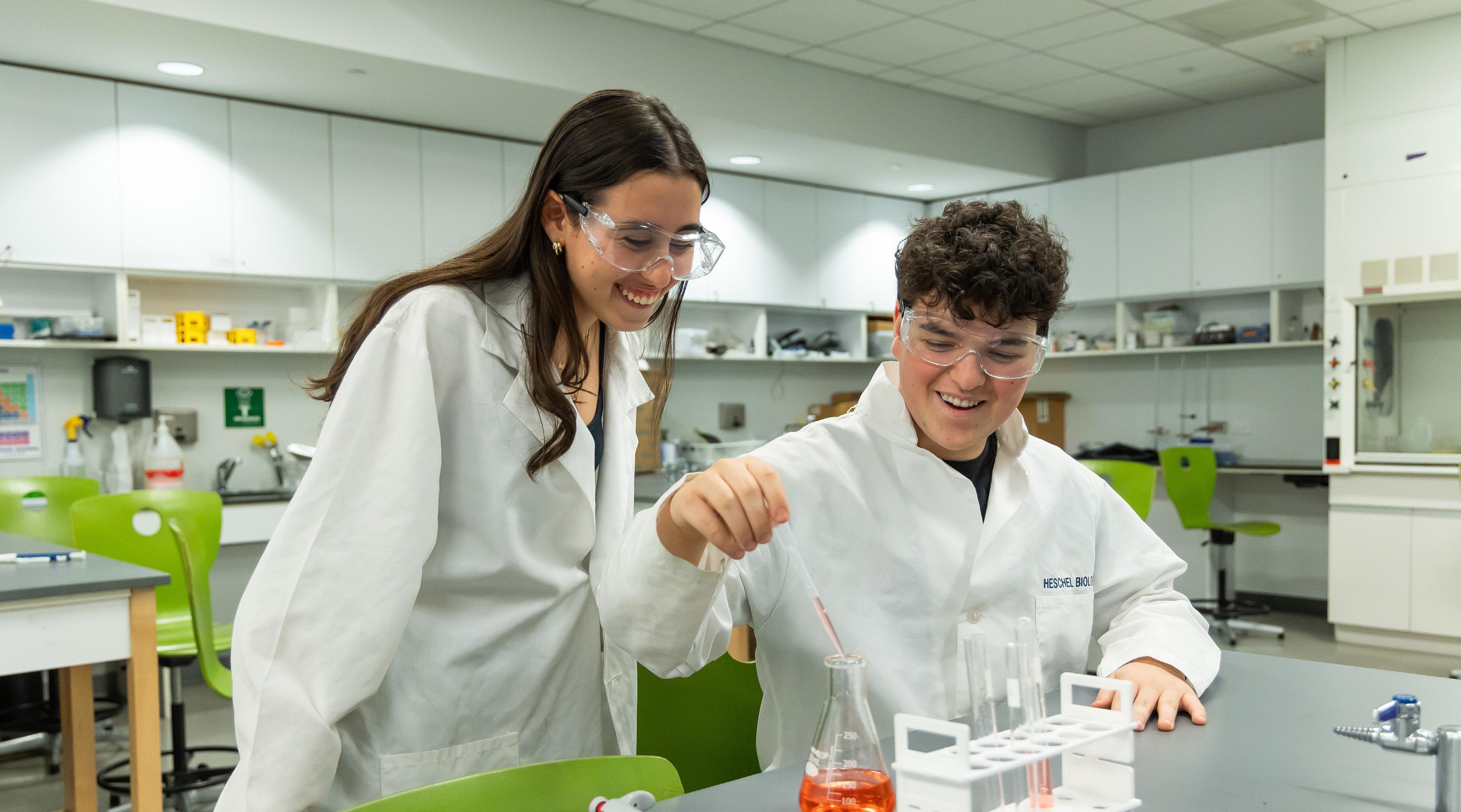
This course is an introduction and survey of the current knowledge of biology, its principles and the scientific methodology that has brought us this knowledge. In addition to learning information, students in this course are challenged to learn how to think critically and scientifically about biology, medicine and science in general. Topics covered include: the nature of life, cell structure and function, metabolism, genetics, ecology, and evolution.
Classwork, discussion, homework and reading assignments are supplemented by experiments and other activities and projects geared to engage students in active scientific inquiry. Biological mechanisms and systems are analyzed through experimentation and observation.
COURSE OFFERINGS:
• Chemistry
• Accelerated Chemistry
• Honors Chemistry
• Topics in Chemistry
CHEMISTRY
This course covers key areas of a traditional high school chemistry course and ensures that students have a solid basis for further chemistry studies. A full understanding of the basic concepts is strongly emphasized in order to make the subject matter in this course more logical and predictable. Major topics include the nature, types, and properties of matter, the historical development of models of the atom, the Periodic Table and its relationship to atomic structure and the properties of the elements, bonding and intermolecular forces, chemical changes, the kinetic
theory of heat and temperature, the behavior of gases, solutions, and acid-base chemistry. Developing a unique understanding of the concepts, and not using rote routes to solving problems, are the main goals of this course. Supporting the coursework is a series of laboratory experiments that not only help bring the basic concepts alive for students, but also give them expertise in handling laboratory equipment, carrying out experiments, and drawing conclusions from their results. While the primary goal of the course is to give students a solid and enduring knowledge of chemistry, a second goal is to encourage students to use scientific reasoning to explore complex areas beyond chemistry. In this regard, a selection of contemporary technical issues are discussed in detail. In previous years these topics have included energy sources; the properties, sources and uses of water; soaps and detergents; the chemical composition of fats and their relevance to a healthy diet; genetically modified foods; sugar substitutes; mercury in the environment; organic produce; herbal and vitamin supplements; energy drinks; the placebo effect; the claimed relationship between autism and mercury in vaccines.
The subject matter of this course is largely the same as that of Chemistry. However, Accelerated Chemistry considers many of these subjects in more detail and more quantitatively. The pace is more rapid than that of Chemistry, as well.
All areas of high school chemistry are covered in depth, with an emphasis on preparing the students for college chemistry courses. This is an intensive course requiring a strong commitment by the students to excel, and is focused on understanding overarching concepts rather than learning discrete areas of chemistry. Supporting the coursework is a series of laboratory experiments that are directly applicable to the key concepts in the course in order to deepen the understanding of these concepts. These labs also give students expertise in handling laboratory equipment, carrying out experiments, and drawing conclusions from their results. Students in this course are prepared to take the SAT II subject test.
Topics in Chemistry emphasizes basic concepts in chemistry using hands-on activities and experiments. The range of topics covered in Topics in Chemistry is largely parallel to that of Chemistry, but with less emphasis on quantitative calculations and more on conceptual understanding. Students will learn about the nature and properties of matter, how the structure of atoms explains the behavior of substances, chemical change, the molecular basis of heat and temperature, and the properties of solutions, acids, and bases.
This class affords students the opportunity to participate in the community of scientific research and scholarship as part of their high school experience. As participants in this course, students engage in the following:
Students choose and explore a topic of interest. The topic may come from mathematics, computer science, physical science, life science, or medicine.
Students develop skills for research by conducting on-line bibliographic searches of international databases of scientific journals.
Students conduct an original piece of research under the guidance of their scientist mentor and their teacher. They work with their mentors in research laboratories for 5-6 weeks during the two summers after 10th and 11th grades.
Students submit their research to both JSHS and to NYCSEF. Students present their research at the NYCSEF competition in the spring, and also present their work at the school’s STEAM symposium.
COURSE OFFERINGS:
• Physics
• Honors Physics
Students in this course will develop an understanding, mathematically and conceptually, of the laws that govern the universe. Through lab work, discussion, mathematical problem-solving, and traditional ped-
agogical methods, students will learn and apply the laws of Newtonian Mechanics, the great conservation laws, electrostatics, electricity and magnetism and the wave behavior of light and sound. Emphasis is placed on developing laboratory and and analytical thinking skills and understanding of practical applications of these ideas in engineering, nature, and other sciences.
Students in this course will use the same approach as the Physics course, but topics will be covered in more depth both conceptually and mathematically.
In the first semester of this course, we will take a deep dive into electrodynamics and electromagnetism. Second semester will begin with introductory quantum mechanics, and modern particle physics, then finish with astronomy, astrophysics and cosmology. Electromagnetism is the fundamental concept behind most of the innovations of the 19th century such as electric motors and electricity generation, as well as the basis of many modern technologies such as wireless charging and wireless telecommunication. Quantum mechanics forms the basis of most 20th and 21st century technologies, such as lasers, computing, LEDs, and nuclear energy. Physics utilizes a great deal of mathematics to make predictions and utilize the theories developed. You should be capable and comfortable with algebra and trigonometry. When applicable, the level is equivalent to an algebra-based AP Physics course.
Prerequisite: Successful completion of Honors Physics or Approval of 11th grade math and science teachers.
The class focuses on advanced topics in Biology that build on concepts previously covered in Honors Biology. The course will begin with the study of water, the key to life on Earth, where we explore water potential and the intersection of biology, chemistry and physics. Then we will focus on viruses and how they manipulate the cellular machinery as well as the immune system. Different cells communicate with one another by generating, transmitting, and receiving chemical signals. We will explore how genes, responding to different chemical signals, are regulated and how these processes have been manipulated in modern biotechnology and genetics. The course will conclude with a study of climate change and an independent research project on an issue in environmental science, which will be presented to the class. Student-directed laboratory investigations will be featured throughout the course. This course will be as fast paced and rigorous as the AP Biology course.
Prerequisite: Successful completion of Honors Biology or permission from the teacher.
In this one-semester course we will explore the structure and function of the human body, including the ways that body systems work together to provide homeostasis. We will examine the skeletal, muscular, respiratory, digestive and nervous systems, as well as a few special senses such as taste and vision. Lab investigations include interactive online activities and dissections of preserved non-human animal organs.
Workload: Weekly homework assignments and three (possibly four) tests.
Environmental chemistry is an interdisciplinary course to study and investigate the conditions of our planet’s air, water and soil, and climate. We will analyze, through a chemistry lens, the phenomena created by human processes that are affecting our environment. In particular, we will go out into our local environment and collect samples to study in our laboratory, and investigate potential solutions to our most pressing problems. We will examine the sources and the chemistry of these phenomena as well as sustainable remediation projects through group research, handson activities, and labs.
Robotic Engineering is a lab-based one semester course that uses a hands-on approach to introduce the basic concepts of robotics, focusing on the construction and programming of working models. Each student will have an Arduino-based robot and sensor set, and will learn to code it to perform tasks of their own design. Building on students’ knowledge of coding and STEM skills, we will use Arduino-based systems to integrate sensors and actuators to build both autonomous robots and interactive stabots. Further, we will look at “the internet of things” to see how systems can wirelessly work together to create functional networks that communicate with each other.
Digital images from cell biology, crystallography, and nanotechnology are beautiful and awe-inspiring even as they illustrate complex phenomena and scientific
discoveries. Delve into the beauty of science as we examine images and videos from Princeton University, the Museum of Modern Art, The European Organization for Nuclear Research (CERN) and many other sources. Learn how artistry through light, sound, and movement can illustrate and illuminate current scientific research, and create your own science art using digital microscopy, bacteria, and other media.
Workload: In-class writing assignments and discussions based on videos and readings, written homework, and a final project worth 50% of your grade.
In this one-semester course, we will investigate how scientific disciplines such as advanced molecular biology, as well as chemistry and physics are applied to the law and allow for investigative techniques. The course aims will primarily be: (i) comprehension of forensic procedures, currently enforced by crime scene investigators in the criminal and civil justice system and (ii) laboratory investigations illustrating forensic methods like fingerprinting, fiber analysis, ballistics, arson, and tracing adopted by scientists to interpret evidence at the crime scene.
There are many professional and academic fields where knowledge of coding would be an important skill. Learn the basics or continue to develop your skills in coding in javascript. Eventually this class will build towards designing and coding interactive video games.
This lab-based advanced chemistry course expands on areas covered in 10th grade and introduces students to new areas of chemistry. Specifically, the course covers thermochemistry, chemical equilibria, entropy and free energy, chemical kinetics and reaction mechanisms, and mechanistic pathways in organic chemistry. To ensure the course is as visually exciting as it is intellectually stimulating, reactions that delight and surprise the senses will be selected.
For all areas, except organic chemistry, assessments are based on regular quizzes and on analyses of lab data. Since organic chemistry can be complicated, assessments in this part of the course are done collaboratively to enhance the learning experience for all students.
Robotic Engineering is a lab-based course that uses a hands-on approach to introduce the basic concepts of robotics,focusing on the construction and programming of working models. Each student will have an Arduino-based robot and sensor set, and will learn to code it to perform tasks of their own design.
Building on students’ knowledge of coding and STEM skills, we will use Arduino-based systems to integrate sensors and actuators to build both autonomous robots and interactive stabots. Further, we will look at “the internet of things” to see how systems can wirelessly work together to create functional networks that communicate with each other.
In this course, students learn the principles of engineering design and apply them to a project of their own design. Students will learn to choose a project that addresses an important problem, and then design a solution with CAD software, 3D printing, and model making in foam core.
This senior elective course is designed to explore the process of technical innovation, from the inception of an idea through protecting an innovation via the patenting process. Students use their imagination to identify ideas that are thought to be novel and follow up with a systematic review of the prior art. Students then assemble the data to support these innovations. Patent lawyers will visit our classroom to teach the students how to write a patent and draft claims to ensure the greatest protection for an innovation, as well as how to navigate the complex patenting process.
What is a clone? What are GMO’s? Will scientists soon manipulate the human genome to change what it means to be human? The students will explore these questions and other topics in Biotechnology. This field of science includes many techniques that involve DNA, such as recombinant DNA technology, CRISPR-Cas9 gene editing, and stem cell research. Through readings, videos, discussions, and laboratory investigations, students will gain a deeper understanding of modern biological concepts, critical thinking, communication, and laboratory skills.
In this course, we explore in depth some of the important scientific issues of the day. These issues will naturally change from year to year depending on their profile in the media.
The course involves students reading and critically analyzing articles from newspapers and magazines, along with abstracts of scientific papers, with an eye to identifying which aspects of the articles lack a scientific perspective, and to determine whether conclusions are merited based on the presented data. In particular, we review discussions on specific scientific subject that come to contrasting conclusions based on common data, and deduce which conclusion is likely to be most valid. Areas that have been discussed include fossil fuels, fracking, climate, vaccination, significant figures, veganism, diet and health, circumcision, the meaning of “organic” and “green”, and natural vs. synthetic.
Computer Science builds abilities in design, problem solving, logic, organization, collaborative work, documentation of process, and refinement of execution through iteration, reflection and re-focusing. The goal of the Computer Science curriculum is to provide students with the skills to be able to construct tools to solve problems in science, art, storytelling and creative expression.
All 9th grade students take a one semester course in computer programming designed to accommodate both beginner and advanced students. Beginning in 10th grade, more comprehensive courses are offered.
Students learn the basics of computer programming in a project-oriented structure. The course is designed so that there are varying levels of assignments to meet the needs of students with different levels of experience and ability from the novice to the more advanced. We use a variety of coding languages, including Flash Actionscript, with its focus on interactive animation and games, and Processing, a simplified version of Java, which is easy to learn while at the same time being a very powerful object-oriented language with extensive libraries for graphics, midi sound, camera vision, etc. Processing is widely used by many contemporary musicians and artists who are moving from traditional media to computer based artworks and installations. Depending on student interest, we also explore microcontrollers such as Arduino to create projects that use sensors, motors and lights. Students learn principles and practice of coding including but not limited to these topics: variables, data structures, functions, objects, debugging, and computer graphics.
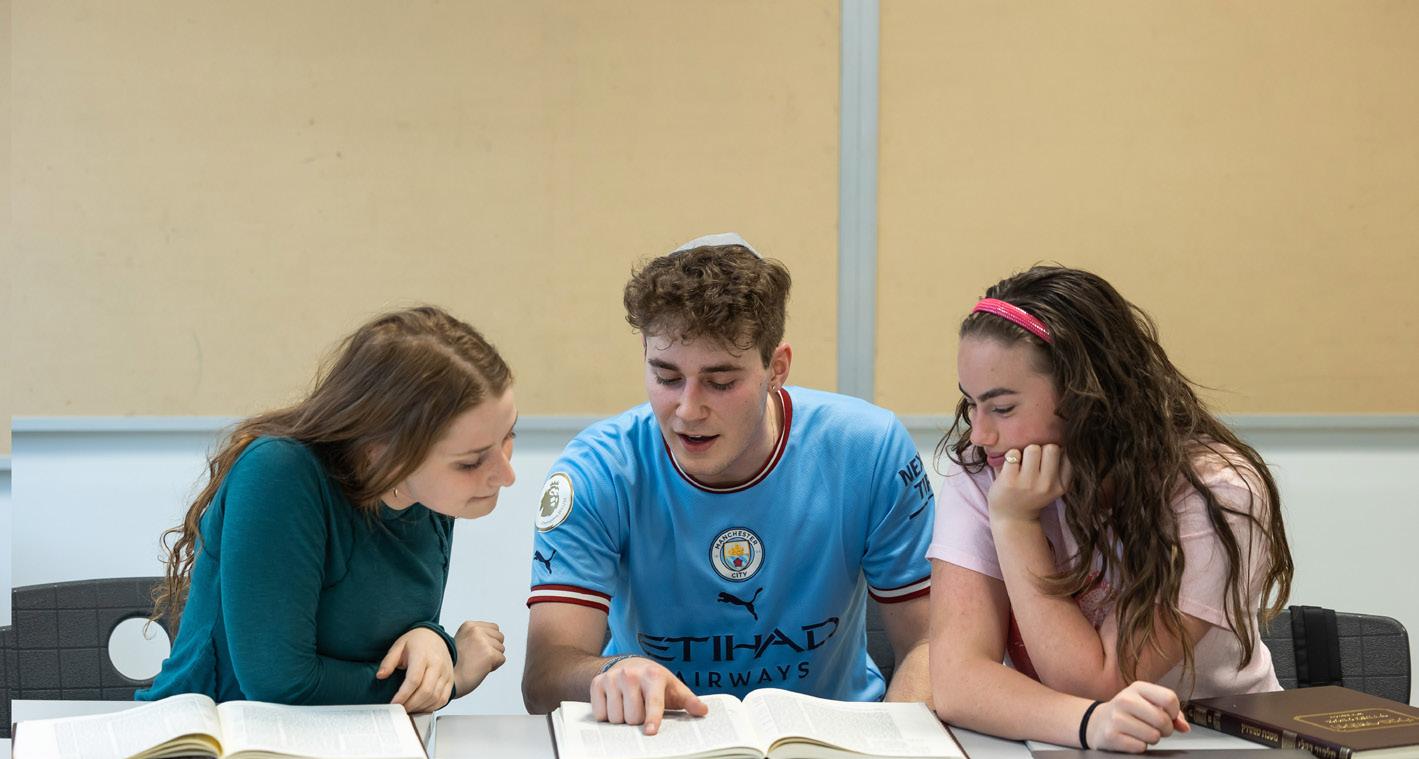
Limudei Qodesh learning experiences are designed to provide students with the skills, knowledge, and most important, the disposition to continue to interact with Biblical and Rabbinic texts throughout their lives. Students are encouraged to see their engagement with these texts and the ideas they express as part of their own developing and growing identity as Jews. Stressing the value of critical thinking, classes are designed for students to learn the skills necessary to engage in close, thoughtful, and reflective readings of the text. Students learn both to raise questions based on their textual studies and to develop the skills to locate textual evidence to support their own conjectures and interpretations. Fundamental to Limudei Qodesh classes is the idea that respectful and thoughtful interactions with others serve to sharpen and refine our own positions. Thus, students learn to listen carefully to each other and to respond seriously and thoughtfully to the other learners in their classrooms. All four years of the curriculum cohere around an examination of the brit (covenant) between God and the Jewish People. Students in 9th grade study those moments in Sefer Bereshit (Book of Genesis), when the Divine-human relationship is most sharply defined as an expression of the covenantal relationship. Through selected sugyot (portions) from the Talmud Masekhet Brachot (Tractate of Blessing), students examine tefillah (prayer) as a manifestation of the covenant. Limudei Qodesh in tenth grade explores the concept of covenant at the national level. Students explore the birth of the nation and its early years in the land in their study of Sefer Shemot (Book of Exodus). Through selected Talmudic sections from the eight chapter of Tractate Bava Kamma, tenth grade Talmud explores the interplay between civil and religious law by examining the consequences of one human being damaging another. Through an analysis of The Book of Kings and Latter Prophets, students in the 11th grade explore 400 years of Jewish history culminating in the destruction of the First Temple and the exile of the nation from their promised land. The study of selections from Tractate Sanhedrin provides students the opportunity to explore the challenge of creating a just society in the face of fundamental competing values. Twelfth grade course electives challenge students to build personal bridges between themselves and their learning, as they work to integrate the texts, ideas and values that they have studied with their own developing identity as young Jewish adults.
Students who are enrolling in a day school for the first time enter the Sha’ar Program, which offers students specialized classes in both Jewish Studies and Hebrew. Meaning gateway in Hebrew, the goal of the Sha’ar Program is to provide students with the skills, content knowledge and comfort to fully integrate into all aspects of life at the High School—academic, co-curricular, religious, and social. The combination of small class size, highly motivated students, and a targeted and focused emphasis on developing proficiency in conversational Hebrew allow students to transition from Sha’ar Hebrew Classes into the regular Hebrew Language and Literature track in twelfth grade. Ninth and Tenth grade Jewish Studies classes for Sha’ar students emphasize acquisition of the linguistic skills necessary to study Tanakh (Hebrew Bible) and Talmud (Rabbinics) in the original language, allowing students to fully integrate into the core Jewish Studies classes by 11th grade. Both inside and outside of the classroom, faculty pays special attention to covering those areas of Jewish life and living that might be new to students enrolling for the first time in a Jewish Day School.
Ninth grade Limudei Qodesh focuses on the brit (covenantal relationship) between God and human beings. The year begins with an exploration of those moments in Sefer Bereishit (Book of Genesis) when the Divine-human relationship is most sharply defined as an expression of brit. We study the development of this concept through an exploration of major personalities in the Book of Genesis, from Noah through Avraham. Utilizing the conversations between God and each major figure and the actions and reactions that surround their relationships, we probe the underpinnings of those interactions, examine the formulation of their covenant, and interpret the ties that bind them to each other. The second half of the year turns to an examination of tefillah (prayer) as a manifestation of the brit between God and human beings. Selected sugyot (portions) from Talmud (Masekhet Brachot) serve as the textual basis for this exploration. The two halves of the course are unified by the following set of guiding questions that form the lens through which we view brit in all of its various manifestations: • How does covenant inform the relationship between God and people? • What are the ramifications of the mutual nature of the covenant? • How does the covenant as expressed in these foundational Jewish texts reflect itself in our lives today? In ninth grade, Limudei Qodesh is taught as one integrated and unified course that utilizes the meeting time of what becomes two separate courses in tenth through twelfth grade. Students study Tanakh in the first semester and Talmud in the second semester.
This double-course embraces the responsibility of introducing the ninth grade Sha’ar students to Jewish studies at The High School, and begins the two-year process of preparing the Sha’ar students to join their peers in eleventh and twelfth grade Talmud and Tanakh. As such, we explore major themes in Jewish holidays, the covenantal narratives of Genesis, and selected sections from the Talmudic Tractate Berachot The texts are chosen with an eye towards four distinct but linked goals: (a) skill-building and introducing the students to Hebrew texts at an appropriate pace for their learning; (b) familiarizing the students with Jewish ritual in the school setting, (c) helping students develop personal understandings and meaning regarding the traditions and observances of Judaism, (d) paralleling the non-Sha’ar ninth grade curriculum offering all ninth graders the opportunities to explore similar themes with an emphasis on how the texts we look at depict the relationship between God and human beings. The course also leverages its small number of students, allowing for the tailoring of materials and assessments, to whatever extent possible, towards each student’s abilities.
Building on the conceptual and textual framework from ninth grade, Limudei Qodesh in the tenth grade explores the concept of the covenantal relationship at the national level. In tenth grade, Limudei Qodesh is divided into two separate classes, one in Tanakh and one in Talmud.
Tenth grade Tanakh focuses on the concept of brit as it undergoes a metamorphosis in the Sefer Shemot (Book of Exodus) from the formalization of a relationship between God and individuals to establishing the foundation of a relationship between God and an entire community. First semester begins by exploring the birth of the nation amidst the pangs of Egyptian slavery. Debating the strength of the Israelites’ ties to their past and their God, the course follows Moshe as God chooses him to redeem God’s chosen people. The Exodus itself is examined through the lens of God’s purpose in inflicting the 10 plagues upon the Egyptians, as well as the foundational role that it comes to play in the future enactment of the brit. Second semester focuses on the Revelation at Sinai, the damage done to the brit through the building of the Golden Calf, and the subsequent re-affirmation of the relationship between God and the Israelites.
The focus in tenth grade Sha’ar Tanakh follows the covenantal relationship as it shifts from an individual relationship to a national one that is codified in law. Following the Jewish people as they leave Egypt, experience the revelation at Sinai, receive the Torah, build the mishkan (Tabernacle), and encamp in the desert, this course explores the making of a nation. The text for this course is Sefer Shmot (Book of Exodus). This course is designed to help students build the necessary Hebrew skills to make a smooth transition into eleventh grade Tanakh.
This course examines the interplay between civil laws and religious values. Based on the assumption that laws regulating the relationships between human beings are a manifestation of the brit between God and humans, this course explores the legal and religious ramifications of one human being causing physical damage or harm to another human being. The text for this course is the eighth chapter of Tractate Bava Kamma. Students begin to encounter the rabbinic process and its intersection with belief in ninth grade. In tenth grade, the goal is for students to consider the underlying values behind certain legal enactments of the Rabbis as they relate to our responsibilities toward one another in the context of our covenantal obligations. As a complement to the Tanakh curriculum, where the role of law in building the nation is explored, the nature of law and the role that law plays in creating and maintaining societal relationships are central elements of the Talmud curriculum.
This course builds on the introduction to rabbinic literature that Sha’ar students encounter in ninth grade. The classroom environment supports collaborative reading Rabbinic texts, investigating the broad range of legal and theological issues, frames of mind, and ways of thinking that characterize classical rabbinic texts. Students learn the skills necessary to investigate these texts. The curriculum fully parallels that of the core class, focusing on selections from the eighth chapter of Tractate Bava Kamma. As is the case for the Sha’ar Tanakh class, this course is designed to help
students build the necessary skills at decoding Rabbinic texts in the original language to make a smooth transition into eleventh grade Talmud. As quickly as the students’ ability levels allow, students encounter Talmudic texts primarily in the original language, as a way of building upon the students’ burgeoning grasp of rabbinic literature and as a preparation for eleventh grade Talmud class.
Students focus on the brit relationship between God and the monarchic society. Beginning with the construction of the Temple and ending with its destruction, they explore the brit relationship in the Book of Kings, as well as the trials and tribulations of Israel’s great prophets in Neviim Achronim (Latter Prophets). First semester focuses on the rise of King Solomon and his building of the Temple. After falling prey to idolatry and untold wealth, the Jewish kingdom is torn in two Judah and Israel. Battles for succession, political upheaval, and civil war pave the way for the famous prophet Elijah. The course then follows the prophetic career of the Elijah as he demonstrates an unparalleled zealousness for God. The prophet Elijah sets the stage for the Latter Prophets which are explored in the second semester. Students study selections from Amos, Hosea, Isaiah, and Jeremiah, and analyze the historical, political, literary and theological dimensions of these prophetic books. In eleventh grade, an honors option is available for students.
Talmud in the eleventh grade focuses on fundamental Jewish religious values as they manifest in the rabbinic justice system. Students explore what happens when fundamental principles that are at the heart of the legal system come into conflict with each other. How can courts balance the need for truth and justice in a way that promotes peace among litigants? How can Jewish courts implement the death penalty, when all human life was created in the image of God? How do we balance individual and societal needs? What is it justified and indeed necessary to intervene as an individual during the commission of serious crimes? When does adherence to the legal system require one to sacrifice his or her own life? What role does God play in the human justice system? Selected sugyot from Tractate Sanhedrin form the core texts for the course. In eleventh grade, an honors option is available for students.
How do we decide what are the right choices in life?
How are traditional Torah values relevant to one’s life and the choices that one makes? Seeking to explore the values that the Jewish legal tradition applies to real-life issues, the Ethics course examines some core halakhic texts and brings them into dialogue with contemporary ethical topics such as: organ donation, abortion, sexuality, war, and stem cell research. Students reflect on their personal decision-making process, the decision-making of the rabbis, and the interface and tension between them. The learning in this class is centered around class participation and reflection. In addition, there will be reading and reflec-
tive writing assignments.
Students explore the world of midrash and the effects that it has had on the world. Students examine famous midrashim, trace their textual roots by learning the Tanakh stories from which they derive, and then follow their path through history. Examples include: midrashim on Akedat Yitzchak (Binding of Isaac) and their impact on Jewish martyrdom, as well as their impact on Christianity; midrashim on Esau and Ishmael and how they shape Jewish perspectives on nonJews and anti-Semitism; midrashim about Gan Eden and their impact on the concept of Satan in Western Civilization; midrashim regarding Eve and their use in the Feminist Movement.
According to the Talmud, the Destruction of the Temple in Jerusalem not only altered our national history, but our very relationship with God and God’s laws. How did the Rabbis who wrote the Talmud have a relationship with God when God did not directly relate to them? How did they deal with the tension of believing in God while horrible things were happening around them? How did they exert their own power and agency in their relationship with God, in light of this destruction? Do God’s laws still belong to God, or to the people charged with actualizing them? This course deals with these questions as addressed in Talmudic texts, and invites students to explore how they relate to God, the Jewish legal tradition, and their own
Jewish practices and beliefs in the world today. The Talmudic texts will be available in the original and in English, with some additional contemporary readings.
This course examines central issues and themes in Jewish thought that continue to challenge us today. With an emphasis on medieval and modern Jewish philosophical texts, we will explore a range of topics with the goal of helping students formulate their own positions on these issues and sharpen their capacities for philosophical reflection. The central questions asked in the course are: “What kind of God do I believe in?”, “How can people believe in God at all?” and “what can we know about the world and our place within it?” Along the way, we will look at classical questions in Jewish philosophy, including “Are there limits to what an Omnipotent God can do?” sometimes formulated as “Can God make a rock God can’t lift?”, “Do people have ‘free will’?” and “Do people have a purpose and how should that influence the way we think about our actions and lives?” We will also complete a major unit in which we discuss thinking about God after the Holocaust and “What does it mean to believe in an all-powerful and good God when there is evil in the world?” The work for this course includes readings, brief response papers, an art project, and a final paper.
What does it mean to live Jewishly? Moments of life transition provide us with opportunities to invite Judaism into our lives. Most cultures and traditions cele-
brate birth, death, marriage, and coming of age. We will explore how the traditional and modern Jewish rituals surrounding these moments harness the natural highs and lows of life, guiding the practitioners to Jewish understandings of the human experience. Learning about these rituals brings us into conversation with rabbinic attitudes toward gender, sexuality, interpersonal relationships, personal responsibility, family, community, meaning of life and death, and the marking of time. We will explore the interactions between spirituality, psychology, theology, the power of ritual, and the power of time itself.
The Jewish tradition holds an awesome wealth of wisdom, one that is not solely restricted to the intellectual/conceptual sphere of learning. It very much exists for the here and the now of who we are as people and as Jews. This wisdom can move us to develop qualities like humility, patience, and respect, fundamentally shifting how we encounter the things in the world that hold us back from living happy, fulfilling, and meaningful lives. The practice of embodying this wisdom is often referred to as Tikkun Middot: a central area of study dealing with the cultivation and refining of our ethical character traits. In this class, we will examine some of the most essential character traits through an honest encounter with various Biblical and Rabbinic texts, all concentrating on Judaism’s demand that we become kinder, happier, stronger and more peace-driven people. This class will include weekly journaling, frequent graded writings, and a final creative project.
This course is designed to challenge students to recognize their assumptions, and investigate different approaches to the learning of Tanakh, as they come to terms with such issues as: subjectivity vs. objectivity in interpretation; significance of authorship; authorial intent; use of archeology; what Tanakh study means to them. The course is divided into four units, each investigating a different approach to Biblical study: the classical commentary approach with emphasis on the role of Midrash [Text: Akeidat Yitzchak]; the literary approach [Text: The Book of Judges]; archaeological approach [Text: Book of Kings]; The Documentary Hypothesis and Modern Biblical Scholarship [Text: Noah]. Through exploration of the biblical texts and secondary articles, the goal of each unit is to raise the philosophical issues behind each approach to better clarify the students’ personal sense of text in general and Tanakh in particular.
The Bible and Rabbinic tradition understand God to have a unique relationship with the Jewish people; at the same time, they do not imagine that everyone in the world needs to become a Jew. In this class we will explore the relationship between Judaism and other religions, such as Christianity, Islam, and Buddhism. What have Jewish thinkers learned from other faiths, and where is it important to draw lines that shouldn’t be crossed? Our exploration of these questions will aim to enrich our sense of what it means to be Jews in a religiously pluralistic society.
In this course, we will study the complexities around the case of mitah b’shogeg (inadvertent murder) and the unique institution of arei miklat (cities of refuge) established to protect the culprit. The 2nd chapter of Tractate Makkot will anchor our study. We will also explore related material in Tanakh, Midrash and halakhic literature. Our exploration will raise deep questions surrounding the definition of responsibility, the ethics of revenge, the nature of exile and the possibility of repentance. Texts will be studied in their original Hebrew/Aramaic. Strong texts skills, love of Talmud, commitment to hevrutah study, and active class participation are required.
In this course, we will learn about the Biblical and rabbinic sources for traditional Shabbat practices. To understand how Biblical and Rabbinic concepts are applied to practice, we will delve into the prohibition of electricity use on Shabbat, the different aspects of this prohibition, and the possible limits of this prohibition. Students in this course will gain insight not only into the halakhic process, but insight into how halakhot develop over time and are applied to modern living. This course will allow students to expand their basic sense of what Shabbat is about and how it is practiced, explain some of the weirder Shabbat practices they have probably encountered, and, hopefully, give them the tools to develop their own Shabbat practices in a way that is close to the spirit of traditional Hilkhot Shabbat, but that is still authentic to their own Judaism. The class will be reading intensive, requiring regular analysis of different Biblical and Rabbinic
sources, as well as some contemporary articles. In addition, students will be expected to complete journal assignments, at least one short project, and a final project.
With the creation of the modern State of Israel, Jews debated what role, if any, Torah law and values should play in shaping national policies. Could the halakhic system, which guided individual people and communities for centuries, now be applied to national issues? This class explores the interface between Halakhic sources and national policy. Topics will be studied through the lens of teshuvot (responsa) literature (with texts available in English translation). Close attention will be paid to the decision-making process. Sample topics include: Is it ethical to export Israeli-made weapons to foreign governments? Should the distinct halakhic traditions of Sephardic and Ashkenazic communities be abandoned in favor of a new “Israeli Halakhah”? Who should be considered a Jew for purposes of the Law of Return? Should conversion standards in a Jewish state be different than in the Diaspora? Should IDF soldiers refuse orders that violate their understanding of Jewish values? How far must the IDF go to avoid civilian casualties? How can shmitah (the sabbatical year) be observed without crippling Israeli agriculture?
We will encounter the Talmudic Rabbis as storytellers and weavers of fantastical tales. Through our study of Talmudic legends, we will deepen our understanding
of the questions, worries, and priorities that animated the Rabbinic community in the period following the destruction of the Second Temple and discover in what ways their struggles and values parallel and diverge from our contemporary moment. With an emphasis on literary analysis, texts will be provided in both their original form and in translation.
We talk a lot about God, our relationships with God, what it means to be a Jew, a person and a member of society. But how often do we talk about how one goes about developing our character, a relationship with God, or ways of connecting with our most essential, spiritual selves? All the more so, how about how Jewish tradition tries to answer some of life’s most essential questions; who we are and what gives life the meaning we so desire? Through the critical examination of science, psychology, philosophy and the Hasidic tradition, this course will examine the many ways these two traditions have answered and continue to answer these questions. Additionally, we will learn to take theory to practice; trying various Jewish Spiritual practices, such as Jewish meditation and prayer. This course will challenge students to deepen their connection with their most essential selves, the Jewish tradition, the Divine, and God, developing a more personal and meaningful Jewish spiritual practice. Students should expect to try all practices examined in the course, be willing to share personal thoughts and be respectful of their peers’ traditions and practices.
In this class we will learn a complicated, textually challenging, and profoundly insightful Talmudic Sugya concerning moments in which human dignity conflicts with Jewish law. When a human’s dignity comes into conflict with the very law that is meant to uphold it, what do the Rabbinic sources say we should do? When we explore human dignity and see the value it holds in the Rabbinic tradition, how do we go about honoring others’ dignity as well as our own? Through this lens, we will also encounter how the Rabbinic attitude toward human dignity developed over time. This course will entail rigorous Talmudic study in the original Hebrew and Aramaic, with accompanying Rishonim, including Rashi and Tosfot. For students who need it, the Talmudic texts will be scaffolded to your skill level and Rishonim will be offered in translation.
The modern world presented the Jewish people with entirely new challenges and opportunities, and at the same time brought a new perspective to classic Jewish questions about God, Torah, and Israel. Centered around a series of topics (for example, modern politics, Jewish law, feminism, race, Jewish denominations), this course will explore the deep questions of what it means to be a Jew in the modern world. Attention will be given both to the contributions of major Jewish philosophers, and to the ongoing meaning of these questions for our own lives.
In this course, we will take a new look at familiar narratives from the Tanakh, study some less familiar narratives, and read classic and contemporary midrashim about these stories. In each case, we will ask questions such as: What does the Tanakh teach about gender? What role do different characters play in this story and how do these roles relate to the gender of the characters? How do we relate to a text that is sacred to us and at the same time offers us problematic and even disturbing stories? The texts we will study include: the story of creation (both versions), Sarah and Hagar, Yehuda and Tamar, the women of Shmot Aleph and Bet, and the story of Bat Yiftakh. We will also explore the perspectives on gender in these texts brought by contemporary scholars including Carol Meyers, Phyllis Trible, Carol Gilligan, Judith Plaskow, Amy Kalmanofsky, Joy Ladin and Tamar Biala.
Limudei Qodesh classes in the spring semester of senior year include a seminar on Judaism and contemporary issues -- Tzei U’lemad . These unique classes provide an opportunity for students to begin the process of integrating their Limudei Qodesh studies at the Heschel High School with their future lives outside of the day school environment. Each student enrolls in a class that explores an issue, topic, or challenge which concerns them and are interested in responding to. Through exploration, reflection, and guided research, students seek to answer the question of what it means to them to bring a Jewish lens as they consider ways to address that topic.
Interfaith marriage continues to be a topic of debate. Is it fair to say we care about Jews marrying Jews? Or do we say love is love? Some say it is time to accept interfaith relationships as a reality. If that is true, how should American Jewish institutions and communities be dealing with our current reality? What policies and practices should be put into place to ensure that those couples remain Jewishly connected? Others argue that we must continue to discourage intermarriage. We will engage in personal reflection and consider our communal response. How should the Jewish community approach the reality of people building their lives with partners outside of the Jewish community?
In this course, we will be exploring, and working toward responding to, antisemitism. Drawing upon biblical and historical examples, we will study a number of different forms antisemitism has taken, including, among others, charges of disloyalty, atheism, particularism, and attacks on the character of Jews (greedy, lascivious, etc.). After identifying parallels with bigoted characterizations of other “outsider” groups and the way these appear in contemporary discourse, students will work to develop projects which respond to antisemitism in the present day, including how it manifests in anti-Israel efforts.
Why are there so many groups within Judaism? What are the historical and sociological factors that led to the splintering of Judaism into groups that are so fundamentally different? What are the main theological and social issues that create these divisions, and why is it that we can’t all just be pluralistic and get along? We will read articles by experts in the field, and explore case studies to understand how schisms form, and why the details are so important to each side in the debate that it is worth the cost. By exploring the Reform, Conservative, and Orthodox movements we will try to further our own understanding of the Jewish world around us, our place in it, and how we prioritize specific issues of religious importance [such as Shabbat] versus unity. Everyone has a line they won’t cross: what is that line for you? The learning in this class is centered around class discussions. In addition, there will be weekly reading and reflective writing assignments.
Jewish spirituality is more than prayer. More than the 3 times daily, heavily structured, austerely obligatory ancient practice curated over centuries. It is a rich encounter with and exploration of the self, God and others. This work has been laid out for us in many iterations, none as impactful for the modern Jewish world as the Chassidic masters. Looking at various ancient and modern Jewish texts, we will set out on the journey the Rabbis demand of a person looking to develop their spiritual selves. We will also try on the spiritual practices they recommend as forbearers to that journey. ‘Any time we feel deeply,’ Rabbi Kalonymus Kalman Shapira writes, ‘we are dealing with the soul.’
Working towards creating a more just society is a human imperative, but we are not just humans, we are also Jews. What is our responsibility as Jews to try to combat pervasive economic inequity? With so many people in the world that need our help in so many ways, how do we set priorities? In this class we’ll examine biblical and rabbinic sources on our responsibility to create a just society, with a specific focus on economic justice. How do we try and prevent people from becoming impoverished? How should we advocate and try to help people who have “less” than us? How much “giving” is enough, and is any amount of giving “too much?” How do we apply these ideas and texts to modern day society? As a group, we will work to come up with ways of addressing these pressing issues on three levels: societal/governmental policies, family/personal imperatives, and communal norm setting.
The Hebrew department seeks to develop students’ proficiency in the Hebrew language as a primary vehicle for expanding their connection to and love of Israel, and for enriching their understanding of their national, religious, and cultural identity. Since Biblical times, Hebrew has been a language of Jewish expression. Through the continued evolution and dynamic growth of Hebrew in relation to the modern world, Hebrew language remains key to understanding Israeli society and culture today.
The Hebrew Department is committed to enabling every learner, regardless of his or her background and innate abilities in second language acquisition, to gain proficiency and a connection to and love of the Hebrew language. We design our curriculum to develop Hebrew language skills in four fundamental areas of language proficiency: speaking, reading, writing and listening. Hebrew prose, poetry, drama, newspaper articles, movies, songs, and advertisements, taken from classical Hebrew literature and current Israeli culture serve as the springboard of Hebrew language acquisition. We organize our curriculum around thematic units that provide opportunities for students to use Hebrew language to communicate about ideas and events that are central to their life experiences as adolescents, to support their ability to navigate everyday life in Israel, and to explore their growing and developing identity as Jewish young adults.
The Hebrew Department provides three separate tracks for students in ninth through twelfth grade.
Students who are heritage speakers, and/or have studied Hebrew in Jewish Day schools, enroll in classes in Hebrew Language and Literature. Within this track, students are grouped according to knowledge and ability. Students in eleventh and twelfth grade are offered the option of an honors Hebrew class.
Non-heritage speakers who are entering a Jewish day school for the first time in ninth grade enroll in the Sha’ar track. Sha’ar classes use an Ulpan methodology, and are designed to transition students into the Hebrew Language and Literature track in twelfth grade.
Students who require additional support in second language acquisition enroll in the Basic Hebrew track. These small classes provide the individualized attention necessary for students to develop increasing fluency in all areas of language proficiency.
Within each track, each successive year of the curriculum builds on the previous year, as students learn to conduct increasingly complicated conversations on a wider variety of topics and read more sophisticated literary texts, and express themselves in writing with greater accuracy and nuance. When appropriate, students may move from one track to another, both mid-year and between years.
HEBREW LANGUAGE AND LITERATURE I
The ninth grade theme, Moreshet Dorot (Tradition as Heritage) speaks specifically to the students’ experience as they transition from Middle School to High School, and begin to make independent decisions about the relationship between their developing identity as Jews and young adults.
LITERATURE:
• Lehol Ish Yesh Shem by Zelda
• Yad Vashem by Aharon Meged
• Ha’kaitz shel Aviha by Gila Almagor
• Tarnegol Kaparot by Eli Amir
FILMS:
• Avia’s Summer
• Salah Shabati
• Under the Domim Tree
HEBREW SHA’AR I
Students with little or no background learn to recognize the fundamental structure of the Hebrew language and to acquire skills in oral expression, reading comprehension, and writing. Students learn the vocabulary and grammatical and linguistic skills necessary to engage in basic oral exchanges and to compose short sentences on familiar topics.
The aim of this course is to review and reinforce basic skills through conversational Hebrew, utilizing the Ulpan method. The course focuses on developing students’ communicative and grammar skills in Hebrew. The dialogues and texts are related to everyday life activities. Work is individuated for students as necessary, to allow for maximum linguistic growth.
The 10th grade theme Bein Adam Lehavero, (interpersonal relationships) focuses upon the interplay between the individual and his/her surroundings. Students engage in discussions about the challenges they face in social and interpersonal relationships, and their struggle to form and maintain their own identity in spite of peer pressure and in the face of new realities and changes. The goal of the class is to provide students with the vocabulary, grammar, and linguistic skills that will allow them to communicate their ideas and express themselves orally and in writing when discussing these topics.
LITERATURE:
• Lehiot Yahad by Shlomo Zamir
• Zemer Nugeh by Rahel
• Ananim by Dalia Rabikovitz
• Fradel by Devora Baron
• Something Sweet
• Broken Wings
• Hakochavim shel Shlomi
The second year in the Sha’ar track places a strong emphasis on the importance of conversational fluency, and students are encouraged to speak only in Hebrew. In a unit on “Travel” students learn vocabulary related to different types of travel, as well as places of interest such as restaurants, hospitals, libraries, offices, and shops. Other units include “The Human Body and Health” and “Professions”. Students acquire the skills to understand the main idea in short narrative texts and to compose written short paragraphs
Students continue learning the Ulpan method, as they develop stronger communication and grammar skills. The dialogues and texts are related to everyday life activities. Over the course of the year, students move from writing individual sentences to short paragraphs, and by the end of the year, compose their own short essays in response to readings and class discussions.
The eleventh grade theme, Dilemot v’arachim (Values in Tension), weaves through three separate units, all of which focus on Israeli culture and society. Using the stories of Etgar Keret, students explore tensions
inherent in the relationships between parents and children, both as a universal theme and as a reflection of tensions specific to life in Israel. The unique challenge of coming to grips with the horrors of the Shoah, and its impact on contemporary s Israeli society, is the backbone of the second unit. Finally, students examine the dilemmas inherent in Arab-Jewish relationships, from before the founding of the State to modern times, focusing on the tension between how the development of these relationships develop on the personal and national plane. Classic Hebrew literature is supplemented with newspaper articles and videos to provide students with a deeper understanding of current Israeli society--its hopes, aspirations, and challenges.
LITERATURE:
• Taharut S’chi’a by Binyamin Tamuz
• Lishbor et Hahazir by Etgar Keret
• Nalayeem by Etgar Keret
• Sakeeyot she Yomuledet by Etgar Keret
• Tzfira by Etgar Keret
• Abed Na’ar Haro’im by Natan Yonatan
FILMS:
• Metallic Blues
• Walk on Water
• The Lemon Tree
• Promises
• Precious
The goal of the third year of the Sha’ar class is to give students the skills and content knowledge to merge into the Hebrew Language and Literature track in twelfth grade. Students continue to focus on units that emphasize functioning in real-life situations. Students learn about famous artists and sports figures, and read a simplified version of an Etgar Keret story that is part of the Hebrew Language and Literature III program. Students work on engaging in longer and more sustained dialogue and producing written work on a range of topics that utilizes more complex grammar and syntax.
This course continues to develop students’ proficiency through the analysis of selected short stories and articles. The topics of these selections afford a wonderful opportunity for students to express themselves both orally or in writing.
The focus of the course is on contemporary issues faced by all sectors of Israeli society. The students discuss these topics in class, learn related vocabulary, and view Israeli films that portray the reality, challenges and complexities of life in Israel. Role playing, oral presentations and
creating short films are some of the activities through which students are encouraged to express and verbalize their ideas and thoughts in Hebrew.
This course is designed to enhance students’ ability to describe a variety of daily life activities in urban settings in Israel and in other cities around the world. Students watch daily conversations at the train station, the market in Jerusalem and Tel-aviv, and they learn about different foods of the world, and explore various hotels and many notable sights in India, Japan, France and around the world. Class activities are targeted to strengthen students’ skills in listening comprehension, speaking, and reading.
Fall Semester: Israel Today. This course offers students the unique opportunity to immerse themselves in Israel’s past and present to better understand the long path that the nation has taken, the current debates that exist, and to appreciate the contributions that it has made to today’s world. For a relatively young country, Israel has been the center of a remarkable number of creative initiatives and contributions in areas ranging from human rights to technology. This course offers an opportunity to personalize Israeli society by exploring selected topics such as: art, dance and movement, science and technology, outstanding people, archeology, Israeli poetry, literature, Nobel Prize winners, ways of dealing with mourning and loss, and Israeli cinema.
Tel Aviv is in many ways a sister-city to New York in terms of its vibrant day and night-life, rich and varied cuisine, and unique architecture. What would it mean for students to fully navigate these cities reading, speaking, and listening entirely in Hebrew? Using trips around New York City to supplement in-class learning about both cities, students in this class develop the knowledge, vocabulary, and fluency to serve as “tour guides” and “cultural critics” in both New York and Tel Aviv.
Students explore Central Park, visit and critique restaurants, take in many of the urban outdoor exhibitions, and learn about corresponding sites in Tel Aviv.
Introduced into an immersion environment, students of French are invited to discover the language and culture of France and French-speaking countries around the world. From everyday conversations, skits and songs to literary discussions and creative writing, students are exposed to a variety of approaches and media that allow them to discover the many facets of the language and culture.
Objectives:
• Speaking and understanding everyday conversations
• Reading unedited texts – Prévert’s poems (level 1) and Le petit Nicolas (level 2), Le petit Prince and the short stories of Maupassant (level 3)
• Writing analytical and creative pieces
In French 1 through 3, students learn to develop their skills from functioning in everyday situations to talking about their environment, feelings and expressing abstract ideas. The first three levels introduce all of the major tenses (present, past, conditional, future) in conjunction with the various pronouns and relative clauses. A textbook is kept at home for reference while class time is used for authentic material – songs, articles from the press, movie clips and literature.
Objectives:
• Reading articles from the press and debating ideas
• Familiarizing students with French painting and art
• Introducing students to French-speaking countries around the world
• Reading and performing a play in French
The main goal of French 4 is for students to zoom in on Paris before embarking on a cultural and linguistic journey to other French-speaking countries around the world. Through a project-based approach, students are first exposed to 19th century French culture and impressionist painters. Then they study and discuss the historical, cultural and linguistic particularities of French-speaking countries. Second semester is spent reading a play (Molière, Sartre) and performing the play for schoolmates. This allows students to work on their pronunciation and expression in a detailed and engagingg manner.
The overall goals for students of Spanish is to learn how to speak and understand the language and to appreciate and gain an understanding of the people and culture of Spanish speaking countries. Students accomplish these goals through daily exposure and practice with literature, skits, music, movies, plays, and games.
SPANISH 1-3.
• Speaking and understanding everyday conversations
• Comprehending authentic media- Bajo la misma luna, Las nueve reinas, El laberinto del fauno
• Reading unedited texts – El otro, Nada menos que todo un hombre, El almoahdón de plumas
• Writing analytical and creative pieces
In Spanish 1 through 3, students develop the language skills that enable them to function in daily situations in Spanish speaking countries. In each progressive year students hone their skillsets to eventually become proficient in the language by their 4th year. All major tenses (present, past, conditional, future) are learned during the first three years of Spanish to be used with all three moods (indicative, imperative, subjunctive). Realia(newspapers, songs, videos, etc.) is used weekly in the classroom in order to create an immersive learning environment that provides high quality exposure to the language.
Objectives:
• Listening to and reading current events and academic articles in order to engage in debates
• Exploring Spanish-speaking artists and their works
• Enhancing students’ knowledge of Spanish-speaking countries
• Reading and performing a play in Spanish
Spanish 4 focuses on the daily life, history and culture
in the focusing in the Hispanic world. Each class is introduced to a Spanish refrán- a Spanish idiom that students explain and find an equivalent of. Through projects, students embark on a journey through Latin America in which they explore immigration, art, music, movies and famous Spanish Novela, El Internado. During second semester, students are in charge of teaching one Spanish level 1 class. They also read and study a play which is then performed in front of their peers.
Objectives:
• Speaking and understanding everyday conversations
• Understanding Roman culture, history, society, and mythology
• Reading unadapted texts – Catullus, Caesar, Plautus, Cicero
• Writing analytical and creative pieces
• Understanding the Latin roots of English vocabulary
In Latin 1 through 3, students use the series Lingua Latina per se Illustrata and are introduced to all of Latin grammar and syntax and build a vocabulary of 3,000 words. Reading comprehension is developed in conjunction with active speaking, listening, and writing abilities. Students learn about Roman mythology, society, and history and discuss and write about these topics in Latin. Additionally, students learn Roman poetry and poetic meters through singing and performing.
Objectives:
• Reading advanced literature - Virgil, Horace, Livy, Sallust, Tacitus
• Deepening knowledge of Roman history and culture
• Expanding ability to express complex and abstract ideas with ease in Latin
Latin 4 is an advanced seminar conducted entirely in Latin. Students read Latin literature and discuss it in the target language. They write lengthy analytical and creative pieces in Latin. They memorize Latin poetry and songs. By the end of Latin 4, students will be able to read any Latin text and will be able to fluently express their ideas in the language.
Ancient Greek II is a continuation of a two-year program that emphasizes the development of reading skills while practicing Greek grammar in context. Following the narrative of Dicaeopolis and his Athenian family, the text interweaves passages about the epic hero Odysseus with modified excerpts from Herodotus’ accounts of the Persian Wars. One important aspect of learning Greek is to understand how languages work. With this understanding, students will gain a deeper knowledge of Greek and other languages, particularly English—as well as improve their reading abilities through the learning of Greek vocabulary. After completing this course, students will have a solid foundation and understanding of Greek language, history, mythology, and culture to apply to the world around them.
In this class, students will continue to build upon their previous three years of Arabic study under the Integrated Curriculum model, wherein we study Modern Standard Arabic (MSA) alongside the Levantine Arabic dialect (LA). We will work to strengthen students’ reading capabilities in MSA through reading short stories, newspaper articles, excerpts of novels, poems and other digital materials. Students will write several mini-essays in MSA throughout the semester, culminating in a longer research essay on the economy, culture, politics, demographics and geography of a country in the Arab world. We will continue to develop speaking and comprehension skills in LA through a variety of in-class activities and listening exercises. We will also expand our knowledge of cultural norms and customs in the Arab world. Students will give a final oral presentation on their assigned country in the Arab world and there will be a final exam.
The Visual Arts department is rooted in the school’s vision that the discovery of personal meaning and the growth of individual identity can emerge from the rigors of study, of student centered inquiry and the development of a sensitive eye, a discerning mind and skillful hand.
We start with the notion that learning to work whether in 2-D, 3-D, traditional or new media, is really a matter of learning to see analytically, deeply, and to value the possibilities and nuances that can be gained through honed observation. This awareness is nurtured through our studio art classes where students acquire a strong and broad foundation in visual concepts through drawing, painting, two-dimensional and three-dimensional design, ceramics, printmaking, illustration, sculpture, graphic design, digital media and digital photography.
In each of the disciplines students are asked to respond to exploration or concept- based assignments in individual ways, arrived at through critical thinking, problem solving, artistic risk-taking and experimentation, but foremost through creating. Artists’ work and periods in art history are often referenced in relation to the lessons.
This studio course presents experiences with various materials and approaches to creating art including, drawing, painting, outdoor sketching of cityscapes, figure drawing, two-dimensional and three-dimensional design exercises, collage, collagraphy, linoleum printing, and ceramics. Projects range from working from observation, imagination and from art history. The goal in this class is for students to develop artistic skills, confidence, and explore their own personal modes of expression.
Students are exposed to principles and elements of drawing and painting through guided exercises that emphasize line quality, design, composition, tone, color and ways to represent form and space two dimensionally. Lessons include design problems, experimentation and sustained drawing and painting projects from observation as well as imagination. Materials include acrylic paint, watercolor, charcoal, collage and mixed media. Students are encouraged to explore the materials, ideas and techniques and apply their own imagination and interpretation to their work.
Students will use clay to create ceramics that are functional forms (bowls, vases, etc.) as well as free-standing sculpture. While discussing space, form, shape and volume, the class will work with various addition-
al materials to create sculpture that is representational or abstract. Additional materials might include wood, wire, found objects, and plaster among others.
Photography is an amazing way to engage the world around us. Through the camera’s lens, one becomes a witness to the story of life, all the while constructing one’s own unique tale. This course is an introduction to the fundamental principles of photography. Students will be using digital cameras, and processing their images using Adobe Photoshop. Topics will include how to operate their camera and produce the highest quality images. In addition to covering the technical topics, we will address the aesthetic elements of photography. Projects will extend to an exploration of animation. Assignments, field trips, and class presentations will encourage students to broaden their creative vision.
The goal in this course is for students to master basic compositional and figurative drawing skills so that they can work expressively, with control and with confidence. Paint, charcoal, spraypaint, monoprinting, and etching, are used to explore each student’s ideas and observations.This studio course will focus on traditional and expressionistic techniques, mastering form from light, understanding the gestural essence of the pose, expressive use of line, brushstroke, color and form, and evolution of individual style.
This course will give students an understanding of how to use the computer as an art medium. Using Adobe Illustrator,students will learn how to create imagery while working from observation. The class will also address principles of design and visual literacy by examining album artwork, book jackets, political cartoons and other areas of our culture. The course will also provide time for students to work from and manipulate photographs as well their own drawings.
This course challenges the students to consider how to transition two-dimensional art making to the third dimension in both concept and practice. Students will gain experience with carpentry as well as clay and found objects. The main focus of the course challenges the students to consider how traditional as well as non-traditional art materials can be transformed into art objects.
This studio course is designed to help students sharpen their artistic skills, develop command of the material and focus on personal modes of expression. Students work in oil paint challenged by guided observational exercises as well as by independent projects, stretch their own canvases and become familiar with various techniques of oil paint. Artists throughout history are referenced to learn how they have used the medium and how they address similar challenges in their art making. Etching projects are also offered when time permits.
Portfolio development and guidance in photographing their artwork is available for students who wish to present their work for college admissions.
This studio course is intended for seniors who are interested in experimenting with new methods and materials or continuing to expand their own practice before they graduate. Students will develop a body of work and focus on finding their artistic voice through prompted sketchbook assignments and material explorations.
The goal of the Music Department is to make music an accessible, enjoyable and expressive outlet for our students. We aim for our students to become knowledgeable and thoughtful musicians who can both listen critically and feel confident playing and/or singing music on their own. The focus of instruction is on Western music, both classical and popular, with a heavy emphasis on theory and composition. We strive for students to gain the confidence to produce their own music and student compositions and arrangements are regularly performed by the bands or choral ensemble. The Garageband program on the students’ Mac computers is a central tool used in class. Classroom activities include live music making, careful ear training, experimentation with musical technology, score analysis and philosophical discussions. The department is also dedicated to connecting our students to their heritage and community through the arts. Every course exposes students to Israeli and Jewish music, as part of performance repertoire or as resources when learning theory.
Our education is based on the belief that artistic expression is essential to our students’ social, emotional, intellectual and religious development. We aim to teach our students how to create art with care, intention and love so that they can apply these skills elsewhere and, as Rabbi Heschel challenged the young people of the world, to build their lives as a work of art.
Our classroom is equipped with: full size piano, three performance keyboards, acoustic and electric guitars, drum set and many hand percussion instruments, violins, clarinet, trumpet, professional soundboard, full recording studio, several microphones, cables, stands, headphones, DA converters, Finale Notation program for computerized MIDI composition, MIDI keyboards--one per student
In addition to our formal classes our musical extra curricular activities include: The Heschel Harmonizers, Jazz Band, Electronic Music Club and our yearly Musical Theater production.
All students are required to fulfill two years of Arts study, in any combination of Art and Music. Every 9th grade student is required to take one semester of Music, choosing from three Music elective options. Students can elect to take Music classes during all four years of high school. Below are the department course offerings.
This one semester ensemble is an opportunity for experienced instrumentalists to be part of a performing group. Students learn to apply musical skills, theory, and techniques to their playing. The class focuses on performance and rehearses during most meetings, developing a repertoire throughout the semester. The class is expected to perform for the Heschel community. A performance at the annual Arts Night is guaranteed and other opportunities will likely arise throughout the semester. In addition to performance skills students will engage in and listen to new music and create their own music using GarageBand as well as music notation software. Students will reinforce the basics of reading and advance their ability to read and interpret music, how to play as an ensemble, how to listen to and approach unfamiliar music, and how to understand and use music vocabulary.
This one semester course is geared towards beginner to intermediate musicians who wish to enhance their musicianship skills and expand their music appreciation. Students are introduced to the study of Music Theory, focusing on ear training, singing and sight reading rhythms and melodies in treble and bass clef. Students are expected to practice ear training skills regularly. Broader musical topics, including musical terminology, dynamics, orchestration, form, lyric writing and movie scoring, are also explored. Students learn to identify these components in famous classical pieces as well as today’s popular music. Students reflect on these concepts in writing and in class con-
versations. Students produce their own music through a series of active class projects such as playing and singing in ensembles, conducting the class as a chorus and creating original Garageband compositions. Students should leave this class excited to take risks in approaching new music, both on their own and in a group, and expressing knowledge-based opinions about the music they hear every day.
This one semester course offers students the chance to explore the music they listen to on a daily basis while expanding their appreciation of genres they might engage with less frequently. The focus is on informed listening and critique skills, as well as experimenting with individual creativity. Students study topics such as rhythm, beat, pitch, scales, chords, dynamics, orchestration, form, lyric writing and movie scoring. Students learn to identify these components in famous classical pieces as well as today’s popular music. Students engage actively in these concepts and produce their own music through a series of active class projects such as playing in ensembles and Stomp bands, conducting the class as a chorus and creating original Garageband compositions. While incorporating Western musical terminology into their vocabulary, students are expected to actively participate in class discussions and reflect in writing about their thoughts and reactions to the music studied in class.
Grade 10 Band is a one semester course that can be taken both semesters. The course continues to
build a well-rounded study of performance and creative music-making. Repertoire selections are made by students either from our Rock and Pop lead sheet library, or, from new recordings chosen by students and played aloud in class. There will be opportunities to perform at the Celebration of the Arts Night in January, and possibly, for a spring event. Students will engage music directly through playing as a band, but also creating compositions on Garageband (1st semester). All players will learn how to best accompany vocals in an arrangement., and to make intelligent decisions about what to play and when. Projects in lyric-writing, songwriting, arranging and composition are spread throughout the year, and provide a counterbalance to the live band play, which typically occupies 50-70% of our time. Electric guitars, electric bass and electronic keyboards are all available to students in this elective, as is our drum kit and a wide array of percussion.
This course offers students the chance to learn elements of Music Theory and ear training. The year begins by covering basic skills of notation and solfege singing, which enable students to visualize and aurally understand the musical concepts addressed later on. Topics covered in this class include scales, key signatures, intervals, chords, counterpoint and 4 part harmony voice leading. All units are studied from a written, theory perspective and practiced aurally using ear training exercises to build singing, hearing and dictation skills. Students learn to hear music internally and produce it vocally, as well as to put it into practice on keyboard and guitar. All units are put into historical context, looking at how theory developed and manifested itself in the progression of Western music. The goals of the class are to build understanding of the
musical system so as to enhance musical, specifically singing, ability, to learn the musical ‘language’ and to sharpen analytical skills, all while encouraging a love and appreciation of music in its essence.
In this course we will explore the history of jazz music from its origin in Black communities of New Orleans to its modern day influence around the globe. With the music’s history as our backdrop we will dive deep into the stories of groups and individuals from Louis Armstrong to Billie Holiday to John Coltrane and many many more. Throughout the course we will develop our skills as listeners allowing ourselves to approach new music. We will learn tools and vocabulary in order to discuss our listening. As a Black American art form the history of jazz music is inseparable from the fight for civil rights. This connection will be a continuous thread throughout the semester while we learn of the importance and power of a true American art form.
Grade 11 Music is a one-semester course that can be taken both semesters. The course is designed as an intermediate creative workshop in lyric writing, arranging and performing. We play as an ensemble more than in 10th Grade: approximately five times every seven meetings. Non-playing units covered will include lyric writing in verse-chorus style (Fall semester), and music production (Spring semester), utilizing the Garageband program. The emphasis on band playing days is sensitive, cooperative participation, and individual improvement designed to better contribute to the sound as a whole. The level of
sophistication of play is raised and the possibility of public performance around Chanukah or elsewhere in the calendar is sought after. Performance at the full school Celebration of the Arts Night is expected.
The goals of the class include:
· To become fluent in song form, and other basic vocabulary of lyric-writing, rhythm, and style
· To become a valuable participant in band play, no matter the skill level on one’s instrument
· To demonstrate basic ability with rhyming, couplets, and verse-chorus creation as a lyricist team
· To utilize Garageband to demonstrate understanding of basic concepts of music production
This one semester course offers students the chance to engage in advanced elements of Music Theory and ear training. Students who enroll in the course are expected to have the skills covered in Music Theory I. Students will be challenged to sight read without preparation and train their internal hearing by singing while performing or hearing simultaneous musical parts. Advanced theoretical elements studied include modes, 7th chords, figured bass, four part harmony writing and different modulation techniques, as well as identifying heard chord progressions, phrasing and cadences. All of these skills will be used as students sing classical canons and become comfortable following and analyzing written orchestral scores to understand the overall form of the music. Forms covered include Binary, Ternary, Fugue and Sonata from the Baroque, Classical and Romantic eras. The goal of this class is to encourage a love and appreciation of
all music in its essence while also sharpening analytical skills that can be applicable in all areas of life.
Grade 12 Music is a one semester course that can be taken both semesters. The course is designed as an advanced creative workshop in songwriting, arranging and performing. We are playing as an ensemble three times a week. The emphasis on band playing days is sensitive, cooperative participation, and individual improvement designed to better contribute to the sound as a whole. The level of sophistication of play is raised from 11th grade and the possibility of public performance around Chanukah or elsewhere in the calendar is sought after. Performance at the Heschel Celebration of the Arts Night is expected. There is room during band time for original songs to be tried out, though this is not a requirement for the class.
The goals of the class include:
· To become fluent in song form, and other basic vocabulary of lyric-writing, rhythm, and style
· To become a valuable participant in band play, no matter the skill level on one’s instrument
This one semester course offers students the chance to engage in choral music in a chamber choir type setting. As a class we will sing classical choral music from 13th century through 20th century Europe and America and we will analyze the theory invoked in each composition. Formal music analysis techniques
will be used to explore form, scales and modal structures, chord progressions, modulation techniques and voice leading methods while studying the acceptable musical practices and cultural implications of the time period in which each piece was composed. Probable music selections will include pieces by Ferenc Farkas, Orlando Di Lasso, Salamone Rossi, Johann Sebastian Bach, Gustav Holst, Zoltan Kodaly, Leonard Bernstein and more. Students who enroll will gain the most out of this course if they have the skills covered in Music Theory I and II, but the course is also open to experienced singers who do not have theory background; such students will be assessed on appropriate tasks for their knowledge and skill level. The goal of this course is to expose serious music students to the vast world of classical choral music which they likely will not have had previous access to and to appreciate the importance of music, or the arts in general, to the culture and time in which it is created. Students will hopefully find their own long lasting connections to and love for the complex and emotional power of choral music.
Physical education plays a significant role in the physical, mental and social development of students at the high school. Heschel’s physical education curriculum exposes students to a wide variety of physical activities and learning styles. It is our goal to foster a lifetime commitment to health through activity.
The goal of physical education is for students to develop habits that assure them productive exercise that leads to maximal physical health and lifelong fitness. Each year, students may select physical education; jazz and hip hop dance (taught through a residency with the alvin ailey company) or yoga.
Physical education classes comprise of but are not limited to: power bands, weights, circuit, jogging, fitness testing, basketball, floor hockey, speedball, wiffleball, softball, soccer & indoor soccer, volleyball, nternational kickball, handball, track and field, and badminton.
The High School curriculum is designed to introduce all students to basic disciplines essential to their intellectual and personal development. While all students must fulfill core requirements, individual interests and talents are supported through extensive elective offerings.
To receive a diploma from The Heschel High School students must successfully complete:
4 years of English
4 years of Social Studies including a ½ year course on Israel and the Middle East
3 years of Mathematics (must complete through Algebra II)
3 years of Science
1 year of Limudei Qodesh (9th grade counts as 2 courses)
2 years of Talmud (10th and 11th grades)
2 years of Tanakh (10th and 11th grades)
4 years of Hebrew
In twelfth grade, a minimum of 4 semestered courses of LQ and Hebrew
2 semesters of Computer Science.
2 years of arts (a semester each of art and music in 9th grade and an additional year) or 1 year of arts and 3 years of independent science research.
4 years of Physical Education
Recommended: 3 consecutive years of modern or world language
All students in grades 9-11 must take at least four general studies academic classes (excluding the arts and world languages) and two Limudei Qodesh courses plus Hebrew. Twelth grade students must take a minimum of four General Studies academic classes (excluding the arts) and two Limudei Qodesh classes.
Ariela Dubler, Head of School ariela.dubler@heschel.org
Rabbi Noam Silverman, High School Head noam.silverman@heschel.org
GRADE DEANS
David Riemenschneider, Grade 9 Dean david.riemenschneider@heschel.org
Michaela Krauser, Grade 10 Dean michaela.krauser@heschel.org
Naomi Bergman, Grade 11 Dean naomi.bergma@heschel.org
Natan Kapustin, Grade 12 Dean natan.kapustin@heschel.org