feature
Hep C is biotech’s Daytona 500 The hep C treatment market is turning into a battle royale that’s more wide open and unpredictible, writes Luke Timmerman from the USA.
B
iotech rivalries are sometimes a bit like boxing matches, where you have two lone fighters vying for the prize. But the hep C market is turning into a battle royal that’s more wide open and unpredictable, with all the competitive manoeuvring, surprise crashes, and comebacks you might expect from the Daytona 500 (USA’s most famous car race). The medical advances in hep C have been dizzying during 2011, especially in what it meant in terms of multi-billion dollar business implications. The safest thing to say is that there’s plenty of good news for patients but that shareholders in the pharma companies had better hold on tight as new treatments and standards of care emerge. Some commentators figured that Gilead Sciences had essentially locked up the dominant position through its $11 billion acquisition of Pharmasset. But it’s still too soon for anyone to declare victory over the wily and fast-mutating hep C virus. Given the way drug development is going now, it’s possible we could have duelling antiviral drug cocktails within five years that cure almost 100% of patients. And before we get there, we’re going to see some fascinating chess moves – and probably a few surprising collaborations – from companies like Vertex Pharmaceuticals, Merck, Roche, Johnson & Johnson, Bristol-Myers Squibb, and Abbott Laboratories, as well as several smaller biotech startups like Inhibitex. Rival drug companies often don’t like to test combinations of experimental drugs together in clinical trials, because when side effects emerge, people often like to point the finger at the other guy’s drug. And who wants to divvy up the profits with some other pharma giant when you want to have it all yourself? But with hep C, the market opportunity is so big, and the variety of drugs to attack it is so broad, that pharma companies have set aside those concerns just to get a piece of the action.
32
www.hep.org.au
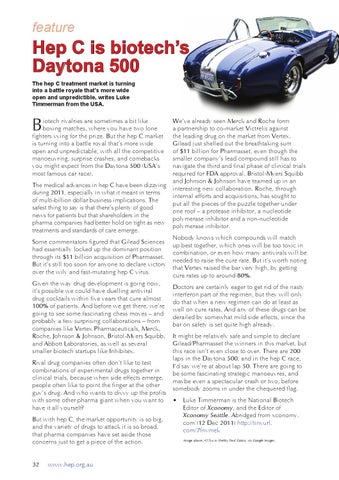
We’ve already seen Merck and Roche form a partnership to co-market Victrelis against the leading drug on the market from Vertex. Gilead just shelled out the breathtaking sum of $11 billion for Pharmasset, even though the smaller company’s lead compound still has to navigate the third and final phase of clinical trials required for FDA approval. Bristol-Myers Squibb and Johnson & Johnson have teamed up in an interesting new collaboration. Roche, through internal efforts and acquisitions, has sought to put all the pieces of the puzzle together under one roof – a protease inhibitor, a nucleotide polymerase inhibitor and a non-nucleotide polymerase inhibitor. Nobody knows which compounds will match up best together, which ones will be too toxic in combination, or even how many antivirals will be needed to raise the cure rate. But it’s worth noting that Vertex raised the bar very high, by getting cure rates up to around 80%. Doctors are certainly eager to get rid of the nasty interferon part of the regimen, but they will only do that when a new regimen can do at least as well on cure rates. And any of these drugs can be derailed by somewhat mild side effects, since the bar on safety is set quite high already. It might be relatively safe and simple to declare Gilead/Pharmasset the winners in this market, but this race isn’t even close to over. There are 200 laps in the Daytona 500, and in the hep C race, I’d say we’re at about lap 50. There are going to be some fascinating strategic manoeuvres, and maybe even a spectacular crash or two, before somebody zooms in under the chequered flag. • Luke Timmerman is the National Biotech Editor of Xconomy, and the Editor of Xconomy Seattle. Abridged from xconomy. com (12 Dec 2011) http://tinyurl. com/7fnvmek Image above, 427cu in Shelby Ford Cobra, via Google Images.