HEFFEL FINE ART AUCTION HOUSE
25
as “un trappeur supérieur”. The cultural bohemians of the avant~garde Paris art world saw him as a wild colonial artist who had burst onto the Paris art scene straight out of the wilderness of Canada. He liked this, and his obsessive work habits and intense, brooding personality fit this stereotype. Hélène de Billy, who has written extensively on Riopelle, describes him as “very handsome and enormously appealing to women”. It was an incredibly heady time.
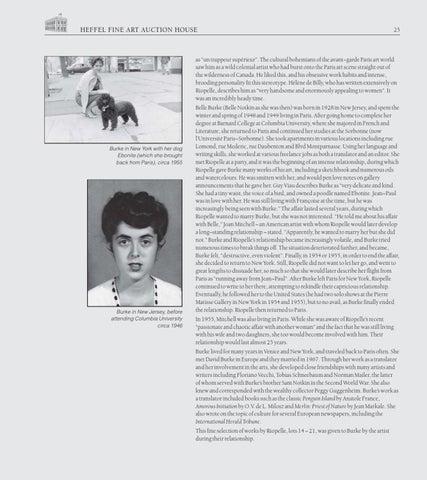
Burke in New York with her dog Ebonite (which she brought back from Paris), circa 1955
Burke in New Jersey, before attending Columbia University circa 1946
Belle Burke (Belle Notkin as she was then) was born in 1928 in New Jersey, and spent the winter and spring of 1948 and 1949 living in Paris. After going home to complete her degree at Barnard College at Columbia University, where she majored in French and Literature, she returned to Paris and continued her studies at the Sorbonne (now l’Université Paris~Sorbonne). She took apartments in various locations including rue Lomond, rue Mederic, rue Daubenton and Blvd Montparnasse. Using her language and writing skills, she worked at various freelance jobs as both a translator and an editor. She met Riopelle at a party, and it was the beginning of an intense relationship, during which Riopelle gave Burke many works of his art, including a sketchbook and numerous oils and watercolours. He was smitten with her, and would pen love notes on gallery announcements that he gave her. Guy Viau describes Burke as “very delicate and kind. She had a tiny waist, the voice of a bird, and owned a poodle named Ebonite. Jean~Paul was in love with her. He was still living with Françoise at the time, but he was increasingly being seen with Burke.” The affair lasted several years, during which Riopelle wanted to marry Burke, but she was not interested. “He told me about his affair with Belle,” Joan Mitchell ~ an American artist with whom Riopelle would later develop a long~standing relationship ~ stated. “Apparently, he wanted to marry her but she did not.” Burke and Riopelle’s relationship became increasingly volatile, and Burke tried numerous times to break things off. The situation deteriorated further, and became, Burke felt, “destructive, even violent”. Finally, in 1954 or 1955, in order to end the affair, she decided to return to New York. Still, Riopelle did not want to let her go, and went to great lengths to dissuade her, so much so that she would later describe her flight from Paris as “running away from Jean~Paul”. After Burke left Paris for New York, Riopelle continued to write to her there, attempting to rekindle their capricious relationship. Eventually, he followed her to the United States (he had two solo shows at the Pierre Matisse Gallery in New York in 1954 and 1955), but to no avail, as Burke finally ended the relationship. Riopelle then returned to Paris. In 1955, Mitchell was also living in Paris. While she was aware of Riopelle’s recent “passionate and chaotic affair with another woman” and the fact that he was still living with his wife and two daughters, she too would become involved with him. Their relationship would last almost 25 years. Burke lived for many years in Venice and New York, and traveled back to Paris often. She met David Burke in Europe and they married in 1967. Through her work as a translator and her involvement in the arts, she developed close friendships with many artists and writers including Floriano Vecchi, Tobias Schneebaum and Norman Mailer, the latter of whom served with Burke’s brother Sam Notkin in the Second World War. She also knew and corresponded with the wealthy collector Peggy Guggenheim. Burke’s work as a translator included books such as the classic Penguin Island by Anatole France, Amorous Initiation by O.V. de L. Milosz and Merlin: Priest of Nature by Jean Markale. She also wrote on the topic of culture for several European newspapers, including the International Herald Tribune. This fine selection of works by Riopelle, lots 14 ~ 21, was given to Burke by the artist during their relationship.