Page 7-1 THE SEV EN C HALLENGES W ORKBOOK -- WWW.NEWC ONVERSATIONS.NET
Challenge Seven ADOPT THE “CONTINUOUS LEARNING” APPROACH TO LIVING: MAKE RESPONDING TO THE FIRST SIX CHALLENGES AN IMPORTANT PART OF YOUR EVERYDAY LIVING
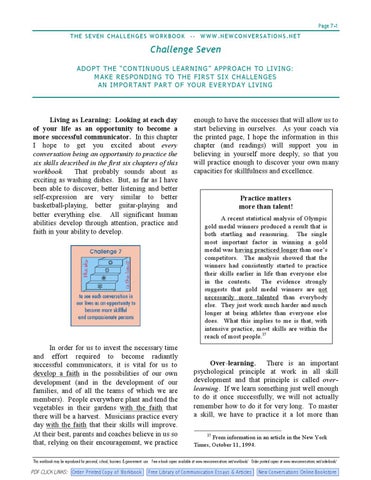
Living as Learning: Looking at each day of your life as an opportunity to become a more successful communicator. In this chapter I hope to get you excited about every conversation being an opportunity to practice the six skills described in the first six chapters of this workbook. That probably sounds about as exciting as washing dishes. But, as far as I have been able to discover, better listening and better self-expression are very similar to better basketball-playing, better guitar-playing and better everything else. All significant human abilities develop through attention, practice and faith in your ability to develop.
In order for us to invest the necessary time and effort required to become radiantly successful communicators, it is vital for us to develop a faith in the possibilities of our own development (and in the development of our families, and of all the teams of which we are members). People everywhere plant and tend the vegetables in their gardens with the faith that there will be a harvest. Musicians practice every day with the faith that their skills will improve. At their best, parents and coaches believe in us so that, relying on their encouragement, we practice
enough to have the successes that will allow us to start believing in ourselves. As your coach via the printed page, I hope the information in this chapter (and readings) will support you in believing in yourself more deeply, so that you will practice enough to discover your own many capacities for skillfulness and excellence.
Practice matters more than talent! A recent statistical analysis of Olympic gold medal winners produced a result that is both startling and reassuring. The single most important factor in winning a gold medal was having practiced longer than one’s competitors. The analysis showed that the winners had consistently started to practice their skills earlier in life than everyone else in the contests. The evidence strongly suggests that gold medal winners are not necessarily more talented than everybody else. They just work much harder and much longer at being athletes than everyone else does. What this implies to me is that, with intensive practice, most skills are within the reach of most people.37
Over-learning. There is an important psychological principle at work in all skill development and that principle is called overlearning. If we learn something just well enough to do it once successfully, we will not actually remember how to do it for very long. To master a skill, we have to practice it a lot more than 37
From information in an article in the New York Times, October 11, 1994.
This workbook may be reproduced for personal, school, business & government. use. Free e-book copies available at www.newconversations.net/workbook/ Order printed copies at www.newconversations.net/orderbook/
PDF CLICK LINKS: Order Printed Copy of Workbook
Free Library of Communication Essays & Articles
New Conversations Online Bookstore