In The Hub
Shure KSM313 Review
SHURE KSM313
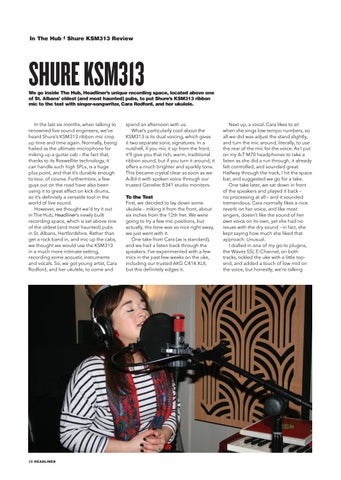
We go inside The Hub, Headliner’s unique recording space, located above one of St. Albans’ oldest (and most haunted) pubs, to put Shure’s KSM313 ribbon mic to the test with singer-songwriter, Cara Rodford, and her ukulele.
In the last six months, when talking to renowned live sound engineers, we’ve heard Shure’s KSM313 ribbon mic crop up time and time again. Normally, being hailed as the ultimate microphone for miking up a guitar cab – the fact that, thanks to its Roswellite technology, it can handle such high SPLs, is a huge plus point, and that it’s durable enough to tour, of course. Furthermore, a few guys out on the road have also been using it to great effect on kick drums, so it’s definitely a versatile tool in the world of live sound. However, we thought we’d try it out in The Hub, Headliner’s newly built recording space, which is set above one of the oldest (and most haunted) pubs in St. Albans, Hertfordshire. Rather than get a rock band in, and mic up the cabs, we thought we would use the KSM313 in a much more intimate setting, recording some acoustic instruments and vocals. So, we got young artist, Cara Rodford, and her ukulele, to come and
28 HEADLINER
spend an afternoon with us. What’s particularly cool about the KSM313 is its dual voicing, which gives it two separate sonic signatures. In a nutshell, if you mic it up from the front, it’ll give you that rich, warm, traditional ribbon sound, but if you turn it around, it offers a much brighter and sparkly tone. This became crystal clear as soon as we A-Bd it with spoken voice through our trusted Genelec 8341 studio monitors. To the Test First, we decided to lay down some ukulele – miking it from the front, about six inches from the 12th fret. We were going to try a few mic positions, but actually, the tone was so nice right away, we just went with it. One take from Cara (as is standard), and we had a listen back through the speakers. I’ve experimented with a few mics in the past few weeks on the uke, including our trusted AKG C414 XLII, but this definitely edges it.
Next up, a vocal. Cara likes to sit when she sings low-tempo numbers, so all we did was adjust the stand slightly, and turn the mic around, literally, to use the rear of the mic for the voice. As I put on my A-T M70 headphones to take a listen as she did a run through, it already felt controlled, and sounded great. Halfway through the track, I hit the space bar, and suggested we go for a take. One take later, we sat down in front of the speakers and played it back – no processing at all – and it sounded tremendous. Cara normally likes a nice reverb on her voice, and like most singers, doesn’t like the sound of her own voice on its own, yet she had no issues with the dry sound – in fact, she kept saying how much she liked that approach. Unusual. I dialled in one of my go-to plugins, the Waves SSL E-Channel, on both tracks, tickled the uke with a little topend, and added a touch of low mid on the voice, but honestly, we’re talking