ISSUE #18
AT I VE C
OM
SUP P OR T
THE C
RE
IN G
MAGAZINE
MUN I T Y
Doc Brown
RAP BATTLES, KANYE & DAVID BRENT Aurora
BACKSTAGE AT SHEPHERD’S BUSH EMPIRE The 1975
DECEMBER 2016 | RRP $6.95 USA/$7.95 CANADA
BRITISH ELECTROPOP AT ITS BEST
RICKY GERVAIS TRAIL BLAZER
CHECK OUT HEADLINER MAGAZINE ONLINE | HEADLINERMAGAZINE.NET
Award winning mastering. Now available to everyone. abbeyroad.com/onlinemastering
Contents #18 Cover Story
P30 / Ricky Gervais 06
36
SWIVEL ON THIS
DOC BROWN
DJ Swivel looks at the latest technological breakthroughs in the industry, including AI.
Multi-talented comedian and musician, Ben Bailey Smith, talks rap, Ronson, and Ricky.
08
39
SONIC VISTA INSIGHTS
Our friends in Ibiza chat to acclaimed producer and dance music icon, Tom Staar.
10
INSIDE ABBEY ROAD
Lucy Laudner reminds us that this landmark studio’s expertise stretches way beyond recording.
12
AURORA
We get experimental backstage at Shepherd’s Bush with this talented Norwegian songstress.
16
BLASTERJAXX
Two top DJs whose mixing has improved dramatically since they took studio time to another level.
LIFE ON THE ROAD
A chat with Adam Scott, sound man for one of Britain’s most surprising 2016 success stories.
40
FOREGONE CONCLUSION We catch up with guitarist in David Brent’s supergroup, Stu Wilkinson (AKA Monkford).
42
MAKING A GREAT IMPRESSION
Headliner’s editor has a head full of silicone as he gets the true JH Audio in-ear experience.
44
BRING ME THE HORIZON
18
We explore the band’s evolution, including an epic musical U-turn that really changed the game.
THE 1975
46
British electropop at its finest, these lads from Yorkshire are making waves across the pond.
22
PLANES, TRAINS, AND ROMAN REMAINS
Part two of our mixing on headphones series, this time using Waves’ Nx Head Tracker.
24
JACK RUSTON
This MPG Awards nominee is serious about audio. He reveals some of his studio secrets.
26
THE ZIPHEADS
Is it punk, rock and roll, ska, or rockabilly? This trio’s unique edge is what makes them shine.
28
MIGUEL CAMPBELL
A DJ/producer with a real focus on his art, and working only on music that really matters.
30
COVER STORY: RICKY GERVAIS
We chat exclusively with a man at the very top of his game: early musical beginnings; comedy with humanity; and turning a semi-successful tampon rep into a genuine rock and roll star.
KATIE PLUS JUAN
Think Sonny and Cher, but not shit. It’s a new take on the boy/ girl duo concept, and it works.
47
THE FEELGOOD FACTOR
After 40 years as a roadie, Dean Kennedy did what any man would: open a rock and roll cafe!
48
THE BLUE MAN GROUP
We go behind the scenes in Florida with three bald-headed, blue-skinned musical maestros.
50
WS HOLLAND
An exclusive with the man who beat the drums for Johnny Cash for more than four decades.
52
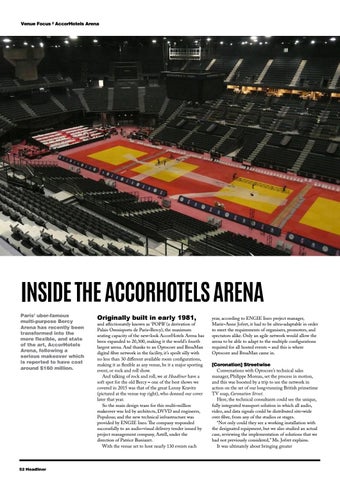
ACCORHOTELS ARENA
A smart networking system has transformed Paris’ leading venue.
54
PRO7ECT
It’s songwriting - but not as we know it. Great fun in Brighton.
56
IN THE STUDIO
Shaun Lowe reviews RME’s new Fireface UFX+ audio interface.
58
GRUMPY OLD ROADIE
A Christmas story from Robert, and not a profanity in sight..!
HEADLINER | ISSUE #18 | DECEMBER 2016
#18 From the Editor
“I think we've all got a bit of Brent in us...” Ricky Gervais
David Brent for Christmas number one, anyone? That, I would love to see. And incredibly, it’s within the realms of possibility. Most of us now know that Brent is officially back (American readers, you’ll get the movie on Netflix in February), but for those that aren’t aware, the former office manager from Slough is now an actual rock star, and is selling out arenas quicker than Oasis did during their Britpop heyday. It might sound a bit bonkers, but we think Brent’s jaw-dropping record, Life on the Road, is an absolute belter, and the rockumentary of the same title has gone viral in British cinemas. The key, Ricky Gervais tells us, was to make sure the album was full of well structured songs, with a comedy element to them. It couldn’t be Monty Pythonesque, it had to be believable; and my word, is it that. So much so, in fact, that no less than 100,000 people were still clambering for tickets as both Brent’s Hammersmith shows sold out at a record six minutes a pop. It’s an achievement of epic proportions, no question - and one Gervais admits surprised even him: “I can understand why rock stars can’t let it go,” he tells us, with a broad smile. Read the full interview on page 30, which looks at his humble musical beginnings, his love of songwriting, and how these live shows are the best thing he’s ever done. We also speak to Gervais’ sidekick, Ben Bailey Smith (AKA Doc Brown). He chats about collaborating in character with Gervais, battle rapping in Carnaby Street with Kanye, and going back to his roots with Stemma, his new rap record that will drop in February. Furthermore, we chat to the spellbinding talent that is Aurora - think John Lewis Ad 2015, the one with the man on the moon. She talks to us backstage at Shepherd’s Bush Empire about experimenting with sounds, and going international after her cover of Oasis’ Half the World Away made her a household name in the UK. And talking of household names, we bring you coverage of The 1975 on tour in the US - a band who have hit the number one spot both sides of the pond; and Bring Me The Horizon, who have taken the most monumental of musical U-turns with the release of their latest record. We hope you enjoy the issue. Paul Watson Editor
SOCIALISE WITH US: headlinermagazine.net @Headlinerhub HeadlinerHub headlinermagazine
HEADLINER | ISSUE #18 | DEC 2016
CONTACT Paul Watson paul@headlinerhub.com +44(0)7952-839296
Graham Kirk graham@gkirkmedia.com +44(0)7872-461938
Artwork Eimear O’Connor Jolien Hordijk
Contributors Adam Protz, Jade Perry Jordan Young, Shaun Lowe, Henry Sarmiento, Jonathan Tessier, Lucy Laudner
Design Without Boundaries Acoustically Coaxial Three-Way Smart Active Monitor We break boundaries in engineering to make the best even better. The 8351 Acoustically Coaxial Three-Way Smart Active Monitor represents this bold and imaginative thinking. The center is Genelec’s Minimum Diffraction Coaxial driver in a Directivity Control Waveguide. Behind the waveguide are two Acoustically Concealed Woofers. The directivity control equals that of monitors four times the size. The smart signal processing perfects monitoring accuracy with GLM AutoCal. The 8351 can only be described as the most solid, most articulate monitor available today – in a surprisingly compact package.
32 Hz – 40 kHz (-6 dB) ± 1.5 dB (38 Hz – 21kHz) 110 dB SPL Amplifiers: 150 W Class D (woofers) 120 W Class D (midrange) 90 W Class AB (tweeter) Drivers: Woofers 2 pcs 215 x 100 mm Midrange 127 mm Tweeter 19 mm
Genelec Oy T +358 17 83 881 genelec@genelec.com www.genelec.com
Comment DJ Swivel
Swivel on this One of my favourite movies growing up was The Matrix. It introduced this brand new idea to the masses, that not everything is as it seems. It allowed for our imaginations to run wild with the possibilities of technology, especially AI - and nowadays, we’re not so far off. AI and machine learning technologies are incorporated into our daily lives more and more. One of the brilliant technologies introduced in that film was the idea that information could be downloaded directly to a person in the matrix. I still remember the infamous line from Keanu Reeves’ character, Neo, “I know kung fu?” Well, we’re nearly there. We now have the cumulative knowledge of the human race at our fingertips. We’ve even started to see technology creep beyond users simply downloading information, to technology augmenting and assisting human output in new and exciting ways. One of these ways is with music. A year ago, I was introduced to a company called jukedeck. jukedeck is an interesting technology that will write original music based on style, mood, and duration inputs the user gives. For example, I can choose to create a melancholic piano song, that is exactly 1m 43s long, and with one click and a short wait, I’m given exactly that. And if I use the exact same inputs over and over, JukeDeck will output a new original song each time. The shocking part is that the songs sound pretty good! More recently, we’ve also seen IBM’s Watson team up with Grammy-winning producer Alex da Kid (Eminem, Imagine Dragons, Rihanna) to create an original song for X Ambassadors. Watson scoured the internet for millions of unstructured data points looking for patterns in language, and melodies from thousands of hit songs. Using that data, Watson then helped compose a song, with Alex da Kid tying it all together. And just this week, I learned about what Adobe is doing around sound manipulation. With their new ‘Project VoCo’ software, Adobe is able to analyse recorded speech, convert it to text, and allow you to actually modify the text, which is then converted back to audio.
06 Headliner
All of these technologies are in their infancy, but connect them together, and we now have an AI capable of creating full songs with lyrics, melody, and even great production. So it’s no secret that this is the direction we’re heading, a world where machines are beginning to learn creativity, something once thought to be a uniquely human trait. Which begs the question, is this where we should be heading? What are the implications of computers writing and creating our art? Art has always been an outlet for the underrepresented - those with the quietest voice. If technology starts pulling from the ‘consensus’, we’ll get content that simply appeases the masses, and questions nothing. We saw examples of this with Facebook’s news algorithms this election season; there were almost two completely different versions, depending on which side of the political fence you stood on. This led to complacency from younger demographics, who use Facebook more frequently, and who predominantly lean with the Democrats - and we all know how that ended. Bringing it back to music, this is a disaster for artistic expression. But this has even larger implications. Automation has already taken over many of the world’s manufacturing jobs, and will continue to do so. Cars are right on the brink of complete autonomy which will impact millions of people who earn their living driving. It’s difficult to look at nearly any profession and not envision a world where machines or AI begin to take over. Creative expression is one of the last areas that humans truly controlled. But where does that leave us? If there are more humans than jobs available, what’s sort of impact does that have on society? Will a universal basic income be introduced? How will governments accommodate this ever changing landscape? I don’t think any one person has all the answers, so rather than impart my own opinion, let’s open it up to a discussion: Tweet me @djswivel with the hashtag #swivelonthis, and let’s talk about it.
“All of these technologies are in their infancy, but connect them together, and we now have an AI capable of creating full songs with lyrics, melody, and even great production.”
THE FAMILY GER
JUST GOT BIG
NEW
4 XL
impression X
NEW
10 OR 20 HIGH POWER RGBW LEDs NEW ULTRA FAST ZOOM 210° TILT MOVEMENT INDIVIDUAL PIXEL CONTROL INTERNAL MACRO EFFECTS
4
impression X
37 HIGH POWER RGBW LEDs NEW ULTRA FAST ZOOM INTERNAL MACRO EFFECTS INDIVIDUAL PIXEL CONTROL BEAM-SHAPE
4S
impression X
Sonic Vista Insights Tom Staar
TOM STAAR: INTERSTELLAR OVERDRIVE
With Annie Mac and Pete Tong regularly spinning his records on BBC Radio 1, and a utility belt full of unreleased bombs, Tom Staar is about to go interstellar. Our friends at Sonic Vista Studios catch up with him in Ibiza, a place Tom’s very happy to call home. So what got you into music, Tom? Music has always been a huge part of my life for as long as I can remember; I knew from a really early age that I wanted to make music of my own. I was into acts like The Chemical Brothers, The Prodigy, Underworld, and Basement Jaxx in my early teens; their music is still timeless for me.
How many shows do you play? I don’t go crazy with the amount of shows I do these days. I had a daughter last year, so I pick and choose what I do a bit more so I can have more time at home. Maybe around 70-80 per year. I tour all over the world, which is amazing; I genuinely feel so lucky to be able to do that.
What was your first release? I started producing my own music in 2000, cutting sounds and parts from other records and putting them together. Back then, I made what was called UK hard house, on labels like Tidy Trax and Nukleuz, a sound originally championed by the late Tony De Vit. I think my first release came out in June that year. So from 19, I was touring all over the world with that sound, which was amazing, but eventually I lost interest with the scene and began working behind the scenes in the studio for some established house acts. Its pretty funny listening back... 150bpm madness!
What does the future hold for DJs? I think over the past few years, the meaning of what it is to be a DJ has changed for the mainstream; you only have to look at the DJ Mag Top 100 DJs to see that! The underground scene has still kept it real, but all these huge headliners that people see as DJs really aren’t at all. They’re more about the show than the art of DJing.
Which artists have you remixed? Ah, I’ve done so many over the past few years alone: Swedish House Mafia, Armin van Buuren, Afrojack - a lot of the full-on EDM guys come to me for remixes, so I can bring my edge to their stuff, but it’s still playable for them in their sets.
08 Headliner
Tell us about Cartel Records... Sure. Cartel is a new label and brand I’ve started with my long-time partner in crime, Kryder. We both wanted an outlet of our own, to put out the music we wanted, rather than trying to tailor our sound to fit on other labels. It’s more of a tribal, Latino-influenced techy sound, but still with some main stage power! My single, Me Sueno, came out a few weeks ago, so head over to my Soundcloud to check it out! We will be touring the brand all over the world
in 2017, and I’m very excited to spread my music on a truly global scale! What’s the best show you’ve played? Ah, I’ve been so lucky to have done some of the best festivals and clubs in the world, so it’s a real tough one! Tomorrowland is always a highlight of the summer for me; and I toured with Fatboy Slim across Brazil a couple of years ago, which was amazing. As far as clubs go, Green Valley in Brazil is great, and The Guvernment in Toronto was phenomenal, but has shut down now. So life is good here in Ibiza? Oh yeah. Having spent six years living right in the middle of London, I just fancied a change of scene, really. London is so fast-paced, which is sometimes great, but it does get a bit much. Also, I didn’t want my daughter to be brought up there. Ibiza is a place that’s been special to me for years; I’ve been DJing here for 15 years, and the Island has a real magic about it, so I just went for it!
@TomStaar www.sonicvistastudios.com
96kHz AS STANDARD
MULTIBAND DYNAMICS
48 TRACK RECORDING
10 X 8 MATRIX
S21 S21
Awesome Specification Exceptional Performance . Stunning Value
Quite simply a game-changer, the S21 has all the power and flexibility of DiGiCo’s Stealth Digital Processing™, the technology behind the legendary SD Series consoles. 96kHz as standard, equivalent to 80 DSP channels, 46 Busses, local I/O with 24 mic line inputs,12 analogue outs, it’s got all this. And more.
www.digico.biz Unit 10, Silverglade Business Park, Leatherhead Road, Chessington, Surrey KT9 2QL
Inside Abbey Road Mastering
MASTERING
INSIDE ABBEY ROAD Although Abbey Road is world-famous for its epic recording spaces, one hidden gem we don’t hear so much about is its mastering service. Head of mastering, Lucy Laudner, tells us a tale or two about her team of engineers, with a whopping 200 years of experience between them, and how catering for artists as diverse as Maria Callas, My Bloody Valentine, and even David Brent, is all in a day’s work. Lucy Laudner
First things first, what is traditional mastering? In a nutshell, it’s the last stage of the recording and mixing process, where an album gets its final polish before the final format, whether it’s CD, vinyl, or MfiT. It’s about checking levels across all the tracks, and achieving a consistency of sound, using a mixture of classic analogue and modern digital kit. But ultimately, the mastering engineers’ ears and experience are the real key to creating a great sounding record. At Abbey Road, our nine in-house mastering engineers work on a wide range of projects spanning many genres: pop and rock, theatre and film, and classical, to name just a few. We have a number of first class mastering suites, all equipped with cutting lathes, and operated by highly trained engineers, including a surround suite, where we work on projects for film, TV, and live music productions. We’re also a dab hand at restoring and remastering older, archive recordings for CD and digital release, and we offer a very popular online mastering service, too, where anyone, anywhere in the world, can access our studio talent and get their recording mastered by the team. Abbey Road was ready and waiting for the resurgence of vinyl, which continues to grow rapidly - you can even pick up a record in your local Sainsbury’s and Tesco nowadays – and it’s a format that I grew up with, searching for ex-jukebox, seven-inch records in my local newsagents. I’ve always loved it for its warmth, and the immersive experience; and I still love
10 Headliner
browsing the racks, and discovering little gems! And then there’s our eclectic client roster. Recently, we helped polish the dulcet tones of young Norwegian songstress, Aurora, (also featured in this issue of Headliner), and harmonising Hertfordshire country duo, The Shires. We also worked with Irish rockers, My Bloody Valentine, on their latest record. Other major projects include Elton John’s Captain Fantastic EP, and The Rolling Stones’ In Mono box set. And talking of box sets, we once mastered a 40-CD epic for classical vocalist, Maria Callas, which took over a year to complete! Then, of course, there’s our endless film and theatre soundtracks, from Star Wars to
“Abbey Road was ready and waiting for the resurgence of vinyl...” The Hobbit, and Funny Girl to Miss Saigon. There’s always something going on here. A more unusual recent project came in the shape of the soundtrack to the David Brent: Life on the Road movie. Mastering engineer, Sean Magee, recalls mastering the session fondly: “Brent came in fresh from his tour [of Berkshire] to master the soundtrack of the film. He took a keen interest in the process, and was eager to get involved. There was a film
crew present, which is par for the course with this level of celebrity, which at times made the job challenging, but all in all, it was great to be involved. He does bear a striking resemblance to that comedian, Ricky Gervais, though...” As you’d expect, we are obsessed with quality, and delivering the best possible experience to the listener. We work closely with lacquer suppliers, Transco, one of only two lacquer manufacturers in the world, to ensure standards are maintained; and regularly test new batches of lacquers to make sure we cut on the best materials. We’ve also established relationships with all the main pressing plants. Furthermore, we cut to copper - a process developed in the 1980s, then viewed as the next evolution in vinyl quality before the introduction of the CD. This format is great for delivering precision over a long album, and also for dealing with high frequencies; and it cuts out the first process, so for purists, there are less chances of clicks and pops. We are working hard to preserve the love of vinyl, working with the industry to support events like Record Store Day - a major force behind this revival - and we want to make Abbey Road mastering available to everyone, whether it’s an established artist already recording here or anywhere in the world, or a bedroom producer, looking for the golden touch of one of our in-house specialists. www.abbeyroad.com
www.audio-technica.com
Aurora
Shepherd’s Bush
WHERE THE MAGIC HAPPENS Aurora is best known in the UK for her emotional rendition of Oasis’ touching 1994 anthem, Half The World Away, which was chosen as the soundtrack for the John Lewis Christmas commercial in December 2015. As beautiful as that is, there is far more to this quirky Norwegian songstress than that. She started writing her own material at a very young age, and now boasts a repertoire of well over 100 songs: “Some of them I hate, some are not good, and some I really love,” she says, with a smile, as we take a seat backstage at Shepherd’s Bush Empire. She’s sold out this iconic venue tonight, but you’d never know it – she is as humble as she is likeable.... So that makes her very humble indeed.
“It’s magical, dreamy, and beautiful, but also a bit harsh and ugly at times!”
Words Paul Watson | Photographs Natasja de Vries Aurora tells me she’s been working with Students at the British and Irish Modern Music Institute (BIMM) recently; they wanted to talk to her about a number of things, she says: being young in this industry, her songwriting process, and how she went about breaking it internationally. So they’ve stolen all my questions, then? Okay, so what was the first song you ever wrote? “[laughs] They didn’t ask me that! Well,
12 Headliner
it was in my bedroom; I was a secret music spy for many years before anyone knew that I wrote or could sing, you see. I was about nine years old,” she explains. “I think it was probably quite bad, the song, and I played it on the guitar, even though I’m a good piano player, not guitar player. But I was a big fan of Leonard Cohen, so I wanted to write in English, and on a guitar, I guess.” Aurora has an effortlessly good voice, and
her sound is quite ambient, but with some percussive and electronic twists. I ask her how much she is involved in the production of the music. A lot, apparently. “I collaborate with Magnus, who plays drums in my band; I am very involved in both the recording and live elements of my music; live isn’t completely different, the main core is there – that’s me, I guess – but it’s nice that everyone in my band can sing, except for my
Aurora
synth player, and that is very important to me, as I don’t like a lot of backing tracks, especially on the vocals,” Aurora explains, softly. “It’s always been my goal to be good, magical, and interesting, as well; and I try in some places to make the live show a little more simple and open than the album, but sometimes we give even more sound, and we focus on the energy. I want us to have fun while we’re on stage, as it should just be about good energies.”
Talking of energy and openness on stage, it was a switch in microphone brands that really changed the game for Aurora. She and her whole band are now using DPA d:factos, which have brought a new element to the show. “I really do like the DPA mic,” Aurora admits. “I don’t know... [pauses] It just opens up the sound, if that makes sense? It makes everything sound so clear, which I think my sound needs live; it’s very pure, distinctive, and crisp; there is a lot of clarity to the sound of the mic, which of course means the sound in my in-ears is very clear, too. I remember the times before we had the in-ears and the d:facto – I used to have to shout very loud to hear anything in the monitors, so this setup has made a huge difference; I can hear everything clearly, and it also means I can focus on adding special things within the performance, which is lovely.” Conversation turns to the various European
music scenes, and how we all perceive different styles of music differently. But when it comes down to it, Aurora thinks it’s all about moments of musical magic. “In Norway, we are open to what comes form the US and UK, but I think somewhere on this planet, people have opened their eyes to something new - an artist, or a voice that they like - and it hits them in a special way, which music can do sometimes,” she says. “It’s the magic in music; and music is one of those basic things, like love, and touch, and hunger, and sadness; it hits us in primitive ways, and also complicated ways, but it’s so human. I feel if it’s good and if it’s real, then people get it. It doesn’t matter where it’s from.” It helps getting a push from somewhere, Aurora admits, like doing interviews and TV shows, but when you get that one opportunity that opens up a door, you take it. This turns the chat towards that excellent rendition of Oasis’ Half The World Away, which she put together for the John Lewis Christmas commercial last year.
“I didn’t choose that song, but the John Lewis team chose it; many artists were asked, and I actually hadn’t heard it before, but I liked it when I heard it,” Aurora recalls. “Nice lyrics, he’s a good songwriter, isn’t he? [smiles] I am not a huge Oasis fan, but I definitely understand what people see in them; I like the soul about them, for sure.”
Shepherd’s Bush
After the success of the campaign, Aurora and her team soon saw a huge increase in their online streams. It’s not something that she tends to care much about, and she confesses she doesn’t know how many streams she has even now, but it definitely opened doors. “Our number one streaming country was suddenly England, so it did make a huge impact, and many people found me through that song; luckily, they liked my music after hearing that,” she smiles. “I don’t have the need for everyone to know about me - not at all - but I do find it comforting that someone out there does.” And selling out Shepherd’s Bush Empire speaks volumes, especially considering this young artist’s career is still in its infancy. She turned 20 in the summer, yet she’s entirely switched on, is business-savvy, and her influences span so many genres. “You know, no-one makes new music, as we’re all affected by something,” she says, very spiritually. “My biggest influence is Enya; I listened to her this morning. I love her! She keeps me going. I love the way she uses so many vocals, and as pads for percussion and synths. Vocally, I am very influenced by that. But then I love The Chemical Brothers, too; and I also love some metal, and folk music! I do like that electronic vibe, as well; and Enya has a few of those sounds. too, although it’s her voice mainly. For me, it’s important that it’s magical, dreamy, and beautiful, but also a bit harsh and ugly at times!”
13 Headliner
Aurora
Great on the piano, certainly a decent guitarist... But I get the feeling Aurora experiments with other types of instruments, given the spacey sounds and electronic experimental elements within her music... “Oh, absolutely! I just bought a harp, in fact,” she says. Hold on, isn’t that the most difficult instrument in the world to play? “Is it? I took many lessons online before I got the harp, which doesn’t really make any sense, but I know everything about it, and I rehearsed on an imaginary harp, which sounded great [smiles]. Then I bought a new one a few weeks ago. I wanted to bring it on this tour, but it was too big. I can’t wait to play it properly. I think I find it quite easy because it’s built up the same way as a piano, and although I can’t play really complex songs yet, I can accompany myself easily enough. I must have a harp player deep in my heart that wants to wake up!” Clearly! As we make our way to soundcheck, Aurora admits she can’t believe she is where she is, considering musical life was so different just 12 months ago. She tells me she has to watch [the movie] Fantastic Mr. Fox before the show – apparently a favourite – and we bid each other farewell for now.
Tour Manager for Aurora since April has been Tomin Tollefson, who I spy setting up microphones around a very Ringo-esque drum kit: snare, small tom, large tom, couple of cymbals. He tells me that due to Aurora’s ambient, electronic sound, and her lack of up tempo material, he tries to make the soft parts sounds really nice. “Tonight, Aurora will play two songs fully acoustic, very down tempo, and the rest of the band leave the stage; I can tell you now 14 Headliner
that the audience will be dead silent to that,” he smiles. “Then she’ll switch to an up tempo track or two, where the drummer and guitarist get to do their thing.” The drummer, Magnus, is very minimalistic, Tollefson says – and that’s a good thing: “He is even working on getting rid of his electronic pad; and he doesn’t want a second floor tom, or anything like that; he doesn’t beat drums, he plays drums, and he is a player because of that.” Refreshing to hear, for sure – as are Aurora’s angelic vocals, especially when sung through her trusted DPA d:facto. As she told me earlier, all her singers are on d:factos, and Tollefson concurs that it’s changed the game, so to speak. “The mics have made a major difference, and we’d like to go wireless [with d:facto] soon, as Aurora really likes to work the stage. Believe it or not, we’ve done 40 festivals this summer, so it’s been a huge step up for her, and she’s taken to it very well,” he says, adding that she employs eight people now, so ‘has had to grow up quickly in this industry.’ Credit to her for that. “I am now tour manager, monitor engineer, and backline; and I do the driving if I need to! [laughs] At Glastonbury, we arrived at the stage just 40 minutes before stage time, so everyone just stepped up and put their own stuff together, and we were on time, which was pretty amazing.” So the crew vibe is as relaxed as the music? “[smiles] Yeah, [FOH engineer] Paul [Vikingstad] is doing mics and leads, I’m doing backline, and we will get it all done in under an hour,” he says, with a smile. On stage, it’s all about the vibe, currently, as Aurora expresses the lyrics so well with just
Shepherd’s Bush
mic in hand, Vikingstad tells me. He’s been mixing front of house for Aurora for two and a half years, in which he’s seen ‘a lot of continuous breakthroughs.’ “From the get go, Aurora has been very open, and she listens. She is also used to working in the studio with different mics, but I remember when I introduced her to the DPA d:facto, there was a very surprised look on her face... The first time she tried it, she was like, ‘How is this possible?’; and now we have DPAs all round; it’s just a huge step up [in audio] without really having to do anything, which is great.” We observe the drum kit together, and I spot no overheads as such – there are ‘underheads’, however: “Yeah, I like to call them underheads, as they make the drum kit stand out more; I’ve got a DPA 2011C sitting under the crash here, one to the right of the ride, also picking up the other crash; and then another one on the hi-hats, with two more on the snare – top and bottom. We also have one on the kick; I was surprised how good it works, but it’s very musical; there’s none of that pre-dialled EQ that you get on kick mics. Then we have a [DPA]4099 on the big tom because it’s very directional, and doesn’t feed back; also, I use tons of low end and low return on my verbs, yet it never gets out of control.” Tonight, Aurora’s set was breathtaking, both vocally and sonically, and the crowd were here to not only listen, but to feel; and I can’t help but think that’s exactly what this talented songstress would have wanted. @AURORAmusic www.dpamicrophones.com
THE Fibre Network for the Pro Audio Industry
The NEW M-Series
Advanced MADI switches with bridging and routing options · Single channel and stream routing · Standalone or network performance · Built-in LAN switch and RS485 router
· Dual PSU, no fan · The most cost-efficient and powerful audio switches on the market
M8
M12
4 BNC or fiber MADI ports 2 SANE ports (MADI over Cat5) 2 Optocore hi-speed fiber uplinks
8 BNC or fiber MADI ports 2 SANE ports (MADI over Cat5) 2 Optocore hi-speed fiber uplinks
.com
inquiry@optocore.com
DJ
Blasterjaxx
BLASTERJAXX Since 2013, this talented DJ-producer duo have been doing their thing all over the globe, and have cemented themselves in the top tier of the DJ Mag Top 100 list. As impressive as that is in such a short time, they remain humble in their approach to their art: “To be honest, we find it unbelievable that we’re really doing this, making our living by doing what we love more than anything,” says Thom Jongkind. We dig a little deeper, chatting music, studios, and giant speakers. “Touring is great, but it has his pros and cons, something a lot of people underestimate,” Thom Jongkind reminds Headliner. “And no kidding, but we really do love all the venues and all the crowds. Each one tends to have its own unique charm.” Blasterjaxx describe their sound as powerful, melodic rave music – and when they’re not out on the road, they meet up every morning around 10am in the studio, to begin work. And there’s us thinking all these big DJs sleep in until mid afternoon...
16 Headliner
“[smiles] Yep, we meet each other in the morning, and either start something from scratch, or continue working on existing material. It’s just the two of us in our ‘workplace’, breathing music until 5pm! Back in the day, we did a lot of night sessions, but we feel more confident with a more normal work routine. “On the road, it mostly starts with a quick room service breakfast, re-packing of the suitcase, a drive to the airport, a quick bite at the airport, take a plane, drive to the hotel,
“The Genelec 1234s are so powerful, and crystal clear...” eat again, work out, nap, prepare for the set, play the show, head back to the hotel... [takes a breath] And the next day we do it all over again! [laughs]” I ask Jongkind what he feels their live shows offer that stands them out from the crowd, so to speak. “The shock effect!” is the quick response. Do divulge. “We try to give the crowd tracks they would never expect us to play, or even hear at a dance festival. Take Daddy Yankee - Gasolina, Eminem - Lose Yourself, Edward Maya - Stereo
DJ
Love, just to name a few, which we bootlegged and made an experience for the people in the crowd,” explains Jongkind. “Other than that, we do play a lot of stuff which never will be released; it could be our own music, or some of the boys we love to support. And last but not least, we use a lot of tools: BPM drops, crazy build-ups, and moments to interact with the crowd. We would go nuts by ‘just’ playing a 128bpm set, believe it or not!”
Game-changer
Blasterjaxx recently upgraded their studio facility with the help of renowned Dutch studio designer (and excellent wine drinker), Jan Morel. We know him well at Headliner, as he’s been pivotal in so many studio designs for the likes of Hardwell, David Guetta, and the current world number one DJ, Martin Garrix. So you were in good hands, then? “Oh yeah! We went from a small studio to a medium sized one; after two years, we needed to go bigger, and we are now the proud owners of a 35 sq. metre studio, completely designed by Jan for producing electronic music. We couldn’t be happier with it!” And a brand new set of monitors, too? “Yeah! We are currently using the Genelec 1234s. Man, those things are so powerful and crystal clear! In the beginning, it took us a while to get used to working with them – you know, it’s a whole new environment, big-ass speakers, and a new acoustic to work in. But
Hardwell has the same ones, so we kinda used him as a reference to purchase our own pair. And they are incredible.” “The guys gave me a call when they were making a new studio two years ago,” Jan Morel recalls. “They’d had some problems, and asked me to come over... Just in time! We changed the whole thing into a more functional and professional studio, and started creating a much bigger place. They were very curious about the big Genelec 1234 speakers, and at that time, they’d started to make a lot of money, but not spend a lot of money. The new car comes first, then the speakers! [smiles] So we had this huge control room, and the speakers they already had just didn’t have the power or the dynamic at all. There was just no low end.” Morel had already recommended Genelec 8030 nearfields, which replaced their previous monitors, but holes had already been made in the studio walls to accommodate something much bigger. It was at this stage that Morel brought in the Genelec 1234s, along with the Genelec 7073 subwoofers. “They had never heard anything like them before, of course; and I demonstrated some different types of music through them to one of the guys: some very nicely recorded Marcus Miller stuff, and then some Knife Party – really good EDM sounds. Blasterjaxx were then very keen to have a listen to their own stuff through the Genelecs, but because
Blasterjaxx
those speakers don’t have any mercy, they were pretty devastated! ‘Switch back to Knife Party,’ they said. [laughs] So then, next month, I came back to do a few tweaks, and they had a very different outlook: ‘We changed our old songs! You can’t imagine what it sounds like now!’ And I have to say, it was a big improvement. You often find when young DJs move to serious monitors, their mixes suddenly get much better.” Blasterjaxx believe that electronic music is now being recognised on a more global scale - the pop/dance crossover has certainly done the genre no harm. But Jongkind does have one particular bugbear: “We don’t want to sound old school, but when we started out, you had to find all the samples and sounds yourself, and by collaborating with other artists, you could learn new tricks to use in your own tracks afterwards. Today, kids rebuild a song in a 12-minute online tutorial, and sometimes the track isn’t even released yet!” Okay, and what about a standout memory? “Probably our meeting with Tiesto in his hometown of Breda back in 2013. To us, he’s the god of this scene, and opened so many doors - including ours - to the big wide world. We are still very thankful for all his support.” @blasterjaxx www.genelec.com www.morelmuziek.nl
17 Headliner
THE 1975: UPPING THE ANTE UK four-piece, The 1975, are well on their way to becoming a household name – and not just on this side of the pond. Currently in the midst of what’s proving to be a very successful tour of the US, the Manchester boys have been bedazzling arena audiences with their smart, melodic pop music which features some great vocal lines and instrumentation, a touch of funk, and a fine dollop of ‘80s electronica. They combine multiple melodies with great guitar lines, and old school ambient synth pads, which gives their sound a classic, yet cool twist.
Their first EP, Facedown, was released on an indie label in 2012, and by the end of that year, they released another, Sex, which was picked up by BBC Radio 1 DJ, Zane Lowe. 2013 saw a third EP appear, Music for Cars, with the single, Chocolate, breaking into the Top 20. This saw the band’s popularity rise all over the UK, and also got them an invite to SXSW in conjunction with a US tour. Their self-titled debut, The 1975, was also released in 2013, produced by Mike Crossey (Arctic Monkeys, Foals), and reached the number one spot in the UK Album Charts. It also raised an eyebrow or two in America, making a mark on the Billboard 200 at a respectable number 28. And with the ever so subtly titled 2016 release, I Like It When You Sleep, for You Are So Beautiful Yet So Unaware of It, they have upped the ante: the record debuted at number one in both the UK and the US.
Jay Rigby has worked front of house for The 1975 for the last year. We caught up with him in Washington, on the morning that Donald Trump became President Elect. “What a crazy time to be in DC,” Rigby says, with a chuckle. 30 seconds of political chat - which will remain unpublished – occurs, and we’re back to music again. “The whole crew is pretty new, on this tour, so we’ve all been fortunate enough to experience the explosion of the band’s popularity.” Venues in the US have been pretty sizeable, Rigby tells us: some sheds, as is the case with any breakthrough band, but also plenty of arenas. “The guys are phenomenal to work with, and they really care about production; they put a lot of time and effort into the audio and the lighting, as the two very much go hand in hand on this tour; and their attention to detail is incredible.
Production The 1975
“Not only is the tonality phenomenal, the Roxannes have such a low end, even on the most natural of settings.” Rigby works from one of two consoles: either his old analogue Midas XL4 workhorse; or his digital powerhouse, a DiGiCo SD10. It all depends on the show. “Because of the basics of what they do – drums, bass, and two guitars – and the fact they are all amazing musicians, the XL4 is the right tool, as analogue is a great sound for them,” Rigby explains. “But that’s when we have space in the truck, of course! [smiles] For me, using a DiGiCo is the closest you’ll get to that sound using a non-analogue board – and that’s both in functionality and layout; and the tone of the desk is also great. It’s the most analogue sounding digital board out there, in my opinion. “I use the SD10, as it can fit in the channel count; and when I’m working on the DiGiCo, I have my Waves [SoundGrid] server dialled in to basically replicate what I have on the XL4: the ATI-2500 drum buss compressor I have in my rack, so I use the Waves version on the DiGiCo; and the same with the dbx 160 plugins - I use the Waves version of those, too, plus some reverbs. Stuff like that, really, but I keep it very simple.”
Faithful Representation
It appears that the band are very much into their sound, too; Rigby tells me they’ve just made the switch to some new in-ears. And not just the band, the entire crew: “Yeah, Francois [Pare, monitor engineer] has a setup like a control station! We’ve got the whole band on JH Audio Roxannes – and a huge shout-out to [ JH Audio’s] Kevin Glendinning for helping make it happen; but not only are the band on Roxannes, we’ve got the backline guys, tech guys, lighting and video guys. Everyone! Francois has a production mix, a lighting mix, you name it. I mean, no-one can hear a radio during a show, so having everyone on ears for comms has made everything so much clearer, and quicker. Oh, and we can also take the piss out of each other during the show, so that’s a bonus.” The 1975 were using another brand of in-ears
before the switch to JH, and although they’d always been happy, the move to the new ears did create a buzz (not literally, of course). “You have to realise that Francois mixes sound like CDs; he is literally one of the best in-ear engineers out there,” Rigby insists. “But when they moved to JH, there was a definite ‘oh my gosh’ moment or two. They’d never heard anything like it. The bassist got so much out of his ears, and was the driving force behind getting the guys onto Roxannes. “And it’s not just the tonality – which is phenomenal – it’s that they have such a low end even on the most natural settings; and if you really need it, you can add a 14-16dB boost on top. Good luck with that! There is so much scope, and also the JH Audio Freqphase is amazing - phase aligning all those drivers in the ears means you’re getting so much more phase coherency out of the ear, and you don’t have to drive it so hard.” It’s all about trust though, isn’t it – making a change like that? After speaking with Jerry Harvey about this myself, I realise many artists don’t want to move from kit they’ve been working with for decades. “It is a trust, yes. But this was all Francois – they trust him so much, every time, and when Ross [MacDonald, bassist] first put them in, he said to the other guys, ‘I would rather never use in-ears again than use anything other than these Roxannes.’ So the rest of the band were soon onboard,” Rigby recalls. “Matt [Healy, lead singer] had a slight fit issue with his, and they were hurting a little to take in and out of his ears, but he refused to go back to the other brand of in-ears we were using, as it sounded so good, so he actually dealt with the pain in his ear until he could get his fit adjustment done! If that’s not a testament, then I don’t know what is!” Rigby and Pare have moved from tour to tour together for some six or so years now. Pare is also a DiGiCo user – he’s on an SD5. They each have their own stage cages (and one spare), and use an analogue splitter.
Communication Centre
“I started on this show about a month before Jay,” says Pare, whose previous mixing credits include Foster The People and 30 Seconds to Mars. “The surge in popularity has been amazing, but it’s very good stuff, too – the music is really well put together – and in terms of the band, you couldn’t really ask for a better bunch of people.” Pare has been on his SD5 since February; he says he ‘outgrew’ his last desk: “As the gig got bigger and bigger, I just couldn’t fit it on my [Avid] Profile; and I love the sound of the DiGiCo, as well as all the features and functionality, so the SD5 it is! It’s also easy to work on. I use snapshots, I use DiGiTubes, plus more of the internal processing, and then a bit of outboard. Everything is nice and simple.” Pare also starts chatting about the recent JH switchover, and echoes Rigby’s comments that the band were ‘over the moon’ with the new ears. I ask him to tell me more about this communication centre of his at monitor position. “[laughs] Yeah, as soon as Ross [MacDonald, bassist] started smiling, and said it sounded incredible, I knew it would be Roxannes! He said there was so much more clarity, definition, and sparkle; and he told the rest of the band they had to make the switch! So the crew needed new ears, too, and we decided we would all move as a group – and we’re not going back! “And yes, I guess my setup really is a comms centre; everyone is on ears, from the LD and lighting techs to the video techs; and all the backline guys also have their own mixes. And depending on the day, we might add people. We might have six backing singers and a trumpet player, for example, so it had to be so flexible. “It does become a challenge, though, as I do all the RF stuff, too, so some days are harder than others, but the support we get from JH has been fantastic, so we can’t complain. Also, I’ve been with my monitor tech for four years now, so I have that relationship, too – how we work together definitely helps.”
19 Headliner
Production The 1975
Illuminating The 1975
Tobias Rylander is the lighting designer for this tour, and he’s been making use of GLP’s X4 Bar 20 LED battens to illuminate the shows, generating giant colour fields and sweeps. He’s also been pretty forward thinking. “Fortunately, I started off by designing an arena sized show that could be scaled back, because we had a feeling it would go that way,” smiles the affable Swede. “The way I use the X4 Bars is to create these big fields in straight lines; they butt up to each other seamlessly, and when we need to scale back, we simply cut a fixture from each side.” Rylander describes his work as ‘an artistic lighting installation rather than a lightshow.’ This perfectly reflects the band’s own influences, which is handy – that, and the fact that The 1975 had been recording in LA, just 30 minutes from Rylander’s house. This is where intense discussions took place prior to the tour – everything from the artwork colour themes to the impact on social media: “These guys really care. We bounced material back and forth, and when they talked about visual artists such as James Turrell as influences, it felt like big fields of colour interspersed with monochrome and pulsating random strobing would be the way to go; the X4 Bars made perfect sense for that.” And there are a few of them. 28 X4 Bar 20s on the first leg of the tour, increasing threefold to a mighty 84 for the larger arena shows, which will continue into the new year; and for the big UK dates, he and his programmer, Darren Purves, have added 56 more under a graduated floor, as a pool of lighting which comes to life when Matt Healy steps into the circle. The Bars also feature as additional lip fills downstage. And in a largely monochromatic setting, the lighting juxtaposes with a number of 9mm LED video pillars, which Rylander uses as light sources: “I have lines of X4 Bar 20s both on the downstage edge in front of the band to create a wall of colour, and on the upstage edge in front of the main video screen to create and match the colour of the video content. I have different colour fields for the video screen, with solid block colour from the Bars operating seamlessly off the back wall. It’s a way to not only give more depth to the video, but to be able to tilt them down and zoom them out to create a field of silhouette.” And with so much video content up against them (particularly with plans to install eight screens in a constellation at London’s O2 Arena), the X4 Bar 20s need to fight their corner: “When you are up against 16,000 sq. ft of 9mm pixel LED screen, where we are using the video purely as light, the X4 Bar has shown not only that it is sufficiently powerful, but that it complements the video very well. They are a real workhorse for me right now.” As are the band – The 1975 will work their way around the US until December 23rd, where they’ll break for the festive season, before hitting the road again in January. We wish them the best of luck, and look forward to catching up with the band in 2017. @the1975 www.glp.de www.jhaudio.com www.digico.biz
20 Headliner
“I just
“When the band talked about visual artists such as James Turrell as influences, it suggested big fields of colour interspersed with random strobing.”
HORUS
An unbeatable combination of the highest quality converters, transparent mic preamps, extraordinary connectivity and RAVENNA/AES67 makes the Merging Networked Audio family the ďŹ rst choice for Pro Tools or any DAW of your choice. Full Pro Tools HDX™ integration with the new PT64 option card. http://www.merging.com/products/networked-audio
Mixing On Location
PLANES, TRAINS & ROMAN REMAINS Words Paul Watson
22 Headliner
There are plenty of clever bits of kit out there today, but one that really appealed was the new Nx Head Tracker from Waves, which I’ve crowbarred into part two of this mixing series. It’s said to improve the whole experience of mixing on headphones. I board my train to North Yorkshire (en route to a brewery tasting) armed with the Nx, and my ATH-M70x headphones. The Nx is a small, battery-operated wireless Bluetooth sensor, which is said to transform the whole experience of mixing while wearing cans. In this series, we’re trying to work out whether or not it’s at all feasible to mix a master on headphones while on the go, or in a particularly tricky environment, and I’m hoping this little device will lend me a helping hand. Firstly, you can attach the Waves Nx to any set of headphones (I tried this with several pairs before boarding the train, and it’s very easy to do), and it then tracks your head movements, sends information nice and quickly to the Head Tracker plugin, and will track in 360 degrees. To make sure it works properly, you need to attach it to the top centre of your headphones – just make sure you know your left and right! I’m using the Nx with Reaper – my preferred DAW – and as I bring up the Nx plugin, it automatically sets the Head Tracker as the active tracking sensor. Clever stuff.
Mixing On Location
“If you know your headphones well, the Nx can provide a true sense of space in your mix, allowing for real feel; and tweaking the stereo image is very addictive!”
I’m sure your results using Nx will depend on your choice of headphones, but the theory is, it essentially replicates a mix room with monitors; and when I pulled on my Audio-Technica ATH-M70xs, I quickly got the idea. Personally, I feel that ‘less is more’ when you’re tweaking your ‘Room Ambience’ setting on the Nx. Much like you would a reverb, you can decide how ‘wet’ you want it to sound, and depending on the level, it’ll offer various virtual reflections, which will impact on your pair of virtual speakers (or handful, if you’re mixing a surround session). On The Train When it comes to speaker position, you can have a lot of fun with this little device. It’s remarkably accurate, too; when I move my head left, right, up, down (which people are already finding odd on the train, I notice) I can see Nx tracking my head movements, at almost twice the speed that a camera can manage (Nx allows for camera tracking also, but if you’re on a Mac, you need to move into low light mode to get the right rate, so I stick to no camera). Two ‘Speaker Position’ dials allow you to widen or narrow your image from mono all the way to 90-degrees each side, and it does genuinely capture that feeling I remember when I used to close my eyes and position my head as central to my old studio monitors as possible some years ago. Hilariously, I find myself sinking into my seat, lowering my head, eyes closed (we’re now passing Doncaster, by the way) as if these virtual speakers are in fact real, and I’m suddenly back in that old barn with my
Soundcraft Ghost console in front of me. But I guess that’s the whole idea? I find my optimal sweet spot (the Nx allows you to set your own, and lock it in), and unlock it again, several times over. I decide I prefer not to be locked in - it just feels ‘spacier’ not being restricted to one mix position, as mad as that might sound, when you consider I’m not in a control room at all..! In The Mix The mix I am working on is, as in part one in this series, from our recent Headliner Helps show. Last month, it was Mark Sullivan, this time, talented Hertfordshire trio, ARC. I’ve got two ambient mics that I’ve decided to hard pan L/R, and when I physically turn my head left or right, it freaks me out a little, as the audience voices move with me. It must be insane when working in surround! The mix perspective default is 60-degrees – one I use regularly - and it feels about right, though I am tempted to go that bit wider, and I find myself starting to play with effects and techniques more than I normally would: panning vocal harmonies 30-40 degrees rather than five to 10. Maybe that’s just because I can? I guess with something as cool as this, the temptation of going OTT will always be there – I mean, the graphic of the head moving in time with your own almost feels like a video game in itself, so there is a definite fun factor to it, as well. But ultimately, the technology on show here is staggering. And at $79, it’s already feeling like a no-brainer. I’m approaching Leeds, some two hours into
my journey, and I must say there have been barely any distractions on this train. I was concerned about volume, but it really isn’t an issue with these headphones - plenty of headroom, despite having no interface with me - and I’m really getting the hang of Nx. At the beginning, I found myself hammering every setting under the sun – but as soon as I got used to the ‘feel’, I began using speaker placements that I used to in the old analogue domain; and probably because my old room was pretty ‘dead’ when I had my studio, I didn’t go crazy with the ‘Room Ambience’, just kept it at default, at a few percent, which did add a little life to the sound. You can even rotate the speakers a complete 360 on Nx - something for surround mixing, perhaps? Something else well worth a mention - I’m mixing using a ‘default’ head size, but if I’d had more time, I’d recommend following Waves’ instructions, and measure the circumference and inter-aural arc of your own head (which I did post-mix) for an even more accurate tracking. It does makes a difference. However, just by playing with the settings until it ‘feels’ right still does a very good job. The Verdict! This is a plugin I will happily keep on my mix buss, and keep going back to - half to experiment, half to reference. I don’t know if it’s the right or wrong thing to do, mixing with Nx dialled in the whole time, but after a while, I have to confess I found it more alien when it wasn’t dialled in than when it was. The key is to make sure you know your headphones. The fact I had gotten used to all the sonics and the nuances of my ATH-M70xs over the last month or so really helped me along the way; and Nx genuinely made mixing on these headphones a fun experience. For me - someone who uses headphones a lot, Nx provided a sense of true space in my mix; and thinking about it, it also freed me up to mix with more feel. I found myself trying new things, playing with new techniques - and tweaking the stereo image, especially in these cans, is very addictive! So as long as you keep your discipline, the Nx comes highly recommended, and is a very welcome addition to any plugin collection. www.waves.com www.audio-technica.co.uk
23 Headliner
Recording Jack Ruston
JACK RUSTON: MUSICALITY When Jack Ruston left school, he enrolled in a course at the Musicians Institute in LA. He saw himself as ‘a hired-gun guitarist with a made-up-name and feathered earrings,’ but by 18, he was wandering around Hollywood in a pair of extremely tight trousers. He’d ditched the course to join a bigger band, but it all collapsed, as these things often do. It was an amazing learning experience, however, which led to his discovery that gigging wasn’t half as much fun as recording. Today, Ruston is an acclaimed producer, mixer, songwriter, and engineer. We catch up with him at his studio. Words Paul Watson
24 Headliner
“Over the years, I’ve bought and sold quite a lot of gear, but I buy far less equipment these days, as I have a clearer idea of what I need, and exactly what I expect it to achieve,” says Ruston, adding that he is primarily concerned with ‘the source.’ “The recording path is really critical to me; I want things going in sounding right. I do the vast majority of my tracking work elsewhere, so personally, I have no need for a desk or piles of mic amps. I need things to be portable, within reason; certain items I want to be able to pull out at a session to get a particular result.” These include his Telefunken V76 mic amp, and a selection of guitar pedals that he finds endlessly useful, including his Audio Kitchen Big Trees and his Tubescreamer. “I like those sorts of curious little devices that do something a bit different,” he smiles. “Like this GigRig Z Cable, which allows you to restore the relationship between the amp and the pickup coil at the end of a pedal run.” It’s the same mind-set when tracking drums; Ruston can be obsessive about tuning: “I wake up in the night thinking about it,” he admits. Seriously? “Yep, I like to tune to the key of a track a lot, and when you work that way, it’s easier if you have a drum that’s very stable. The head is well-seated, and it’s always kept tuned in some way, and then moved up or down in increments.
“I often find that people want that ‘60s super-classic sort of sound, which doesn’t benefit from the sort of tuning that you might do with a modern kit. Older drums don’t produce defined pitches in the same way they have a narrower spot where they sound good, so the benefits of keeping my own toms all nicely pitched are outweighed by the practicality of space in the back of the car!” When it comes to mixing, he’s back in his own studio, which is now totally ‘in the box.’ “It’s not just a question of practicality, it’s that people need all kinds of different versions or changes made later down the line; that’s where people’s expectations sit now,” Ruston explains. “It’s easy to get caught in this funny middle ground with hybrid hardware setups, where you’re not quite able to take full advantage of either approach, so it’s practical to be in the box . But there are other advantages. For me, there’s a big question of headspace. I don’t want things to distract me from the creative process.” Ruston admits he struggles with control surfaces - they seem to be the worst of both worlds for him. “You don’t have the muscle memory advantage, because the faders aren’t always the same thing, and you have the acoustic disadvantage of a big flat surface right in front
Recording Jack Ruston
“I like those curious little devices that do something a bit different.”
of the speaker,” Ruston says. I can see his point. “I think the future of this stuff is probably going to be VR. I thought it was going to be touch screens, but for me, they’re not really there yet. VR is a very interesting area.” Ruston is still gear-dependent, however, and there are some very particular elements within his setup that he relies heavily on: “Firstly, the monitoring is absolutely crucial; I like to work quite quietly, quite close, in a controlled space with no big reflective surfaces causing problems. I use Amphion One18s with an Amphion Amp 100, and they do everything a small mixing speaker should do. “The other side of that equation is the sound of the converter. My requirements meant that I wanted something which would be as good as the best two-channel units, but with the scope for multichannel use, both for surround, but also on the A-D side for tracking. I didn’t want to have a completely separate rig - I wanted something I could hook up to a laptop and record a vocal one day, and mix a record the next, with the highest possible quality. I went through a long and quite frustrating process of trying more or less everything. It can be very difficult to find the balance between sonics and functionality in these things.” Ruston opted for a Merging Technologies Horus - in his opinion, the Horus DA-P card provides the best sounding D-A there is. “There’s a total lack of anything irritating, or grating. It’s a very good match for my monitors, too, in that you don’t hear either of them! It was surprising to me that this difference has actually affected the way I equalise things. I find it far easier to zero in on the exact frequencies I’m after. “It’s really quite a profound difference, and while I very nearly bought the DAD unit, which has a bit more to it functionally - it would have given me ‘in the box’ monitor control as well - in the end, I found the Horus won, in terms of sound. Every time I went back to it, it just felt right. “I then use a Drawmer MC2.1 for monitor control, which is absolutely transparent, and has a nice party trick in letting me do completely analogue
cue mixes when I’m tracking vocals in my own room. “The Horus also has extremely good quality clean mic amps, for times when I need those. I’m connecting it over Ethernet via Ravenna. You never have to open anything up or restart a network. So that chain has been a significant step in terms of equipment; it’s the removal of things that push you off course, so you end up back with the balance, but with things moving faster.” In terms of software, Ruston admits he’s had a bit of a seismic shift: “I’ve used Pro Tools my whole career, but I wanted to learn a different DAW in addition, and I’ve started to work more seriously with Reaper. It’s like an unfinished bit of software when you start off with it, and over time, you develop a huge catalogue of custom actions and scripts that can do almost anything you want. “I took the plunge earlier this year on the last Judas Priest Battle Cry Live mixing project, and did the whole thing in Reaper. It’s a quirky application, but it’s extremely clever, and saved me quite a lot of time in the end. I now do all my mixing in Reaper, but I still rely on Pro Tools for multi-tracking. I’m using a custom PC, as well as a little MacBook Pro, so I can just connect the Horus via Ethernet to either system.” In addition to the Judas Priest album, Ruston has been noticed for his work on the latest Walking On Cars record, Everything This Way. It’s earned him a ‘Breakthrough Engineer of the Year’ nomination at the 2017 MPG Awards. “The way music is delivered and consumed has evolved, and with that, the nature of our job on the production side,” Ruston says. “The MPG not only highlights and celebrates our achievements, it acts as a forum for discussion on how these changes affect us all – it’s a collective voice for our community, speaking up for us as we try to maintain a fair slice of an ever smaller pie.”
@jackruston www.merging.com
25 Headliner
THE ZIPHEADS: ON THE RAMPAGE Three men dressed in suits and wearing sunglasses with a Z written in white on each lens. The Zipheads are cousins, Ray and Tom Waters, and Will Bennett on drums - an indistinguishable trio whose music covers elements of punk, ‘50s rock and roll, rockabilly, ska, and plenty more guitar. I have a chat with frontman, Ray, in a Camden alleyway, outside rock bar and venue, My Black Heart, where they’ll shortly be launching their stonking new album, Z2:Rampage! Words Adam Protz
26 Headliner
Smooth Operator Robin Millar
“W
e did a seven day tour of Florida,” Ray tells me, between drags of a roll-up cigarette. “Before that, we were recording the album, and before that we were just playing venues all over the UK and Europe.” The Zipheads have just arrived back from their first US tour, and it’s straight on to the album launch tonight. Z2:Rampage! is the band’s first release under label and publisher, Bomber Music. They recorded this record digitally, after opting for an analogue debut, Prehistoric Beat. “Yeah, because analogue, although it was what we wanted at the time, just didn’t sound good,” Ray says. “Also, these songs are a lot less retro; they’re heavier and faster. So we needed a sound that would match that, and that’s why we went digital at Signal House Studios in St Albans.” I prophesise that fans and listeners alike should expect a very different sounding record. “Yeah, it’s darker – literally, because the cover is black, and the last one was bright yellow,” Ray smiles. “But also thematically and sonically. Because we’re angrier, older, more bitter people [laughs].” So just how big a deal is singing to the new label for this release, then?
in at 15 tracks long (don’t worry, the average track “Well, we self-released Prehistoric Beat back in 2013,” Ray explains. “Shortly after we did, length is a little over two minutes). Bomber approached us and offered us a two-album “A lot more of our punk influences come through,” publishing deal. They also have a record label, so Ray admits. “There’s a bit of surf music, which is they were the first people we approached. We were something we didn’t get to do on the first album, very keen to work with them because of people there’s a bit of Latin influence, a bit of blues; there’s they’ve worked with in the past, like The Graveyard plenty going on! There’s a lot of Dead Kennedys Johnnys, who are good friends of ours. They also influence, Oingo Boingo...” work with The Skints, who are one of our favourite “I’d even go so far as to say there’s a System of a bands. Probably the best band working in the UK at Down influence,” Tom adds. the moment, actually.” In terms of future plans, it appears to be a case The Zipheads also released their first music of just keeping on doing what they’re doing. Right? “Yeah, we want to go back to Europe next year, video for the new album last month, for Last Man On Earth. If you take one thing away from reading and hopefully back to the States, too,” Ray says. this, it should be to watch the video. It’s a lot of fun. “Just revisit all the places we’ve played over the last “We wanted to get as many references in to post three years, but with these new songs!” apocalyptic films, and it’s quite obvious when you As more and more of The Zipheads’ friends and watch it,” Ray says. You really can spend a good half fans turn up, I let them greet everyone, and get an hour rewatching it and picking them out. “Like onto the business of playing. Once upstairs, it’s an Mad Max, Planet of the Apes, a lot of Fall Out.” electric set, with everyone attempting to move along “And Hamlet!” double bassist Tom interjects. to the frantic tempos. The new songs are greeted There is a great moment in the video where he has very warmly indeed, and the older tunes inspire his own unique take on contemplating his mortality. many singalongs and mosh pits. The Zipheads While their most obvious USP has always been really are a band on the rampage right now – the best their use of upright bass, the Zipheads are very advice is either to get involved, or get out of the way. pleased with their progression – Z2:Rampage! also sees their first LP-length vinyl release, weighing @zipheads
27 Headliner
DJ Miguel Campbell
MIGUEL CAMPBELL: SKY HIGH AMBITION DJ, producer, and label owner, Miguel Campbell, has just arrived back from a trip to Ecuador, to snow in his home city of Leeds, and news that Donald Trump has been elected president of the United States. It’s not ideal. Words Adam Protz
28 Headliner
“I woke up to the news, and I’m just thinking, what’s going on in the world?” Campbell reflects, over the recent Trump announcement. “I’ve just been in a thirdworld country, partying in mud huts, so it’s a bit mad to come back to all the politics over here.” Active since the explosion of the early ‘90s house music scene, Campbell’s own brand of house is still as loved as ever, even in the face of London’s premier dance club, fabric, recently closing its doors. “I’d only played in the main room the once,” Campbell reminisces. “It’s a shame it’s gone. I’m hoping that something will happen, and it will pop back up, on point. I believe that with the right people on board, and with the right arguments put forward, we should be able to negotiate something.” Strangely enough, since we spoke, fabric has announced it will re-open. Spooky... While some DJs will tell you they blagged getting sets at nightclubs when they were underage to get ahead of the game, Campbell went a step further – DJing at his school youth club at just 10 years of age: “I had lots of records from when my parents used to go record shopping, and as I started getting into Run DMC and Ice Cube, I started taking the records to school with me. Then, when I got to about 14 and
started growing my moustache, that was when I started going to the nightclubs.” It was at the clubs that he first heard breakbeat music, the first genre that instilled his fascination in electronic music, and a sureness that he had to make it himself. When it comes to remixes, he generally puts his own stamp on them. However, since rebooting his studio, he’s been more experimental when it comes to his originals. “I’ve been playing with sounds that I otherwise would have turned my nose up at and said ‘oh no, that’s too crazy,’” he admits. “Now, as the sounds on the dancefloor are becoming more eclectic, and the techno and house is coming back stronger, along with the grimey type sounds, I find myself becoming more experimental in my own music.”
MIXING IT UP Campbell recently remixed Janet Jackson’s Dammn Baby - I ask him how that particular rework came about. “The label manager at BMG got in touch and said, ‘hold the press, I’ve got Janet Jackson, if you’d like to give this a go.’ Once I got the parts, I gave it a go! [smiles] Then I was just waiting on Janet’s team to let us know what they thought about the music, and they came back and said they loved it – both mixes were accepted.
DJ Miguel Campbell
“I’m not saying I won’t remix any smaller independent artists, but I am enjoying doing the bigger names at the moment. It’s more of a challenge for me – I feel I’m more scared in the studio when I’m working on something that I know is going to be heard by more people. I like that excitement. And then ultimately, what I’d love to do is produce someone’s album for them – help an artist, and produce bass lines and drum tracks with them.” And Campbell has a similar attitude to touring – he could spend half his life playing in Ibiza, and the other obvious havens of dance music, but instead, he’s looking to play as many different countries as he can to get a more rounded world experience. “There are times when you just fly from Italy to Germany to France, and stay close in the EU,” he says. “But this winter, I’ve got some really interesting places to go to – certainly Mumbai. I’ve never played in India; I think it’s a boiler room type thing. Following that, it’s Australia.”
IN THE STUDIO “For my audio interface, I use RME,” Campbell says, adding that Native Instruments is another of his big go-to brands. “I used to use the Hammerfall, but now I’ve got my new Mac, I use the [RME] Fireface. It’s essentially the same card, although it’s a rackmount unit. The really good thing is that it has optical outs, so I’ve managed
to create an optical link between my RME Hammerfall and Fireface, so I can have 16 channels of digital audio that run directly from my Windows XP and into my Mac. It’s lossless audio quality, so I can use all of my VSTs on both machines at the same time. It works great.” An established name since the ‘90s, what does Campbell still want to achieve within this biz? “It’s a fresh start now,” he says. “If I didn’t feel this way, I’d just be going round in circles – more touring, more records, sign more artists to my label. This is why I want to choose my remixes carefully. It would be amazing if Kylie came and said, ‘could you produce four tracks on my album?’ Or if someone from a movie company making an indie film came to me and said, ‘we’re making a film about young culture, would you like to soundtrack it?’ – that would be a dream. “I’m someone that has full belief that anything I want to achieve is possible. All you’ve got to do is put it out there to the universe, work hard, and let people know what you want to do. Connect the dots, and things will always work out for you. It took me a while to become a successful DJ, but a voice in the back of my mind told me I could do it. You just have to keep your head to the sky.” Nicely said. And may his career remain there also for the foreseeable future.
“I’m more scared in the studio when I’m working on something that I know is going to be heard by more people.”
@miguelcampbell www.rme-audio.com
29 Headliner
RI K CY R I C K Y G E R VA I S
Words Paul Watson / Photographs Ray Burmiston
Can you believe it’s been 15 years since The Office first hit our [analogue] TV sets? Me neither. That also means for the last 15 years, scores of pub locals have had to endure my mates and I offering endless ‘Brentisms’ over
gallons of lager (well, real ale these days). I cringe at the thought. But ultimately, it proves that David Brent has
not only stood the test of time, he’s been the comedy hero of a generation. Now he’s back. Once a paper merchant office worker, now a tampon rep turned rock star, he has his own hit record and movie, and is selling out UK
theatres quicker than Oasis did in their Britpop heyday. Yes, this is actually happening. How, might you ask, has Ricky Gervais pulled this one off? Good timing, and some great songwriting. Fact.
“I do try and stress that this is an artist album, but the artist is fictional. That’s important. If they think it’s me trying to be a rock star living vicariously through Brent, it’s odd,” opens Gervais, putting his feet up on his office desk. No cuban heels this time, sadly. We’re talking about Life on the Road, of course, the epic David Brent comeback project (album, movie, and songbook combo) which has, even in Gervais’ humble opinion, spiralled wildly out of control and into the ‘fucking hell’ popularity bracket. “It’s mental to think [Brent’s band] Foregone Conclusion are actually one of the biggest bands in Britain at the moment,” Gervais smiles. “And the thing is, they’re all written as ‘real songs’, as if it wasn’t a fictional character. Although they’re tongue in cheek, it’s still important they were done well; melody and song structure was very important. I didn’t want the joke to be that it wasn’t good, just that he wasn’t relevant. So they’re not comedy songs like Monty Python, and you’re not laughing at the song, per se, you’re laughing at the back story.” Brent’s back story speaks for itself, of course, though it isn’t a million miles away from Gervais’, either: Gervais worked in an office for 10 years, he too was an aspiring pop star, and he even managed the band Suede for a brief time. So music has always been in the blood, then? “Oh, definitely. But that was very fast. I was at college, in a duo, and we were signed over as quickly as we started; that’s the picture they find on chat shows: me at 20 with eyeliner! But after that, and before Suede, I then tried again with rock bands; there was another few years of me trying to get that second bite of the cherry, which never happened. “The biggest mistake I ever made is that I wanted to be a rock star, and I should have wanted to be a musician; and when I came to be a comedian, I brought that with me. I love the creative process, and I am probably a much better writer or comedian than I ever was a musician, because it was life experience. As a pop star, you’ve only got a couple of years to learn everything, but the life expectancy of a director is 80 years old, so in theory, you should get better.” We start to chat about Life on the Road the album, and how I myself end up playing it on repeat in the motor, and know all the words already. That’s bonkers, isn’t it? 31 Headliner
R I C K Y G E R VA I S
“I am probably a much better writer or comedian than I ever was a musician.” “[laughs] Okay, but if you take Freelove Freeway, there’s nothing funny about it; it’s a rock and roll song about picking up chicks. But when you realise it’s written by a 55 year old tampon rep who’s never been to America, you get the parody almost of one of these guys that thinks they can go on The X Factor, or con an A&R man,” Gervais says. “They don’t realise it’s the whole package in pop music; people want to wear you as a badge. You could have two equally great records, but who’s singing it is important to people, so you use all your skills as a real songwriter or musician to enable the project. That was very important, that we did everything like it was real.”
ROCK & ROLLERCOASTER
Unlike, for example, Bill Bailey, who uses a little bit of music in his stand-up show, Gervais, through Brent, is putting on a real rock and roll show, with a bit of stand up thrown in. “[nods] Yep, and it had to be done like that for it to work. And I am in character the whole time - no-one screams, ‘Ricky!’, as they’re all in on the joke. It is odd that David Brent can sell out the Hammersmith Apollo in six minutes, but they know they’re seeing a fictional character off the telly. [smiles] If you go to the theatre, you don’t sit and watch Shakespeare and go, ‘Why is a Danish prince in Slough?’ It’s an act, and they know that.” The fact that “Brent doesn’t hear the screams” at his live shows, and that Gervais gets into the character so much, is kind of how the whole idea of Life on the Road the film came about: “I first brought Brent back for a Comic Relief sketch on the 10 year anniversary of The Office. I made him a tampon rep, and he was managing a young rapper [Dom, AKA Doc Brown], and we did Equality Street. I realised I had quite a few songs: three from The Office - Freelove Freeway, Spaceman, and Paris Nights - this one, and a couple more, so I thought we’d do some gigs, for a laugh. So we did the Bloomsbury [Theatre], and again, that sold out in no time; we had 110,000 ticket requests for a 500-seater! “And I started thinking, ‘Hold on, why has Brent got this amazing band, and everyone’s coming to see him?’ And I thought, ‘Oh, he’s paid for it!’ So I’ve built that into the narrative [of the film]. And on stage, Brent will say, ‘I’m not making any money out of tonight, because this lot have charged me a lot more.’ And that was the seed of the idea for the film: to justify why David Brent was a success, so to speak, but he wasn’t...” Bringing Brent back was a big call, which clearly Gervais has done brilliantly well, but if it hadn’t been for the power of the Internet, he might never have truly understood the impact Brent had, and continues to have, on the world. “Before social media, I wasn’t aware of how it all gets into the common consciousness, but on Twitter, a couple of people asked me who does my tampons, and I was like, ‘Why are they asking me – oh, okay,’” Gervais recalls. “And those little Brent phrases, not even phrases, words... like, ‘fact’. It’s all very nice. “So I tried to do the film for the fans, but also for people that had never watched The Office. It’s funny, as it’s life imitating art, and vice versa, because in the film, I put in that some people don’t remember Brent from the documentary, The Office, and in a scene with Brent and a DJ at a local radio station, he says some people weren’t even alive when Brent was on TV, and that he himself had forgotten Brent, and all that – but there, they’re forgetting a guy in a real docusoap. Also, I was conscious of people that didn’t know The Office – the 16, 17, 18 year olds.”
THE GENERATION GAME
These are the youngsters that are being introduced to Brent for 32 Headliner
the first time by their parents? A whole new generation, really. “I think so, yeah. I wanted it to be standalone, so if you hadn’t watched The Office, or didn’t know David Brent, you could watch it as a standalone piece about a middle-aged man who wanted to be famous, and was paying for it,” Gervais explains. “It stands the test of time; it follows that lineage. You know The Rebel with Tony Hancock? He was an ordinary guy who wanted to be an artist, and he was a fish out of water in the art world. So I am definitely not the first to take a middle-aged delusional man, and dream of cooler things. I think it’s the biggest staple for comedy: a normal guy trying to do something he’s not equipped to do, and that is why we find it funny. “It’s why we find ego funny, and pretension funny, and it’s not only that we’re laughing at them, we also see ourselves in it: ‘I’ve done that, I wonder if people noticed?’ So it’s holding up a mirror. I think we’ve all got a bit of Brent in us.” Sure. As a former band member, I found I could directly relate to certain scenes in the film; I mention to Gervais the moment when Brent tells a music club manager to let the fans in for free, as no-one’s turned up to see them. It seems we’ve all been there... “That actual one happened to me at the Bull & Gate in 1986,” he laughs. “We were on stage, did the soundcheck, the guy came over and said, ‘you might as well stay up there, lads, you’re on now.’ And I said, ‘when will they open the doors?’ He said, ‘they’re already open.’ In real life, I said to the band, ‘let’s treat this like a big rehearsal,’ and we played eight songs to an empty room.” I find this genuinely nostalgic to hear – and then realise it’s part of the true art within all of Gervais’ writing: he sets you off on a rollercoaster of emotions, and somehow brings you full circle. “I look at things like that fondly, as they’re all experiences; and because I am an observational comedian, I use those experiences, as they’re never wasted,” Gervais continues. “At the time, it was probably a bit crushing, but 30 years, later you realise, ‘that’s funny.’ I think it was Thomas Edison who said, ‘I’ve never failed, but sometimes it took 2,000 steps,’ which is great, isn’t it? So you use all your life experiences, they’re never worthless; and failures teach you more than your successes.” Conversation turns to reality TV, and how it’s brought a whole new level of ‘celebrity’, which didn’t exist in Brent’s era. We’ve got a dog eat dog world, Gervais tells me, which he shows us in the film. Brent is now more sympathetic; he was the boss, and he worked with nice people; now he’s not the boss, and he’s in a room of alpha males, because the world has changed. “That’s why I’m glad I left it so long to bring him back,” admits Gervais. “Since The Office, we’ve had all those shows: The X Factor wasn’t invented, The Apprentice wasn’t invented, The Kardashians weren’t invented; and since then, we’ve had these crazy 15 years of people becoming famous for nothing, and doing anything to be famous. And it’s a state of diminishing returns, where people start doing less and less and worse and worse things to be famous. “They sign that deal with the devil: ‘I’ll have breakdowns for you, I’ll tell you about my drug abuse; anything, just keep me in the papers, and relevant.’ And it’s crazy. People get on The Apprentice by saying, ‘I will destroy anyone who stands in my way’, and people get on Big Brother by saying, ‘I’m going to run around, get drunk, party, and have sex,’ and they go, ‘Promise?’ [smiles] It’s true! [laughs] That didn’t happen in the first Big Brother; it was like a social experiment, where people were seeing how they got on, and talked. Now, people go in there at their lowest ebb saying, ‘I will do anything,’ and there’s nowhere to go! They contrive it for fights; they put a gay guy in with a self-confessed homophobe, a black guy with a racist; it’s no longer a social experiment.”
“It is odd that David Brent can sell out the Hammersmith Apollo in six minutes.” A HUMAN TOUCH
There is always a level of humanity in Gervais’ comedy, which of course is evident not only in the film, where Brent confesses to having mental health issues, but in several of the characters Gervais has brought to our screens so ingeniously over the last decade and more: Derek, Kevin Twine, Andy Millman... even Julie Anderton (in a way). “People are looking for something they’re not going to find; how many times have you seen people go on Celebrity Big Brother after a fall from grace, a bit of a disgraced episode? They go in saying, ‘I want to show the public a different side of me,’ and I think, ‘why do you want to show a different side of you; why do you care what the public thinks?’ Fuck the public. They want you to have another breakdown; this isn’t good for you, and this isn’t therapy,” Gervais says. “And that’s why I introduced that through Brent, that he’d had a bit of a breakdown after The Office. I wanted people to realise that it does affect you; you can laugh at him, but you don’t know if he goes home and has a cry, or worse. I did want people to think this is a real human being that we’ve been laughing at, because it is dangerous; if you’re that desperate for the love of strangers, you’re emotionally stunted. “It’s not all just surreal and puns, it’s always about people; and there’s always an emotional connection. I think a comedian’s job isn’t just to make you laugh, it’s to make you think; and particularly when you’re building a narrative around people. It’s all about the relationships - Laurel and Hardy taught me that. It’s not because they were funny, they were thrown together; it was them against the world, and they were precarious, which I loved, and they fell over, but they got back up, and I liked that
as well, and I put that in this film as well, as he keeps trying. Brent says, ‘at least I tried’, and it’s... [raises hand to heart]” I ask Gervais about the acoustic guitar next to his desk, and he tells me he plays it every time he’s in the office – it brings me onto making music, and more notably, making David Brent’s album. It was recorded at Air Edel in London. “We stumbled across the place when we did the Equality Street thing; we filmed in it, and we recorded the stuff there as well, and we used one of the engineers [called Nick] as an extra. Then we discovered he was really good at it, and was also a really good engineer,” Gervais recalls. “So when it came to doing the album, we knew the place, it was cosy, and it was great; and as it turned out, they’d done soundtracks there as well, so we really had discovered the perfect place. Before the movie - because we needed some raw tracks for that - we did seven or eight days; and then after the film, we went back and finished the songs. The whole album was 25 days or so, I think, with the mixing. It was the most fun every time we went back in.” But did he ever ‘lose it’ at any point, taking into consideration Brent’s jaw-dropping lyrics? “[laughs] Well, it’s funny, because it’s important, but at times it doesn’t matter if it’s a comedy song; when those strings kick in on Slough, the emotions of it make me cry like it’s Vaughan Williams, because even though it’s a joke that Brent is haemorrhaging money putting strings on it - because he thinks it’s Vaughan Williams meets Radiohead - it’s meant to be pretentious, and, actually, there is nothing funny about a beautiful chord, even if he is singing about Taplow and Brae,” Gervais smiles. “And actually, when the string players were recording
it, you could sort of see them going [mimics smirking and laughing] ‘cause they were hearing it for the first time. And there were times when you take the vocal out – on Thank Fuck it’s Friday, for example – and it sounds like the best hook The Stones never wrote - The Stones meets Jane’s Addiction! And I always wrote with something in mind, to make sure I had a focus. “Freelove Freeway is like a Tom Petty ‘80s crossing America type thing; Slough was meant to be Radiohead meets Bowie, because it’s about England, and I thought I’d make it very quintessential; and then you’ve got Paris Nights, which is a late ‘70s, early ‘80s power ballad one of those Billy Joel meets Elton John things. Then down the line, Don’t Make Fun of the Disableds is meant to be like, what’s her name – who did Titanic? Celine Dion, yeah. It’s meant to be a big, pompous, over the top thing. I stole clichés, because that’s what Brent would do, and I had to take it all from his era.”
BOX CLEVER
As with Gervais’ TV series, the more I play the Brent record, the more I notice bits I hadn’t clocked on the first listen. I tell him this. “Ah, that’s nice. And yeah, there’s always one little ‘in joke’ within the songs: ‘70 miles an hour, but no more,’ it’s where Brent goes [in The Office], ‘70 miles an hour, tops’, where he realises he’s being filmed,” Gervais reveals. “But yeah, with the songwriting, you have to remember it’s a comedy song; and if there is literally no comedy, you think, ‘hold on, this doesn’t make sense, why would Brent do this? It’s a good song!’ There has to be a little nod to him not being quite right. Again, with Ooh La La, the in joke is that he picks up a girl, and she is gutted he is leaving her – it’s still adolescent fantasy: 33 Headliner
“I think we’ve all got a bit of Brent in us.”
‘Sure, she cried, but then I was gone.’ A middleaged man thinking he’s cool and sexy is enough to do a back story for a catchy song. “I suppose the odd one out [on the album] is Lady Gypsy, where there is almost a comedy piece in it where he’s arguing with the girl. But I like the fact that again he put in the admin, he is talking about losing his virginity, but he included the argument over paying for a bit of heather. The same on Thank Fuck it’s Friday why bring up the fact that he goes to the dry cleaners on a Sunday? It’s just not rock and roll, but he thinks it’s important.” And for the film, so he didn’t accidentally create ‘an extended version of Glee’, Gervais cut up bits, and interrupted the songs on purpose, so it all looked and felt real. “You think the album’s great, but if you heard the whole album in the film you’d think, ‘where’s the fucking story?’,” he says. “The film came in at three hours, and I cut it down to one and a half. You’ve got to be ruthless!”
instead of doing Wembley or The O2, I’ll just do a few weeks at Hammersmith. If you’ve got time to do it, it’s a way better audience experience.”
Such was the demand for tickets, Brent could have sold out The O2 for a week, if he’d really wanted to. But that’s not Gervais’ style. “If you do too many live shows, half the people there you’ve had to prise in. I do it to myself, when I play arenas; I know half of them came along with someone else, or they’ve seen me in Derek or Extras or on Graham Norton; and when they get there, they go, [adopts squeaky voice] ‘why is he making these awful jokes about paedophilia?’ You know what I mean? It’s not quite their thing,” he smiles. “I’m too famous for the things I talk about. I should be a cult comedian, I shouldn’t be playing arenas. They get there and they go, ‘Fuck me, he was so happy and funny on Sesame Street.’ So if you just sell out one venue fast, everyone gets everything, as they’re the hardcore fans. The more you sell, the more people at the back are like, ‘Jeeeesus, this is a bit heavy for me.’ “And for me, Hammersmith Apollo is the best venue in London, and my favourite venue for everything music and comedy, because even though it’s big, it seems intimate; it’s like an old Victorian theatre. That ‘whoof ’ is immediate, and there is no wave, like you get in arenas when you play. You think, ‘They’re not laughing... [pauses] Oh, yes they are!’ Whereas there, it’s ‘boom’, and in your face. For my next stand-up,
And how will America react to the film? I suggest that Gervais has single-handedly helped America ‘get’ irony over the last few years, to which he lets out another infectious laugh. “It’s funny, because when The Office first came out in America, it was on BBC America, and was the biggest show at the time and getting one million – that’s nothing, when you think about it. But where it was loved was within the industry, and when we were making a remake, they were going, ‘this will never work, it’s dreadful.’ “And the first one came out, and again, they said, ‘this is dreadful’, [smiles] but by the end, it was getting 10 million, and some people love it more than the original! To the Americans, that’s The Office – I think some people think this one’s a remake! So you know, if you just do it your way, someone will like it. When I first started The Office, I knew it wouldn’t get 10 million viewers, but I wanted it to be a million people’s favourite show ever, and that’s what happened. “And again, I think Life on the Road will find the right audience. If it went out on NBC at 8pm, half the audience would go, ‘what the fuck is this?’ But people that like that sort of stuff will find it; they might know the US or the English version, or just know me, watch it, and they’ll like it. It’s the beauty of Netflix: it’s not intruding, it’s not following a soap opera;
34 Headliner
MAGIC MOMENTS
With this in mind, I assume there won’t be a Brent tour, as such. Keep it intimate, make the shows special, and create ‘moments’? “Do you know what, we do want to keep it special; we’ve played four Hammersmiths, we did Bristol, we’re doing Brighton and Bournemouth [in December], and I’ve promised the next one will be more northern. I think maybe half a dozen, total; and again, I don’t want to be a cabaret, where some of them don’t get it. We might play six big ones for real fans, then leave it a while; I don’t want to milk it. You don’t want it to be embarrassing to be at that show. ‘I saw the sex pistols at the 100 Club’, you know? We want that to be the case. And the same in the US; it’ll be cult. The film comes out on Netflix in February out there.”
it’s people who want it, find it, and love it, and it keeps going. I still get people going, ‘I just discovered Derek, I’m crying.’ That’s the beauty of Netflix. It’s always there. I think it’ll be cult.” As our conversation comes to a close, I ask Gervais if, in this 15-year whirlwind, there has been a favourite moment, or a career high, even – or is that a daft question? “[leans back in chair, eyes to the ceiling] Okay, okay... Erm, let’s see... [pauses] I’ll tell you, I laughed and broke the fourth wall at the Hammersmith shows when 3,000 people sang along to ‘head on a pillow’ [from Please Don’t Make Fun Of The Disableds],” he says. I fail to keep my own laughter in at this point, not for the first time in this interview. “I actually thought, ‘this is madness.’ The album had been out a couple of weeks, and even the song titles got cheers, as if we were a real rock band. ‘This one’s called Life on the Road [imitates cheering].’ It’s like I’d said, ‘This one’s called Bohemian Rhapsody.’ It was fucking mental. And I defy anyone – even though it’s tongue in cheek, and it’s not real - when 3,000 people roar and sing along to a lyric, it feels fucking amazing. You have to pinch yourself. “So the Brent gigs after the film was out was probably the most fun thing I’ve ever done in my career. I’ve done a lot of amazing things, but I got addicted immediately – I can see why rock stars can never let it go; it’s an amazing feeling, and it’s such a compliment. You can do a joke, and you can’t do it again for them, but with music, they want to hear exactly what they’ve just heard – it’s really weird, and such a different format. Imagine telling a story twice! But if you do an encore, they go mental, and want it twice. I have to confess, that was the highlight.” So forget the aspiring pop star who never quite made the grade; Gervais, through Brent, is officially a true rock and roll star. “[smiles] I know... It’s funny, isn’t it? But Brent is 10 times the rock star that I ever was!” Inspired, I make my way back down Hampstead High Street, and breathe a deep sigh of relief in the realisation that the old adage that you should never meet your heroes is, thankfully, a load of old bollocks.
@rickygervais
Genres Neo-Classical
DOC BROWN
Just what the Doctor ordered Words Paul Watson Ben Bailey Smith (AKA Doc Brown) has come a long way since his early hip hop days hanging out at Deal Real record store on Carnaby Street. An unparalleled determination and drive, a no-bullshit attitude, and a lot of talent, has seen him develop his own unique spin on musical comedy, and carve out a special relationship with two icons of their respective fields, Mark Ronson and Ricky Gervais. Recently, Smith began writing real music again, as he puts it, which has resulted in a brand new, and seriously good, Doc Brown album, due to drop in February. He’s gone back to his roots, which puts on the pressure, but that’s something he knows all about. I hand the man a beer, and ask him to start from the beginning...
“Deal Real was my friend’s record shop; it’s where [clothing shop] Diesel is now, on Carnaby Street,” Smith explains. “It was a hang-out, really; it just felt like a great opportunity to do something fun. Plus, we weren’t selling records! [smiles] We’d get guest DJs in to play sets while people were shopping, and that evolved to proper little off the cuff shows. I would just host, and open up the mic for the kids to have a go, and it spiralled from there.” The boom began around 2003, with [hip hop artist] Mos Def, Smith tells me. Def – also a serious actor - was doing a play at the Phoenix Theatre in Holborn, popped his head round the door one day, and loved the vibe. “From then on, he came down a lot; he’d bring other rappers down from town, including a young Kanye, who had just signed to Roc-A-Feller as a producer, and was writing the songs that ended up being on [his record] College Dropout. He’d written a song called Just To Get By, which was kind of his breakthrough as a rapper, but he was more known as a producer. “From there, the floodgates opened; we had
CeeLo Green there, Black Eyed Peas, Method Man, Redman, GZA, Slick Rick, Amy Winehouse, plus a bunch of the UK guys. It was a cult thing, just preceding the big Internet boom, and there were no camera phones, just the brother of one of the owners, who filmed days of footage. There’s some incredible stuff, but it was all very innocent; it wasn’t really about anything.” According to Smith, rap music is not like grime – it doesn’t have the same level of audience and industry. In his experience, it’s always been a case of, ‘we don’t really know why do it, we just do it,’ and he’s applied that thinking to everything he’s done since, in many ways. “By the time I started making a living off rapping again [through comedy], I’d long given up on any kind of income coming through what I was writing before,” he admits. “It didn’t seem that anybody cared. Then when I sort of turned
out of the blue from Ricky Gervais. “I met Ricky for the first time ever in Oslo, backstage,” Smith recalls. “He’d seen me on YouTube, found my number, and called me. I didn’t believe it was him for a while, but when I realised it was him, I agreed to open for him at these gigs in Norway and Sweden.” For most people, this would be a jaw to the floor moment, and although Smith was shocked – and is also a huge Gervais fan – this wasn’t the first time something like this had happened. “It is so weird the way my life has gone, man, because such a similar thing happened to me with Mark Ronson, 10 years ago; he was one of the guest DJs we had at the [record] shop. Mark was putting together a band, moving out of the world of hip hop; his first album was kind of exclusively hip hop, a rap album called Here Comes the Fuzz. And then he put this band together, and they
“The crucial thing for me is for people to understand this is where I’m from; this isn’t Idris Elba suddenly becoming a DJ.” a mirror on it, and saw how tragic that was, and found a way to laugh at it, it really opened things up again.” It did indeed. Since 2008, he’s been making a name for himself on the stand-up circuit. Though when he first started out, he says he didn’t even have any jokes. Seriously? “Oh yeah, because I’d come from a battle rap kind of scene – always quite aggressive. A kind of, ‘I don’t give a fuck’ attitude, you know? It was hip hop, we were kids! [laughs] During my early shows, there was no script at all, and people really didn’t know how to take me; I’d tell stories, and you could see them thinking, ‘where is this going?’, waiting for a punchline... But the punchlines never came!” This prompted Smith to start penning his own excellent material, which he’s honed over the years, and found a real niche for. There was also a big moment in 2011 when he got a phone call
were going to go on the road and try out these new songs - songs that would become the songs on his album, Version. But they wanted a rapper in the group too, and they took me.” Madness. So really, the Gervais thing was like your whole life starting again, doing the same things, but with a different bloke? “Yeah, exactly. So we played some warm-up gigs: we did Spectrum in Oslo, which is 8,000 capacity; and Globe in Stockholm, which is 12,500; and people were like, ‘how did you do that, man?’ And I was like, well, we did festivals to 45,000 with Mark, so for me, it was all, ‘here I am again!’” Stop, Collaborate & Listen After the very first warm-up gig, Smith and Gervais went and had a couple of beers; Gervais was telling Smith about his plans, which included a pilot he’d made, not for broadcast, but just a
37 Headliner
DOC BROWN
little idea. It involved a character called Derek... “So I watched the pilot with him, and he said when we got back to London, he’d try to crowbar me into this show somehow. He said when it’s all over, I should come round, and that we’d sit and work on some ideas,” Smith recalls. “So we did that, and we started trying to work out how I could create a character for Derek. I wrote a song for the show, as well; and it was during that process that we started talking more and more about music. “We’d just hang out more, and write more, and the sessions became... [pauses] Ricky would ‘get the guitar’, literally [smiles], and he’d go, ‘listen to this’, and play hooks and ideas for main lines, and he’d say, ‘this is the concept’ – and it’d be something really worthy or earnest – and then I’d try and write a rap for it. We did that loads, and we’ve probably written more than 10 songs together, easily, but you’ll never hear all of them.” Why not? “Because some of them were just pretty good songs; they weren’t funny enough! We’re both musicians, so it’s very hard to write a good shit song. We did one song called What Johnny Wants, and it was about a rock star who just loses his way and becomes a dick; it’s a great song, but it wasn’t funny, so it wasn’t right. “Other times, the lyrics for Dom’s rap would be too gaggy, like how my stand-up is,” Smith explains. Dom Johnson, for those that don’t know, is the character Smith plays in Derek. “We had to tear up loads of drafts, because there were moments where Ricky would go, ‘that’s really funny, but that’s Ben telling a gag; what we need is Dom - who thinks he’s an amazing rapper - delivering an amazing lyric, that an audience member will think is funny, and also ridiculous.’ And that’s a rule we stuck by.” The same applied with Gervais and David Brent: the pair began throwing out lines in character, as it was the only way of making it work. Oh, to be a fly on the wall. Surely that was the ultimate test of wit? “It really was! My challenge was to make Ricky laugh, and make sure I maintained and sustained the character; and it was Equality Street that gave us loads of confidence,” Smith says. “That song had us in stitches for ages, it was so funny. That final verse - the fourth draft – I remember I said to Ricky, ‘you have to hear this, I’ve got it,’ and there was a gag for every single line.” It was when Equality Street went viral that Smith realised what he might be getting into. “When Ricky said he was thinking of doing a whole Brent sketch around this, I was immediately overwhelmed, because I just thought it was a bit of fun, but it won’t be anything more; but Comic Relief was coming out, and he said the best thing to do would be to make a video for it, and get it out there,” Smith says. “One, Richard Curtis will fund it, he said; and two, even though it seems like huge pressure being part of a Brent comeback, it’s for charity, so if people don’t like it, you can say, ‘well, what about the Africans?’” As the Comic Relief sketch aired – to a rapturous response – the pair were secretly thinking about a string of videos: creating a Brent
38 Headliner
and Johnson meta-world, a bit like Steve Coogan does with Alan Partridge. It was all dependent on Equality Street, and when it hit four million views, it became crystal clear that people were really into it. “Ricky said we had to go bigger, and that’s how the David Brent movie came about,” Smith says, with a hint of reflection. “It’s amazing being part of the process from a blank page.” I can imagine. And now, Smith finds himself in the same place as Gervais, musically speaking. “I’m someone who genuinely wanted to make music, and then went into comedy, and now genuinely wants to make music again,” he laughs. “It’s great, as Ricky has given me an opportunity to do that in a comic way, but at the same time, it’s really stoked the fire for me to go back to writing songs again – which I have been doing.” Back To Basics Stemma is the new Doc Brown album, and will drop in February. Smith let me have a listen to some of the tracks, and it’s seriously good stuff. But was it tricky to steer away from the comedy, considering recent events? “The crucial thing for me is for people to understand this is where I’m from; this isn’t Idris Elba suddenly becoming a DJ,” he says, as I almost spit my Guinness out. “I don’t even like to call it parody, because I don’t believe it is. I wouldn’t have been able to discuss rap on any level without being something of a parody or a kind of figure of disrespect of the culture if I didn’t come from it. “The way I talked about rap in my stand-up when I started in 2008 came from a position of 100% authority, which is why everybody from that world and the grime world has come along with me and celebrated what I have done, because they know it’s one of their own. It’s an interesting position to be in, and also a responsible one, but it’s no surprise to me; I constantly smirk about it when I’m on the road, because when I arrived on the circuit, suddenly all those bits the middle class comics were doing - the way they’d do a rap at the end of their set - they suddenly dried up! [smiles] And it’s because I shifted the
concept of parody, and the concept of musical comedy. I just changed it. “The Concords I think were the kings of this; a lot of the time there were comics who were shit musicians, and the funny thing was that the song was shit, or it was a straight parody. I made sure the beat was wicked, and the flow was wicked. Make sure it’s fun, and the funny will come. “One thing I changed massively is that I simplified everything – the musical production, the wordplay. Hugely. And I think that’s the one thing any new fans that come to hear my proper music in the coming months will be really surprised by. The old fans will be like, ‘oh thank god he’s not doing that Sesame Street style rapping anymore.’ These new songs are the best I’ve ever written, by a country mile.” I ask Smith if he thinks the whole Gervais experience has helped him with this new project. “Massively. Everything I have experienced in my life is in this album in some way or form. The professionalism, the comedy, how I intend to perform the songs; it has all come from my experience of working with Ronson and Ricky, two guys who you could argue are at the absolute pinnacle of their respective careers,” Smith says. “I like to learn from the best because I want to be the best; not from any desire for people to worship me, but because I respect my genres so much: comedy, acting, and music writing, that I need to be above standard, at a high standard. “No-one’s ever going to touch [Richard] Prior! In the same way you’ll never touch Lennon, James Brown, Bowie, or Hendrix. But there is a point in trying to be in that conversation, because it means you’re competing for the right reasons.” It’s a good point. And Smith’s hip hop roots are really where it all comes from. I get the impression if it all ended tomorrow, he wouldn’t be too bothered. Actually, I don’t think he’d necessarily give a fuck... “[smiles] Rap is naturally aggressive; when I was growing up, one in three were reformed hoodlums – guys that would have been doing something horrific if they weren’t rapping. And that meant it was always on the edge of being PC or non-PC, and it was all very intriguing and sexy and lucrative for a lot of people. It’s a fascinating world to come out of. That nature has never left me. I want to stand out. Not only for me, but for the culture.” What would Dom Johnson make of all that? “Ha! People see him as the cool, and Brent as the uncool, but really, he’s a bit of an idiot, too. Only an idiot would hang around with a guy like that! And lest we forget some of his lyrics: ‘I’m like John Lennon, except I do imagine there’s a heaven.’ In other words, I’m like the greatest songwriter of all time, but way better.” Ben will join Brent and co. on stage for two UK arena shows in December, and the new Doc Brown album drops in February. With this kind of ability, focus, and drive, don’t be surprised if Stemma does very well indeed.
@docbrown88
Life on the Road Adam Scott
LIFE ON THE ROAD We chat to Adam Scott, sound engineer and production manager for Ricky Gervais, whose latest role, making stages ready for David Brent, has been, “In a weird way, perfectly normal.”
Adam Scott started doing sound for Ricky Gervais back in 2005, and he’s basically been there ever since. In that time, he’s added production manager to his mantle, be it on the road with Gervais on his various stand-up tours, or flying the faders for David Brent’s uber-band, Foregone Conclusion (Mark II). And when he’s not doing this, you’ll find him at front of house position for Squeeze. We ask Scott to take us through the Brent experience, which actually began a few years ago, way before Foregone Conclusion became a serious household name. “The first show we did was in 2013 – we did some little ones at the Bloomsbury Theatre in London, and the first big show was Bristol – at Colson Hall,” Scott recalls. “I’m surprised how many people don’t know about those shows, in honesty, but it’s a master-stroke for it not to have blown up until now. Ricky is very astute when it comes to such things; he’s the king of
point taking that out to put one in. Hammersmith is one of the few venues where they’ve done the install exceptionally well; it’s a great sounding system.” SSE also provided L-Acoustics X15s and SB18s for monitoring; and in terms of consoles, it’s Soundcraft Vi6s for Brent, operated by front of house engineer, Chris Brothers, and monitor man, Mike Benson. Scott himself uses a Soundcraft Vi3000 with Realtime Rack when he works front of house. “Ricky said from the start that this had to be a real gig, not a comedy show with backing music,” Scott explains. “It’s a full concert experience. In terms of mics, we went back to the standards: Shure SM58s and 57s, AKG 414s; you know, all the usual stuff. Because it’s authentic.” It’s proper rock and roll, too: for Hammersmith, Scott designed an impressive, sizeable truss upstage to spell ‘DB’ (David Brent), which not only added to the
“Hammersmith was nuts; one of the strongest reactions I’ve heard from any crowd ever.” undersupplying – a bit like Rolex watches!” Scott says he doesn’t think anyone does stand-up comedy without wanting to stand up in front of people, and we chat a little about Gervais’ pop star beginnings: “He was in [the band] Seona Dancing all those years ago, but it’s not just like he’s fulfilling his dreams, because it’s not like he’s paying for it; the product is genuinely good,” he laughs. “That’s the beauty of it, you see, he’s not resting on laurels; these songs are as good as any pop song that you’d hear in the charts today – better than some of them, in fact. As songs, they’re tuneful and melodic with great hooks; and on top of that, they’re bloody funny! “We haven’t done lots of shows, so the production depends on the venue, and the size of the audience. The last two Hammersmith shows were the biggest; we used the in-house L-Acoustics K2 system which was installed last year by SSE Audio, as there was no
stage design, but doubled up as a lighting feature, too. Furthermore, when Brent and co. play their Christmas song, Don’t Cry, It’s Christmas, a snow effect (just like in the Brent movie) is used; and at the end of each show, there is a confetti blast. The cherry on the top is Brent’s T-shirt gun, which has made an appearance at every show, so far causing no serious casualties... “I did the second night at Hammersmith, and it was nuts; one of the strongest reactions I’ve heard from any crowd at any show,” Scott smiles. “When we first started four years ago, no-one knew the words. They were coming because of Ricky... [pauses] A bit polite, and slightly weird! [laughs] Now, everyone knows the words, which has been phenomenal in terms of audience participation. And in a weird kind of way, it all seems perfectly normal... [smiles]” www.davidbrent-movie.co.uk
39 Headliner
Stu Wilkinson Foregone Conclusion
STU WILKINSON:
SLIDING DOORS Words Paul Watson Photography Colin Hart
Stu Wilkinson (AKA Stu Monkford, pictured below
right) is the guitarist in Mark II of David Brent’s accidental supergroup, Foregone Conclusion. And when this multi-instrumentalist isn’t sharing a stage with Brent and co., he’s busy working on one of his other ongoing musical projects, which could mean a bit of rockabilly with Billington & Quinn, beating the drums for The Sad Professors, or something completely different. We sit down for coffee to find out more.
As unassuming as Stu Wilkinson is, it should be noted that way before the whole Brent thing descended on him, music had always been in his bones. He achieved chart success with indie band, Dum Dums, at the turn of the century; and he even made his keyboard playing debut on the second stage at V Festival, playing keyboards for Razorlight. A particularly impressive achievement, given that he doesn’t actually play the keyboards. “Yeah, that was a funny one, ” Wilkinson smiles. “I initially got the job as drum tech for Andy [Burrows, ex-Razorlight and now Foregone Conclusion drummer]; we hit it off pretty quickly, and then they offered me
40 Headliner
a role as their live keys player. Somehow, I managed it; I only knew about four chords! But because it went well, so they told me, they asked me to learn six more tunes on the keys for live... So I did!” Wilkinson is quite the instrumentalist. He played drums in Dum Dums, is on the guitar for Brent, and flits between the two (with occasional mandolin cameos) in various other guises. He also depped for The Feeling drummer, Paul Stewart, supporting ELO on their European tour. So, no stranger to the big stage, which is handy, considering the manic success of Foregone Conclusion. How did that all come about, then? “[smiles] It’s one of those serendipitous
Stu Wilkinson Foregone Conclusion
“Ricky and I are constantly exchanging Nigel Tufnel references.” things, actually,” Wilkinson says, sipping on his Americano, as I realise I’ve just poured milk into what looks like green tea. FFS. “Andy [Burrows] met Ricky years ago on The Jonathan Ross Show, and they stayed in touch loosely; then Andy had his phone stolen in a pub, got really annoyed, and him being the very old school guy that he is, went back to where he used to live to the phone shop he bought it from, to get a new phone. “As he walked out of the shop, he bumped straight into Ricky. Ricky said he’d recently spoken with Chris Martin about doing a project which required a music guy, and that he’d suggested Andy. He and Ricky agreed to discuss it the following week, and sure enough, he called him, said he needed a band, and Andy said he’d got a band – which included me, and Steve and Mike [Clarke, now Foregone Conclusion’s bassist and keyboard players].” Spooky... And from Gervais’ perspective, having an actual band rather than a bunch of session guys was a big positive, right? “Well, it definitely helped; we have all been playing music together for years, and Andy and I are great friends; it’s lovely, as we understand each other well, and I feel like his right hand man, really,” Wilkinson explains. “I drummed for him for years, and then when Foregone Conclusion came up, he said he wanted me involved, but as guitarist, as he wanted to drum; and that’s how it happened.” The first rehearsals took place in 2012, in London’s Ladbroke Grove area: “The way it had worked before we met up was that Ricky would get his guitar at home, record a song, and send it to Andy - just music and vocals. They’d then discuss the kind of vibe they wanted, and then Andy would send it to us, and tell us what he wanted; we’d think about that, then we’d get together and play it,” Wilkinson says. But there was a twist... “It was quite funny at first, because Ricky didn’t have a guitar tuner, so we were all learning the songs in a variety of different keys! Constantly, we were like, ‘hang on, this isn’t right, is it?’ Thankfully, Andy is fantastic at marshalling a band, without being bossy. So although it’s always a hilarious experience when Foregone Conclusion get together, it’s also productive. “What’s also cool is, as a band, we’ve always had our routine - and Ricky loves that, too. For example, we were backstage at Hammersmith, and we were playing around with a song idea that we thought might be the kind of
thing you could sell to Ronan Keating... [smiles] Ricky just joins in with us, and starts singing. The man has got stupidly funny bones; he can make a joke out of anything.” Wilkinson says each member of the band has some kind of ‘thing’ with Gervais. For Ben Bailey Smith (AKA Doc Brown, AKA Dom Johnson), it’s he and Ricky talking comedy language during soundcheck; for him, it’s all about Spinal Tap references: “Because they’re both great comedians, Ben and Ricky can really lose you at soundcheck - ‘that would be really funny’, ‘what if we do this?’, and so on – and it doesn’t sound funny at all, yet when they do it, it really is,” Wilkinson laughs. “Then, Andy and Ricky have a great vibe, and a strong musical connection; and I have developed my thing with Ricky with Spinal Tap – we are constantly exchanging Nigel Tufnell references, which is fun... It’s like the perfect gig, really.” There is a real element of full circle here, too: Wilkinson and Foregone Conclusion bassist, Steve Clarke, were in Dum Dums together, and Clarke was also the bass tech for Razorlight when Wilkinson was drum tech for Andy Burrows. Furthermore, Wilkinson also started The Sad Professors with Michael Clarke, Steve’s brother! This was all fate, surely?! “It does feel like that, yeah,” Wilkinson admits. “But Ricky is also very good at ripping it out of you on stage, I should add... [smiles] The whole thing in the [David Brent: Life on the Road] film of me ‘not being a rapist, but potentially being a rapist,’ he just throws out there without really any warning at a live gig. The first time he did that, it was a testing moment for me: in front of 500 people. Somehow, I managed not to laugh. But got used to it now, even though the insult gets worse and worse every time he does it..!” Foregone Conclusion will take to the stage twice over the festive period - one show in Bournemouth, and one in Brighton, on December 15th and 16th respectively. If you’ve been lucky enough to get tickets, you’re in for a treat! If not, the album is out now, and David Brent: Life on the Road the movie is available on DVD, Blu-ray, and digital download from December 12th. @MrStuWilkinson
41 Headliner
JH Audio Making a Great Impression
MAKING A GREAT IMPRESSION Words Paul Watson
42 Headliner
In part two of our JH Audio company profile, I go through the process of choosing my own set of in-ears. First, I listen to the various models available, then I get fitted, and finally, I watch my own moulds get made – all in under 24 hours! First things first, I need to decide which in-ears to go for. I am handed an Astell&Kern hi-res audio player with every album under the sun on it, and two universal sets of in-ears: one Roxanne, one Layla. I flick through the albums, settling eventually on Rumours by Fleetwood Mac. “You’ll hear things you’ve never heard before, buddy,” comes a voice from afar. It belongs to Kevin Glendinning, who heads up artist relations at JH, and has worked monitors for the likes of Maroon 5, Alicia Keys, and Justin Timberlake. We’ll see..! I pull on the Roxannes, and start playing the first track. I notice the low end is tremendous – almost overbearing - and then remember these bad boys have adjustable bass drivers, and I have them up very high. Kevin told me, ‘One o’clock is pretty safe’, so I decide to monitor at that level. I’ve heard that Roxanne is a little ‘nicer’ sounding than Layla, and that Layla is flatter – to the extent that you can mix a record on them - so I find myself switching between the two. But it’s all a case of personal taste, of course; these products are proven at every level. It’s when I bring up Let It Grow by Eric Clapton (on the Layla, ironically) that something odd happens. As I crank it up, I can literally hear Clapton taking breaths I didn’t know he took between words, and the guitars are sparkling. It all feels slightly
JH Audio Making a Great Impression
“I can literally hear Eric Clapton taking breaths I didn’t even know he took between words; it all feels slightly other-worldly...”
other-worldly, so I decide to go for the Laylas; they just edge it for me, and being a keen music producer, I like the idea of playing with them in the studio. SIZING ME UP Next, I meet a gent named Eric, who is assigned to ‘shoot my ears’. It feels a little daunting, that silicone is about to be plunged into my head, but as soon as I find out some of his clients have been megastars, it’s all good. First up, he checks both my ear canals – all clear. And then I have to bite on something to keep my mouth open. He hands me a tissue, insisting, “You might dribble quite a bit.” And sure enough, by the time the second ear is filled up (and I am deaf ), I begin to salivate. Dammit. Minutes later, it’s all set, and out come the impressions. I dispose of the tissue, and take a look. Pretty cool, I decide. Next, I am introduced to Shawn Bassett, VP of operations. He’s about to show me the building process, and if I’m lucky, I’ll even see my own in-ears being made. We approach the inventory room, the first port of call once JH receives an impression from any audiologist. “We get a bare impression, then these guys have to envision what the earpiece has to look like,” he says. “They then cut it by hand with scissors, to trim off all the fat, so to speak.” Next up, they’re smoothing it all out, and Eric is building up the earpiece, to achieve a really good fit. A wax screen is then added, to seal it all up, and once it’s ready to go, they
have to duplicate that shape, to make up what they call a silicone negative. “Even routing the drivers is different from person to person, due to the varying space in people’s ears, so it really is truly bespoke,” Shawn says. We both realise it’s my negative they’re filling up with silicone, and next in line (seriously) is a certain Roger Waters..! “[laughs] So that’s pretty cool, you’re seeing your own negative made! They’re filling it up with silicone as we speak; and then we’ll extrude the earpiece out of it, so we’re left with a negative cast. There is no book on how to do this; it’s years and years of figuring it out.” As I examine my ear, I realise that all these guys are artists: every aspect, from aesthetics, to sound, to finish, has got to be the best it can be. “If we’re doing Madonna’s ears or yours, they have to have the same intricacies; you’re literally getting the exact same technology,” Shawn says. “And it really is an experience we’re delivering. “So, what’s gonna happen now is, we’ll take that silicone cast and fill it up with UV-curable resin; it’s hypoallergenic, and a pretty cool technique,” Shawn continues, as I watch on. “We fill up the cast completely with resin, and this is the kind of thing that blows people’s minds: we have a UV-curable oven, and we time it so if we have enough light on it, it basically cures from the outside in. “If we cure it, for example, for X number of seconds, it fills Y of a wall thickness, then he’ll pour the excess out. And now we have your shell entrapped inside. He’ll let it drain, and
once it’s drained, he’ll cure it again.” Remarkably meticulous – and so impressive. There must be a handful of people involved hands-on during this process, right? Wrong. “Probably seven to eight pro craftsmen will be involved in the process, actually,” Shawn says. “So we cure it one more time - the shell, inside and out - so it’s nice and hard, and not sticky; and then we check for any imperfections. Then it’s off to Billy, who will face down the excess off, and notch a hole for your four-pin socket. “Once they’ve done that, and got the shell they want, we put the parts in it. Travis and co. do this – be it a JH5 or a Layla, we have to figure out how to get it into a shell, and it’s sometimes very difficult! Even left/right can be very different, as your ears aren’t mirrored.” Fascinating stuff. I am watching this guy grouping the drivers together to see what the layout is going to be, before he routes them in the shells. Considering it’s imperative that everything remains in phase, it must be an extremely tricky process. It is, Shawn confirms: “Once the parts are in, we give it to our closers; they will take a generic board face plate and sculpt it to fit your shell, they’ll bond it and everything. Then, once they’re closed, they give the shell a full sand.” I pop my head into the custom art room – there is some serious kit in here, and even 3D printing capabilities, I am told. “Yeah, the closers get really busy towards the end of the day,” Shawn explains. “You can take a pic of your grandma on your phone, size it down, and put it on your earpieces, if you really want to.” I think I’ll stick to my red and white translucent design thanks, Shawn! “[smiles] Then we make sure it’s perfect from an audio perspective; we have a very tight tolerance curve; and when we are satisfied, we send it out to the customer.” I ask Shawn what it is about JH Audio that stands them out from the crowd. “It’s just a great feel. We come to work smarter today than we used to, and we’re always set up for success, not failure. We just tend not to look at the name on the box too often..! [laughs]” So, the end result (pictured centre). What can I say? The fit is incredible, and the sonics are tough to put into words: there’s as much sparkle in the highs as there is warmth in the lows; and that, for me, is bang on the money. What a product. www.jhaudio.com
43 Headliner
BRING ME THE HORIZON: FROM SCREAMO TO THE ROYAL ALBERT HALL
Is it possible to go from being a niche deathcore band who critics described as ‘unimaginative’, carrying around allegations of urinating on fans, to one of the biggest bands on the planet performing at the O2 Arena and The Royal Albert Hall? If your reply was ‘there’s no way in hell’, you aren’t fully acquainted with Sheffield’s Bring Me The Horizon. It’s very difficult to think of another group who have transformed their sound so dramatically, with such a resulting increase in success. We look back over their twelve year career and ask the question: have Bring Me The Horizon compromised their sound to sell more records, or has it all in fact been a natural trajectory towards greater things? Words Adam Protz Photography Natasja de Vries By delivering track titles such as Stevie Wonder’s Eyes Only (Braille), debut album, Count Your Blessings, was polarising to say the least, and panned their public perception. At this time, lead singer Oliver Sykes’ vocals were deliberately unsettling – either high screams that sounded as if he were being disembowelled, or deep guttural growls. While the band have distanced themselves from their 2006 debut, and virtually refuse to perform any of the songs live, it remains one of the most successful albums to ever come from the deathcore genre. It was around this time that a female fan accused Sykes of urinating on her;
44 Headliner
she also posted a photo of a facial injury, allegedly sustained from having a bottle of Jäger thrown at her forehead. The charges were dropped due to a lack of evidence, and whatever took place on that tour bus further damaged the band’s reputation, which particularly centred around Sykes. BMTH then went about recording their follow up, Suicide Season, which saw them move into a more metalcore area. In other words, the constant syncopated breakdowns gave way to a more palatable metal sound. Probably most important was Sykes’ change of vocals – the horror movie screams became more sparing, mostly replaced by a shouting style that you might use at your television
Bring Me The Horizon
“The genius experimentation and production is still there, and the viceral edge isn’t gone.” screen when your football team are losing. So if these changes were subtle, it was the third LP, There Is a Hell, Believe Me I’ve Seen It, There Is a Heaven, Let’s Keep It a Secret, that announced a new sonic version of the outfit. Its brilliant lead single, It Never Ends, was a huge signal of intent: epic strings and a choir with some very clever processing. A fair amount of glitching on Sykes’ vocals added further interest. BMTH were now fully experimenting, and were going to push their metalcore sound as far as it could go. Sykes’ voice had also developed well, although sung vocals on the album called in cameos from You Me At Six’s Josh Franceschi, and Canadian singer, Lights. There Is a Hell won the band more critical plaudits, and they were now one of the most popular heavy bands in the world. Nonetheless, they were still plagued by troubles on and off stage – the band had one particularly troublesome US tour in which it appeared some people were turning up just to bottle the stage. Sykes’ reputation, deserved or not, really was preceding him. At a Salt Lake City show in 2012, he lost his cool, and invited the troublemakers on stage to fight him. Sadly, a number of attendees accepted the invitation, and chaos ensued. Thankfully, 2013’s Sempiternal healed public relations, with its daunting success. Lead single, Shadow Moses, was debuted on BBC Radio 1’s Rock Show in the UK. The main revelation here was Sykes’ ability to sing, or just the fact he was singing at all. Bring Me The Horizon’s songs were already huge in scope, and with the addition of singalong choruses, they were becoming unstoppable. The album’s opening track, Can You Feel My Heart, increased the electronica experiment – the excellent song combined rave euphoria with a huge, stadium rock riff. While altercations with fans had halted, Sykes revealed at the 2014 NME Awards a history of addiction, and that he had spent a month in rehab to treat his ketamine abuse. He did, however, give the audience these very significant words: “When I got out of that rehab, I didn’t want to scream anymore, I wanted to sing from the fucking rooftops.” BMTH honoured their singer’s wish; in October 2014, they released Drown, marking a huge shift in sound. While Sempiternal incorporated Sykes’
sung vocals into their brutal sound, this song was noteworthy for its near complete absence of screaming and breakdowns. And yet, it was one of the hugest songs BMTH had come out with - a real anthemic track. The release of their latest album, That’s The Spirit, confirmed that the Yorkshire outfit were going all out with their most melodic sound yet. Certain tracks like Doomed even had a very strong pop influence. Inevitably, comments along the lines of, ‘When did BMTH turn into the Jonas Brothers?’ began appearing beneath their YouTube videos. Many detractors blamed keyboardist, Jordan Fish, now a full member, for this supposed betrayal. This can’t be a case of BMTH selling out, though, because when we’ve had clear cases of an artist doing a commercial U-turn, it rarely works out well for them. The band have very strong reasoning: “We’ve squeezed metal for all its worth,” Sykes told Loudwire in an interview last year. “This album we’ve made is for no other reason than that’s the music we love – it’s just a bonus that it’s mainstream music.” And in their defence, it does somehow still sound very Bring Me The Horizon – the genius experimentation and production is still there, and the visceral edge isn’t gone, particularly on Happy Song. The live performance of that track at the NME Awards saw an amazing viral moment in which Sykes climbed on top of Coldplay’s table – Chris Martin and co. were forced to flee the scene as the table gave way. As we now know all too well, artists hate being pigeonholed, and they equally hate the pressure to put out the same album again and again. And after an orchestra-backed performance for charity at the Royal Albert Hall, alongside the O2 Arena, Glastonbury, and Alexandra Palace, the gamble is paying off, no question. Let’s all raise a glass to the success of Bring Me The Horizon (provided it’s not from Coldplay’s table). Where do they go from here, one might ask? Very hard to say, but I’m sure they’ve got more surprises in store yet. @bmthofficial www.bmthofficial.com
45 Headliner
Album Review Katie plus Juan
KATIE PLUS JUAN TOM’S GARDEN Since the bygone era of Sonny and Cher, the male and female singer-songwriter duo has become increasingly rare, beyond the odd cringeworthy couple doing the rounds of pub open mic nights. But this London-based acoustic duo are seeking to change that. Words Adam Protz Featuring the team-up of singer/guitarists, Katie Masson and Juan Fos, their means to break the mould is their debut album, Tom’s Garden. Can it do the business, or should it stay banished to the local boozer on a dismal Wednesday evening? Well, Tom’s Garden is certainly a big, sizzling pot of genres and influences. There’s soul, pop, blues, Latin, and country all thrown in there - and not liberally. Thankfully, Katie plus Juan pull it off remarkably well. Like many of the great duo albums, this debut follows the ‘his’ and ‘hers’ alternating approach on each track, with the twosome’s voices waiting until the chorus to make a harmonious connection. On opener, Drip Drip Goodbye, it quickly becomes clear that a massive selling point of this music is Masson’s singing. An absolute vocal powerhouse that deserves to reach as many ears as feasibly possible, she has the technical prowess of her contemporaries, including the likes of Jessie J, but with a raw authenticity that so many of these showy singers don’t possess. In that regard, her jazzy singing reminds me of one Amy Winehouse, and I’m very aware it’s a crime to make such a comparison lightly. The vocal fills are all in the name of the music, her vibrato oozes emotion, and when her voice cracks occasionally, it hits you hard. Not that these two are in any way a mismatch – when Fos takes centre stage for When You’re Young, the album’s first Latino number, such fears are put to bed. He, too, shows off a wonderful voice with
46 Headliner
great range, not dissimilar to Bruno Mars, in fact; and an honourable mention to some fantastic bossa nova guitar playing on said track. And last but not least, the songwriting itself: third track, Better Days, is a huge highlight; a Hammond organ led number in which Masson sings, ‘on the corner of Hadley Park / lives a fellow with a broken heart’; its chorus is beguiling, and the duo’s harmonies are a delight. Heart Overload is a fairly heavy nod to Stevie Wonder, but it’s a joyous track that’s arguably worthy of the great man himself. There’s some balladry in the Rhodes piano led Sun Goes Down; and the acoustic Blueberry Lady (Headliner editor’s firm favourite) affirms that Katie plus Juan can make this work in any number of tempos. The pair wisely end their LP on a cheery note: Favourite Sight is a lot of fun, with its ensemble including ukulele and muted trumpet, and some cracking shoo-wahs from Masson. Tom’s Garden is unapologetically an album that relies on the strength of its songs and instrumentation, foregoing touch-ups in the studio, and overlaying of unneeded effects. And while a very organic album of blues, soul, Latin and country might sound a tad retro, a crisp studio sound and the sheer talent of its two songwriters ensure this music is very relevant. Can Katie plus Juan resurrect the singer-songwriter duo? Absolutely, and here’s to them making a great success of it.
@Katie_plus_Juan
“Tom’s Garden is unapologetically an album that relies on the strength of its songs and instrumentation.”
Dean Kennedy Rock & Roll Kitchen
THE FEELGOOD FACTOR “I knew a bit about food, and I had
all this memorabilia, so I thought, I know what I’ll do, I’ll make a cafe with a roadie theme,” Kennedy says, handing me a proper cup of builder’s tea. “There are loads of rock cafes, but no-one thinks of the roadie side of things - and that’s how it happened, the rock and roll kitchen thing.” Not only is Roadies (its official title) a nice place to have a tea or coffee, Kennedy’s accumulated a very good knowledge of food over the years, largely from his days touring the globe, so punters won’t be disappointed by the grub, either. “When you stop enjoying touring, that’s the time to get out,” Kennedy declares, adding casually that he broke my back in ‘banger racing’ when he was 28, which hasn’t helped matters. “And five years ago, the touring industry was really starting to change; it all became a lot more about paperwork and clerical work, and it just didn’t feel like fun anymore. I felt more like an accountant! That’s when I knew I had to do something different.” To put Kennedy’s touring life into true perspective, we should start at the beginning. Born in Stepney, East London, his dad was a docker, which led to the family moving to Canvey Island. It was here that he “kind of fell into the roadie game,” as he wasn’t good at school. He suffered as a child, losing his mum when he was very young, which he admits sent him off the rails, but it was discovering music that saved him, as cliché as that might sound. “Yes, it really was,” he reflects. “It all started when I was a pot boy on Canvey Island at a club called Kings Club; bands like Blackfoot Sue, Hot Chocolate, and Johnny Johnson played there. I was only 11 or 12, and got the job of helping the bands in with their equipment. Then in 1974, Dr. Feelgood gave me a real chance as a little boy, and took me on tour. And having Wilko [ Johnson, Dr. Feelgood frontman] as your school
After 40 years of touring, Dean Kennedy has opened a rock and roll kitchen in one of the UK’s more surprising former musical hubs, Canvey Island.
teacher was very easy, too! [laughs] Instead of doing English, we were talking about Johnny Kidd & the Pirates, The Who, and Screaming Lord Sutch - mutual things we liked, you know? “Those guys and Eddie and the Hot Rods were the first bands I had when I was 15, and they’re both from Canvey. I knew how to set up the stuff, so I got the work. I’ve now got Dr. Feelgood’s first PA up there [points out a tiny speaker/mixer above the cafe window].”
CLIMBING THE MUSICAL LADDER
Kennedy moved into the Dr. Feelgood house, where the band’s studio and office was, and they even bought him a motorbike. In many ways, it was rock and roll parenting. “They really were just like lovely parents,” Kennedy says, with a smile. “So I was on the road at 16, and tour manager by 18 – I say tour manager, it was really road manager back then; I was in charge of the tour, but it’d be, ‘do we use a riser or not at this gig?’ you know? [smiles] Not all the delegating that you see in tour management today. We’d be on tour somewhere in Scandinavia, playing in a box, and then we’d find ourselves in France in an ampitheatre. But the band never complained. They were always great.” Kennedy was out with the guys for 20 years up until band member, Lee Brilleaux, died in April 1994. At this time, he was offered a gig with The Divine Comedy - then unknowns. He had a splitter bus company, the band had no kit, so he decided to help them out. This led to another 20-year working relationship: “I went back to Canvey, got a bass rig and keyboard, loaded up the van, and went and did a couple of gigs with the guys in Ireland. I thought he had some good songs and a big voice. I went back to [the band’s label] Setanta, and said they could be huge, so they put them on tour with Supergrass, and they brought out a single, Something For The Weekend, which went straight
in at number 14. Then we went on TFI Friday, and from there, it just got bigger and bigger. “I had the old fashioned touring psyche in my head: all we needed do is keep them on the road and make them look bigger than they are! I was with them for 20 years, and Rob, the percussion player, still comes down here to to see me.” It’s quite a remarkable story, all in all, when you look at what Kennedy’s achieved after being dealt such a rough hand all those years ago. But he is very matter of fact about it all – in fact, he’s expecting Feelgood bassist, ‘Sparko’, to turn up shortly for his lunch, so I’d better make tracks. “He’s in every day for his chilli – about 2.30,” Kennedy says, checking his watch. So finally, Dean, what about the new generation – is there real uptake for this rock and roll kitchen? “Oh yeah, people travel to come here – there are big [Dr. Feelgood] fan clubs who come in and walk around Canvey, and come here afterwards for a chat. The whole idea came to me because when I was young, I was so proud of Canvey and Dr. Feelgood; and when people come in here, I show them what happened here. “Here’s a picture of Freddie Mercury playing The Paddocks. It was from the first Queen tour, and only 18 people turned up! Just prior to Seven Seas Of Rye coming out. We only got in that night as we knew a couple of local boxers who were on the door!” Before I leave, I take a final look around the cafe’s walls, which must house a million and more of Kennedy’s memories. He is a proud man that came from nothing, and fell into the famous pub rock era with the ultimate pub rock pioneers as his family. Canvey was indeed a once thriving musical hub, though sadly its music venues have nigh on disappeared today. Thankfully, through Roadies, Kennedy has given locals a place to keep all those old stories alive, and perhaps even create their own little piece of Canvey Island folklore. Good for you, mate.
47 Headliner
Theatre Blue Man Group
BLUE MAN GROUP: ORLANDO, FL. If you’ve ever been online and stumbled across three bald, blueskinned men dressed fully in black - all mute, and playing otherworldly musical instruments - then chances are, you know who Blue Man Group are. If you haven’t, and this sounds like the ramblings of a mad man, let me explain: this group is a performing arts company, the brain child of Matt Goldman, Phil Stanton, and Chris Wink. Words Adam Protz
48 Headliner
Three good friends got together and decided they would carve out their own unique creative career path, leading them to the creation of their blue man character – a theatrical idea in which the blue men could not speak, and could only interact with the audience through physical movement and the playing of music. While the idea is relatively simple, the logistics of bringing all the musical, physical, and visual elements together are vast. Such an idea may sound noble in its creative element, and not much else. But Blue Man Group has grown enormously in its 25 years of life. From starting out in a tiny New York theatre, Blue Man Productions now has long running shows in Las Vegas, Orlando, Boston, Chicago, and Berlin; and has toured many parts of the world. The company also encompasses creative workshops across the States, and a school in New York called the Blue School. With the permanent Orlando show being one of the biggest, I spoke to the Florida show’s sound supervisor, Tony Pittsley, about what it’s like to be part of this awe-inspiring show, and the audio equipment vital to its success. I ask Pittsley, who has previously worked on
Broadway hits like Billy Elliot and Spamalot, to explain what his role actually entails. “The sound supervisor is actually in charge of all aspects of audio and communications,” he tells me. “And all of the musical instrument technicians are also under these auspices. In day to day operations, I’m charged with making sure the vision of the show stays the same for the following night, and making sure any combination of our musicians and blue men can perform to the same level and get the same quality of monitoring each night." As you can imagine, a guy like Pittsley, working in a logistically challenging show like this, needs the best audio equipment he can get his hands on. His go-tos are RME and DiGiCo, for interfacing and control, respectively. “I initially upgraded to the RME Fireface 800, because they were a better fit than the Echo sound cards that we were using,” he says. “And also because we had moved to Apple products from PC. Since then, the Fireface 800s are now in my portable rack, and I now rely on the MADIface USBs and MADI Router to go through my console. “When we had the ability last year to
Theatre Blue Man Group
“The DiGiCo Core II update has given me all sorts of options; I've got a lot more outputs. I could be delivered 7.1 content, and send it discretely to my surrounds.” upgrade the console to DiGiCo, that opened up so many possibilities. So then the decision was, do we go with the RME MADIface XT or the USB? In a very simplistic form, we went for the USB, and the interconnectivity was so much easier. There were a lot of functions on the XT I didn’t personally need. Other cities in the Blue Man Group do use the XT – I know that Vegas runs more output channels than we do.” Tony offers some application examples: “So right now, our two QLab rigs are Mac minis,” he says. “They feed directly into the MADIface USBs. Because we made the decision to go to 96kHz on the console, we have a DiGiCo SD10, which cuts the custom MADI ports in half, so instead of two, we have one. So I needed to switch MADI streams to give me the ability to do a backup. “I started using RME back on Billy Elliot in the pit; the sound and the build quality of them has always been far superior to any of the other products out there. I went through the Moog 2 phase where they stopped responding to users, and the Moog 2 products started to fail. In what I’m doing in theatre, I don’t have that option! If something doesn’t start up, I don’t have the time to fix it, because I’m also dealing with 50 or 60 radio mics. I’m not going to save a couple of hundred dollars to compromise a show – I have much respect for RME, the fact that it’s going to
turn on and it’s going to work.”
Pittsley made the move to DiGiCo from an Avid board, which in turn, he had upgraded to from a Yamaha one. The DiGiCo has made a big difference to his overall workflow: “The Avid was a 96-channel console, and it was pretty full,” he recalls. “I don’t really use input channels to their fullest potential - it’s the bussing and routing that I use a lot of - so my first choice was an SD7, but the Orlando show doesn’t actually need that amount of horsepower. The SD5 was just out of our price range, so we went with the SD10 for our first year, and it works very comfortably. “We just did the DiGiCo Core II update, too, which has given me all sorts of options. Currently there are around 48-50 band inputs, and another 16 Blue Man instrument inputs. I’ve got another 24 QLab inputs all now sitting comfortably, with some room to spare. So with the Core II update, I’ve got a lot more outputs. I could be delivered 7.1 content, and send it discretely to my surrounds; whereas before, when I only had an eight-channel matrix, I was creating surrounds with some delay and reverb. It wasn’t really ideal. Now I’ve got full control.” Interestingly, since making the switch to DiGiCo, fatigue seems to have become a thing of the past. How, exactly?
“Well, if you go from a sub-par console to a console running at 96kHz, you'll have headroom for days! And when it does get loud, it’s not painful. I have loads of people comment on the impact of the sound. In fact, after the first night with the SD10, our general manager came in and said, ‘I don’t know exactly why, but I do not feel tired. Up until this point, the show always made me feel tired at the end.’" Pittsley also utilises snapshots: “I use them for the players who are on stage, and underneath your fingertips, to mix line by line,” he explains. “Because I’m also mixing monitors from front of house, I do a lot of routing. I use snapshots to mute and unmute instruments to the Blue Man ears and band ears. The most common thing is to recall a scene, and have the levels be set. It is vital that every member of the crew is pulling their weight." Clearly, the audio of the Blue Man Group show is in safe hands with Pittsley, not to mention his very well chosen equipment. And if you’ve not been to a Blue Man show, make a commitment to go and discover their world at the next opportunity. www.digico.biz www.rme-audio.com
49 Headliner
WS Holland 40 Years of Cash
A lot of emphasis is put on the frontman of a band, and singers alike. Think Elvis, Johnny Cash, Buddy Holly, Kurt Cobain, the list goes on. The stars of the show, the main attraction. But where would they be without the people who make them sound great? Not enough attention is given to the musicians who make the music we dance to at a gig, hum to at our desks, or blast out of our stereos as we’re driving through the countryside singing like no-one can hear us. And this couldn’t be truer for WS Holland, who has worked with some of the biggest rock and rollers of all time. Starting his career as drummer
WS HOLLAND:
40 YEARS OF CASH Words Jade Perry
50 Headliner
for Carl Perkins, WS Holland went on to work and tour with the likes of Elvis Presley, Jerry Lee Lewis, Marty Stuart, Roy Orbison, Chuck Berry, and countless others; yet he is most recognised for being the only drummer to ever appear in Johnny Cash’s legendary Tennessee Three, working with him from 1960 until Cash’s retirement from the road in 1997. The truly amazing thing about WS’ story, however, is that at the time he made his first recording for Sun Records, he had played the drums only once before, earning him the name that would follow him for the rest of his life, WS ‘Fluke’ Holland. Speaking of his many achievements spanning 62 years in the music industry, he cites the Million Dollar Quartet session, and working with Johnny Cash for nearly 40 years, as his proudest moments; however, amusingly, he is also proud that he made a living out of playing an instrument he’d never thought of playing before. “The music has changed; time always changes music,” WS smiles. “A lot of people didn’t like our music, a lot did. Nearly everyone in Sun Records beat on the two and the four, then people came with a different style on the two and the three. Now it’s electric sounding, and different again! “I like music now if I can tell what the players are playing, and what the singer is saying - that’s
WS Holland 40 Years of Cash
“John would have a song, we’d get to the studio, he’d turn on the tape machine, and we’d just record! It was that simple.” not always so easy with some of today’s music!” And what about the recording process? “Well, John [Cash] would have a song, we’d get to the studio, he’d turn on the [tape] machine, and we’d just record it! It was that simple. Writing a song today is so different; a whole team of writers, producers... It’s so different to get into the
new role as road manager. “So many unusual things happened when John was around, it’s untrue,” WS laughs. “People always used to think that John had been to prison! He hadn’t! I had to keep telling people the closest he’d been to being in prison was when we played in them! I quit trying to convince them - they
“When we were travelling, we always thought it would be fun to take guns with us.” business today. We’d go to Sun Studio, record a record in three minutes; Sam would take it on up to Dewey Phillips at the radio station, and that’s how you’d hear us” Inspiring stuff. WS’ working relationship with Johnny Cash was originally intended to last for two weeks, yet continued for almost 40 years. “It was the end of the ‘50s, and I was gonna retire. I thought it was all over with Carl Perkins and Sun, then I did a session with [rockabilly singer] Carl Mann, and that was it. Then I met Joyce, and was gonna get married and get a real job. By then, I had already met John, and he said he had an engagement in Atlantic City, and wanted to make more noise than the Tennessee Two could. I actually said no, ‘cause I wanted a regular pay cheque, but I went along anyway, and John said to me, ‘I want you to work with me every show I play as long as I’m in the business’, so I said, ‘sounds like a regular pay cheque to me!’” From 1980, not only was WS touring with Johnny Cash as his drummer, but also began his
didn’t want to hear it - so I started telling them that he had. I think if we did things nowadays like we did back then, we’d definitely get arrested!” Intrigued by this statement, I was eager to hear some of the infamous Johnny Cash pranks and shenanigans that ensued on the road. “When we were travelling, we always thought it would be fun to take guns with us,” WS says. “I had a lot of experience with boats, and we had a little boat with a small canon on the front. We thought it would be a lot of fun to load it with real ammunition. We shot at a neon sign, but instead, it fired backwards, and got the side up of a real nice Cadillac!” Cash was known for cutting through hotel walls with an axe to ‘make adjoining rooms’, and painting dressing rooms black because he ‘wasn’t happy with the décor’. But were there any pranks that were purely pulled by Mr. Holland? “[laughs] At a venue we were playing at, Elvis Presley pulled up and someone standing there made the statement, ‘Hey, here’s Johnny Cash.’
Elvis heard him say it, and snidely remarked, ‘Man, Johnny Cash will never have a nice car like this.’ Although he was probably joking, I wanted to get even with Elvis, so we hatched a doozy to give Presley a little old fashioned pay back. “Before that night’s show, Clayton Perkins and I went into the town and found a fish market. We bought several fresh fish, and brought them back to the venue. We removed some of those Cadillac’s huge hubcaps, and stuffed them full of dead fish before putting them back on the car. We thought it was the perfect crime, since no-one would know anything until a day or so later, when those fish would start to smell to high heaven. We had tons of fun saying people in each town would be able to smell Elvis coming a mile off!” Johnny Cash’s Live at Folsom Prison album was recorded nearly 50 years ago, yet is still accredited as being one of the greatest of all time. So how did the atmosphere compare to a regular gig? “Folsom was just like any other show. I always used to joke with John saying, ‘I know why you love to play prisons so much; if they don’t like us, they can’t leave!’ Playing in Folsom or San Quentin, the reactions of the inmates made it so exciting. It was always an honour.” When he’s not touring the world with his group, The WS Holland Band, WS keeps himself busy working on a number of musical projects: “I’ve recently brought out a CD, The Sound Must Go On, that I’m very excited about; and a documentary is being made about me called The Father of the Drums - it’s about my life, from my baby years to now. Also, a book is on its way Behind the Man in Black: The WS Holland Story.” We wish WS and his band all the best, and will wait not so patiently for the release of that book!
@wshollandband
51 Headliner
Venue Focus AccorHotels Arena
INSIDE THE ACCORHOTELS ARENA Paris’ uber-famous multi-purpose Bercy Arena has recently been transformed into the more flexible, and state of the art, AccorHotels Arena, following a serious makeover which is reported to have cost around $160 million.
52 Headliner
Originally built in early 1981,
and affectionately known as ‘POPB’ (a derivation of Palais Omnisports de Paris-Bercy), the maximum seating capacity of the new-look AccorHotels Arena has been expanded to 20,300, making it the world’s fourth largest arena. And thanks to an Optocore and BroaMan digital fibre network in the facility, it’s spoilt silly with no less than 30 different available room configurations, making it as flexible as any venue, be it a major sporting event, or rock and roll show. And talking of rock and roll, we at Headliner have a soft spot for the old Bercy – one of the best shows we covered in 2015 was that of the great Lenny Kravitz (pictured at the venue top right), who donned our cover later that year. So the main design team for this multi-million makeover was led by architects, DVVD and engineers, Populous; and the new technical infrastructure was provided by ENGIE Ineo. The company responded successfully to an audio-visual delivery tender issued by project management company, Astell, under the direction of Patrice Buniazet. With the venue set to host nearly 130 events each
year, according to ENGIE Ineo project manager, Marie-Anne Jofret, it had to be ultra-adaptable in order to meet the requirements of organisers, promoters, and spectators alike. Only an agile network would allow the arena to be able to adapt to the multiple configurations required for all hosted events – and this is where Optocore and BroaMan came in. [Coronation] Streetwise Conversations with Optocore’s technical sales manager, Philippe Moreau, set the process in motion, and this was boosted by a trip to see the network in action on the set of our long-running British primetime TV soap, Coronation Street. Here, the technical consultants could see the unique, fully integrated transport solution in which all audio, video, and data signals could be distributed site-wide over fibre, from any of the studios or stages. “Not only could they see a working installation with the designated equipment, but we also studied an actual case, reviewing the implementation of solutions that we had not previously considered,” Ms. Jofret explains. It was ultimately about bringing greater
Venue Focus AccorHotels Arena
“The AccorHotels Arena now proudly rivals the largest indoor facilities in the world.” flexibility and scalability to the site in order to offer production companies a fast response in terms of reconfiguration from all points of the site: “The latency time between sending and receiving signals also had to be extremely low when managing the live events, or at the OB vans for the video part.” The audio and video networks needed to support the stage setup as well as ambient sound for the VIP boxes and public and non-public circulation areas. Video links with the OB broadcast vehicles also needed to be provided, as well as DMX for the lighting. ENGIE Ineo’s chief designer, Thierry Voisin, conceived these networks around two Optocore rings – for PA sound and AV infrastructure. The PA sound ring is managed from the front of house PA position, with AES, Mic & Line distributed to the different technical areas via the Optocore interfaces from a Studer Vista 1 console running MADI. The [AV] Ringleader The audio-visual ring is managed from the central control hub, and distributed to different technical rooms. Audio signals (AES, Mic & Line) are relayed from a Yamaha QL1 console, and this ring also distributes intercom and video, combining Optocore interfaces with BroaMan
Mux22 devices. The video element of the system is run via various distribution points as point-to-point multi-fibre video or multiplexed in single fibre in order to limit the necessary fibre streaming resources required. Multiple X6R-FX, X6R-TP and V3R-TP were specified in various I/O configurations (Mic In, Line In, Line Out). Also deployed were X6R-FX-INTERCOM devices equipped with intercom board for Clear-Com, DD32R-FX for AES/EBU and DD2FR-FX for MADI - which connects to the Studer Vista 1 for control of the Optocore mic preamps. For the data and video distribution, a number of BroaMan Repeat48 devices with different I/O configurations were provided in Standard (one channel per fibre) and WDM (multiple channels on a single fibre) — with as many as 12 video channels on a single fiber. The BroaMan Mux22, in addition to video and data, provided intercom connectivity in some locations. Marie-Anne Jofret confirms the products had been chosen for many reasons: “In addition to being flexible,” she says, “they also represented a real financial advantage, offering a good quality/price ratio.” Both ENGIE Ineo and Astell were happy that the Optocore/BroaMan networks had fulfilled their objectives, she said in summary. The
goal had been to make available, at different key points in the building, a number of audio/video signals in order to manage the venue without having to re-cable for each event. “The combination of BroaMan and Optocore gear made it possible to meet these constraints — simply by implementing these optical fibre networks,” she confirms. “And when it came to achieving low latency, the Optocore and BroaMan devices met the requirement, allowing us full flexibility.” Everyone involved had a key role: AV design consultants, Astell, answered all questions at the procurement stage, validating proof of concept of the fibre infrastructure; and Philippe Moreau provided commercial and technical support throughout, and was the link with the Optocore and BroaMan R&D teams in Germany. In addition, Moreau organised training sessions and a three-day workshop for hands-on experience. Now, the facility proudly rivals the largest indoor facilities in the world: Madison Square Garden in New York, Staples Center in Los Angeles, London’s O2 Arena, and the Mercedes-Benz Arena in Berlin. www.optocore.com www.broadcastmanufactur.com
53 Headliner
Pro7ect Hotel Pelirocco
PRO7ECT: SONGWRITING WITH A TWIST I head down to Brighton's very rock and roll Hotel Pelirocco, the host each year to Project Seven (Pro7ect): a forward-thinking songwriting and music production group, spearheaded by songwriter, Lisa Fitzgibbon, which brings professional songwriters and producers together to make sweet music. Today, I'll be getting my own Pro7ect experience - but with a twist - the task set is to write, produce, mix, and master a song in a day, with a group of strangers, half of whom can't hold a tune in a bucket. WTF? Exactly. Words Paul Watson Photographs Ian Wallman
54 Headliner
Having been a songwriter and producer of sorts since, well, forever, the idea of being locked in a room with a bunch of strangers trying to make a record in a single afternoon didn't sound entirely feasible. First, I have only ever written alone; second, half the group literally can't hold a musical note (and that's all part of the plan); and third, too many cooks and all that. However, collaboration is a major buzz word in the songwriting industry today, so I am intrigued, if not a touch sceptical, to give it a go. First, a little about Pro7ect. Now in its fourth year, this is a very cool retreat set in the fabulous quirky Hotel Pelirocco that gives songwriters and artists the opportunity to work with the creme de la creme of producers to compose and cut their own tracks; and we're talking about the likes of Liam Howe (Lana Del Ray/Ellie Goulding), Stew Jackson (Massive Attack), and Youth (The Verve, Pink Floyd, Paul McCartney), all of whom have some serious music industry chops. For the duration of Pro7ect, four pop-up recording studios are installed at various locations around the hotel, each of which is equipped with the latest recording technology from renowned equipment manufacturers such
as Audio-Technica, PMC, Focusrite/Novation, and Roland; and participants work in teams led by a producer, and write a track per day for four days. The teams are changed each day, and the songs are either written for one of the artists in the room, or to spec, using tip sheets supplied by Pro7ect. Every evening, there is a feedback session where teams play the result of their day’s work to the entire group. Also, there's a great bar (just saying). Okay, so let me set the scene: after meeting the team and being lightly fed and watered, we're led by Pro7ect's affable creative director, Lisa Fitzgibbon, into a nice little project studio which has been set up this morning, and will be packed down later today. There's a fullsize digital piano, a Taylor acoustic guitar, and some A-T microphones. At the production helm is Pro Tools whizz, Ian Wallman, sat at a desk with a Mac and MIDI keyboard, alongside songwriter, Georgia Train, who's currently kneeling down tweaking draft lyrics with a marker pen on a white board. Also in the room we have Sue, William, and Samantha, all of whom will be contributing to this radio smash we're apparently due to churn out in a few hours.
Pro7ect Hotel Pelirocco
“The vocal performance is the real wow factor: Georgia delivers a pitch perfect lead and a string of BVs, all doubled, tight as a drum, in a matter of minutes.” As Lisa talks us through what's going to be our 'writing' process – how essentially there are no rules, and everyone's opinion counts - we have a listen to the guide track that Georgia and Ian have already put together: it's a couple of drum loops, some ambient pads, and a bit of piano, and Georgia casually sings the melody, seated. Firstly, her voice is ridiculous. Great tone, effortless. Secondly, this song is actually quite good already. There are some great vocal spikes in the bridge (I'm humming it as I type, in fact), and from a songwriting perspective, I see the potential right away. Lyrically? Jury's out.
What's really interesting here is, the first of us to dive in and get creative are those with the least (as in, zero) songwriting experience. William in particular is all over changing X lyric for Y, and Y for Z, and actually, he has a point in a few places; what's a bit of a headfuck is, he's immediately expecting the lyrics to make sense, and tell a story – as a consumer of music does, I guess? But honing lyrics can take hours, days, or sometimes way longer, from my experience. Then I get it - this is what it's all about; Lisa wants us to think outside the box. For now, I remain quiet, soaking it all up - as she predicted,
in fact: “You'll often find the guys and girls with the real songwriting experience don't get involved for a while in these situations,” she said, before we started. Yep, point well made. About an hour later, after Georgia's laid down a seamless guide vocal to tape (well, disk), and we've played the track back over and over, offering small lyrical changes as we go, I decide, 'sod it, I'll pick up the guitar.' I can feel a chord change coming – we need to repeat that section, and so on. Georgia agrees, and she drops in the piano parts. And it works. Great. We're all getting involved now, and we've only been going a couple of hours. Ian is clearly adept at making beats, but more importantly, he is lightning quick. This simply wouldn't work without him.
After a very satisfying late lunch, and a quick tour of the hotel (the rooms all have amazing themes, and little do I realise that come midnight, I'll be rolling into the Diana Dors suite myself – but that's another story), we're all raring to go again, and the track is really taking shape. The process is beginning to feel way less alien - in fact, it's proper teamwork. Confidence is definitely growing in the room, and an energy is certainly building. Then comes the most remarkable part of the
day; we are very close to deadline. Deadline? Apparently, a group of people will soon arrive, cocktails in hand, to give their critique on our completed song. Jesus. Georgia and Ian up the ante here, and what follows is nothing short of ludicrous. The vocal performance is the real wow factor: Georgia delivers a pitch perfect lead and a string of BVs, all doubled, tight as a drum, in a matter of minutes. Georgia even has time for a couple of vibey one-take ad-libs, which involve her hitting notes several octaves higher than I can scream, let alone sing. I also note Ian's staggering ability to keep up with the pace. He can drop in and go again in milliseconds. Before we know it, the track is complete, and when the audience arrives, it's received very nicely indeed. So what can I take from this? It was a lot of fun, and quite brilliantly run. I can imagine how buzzing this place will be at next year's Pro7ect retreat in March, with heaps of pro talent dashing from room to room Any songwriters that want to get better, or to learn more, could do worse than get involved with these guys.
www.pro7ect.com
55 Headliner
Review RME Fireface UFX+
“I notice that the outputs are as clean as you could ever wish for - no noise detected here whatsoever.”
IN THE STUDIO Shaun Lowe has produced and engineered over 400 albums in his career; and his facility, Prism Studios, is one of the finest and most unique in the UK - housed in an old WWII bunker, it fuses the best of analogue and digital kit, and caters for a wide range of genres. Today, he’s trying out the RME Fireface UFX+ audio interface, to see if it cuts the mustard. Words Shaun Lowe
56 Headliner
First impressions can be everything, and I have to say that the first thing I thought when unboxing this unit is how good it looks! I think it’s actually quite important when you’re sitting looking at equipment over many hours and days. Also, I immediately notice that the build quality is outstanding: very solid, nothing is loose and wobbly, which I’m afraid is quite common these days with new hardware units. So, I’m going to try and get this unit up and running without referring to the manual to see how easy it is to do. First things first, I need to install the drivers - I’m pleased to say, no problems there; it takes all of 30 seconds! Now I’m going to connect the unit. After rebooting, the host light is shining straight away, which is a good sign that everything is connected and communicating. I’m very encouraged to see a rather impressive looking on-screen mixer - RME Total Mix - appear once the unit has found its connection. It looks like there is everything you would need and more on this software mixer, and again, it’s good looking, too. I load up a jazz track I’ve just mixed, so I can have a listen to the outputs first of all, and I’m glad to say that my ears are not wagging with disappointment; it sounds really great, and it stands up to my normal choice of interface without any problems. On stopping the track, I notice that the outputs are as clean as you could ever wish for - no noise detected here whatsoever. So let’s try and record something. I’ve miked up my acoustic piano with some lovely old vintage valve mics, recording at 96kHz, 32-bit. I have to say it sounds superb; very detailed, very open, and very quiet mix pres. Obviously the important thing with
an audio interface is the quality of the ins and the outs, and once again, the UFX+ doesn’t let me down. I’m very impressed with this unit, and it also has a hell of a lot more going for it, like the built-in MIDI interface, and a crazy amount of different interface options, so on an audio level, I have to give it top marks. Having only been using the Fireface UFX+ for a couple of hours, it just feels very solid, and it’s very simple to get to grips with. Absolutely love it. @prismstudios www.rme-audio.com
G E T C LO S E R
TO THE POWER OF LIVE
When it’s your reputation on the line, choose mics that will provide the most consistently honest sound. DPA Microphones offers a wide range of specially-designed produc ts for your close-miking or ambience-miking needs. No matter what you choose, you can be cer tain that there are no other mics that will deliver a live experience as powerful to your audience. Visit your local audio dealer to learn more about the range of options available.
dpamicrophones.com
Made in Denmark
%!*@
GRUMPY OLD ROADIE A Christmas Story
It’s Christmas Eve at 72 Winkle Street, somewhere way up in the North East of England. Further up even than the Blue Boar services on the M1, which, of course, is now rebranded as Watford Gap services. Little Johnny doesn’t know this nor does he really care. What he does know is that this is the service station where his dad will be dropped off by the tour bus. Dad is a roadie, and he left his car at the ‘Boaring Gap’ a couple of days ago to do a couple of preChristmas arena shows with a band that won The X Factor a while back, before he was born. Dad’s a lighting technician, and he’s been focusing lights as long as Johnny can remember, so he’s away from home a lot. From his top bunk, he can just make out the front garden gate illuminated from the old street lamp with a performance that is only effective within a 10-foot radius. But good enough for tonight, he hopes. Johnny notices these things. Maybe he’ll be a lighting technician one day, too. A car pulls into the drive. Johnny can’t see that side of the house, but knows that he’ll park and walk around to the front gate, so he listens eagerly for the sound of his dad’s footprints on the virgin snow. He’s a couple of hours earlier than expected, but that’s good. The load out must have gone really well. Dad has told Johnny about load outs, and men called local crew who drink cans of Special Brew to give them extra strength - at least he thinks he said that. And then he’s walking through the gate, and up the path to the front door. But he’s made such an effort this year. He’s dressed as Santa Claus with the full red robe and flowing tassels. He’s sporting a full white beard, and carrying a really heavy looking sack over his shoulder which must be full of presents. He looks fantastic! What a dad. ‘Santa’ rings the doorbell (he must have forgotten his key), and a cheap recording of Auld Lang Syne resounds around the house. Johnny can hear his mother fiddling with the lock on the front door, and he can only imagine the joy he must be feeling. Christmas as a family, together. Johnny can’t contain his excitement for another second. He puts down the PlayStation controller, slips on his Superman slippers, jumps down off the top bunk, and out through his bedroom door, past the autographed Little Mix poster, to the landing where he stops dead in his tracks. Downstairs in the hallway, mum and dad are kissing. But this is no ordinary kiss. And Johnny’s dad has only been gone for two days - not the normal two month gaps when they miss him so much. And he’s still in his full Santa Claus outfit. Johnny’s mum must be getting really hot with all this kissing because his dad is helping her take her T-shirt off. In the middle of winter, as well. Johnny thinks dad will turn down the central heating the minute they finish their cuddle. Yes, he will, because he’s getting too hot as well now, and takes off his Santa tunic and T-shirt. Mummy helps. Johnny sees the brand new tattoo on his dad’s arm which he must have had done whilst he’s been away. Dad doesn’t normally like tattoos. It’s got loads of bright colours, and goes all the way around and up his right arm. The finished design is in the shape of a giant pineapple. It’s exactly the same as the one uncle Brian has on his arm, which Johnny saw when the two families went on holiday together in the summer. But Johnny can’t work out why his dad would have the name Brian tattooed in exactly the same way on his arm, as well. Especially as his name is Steve. Merry Christmas, readers. Remember the families you’ve left at home.
58 Headliner
“A cheap recording of Auld Lang Syne resounds around the house...”
Das bringt’s
Versatile, Expandable, Portable
Babyface Pro
24-Channel 192 kHz bus-powered professional USB Audio Interface
Distribution of Americas: Synthax Inc. 6600 NW 16th Street, Suite 10, Ft Lauderdale, FL 33313, Phone: + 1 754 206 4220 www.rme-audio.com