INTERVIEW PETE BOXSTA MARTIN
MUSIC MAKER
W
hether it’s an up and coming new artist, a former X Factor winner, a global superstar, or even a stormtrooper, Pete Boxsta Martin’s passion and enthusiasm doesn’t falter one iota. The Oscar-longlisted South African producer has a beautiful studio in South West London, in one of the city’s most musical buildings, you could say; and he admits that he does more business over a cappuccino in the café than anywhere else. We decided to check it out for ourselves.
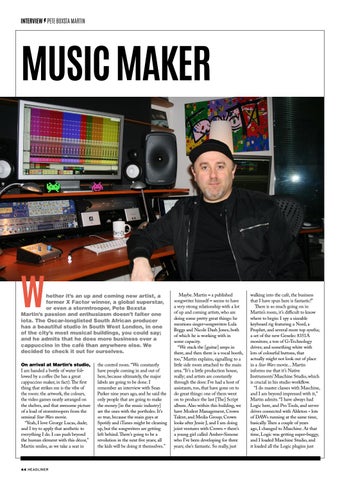
On arrival at Martin’s studio, I am handed a bottle of water followed by a coffee (he has a great cappuccino maker, in fact). The first thing that strikes me is the vibe of the room: the artwork, the colours, the video games neatly arranged on the shelves, and that awesome picture of a load of stormtroopers from the seminal Star Wars movie. “Yeah, I love George Lucas, dude; and I try to apply that aesthetic to everything I do. I can push beyond the human element with this décor,” Martin smiles, as we take a seat in
44 HEADLINER
the control room. “We constantly have people coming in and out of here, because ultimately, the major labels are going to be done. I remember an interview with Sean Parker nine years ago, and he said the only people that are going to make the money [in the music industry] are the ones with the portholes. It’s so true, because the main guys at Spotify and iTunes might be cleaning up, but the songwriters are getting left behind. There’s going to be a revolution in the next five years; all the kids will be doing it themselves.”
Maybe. Martin – a published songwriter himself – seems to have a very strong relationship with a lot of up and coming artists, who are doing some pretty great things: he mentions singer-songwriters Lula Beggs and Nicole Dash Jones, both of which he is working with in some capacity. “We stack the [guitar] amps in there, and then there is a vocal booth, too,” Martin explains, signalling to a little side room attached to the main area. “It’s a little production house, really; and artists are constantly through the door. I’ve had a host of assistants, too, that have gone on to do great things: one of them went on to produce the last [The] Script album. Also within this building, we have Modest Management, Crown Talent, and Media Group; Crown looks after Jessie J, and I am doing joint ventures with Crown – there’s a young girl called Amber-Simone who I’ve been developing for three years; she’s fantastic. So really, just
walking into the café, the business that I have spun here is fantastic!” There is so much going on in Martin’s room, it’s difficult to know where to begin: I spy a sizeable keyboard rig featuring a Nord, a Prophet, and several more top synths; a set of the new Genelec 8351A monitors; a ton of G-Technology drives; and something white with lots of colourful buttons, that actually might not look out of place in a Star Wars movie... Martin informs me that it’s Native Instruments’ Maschine Studio, which is crucial in his studio workflow. “I do master classes with Maschine, and I am beyond impressed with it,” Martin admits. “I have always had Logic here, and Pro Tools, and server drives connected with Ableton - lots of DAWs running at the same time, basically. Then a couple of years ago, I changed to Maschine. At that time, Logic was getting super-buggy, and I loaded Maschine Studio, and it loaded all the Logic plugins just