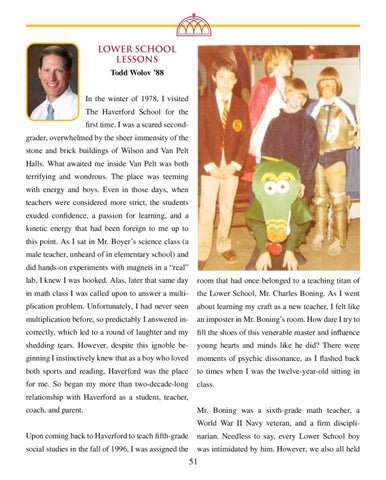
LOWER SCHOOL LESSONS Todd Wolov ’88 In the winter of 1978, I visited The Haverford School for the first time. I was a scared secondgrader, overwhelmed by the sheer immensity of the stone and brick buildings of Wilson and Van Pelt Halls. What awaited me inside Van Pelt was both terrifying and wondrous. The place was teeming with energy and boys. Even in those days, when teachers were considered more strict, the students exuded confidence, a passion for learning, and a kinetic energy that had been foreign to me up to this point. As I sat in Mr. Boyer’s science class (a male teacher, unheard of in elementary school) and did hands-on experiments with magnets in a “real” lab, I knew I was hooked. Alas, later that same day
room that had once belonged to a teaching titan of
in math class I was called upon to answer a multi-
the Lower School, Mr. Charles Boning. As I went
plication problem. Unfortunately, I had never seen
about learning my craft as a new teacher, I felt like
multiplication before, so predictably I answered in-
an imposter in Mr. Boning’s room. How dare I try to
correctly, which led to a round of laughter and my
fill the shoes of this venerable master and influence
shedding tears. However, despite this ignoble be-
young hearts and minds like he did? There were
ginning I instinctively knew that as a boy who loved
moments of psychic dissonance, as I flashed back
both sports and reading, Haverford was the place
to times when I was the twelve-year-old sitting in
for me. So began my more than two-decade-long
class.
relationship with Haverford as a student, teacher, coach, and parent.
Mr. Boning was a sixth-grade math teacher, a World War II Navy veteran, and a firm discipli-
Upon coming back to Haverford to teach fifth-grade
narian. Needless to say, every Lower School boy
social studies in the fall of 1996, I was assigned the
was intimidated by him. However, we also all held
51