Alvin Baltrop (1948–2004)
a taxi driver and became a self-employed mover.… In spite of the remarkable documentary and aesthetic value of what he accomplished, Baltrop was almost completely unsuccessful at getting his work exhibited during his lifetime.” But since his death, his work has increased dramatically in visibility— on the walls now in the permanent collection of the expanded Museum of Modern Art, for example, and in a critically celebrated retrospective at the Bronx Museum that remains on view through February 9, 2020.
Raynes Birkbeck (b. 1956)
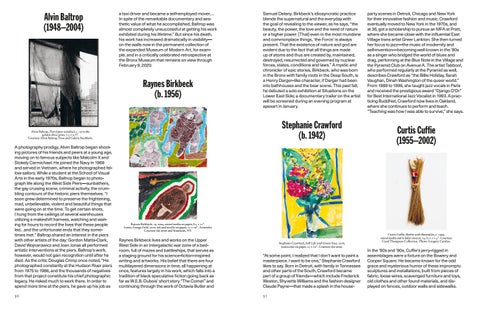
Samuel Delany. Birkbeck’s idiosyncratic practice blends the supernatural and the everyday with the goal of revealing to the viewer, as he says, “the beauty, the power, the love and the need of nature or a higher power. [That] even in the most mundane and commonplace things, ‘the Force’ is always present. That the existence of nature and god are evident due to the fact that all things are made up of atoms and thus are created by, maintained, destroyed, resurrected and governed by nuclear forces, states, conditions and laws.” A mystic and chronicler of epic stories, Birkbeck, who was born in the Bronx with family roots in the Deep South, is a Henry Darger–like character, if Darger had been into bathhouses and the bear scene. This past fall, he debuted a solo exhibition at Situations on the Lower East Side; a documentary trailer on the artist will be screened during an evening program at apexart in January.
Stephanie Crawford (b. 1942)
Alvin Baltrop, Piers (open window), c. 1975–86, gelatin silver print, 7.5 × 9 .5". Courtesy Alvin Baltrop Trust and Galerie Buchholz.
A photography prodigy, Alvin Baltrop began shooting pictures of his friends and peers at a young age, moving on to famous subjects like Malcolm X and Stokely Carmichael. He joined the Navy in 1969 and served in Vietnam, where he photographed fellow sailors. While a student at the School of Visual Arts in the early 1970s, Baltrop began to photograph life along the West Side Piers—sunbathers, the gay cruising scene, criminal activity, the crumbling contours of the historic piers themselves. “I soon grew determined to preserve the frightening, mad, unbelievable, violent and beautiful things that were going on at the time. To get certain shots, I hung from the ceilings of several warehouses utilizing a makeshift harness, watching and waiting for hours to record the lives that these people led…and the unfortunate ends that they sometimes met.” Baltrop shared an interest in the piers with other artists of the day: Gordon Matta-Clark, David Wojnarowicz and Joan Jonas all performed artistic interventions at the piers. Baltrop’s work, however, would not gain recognition until after he died. As the critic Douglas Crimp once noted, “He photographed constantly at the Hudson River piers from 1975 to 1986, and the thousands of negatives from that project constitute his chief photographic legacy. He risked much to work there. In order to spend more time at the piers, he gave up his job as 50
party scenes in Detroit, Chicago and New York for their innovative fashion and music. Crawford eventually moved to New York in the 1970s, and at 36, got a scholarship to pursue an MFA at Pratt, where she became close with the influential East Village trans artist Greer Lankton. She then turned her focus to jazz—the music of modernity and self-invention—becoming well known in the ’80s as a singer who bridged the world of blues and drag, performing at the Blue Note in the Village and the Pyramid Club on Avenue A. The artist Tabboo!, who performed regularly at the Pyramid as well, describes Crawford as “the Billie Holiday, Sarah Vaughan, Dinah Washington of the queer world.” From 1989 to 1996, she taught jazz vocals in Paris and received the prestigious award “Django D’Or” for Best International Jazz Vocalist in 1993. A practicing Buddhist, Crawford now lives in Oakland, where she continues to perform and teach. “Teaching was how I was able to survive,” she says.
Curtis Cuffie (1955–2002)
Raynes Birkbeck, 19, 2004, mixed media on paper, 8.5 × 11". Lester, Energy Field, 2010, ink and acrylic on paper, 17 × 20". Artworks: Courtesy the artist and Situations, NY.
Raynes Birkbeck lives and works on the Upper West Side in an intergalactic war zone of a bedroom, full of mazes and battleships, that serves as a staging ground for his science-fiction-inspired writing and artworks. His belief that there are four multilayered dimensions in time, all happening at once, features largely in his work, which falls into a tradition of black speculative fiction going back as far as W.E.B. Dubois’ short story “The Comet” and continuing through the work of Octavia Butler and
Stephanie Crawford, Still Life with Green Vase, 2016, watercolor on paper, 15 × 22". Courtesy the artist.
“At some point, I realized that I don’t want to paint a masterpiece. I want to be one,” Stephanie Crawford likes to say. Born in Detroit, with family in Tennessee and other parts of the South, Crawford became part of a group of friends—which include Frederick Weston, Shyvette Williams and the fashion designer Claude Payne―that made a splash in the house51
Curtis Cuffie, Barbie with Binoculars, c. 1999, mixed media and le balai citoyen, 14.75 × 2 × 4". Courtesy Carol Thompson Collection. Photo: Gregory Carideo.
In the ’80s and ’90s, Cuffie’s jerry-rigged in assemblages were a fixture on the Bowery and Cooper Square. He became known for the odd grace and mysterious humor of these impromptu sculptures and installations, built from pieces of fabric, loose wires, scavenged furniture and toys, old clothes and other found materials, and displayed on fences, outdoor walls and sidewalks.