

CLICK HERE IF YOU HAVE NOT ALREADY OPTED IN!

CLICK HERE IF YOU HAVE NOT ALREADY OPTED IN!

CLICK HERE IF YOU HAVE NOT ALREADY OPTED IN!

Phone: 334-834-1170
Fax: 334-834-4525
www.southernloggintimes.com
Publisher David H. Ramsey
Chief Operating Officer Dianne C. Sullivan
Editor-in-Chief Rich Donnell
Senior Editor Dan Shell
Managing Editor David Abbott
Senior Editor Jessica Johnson
Publisher/Editor Emeritus David (DK) Knight
Art Director Cindy Segrest
Ad Production Coordinator Patti Campbell
Circulation Director Rhonda Thomas
ADVERTISING CONTACTS
DISPLAY SALES
Eastern U.S.
Kathy Sternenberg
Tel: 251-928-4962 • Fax: 334-834-4525
407 Barclay Ave.
Fairhope, AL 36532
E-mail: ksternenberg@bellsouth.net
Midwest USA, Eastern Canada
John Simmons
Tel: 905-666-0258
29 Bugelli Dr.
Whitby, Ontario, Canada L1R 3B7
E-mail: jsimmons@idirect.com
Western Canada, Western USA
Tim Shaddick
Tel: 604-910-1826
4056 West 10th Ave.
Vancouver, BC V6L 1Z1
E-mail: twshaddick@gmail.com
Kevin Cook
Tel: 604-619-1777
E-mail: lordkevincook@gmail.com
International
Murray Brett
Tel: +34 96 640 4165
Mobile: +34 66 931 5837
58 Aldea de las Cuevas • Buzon 60
03759 Benidoleig (Alicante), Spain
E-mail: murray.brett@abasol.net
Bridget
Email:
CLASSIFIED ADVERTISING
DeVane
1-800-669-5613 •
Tel:
Tel: 334-699-7837
Vol. 53 No. 4 (Founded in 1972—Our 619th Consecutive Issue) April 2024 A Hatton-Brown Publication Southern Loggin’ Times (ISSN 0744-2106) is published monthly by Hatton-Brown Publishers, Inc., 225 Hanrick St., Montgomery, AL 36104. Subscription Information—SLT is sent free to logging, pulpwood and chipping contractors and their supervisors; managers and supervisors of corporate-owned harvesting operations; wood suppliers; timber buyers; wood procurement and land management officials; industrial forestry purchasing agents; wholesale and retail forest equipment representatives and forest/logging association personnel in the U.S. South. See form elsewhere in this issue. All non-qualified U.S. subscriptions are $65 annually; $75 in Canada; $120 (Airmail) in all other countries (U.S. funds). Single copies, $5 each; special issues, $20 (U.S. funds). Subscription Inquiries TOLL-FREE 800-669-5613; Fax 888-611-4525. Go to www.southernloggintimes.com and click on the subscribe button to subscribe/renew via the web. All advertisements for Southern Loggin’ Times magazine are accepted and published by Hatton-Brown Publishers, Inc. with the understanding that the advertiser and/or advertising agency are authorized to publish the entire contents and subject matter thereof. The advertiser and/or advertising agency will defend, indemnify and hold Hatton-Brown Publishers, Inc. harmless from and against any loss, expenses, or other liability resulting from any claims or lawsuits for libel violations or right of privacy or publicity, plagiarism, copyright or trademark infringement and any other claims or lawsuits that may arise out of publication of such advertisement. Hatton-Brown Publishers, Inc. neither endorses nor makes any representation or guarantee as to the quality of goods and services advertised in Southern Loggin’ Times. Hatton-Brown Publishers, Inc. reserves the right to reject any advertisement which it deems inappropriate. Copyright ® 2024. All rights reserved. Reproduction in whole or in part without written permission is prohibited. Periodicals postage paid at Montgomery, Ala. and at additional mailing offices. Printed In USA. POSTMASTER: Send address changes to: Southern Loggin’ Times, P.O. Box 2419, Montgomery, AL 36102-2419 FEATURES 4 ● APRIL 2024 ● Southern Loggin’ Times Other Hatton-Brown publications: ★ Timber Processing ★ Timber Harvesting ★ Panel World ★ Power Equipment Trade ★ Wood Bioenergy Southern Stumpin’..........................6 From The Backwoods Pew..........22 Industry News Roundup..............26 Machines-Supplies-Technology..32 Iron Works......................................34 Coming Events/Ad Index..............38
Robertson is the latest in a long line of loggers in his Tennessee family. He took over the family business, Robertson Logging, from his
just over 10 years ago. Based near the Mississippi border, Robertson
and hauls in
working exclusively for Mississippi mill company
limitations
staffed
family members. Story
on CLICK HERE IF YOU HAVE NOT ALREADY OPTED IN!
bdevane7@hotmail.com
Scottie
father
cuts
both states,
Hankins Inc. Though still with enough equipment to field two crews, Robertson has dealt with labor
by consolidating operations onto one job
mostly with
begins

CLICK HERE IF YOU HAVE NOT ALREADY OPTED IN!
 By David Abbott • Managing Editor
Gdavid@hattonbrown.com
Open Canopies
ood forest management—responsible, sustainable and effective—is an essential service in our society. We need to manage our forests for a variety of reasons: so that we can benefit from the resources they provide (building and shipping materials, paper products, fuel for heat and energy, and so on), and to provide jobs; but also for our recreational enjoyment (hunting, camping, etc.), for wildlife habitat, and of course for their own intrinsic beauty and value. No matter how you cut it, logging, done properly, is a necessary aspect of forest management.
In recent months I have attended several forest products industry meetings during which various speakers reported on forest management programs aimed, for example, at regenerating longleaf pine stands. And on page 8 in this issue, our cover profile subject, Scott Robertson in Tennessee, talks about his technique for opening up the canopy to help regenerate pine in hardwoodheavy stands, while over in the “From the Backwoods Pew” column on page 22, Brad Antill also discusses how canopy shade and sunlight affects the growth of various species of trees to illustrate spiritual growth or lack thereof in our own lives.
Coincidentally, all of these things seemed to dovetail pretty well with each other thematically, as well as with this submission we recently received from Robert Williams, a retired New Jersey forester with Pine Creek Forestry. Bob wrote: “A small story for your use! A positive forestry situation—so much more that could be said and shown!! One small victory for working in the woods!” So, I thought it would be a good thing to share with our readers. Hope you enjoy. Thanks for the story, Bob!
Wolf Tree Forest
Wolf trees occur throughout most forest types across America. They are typically large older trees left as a legacy from past land use activities such as agriculture or timbering. When left to grow freely in the open, these trees develop an extensive spreading, large branching condition, not typical of cedar trees growing in a stocked forest. As the trees mature, their branches are typically numerous and gnarly. They usually are found as single trees that are scattered in a larger forested landscape.
It is rare to see a wolf tree forest. The Wolf Tree Forest found in southern New Jersey is a large section of the once extensive Atlantic White-Cedar resource of Wharton State Forest— New Jersey’s largest state forest.
Wharton State Forest was purchased in the mid-1950s and contains around 125,000 acres. This forest experienced repeated timbering starting in the late 1600s into the 1900s. The land also experienced heavy industrial use for many
centuries, when the forest supplied the fuel for industry as well as the lumber and fuel for the development of the colonial cities of New York and Philadelphia.
The cedar resource was exploited into the 20th century, with the last cedar harvests in the 1930s and 1940s. It is important to understand that the centuries of cedar cutting were not based on any standards of ecologically sustainable forest management. There was little to no effort to cut or control the cedar competitors of red maple, black gum, or pitch pine, which allowed those species to continually gain dominance, gradually replacing the cedar on many sites. The shade-intolerant cedar has been unable to regenerate under the shade of these species including the woody brush species understory that followed as well.
As the cedar exploitation ceased, the wood cutters arbitrarily left individual cedar trees or small groups in a random pattern across the cedar swamp areas. Small cedar trees, defective cedar trees, and trees that simply were too hard to reach in these swamp conditions were left to continue growing in the resulting open conditions. This led to the development of a forest of “wolf trees” across many of the cedar swamps, resulting in the Wolf Tree Forest.
Great White Cedar Hope
Having grown in the open, these trees are now the largest cedar trees in the forest. They have unique physical character and high ecological value. For the lost cedar forests in this region, the Wolf Tree Forest provides a unique seed source for needed Atlantic White-Cedar restoration efforts that could return cedar to the landscape. These large cedar trees stand tall above an ocean of woody brush and greenbriar, which continues to prohibit natural cedar regeneration from occurring.
Atlantic White-Cedar is a declining forest ecosystem across the East Coast, with less than
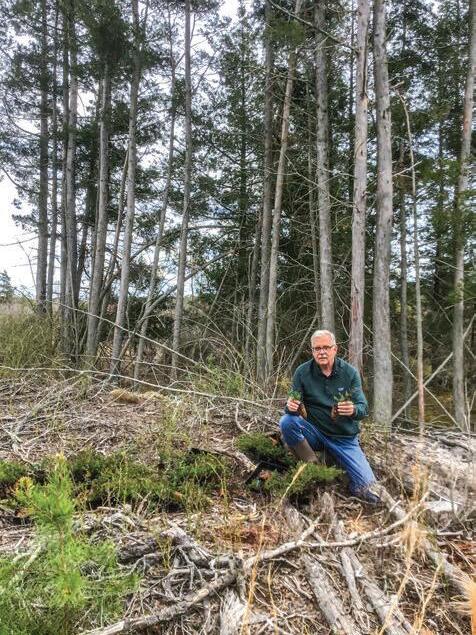
After more than 85 years of no forest management, viable cedar regeneration remains absent.
The decline of this important cultural and ecological forest ecosystem continues across its entire range from Maine to the Gulf Coast of Mississippi. However, the Wolf Tree Forest still offers an opportunity to restore thousands of acres of this once magnificent Atlantic WhiteCedar forest ecosystem.
Active forest management is needed before this natural seed source is lost, as is the case in many states. The science on Atlantic White-Cedar management is well established, with extensive research as well as the numerous examples of cedar regeneration by foresters on both public and private lands over the last 30 years across southern New Jersey. Today, the most viable cedar regeneration is found only where foresters and loggers have applied the needed forest management based on science and experience.
The Wolf Tree Forest is at a critical juncture; its restoration can be one of the most significant forest conservation efforts in the United States, resulting in reversing the long-term decline of this globally threatened forest ecosystem. Restoration efforts can
STUMPIN’
SOUTHERN
• Ph. 334-834-1170 • Fax: 334-834-4525 • E-mail:
CLICK HERE IF YOU HAVE NOT ALREADY OPTED IN!

CLICK HERE IF YOU HAVE NOT ALREADY OPTED IN!
High Ground
 By David Abbott RAMER, Tenn.
Coming from a family that has worked in the woods for generations, Scottie Robertson, 50, has been around the logging business all his life. His grandfather mixed sawmilling with farming nearly 100 years ago. Scottie’s dad, James Robertson, followed in those footsteps; he also split his time with farming when he first started logging in 1969. James bought his first new skidder in 1973 and continued logging full-time for 50 years before he retired.
James’s son Scottie went to work on the crew full-time after graduating high school in 1992. James and Scottie started a second crew then, with one running in pine and the other dedicated to hardwood all the time. They logged hardwood tracts
during that time for Selma, Ala.based Miller Lumber Co., which used to be one of the largest timberland owners in western Tennessee, according to Robertson.
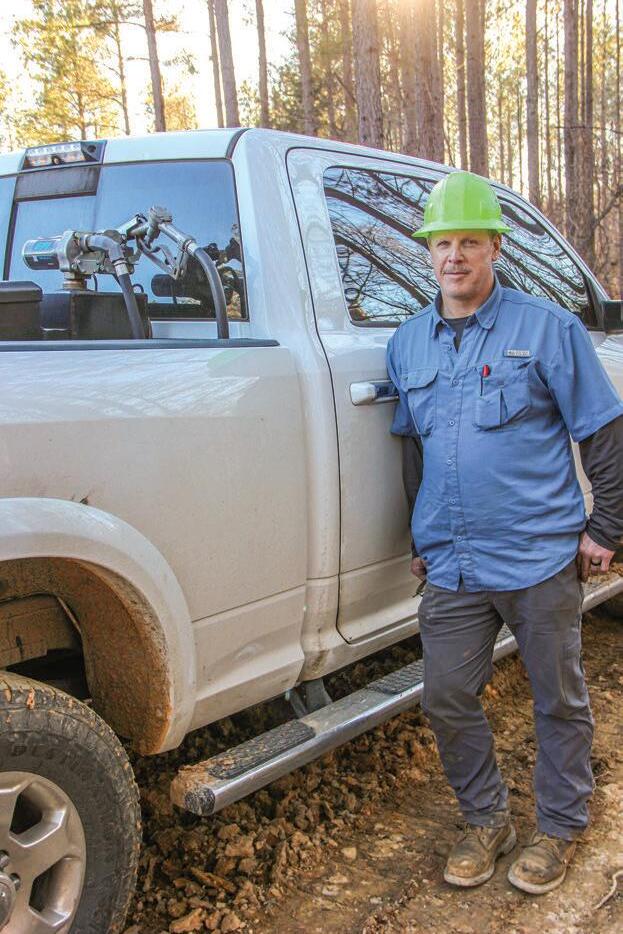
Scottie took over the family business, Robertson Logging, LLC, from his dad in 2013, just over 10 years ago. “I’ve seen a lot of change over my lifetime out here,” Robertson says. “I love being out here.” But, he admits, his perspective of it has changed since he took on the owner’s mantle, with the responsibility for the business’s finances and sustained viability on his shoulders.
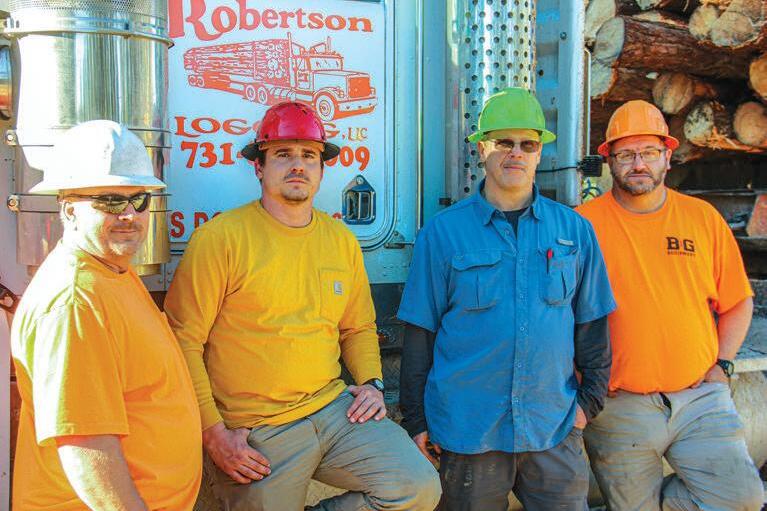
The family aspect of the family business continues into the present: Most of the operators are family. Scottie’s younger brother Jamie is out here with him in the woods today, manning the loader, and stepson Zach Lambert runs the skidder. Another employee, Jerry
Wrenn, drives the other skidder. All of them can trade places to operate any piece of equipment in the Robertson roster when needed.
Robertson and wife Angie celebrate their 30th wedding anniversary this year. When they married in 1994, Zach was 18 months old and
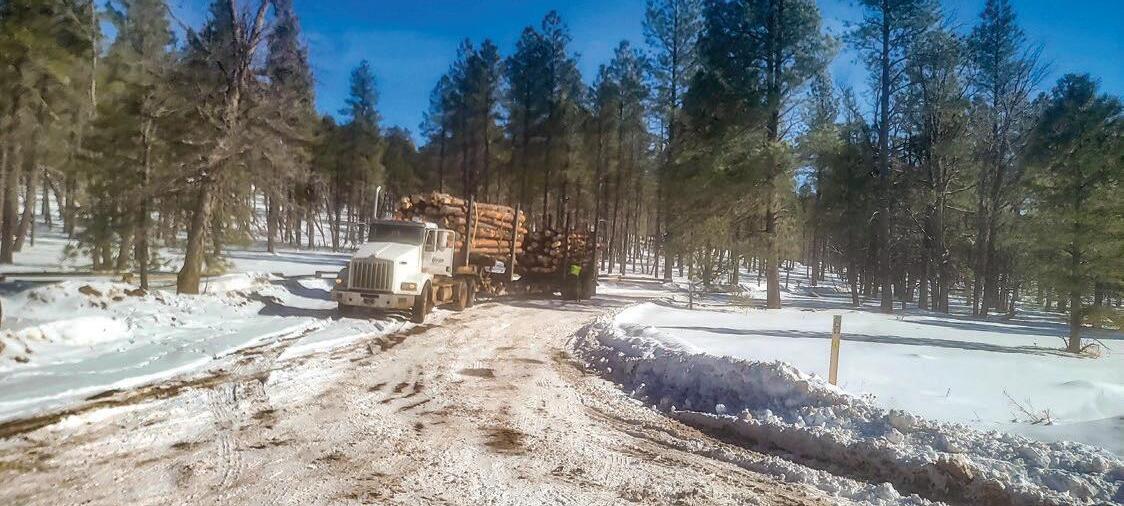
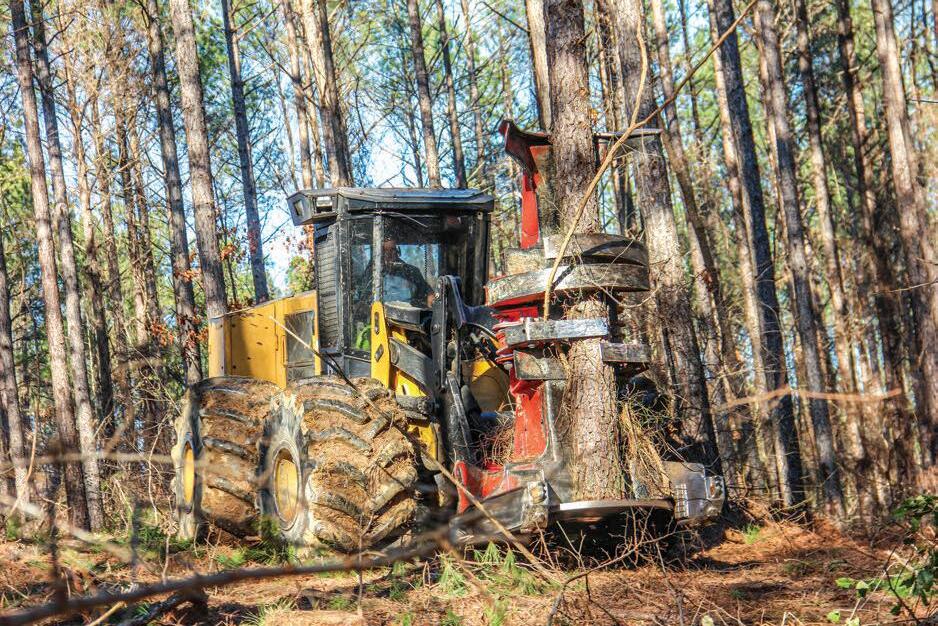
 Robertson Logging cuts hardwood and pine on high elevation tracts.
★ CLICK HERE IF YOU HAVE NOT ALREADY OPTED IN!
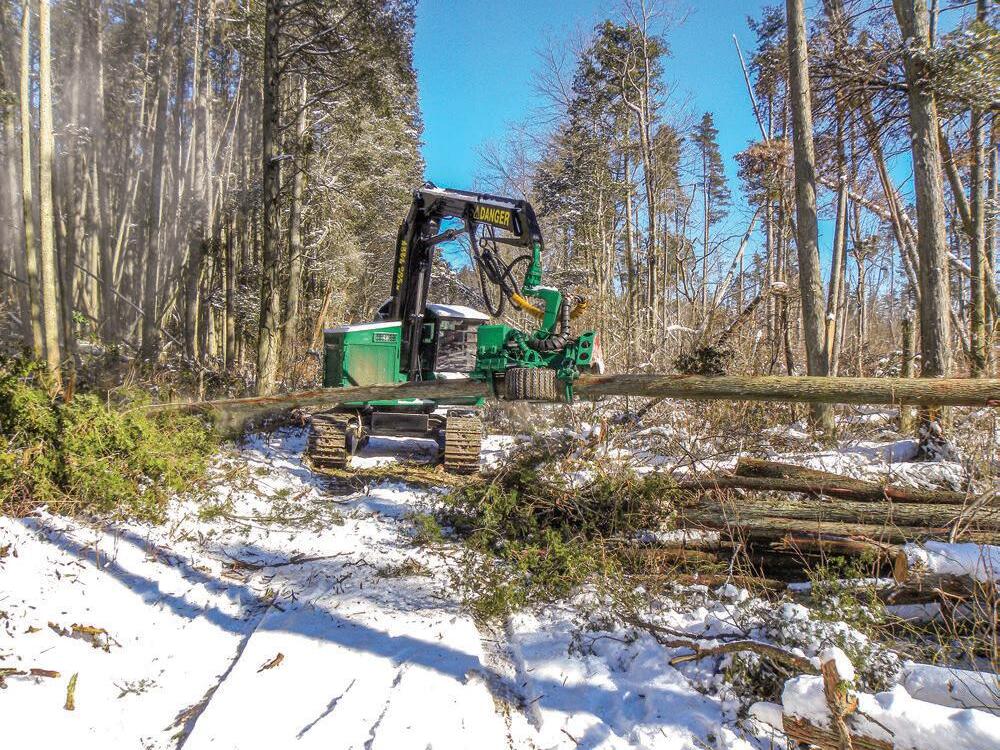
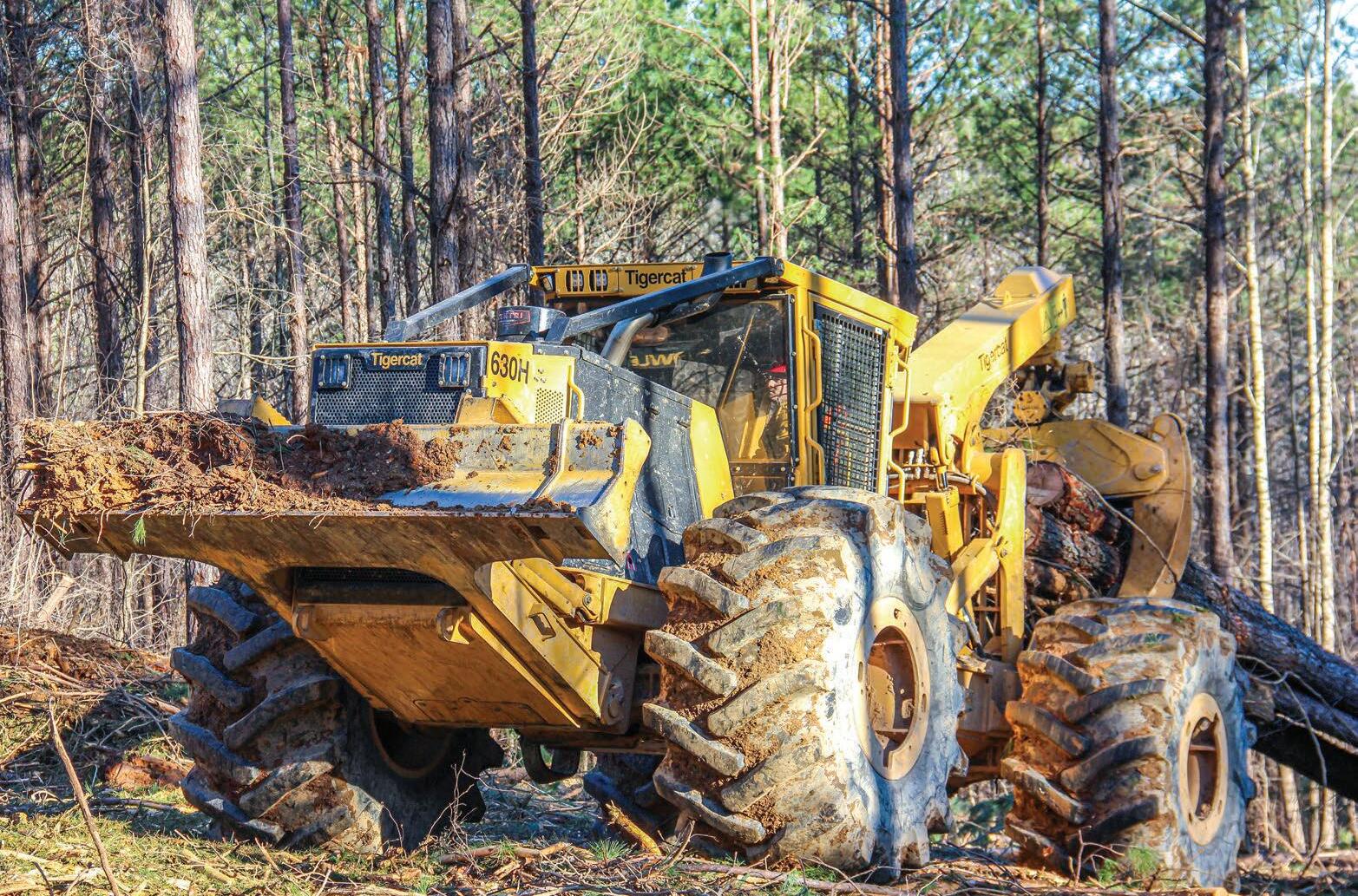
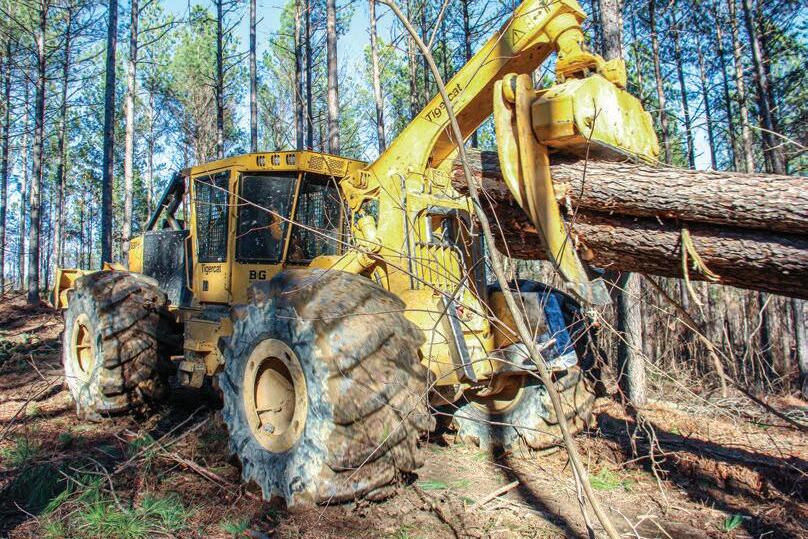
Robertson has addedTigercat machines to his roster recently.
Robertson’s daughter Whitney was three. By Whitney, whose husband works on the railroad, Robertson has three grandkids.
Equipment
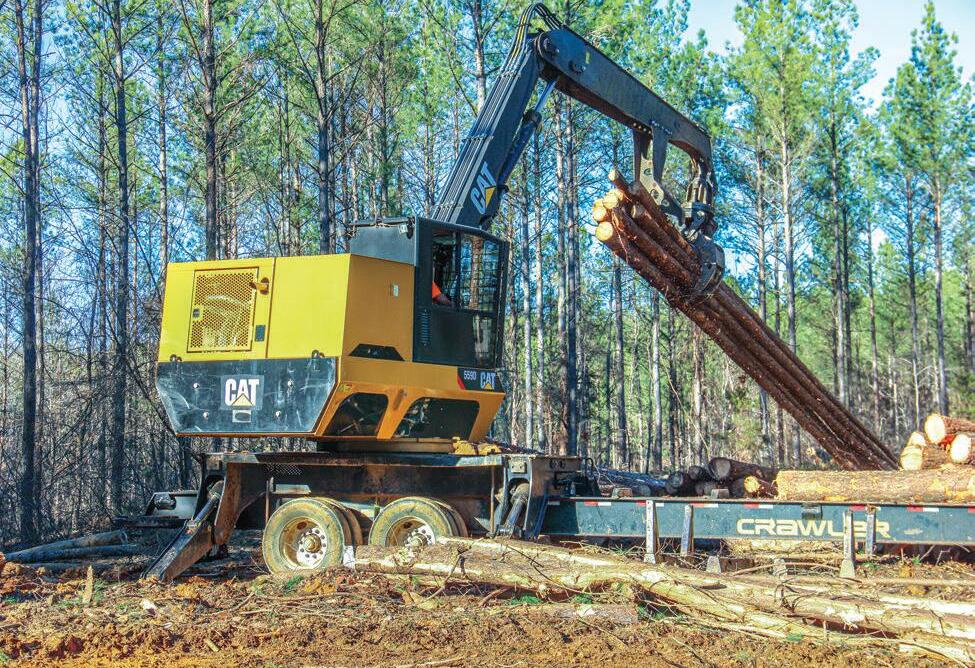
Robertson Logging still has enough equipment to run two separate crews, but not enough operators currently to run it all at the same time. They do sometimes set up on two separate job sites; that way the operators can move from one to the other to keep working in case one tract gets rained out, or in case of major breakdowns. In this case, on this tract where Southern Loggin' Times found the crew working in February, Robertson set up two separate loader ramps on different parts of the same job, one for hardwood, one for pine.
Robertson has traditionally run mostly all Caterpillar machines, but just last September he bought a brand new Tigercat 630H skidder. It was the last 2023 model the dealer, B&G Equipment in Iuka, Miss., had. He also has a Tigercat 234B loader working on his hardwood side, and an older Tigercat 724D cutter kept as a spare.
The Tigercat machines work alongside a Cat 535C skidder, Cat 559D loader and Cat 573 fellerbuncher. A Cat 324 excavator with Rotobec grapple saw for topping hardwood means there’s no longer any need to have anyone on the ground with a chain saw. Robertson also has a 1978 model Cat 14 grader to maintain roads, an absolute necessity in much of the terrain in which Robertson Logging often works. Thompson Cat in Tupelo, Miss., is his Cat dealer.
“I’ll have to update some more equipment over this next year,” Robertson predicts, adding, “I’m gonna go all Tigercat.” But he doesn’t plan to do it all at once. “With the price of this equipment, you can’t just jump out there and overload yourself. I’ve done that one time and I said no, I ain’t doing that no more. It was a struggle. I had three brand new pieces out here at
one time and it was too much of a monthly payment to try to swing.” To avoid repeating that scenario, he plans to upgrade machines one piece at a time.
On his cutters, Robertson likes to run size 34 tires, while newer skidders run on 35s. In full clear-cuts, he keeps dual tires on the back and chains on the front tires. “We can’t do that where we’re thinning here on the tops of the ridges, but in the hollows, we will dual up the rear tires and put chains on the front.” Firestone is among the best tire brands on the market, he believes, but for the price difference, he now opts to run with Maximas.
The operators grease their machines daily and change oil every 250 hours, and they handle all basic repairs and routine maintenance on weekends and rainy days, working from Robertson’s 100x100 shop back in Ramer. For breakdowns in the woods that have to be repaired on the fly, he keeps an array of spare hoses and parts, filters and other necessities in the service truck. “You can’t carry it all but we try to keep enough, and I have a portable welder I bring on days I know we’ll need to use it to repair something to keep us running.”
Robertson will look to the dealer for major problems he can’t solve. “We’ll call them out because these computers nowadays make it harder to work on.” He also knows a few mechanics with their own service trucks who come out to the woods when needed, such as Brandon Blakeley, who has a welding and equipment repair shop that Robertson often uses.
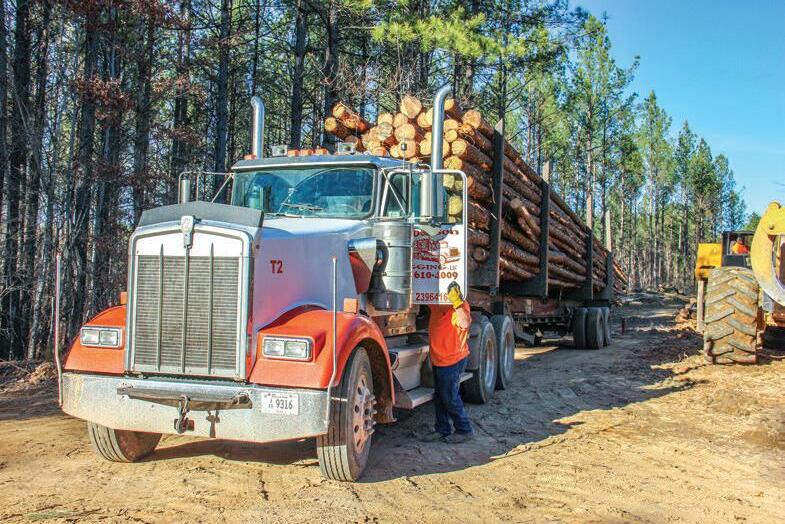
Robertson’s truck fleet includes a 1999 model International, a ’99 Kenworth W9 and a ’94 Ford for moving equipment with a lowboy. Savannah Machine Shop supplied most of his log trailers and lowboy,
which had been modified before he bought it, beefed up to rate at 50 tons. Robertson further modified it by adding hydraulic ramps.
Drivers include Jeff Willbanks, Keith Ham and John Griffin out of Faulkner, Miss.
Robertson has a Vestige dash cam system on all his trucks, with one camera facing forward and two facing backwards from the side mirrors. Phones and distracted drivers not paying attention, he believes, are the main problems causing accidents on the road today, but log trucks often still take the blame anyway. A car hit one of his trucks recently and no doubt Robertson Logging would have been held at fault but dash cam footage proved otherwise.
Timber
This higher elevation tract is about 778 acres of pine and mixed hardwood, owned by Hankins Forest Products of Ripley, Miss., the company Robertson works for. “We’re second thinning all the
through so many times,” Robertson says. “We’re gonna take it all out, and then it will just be one solid tract of pine. They’ll replant everything.”
Though the management plan here calls for a certain basal area, Robertson, who handles felling duties on the crew, relies on his years of experience thinning pine. His goal is to open the crowns back up and space the trees out such that the crowns don’t touch. He makes his selection primarily by visual determination. “I look for the cull trees still left in the stand, the forks and the ones that are not going to make a pretty mature log; we try to take those out.” His method gives the remaining trees better access to sunlight and nutrition. “You give it a year or so and that (canopy) will be closed back off again, but the trees will start getting larger.”
They don’t expect to finish this job this year, he says. “We are waiting on a couple of months of dry weather; we have a couple of other tracts we’ll go to in between. Dad
Southern Loggin’ Times ● APRIL 2024 ● 9 CLICK HERE IF YOU HAVE NOT ALREADY OPTED IN!
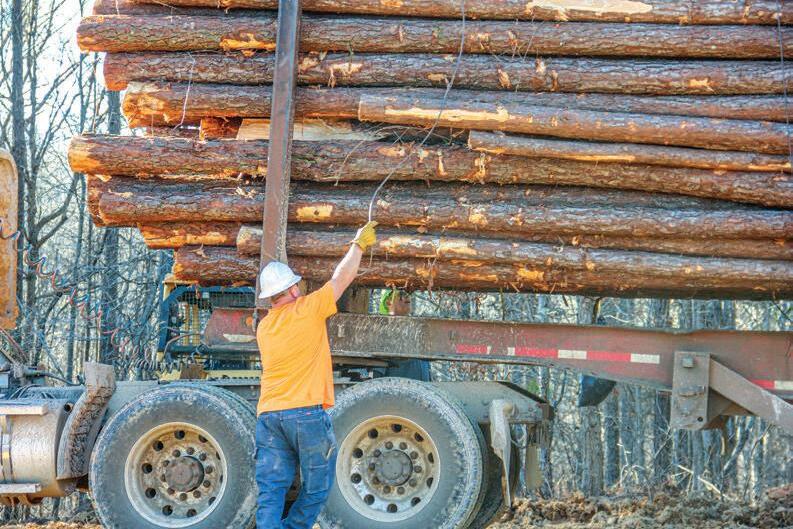
Robertson believes his raising has given him some advantage, helping him earn a reputation with landowners as a skilled logger who can get fiber out of hard to access places without damaging the land.
Even so, Robertson Logging works exclusively on Hankins, Inc. tracts. In the past he has tried cruising his own timber but eventually decided his time was better spent working on the feller-buncher full time. There weren’t enough hours in the day to also cruise and buy timber. “I could go on my own and buy all the timber I want, but I got too much on my plate, and got tired of
the hassle and dealing with lawyers and experience bonds. It’s too much. Hankins does all that so I don’t have to. I just come to work and deal with the job. I am out here every day and work right along with the crew. I won’t ask nobody to do nothing that I’m not going to do myself.”
From his home base in Ramer, Tenn., Robertson’s operational territory is very close to the Mississippi line, so the business covers ground in both states. Obviously the crew works for Hankins, a Mississippi company, and hauls to several other mills in Mississippi. Every now and then Robertson Logging crosses over
the line to work on jobs in Mississippi, about 20 miles in, but doesn’t usually venture further south than that. Since 2019, however, Hankins forester Jay Wolf has usually kept Robertson working in the Natchez Trace state park all summer.
Markets
Robertson reckons the crew sends out 50-60 loads weekly, though it’s limited to around 40 during some of the winter. Pine logs go to Hankins in Ripley, Miss.; pine pulpwood to PCA (Packaging Corp. of America) in Counce, Tenn.; and chip-n-saw to
Mission Forest Products in Corinth, Miss. The Robertson crew has multiple outlets for hardwood pulpwood, locally at Mississippi Silicon in Burnsville, Miss., and Cooper Marine & Timberlands in Bay Springs, Miss. A third is in Wickliffe, Ky., about a 150-mile drive; extra contract drivers will take a load there on backhauls between other jobs for other loggers, Robertson says. “We all try to work together if we can when it comes to that.”
The logger points out, “I’m happy Hankins lets me do what we do. It’s not all gravy, but that’s part of logging. There will be quotas every time

10 ● APRIL 2024 ● Southern Loggin’ Times
Robertson has his own trucks and hires contract haulers.
CLICK HERE IF YOU HAVE NOT ALREADY OPTED IN!
It's a long family tradition for the Robertsons.

CLICK HERE IF YOU HAVE NOT ALREADY OPTED IN!

you turn around; one of the biggest obstacles right now is quotas.”
Another problem, he says: a lot of mills don’t start unloading trucks till 7 a.m. and cut it off by 3. Some, like Hankins, take in loads from 6-5 during the week and till 4 on Fridays. But there is a limited time frame to get the loads hauled. Conse-
quently, the crew loads trailers in the evening for drivers to pick up in the morning so that they can have trucks sitting at the mill waiting when they open. The crew usually gets to the woods to start working about 6 in the morning.
All of Robertson’s workers’ comp and trucking insurance is through BITCO.
The logger often conducts safety meetings during the commute to the job site. When they’re working the Natchez Trace, that’s an hour and a

half the crew is riding together in a truck. Robertson always furnishes transportation for his men, who meet at the shop in the morning and ride to the woods together.
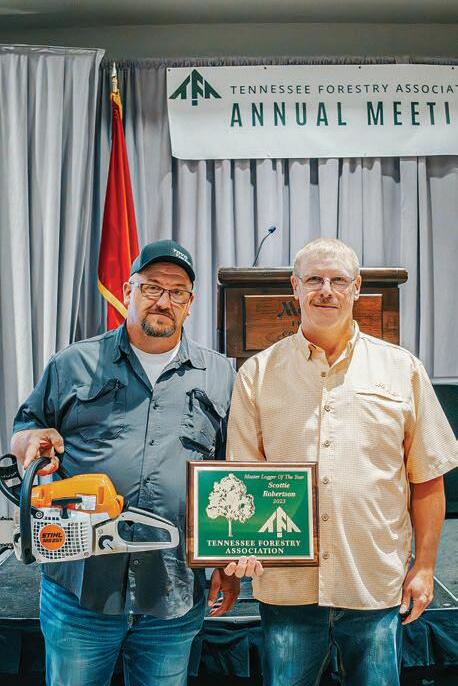
Robertson Logging was Tennessee Forestry Assn.’s 2023 Logger of the Year. He received the award at a TFA meeting in Franklin last year. One of the reasons he was selected was his ongoing commitment to education about the industry. He has been involved with 4H and FFA and has hosted high school students on his job site to talk about logging business and safety. “My nephew just graduated high school, my brother Jaime’s oldest son, and he is going to forestry school currently,” Robertson says. “One thing, it is hard to get people educated to know how to log and get them interested. We’re on machines, yeah, but it’s not easy work. There’s a whole lot goes on from day light till dark.”
He’s also active in his faith, overseeing the men’s ministry at Holly Baptist Church for the last few years. He and a group of men from the church get together the first Friday of each month to bring a meal and reach out to those at the Freedom Center, a drug addiction treatment and rehab center in Corinth, Miss. “I was scared to step out on faith, but the good Lord has put me in this position and given me a platform to witness,” Robertson says. “It’s got me through some hard times in this business. I can’t see it and get frustrated sometimes, but he’s gonna provide for us. I can’t complain about my life.” SLT
12 ● APRIL 2024 ● Southern Loggin’ Times
Loggers of theYear for 2023,Scottie Robertson holds the plaque while Jamie holds Stihl chainsaw donated by Bryan Equipment.
CLICK HERE IF YOU HAVE NOT ALREADY OPTED IN!
The Robertson family with JayWolfe,Hankins Forest Products procurement manager in Savannah,Tenn,who nominated Robertson for the award.Their dad,James Robertson, in the wheelchair,wasTN Master Logger of theYear in 2009.

CLICK HERE IF YOU HAVE NOT ALREADY OPTED IN!
Adaptability
n
In response to sawmill closures, the Bardens moved from Florida to Arizona.
By Teresa Hannah, President, Caribou Software, and Economics Ph.D. from University of California, Davis
EDITOR’s NOTE: Caribou Software submitted this article. Many thanks to the Bardens for being willing to share their story.
FLAGSTAFF, Ariz.
This past year has been notably challenging for the forest industry, and Northern Florida is no exception. The logging communities there have felt a profound impact following significant operational shifts at two major mills.
West Fraser’s decision to indefinitely curtail operations at its Perry sawmill early in 2023, followed later in the year by Georgia-Pacific’s announcement that it would cease production indefinitely at their Perry Foley mill in September, sent shockwaves through the local economy. The cessation of these operations left

over a thousand employees jobless, and adversely affected numerous logging crews that supplied these mills with essential fiber. The Foley mill, for instance, processed around 1,100 loads of wood weekly, highlighting the magnitude of the impact on local logging contractors.
Faced with such significant reductions in demand in such a short period, how do logging operations with
capital assets worth hundreds of thousands of dollars even begin to formulate a plan for survival? This question looms large for many in the logging industry across the U.S. and Canada right now.
I had the opportunity to learn about the remarkable response of one such company, Lucas Barden Logging, Inc. from Cross City, Fla., during a completely unexpected chance
encounter at the Oregon Logging Conference in Euguene, Ore. on February 24th.
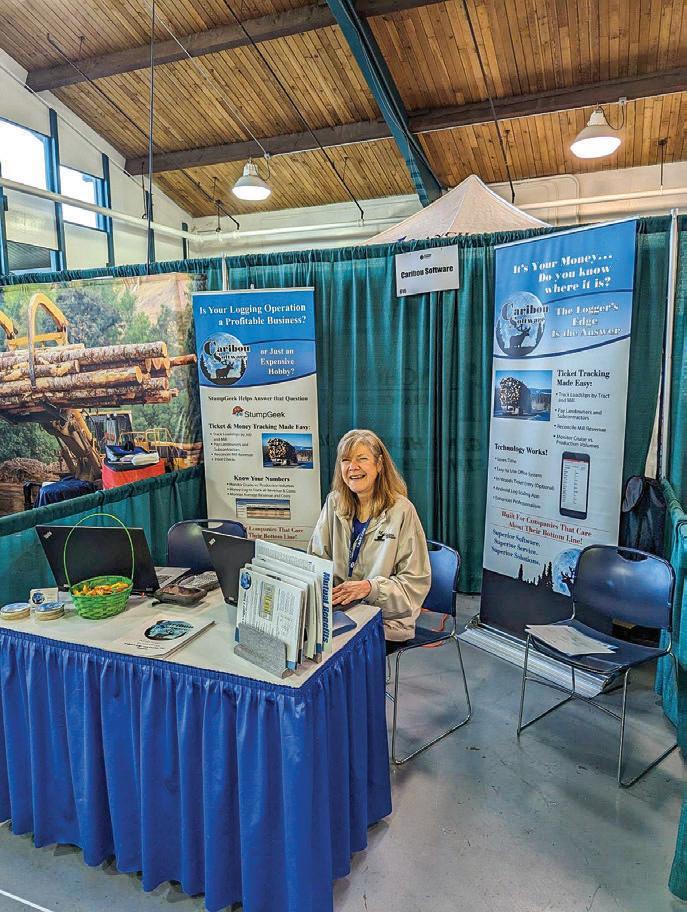
Caribou Software was exhibiting at the conference, showing our Logger’s Edge and Stumpgeek software solutions for loggers and timber dealers, as well as our Log Scaling and Wood Procurement systems for mills. On the last day of the show, a woman approached my booth and said, “Hello, I’m one of Caribou’s customers.” Her name was Pam Barden, wife of logger Lucas Barden.
I first met Pam 16 years ago when I arrived at their home office in Cross City in March of 2008 to train Pam on how to use our Logger’s Edge software, which she and Lucas had recently purchased for their new logging operation. They originally had heard of Caribou from Lucas’s uncle, Dave Barden, of Barden Contracting, out of Houston, British Columbia, who had purchased our software the year before.
“What on earth brought you and Lucas all the way out to Oregon from Florida?” I asked. And that’s when I learned about their remarkable story.
14 l APRIL 2024 l Southern Loggin’ Times
Lucas and Pam Barden,seen here at the Grand Canyon,moved their operations toArizona after mill closures in Florida last year.
MarcogetswoodprocessedfortheRFORMill.
★ CLICK HERE IF YOU HAVE NOT ALREADY OPTED IN!
Tough Day
“On Monday September 18th, 2023, ” Lucas began, as he stood next
(9-18). Your forester will be contacting you soon. Thanks.
Talk about a tough day at the office. Similar and equally unwel-

the time, I was vaguely aware of the attempts to get logging going again in the Arizona Ponderosa Pine forests, where roughly 30 years ago environmentalists pretty much brought it to a standstill,” he recounts. “I had seen an article in one of the industry publi-

going, there’s a lot of potential for logging contractors.”
He continued: “My first contact with RFOR was by email on October
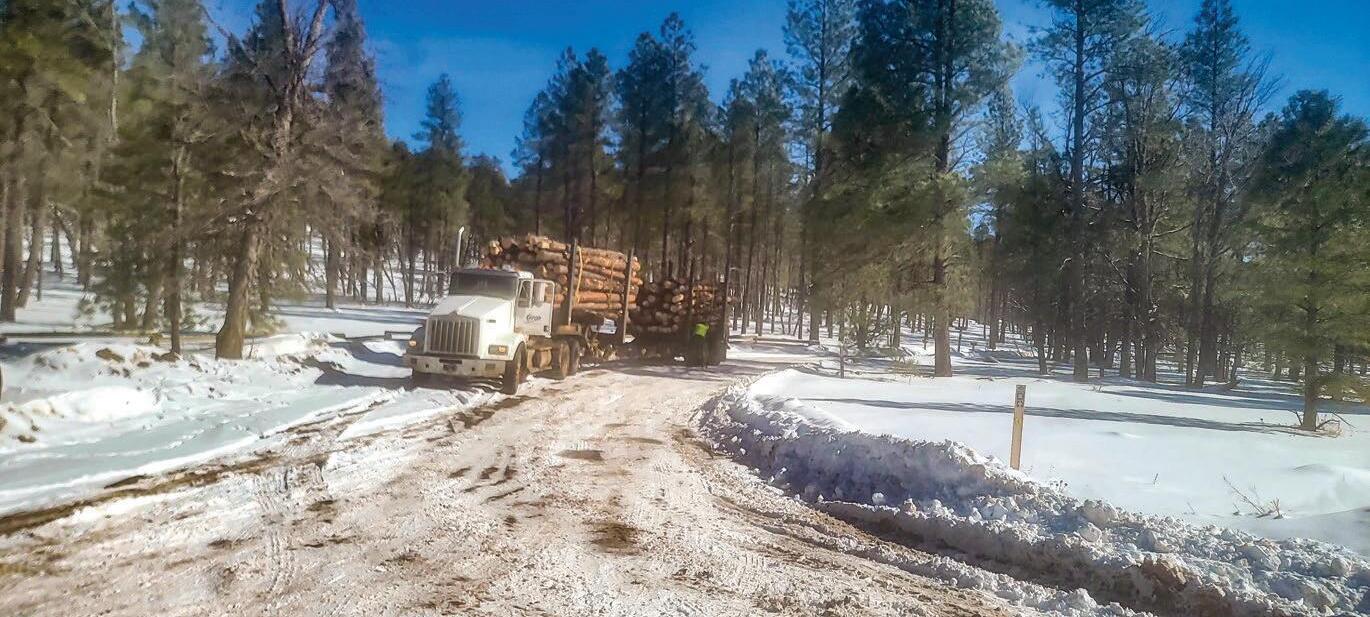
Southern Loggin’ Times l APRIL 2024 l 15 CLICK HERE IF YOU HAVE NOT ALREADY OPTED IN!
CEO, Allen Sherrington, on our last trip to Flagstaff, I had enough confidence in them that Pam and I decided to give it a try.”
They loaded their last tree in Florida on December 8th, and just 10 days later, on December 18th, they were cutting trees in Flagstaff, Ariz.
The Move
The transition from the flatlands of Florida to the high desert mountains of Arizona presented unique
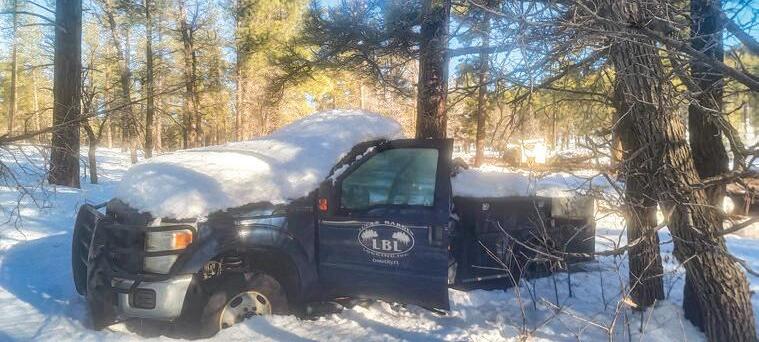
challenges, from adapting to different terrains to facing harsh winter conditions unfamiliar to the Florida natives.
“I have to admit that I have an adventurous component in me, and thankfully Pam does, too, at least enough to be willing to sign up for my crazy ideas,” Lucas says. “We could certainly have stayed closer to Florida, but I thought that if we have to move, then we may as well go for what seemed like the best opportunity.”
His reasoning didn’t end there. “And to be honest, I didn’t feel like I was up to the task in Florida. I was not in a good position there, and didn’t see a way to get to one with all the changes occurring around us. We had just finished up a job for a landowner, and I figured with my stumpage obligations met, we would not try to buy any more timber. Timber might be hard to sell in Florida for a while, so it seemed the time was right to consider a change.”
The need for revitalizing the

forests out west due to overcrowding and lack of proactive forest management presented a promising opportunity for Lucas and his employees. He didn’t just make his decision to pick up and move on a dime; he took into consideration and was influenced by several factors: the clear demand for loggers in the Flagstaff area, the willingness of his crew to relocate, the logistical support offered by RFP through their provision of trucking services, and the chance to continue utilizing their existing equipment, which, surprisingly, fit nicely into the Arizona logging context.
“We could use the equipment we already own,” Barden notes. “You might not think it, but our Southeast tree length logging operation actually translates reasonably well to the Arizona ponderosa pine. This is what made the deal happen. If all

goes well, we will probably eventually transition to a cut-to-length operation.”
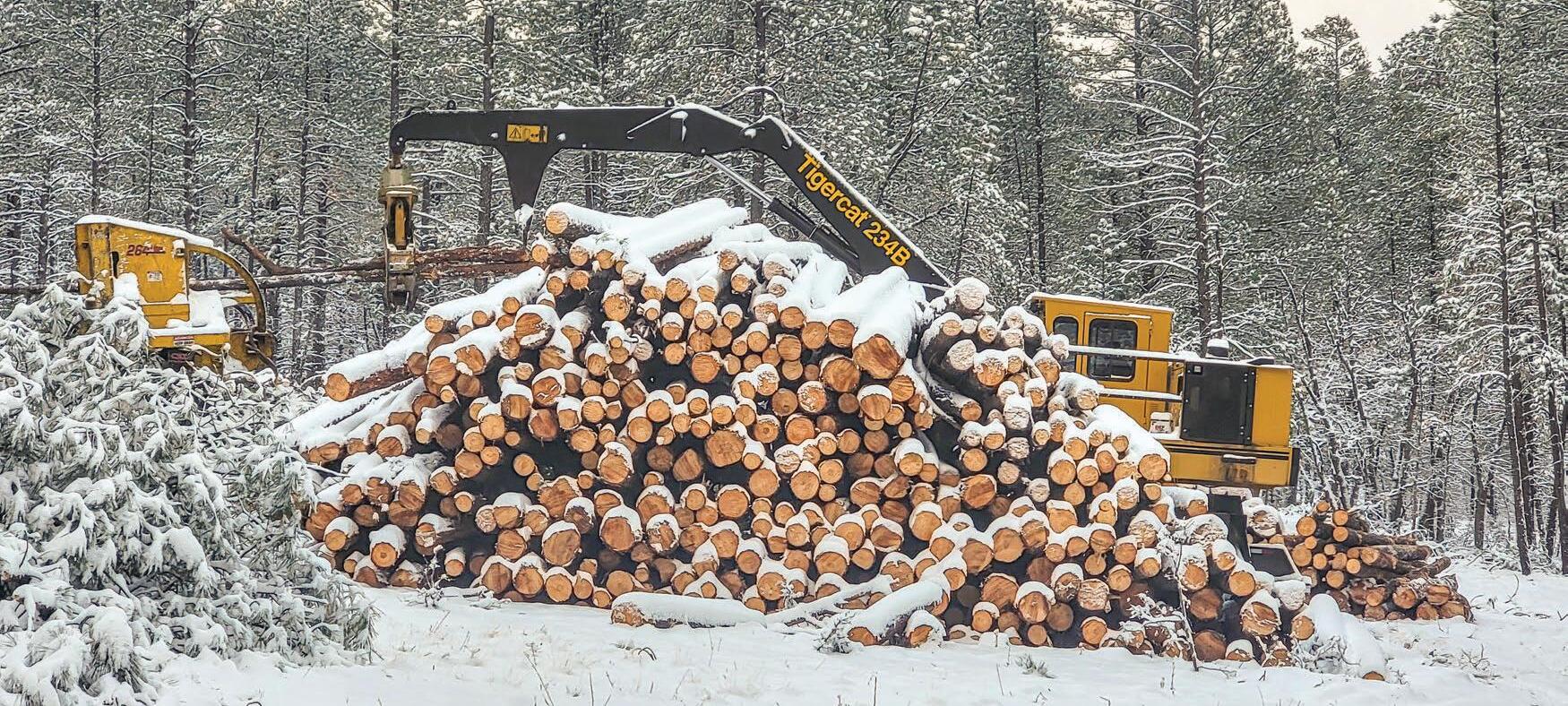
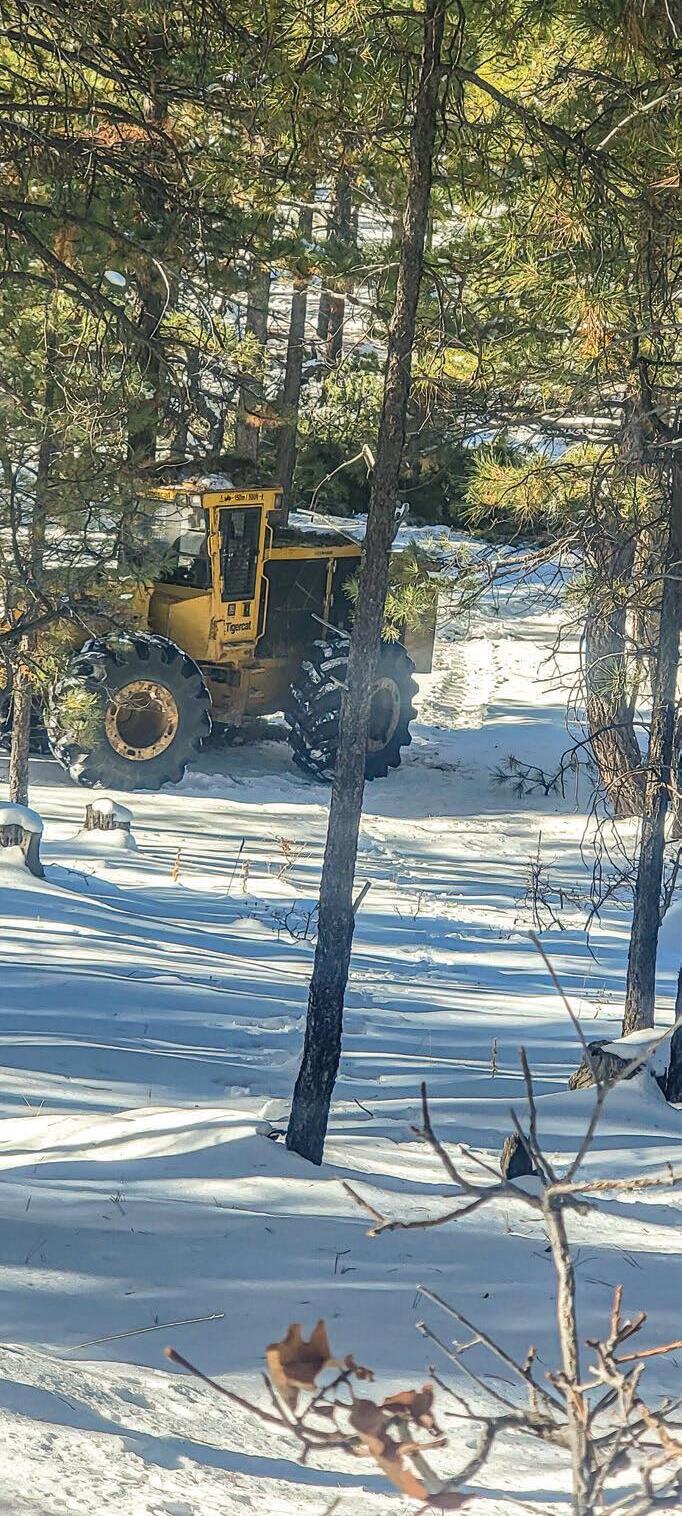
It definitely took some logistical planning to get their equipment moved 1,900 miles across the country. “We drove our service trucks, and used an equipment transport service to move our equipment,” Barden says. The company has a 2016 Tigercat 234B loader with CSI 264 delimber, a 2023 Tigercat 234B loader with CSI 264 delimber, a ’22 Tigercat 720G feller-buncher, and a ’21 Tigercat 620H skidder.
They also purchased for the move a Wynn Welding WS 56 circle saw and CSI DL-4400 slasher ground saw for processing logs. “We were surprised how well the WS-56 works,” Barden admits. “It’s pretty impressive. Though not quite as maneuverable, our system is a pretty good alternative to CTL, or at least we think so.”
They quickly located several local businesses in the area for service, parts and fuel: Bejac Equipment, a Tigercat dealer in Arizona;
16 l APRIL 2024 l Southern Loggin’ Times
CLICK HERE IF YOU HAVE NOT ALREADY OPTED IN!
Marco and Lucas
CLICK HERE IF YOU HAVE NOT ALREADY OPTED IN!
Southern Tire Mart in Flagstaff; Vanguard Truck, a Mack dealer; NAPA for hydraulic hoses and parts; RDO, a John Deere Dealer that supplies saw teeth and parts; and Bennett Oil for fuel.
Later on, they brought their 2016 CHU613 Mack and three trailers, and hired a local driver.
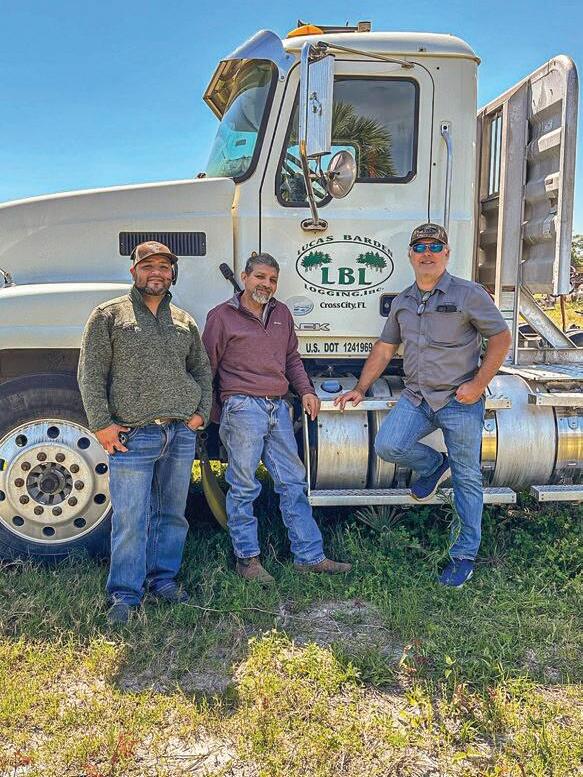
While not all employees were down with signing up for a crosscountry move, many key ones were. Marco Olvera and his father Rigoberto were willing to view this disrup-

tion as an opportunity, and agreed to relocate with Lucas and Pam. Now that’s teamwork and trust, both of which are key for a business navigating such significant changes. Marco is the loader man, and Barden says, “He makes everything happen. When I get out of the way, he really gets things going around here. He will be the man in charge of this operation when we get it off the ground. He is as talented a person as I’ve ever worked with, and I have confidence that he will do well here.”
On the skidder is Marco’s dad, Rigoberto. “They really make a good team and I’m thankful to them for being willing to try,” Barden continues. “I think we all may have stumbled onto something here.”

These stories are why, after 20 years of selling software in the forestry industry, I still love our business. Lucas’s perspective on risk, seeing more danger in stagnation than in the bold move to Arizona, and his and his employees’ willingness to embrace change are truly inspiring.
That said, if I ever decide to stop selling forestry software and go back to teaching economics and public policy, which was my original career path, I will most certainly use this story as a testament to the opportunities that are created by free market competition and economic policies that allow for free movement of capital and labor. While free markets can be harsh, they also provide an environment for those with entrepreneurial spirits and strong work ethics to not only thrive, but shine.
Lucas and Pam’s story is a vivid and inspiring reminder that even in the face of industry downturns and economic uncertainty, adaptability, perseverance, and the courage to embrace change and embark on life’s adventures are keys to success in navigating the economic challenges in our industry. SLT
18 l APRIL 2024 l Southern Loggin’ Times
Service truck left in the woods after 12 in.snow in a very different environment from Florida
CLICK HERE IF YOU HAVE NOT ALREADY OPTED IN!
LucasandRigoberto

CLICK HERE IF YOU HAVE NOT ALREADY OPTED IN!

CLICK HERE IF YOU HAVE NOT ALREADY OPTED IN!

CLICK HERE IF YOU HAVE NOT ALREADY OPTED IN!
FROM THE BACKWOODS PEW Canopy
In the woods, like in life, everyone struggles to survive. The faster, stronger, more aggressive ones always seem to get in front first, and often stay there.
But every now and then a turtle shows up, moving slow and steady, and wins the day. In the woods, the fight is for the sunlight, and to get that you need to be in the canopy, which is the ceiling of the woods.

When standing deep in the woods, with no reception for your smart phone, no satellites for your GPS, and no compass, it is the canopy that keeps you from seeing the sun and knowing which way it is setting…or rising (If following the moss really got you in deep!).
The canopy is where the sunlight is gathered, the life-blood of the tree, essential for the making of food through photosynthesis. Interesting is the fact that not all trees have the same “craving” for sunlight. God made many tree species
to have such a craving for being in the canopy, being in full sunlight, that if they cannot get there first, and be completely immersed in sunlight, they will die off. On the other hand, many tree species do quite fine growing in a more shaded environment. These trees grow under the other trees, but are mostly characterized as underachievers. While they are alive, their form and size never rise to the level of the trees comprising the canopy.
But then there are the “turtle” trees. These are the species that start off slow, putting down some serious roots, but they never lose their desire to grow into the canopy, their thirst for sunlight. Their form remains straight, and with the advantage of being well rooted, they push upward. Soon, they reach the canopy, breaking through a gap left by some other fast runner, or sometimes literally thrusting through to the top. Now the “turtle” flexes its muscle, the muscles of a great root system; and they begin to push and grow out over the tops of their neighbors, all the while taking more and more sunlight for
themselves. It is a true picture of overcoming; they overcome the competition, the shade, and eventually they take over the canopy. Their reward is life, and life abundant in the form of more sunlight.
The “turtle” trees are often the most valuable species. Their wood is in great demand for lumber and furniture. In the Coastal Plain, the “turtles” are the oaks. The fast growers are the pines, the sycamores, and the sweet gums. While these trees have value themselves, no one is knocking down the doors of the local lumber store to have their cabinets made from their lumber. When a block of timber is clear-cut, meaning that all the trees are cut and removed (making a meadow), the forest floor is exposed to direct light for the first time in many decades. Seeds and acorns, lying on the ground, buried under the debris of fallen leaves and branches, immediately begin the race. But the oaks, given time, will eventually win. They put their energy into growing roots first, and then growing up. Nothing seems to distract the oak trees growing in the middle of the woods. They have one thing on their minds: grow towards the canopy.
In the parable of the sower, one of the target soils mentioned by Jesus, one of the places where the seed falls, is in a place described as being covered with thorns.
Matthew 13:7: “And some fell among thorns, and the thorns sprang up and choked them.”
In the great outdoors, thorns grow in the sunlight. They will take over a clear-cut, or any place in the woods where the sunlight hits the ground. And they will defend their newfound neighborhood with a vengeance. They take the light, drink the water out of the soil, and wrap around any woody stem that threatens to grow over their space. They want the canopy; even if that canopy is only head high. The battle for the sunlight has begun.
Matthew 13: 22: “Now he who received seed among the thorns is he who hears the word, and the cares of this world and the deceitfulness of riches choke the word, and he becomes unfruitful.”
To become unfruitful implies that one has the ability to be fruitful,
22 l APRIL 2024 l Southern Loggin’ Times
CLICK HERE IF YOU HAVE NOT ALREADY OPTED IN!
Antill

CLICK HERE IF YOU HAVE NOT ALREADY OPTED IN!
that one has been fruitful. And such it is in the forest as it is in our lives. Everything wants our light, our energy, our time, our calendar. The thorns of the world are insatiable, they race for the canopy, and they
seek to rule the soil of our lives, to dominate us, to affect our growth, to make us unfruitful.
In the forest—absent man’s intervention—there is only one answer to this life-or-death drama. If the


seedling, or the tree, cannot put down the roots to allow it to overcome, then it will become useless: a poor, misshaped tree at best, fodder for termites most likely. Likewise, in our lives, there is only one answer to this life-or-death struggle, the struggle to survive and be fruitful or wither and die: put down some roots.
Jeremiah 17: 7, 8: “Blessed is the man who trusts in the LORD, and whose hope is the LORD. For he shall be like a tree planted by the waters, which spreads out its roots by the river, and will not fear when heat comes; but its leaf will be green, and will not be anxious in the year of drought, nor will cease from yielding fruit.
Starting to get the picture? We are called to put down roots, anchor ourselves in the Lord; trust in him and hope in him. All that we are must come from and through God,
by Jesus Christ, his Son. Like the life-giving action of photosynthesis, the SON brings us life, and produces fruit in our lives. Without the roots, the thorns will win: we will wither; we will become unfruitful; and we will be in danger.
John 15:6: “If anyone does not abide in Me, he is cast out as a branch and is withered; and they gather them and throw them into the fire, and they are burned.”
Maybe it’s time to do some weeding, to strengthen the roots. Begin reading God’s Word, turn your schedule over to him, and measure what is important by what gets you to the canopy, into the light of the Son. We can grow into the warmth of the canopy, or find ourselves in the fire!
Excerpted from Pines, Prayers and Pelts, Bradley Antill author. See www.onatreeforestry for more.


24 l APRIL 2024 l Southern Loggin’ Times
CLICK HERE IF YOU HAVE NOT ALREADY OPTED IN!

CLICK HERE IF YOU HAVE NOT ALREADY OPTED IN!
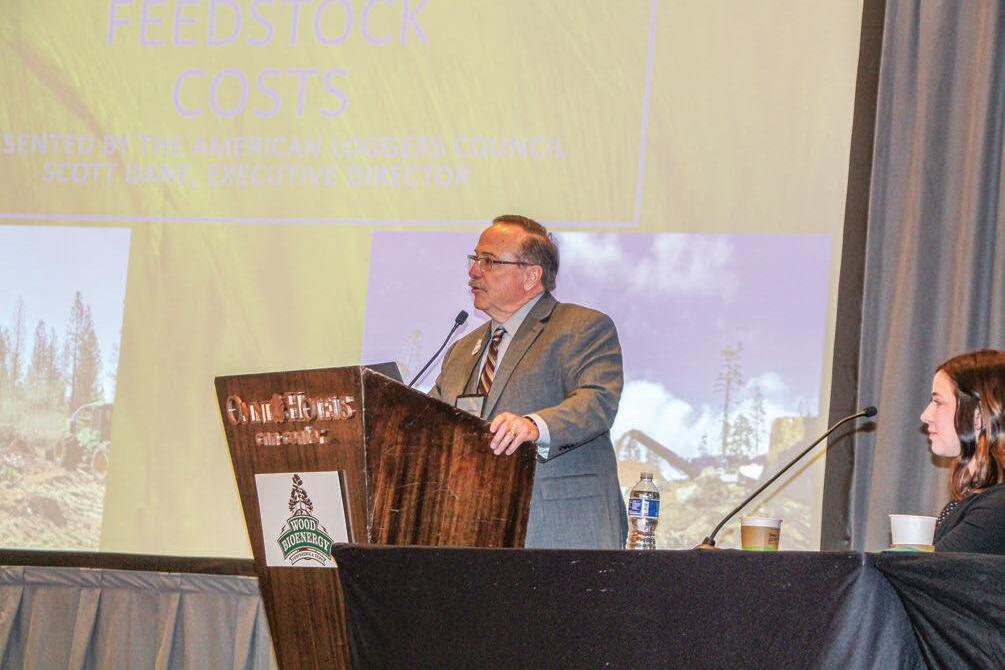
greatest opportunity to expand the forest products industry and overall utilization, and to help replace current pulp log markets that are faltering in certain areas.
Dane also delivered a dose of realism to the assembled biomass project developers and managers who dream of sourcing woody biomass as feedstock for around $10$20 a ton. Instead, he showed a

chart that noted the investment required for one chipping crew is around $2.8 million.
“People think you just add a chipper, but the logs don’t jump into the chipper,” Dane said, also pointing to production costs such as $170 per hour each to operate a skidder, feller-buncher and loader and $400 per hour for a chipper, bringing total hourly production costs up to $910 per hour.
Once all the input costs are added in, including transportation, the actual cost of sourcing and delivering woody biomass is much closer to $35-40/ton, Dane said.
He stated that expanding the use of biomass for energy enables an opportunity to establish more collaborative relationships between biomass producers; and that longer term contracts with mutually protective costs causes can provide both ends of the supply chain with more stability and consistency.
“Otherwise, it is a merely a revenue stream, but not a sustainable profit center,” he said.

Paul Oesterreich, Senior VP Project Development, Strategic Biofuels, spoke on his company’s intention to develop a series of negative carbon footprint plants in Louisiana that convert waste materials from sustainable forests into renewable transportation fuels. The ambitious project includes conversion of plantation pine forest thinnings into fuel, production of green power primarily from sawmill waste, capture of carbon dioxide emissions from those processes and its permanent geologic sequestration.
He announced that the project, entitled Louisiana Green Fuels, at the Port of Columbia in Caldwell Parish, La., now has a new partner, Sumitomo Corp. of Americas, in a joint development agreement in which SCOA will take an anchor position and lead the formation of a Japanese-based investment consortium aimed at funding the majority of development capital. The new funding influx has prompted Strategic Biofuels to change its primary renewable fuel product to sustainable aviation fuel, and that SCOA intends to provide a 20-year offtake for the approximately 640 million gallons of renewable fuels produced as well as all state and federal renewable fuel credits.
He expects 1 million tons per year of plantation forest thinnings to feed the biorefinery and 1 mil-
26 l APRIL 2024 l Southern Loggin’ Times
Dane
CLICK HERE IF YOU HAVE NOT ALREADY OPTED IN!
Oesterreich

CLICK HERE IF YOU HAVE NOT ALREADY OPTED IN!
lion tons per year of sawmill waste for the biomass power plant, and he noted that 40% more tons of wood is grown per year than harvested in their supply area.
Oesterreich said the site is 327
acres with all land leased from the Port of Columbia. The project has received numerous infrastructure grants. Total project cost is $2.9 billion with commercial operation anticipated for 2028.

Looking at the potential uses of biomass from the perspective of a large landowner, Seth Walker, Senior Manager, Strategy for Rayonier, noted that roughly half of the world’s largest companies have made some sort of “net zero” commitment to greatly reducing or eliminating the use of fossil fuels in their business operations, some as soon as 2030.

ment, considering that solar energy costs have decreased 80% in the past 15 years. Rayonier views solar as a near-term opportunity, while longer-term are carbon markets and fiber for bioenergy/biofuel.
Global demand for pellets increased 300% from 2012 to 2024, from 6 million to 24 million metric tons, Walker said, yet in the U.S., pulp mill and machine closures in the past five years represent more wood consumption than the whole U.S. pellet industry combined.
Walker provided Rayonier perspectives on bioenergy and the net zero transition, noting that the company has 1.85 million acres in the U.S. South, 418,000 acres in the Pacific Northwest and 421,000 acres in New Zealand.
While net zero commitments are laudable for their ambition, Walker said, the organizations aren’t going to get there without some seriously carbon negative policies or activities, and that’s one of the many trends now driving demand for greener feedstock sources such as biomass.
Looking at renewable energy trends overall, Walker noted that solar is receiving significant invest-
Biomass is readily available as a key source of decarbonization for a variety of applications, Walker said, and is a solid choice considering the feedstock is part of a mature supply chain with proven logistics and also fits well with coal-burning facilities.
Biomass could also see increased demand as a result of more solar and wind capacity coming on-line in the future, Walker added, as additional baseload power sources are needed to back up such systems and step in for retired coal plants.
Walker also offered scenarios to “optimize the bioeconomy,” including a “GREAT” stand example, where less expensive open pollinated seedlings are planted at a higher

28 l APRIL 2024 l Southern Loggin’ Times
CLICK HERE IF YOU HAVE NOT ALREADY OPTED IN!
Walker


CLICK HERE IF YOU HAVE NOT ALREADY OPTED IN!
density in pre-planned take-out rows with controlled pollinated seedlings. providing for additional savings in fertilizer and other treatments. GREAT stands for Genetic Resources Explicitly Arranged for
Thinning.
Walker echoed ALC’s Dane about biomass costs, noting that $10-$20/ton is unrealistic and $45$50/ton depending on market is more likely.

Enviva Proceeds Into Chapter 11
Enviva Inc., the world’s largest producer of industrial wood pellets, and certain of its subsidiaries have commenced voluntary Chapter 11 proceedings in the U.S. Bankruptcy Court for the Eastern District of Virginia, citing $1.8 billion of debt outstanding.
Trouble for Enviva became apparent when it filed a 10-Q with the Securities and Exchange Commission upon releasing its third quarter 2023 earnings report, which stated, “Our future profitability and liquidity are expected to be negatively impacted by the following matters which have resulted in substantial doubt about the company’s ability to continue as a going concern.”
At the time, Enviva specifically pointed to agreements in late 2022 for it to purchase 1.8 million metric tons from a client, believing that the global wood pellet market was substantially short for the foreseeable future and these purchases would provide an opportunity to flexibly capture margin in future periods. However, market prices for wood
pellets during 2023 fell well below the elevated spot market prices of fourth quarter 2022 and lower than the prices at which Enviva agreed to purchase these volumes. As a result, according to Enviva, the anticipated loss on the sale of the purchased volumes was expected to negatively impact the company’s cash flow and liquidity through 2025.
Enviva said it was in negotiation with the existing customer to restructure or renegotiate the terms of the 2022 purchase transactions. Recent reports indicate the trade was with German utilities concern RWE, and that Enviva still owes $348.7 million for the transaction. According to reports, there may have been a lack of internal communication about the commencement of the transaction at Enviva.
Upon the Chapter 11 announcement, Enviva said it has entered into two Restructuring Support Agreements (RSAs). The restructuring is targeted to be completed during the fourth quarter of 2024, and Enviva plans to continue constructing its Epes plant, with an in-service date expected to be during the first half of 2025, but the company announced plans to pause development of the Bond, Miss. facility.

30 l APRIL 2024 l Southern Loggin’ Times
CLICK HERE IF YOU HAVE NOT ALREADY OPTED IN!

CLICK HERE IF YOU HAVE NOT ALREADY OPTED IN!
MACHINES-SUPPLIES-TECHNOLOGY
Tigercat Triangulated Harvesting Head
Tigercat adds a fifth model to its harvesting head line-up with the new three-wheel drive 573.
In late September 2023, visitors to the PLC live demo event held in Washington state got a sneak peak
of the new Tigercat 573 harvesting head processing logs on the end of a Tigercat 875E logger. Since then, multiple units have been testing in far flung regions from Alberta to Australia and the results are in. The 573 is shaping up to be a high performing, reliable head for roadside processing and harvesting.
Best suited to medium and large
tree profiles, the 573 has a 800 mm (31 in.) maximum cut capacity and offers optimal performance in 400600 mm (16-24 in.) diameter timber. The feed rollers close down to 60 mm (2.4 in.), allowing the 573 to smoothly delimb and process smaller diameter trees and thus achieve higher value fiber recovery.
The compact frame design deftly


handles poor stem form and contributes to tidy delimbing performance. The triangulated feed wheel arm configuration operates in locked three-wheel drive. This, combined with timed knife arms, provide the operator with fast picking and positive stem control for high productivity in roadside processing applications. Independently mounted, trailing-arm length measuring ensures reliable tracking and accuracy.
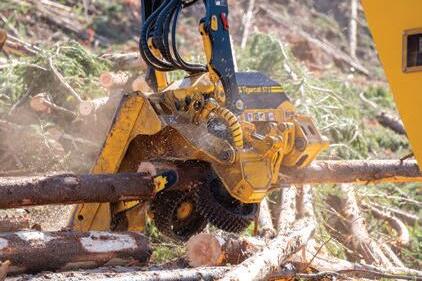
The top knife and lower/back knife pivot on the same side of the chassis frame, aligning the position and flow of each stem centrally through the head. This arrangement promotes positive contact with all three feed rollers and the measuring wheel at all times. The result is better quality and accuracy, reduced fuel consumption, and greater processing speed. The orientation also provides the operator with a clear sightline to the measuring wheel.
The 573 is standard equipped with continuous rotation for ease of use and superior hose routing and protection. Quick, stable WiFi connectivity between the cab and attachment modules reduces wire routing along the boom and provides excellent command response.
The Tigercat D7 control system is available with Priority or Optimization levels and is fully compatible and compliant with StanForD Classic and 2010.
The 573 is a great fit for the H250D, 850 and 875E for roadside processing applications and the H822E and H855E carriers for in-stand harvesting.

32 l APRIL 2024 l Southern Loggin’ Times
CLICK HERE IF YOU HAVE NOT ALREADY OPTED IN!

CLICK HERE IF YOU HAVE NOT ALREADY OPTED IN!



34 ● APRIL 2024 ● Southern Loggin’ Times CLASSIFIED AD RATES: Classified advertising rates are $55 per inch. Space is available by column inch only, one inch minimum. DEADLINES: Ad reservation must be received by 10th of month prior to month of publication. Material must be received no later than 12th of month prior to month of publication. CONTACT: Call Bridget DeVane at 334-699-7837, 800-669-5613, email bdevane7@hotmail.com or visit www.southernloggintimes.com IRONWORKS TOLL FREE: 1-800-669-5613 6209 2687 CLICK HERE IF YOU HAVE NOT ALREADY OPTED IN!


Southern Loggin’ Times ● APRIL 2024 ● 35 WANT TO PLACE YOUR CLASSIFIED AD IN IRONWORKS? CALL 334-699-7837, 1-800-669-5613 OR EMAIL: CLASS@SOUTHERNLOGGINTIMES.COM 6288 2891 CLICK HERE IF YOU HAVE NOT ALREADY OPTED IN!

36 ● APRIL 2024 ● Southern Loggin’ Times WANT TO PLACE YOUR CLASSIFIED AD IN IRONWORKS? CALL 334-699-7837, 1-800-669-5613 OR EMAIL: CLASS@SOUTHERNLOGGINTIMES.COM 4433 2687 CLICK HERE IF YOU HAVE NOT ALREADY OPTED IN!






Southern Loggin’ Times ● APRIL 2024 ● 37 WANT TO PLACE YOUR CLASSIFIED AD IN IRONWORKS? CALL 334-699-7837, 1-800-669-5613 OR EMAIL: CLASS@SOUTHERNLOGGINTIMES.COM EUREKA! EUREKA! EUREKA! OWNERS HAVE OVER 30 YEARS COMBINED EXPERIENCE! We can save you money on Saw Teeth. Hundreds of satisfied customers. Rebuilt Exchange or New. We specialize in rebuilding Koehring 2000, Hurricana, Hydro Ax split teeth and all other brands. Call Jimmy or Niel Mitchell. Quantity Discounts! EUREKA SAW TOOTH CO., INC. 4275 Moores Ferry Rd. • Skippers, Virginia 23879 PH./FAX (day) 1-434-634-9836 or Night/Weekends • 1-434-634-9185 NOW ACCEPTING CREDIT CARDS 7180 Call 1-800-669-5613 To Place Your Ad Today! NOTICE: ANY WELDING such as filling in the pockets that wear just forward of the cutting teeth on fellerbuncher saws must be stress relieved by air hammering or cracks in the disks will occur. Hard face rod should not be used. I specialize in straightening, repairing and balancing feller buncher sawdisks. CARVER SAWDISK REPAIR 252-945-2358 566 FOR SALE 2019 Tigercat 720G Feller Buncher VERY NICE, Just coming in........POR Call or Text Zane 334-518-9937 3939 7393 13189 2583 CLICK HERE IF YOU HAVE NOT ALREADY OPTED IN!
COMING EVENTS
April
12-13—East Coast Sawmilling and Logging Exposition, Meadow Event Park, Doswell, Va. Call 804-7375625; visit exporichmond.com.
23-25—2024 Virginia Forestry Summit, Boar’s Head Resort, Charlottesville, Va. Call 804-278-8733; visit vaforestry.org.
29-May 1—Forest Resources Assn. annual meeting, The Westin Nashville, Nashville, Tenn. Call 202296-3937; visit forestresources.org.
June
4-6— 2024 SFI Annual Conference, Loews Atlanta Hotel, Atlanta, Ga. Call 202-596-3450; visit sficonference.org.
13-15—Southeastern Wood Producers Assn. annual meeting, Hammock Beach Resort, Palm Coast, Fla. Call 904-845-7133; visit swpa.ag.
27-29—Georgia Forestry Assn. Annual Conference, Savannah Convention Center, Savannah, Ga. Call 478-992-8110; visit gfagrow.org.
July
21-25—SLMA 2024 Annual Conference, JW Marriott Marco Island

Beach Resort, Marco Island, Fla. Call 504-443-4464; visit slma.org.
August
6-9—IWF 2024, Georgia World Congress Center, Atlanta, Ga. Call 404-693-8333; visit iwfatlanta.com.
8-10—Virginia Loggers Assn. annual meeting, Williamsburg Lodge, Williamsburg, Va. Call 804-677-4290; visit valoggers.org.
September
8-10—Alabama Forestry Assn. annual meeting, Perdido Beach Resort, Orange Beach, Ala. Call 334-265-8733; visit alaforestry.org.
25-26—North Carolina Forestry Assn. annual meeting, Wilmington Convention Center, Wilmington, NC. Call 800-231-7723; visit ncforestry.org.
October
2-4—American Loggers Council annual meeting, Chicken Ranch Casino Resort, Jamestown, Calif. Call 409-625-0206; visit amloggers.com.
8-10—Arkansas Forestry Assn. annual meeting, Oaklawn Hotel & Spa, Hot Springs, Ark. Call 501374-2441; visit arkforests.org.
23-25—Texas Forestry Assn. annual meeting, Hyatt Regency, Conroe, Tex. Call 936-632-8733; visit texasforestry.org.
November
1-2—Mid-Atlantic Logging, Biomass, & Landworks Expo, Laurinburg, NC. Call 252-809-3057 or 704-564-2168.

38 ● APRIL 2024 ● Southern Loggin’ Times American Truck Parts 30 888.383.8884 B & G Equipment 13 601.656.7011 Bandit Industries 23 800.952.0178 Big John Trailers 5 800.771.4140 BITCO Insurance 10 800.475.4477 Caterpillar Dealer Promotion 17 919.550.1201 John Deere Forestry 11 800.503.3373 Dobbs Equipment 2,19 844.469.3622 East Coast Sawmill Expo 26 804.737.5625 Eastern Surplus 28 855.332.0500 FMI Trailers 16 601.508.3333 Forest Chain 28 800.288.0887 Forestry First 35 803.708.0624 G & W Equipment 32 800.284.9032 Glass to Go 24 715.746.3757 Hawkins & Rawlinson 12 888.822.1173 Interstate Tire Service 37 864.947.9208 Iron Horse Auction 32 800.997.2248 Kaufman Trailers NC 3 336.790.6807 Mike Ledkins Insurance Agency 29 800.766.8349 LMI-Tennessee 25 800.467.0944 Logger Associations 24 Magnolia Trailers 31 800.738.2123 Maxi-Load Scale Systems 18 877.265.1486 Midsouth Forestry Equipment 22 870.226.0000 Moore Logging Supply 24 888.754.5613 Morbark 1,7 800.831.0042 Olofsfors 20 519.754.2190 Pitts Trailers 40 800.321.8073 Ponsse North America 39 715.369.4833 Prolenc Manufacturing 38 877.563.8899 Quality Equipment & Parts 36 386.487.3896 Southern Loggers Cooperative 30 318.445.0750 Stribling Equipment 35 855.781.9408 Tidewater Equipment 34,36 912.638.7726 Timberblade 27 519.532.3283 TraxPlus 29 601.635.5543 W & W Truck & Tractor 33 843.761.8220 Wallingford’s 30 800.323.3708 Waratah Forestry Attachments 21 770.692.0380 Waters International Trucks 37 601.693.4807 Yancey Brothers 28 800.282.1562
ADLINK is a free service for advertisers and readers. The publisher assumes no liability for errors or omissions. A ● D ● L ● I ● N ● K ADVERTISER PG. NO. PHONE NO. Listings are submitted months in advance. Always verify dates and locations with contacts prior to making plans to attend. southernloggintimes.com CLICK HERE IF YOU HAVE NOT ALREADY OPTED IN!

CLICK HERE IF YOU HAVE NOT ALREADY OPTED IN!

CLICK HERE IF YOU HAVE NOT ALREADY OPTED IN!
