INTRODUCTION & BACKGROUND
INTRODUCING THE WAIMARAMA RESERVES Jacqui Wilson Maud was the grandmother of Mrs Jacqui Wilson whose discussions with Council and the Society of Mary led to the provision for the Waimarama Domain to be renamed the Airini Donnelly Reserve: and for a descendant of Airini and a local hapu member to be included in the establishment of a Reserve Management Group. Council would like to acknowledge Mrs Wilson who, after three years of negotiation and settlement with the Society of Mary called a meeting of Airini’s descendants on 10 December 2010. There was a welcome, by Tuwharetoa, a dinner, and a meeting of kaupapa as she presented the results of discussions with the Society of Mary, to each family. Mrs Wilson respected the ahi kaa of mana whenua at Waimarama, as she had lived in other parts of the country throughout her adult life. As the eldest living mokopuna of Airini she held to the principles of whakapapa and whanaungatanga that distinguished all of her remarkable tupuna whose lineage includes the whanau whanui at Waimarama today, and embraced the whole of Heretaunga extending to Rangitikei and Tuwharetoa. Tiakitai Tiakitai was a paramount chief of Waimarama and his descendants continue to occupy the land today. Tiakitai was born of the ure Tarewa, seventeen generations back to Tamatea Arikinui – Rongokako – Tamatea-pokaiwhenua – Kahungunu – Kahukuranui – Rakaihikuroa – Taewha – Takaha – Hikawera – Whatuiapiti – Te Wawahanga-o-te-rangi – Rangikawhiua – Manawakawa – Rangikoianake – Te Karaha –Te Orihau Poha - Tiakitai, a reflection of a royal genealogy born to the rangatira Te Orihau and Hinekona a descendant of the great Takitimu Tohunga Tunui, ariki tapairu Hinengatira and rangatira, Tumapuhiarangi. His grandmother Horongaiterangi was also a direct descendant of Honomokai. Despite his strong Upokoiri link his allegiance was to his Waimarama people, Ngati Kurukuru. Growing up at the turn of the 19th century Tiakitai became a strong fighting warrior rangatira with the taiaha and he proved himself to be defender and saviour of the Ngati Kahungunu ki Heretaunga. One of Tiakitai’s journeys as a young man saw them being stoned and thus they took on the name Ngati Kurukuru in remembrance of the event.
During the musket slaughters of the Amiowhenua in the 1820’s, Tiakitai changed weapons to the more destructive gun and defended the area with Pareihe who had allied himself with Te Wera Hauraki of Nga Puhi. Proving to be an elusive fighting warrior Tiakitai had defended Ngati Kahungunu during those tumultuous times of the 1820’s. There were many battles Tiakitai was involved in including; Te Aratipi, Te Whiti o Tu, Te Pakake, Kahotea, Te Roto a Tara I and II, Omakukura (Tuwharetoa) and Toka a Kuku (Te Whanau a Apanui). The inter-tribal wars had ceased by the 1830’s and Tiakitai had become a boat owner and business man, and charged freight for cargo back and forth to Mahia and Ahuriri, where he often stayed. Tiakitai did not take a great interest in the Christianity preached by the missionary William Colenso, who settled in Heretaunga in 1844. Tiakitai was known to fire his double barrelled shot gun into the air in protest at Colenso’s meddling with his affairs. On 1 September 1847 Tiakitai set out with 21 companions on his whaleboat to visit Wairoa and Mahia and to attend a marriage feast. During the night a heavy sea arose and the boat was lost with all hands. As the only major chief who did not abandon Heretaunga and flee to Nukutaurua, Tiakitai’s mana was recognised by all. He was greatly mourned by his people. Tiakitai was survived by some of his wives and children, including Te Teira Tiakitai, and his daughters, Haromi and Horiana. Bayden Barber (December 2012) Harawira Harawira Mahikai Te Tatere, Waimarama chief was one of three Whatuiapiti chiefs who signed the Treaty of Waitangi in 1840. A descendant of Te Rangikoianake through his grandfather, Te Karaha; Harawira was the younger brother of the fighting chief Tiakitai also of Waimarama. There is a view that Harawira signed the Treaty because his older brother Tiakitai would not. This is not true as Harawira was a fierce supporter of his brother throughout his fighting campaigns. Tiakitai utilised his skills as a negotiator on numerous occasions. Having Harawira sign the treaty suited Tiakitai and enabled him to pursue an independent path whilst maintaining an interest in the new order. In the seven years after the signing of the Treaty the brothers maintained a close relationship. On that fateful day when Tiakitai drowned at sea, Harawira travelled from his island fortress at Karamea to Waimarama. He had serious misgivings and cautioned his brother about the worsening conditions. Unfortunately Tiakitai did not heed his brother advice and he was lost at sea along with twenty one others as they were crossing the bay to attend a wedding at Mahia. After the death of his brother Harawira returned to live in Waimarama. He would survive his brother for almost fifty years. These would be turbulent times of transition for the people of Waimarama. He would be a fierce advocate often appearing at land court meetings: an imposing figure with his full facial tattoo. Like his brother Tiakitai he would never adopt European clothes. In his later years his people would fondly refer to him as ‘Mahikai’ in preference to ‘Harawira’.Mahikai, the provider of sustenance and support, is a fitting name for a loved and benign ancestor. Harawira Mahikai Te Tatere continues his influence through his descendants, many of whom steer the fortunes of Waimarama today. Robert MacDonald (April 2013)
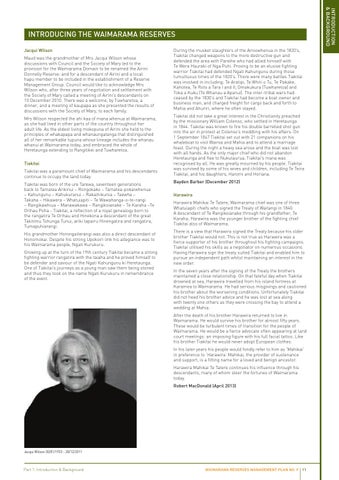
Jacqui Wilson 30/01/1933 - 28/12/2011
Part 1: Introduction & Background
WAIMARAMA RESERVES MANAGEMENT PLAN N0. 9 11