Summer 2016
puses like Morehouse by film director Spike Lee, has a goal of recruiting 1 million teachers in the next 10 years, with an emphasis on diversity. Hayes even met with Secretary of Education John King last November about how better to recruit and retain minority teachers. “In some instances,” Hayes says, “this movement is in its grassroots phase. But all students, white students — I think that this country — can benefit by viewing people of color in positions of power that they trust and respect and grow to love.” For exactly this reason, writes Gloria Ladson-Billings, a black professor at the University of Wisconsin–Madison, in a recent essay in Ed Week, “There is something that may be even more important than black students having black teachers, and that is white students having black teachers. It is important for white students to encounter black people who are knowledgeable. What opportunities do white students have to see and experience black competence?” And white students, Rodriguez says, are ready. She mentions a friend, a minority teacher in an affluent district, who teaches her white students about racial inequality and institutional racism. “I say, ‘Wait, you did a lesson on what?’ But white students want to talk about these issues.” Looking ahead, Brewster recently agreed to return to his school in Dorchester for at least a year after graduating. That’s as much
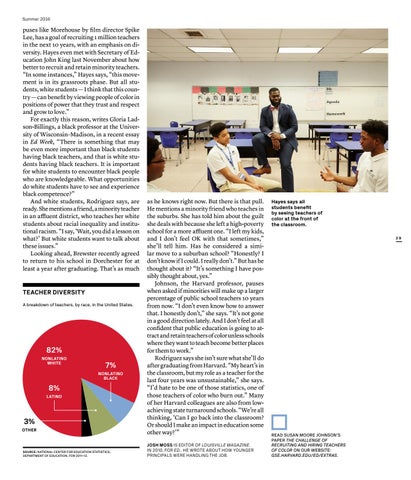
TEACHER DIVERSITY A breakdown of teachers, by race, in the United States.
82% NONLATINO WHITE
7% NONLATINO BLACK
8% LATINO
3% OTHER
SOURCE: NATIONAL CENTER FOR EDUCATION STATISTICS, DEPARTMENT OF EDUCATION, FOR 2011-12.
as he knows right now. But there is that pull. He mentions a minority friend who teaches in the suburbs. She has told him about the guilt she deals with because she left a high-poverty school for a more affluent one. “I left my kids, and I don’t feel OK with that sometimes,” she’ll tell him. Has he considered a similar move to a suburban school? “Honestly? I don’t know if I could. I really don’t.” But has he thought about it? “It’s something I have possibly thought about, yes.” Johnson, the Harvard professor, pauses when asked if minorities will make up a larger percentage of public school teachers 10 years from now. “I don’t even know how to answer that. I honestly don’t,” she says. “It’s not gone in a good direction lately. And I don’t feel at all confident that public education is going to attract and retain teachers of color unless schools where they want to teach become better places for them to work.” Rodriguez says she isn’t sure what she’ll do after graduating from Harvard. “My heart’s in the classroom, but my role as a teacher for the last four years was unsustainable,” she says. “I’d hate to be one of those statistics, one of those teachers of color who burn out.” Many of her Harvard colleagues are also from lowachieving state turnaround schools. “We’re all thinking, ‘Can I go back into the classroom? Or should I make an impact in education some other way?’” JOSH MOSS IS EDITOR OF LOUISVILLE MAGAZINE. IN 2010, FOR ED., HE WROTE ABOUT HOW YOUNGER PRINCIPALS WERE HANDLING THE JOB.
Hayes says all students benefit by seeing teachers of color at the front of the classroom. 29
READ SUSAN MOORE JOHNSON’S PAPER THE CHALLENGE OF RECRUITING AND HIRING TEACHERS OF COLOR ON OUR WEBSITE: GSE.HARVARD.EDU/ED/EXTRAS.