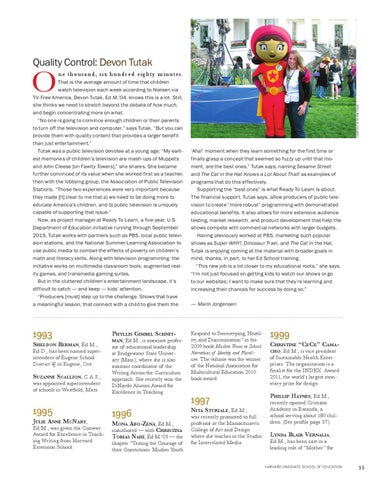
Quality Control: Devon Tutak
O
ne thousand, six hundred eighty minutes . That is the average amount of time that children watch television each week according to Nielsen via
TV-Free America. Devon Tutak, Ed.M.’04, knows this is a lot. Still, COURTESY OF DEVON TUTAK
she thinks we need to stretch beyond the debate of how much, and begin concentrating more on what. “No one is going to convince enough children or their parents to turn off the television and computer,” says Tutak. “But you can provide them with quality content that provides a larger benefit than just entertainment.” Tutak was a public television devotee at a young age: “My earli-
‘Aha!’ moment when they learn something for the first time or
est memories of children’s television are mash-ups of Muppets
finally grasp a concept that seemed so fuzzy up until that mo-
and John Cleese [on Fawlty Towers],” she shares. She became
ment, are the best ones,” Tutak says, naming Sesame Street
further convinced of its value when she worked first as a teacher,
and The Cat in the Hat Knows a Lot About That! as examples of
then with the lobbying group, the Association of Public Television
programs that do this effectively.
Stations. “Those two experiences were very important because
Supporting the “best ones” is what Ready To Learn is about.
they made [it] clear to me that a) we need to be doing more to
The financial support, Tutak says, allow producers of public tele-
educate America’s children, and b) public television is uniquely
vision to create “more robust” programming with demonstrated
capable of supporting that issue.”
educational benefits. It also allows for more extensive audience
Now, as project manager at Ready To Learn, a five-year, U.S. Department of Education initiative running through September 2015, Tutak works with partners such as PBS, local public televi-
testing, market research, and product development that help the shows compete with commercial networks with larger budgets. Having previously worked at PBS, marketing such popular
sion stations, and the National Summer Learning Association to
shows as Super WHY!, Dinosaur Train, and The Cat in the Hat,
use public media to combat the effects of poverty on children’s
Tutak is enjoying coming at the material with broader goals in
math and literacy skills. Along with television programming, the
mind, thanks, in part, to her Ed School training.
initiative works on multimedia classroom tools, augmented reality games, and transmedia gaming suites. But in the cluttered children’s entertainment landscape, it’s difficult to catch — and keep — kids’ attention.
“This new job is a lot closer to my educational roots,” she says. “I’m not just focused on getting kids to watch our shows or go to our websites; I want to make sure that they’re learning and increasing their chances for success by doing so.”
“Producers [must] step up to the challenge. Shows that have a meaningful lesson, that connect with a child to give them the
— Marin Jorgensen
1993
Respond to Stereotyping, Hostility, and Discrimination” in the 2009 book Muslim Voices in School: Narratives of Identity and Pluralism. The volume was the winner of the National Association for Multicultural Education 2010 book award.
1999
1997
Phillip Haynes, Ed.M.,
Sheldon Berman, Ed.M.,
Ed.D., has been named superintendent of Eugene School District 4J in Eugene, Ore.
Suzanne Scallion, C.A.S., was appointed superintendent of schools in Westfield, Mass.
1995 Julie Anne McNary,
Ed.M., was given the Conway Award for Excellence in Teaching Writing from Harvard Extension School.
Phyllis Gimbel Schnitman,
Ed.M., is associate professor of educational leadership at Bridgewater State University (Mass.), where she is also assistant coordinator of the Writing Across the Curriculum approach. She recently won the DiNardo Alumni Award for Excellence in Teaching.
1996 Mona Abo-Zena, Ed.M., coauthored — with Christina Tobias Nahi, Ed.M.’03 — the
chapter “Testing the Courage of their Convictions: Muslim Youth
Nita Sturiale, Ed.M.,
was recently promoted to full professor at the Massachusetts College of Art and Design where she teaches in the Studio for Interrelated Media.
Christine “CeCe” Camacho,
Ed.M., is vice president of Sustainable Health Enterprises. The organization is a finalist for the INDEX: Award 2011, the world’s largest monetary prize for design. recently opened Crimson Academy in Rwanda, a school serving about 180 children. (See profile page 37.)
Lynda Blair Vernalia,
Ed.M., has been cast in a leading role of “Mother” for
HARVARD GRADUATE SCHOOL OF EDUCATION
35