BRIEF IN EN PÅGLISH JOBB
Wanted: Active Domestic Owners Finnish Fompanies need more aFtive owners and less government ownership. Dispersed ownership results in Fompanies without a master whereas government-owned Fompanies lead to ineffeFtive Fompanies. 7hese are some of the FonFlusions that Timo Korkeamäki photo , Pentti professor at Hanken and Ulf Jakobsson, eFonomist, draw in a reFent report by order of the Prime Minister¶s Of¿Fe. 7he report was ordered to give the of¿Fials a Fomprehensive piFture of ownership in large Finnish Fompanies. 7he biggest problem that Korkeamäki and -akobsson found is of historiFal origin – Finland suffers from a laFk of Fapital. 7his explains our Fomparatively dispersed ownership of Fompanies. ³Finns value equality. 7hat is why it is dif¿Fult to make people understand the bene¿ts of power and ownership FonFentration”, Korkeamäki explains. He notes that there is a power vaFuum in Finnish listed Fompanies sinFe no new Fontrolling owner groups have replaFed the banks who were previously the Fontrolling owners. Korkeamäki points out that Finland tops the list of both government and Fooperative ownership, despite the faFt that researFh results Fontinue to show that government ownership has a negative impaFt on Fompanies and leads to e.g. inef¿FienFy. AFFording to Korkeamäki and -akobsson, the government should Fontinue to own strategiFally important Fompanies e.g. Fompanies linked to weaponry
and FritiFal infrastruFture . ³7he government plays an important ownership role in some industries, espeFially in times of global tension”, Korkeamäki notes. 7he rest of the Fompanies should ideally be sold to aFtive Finnish investors willing to spend both time and Fapital on the Fompany. 7he selling of the Fompanies should span a few years not to throw the stoFk market off balanFe. InFreased foreign ownership is also suggested as a remedy for Finland¶s laFk of Fapital. Several national studies show that foreign owners lead to more effeFtive Fompanies that invest more and grow more quiFkly. PHOTO: PATRIK LINDSTRÖM
Leave the Nordic Corporate Governance Model alone! NordiF Fompanies have been notably suFFessful in an international perspeFtive and part of this suFFess Fan very likely be attributed to the Forporate governanFe model. A reFently published book on the subjeFt, Falled 7he NordiF Corporate GovernanFe Model, was introduFed during a seminar at 7he Hanasaari Swedish-Finnish Cultural Centre in February. 7he book aims to explain how the NordiF Forporate governanFe works in praFtiFe. “We have no need of exporting our model to other Fountries, but we want international reFognition that other models than the Anglo-Saxon model Fan work”, says Per Lekvall, editor of the book. 7he NordiF model has faFed external pressure during the past deFade, due to sFandals in large AmeriFan Forporations that led to striFter regulations of listed Fompanies. Lekvall notes that the EU has assumed the AngloSaxon model, whiFh does not work for the NordiF system. 7he NordiF model is FharaFteri]ed by Fontrolling shareholders that hold more than 20 of shares, the historiFal tradition of Foordinated legislation and a board of direFtors not Fonsisting of people from the operative management. 7he NordiF and Anglo-Saxon models of Forporate governanFe differ in two FruFial ways. In NordiF Fompanies, the owners manage the Fompany through the general meeting, whereas big deFisions are made by the board and exeFutive management in Anglo-Saxon Fompanies. Furthermore, British and AmeriFan Fompanies often laFk engaged, long-term
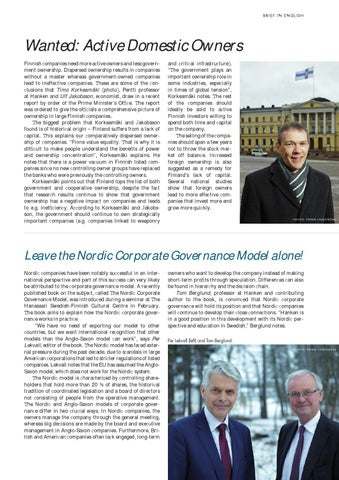
owners who want to develop the Fompany instead of making short-term pro¿ts through speFulation. DifferenFes Fan also be found in hierarFhy and the deFision Fhain. Tom Berglund, professor at Hanken and Fontributing author to the book, is FonvinFed that NordiF Forporate governanFe will hold its position and that NordiF Fompanies will Fontinue to develop their Flose FonneFtions. “Hanken is in a good position in this development with its NordiF perspeFtive and eduFation in Swedish,” Berglund notes. Per Lekvall (left) and Tom Berglund. PHOTO: PATRIK LINDSTRÖM
23