As always, the Record highlights the vitality of our College’s educational experience and profiles alumni whose accomplishments exemplify the outcomes of a Hampden-Sydney education. This issue features a number of alumni doing interesting and important work in banking and finance, and each of their stories demonstrates the power of the liberal arts in their lives and careers. We see through the experience of our alumni how our students’ close engagement with alumni, courses taught by our talented faculty members, and participation in co-curricular opportunities—such as internships, Wall Street Prep, and our Tiger Fund— deepen their liberal arts educational experience and make them competitive for the best career opportunities. This is the distinctive preparation that our College offers our students that paves the way to their future success.
Also featured in this issue is an essay by Hugo Rodriguez ’88, U.S. ambassador to Nicaragua and principal deputy assistant secretary in the U.S. Department of State’s Bureau of Consular Affairs. Through courses and study abroad opportunities, we seek to prepare our students for current and future global challenges, and we can be proud of the outsized impact of our small College in the larger world. Hampden-Sydney can boast having two alumni serve as ambassadors (in addition to Ambassador Rodriguez, Ed McMullen ’86 recently served as our country’s ambassador to Switzerland and Lichtenstein), and many other alumni who have had or are pursuing a wide array of impactful international careers.
This theme continues with the On the Hill story of our most recent Fulbright faculty scholars: Professors Evan Davis, Rachel Goodman, and Andre Pagliarini, who received Fulbright awards to take their research or teaching expertise abroad. It was a special moment for me to have the opportunity to represent the College at a reception hosted by the U.S. Department of State in Washington, D.C., honoring colleges and universities designated “Top Fulbright Producers.” Hampden-Sydney is ranked among the top six of 46 recognized Fulbright U.S. Scholar-producing undergraduate institutions in the country.
Of course, this issue also features the 2023-24 Hampden-Sydney Basketball Team—the Old Dominion Athletic Conference Champion, NCAA Division III National Runner-Up, and the winningest basketball team in the College’s history. The team offered us a thrilling season and, as impressed as I am by the team’s success, I’m equally impressed by the character of our players and coaches. Our basketball team embodies Hampden-Sydney’s mission “to form good men and good citizens.”
Just as our basketball team is pursuing its vision of being the standard of excellence in Division III basketball, so too do we want Hampden-Sydney to represent all the best in higher education, offering young men an extraordinary coming-ofage experience. Our mission guides us in everything we do in our pursuit of an ambitious future for the College. Forming the good men and good citizens who would be the leaders of an emerging Republic was critically important in 1775 on the eve of the American Revolution, and that mission remains just as important, relevant, and vital today. I’m grateful to the faculty and staff of the College who daily help us fulfill our mission, and I’m also grateful to the alumni, parents, and friends of the College who so generously and unselfishly support this important work.
Dr. Larry Stimpert President, Hampden-Sydney College
Published by Hampden-Sydney College, Hampden-Sydney, Virginia 23943, as a service to its alumni and friends. Content of the Record is determined by the editor. Although the editor welcomes news about alumni, the Record does not print unsolicited articles or articles that are solicited without prior consent of the editor.
This issue may be viewed online at record.hsc.edu
NON-DISCRIMINATION POLICY:
Hampden-Sydney College, while exempted from Subpart C of the Title IX regulation with respect to its admissions and recruitment activities, does not discriminate on the basis of race, color, sex, religion, age, national origin, handicap, sexual orientation, or veteran status in the operation of its education programs and with respect to employment.
For information on this non-discrimination policy, contact the Office of Human Resources, Box 127, Hampden-Sydney College, Hampden-Sydney, VA 23943, (434) 223-6220
Photo by Howard Korn
If this Hall could talk…
It would tell you about a time when…
“There were only two payphones for the whole building, and there were these ridiculous battles royale to get to those phones. When girlfriends would call and ask for their boyfriend…well, good luck. Whoever answered that thing when it rang owned it, and he would pass the phone around to every other guy in the building. The guy the call was intended for never got to talk to his girl.”
-Wick Lyne ’67
or how…
“The bathroom was in the basement, and it was open air. So the trick was to steal a guy’s towel while he was in the shower and make him walk naked up three floors. I quickly learned to bring two towels with me.” - Gary Lane ’70
or the time…
“The fourth floor of West Wing turned the water faucet spigot outward and flooded the hall to make a slip and slide with dishwasher detergent.” - Carson Pitts ’15
It would also tell you about the decades-long friendships that began within its walls, the late-night study sessions, and the existential debates that are the hallmark
of young men sharpening their understanding of the world. Venable Hall is Hampden-Sydney history. It has welcomed, sheltered, initiated, and launched Hampden-Sydney men for centuries.
Now, following a triumphant three-year, $25 million renovation, Venable Hall is poised to continue to fill its important role for centuries to come. To honor both the building and the occupants who formed eternal bonds of brotherhood within its walls, the Office of College Advancement is excited to announce a unique opportunity for Hampden-Sydney community members to make their marks on this iconic part of campus.
The College is offering a special opportunity to name a room or any of the beautiful common spaces throughout Venable Hall. This initiative is the first of its kind at the College. Venable holds a special place in the hearts of all Hampden-Sydney men, whether they called it home or celebrated rites of H-SC passage on its front lawn. Named spaces will be adorned with an engraved plaque bearing the names of the donors, and the front porch of Venable will boast a master plaque with the names of all donors.
Commitments for naming opportunities begin at $50,000. If you are interested, please contact Heather Howarth at hhowarth@hsc.edu or visit hsc.edu/venable-hall to learn more.
VENABLE GRAND OPENING
OCTOBER 25-26, 2024
HOMECOMING WEEKEND
The How What and Why of Diplomacy
BY HUGO RODRIGUEZ ’88
The How
Any time I speak to undergraduates interested in a career in foreign affairs, they ask me: “What should I study to become a diplomat?” It’s a great question but not an easy one to answer. My colleagues in the State Department’s Foreign Service come from every academic background imaginable: lawyers, historians, linguists, scientists, even MBAs. In fact, according to USAJobs.gov, no specific educational level or degree is required for entry into the Foreign Service. I have heard it said that students should study whatever they enjoy. Now, after 25 years in the diplomatic corps, I have a different answer: study people.
At its heart, diplomacy is a people business. We learn upon entering the Foreign Service that our primary mission is the protection of American citizens overseas, followed closely by serving the interests of the American people and the foreign policy objectives of the Administration. Foreign Service generalists choose from one of five career paths, or cones: political or economic analysis, public diplomacy, consular affairs, and resource management. We spend roughly two-thirds of our
careers overseas. All Foreign Service officers, regardless of cone, will serve at least one tour of duty (two years) in a consular assignment early in their career, interviewing visa applicants and supporting the needs of Americans living or traveling overseas. In a consular tour, as with all human interaction, the ability to establish trust and communicate clearly are fundamental to building relationships and achieving our goals. As an early-career Consul in Rome, one of my well-connected local staff members spent a day taking me around the city, visiting hospitals, meeting administrators, and making connections. Almost a year later I got a call from one of the doctors I met that day. He was treating an elderly American tourist who had fallen on Rome’s famous cobblestone streets and broken a hip. She was traveling alone and could not speak Italian. The doctor knew I’d be interested in her well-being, and he asked if I might stop by to translate and help them contact her family in the U.S. I ended up spending the day with her and visiting for several days following her surgery, until her family arrived to help her get home.
The What and the Why
Our work varies greatly depending on our cone, but the common thread is the need to develop relationships—with foreign governments, NGOs, the business community, even local doctors—to accomplish our missions. Our trust-based relationships allow us to establish common ground, learn about our interlocutors, and eventually win allies. We build trust by listening, by asking questions, and by being curious. And we build trust through humility and shared humanity. Through emotional intelligence, we can put our own needs, desires, and dreams to the side for a moment while we learn about the dreams and goals of others. In diplomacy, taking the time to listen demonstrates trust and respect while giving you insight about what your counterpart is trying to achieve. This gets you halfway to a win-win outcome. A relationship with a restauranteur in Paraguay, sparked by a discussion about our similar-aged daughters, led to an introduction to a young senator who was in the early stages of planning a presidential run. My restauranteur friend hosted several lunches where I got to know, and build trust with, this politician, whose insurgent, outsider campaign delivered him the presidency 18 months later. Our connection, established early, was a strong foundation upon which the U.S. and Paraguay deepened ties and collaborated on issues important to both sides, and we remain in touch today, long after the end of his term. However, all the relationship-building is pointless if you don’t know what you are trying to achieve. The what and the why. The key here is clear communication, both spoken and written. The State Department is known for the quality of our written communication: following Wikileaks’ unauthorized releases of internal State Department cables, many commentators applauded their clarity and brevity. And justifiably so. When instructions from Washington were actually sent by telegram and cable, the U.S. government had to pay by the letter, so an economy of words was prized almost as much as the ability to convey complex policy instructions. Likewise, when we as diplomats sit with our foreign counterparts to share our goals and to learn about theirs, to bargain towards a win-win, there is little room for error. As a member of the U.S. delegation negotiating a migration
agreement with the government of Guatemala, I found my most important role was acting as a kind of translator, helping the Guatemalan team understand what we were trying to achieve, while helping the U.S. side understand what Guatemala’s redlines were and where they had room to negotiate. To be effective, I relied on trust I had built for years with my Guatemalan counterparts, and over the course of multiple rounds, I spent more time in one-onone meetings with both Guatemalan negotiators and our own than I did at a negotiating table. The result was a first-of-its-kind agreement that opened new options for tackling the shared challenges around migration.
The Gifts
I have long believed the gifts I received at HampdenSydney, starting with the Rhetoric Program, prepared me for a successful career as a diplomat. While I still had to learn how to write in the unique State Department style, I arrived to the work of diplomacy with a facility for sharing complex ideas clearly and economically. The Rhetoric Program gave me a gift I have relied on for 25 years. Just as important, Hampden-Sydney taught me to be curious, courteous, and humble. Thanks to my professors, the deans, and the College administration, I was comfortable interacting with others—more learned, more experienced adults—in formal situations. How many schools give you the opportunity to regularly dine with the president or the dean of students or attend cocktail parties and make small talk with visiting luminaries? How many schools teach you which fork to use with your salad or how to make proper introductions? On campus visits in recent years, my heart still glows when students greet me with “good morning!” on the pathways between classes. Maybe because of H-SC’s size, but more likely due to a unique ethos of care among teachers and administrators, trust and respect are valued and defended on the Hill. At Hampden-Sydney, I was treated as worthy, and so I learned to treat others that way, regardless of origin, background, or status. Hampden-Sydney gave me more than an education; she made me a good man and a good citizen of the world.
The ROI of H-SC: ALUMNI in FINANCE
Although Hampden-Sydney currently offers no formal finance minor or stand-alone business degree, the College has produced a cadre of leaders who are influencing the financial industry across the globe.
How do we do it? By providing a best-in-class liberal arts curriculum and bolstering that curriculum with unique co-curricular and post-graduation opportunities to equip students with both the hard and soft skills critical for a successful career in finance.
In this article, you’ll meet five alumni who will expound on four components of a liberal arts education they believe have been crucial to their success: critical thinking, problem solving, communication, and social responsibility.
With the fall of the Bretton Woods system and the rise of free-market principles and neoliberalism in the late 20th century, the relative size and importance of the financial sector compared to the overall economy experienced a marked increase, resulting in a phenomenon known as financialization. According to Investopedia, the size of the U.S. financial sector as a percentage of gross domestic product grew from 2.8 percent in 1950 to 21 percent in 2019. This shift contributed to the rise of economic globalization of the late 20th and early 21st centuries. The value of global financial assets stood at $56 trillion in 1990. By 2020, that number was $219 trillion.
These shifts, coupled with the meteoric rise of financial technology following the 2008 global financial crisis, made finance professionals more motivated than ever to have a deeper understanding of all parts of the economies they work in as well as the broader systems influencing those economies. Politics, anthropology, sociology, psychology, history, and technology all shape the factors that drive economies and the financial decisions that individual clients face. Understanding these systems and developments enables finance professionals to identify patterns, see potential outcomes, and weigh their decisions more holistically. Nothing prepares financial professionals to undertake this analysis like a liberal arts foundation. Thinking critically and quickly is paramount to the
Dee O’Dell ’87
success of a finance professional, their firm, and their clients. Luckily for the five alumni interviewed for this article—and for their firms and clients—it is also the hallmark of an effective liberal arts program. “A broad liberal arts education and the thought process that comes with that pays off significantly long term,” confirms Dee O’Dell ’87
As executive vice president and head of business banking sales at U.S. Bank, O’Dell leads the sales and relationship management organization for business clients with $2.5 million to $25 million in annual revenue. O’Dell’s mission is to first understand what his clients do and what their vision is for where they want to go, and to then bring his clients advice, products, and services that will help them achieve those goals most efficiently. To do this, he says he must always begin by asking the right questions, a skill he first learned and honed as an economics and business major at Hampden-Sydney.
“The learning environment at Hampden-Sydney set in motion a life of learning and curiosity,” O’Dell says. “I really benefited from the dedication of professors who pushed me to expand my horizons and see the world in a broader perspective. And through that process, I learned how to ask great questions and to really seek a higher level of understanding.”
“There are so many classes on the humanities side I never would have taken without a liberal arts course requirement to fulfill,” admits John Neuner ’97, current College trustee and co-CEO of Harris Williams. An economics major from Charleston, West Virginia, Neuner arrived on the Hill in 1993 after Assistant Basketball Coach Drew Catlett recruited him for the Tiger Basketball team. Neuner says if he had gone to another college, he likely wouldn’t have taken the humanities courses he did at Hampden-Sydney.
“I’ll take all the math and econ. Please don’t make me take English and philosophy,” Neuner laughs. “But those courses are what forced me out of my comfort zone, and that’s a good thing. In those courses, I learned how to think and make connections that weren’t necessarily obvious. Instead of just being taught how to do something, Hampden-Sydney students are able to synthesize why they’re doing it.”
The varied disciplines that Hampden-Sydney students are exposed to are foundational to the development of problem-solving skills. This skillset is indispensable to a finance professional as they navigate complex regulatory frameworks, dynamic markets, and high-stakes dealmaking. Being able to see a problem from multiple angles empowers financiers to assemble the best solution to whatever challenge they are facing at the moment.
“My job as a leader is to analyze the problem at hand from every useful angle and then figure out the best way to build a better mousetrap,” says Sekou Kaalund ’97
Hailing from Raleigh, North Carolina, Sekou arrived on the Hill with visions of ending up on Capitol Hill as a senator—a dream he developed at the age of five. With that aim in mind, Kaalund pursued a classics degree, believing an understanding of the influence of Athenian democracy in our own modern Republic would help him become an effective politician. After winning a business case competition during his master of public policy program at Duke University, Kaalund realized that through a career in finance—influencing large budgets, managing scores of people, and impacting how companies show up in the communities they operate in—he could make just as big of a difference going into business as he could by going into politics. Now he applies what he learned while studying classics at Hampden-Sydney in his role as executive vice president and head of branch and small business banking at U.S. Bank.
“As they say, there’s nothing new under the sun,” Kaalund muses. “When we were going through the financial crisis in 2008, I reminisced on Tacitus’ Annals, where he details how Rome went through the same thing because they made lending cheap. Roman citizens speculated on purchasing, and the government had to do a bailout. And then there we were, 2,000 years later, dealing with the same problem. So a lot of what we do as problemsolvers is understanding how humanity has evolved and how difficult problems and tasks have been tackled over time and how those solutions aged.”
John Neuner ’97
Sekou Kaalund ’97
“At the end of the day, a lot of our work in finance is developing a deep understanding of what the problem that we’re trying to solve really is and if we have the right solution,” Mark duBose ’90 agrees. “Beyond that, though, we have to ask ourselves what are strengths and the risks that this solution presents and how can we mitigate any risks?”
Risk management is ever present in duBose’s problemsolving approach. As chief compliance and risk officer of Anchorage Digital, the first and only federally chartered cryptocurrency bank, duBose is indeed tackling something new under the sun.
A classical studies major from Dallas, Texas, duBose is a prime example of the versatility of a liberal arts degree. From his first job teaching at The Lawrenceville School under headmaster Josiah Bunting —19th president of Hampden-Sydney—to the U.S. Army JAG Corps, to mergers and acquisitions attorney at Moore & Van Allen, into investment banking, and finally the world of risk management, duBose has done and seen a bit of it all. He’s using those experiences now as the well-rounded base from which he understands the problems he’s trying to solve as a leader in the new frontier that is cryptocurrency regulation.
“Crypto is a new financial product, a new way of delivering financial services,” duBose explains. “This is a new industry, and the regulators are trying to understand how to standardize it. But trying to retrofit old laws, such as the Securities Acts of 1933 and ’34, is not a viable
long-term solution, so we are the boots on the ground really helping to validate the regulatory framework as it is developed. It’s a fascinating place to be and constantly puts my knowledge of financial services and regulations to its highest and best use.”
Believing in the power of blockchain solutions as a gateway to financial stability for some at-risk populations, duBose is excited to be on the front lines. “Forty percent of American households have zero credit,” he explains. “Their credit is tapped out, and they have zero savings. What happens when their car breaks down and they don’t get paid for 11 days? They might be forced to take a payday loan, which are often predatory and bury them deeper in debt.”
“But if you can do micropayments so that workers are paid by the day, they are better equipped to handle problems as they arise,” duBose continues. “Similarly, for migrants who are sending money to family members in their home countries, cryptocurrency has the potential to eliminate exorbitant foreign transaction fees and ensure more of their hard-earned money is reaching their family and not being pirated by the current system. It’s a social justice issue as much as anything.”
This awareness of the power of financial systems to alleviate or exacerbate common social ailments is yet another benefit of a liberal arts education.
Financialization can be argued as a bad thing for many reasons, including the growing emphasis on maximizing shareholder value and corporate profits over long-term sustainability in areas such as research, development, and employee development. But in the hands of ethical, socially minded professionals, the financial industry also has immense power to transform lives for the better. And whose hands are more ethical or socially minded than those of a good man and a good citizen with a strong foundation of a liberal arts education?
With a broad vision of the interconnectedness of social and political systems, liberal arts trained financiers have a heightened awareness of the ethical implications of financial policy and practice.
“When I realized there were other ways for me to make an impact on the world around me besides running for office, I was able to focus on other—arguably more effective—avenues that I could use my talents, influence, and experience to help drive the change that’s needed,” Kaalund says.
Mark duBose ’90
Kaalund has inarguably effected change in his industry. While at JPMorgan Chase as head of Chase Consumer Bank for the Northeast Division, Kaalund launched and led Advancing Black Pathways, the first global corporate initiative working to develop scalable programs that address the racial wealth gap. The success of the initiative led to a historic $30 billion commitment from JPMorgan Chase.
“There’s something about leadership and the leadership opportunities available at Hampden-Sydney that really teach young men how to be of service to others and to lead with humility,” O’Dell says.
O’Dell puts his money where his mouth is so to speak. Based in Charlotte, North Carolina, O’Dell has been active in local philanthropy since he arrived in the Queen City with Wachovia—now Wells Fargo—two decades ago. From 2014 to 2017, O’Dell co-chaired the Opportunity Task Force, which examined how to improve economic mobility, and in 2023, he served as board chairman for the United Way of Greater Charlotte.
“Part of being a good man and a good citizen,” O’Dell continues, “is recognizing that we have an opportunity and an obligation to be engaged in the communities in which we live, work, and play and to make those communities better so that everyone can thrive.”
Sometimes the communities we live, work, and play in are familiar and native to us. Other times, they are foreign and adopted as in the case of Andrew Barden ’21.
Barden says building a life and career in Africa was never on his vision board. After a life-changing internship with Africa Fintech Summit (AFTS) as a junior at Hampden-Sydney, he can’t imagine doing anything else. In 2019, Barden connected with Leland Rice ’01—CEO of Dedalus Group and co-founder of AFTS—through fellow Phi Beta Lambda members Raleigh Jernigan ’19 and Alex Zorko ’22. Rice told Barden that if Barden could find a way to get to Addis Ababa, Ethiopia, where that year’s AFTS was happening, Rice would give him an internship. Long story short, Barden landed in the Ethiopian capital city in the nick of time, and though he physically returned to the Hill five days later, his heart remained in Africa.
Barden has been involved with AFTS ever since, first as a returning intern in 2020 and then as lead organizer and content director following his graduation. He says that the vision of the organization to build a pan-African financial framework that builds national economies and sustainable economic growth is one he is passionate about.
The rise of financial technology in Africa is helping an already diverse and vibrant economy grow and become more sustainable. Alex Lazarow reported in a September 26, 2023, Forbes article that though venture capital spending tanked worldwide in 2022 and 2023, it grew nearly 10 percent in Africa during that timeframe, and in 2021 and 2022, 40 to 60 percent of venture capital funding went towards fintech. Furthermore, the article continues, the African fintech market is projected to reach $65 billion by 2023, a 13-fold increase from 2021. “In emerging ecosystems around the world,” Lazarow says, “startups create markets rather than Disrupt them…that’s why fintech across Africa isn’t about making something faster/cheaper but rather about providing real value to customers, and in some cases literally changing their lives.”
In addition to his responsibilities at AFTS, Barden became CEO of The Kenyan Wall Street in January of this year. The fastest-growing media house in Kenya, The Kenyan Wall Street is committed to providing in-depth financial and business news to sub-Saharan Africa.
“My original plan was to go into investment banking or private equity,” Barden says. “I’ve kind of found myself in a similar role because I’m helping founders get their companies acquired or acquire new companies. But I really found my calling in the media industry. I like that omniscient point of view and making connections between people who can help each other.”
“One of the best skills I learned at Hampden-Sydney was how to network: how to work with people, how to build connections,” Barden continues. “I was able to do 20 years of networking in a very short amount of time because of the communication skills I began developing as a student at Hampden-Sydney.”
Andrew Barden ’21
Effective communication skills are critical in any profession. In finance though, where concepts are complex and the stakes are so high, the financiers’ ability to communicate with their audience can make or break a deal.
“You can hire a chief of staff for organization and detail work if that’s not your forte,” duBose agrees. “But you can’t bring in a proxy for critical thinking, analyzing, influencing and communicating.”
A liberal arts background can help students hone their critical thinking and written and interpersonal communication skills. A liberal arts background at a college with a renowned rhetoric program? Now we’re talking.
O’Dell concurs: “The Rhetoric Program taught me how to organize my thoughts and communicate effectively.” He notes that when he was interviewing Kaalund for the position at U.S. Bank, they got about two minutes into the conversation before congratulating each other on surviving the Rhetoric Proficiency Exam—the significance of which only Hampden-Sydney men truly understand.
“You can pick up the technical acumen in graduate or certificate programs, but the way the Rhetoric Program trains H-SC students to communicate and influence serves them so well when they enter the corporate environment,” Kaalund confirms.
“When you’re in the Rhetoric Program,” Neuner says, “there’s a feeling of ‘Okay, I just have to get through this, learn it and survive it.’ But then you get into the professional space, and people notice how well-equipped you are to communicate effectively. That moment in my career was when I really understood the impact of my Hampden-Sydney education on my future potential.”
The well-roundedness imbued by a liberal arts education is precisely what opens up limitless career options in the financial field. The financial landscape is dynamic, and graduates bring flexibility and adaptability to finance roles,
ADVICE PROS FROM THE !
Learn how to cut through the noise. Especially in crypto, because it’s so novel there’s an immense amount of noise. Really develop an understanding of how the technology or system you’re working with operates, what problems it’s trying to solve, and its strengths and weaknesses.
—Mark duBose
Number one, use your network to talk to lots of people who are in banking already today. Understand as much as you can about the culture of different firms and about different entry-level jobs. Number two, whatever you do, wherever you start, do your absolute best and go beyond the job that you’re assigned to find ways to help other people and help the organization beyond your primary job. Number three, be curious and commit to a lifelong pursuit of learning.
—Dee O’Dell
Start early. Figure out what coursework you need to take; keep your grades up from the start; understand the cadence of internship cycles, graduate program admissions, and hiring cycles.
—John Neuner
Take humanities courses. You’ll pick up the technical expertise, but how you communicate, your ability to be receptive to different ideas, and how you process information will serve you well in the corporate environment with people from different backgrounds who are processing or strategizing from a different perspective. You’ll be able to see possible solutions without getting tunnel vision.
—Sekou Kaalund
Understand that you do not have to be the smartest person in the room, but you should know when you must be the most confident. If you fully understand what this means, all else in your career can fall into place.
—Andrew Barden
helping them navigate changing market conditions and evolving industry trends.
“You don’t have to have a business degree or a finance degree or an economics degree in order to be successful in banking,” O’Dell says. “You do have to demonstrate skills.”
“The toughest part is getting a foot in the door,” Neuner admits. “Once you do, you can prove yourself and build that skill set in the years to come. To elevate above analyst into the first rung in investment banking and to move into positions like associate, vice president, director, managing director, etc.—that’s where Hampden-Sydney graduates can really separate themselves and shine. The connective tissue of our liberal arts training sets us up really well to be successful in finance.”
Critical thinking. Problem solving. Communication. Social responsibility. These timeless competencies are at the heart of a Hampden-Sydney liberal arts education. Technology will change as new programs usurp usefulness. Markets fluctuate daily. Periodic economic crises are all but inevitable. The ability of finance professionals to think critically, problem solve effectively, and communicate persuasively, however, will determine how well they survive these industry evolutions. With a liberal arts foundation, these professionals and those Hampden-Sydney is currently cultivating, are well-positioned to survive dynamic market conditions and flourish into the future.
The fifth component of a Hampden-Sydney education that is critical to success is career preparation. Learn more about the ways Hampden-Sydney and her alumni are paving the way to success for students interested in finance on page 26.
The Future is Fulbright
Hampden-Sydney earned the distinction of being named a 2023-24 Fulbright Program Top Producing Institution for U.S. Scholars by the U.S. Department of State’s Bureau of Educational and Cultural Affairs, one of only six American undergraduate institutions to earn this honor.
The Fulbright Program is the U.S. government's flagship international academic exchange program. Since 1946, the Fulbright Program has provided over 400,000 talented and accomplished students, scholars, teachers, artists, and professionals of all backgrounds and fields with the opportunity to study, teach, and conduct research abroad. Fulbrighters exchange ideas to build mutual understanding and find solutions to critical global issues.
Each year, the U.S. Congress appropriates funds to the U.S. Department of State to sponsor the Fulbright Program. Many foreign governments contribute substantially as well. Additional funding and in-kind support is provided by U.S. and foreign host institutions, non-governmental organizations, private organizations, corporate partnerships, and individual donors.
“It is an impressive accomplishment for Hampden-Sydney to be included in the list of Top Producing Institutions for U.S. Scholars,” says Dean of the Faculty Tim Diette. “Earning this honor provides additional external validation of the academic excellence achieved by our faculty. These awards enable our faculty to engage globally, impact communities around the world, and bring these experiences and insights back into our classrooms at H-SC.”
Hampden-Sydney’s Top Producing Institution distinction is due to the awards of Dr. Rachel Goodman and Dr. Evan Davis in the 2023-24 scholarship cycle, though Dr. Andre Pagliarini received a Fulbright in the 2022-23 scholarship cycle.
Beyond the prestige this award brings both the Fulbrighters and the College, the real beneficiaries of these professors’ experiences will be the students they instruct back on the Hill. The infusion of global perspectives into the Hampden-Sydney educational experience catalyzes students to consider diverse viewpoints and better understand their place within our global ecosystem.
"The experiences of Hampden-Sydney’s Fulbright scholars will elevate the discourse within classrooms on the Hill and inspire our students to think beyond borders and question preconceived notions, all key elements to becoming good men and good citizens," says President Larry Stimpert
The award of a Fulbright scholarship is a testament to a scholar’s excellence. The commitment of Pagliarini, Davis, and Goodman to using their experiences to foster global awareness and diverse perspectives back on the Hill is a testament to the College’s excellence in creating a culture where good men, great faculty, and global citizens can excel.
Andre Pagliarni
Rachel Goodman
Evan Davis
Meet Hampden-Sydney’s most recent Fulbrighters
Andre Pagliarini
Elliott Assistant Professor of History
Brazilian politics is in Andre Pagliarini’s blood. The grandson of a Cold Warera Brazil diplomat, Pagliarini grew up outside of Sao Paulo. Dr. Pagliarini was awarded a Fulbright scholarship in 2022 and completed his research across two two-month long trips to Brazil, the first in summer 2022 and the second in summer 2023. Sponsored by Universidade de São Paulo, Dr. Pagliarini conducted research into nationalism in 20th century Brazil through interviews and archival research. Dr. Pagliarini’s research is an expansion of his doctoral dissertation and is intended for a book tentatively titled Claiming the Nation: The Politics of Nationalism in Modern Brazil
“We can't say enough about how important it is to actually be in the places that you're studying,” says Pagliarini. “Fulbright is really valuable in that regard. It helps us go to the places where we need to go to bring back some of that to rural Virginia.”
Rachel Goodman Elliott Professor of Biology
For Rachel Goodman, pursuing Fulbright research in Colombia in the fall was also a bit like coming home. As a child, Dr. Goodman lived in the coastal city of Barranquilla, Colombia, for two years while her parents taught in a local school. As a biologist, Dr. Goodman was called to Colombia due to its tremendous biodiversity as well as its limited research into ranavirus, a large double-stranded virus that infects and can cause mass mortality events in reptiles, amphibians, and fishes. Due to deteriorating safety conditions in Colombia, Dr. Goodman will be unable to return to complete her Fulbright this coming summer as planned.
“The Fulbright program is a fantastic way to collaborate and undertake cultural exchange with scientists and students in another country,” Goodman says. “Although H-SC students cannot benefit directly from working with me in Colombia, I hope to share my experiences and observations with them in the coming years through seminars, classes, and continued interactions with the Spanish program in the H-SC Modern Languages department.”
Evan Davis
Elliott Professor of English
Ever since a trip to Japan in 1990, Evan Davis has been itching to get back. So in the fall of 2023, Dr. Davis took his Fulbright scholarship east, landing in Tokyo, where he has been teaching courses in American satire and American graphic novels at Tsuda University and Hosei University. In a country where manga is king, Dr. Davis’ work in graphic novels is a natural fit and an interesting cultural juxtaposition. Dr. Davis will return to his teaching duties on the Hill in the fall of 2024.
“Faculty love when our students go abroad for a time, because, inevitably, they come back and even when they're not talking about the place that they went, they have simply a different perspective on things, Davis says. It’s the same for us as Fulbrighters. I'll be teaching in the Core Cultures program next year. And even if what I'm teaching is thoroughly Western, just simply having spent time in Japan will give me a new perspective on the material.”
Lambda Circle Celebrates Centennial
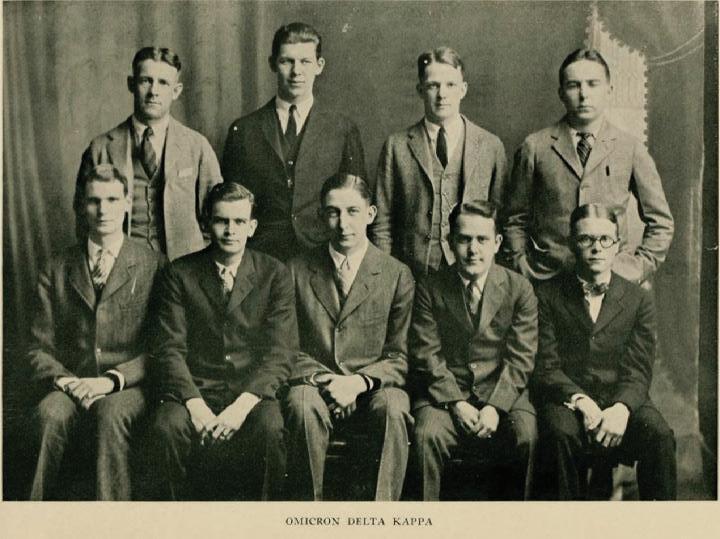
The Lambda Circle is HampdenSydney’s chapter of Omicron Delta Kappa (ODK), the nation’s premier leadership honor society for college men and women. ODK was founded in 1914 at Washington & Lee University to recognize and encourage superior scholarship and leadership by men and women of exemplary character. Membership in ODK is a mark of highest distinction and honor.
Founded on April 12, 1924, the Lambda Circle is the 11th oldest ODK chapter. The inaugural class was 11 strong and included J.F. White ’24, J.H. Reed, Jr. ’24, E.M. Sager ’25, H.J. Dudley ’25, M.H. Bittinger ’24, B.S. Mogan, Jr. ’24, G.W.F. Tynes ’24, F.R. Hurt, Jr. ’25 as well as Professor S.M. Reed and Coach Charles A. Bernier. In the centennial celebration held on April 12, 2024, Lambda Circle initiated nine Hampden-Sydney students, five resident members, and two honoris causa members.
“Omicron Delta Kappa has a natural home at a place like Hampden-Sydney that values leadership and good citizenship as part of its educational mission,” says Circle Coordinator Mike Wolyniak. “ODK members are active in philanthropic ventures in the greater Farmville area, and the Circle provides a variety of opportunities to receive leadership training. Hampden-Sydney has benefited immensely from Lambda Circle contributions over the last century, and the Circle looks forward to serving the H-SC community for years to come.”
“Being in ODK has profoundly impacted my tenure at Hampden-Sydney,” says Circle President Patrick Strite ’24. “As an underclassman, I admired the leadership traits exhibited by upperclassmen in ODK. Now, as a member, I take pride in contributing to the legacy of service and collaboration that defines a Hampden-Sydney man. With the recent celebration of the Lambda Circle's 100th anniversary, I'm optimistic about its enduring success for centuries to come.”
Other commemorations of the Lambda Circle centennial included two exhibits displayed in the Bortz Library. Patrick, Daniel Nivens ’24, and Director of Bortz Library Shaunna Hunter curated a display of publications, awards, and mementos unique to the Lambda Circle. Special components of the display include the official register of Lambda Circle signed by every member since 1924, a pocket watch engraved with the ODK laurel wreath that belonged to former Professor of Classics John Luster Brinkley ’59, and the first Lee Cohen Citizenship Award. This award was created in memory of Professor of Mathematics Leon “Lee” Cohen, who was a revered professor and a dedicated faculty advisor to the Lambda Circle. The silver bowl representing this honor was awarded to Lieutenant Colonel Lawrence Rucker Snead III ’81 in May 1981. Colonel Snead went on to serve the College devotedly—much as Dr. Cohen did—for over 30 years in positions such as director of the Wilson Center, ROTC advisor, and lecturer in government and foreign affairs until his passing in 2023.
The second display was filled with artifacts loaned to the College from the Omicron Delta Kappa National Office and Dr. Tim Reed, ODK vice president for membership and operations. Special items in this display included original initiation regalia, national publications, and anniversary items.
Lambda Circle would like to extend special thanks to former Director of Publications
Tommy Shomo ’69, retired Elliott Professor of Rhetoric and Humanities Elizabeth Deis, Patterson Professor of Biology Alex Werth, and Ms. Karen Snead for their assistance with and contributions to the centennial commemoration exhibits.
Staying True to Our Culture with Dean Washington
“Hampden-Sydney is distinct,” says Dean of Culture and Inclusion Desiree Washington. “It is the place to form good men and good citizens in an atmosphere of sound learning, and it is true to itself, its mission, and its brotherhood.”
Dean Washington believes strongly in that brotherhood. As the College’s first dean of culture and inclusion, Washington is tasked with nurturing that brotherhood by empowering all Hampden-Sydney community members to cultivate meaningful and diverse relationships; supporting students and faculty and staff members from minority groups, and promoting a culture of inclusion and respect on campus.
Washington says that focusing on culture is crucial to the future of Hampden-Sydney and its mission of forming good men and good citizens. “By prioritizing an inclusive culture, the College cultivates an environment where individuals from various backgrounds feel valued and supported,” Washington explains. “This inclusive culture fosters a sense of belonging and encourages students and members of the faculty and staff to
engage actively in the learning process and campus life. Moreover, emphasizing culture aligns with the College's mission of forming individuals who embody integrity and civic responsibility. By promoting respect, acceptance, and understanding among all members of the community, HampdenSydney College instills essential values that are integral to becoming good citizens. This emphasis on culture helps students develop into well-rounded individuals who are equipped to contribute positively to society.”
The Office of Culture and Inclusion oversees athletics diversity, equity, and inclusion efforts, harassment and discrimination policies and complaints, Title IX, Accessibility and Disability Act services, campus culture initiatives, the Brother4Brother (B4B) program, and more. “I love to say we have the unique position of being in everyone’s business,” Washington jokes. “We touch every area on this campus and every group, too! We are true to H-SC because we aim to see everyone, affirm everyone, and empower everyone to thrive. Again, we don’t try to change what people believe. We aim to provide everyone with the tools they need to connect with others regardless of belief, background, or identity. We believe strongly in the brotherhood and the best way to be a brother, in our opinion, is to see each other, love each other, and accept each other in spite of any difference that appears.”
Less than a year into her tenure, Washington has already made an impact in the College community. OCI has established an on-campus resource called the Elizabeth Keckley Career Closet located in the Bortz Library. The closet is named in honor of Elizabeth Keckley, who was enslaved as a child to HampdenSydney steward Armistead Burwell and went on to become a highly sought after dressmaker, a favorite of Mary Todd Lincoln. “The idea here is that we have a standard on the Hill as to how we present ourselves to the world. Not every student arrives at H-SC with a blazer and tie. As easily as you can check out a book, you can check out a suit, dress pants, a tie or any other professional clothing item,” Washington explains.
Washington and Saint Blizzard III, director of athletic compliance and DEI, have also expanded B4B, a mentorship program for Black, brown, international, first generation and/or low socioeconomic students. “We develop personalized academic success plans; connect B4B students to resources on and off campus; host bi-weekly meetings based on themes of personal elevation such as professionalism, mental health, life after
graduation, self-efficacy, academic success; and so much more,” Washington says.
OCI’s current programming as well as future plans are designed to advocate for and support the development and achievement of underrepresented students; encourage the development of academic, leadership, and cultural identity competencies amongst all members of the Hampden-Sydney community; and promote inclusivity and respect for all members of the Tiger family, including alumni and prospective students: all goals that are foundational to the College's mission to form good men and good citizens in an atmosphere of sound learning.
“I have no desire to change Hampden-Sydney,” Washington says. “I just want to make sure every person on the Hill finds their fit. When students find their fit, they stay and they thrive. Same goes for our faculty and staff. When we take care of our Tigers, identify and remove barriers to their success, and provide them with access to opportunity, there is no limit to what they can be.”
How
to get involved with the Office of Cultural Inclusion at H-SC
• Follow @OCI_HSC on Instagram to stay up to date
• Donate to the Career Closet
• Drop off items to the 3rd floor of Brown Student Center
• Visit the Amazon Wishlist
• Come back to campus to speak to students about your professional journey, your lived experience during your undergraduate tenure, or anything pertaining to campus culture. Email Dean Washington at dwashington@hsc.edu to discuss.
When Dean Washington joined Hampden-Sydney last June, the College reported on her background, credentials, and experience. Read on to learn more about Dean Washington as a person.
Q: DESCRIBE YOUR PERFECT SATURDAY
Growing up, my mom called every Saturday morning “National Clean-Up Day.” So as an adult, my Saturday mornings start with my fiancé and I doing full house clean to some oldies playing on our record player. In the fall, we enjoy some good old fashioned SEC football. War Eagle! On a free weekend, we love to do miniroad trips as we learn this area.
Q: AS A KID, WHAT DID YOU WANT TO BE WHEN YOU GREW UP?
As a young child, I wanted to own an all-star cheerleading gym. It is still one of my biggest dreams! I have been an all-star cheerleader since I was four years old, and now I coach. As a teen, I dreamed of doing exactly what I do now – impacting the lives of young people and being a vessel to my community! I am very blessed to be able to do that.
Q: WHAT'S THE LAST GREAT BOOK YOU RAED?
I just wrapped up On Earth We’re Briefly Gorgeous by Ocean Vuong and I highly recommend. I also re-read The Alchemist by Paulo Coelho multiple times a year as a mental and spiritual reset.
Q: IF YOU COULD HAVE DINNER WITH ANY ONE, LIVING OR DEAD, WHO WOULD IT BE?
James Baldwin. He is my all-time favorite author, and his literary works have deeply impacted my life, my thought process, and my perspective.
Q: WHEN DO YOU FEEL MOST LIKE YOURSELF?
When I am coaching or mentoring! I deeply believe in servant leadership and being a member of someone’s village. I love being a vessel of opportunity, hope and access for young lives. I know that is my divine calling.
Q: IF YOU COULD BE THE BEST IN THE WORLD AT SOMETHING, WHAT WOULD IT BE?
Discipline. Because with discipline, I can master any other thing.
Q: WHO WAS THE BEST TEACHER OR MENTOR YOU EVER HAD, AND WHY?
I am the youngest of six children, and my eldest sister truly took me under her wing. My sister has had a very successful career and allowed me from a young age to be on that journey with her. She would take nine-year-old me to executive meetings, hand me a note pad to take notes for her, and ask me to stand up and recap the meeting for the attendees at the end. She accompanied my parents and me on every college visit. I love hearing her tell me she is proud of me because I recognize how much she poured into me. She is my person.
Q: ARE YOU A CAT PERSON OR A DOG PERSON? DOG!
Q: IF YOU WERE A PROFESSIONAL BASEBALL PLAYER, WHAT WOULD YOUR WALKOUT SONG BE?
Morris Brown by Outkast
Q: WHAT LEGACY DO YOU HOPE TO LEAVE IN LIFE?
I hope that the young people I was blessed to serve can look back and say it wasn’t Desiree but that it was God moving through her. I would like my legacy to be that I followed my divine calling and that through my obedience others were blessed.
SPORTS NEWS
It was a season to remember. The 2023-24 Hampden-Sydney College Basketball team finished as the NCAA Division III National Runner-Up.
“It is hard to put into words the joy that I felt as a coach, watching the young men in this program commit to Hampden-Sydney, commit to this basketball program, commit to each other, and commit to being the standard of excellence each and every day,” said fifth-year head coach Caleb Kimbrough. “The experiences we were fortunate enough to have together this year are experiences that we will talk about for the rest of our lives. This season was filled with a lot of hard work, a lot of joy, and an unwavering dedication to getting better each and every day. Finishing the season 31-3, winning the ODAC championship, and advancing to the National Championship are incredible achievements that are the results of focusing on our program’s vision, values, and standards. To the students, community, and all other supporters, we always thought about you as part of this team and a huge part of this season’s success. It does not get any better than H-SC!”
H-SC, under the direction of Coach Kimbrough, fifth-year assistant coach Bryson Gibson and second-year assistant coach Carson Long, served notice early with its 74-53 season-opening home win past defending national champion and top-ranked Christopher Newport University on November 8 in S. Douglas Fleet Gymnasium at Kirby Field House. The Tigers, ranked No. 8 in preseason, led 31-22 at halftime, and by as many as 24 points in the second half, in arguably one of the biggest wins in program history, while believed to be the first Top 10 match-up at home, as well. Six weeks later, with eight wins in the first nine games, H-SC did it again on the road, defeating top-ranked John Carroll University 85-67 on December 19 in University Heights, Ohio. The Tigers, ranked No. 6 at the time, closed the first
half on a 16-4 run to lead 34-31 at halftime and outscored the hosts 17-8 to open the second half toward another Top 10 triumph.
“We have never shied away from competition in the five years I have been at H-SC, and we did not plan on doing that this season either,” explained Kimbrough. “We chose to schedule John Carroll and CNU in hopes that they would help prepare us for a tough conference schedule, and I think they did just that. We were confident in the team we had going into this season and our experience and depth really showed in those two wins.”
The Garnet & Grey began the new year ranked No. 1 nationally in the D3hoops. com Top 25 on January 2, the first time the program had been ranked first in the national poll since Jan. 12, 2004.
The top billing came during the longest winning streak of the season of 14 games, beginning with a 61-52 road win at archrival and four-time defending ODAC Tournament Champion Randolph-Macon College on Dec. 8 in Ashland, and ending with a 77-54 home win past Virginia Wesleyan University on Jan. 31. The visitors led 28-19 at halftime and secured their first win against their archrivals since 2017, also the first win in Ashland since 2013, with 1010 free throws over the final 3:20. It ended the Yellow Jackets 37-game ODAC winning streak, as well as a 57-game regular season home win-streak. H-SC took a 67-46 home win past No. 25 Swarthmore (PA) College on Dec. 14, as well, along with 10 ODAC wins, including the victories at both RMC and VWU, during the 14-game streak.
“It is hard to put into words the joy that I felt as a coach, watching the young men in this program commit to HampdenSydney, commit to this basketball program, commit to each other, and commit to being the standard of excellence each and every day."
— Head Coach Caleb Kimbrough
Following a disappointing 48-46 setback to RMC on February 3 in Fleet Gym, the truly magical portion of the season ensued as Coach Kimbrough’s squad put together 12 consecutive victories that took them all the way to the national title contest. The first four wins helped the program complete the regular season with a record of 23-2 overall, and included a satisfying 70-59 home win past Mary Washington University on Senior Day (Feb. 17) when eight special Tigers were recognized. The team returned to No. 1 in the D3hoops.com Top 25 on Feb. 19, and would remain in the top spot until the final poll was released after the national championship.
H-SC finished 14-2 in the ODAC for the #2 seed in the ODAC Tournament, and won three games in four days at the Salem Civic Center, including 81-61 past #10 seed Ferrum College in the quarterfinals on Feb. 22 and 63-52 past #6 seed VWU in the semifinals on Feb. 24, before an 81-56 triumph past #4 seed Washington and Lee University on Feb. 25 in the championship to gain automatic qualification into the postseason NCAA Tournament.
The Garnet & Grey entered the NCAA Tournament as the (unofficial) overall top seed, hosting and playing at home during the opening weekend of rounds one and two, where they defeated La Roche (PA) University 98-61 on March 1 and Farmingdale State (NY) College 72-51 on March 2. Hampden-Sydney then hosted the third round and quarterfinals of Sectional competition, where they defeated Rowan University (NJ) 91-76 on March 8 and No.
19 Nebraska Wesleyan University 6860 for the Sectional Championship on March 9.
“Hosting the NCAA Tournament games until the Final Four was a huge advantage to our team this season,” added Kimbrough. “People complain about our fans, people fear our fans, and people WANT our fans. Our fans are passionate and support in a way that is unmatched by our competitors. Playing on our home court in front of our fans made this season all the more special.”
No. 1 H-SC took a 62-57 come-frombehind win past fellow ODAC member and No. 7 Guilford in the national semifinals on March 14 at the Allen County War Memorial Coliseum in Fort Wayne, Indiana. The victory against the Quakers avenged one of the team’s three losses (80-71, Dec. 2, at GC).
In the finale to the season, topranked Hampden-Sydney dropped a heartbreaking 69-61 decision to No. 13 Trine University (IN) in the 2024 NCAA Division III Men’s Basketball National Championship on March 16. H-SC led 25-23 at halftime, but the Thunder began the second half with a 13-3 run, and the Tigers were not able to get closer than three points (50-47) with 4:06 remaining. The contest was played before a Division III men’s basketball title game record crowd of 4,546, aided by the fact that TU’s campus is located just 35 miles northeast of Fort Wayne in Angola, Indiana. It was a stunning and bittersweet ending to a remarkable season that will take time for everyone involved to fully appreciate its greatness.
“Flying into Fort Wayne to compete in the Final Four with this team was a dream come true,” stated Kimbrough. “Of course, we will always remember how intense the Final Four game against Guilford was, how we had to overcome a late deficit, and the emotional lead up to the game considering we were also conference opponents. Of course, we will also always remember the hurt of losing to Trine in the National Championship game, where we simply didn't play our best basketball and could never get into the groove and make the necessary adjustments to get it done like we had throughout the entire season. But most importantly, we will always remember the love and support that we received from the Hampden-
1st 1st #1 2nd 2nd 11th
30 Win Season (31-3) (16-1 at home) and best season in last 25 years
Season with two All-Americans Adam Brazil and Davison Hubbard
Ranking for Seven Weeks and top five for 11 of the 13 polls
Consecutive 20+ Win Season and 17th overall 20+ Win Season
National Runner-Up Finish with three Final Four Appearances
ODAC Championship Win with 16 appearances
Sydney community. We will remember the text messages, calls, and emails of encouragement. We will remember walking to a pre-game meal near the hotel and hearing the ‘H-S-C … H-S-C’ chant from a rooftop bar where alumni and supporters were gathered. We will remember the reception in the hotel lobby after our loss to Trine and the handshakes, tears, hugs, smiles, and pure joy of being together as a Hampden-Sydney family. When I reflect on the Final Four and National Championship Games, I rarely think about a single play or particular stat line. This experience brought together a community and allowed us to be a part of something way bigger than us.”
While they relish in the success of this magical season, the Tigers eagerly await
returning to action next season. There is the opportunity to welcome back as many as 13 Tigers for 2024-25, including captain and All-American Adam Brazil ’25 and Shane Fernald ’26—Fernald played his best at the end of the season when he averaged 10.0 points, 4.2 rebounds and 3.0 assists in the six NCAA Tournament games. The 6-7, 260-pound forward was 27-41 from the field (66%) during his 96 minutes (16.0) of total playing time.
Until then, your Hampden-Sydney Tigers are the 2023-24 NCAA Division III Men’s Basketball National Runner-Up!
SPORTS NEWS
Ryan Clements
The Tigers also say goodbye to four other graduating seniors.
New
50 Yard Freestyle Record
Swimming
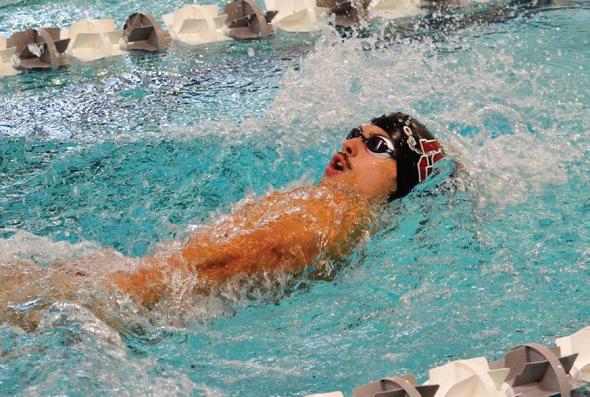
Hampden-Sydney Swimming enjoyed a 2023-24 campaign that saw them take victories over Virginia Wesleyan University, Randolph College, and William Peace University. There was also an individual record broken this season for the second straight year. In the ODAC Swimming Championships, the Tigers placed eighth accumulating 118 points over four days. Team members this season included Patrick Duffy ’24, Charles Adams ’25, team
captain Matt Brooks ’25, Kevin Busch ’25, Cody Carnes ’25, Trey Craft ’25, Quinn Hardimon ’25, team captain Brandon Hyde ’25, Carson Mann ’25, Cole Renfrow ’25, Robert Parke IV ’26, Jackson Pizza ’26, Owen Renfrow ’27, Ronan Self ’27, Peter Gonzalez ’27, Ben Gerber ’27, and Mason Brooking ’27
Carnes and Hardimon were top performers in the pool for the Tigers this season, with Carnes adding a second
school record to his name. Carnes broke the 50 Yard Freestyle record, previously broken last year and held by Braxton Psuik ’23 by .28 seconds. Hardimon posted multiple times that placed him in the top three of events all season long. Hyde, Brooks, and Cole Renfrow also had good years in the pool for H-SC. Owen Renfrow and Gonzalez each showed improvement throughout their first year on the team.
Quinn Hardimon ’25
Brandon Hyde ’25
Matt Brooks ’25
Patrick Duffy ’24
Cody Carns ’25
Waters Memorial Cup
The Office of Alumni and Parent Engagement is proud to award the 2023 John H. Waters Memorial Cup to the Alumni Club of Charlotte. Under the leadership of Club President Alex Luna ’17, the Club of Charlotte has developed a vibrant, active base that holds regular outings for their members and engages meaningfully with the College to support recruitment and mentorship efforts.
“I started attending alumni events as soon as I arrived in Charlotte in 2017,” Luna says. “Events had stalled a bit with a transition of leadership. After a few years of no events, I revived the Club and worked hard to include diversity in the events I was hosting.”
The Club of Charlotte hosts regular happy hours, an annual pickleball tournament, concert outings, watch parties, Welcome to the City events, and RPE toasts. “It all comes down to consistency,” Luna says. “We have 10 to 15 individuals that consistently attend the events. In addition,
The John H. Waters Memorial Cup is an honor presented to the regional alumni club that has the greatest impact in a single year in the areas of engagement, recruitment, philanthropy, and mentorship. The award is named in honor of the exceptional life and legacy of Johnny Waters III ’58, beloved HampdenSydney alumnus and longtime director of alumni relations.
we always have about 10 new faces which makes every event different and exciting.”
With club programming humming along steadily, Luna says his next goal is to expand the club’s engagement with current students as well as incoming freshmen, introducing them to the legendary alumni network they will one day be a part of. This year, the club welcomed incoming freshmen and their families to the RPE toast and hosted a Phi Beta Lambda networking trip.
Luna notes that the Club of Charlotte’s success is truly a team effort, highlighting Thomas Passenant ’16, Garris Stokes ’20, and JD Allen ’20 for their efforts in marketing club events; Zach Dussault ’07 for his support in making the pickleball tournament a success; and Assistant Director of Alumni and Parent Engagement Linda Cheyne and Alumni and Parent Engagement Coordinator Victoria Fenton for their support and encouragement.
PHOTO GALLERIES
ODAC/NCAA Tournament
COLLEGE AND ALUMNI EVENTS
Orientation ............................................ August 22-29
H-SC Bar Association CLE September 19-21
Family and Friends Weekend ...................... October 5
Homecoming ....................................... October 25-26
250TH EVENTS
In celebration of the 250th anniversary of the College’s founding, Hampden-Sydney is excited to present a host of commemorative events. Past events include the 2023-24
Opening Convocation keynoted by the Honorable John Charles Thomas, the 2023 Founders Day Lecture given by historian Christy S. Coleman, and the 2023 Ronald L. Heinemann Lecture in the History of the American South given by Patricia A. Sullivan on the topic of Robert F. Kennedy’s 1964 visit to Hampden-Sydney. Additionally, David Brooks was invited to serve as commencement speaker for the
class of 2024, closing the year and our graduates’ four years with a focus on the subject of character, an important theme in the College’s celebration of our 250th anniversary.
The 2024-25 slate of events promises to be captivating with plans for speaker series on the anniversary theme of civic virtue and trips to St. Johns Church for the reenactment of Patrick Henry’s “Give me Liberty or Give me Death” speech and the Virginia Museum of History & Culture. To stay abreast of event dates and registration details as they become available, visit 250.hsc.edu regularly.
Alumni Host Phi Beta Lambda in NYC
You read in The ROI of H-SC on pages 8–13 how the liberal arts foundation of a Hampden-Sydney education sets students up for success through its training in critical thinking, problem solving, and communication and its propensity to imbue men with a strong sense of social and ethical responsibility. The final piece in the puzzle are the hard skills needed for comprehensive career preparation.
Internships are a great way for students to gain hard skills and practice theoretical application in real-world settings. Thanks in part to engaged alumni, financeinclined students were able to secure impressive internships following a Phi Beta Lambda-sponsored recruiting trip to New York City this past fall. Alumni in the financial industry led tours, made introductions, and networked with students at dinner. Blair Washington ’09, Fitz Robertson ’09, Robert Lamkin ’02, Darren Long ’98, Matt Moore ’08, Tom Melton ’06, and Rob Citrone ’87 organized company visits to Bank of America, Search One, Discovery Capital, Citi Group, Pritchard, and Nasdaq.
“I was pleased to have been given the opportunity to host members of Phi Beta Lambda, at Nasdaq’s global headquarters at 4 Times Square in New York for a brief meeting, tour and bell ringing viewing,” says Long, senior vice president of advisor tools for Nasdaq Dorsey Wright. “These fine young men made me even more proud than I always have been of the diploma hanging on my wall, signet ring on my hand, and crest sticker on the back of my car!”
“I was fortunate to take part in pre-business student trips to New York City, Washington, and Charlotte during my time at H-SC,” says Moore, president of the H-SC Club of New York City and member of the Alumni Board of Directors. “The trips were great bonding experiences with my fellow students and eye opening in terms of seeing what a degree from H-SC could translate into beyond the gates.”
A managing director at investment recruiting firm SearchOne Advisors, Moore notes that recruiting timelines have accelerated in recent years, going on to say that “the most competitive pre-senior year internships in finance are now often secured by the second semester of a student’s sophomore year.” The reality of these timelines makes trips like this and intentional connection between students and alumni even more crucial.
“We (Phi Beta Lambda), along with generous alumni and faculty members, are working together to construct a more structured academic path from the College into high finance,” reports Waylon Gibson ’25. “This trip generated a wealth of networking opportunities for Hampden-Sydney students hoping to break into finance and business.”
Three of the five attendees secured internships for this coming summer partly thanks to connections made. The remaining two already had internships lined up. Ethan Hopp ’25 secured an exceptional internship with Nasdaq Dorsey Wright—the only candidate selected out of 500 applicants.
“The alumni network at Hampden-Sydney is second to none,” Moore says. “I look at my involvement with students and younger alumni as a means of paying back the alumni who graciously gave me their time when I was a student.”
Career preparation in the form of this fall’s recruiting trip is just one investment in a growing portfolio of cocurricular offerings that devoted economics and business faculty members, passionate students, and dedicated alumni have cultivated over the last few years to augment HampdenSydney’s liberal arts foundation. Other offerings include:
From top to Bottom: Bell-ringing ceremony at Nasdaq Outside of the Bank of America Inside of Bank of America
TigerFund
Started in 2002 by late President Walter Bortz and Elliott Professor of Economics and Business Gregory Dempster, TigerFund gives students the chance to invest and manage a portion of the College’s endowment. TigerFund managers also enroll in BUSN 343, a Compass companion course. Made up of one general manager and a team of managers, associates, and analysts, TigerFund is supervised and advised by a member of the economics and business department, but the managers are entirely responsible for the investment decisions, from determining the investment philosophy to researching prospective stocks and finally executing the trades. Analysts and associates support the managers in these activities and practice hard skills in investment analysis. As part of this past fall’s TigerFund kickoff, Moore, Hunter Williams ’20, and Will Thornton ’23 participated in the first Alumni Banking Information Session.
When TigerFund was first established, students managed $200,000 of endowment funds. Thanks to a 2022 gift by former Trustee Frank W. Roach ’73 and his wife, Mary, students now manage a staggering $1,000,000 of endowment money. This generous gift makes TigerFund one of the largest student-managed investment funds in the nation. Income generated from the management of these funds will be used to offset an endowed finance professorship.
Expanded Course Offerings
The economics and business department has added four additional finance electives bringing the current selection of banking and finance courses to 13. This list continues growing as new courses are developed and added. The spring semester’s section of Investment Banking (BUSN 242) brought in Richard Blank ’78, Matt Kanne ’14, Matt Guill ’06, and Rob Ferguson ’06 as guest lecturers.
Wall Street Prep
In February of this year, eligible students had the impactful opportunity to participate in Wall Street Prep training generously funded by John Neuner ’97. Twenty-five students gathered for a two-day bootcamp training in three statement modeling and discounted cash flow programs—real-world financial and valuation modeling skills students will need to break into the finance industry after they graduate.
Access to Industry Tech
While meeting with students in New York, Long learned that several of the students were also on TigerFund and generously arranged a training a few weeks later with Nasdaq Dorsey Wright staff who were also members of their respective colleges’ student run investment fund. “We hoped to not only educate the TigerFund members on our approach to technical investment research but also share some best practices our staff learned while working on their own school’s fund,” Long says. Going above and beyond, Long also arranged for all of TigerFund to have access to DWA, Nasdaq Dorsey Wright’s proprietary research platform.
Graduate School Agreements
Finance-minded students preparing to graduate from Hampden-Sydney benefit from the many agreements that H-SC holds with renowned graduate schools across the southeast such as Duke University’s Fuqua School of Business, University of Virginia’s Darden School of Business, and the University of North Carolina’s Kenan-Flagler Business School. The College also has solid informal relationships with specialized graduate programs such as the UVA McIntire School’s Master of Commerce and the William and Mary Mason School of Business Master of Accounting programs. Hampden-Sydney is pleased to have established a formal agreement with Christopher Newport University (CNU) for preferred admission to CNU’s master of financial analysis (MFinA) program, the only program of its kind in the commonwealth.
The College thanks its many alumni supporters who make it possible to train the next generation of leaders in finance. Alumni support for the economics and business department allows Hampden-Sydney College to continue offering these opportunities as well as pursuing additional opportunities such as hosting a Bloomberg Terminal to give students access to industry data, news, and analytics. To support any of these initiatives, please contact collegeadvancement@hsc.edu
HAMPDEN-SYDNEY
www.hsc.edu/alumni/10under10 to learn more about these outstanding alumni or nominate a recent graduate for the upcoming class.
L–R: Alex Luna ’17, Ben Anderson ’20, Harrison Taylor ’23, Jacky Cheng ’18, Leonardo Kowalski ’15, Michael Good ’19, Nate Oliver ’16, Thomas Bales, ’17, Tyler McGaughey ’18, and Charles Dulaney, Jr.’21.
1960s
WAVE TOWNES '66 was inducted into the Seneca High School Hall of Fame in Louisville, Kentucky. He joins other prior inductees such as broadcast journalist Diane Sawyer, former NCAA All American and NBA MVP Wes Unseld, and Wave's wife, Brenda Igo Townes, MD. Wave says, "I was always one step (at least) behind Brenda."
1970s
RICK JEFFREY '75 is the 2024 Virginia Sports Hall of Fame Distinguished Virginian Award recipient per a November 27, 2023, WAVY report. Rick is retired president of Virginia Special Olympics in Richmond.
Dr. JOHN HUBBARD '76 recently published a book with Ray Leonard, Jr. (son of legendary boxing champion Sugar Ray Leonard) and Dr. Earl Suttle (motivational speaker and NFL substance Abuse regional director) titled Know Better, Do Better: A Life Guide for the Next Generation. The purpose of this book is to provide an easy-to-read, inspiring, and thought promoting resource for young people. Personal story contributions were made by NBA great Magic Johnson and other successful role models. Dr. Hubbard has previously published 18 books, six for physicians or scientists and 12 for the general public. Previously, he has been a professor at MCV, Harvard Medical School, the University of Virginia School of Medicine, and Vanderbilt Medical School. Dr. Hubbard is currently a full-time clinical psychiatrist in Richmond, Virginia.
GREGORY W. FELDMANN '79 has been appointed to the GO Virginia Region 2 board. GO Virginia is an initiative by Virginia's senior business leaders to foster private-sector growth and job creation through state incentives for regional collaboration by business, education, and government. In addition, Greg serves on the boards of P1 Technologies, a privately held contract manufacturer of injected molded products and interconnect cables used by the medical industry; and Carter Bankshares Inc., a bank holding company and the parent company of Carter Bank & Trust, a commercial bank serving markets in Virginia and North Carolina with $4.4 billion in total assets as of June 30, 2023.
1980s
VEE PITTMAN '84 hosted an esteemed group of alumni at the Pittman family farm in Courtland, Virginia, on September 8, 2023, for lunch and a dove hunt. All enjoyed a good old-fashioned meal and then headed to the field for the hunt. Although the weather was extremely hot, the hunt was great, all had a good time and enjoyed the hunting as well as the camaraderie! Always a fun time to get old friends together and the Tiger faithful did not disappoint. Already looking forward to next year's event!
1990s
CARLOS A. ALVARENGA '90 recently published a new book, The Rules of Persuasion: How the World's Greatest Communicators Convince, Inspire, Lead and, Sometimes, Deceive (Post Hill Press). The book, which features an afterword by Thompson Professor of Classics (Emeritus) James A. Arieti, updates and expands on ideas presented in Aristotle's Rhetoric and examines what persuasion is and how it works in all forms of human communication.
JAMES FACE '90 published his latest book, A Roadmap for Success in July 2023. This book combines economics, psychology, philosophy, history, business, science, and many other domains, as well as personal experiences to uncover the groundbreaking secret to success. James says, "I give credit to my professors ( Tom O'Grady, Hassel Simpson, and many others) at H-SC who inspired me to study the humanities and continue my writing."
KEITH BARKSDALE '93 has been named to the National Small Business Association (NSBA) Leadership Council according to a December 11, 2023 Power Analytics press release. He is co-founder and chairman of Power Analytics Global.
Dr. ROBERT "BO" COFIELD '93 is now COO of Northern Arizona Healthcare according to a December 15, 2023, company press release.
PORTER BANISTER, JR. '93 has been promoted to vice chancellor for state affairs at the University of Alabama per a November 7, 2023, Yellowhammer News article.
MATTHEW E. MALONE '95 was one of the winners of the Business Intelligence Group 2023 BIG Awards for Business Entrepreneur Award per a November 22, 2023, IT News Online release. He is founder/CEO of Groundworks in Virginia Beach and founder/managing partner with Succession Capital Partners.
VEE PITTMAN ’84
SEKOU KAALUND '97 was honored in October 2023 by the Harlem Educational Activities Foundation for championing diversity and equitable opportunities. He is head of branch banking with U.S. Bank.
STEPHEN B. JONES '99 has been appointed senior vice president of field and market development at Colonial Life in Columbia, South Carolina, according to a September 28, 2023, company press release.
2000s
ASHBY W. PRICE '01 has been elected president of the CFA Society Virginia. Ashby is the Founder of Ashwood Financial Partners, a financial planning, investment management, and retirement plan advisory services firm.
NATHANIEL J. GOODWYN '01 has received the Craigie Award for Teaching Excellence at Collegiate School. According to the school website, this honor is bestowed on a teacher who "who exemplifies the values and ideals of teaching at Collegiate."
Dr. DUSTIN S. REYNOLDS '05 has been elected president of The Virginia Dental Association per a September 27, 2023, ABC News 13 article.
Dr. JUSTIN R. NORBO '06 has been elected president-elect of The Virginia Dental Association per a September 27, 2023, ABC News 13 article.
WILLIAM G. KAMMERER III '07 was promoted to the rank of major for the United States Air Force. Bill is based at the Pittsburgh Air Reserve Station for the Air Force Reserves and flies the C-17. He is also based at Newark, New Jersey, for United Airlines and flies the 787.
PHIL MISKOVIC '08 has been appointed town manager for the town of Crewe, Virginia, reported a November 21, 2023, article in The Crewe-Burkeville Journal. Phil is scheduled to begin his duties in midJanuary and resign as Crewe mayor.
BRANDON CLAPP '09 has been named partner at Swift Currie McGhee & Hiers LLP in Birmingham, Alabama, per a December 4, 2023, Metro Atlanta CEO article.
ZEKE TRAYLOR ’06 published his first book on October 13, 2023, when it reached number one for New Releases on Amazon. The Path: Strengthen the Team, Empower the Individual is an inspirational journey that unveils the profound power of teamwork and the quest for individual empowerment in the most challenging of circumstances. Zeke, former H-SC assistant football coach, illuminates his personal tale of adversity and redemption into a universal message about the power of collaboration. Through his unwavering determination and the support of his newfound team of family, friends, and medical professionals, he triumphs over life-threatening odds. This gripping narrative, told in the context of a football season, transcends the sport to offer profound insights applicable to any team, from corporate offices to family gatherings.
“Teams are an integral part of our daily lives, and I firmly believe that being an exceptional teammate is one of the most valuable qualities an individual can possess,” Zeke says. “However, this skill must be cultivated through learning, consistent practice, and constant nurturing. The distractions that surround us can easily divert our attention from the commitments we have made, and despite our awareness of the obstacles that may arise, we must fervently seek the means to overcome them. As I walked my own path, redirecting my focus toward the fundamental principles of teamwork facilitated the healing of my family, the restoration of my spirit, the preservation of my life, and developed a formidable team to support me regardless of the challenges we might face. It is my sincere belief that the lessons implored in The Path can have a similar transformative effect on you and your team.”
2010s
JOHN ANDREW STEWARD '11 has taken the position of managing director of aircraft sales and acquisitions for SkyShare as of August 2023.
GENERAL JENKINS '12 married Mattie Witt (Sweet Briar College '12) on September 17, 2022. In attendance were Frasher Bolton '12, B. Alex Lemieux '12, J. Lawson Olson '12, Slade Weldon '12, Nick Almond '13, Connor Winstead '12, Kevin Besserer '12, McEnery Garrett '12, Wesley Morck '13, and Forrest Allen '13.
KEVIN BESSERER '12 married Monica Estes on September 23, 2023. The bride is a 2016 graduate of Florida Gulf Coast University. Pictured are Bo Farrar '12, Connor Winstead '12, Kevin Besserer '12, Lawson Olson '12, and General Jenkins '12
Dr. THOMAS WILLIAM MASSEY JR '12 married Dr. Mallary Erin Gum on October 7, 2023, at The Country Club of Virginia in Richmond. Tigers in attendance included (left to right) Matt Shankle '11, Chris Avellana '12, Darden Barrett '11, Howard Bullock '11, Ned Massey '13, Nathan Cohee '12, Clay Draughon '12, Ryan Davis '12, and Scott Boze ’14
WILL HOPKINS '16 married Megan Wolfgang on August 5, 2023, at St. Peter's Pro-Cathedral with a reception at the Virginia Museum of Fine Arts in Richmond.
TYLER McGAUGHEY ’17 married Catherine VanMeter on May 20, 2023, at Lambert’s Winery in Weston, West Virginia. The bride is a graduate of West Virginia University and is the research coordinator for the West Virginia University Medicine Hospital Trauma Department. Tyler completed his Ph.D. in neuroscience at West Virginia University in August of 2023. He is now the research imaging specialist at the West Virginia Clinical Translational Science Institute with a secondary appointment as an assistant clinical professor in neuroradiology. The couple resides in Morgantown, West Virginia. Robert Jackson ’18 and William Echols ’17 served as groomsmen.
BESSERER-ESTES WEDDING
JENKINS-WITT WEDDING
DALLAS NEGAARD '18 recently completed a thru-hike of the Appalachian Trail with his wife, Alli on September 10, 2023. The couple took five months and five days to hike all 2,198.4 miles from Gerogia to Maine.
GEORGE CLISSOLD ’19 married Hailey Smith on May 13, 2023 at Roanoke Island Festival Park in Manteo, North Carolina. The bride is a 2019 graduate of North Carolina State University and a 2022 graduate of the University of North Carolina at Chapel Hill’s physician assistant program. She is a physician assistant at Wake Skin Cancer Center in Wake Forest, North Carolina. George is a procurement manager at Parexel International in Durham, North Carolina. The couple resides in Raleigh, North Carolina. Pictured are (left to right) Ian Fraser ’18, Wallace Casey ’20, Vince Babashak ’19, Cameron Bachman ’19, Jeffrey Edwards ’19, George Clissold, Austin Wallace ’19, Zach Shields ’19, Parker Hartline ’19, Chance Diffee ’19, and Liam Kenny ’19
CONNOR GREENE HALL '19 became the 2023 NASCAR Advance Auto Parts Weekly Series national champion on September 19, 2023.
MICHAEL GOOD '19 has joined the expanding Virginia Beach office of Commonwealth Commercial Partners as senior associate broker reported a September 7, 2023, company press release.
CLISSOLD-SMITH WEDDING
CONNOR GREENE HALL ’19
DALLAS NEGAARD ’18
McGAUGHEY-VANMETER WEDDING
CLASS NOTES
OBITUARIES
1940s
ROBERT GILMORE MOORE '46 died on September 15, 2023. His time at Hampden-Sydney was interrupted by service in the U.S. Navy in World War II. After graduating from Virginia Polytechnic Institute with an agricultural degree, he operated his father's farm. He particularly enjoyed working with his flock of sheep and he was active in the Rockbridge Sheep Producers and the Valley Northern Wool Growers associations. Although he was firmly anchored in the area here from childhood on, many more residents of the city and county got to know him while he served as postmaster in Lexington for over 20 years. Easygoing and meditative, yet persevering by nature, much of Bob's effort went into working with others to serve his community. An Eagle Scout himself, he founded a Boy Scout troop in the Kerrs Creek area early on. He served on the Rockbridge County Board of Supervisors and the Carilion Stonewall Jackson Hospital Board of Directors and was a member of the Lexington Rotary Club. An enthusiastic outdoorsman, Bob was an avid turkey hunter into his early nineties. Having grown up on Whistle Creek and the Maury River, fishing also became a favorite hobby. He had an innate understanding of the natural world and supported many conservation efforts. He was always happy to attend picnics and celebrations with family and friends and to watch games with fellow enthusiasts of any of the college ball sports. Bob cherished having a large group of Lexington and Rockbridge County friends from his youth and considered himself especially fortunate to have been able to carry on those friendships throughout the many decades of their lives. He is survived by his daughter, daughter-in-law, six grandchildren, and six great-grandchildren.
1950s
H. PEIRCE BRAWNER, JR. '50
died on October 26, 2023. Peirce started his higher education at Hampden-Sydney College, transferring to Cornell University to study electrical engineering. He served in the Army Reserve and honorably discharged with the rank of captain. After college, Peirce worked at the Bethlehem Steel Fore Shipyard, Sun Ship and Drydock Co., and finally at Boeing until his retirement in 2001. Peirce's lifelong passion was sailing, both racing and cruising, with a particular interest in navigation. Peirce was very involved in teaching and sharing his love of sailing and seamanship as a member of or volunteer for many sailing organizations including U.S. Power Squadron, the Corinthians, and Seattle Wooden Boat Center. His most gratifying work was with the Sea Scouts Ship 1909 based in East Greenwich, Rhode Island, with whom he experienced many adventures and made many cherished friends. In addition to the many destinations Peirce reached through his sailing, he and Ann enjoyed traveling and traveled extensively all over the world. He is survived by two children and two grandchildren.
Dr. JULIUS TEMPLE GOODMAN '50 died on September 28, 2023. Dr. Goodman attended HampdenSydney College and the Medical College of Virginia. Following his internship in Augusta, Georgia, Dr. Goodman served as a captain in the U.S. Air Force for four years. He practiced medicine in Glade Spring, Virginia, from 1958 to 1968 and then moved to Augusta, Georgia, where he worked for the Veterans Affairs hospital until his retirement in 1990. Dr. Goodman was an avid sports fan and enjoyed watching SEC and ACC football and the Atlanta Braves. Dr. Goodman is survived by three sons, four grandchildren, and seven great-grandchildren.
Dr. ROBERT H. RAMEY, JR. '51 died on October 18, 2023. He attended Hampden-Sydney College, where he was a member of Sigma Chi fraternity and the tennis team and graduated Phi Beta Kappa with a B.A. and a B.S. After college, Bob attended Union Presbyterian Seminary in Richmond, Virginia, and earned a B.D. and Th.M. In the early 1970s, he also earned his D.Min. from Union Presbyterian Seminary. Later he was awarded an honorary doctorate from Hampden-Sydney. A gifted preacher, Bob had a long and illustrious career, founding and pastoring first at St. Andrew Presbyterian Church in Lynchburg, Virginia. After seven years he became pastor at Knox Presbyterian Church in Norfolk, Virginia; and then as pastor at Selwyn Avenue Presbyterian Church in Charlotte, North Carolina; and finally as pastor of Memorial Drive Presbyterian Church in Stone Mountain, Georgia. He then joined Columbia Theological Seminary in Decatur, Georgia, as a professor of ministry until he retired in 1996. In his retirement, Bob authored 17 books and served as interim and substitute pastor in many churches across the Southeast. He created children's sermons featuring Rocky Bear, a giant stuffed bear that became wildly popular at a myriad of churches. Bob loved tennis, running, and badminton and exercised religiously every day until just weeks before he died. He was also an avid Atlanta Braves fan, instilling that love of the Braves in his oldest grandsons. He was also a huge Green Bay Packers fan and fulfilled a lifelong dream by attending a game at Lambeau Field in Green Bay in the early 2000s. UNC basketball and UGA football were his two favorite college sports teams. Travel was another of Bob's passions. Over the course of his life, he traveled to 105 countries. Bob is survived by his wife, Gail; four children, nine grandchildren, and eight greatgrandchildren.
BLACKFORD VINCE SHELTON, JR. '51 died on September 2, 2023. Vince earned his bachelor's degree from Hampden-Sydney, where he played basketball and baseball. After college, he enlisted in the Army, served during the Korean War, and achieved the rank of captain. Vince worked as the regional sales manager for the Chevrolet Motor Division for 32 years. He was an active member of Severna Park United Methodist Church. Vince loved working with tools. He was always piddling with and fixing things that should have been trashed. Most of all, Vince enjoyed his family. He loved being a dad, granddad, and great-granddad. He was always playing with the kids and didn't miss a game, supporting his wife's coaching career. Vince is survived by his four children, seven grandchildren, and one great-grandchild.
The Hon. Dr. CLARENCE A. "CLANCY" HOLLAND '52 died on November 11, 2023. Clancy attended Hampden-Sydney on a football scholarship and was a member of Kappa Sigma and Omicron Delta Kappa. Invited to play for the Green Bay Packers after graduation, Clancy accepted his service in the United States Navy instead, where he served at sea for three years before taking assignment as an admiral's aide for one more year, leaving at the rank of lieutenant. After his military service, Clancy studied medicine in Richmond at the Medical College of Virginia, graduating with his M.D. in 1962. Dr. Holland practiced family medicine for 53 years in Virginia Beach, Virginia, retiring in 2013. During that practice, Dr. Holland and his three partners built a popular and successful practice. Dr. Holland was the recipient of many awards and honors, including nods from the American Medical Association, The Medical Society of Virginia, and the Virginia Family Practice Society. Over the course of his career, Dr. Holland did everything from delivering babies to diagnosing and treating sick patients, all the while advocating for medical education. His love of medicine and strong belief in advocating for his patients and his community would eventually lead him to a career in politics. Clancy served on several local boards in Virginia Beach before being elected to the City Council in 1970. Clancy served on the council for 12 years, including two years as the mayor of
Virginia Beach, before running for the 7th District Virginia State Senate seat in 1983. Winning that seat, Clancy served for 12 years in the senate, continuing to practice medicine during all three terms. His work in politics helped to create numerous programs and policies that live on today, including bills on public safety, beach conservation, transportation, and the creation of the Virginia Marine Science Museum (now known as the Virginia Aquarium). In his retirement Clancy remained active in both medicine and politics but also spent many wonderful hours with his family. Clancy is survived by two daughters, five grandchildren, and two greatgrandchildren. Clancy's nephews include Gary Holland '83, Greg Holland '77, and Dick Holland '74
CARTER BRANHAM SNOW FURR '54 died on October 6, 2023. Carter graduated magna cum laude from Hampden-Sydney College in 1954 and received a juris doctorate in 1957, Order of the Coif, from the University of Virginia. He spent over 30 years in the Army Reserve JAG Corps, retiring as a colonel. Carter practiced law for more than 60 years with partners and friends Arthur Jett and Waverly Berkley. Their firm, Jett, Berkley, and Furr, which later merged with McGuire Woods, was known nationally for its expertise in maritime law. In addition to many other organizations, Carter was a member of the Norfolk and Portsmouth Bar Associations, a member of the United States Court of Appeals Fourth Circuit Judicial Conference, and a permanent member of the Bar of the Supreme Court of the United States. He also served as a board member of the Hampton Roads Naval Historical Foundation, past president of the Norfolk German Club, past president of the Virginia Club, and a member of the Advisory Council to the Virginia Commission on the Bicentennial of the American War of 1812. Having a deeply rooted interest in historical and genealogical matters, Carter could proudly trace his ancestry back 40 generations as a member of the Order of the Crown of Charlemagne. He served as the state chancellor and past president of the Norfolk Chapter of the Sons of the American Revolution, past president of the Order of First Families of Virginia, governor of the Jamestown Society, and a consultant to The Hereditary Society Community of the United States of America. He also held active membership in more than two
dozen hereditary, preservation, and historical societies. Although never able to shoot his age, Carter was a dedicated golfer and an enthusiastic traveler who shared countless trips with his wife, Huffy, and a wonderful group of lifelong friends. He was a passionate civil war historian, a faithful Wahoo, and a longsuffering Washington football fan. Carter loved any social event but was most at home on his deck at Sandbridge enjoying a cocktail and the sunset with his wife and family. He is survived by his beloved wife of 61 years, Huffy; one son, and three grandchildren.
The Honorable JOSEPH PAUL RUSHBROOKE '55 died on November 8, 2023. At HampdenSydney College, Joe was a prominent member of the track team, and graduated cum laude, with a Bachelor of Arts degree. He attended law school at the University of Virginia and the University of Richmond, graduating from the University of Richmond Law School with a Juris Doctor degree in 1958. He practiced law with the firm of Gentry and Locke in Roanoke until 1963, when he was appointed deputy commissioner of the Industrial Commission of Virginia in Richmond. In 1971 he was appointed federal administrative law judge in Knoxville, Tennessee. He returned to Roanoke as an administrative law judge with the Office of Hearings and Appeals in 1973 and served in that capacity, as well as chief judge from 1984 to 1995, until his retirement in 2004. He was a member of the Virginia State Bar, Roanoke Bar Association, Three Hundred Club, Cotillion Club, Hidden Valley Country Club, and Cave Spring United Methodist Church. In his retirement years, Joe enjoyed playing golf with his buddies, bowling in several leagues, and spending time at home playing his grand piano and ukulele. He also had a well-renowned sense of humor and did a little stand-up comedy from time to time. He is survived by his devoted wife of 66 years, Alice; two sons, three grandchildren, and three great-grandchildren.
Dr. MAURICE NOTTINGHAM JR. '56 died on December 22, 2023. Maurice's journey in medicine was marked by academic excellence, graduating cum laude from Hampden-Sydney College in 1956 and earning his medical degree from the Medical College of Virginia in 1960. Following his military service in the U.S. Navy from 1962 to 1964, he joined the Internal Medicine Group of Paul D. Camp, specializing in cardiology. Dr. Nottingham's commitment to patient care and excellence in medicine led him to an admirable 30-year career at Chippenham Hospital in Richmond, Virginia. He not only dedicated himself to the well-being of his patients but also served on the boards of Chippenham Hospital and JohnstonWillis Hospital. His leadership extended to the presidency of the Richmond Heart Association, where he played a vital role in advancing cardiovascular health within the community. Beyond his professional achievements, Maurice was a loving family man. His marriage to Reid was a testament to enduring love and partnership. His pride in his family was immeasurable, and he cherished every moment spent with his children, grandchildren, and great-grandchild. The laughter and love shared within his family were the true sources of joy for this dedicated patriarch. Maurice is survived by his devoted wife of 65 years, Reid; his two sons, Jim Nottingham '83 and Rob Nottingham '85; five grandchildren; and one great-grandchild.
Dr. GEORGE LAMB BUIST GRINNAN '57 died on November 1, 2023. After graduating from Hampden-Sydney, George continued his education at the Medical College of Virginia School of Medicine in Richmond, Virginia. After completing his residency and fellowship at MCV, he went on to become a celebrated thoracic and cardiovascular surgeon at Sentara Norfolk General Hospital. George was active in his community, serving in leadership positions in several professional societies including as partner in the Mid-Atlantic Cardiothoracic Surgeons, past president of the Tidewater Chapter of the American Heart Association, and past president of the Humera Surgical Society. He was an author and co-author of many publications and involved in numerous hospital staff memberships and committee
appointments in Norfolk, Portsmouth, and Virginia Beach. George was a military veteran, called to serve during his medical studies at the U.S. Air Force Hospital Clark A.F.B in the Philippines during the Vietnam War. He received the Air Force Commendation Medal for Outstanding Achievement. He and his wife traveled the world together, sailing, biking, hiking, and touring. Their most favorite destination was Tanzania, Africa, which they visited three times. George was an avid outdoorsman, adventure seeker, and travel enthusiast, spreading his love for his hobbies with all loved ones. He was an active waterfowl hunter, fisherman, crabber, and boater. He was a dog lover and actively involved in training his many Labrador retrievers. He was a mountain climber, marathon runner, wind surfer, bird lover, and Jimmy Buffet's number one fan. He is survived by his wife of 45 years, Karon; two children, two step-children, 11 grandchildren, four grandchildren, and nephew Randy Grinnan '84. His grandfather was R. Bryan Grinnan, Sr, class of 1879, and his brother was R. Bryan Grinnan III '57
Former Trustee MALCOLM REESE MYERS '57 died on December 24, 2023. After graduating from Hampden-Sydney with a B.S. degree, he entered the Navy, where he proudly served his country. An exceptional manager, Malcolm served as president, CEO, and then chairman of Cloyes Gear and Products, Inc. He also served as a director of Fairfield-Arkansas Community Land Corporation and director of Standard Products Company in Cleveland, Ohio. In addition, he was a lifetime trustee of both University School and Hampden-Sydney College. After retirement, he went back to sea on cruise ships, visiting each continent and developing friendships around the world. He avidly enjoyed fishing in the fresh waters of Canada and the world's oceans. He was also a huge Cleveland Browns and Guardians fan, as well as an Ohio State Buckeye fan. He is survived by two children, five grandchildren, and three great-grandchildren.
RICHARD S. COPELAND '58 died on October 12, 2023. After attending Hampden-Sydney College and William and Mary, he taught math and science at Granby High School. After five years in the classroom, Dick opened his automobile dealership, Copeland Toyota Volvo. He is survived by four children and six grandchildren.
1960s
CHARLES BONHAM COLLMAN ’60, (Capt., USN ret.) died on October 24, 2023. After graduating from Hampden-Sydney College, he served 30 years in the United States Navy as a naval flight officer. He enjoyed and was justifiably proud of his career. He flew in various squadrons including Tactical Support Squadron 3, Fighter Squadron 102, and Patrol Squadrons 23 and 45. He served aboard the USS America, the USS John F. Kennedy, and the USS Saratoga. After operational years, Chuck served as the emergency action officer for the Joint Chiefs of Staff and later held command positions with Training Squadron 10, Navy Recruiting District New Orleans, and finally as commodore of Navy Recruiting Area 3. His various awards included the Legion of Merit Medal, Defense Meritorious Service Medal, Air Medal, and the Vietnam Service Medal. After retiring in 1990, Chuck spent countless hours on the golf course enjoying the camaraderie of friends and competitors. When he wasn't playing golf or exercising, he was usually found tending his lawn. Chuck is survived by his wife of 44 years, Jeannie; five children, and 10 grandchildren.
THOMAS ALGERNON HICKMAN, SR. '60 died on December 11, 2023. Tommy attended Hampden-Sydney College before entering the Army and serving his country in the United States and the Middle Eastern and North African theatres. Besides managing Hickman Lumber Company in Painter, Virginia, for over four decades, Tommy quietly gave his time to many worthwhile causes in the community. While he is often remembered as the gentleman behind the hardware and paint counters at
Hickman Lumber, he also served as a town councilman and mayor for the Town of Painter, a volunteer fireman for the Painter Volunteer Fire Company, a member of the local advisory board of Crestar Bank, a member and chairman of the Broadwater Academy Board of Directors, a member of Governor John N. Dalton's Boating Advisory Committee, and a member of the United States Coast Guard Auxiliary, Painter Flotilla 12-2. Boating safety and respect of the water were very important to Tommy, and he taught boating safety classes in the community for many years. He was a former member of the Exmore Moose Lodge and the Eastern Shore Yacht and Country Club. He is survived by his two sons, Thomas A. Hickman, Jr. '85 and Philip T. Hickman '88; and four grandchildren.
LEWIS MERIWETHER WALKER III '61 died on September 9, 2023. He initially worked for the Richmond-Times Dispatch before returning to Petersburg as a manager at Builders Supply Corp. and partner in Roslyn Farm Corp. Over 30 years he created an awardwinning 1,000-acre farming operation, which produced corn, soybeans, wheat, and barley. Always civic minded, Lewis served as state president for the Virginia Jaycees, the Virginia Heart Association, and the Virginia Soybean Association. He was also a board member for the Virginia Corn Growers Association and president of the Petersburg, Virginia, Rotary Club and Battlefield Park Swim Club. He represented Grayson County as Twin County Airport commissioner for eight years during which time he oversaw construction of the new t-hangar building. At age 58 Lewis pursued his life-long dream of learning to fly. Within two years he earned a private pilot's license plus multi-engine and instrument ratings. He and wife, Joanie, volunteered to transport cancer and transplant patients for Angel Flight from North Carolina to Pennsylvania. They also flew their plane from coast to coast twice and to the Caymans and Bahamas on business. After retiring from farming, Lewis delved into the natural supplements arena, always researching the best products and companies for great health. He helped thousands of people in the U.S., Jamaica, and Greece improve their health naturally. An avid supporter of the Boy Scouts and chairman of Petersburg's Troop 175, Lewis encouraged his two sons and two grandsons to become Eagle Scouts. He is survived by his wife, Joanie; five children, 11 grandchildren,
three great-grandchildren, and his brother Bob Walker '70. His father was the late Lewis Meriwether Walker III '61
SIDNEY GRAYDON ARMSWORTHY '62 died on August 12, 2023. Sidney graduated from Hampden-Sydney and went on to work in insurance, real estate, and banking. He enjoyed fishing with his son, Graydon, throughout his life including a fishing trip to Mexico. Sidney always seemed to have some sort of project happening, including rebuilding a car for Graydon when he was a teenager. He liked building furniture in his wood shop or restoring a boat. In later years he and his wife completed multiple cross-country road trips to visit Graydon in San Diego, California. They also enjoyed international cruises to Central America and Europe. His grandkids loved the yearly visits and looked forward to crabbing on the dock, fishing, and tubing on the boat. He is survived by his wife of 48 years, Monnie; one child, and three grandchildren.
DENNIS BRENT DILLS ’63
died on September 23, 2023. While at Hampden-Sydney, Dennis played football. To make ends meet, Dennis and his wife, Donna—who worked in the H-SC dean's office— started Dills Sandwich Service. Dennis sold sandwiches and juices to the other students in the evenings after the dining hall closed. After his graduation from college, Dennis enlisted in the United States Navy. The former Vietnam veteran and his wife travelled all over the world with the Navy. After the Navy, they settled in North Carolina, where Dennis embarked on a banking career with Wachovia Bank, First Bank, and Suntrust Bank. When he retired, Dennis was the president and CEO of Suntrust Bank's trust department in Atlanta. He and Donna went home to Lynchburg, Virginia, upon retirement. Once back in Lynchburg, Dennis could be found chasing golf balls on the course at Boonsboro Country Club just about every day. Everywhere they lived, he and Donna were very involved in the Episcopal Church. In Lynchburg, they enjoyed fellowship and worship at Trinity Episcopal Church. He is survived by his wife of 62 years, Donna; two children, and five grandchildren.
WILLIAM SIDNEY DRUEN '64 died on December 16, 2023. He graduated with a Bachelor of Arts in history from HampdenSydney College in 1964. During his undergraduate years, he was a member of Sigma Chi, the co-captain of the football team, and winner of the Gammon Cup. Sid then graduated from the University of Virginia with a Bachelor of Laws in 1968. After working briefly in the Virginia Governor's Office, Sid began his 30 years as an attorney with Nationwide Mutual Insurance Company in Columbus, Ohio. He ended his time at Nationwide as senior vice president and general counsel. Sid also served the Columbus area and beyond as a member of the Council for Ethics and Economics and the Ohio Chamber of Commerce. He contributed to and was a member of the German Village Society, Friends of Schiller Park, and Village Connections. He was director of the Public Affairs Council of Washington, D.C., trustee of the Ohio Historical Society Development Committee, president of the University Club of Columbus, president of the German Village Foundation, board member and president of Program 60 at The Ohio State University, board member of the Franklin County Alcohol, Drug, and Mental Health Services Board, board member of the Ohio Insurance Institute, board member of the National Association of Mutual Insurance Companies, and chair of the membership committee in 2023 of the Kit Kat Club. Sid enjoyed a love of history, genealogy, and travel. He used his retirement to travel to over 80 countries. He had a studied eye for art and antiques as well as a keen sense for negotiation. Sid's constant presence will be missed at art and antique auctions and the South High Drive-In flea market. Sid possessed an unwavering commitment to family, a generous dedication to community, and made meaningful contributions to his profession. He will be remembered as a proponent of reason and the opportunities that education affords. Sid is survived by his wife of 54 years, Janet; two children, and three grandchildren.
CLASS NOTES
LEONARD CECIL BO LONG '64 died on September 8, 2023. Bo was an avid golfer who loved spending time with his golf buddies, considering them to be his family. He had a deep passion for sports. If he wasn't playing golf, he was watching some sporting event. Bo cherished the moments spent with friends and family, and he especially enjoyed going on golf trips with his buddies. In his professional life, Bo had a successful career in the meat commodity business, owning his own company, Trans Continental Meats. He built a reputation for excellence throughout his years. Bo is survived by his wife, Pamela; one daughter and one stepdaughter.
RICHARD HUSE CRANE, JR. '65 died on September 7, 2023. Rick earned a bachelor's degree in mathematics from Hampden-Sydney College and a Master of Education from the University of Virginia. He began his teaching career in Lynchburg, Virginia, and moved to Richmond seven years later to teach mathematics at Midlothian High School. While there, he also coached the boys tennis team to five state championships. Rick is survived by his wife of 47 years, Donna; and two children.
ROBERT CARLETON WIMER '65 died on December 26, 2023. At HampdenSydney he majored in history and political science and served as president of Sigma Chi fraternity, forming many lifelong friendships. Bob began his career in journalism in Charlottesville as an obituary writer and later as a photographer for The Daily Progress. Bob joined the U.S. Army in 1966, spending the next three years stationed in Germany working as part of a Psychological Operations Unit near Stuttgart during the Vietnam War. Following his service in the Army, Bob returned to the The Daily Progress. He later worked for the Amherst New Era Progress before taking a job as a reporter for the Lynchburg News and Advance He spent the next 34 years in a series of progressively responsible positions, concluding his career at the News and Advance as the editorial page editor. He was a member of the
National Conference of Editorial Page Editors and won numerous awards throughout his career. Bob was a selfless leader in the community, serving as a charter member of the Amherst Humane Society, a member of the Board of Directors of the Salvation Army, and a president and member of the Sphex Club. Baseball was important to this Brooklyn Dodgers fan who followed their wins and losses over the course of his lifetime. As a historian and outdoorsman, Bob served as part of a crew during the inaugural James River Bateau Festival and enjoyed many years of floating down the river during this annual event. After retirement, Bob continued writing as the co-author of From Tavern to Town, which chronicled the history of the Town of Amherst. He also published a book of columns with News and Advance colleague Darrell Laurant titled We're Still Here, which includes many of his columns featuring his alter ego Uncle Harry who dispensed advice on everything from politics to relationships. Bob will be remembered by his many friends for his game of horseshoes, love of music, ready smile, and willingness to share a drink just to be sociable. He is survived by his wife of 58 years, Betty; two children, three grandchildren, and one great-grandchild.
1970s
ROBERT PASCHAL BENDALL III ’70 died on February 21, 2022. Bobby attended Hampden-Sydney College for a year, during which he pledged Kappa Sigma fraternity, before joining the U.S. Marine Corps as a private first class in the Vietnam War. Following the war, he graduated from the College of William & Mary, after which his interest in art history led him to work in New York City in art galleries, artistic jewelry sales, and as a model and actor. Signing with an agent, Bobby performed in plays in New York City, and then ventured to Hollywood where he landed a role on the TV show Night Court. He went on to earn his master’s degree in educational administration and taught in Los Angeles elementary schools. In retirement, he shared his love of art through interactive wall art and by painting in acrylics and oil. A favorite subject of many of his paintings was his love of the beach and surfing. Bobby is survived by his wife of 23 years, Susan; four children; four grandchildren; and two brothers, Gordon Pannill Bendall ’72 and Charles Hunter Bendall ’76. His father was Robert Paschal Bendall, Jr. ’44
EDWARD RUCKER "SONNY" WITT, JR. '70 died on October 21, 2023. He graduated from Hampden-Sydney, where he served as the chapter president of Lambda Chi Alpha fraternity. He went on to complete his M.Ed. at Lynchburg College in 1975. He retired as an employee of Lynchburg City Schools, where he served as an assistant principal, supervisor, and director and ended his 43-year education career as assistant superintendent. In all his positions in the school system, his main concerns were always the students' education and well-being. Sonny was a kind and gentle man, always thinking of others. He seemed to know everyone in town as his children will attest. He would always tell you a good joke. He loved sports, playing city league baseball, and high school and college football. He also loved watching his children swim competitively and never missed a swim meet. Sonny is survived by his wife of 52 years, Betty; two children, and two step-grandsons.
Dr. JOHN C. FOWLER '75 died on November 6, 2023. John entered the Navy in June 1966 at the Great Lakes Recruit Training Center and later returned to the Great Lakes for Hospital Corps training followed by Field Medical Service School at Camp Lejeune in North Carolina. He served at the Philadelphia Naval Hospital, Pennsylvania; Marine Corps Air Station in Beaufort, South Carolina; and the Fifth Force Service Regiment at Camp Pendleton, California. He deployed to Vietnam as a senior corpsman 3/3/KILO Company located on the DMZ. After suffering a serious head wound, he was returned to combat with one stipulation: "You can't wear a helmet." After more combat and upon completion of his four-year obligation, he reentered the civilian world in January 1970. John then studied psychology at Hampden-Sydney College and received his master's degree from James Madison College. He helped establish Piedmont Geriatric Hospital, Virginia's first geriatric hospital, in Burkeville. In 1981, he earned his Ph.D. in clinical psychology from Alliant International University. He served in the Marine Reserves in college and was commissioned LTJG. His first assignment was to the Naval Drug Rehab Center at NAS in Miramar, California, and he later taught at the U.S. Naval Academy. While practicing psychology in Maryland, he helped to establish a clinic and develop a protocol utilizing biofeedback for the treatment of post-traumatic stress and other stress disorders. He treated
thousands of military trauma victims. He maintained private practice in medical psychology for the Johns Hopkins Hospital, Anne Arundel Medical Center and physicians of Annapolis while serving as a naval psychologist. While stationed at the Bethesda Naval Hospital, he created a Medical Psychology Division which quickly received APA accreditation and was emulated by the Navy's other teaching hospitals. Concurrently he served as head of psychology at the Naval Postgraduate Dental School. After Bethesda, John was assigned as head of health and physical readiness for the Bureau of Naval Personnel, where he helped to develop and teach the Combat Stress Protocol for Desert Shield/Desert Storm. He was promoted to CDR/MSC/USN and ordered back to the Naval Academy as head of the Mental Health Department USNA Clinic. From there he went to Central Command, Bahrain, and then returned to the Naval Academy. He retired from the United States Navy in September 1994. John recently retired from private practice but not before receiving the designation of master clinician for the Walter Reed National Military Medical Center, Bethesda, Maryland. He will be remembered for his great sense of humor, fearless spirit, and his love of animals, family, and country. Dr. Fowler is survived by his wife, Terri; two children, and five grandchildren.
DAVID WAYNE EGGLESTON '76 died on November 22, 2023. Dave, a 1976 graduate of HampdenSydney College, went on to a career in telecommunications. He enjoyed fishing, the beach, NASCAR, and history, but his family and friends were his greatest treasure. He is survived by his loving wife of 41 years, Kathleen; and his son.
1980s
JOHN ERIC RIEDLIN ’82 died on December 30, 2023. After attending HampdenSydney College, Eric graduated from American University. He went on to partner at Monticello Associates and served on the board of directors at the Denver Country Club and the Denver Teacher’s Awards. His passions in life were first and foremost his family, followed by friends, career, golf, and wine. He is survived by his wife, Cari; two children, two stepchildren, nine grandchildren, and brother Carl Riedlin ’88
CLARK BAROUSSE ’87 died on September 3, 2023. Clark was a three-sport varsity letterman at HampdenSydney before graduating with a Bachelor of Arts in economics and Spanish. Clark furthered his academic pursuits with a Master's of Business Administration from Georgia State University in 2002. Soon after completing his education, Clark began working for First Florida Bank. Throughout his career, Clark found great satisfaction in the medical device industry. He embraced the challenges of running and assisting many companies, guiding them to new heights of success. His dedication and hard work earned him a reputation as a respected professional, president, and CEO in his field. Beyond his professional accomplishments, Clark was an avid golfer, finding solace and joy on the greens. As a devoted New Orleans Saints fan, he enthusiastically supported his beloved hometown team, cheering them on through every victory and the many defeats. Clark found his greatest source of pride and joy in his children, who were the very heart and soul of his existence. His life revolved around them, and he wholeheartedly embraced the role of a devoted father and protector. He attended every sports event, cheering passionately from the sidelines, and supported their every endeavor with unwavering encouragement. His legacy of love and support will forever live on in the hearts of his beloved children, a beautiful reflection of his enduring devotion. Clark is survived by his wife, Louise; and four children.
2000s
WILLIAM
ROBERT BORLAND ’07 died on September 26, 2023. After high school, Will made his way to Hampden-Sydney, where he spent two years before heartstrings pulled him to be closer to family and friends at Auburn University. After graduation from Auburn, Will moved to Birmingham, where he and his college sweetheart, Jennie, created a life together. Will and Jennie had the surprise of their lives during the fall of 2016 when they found out that they would be welcoming twins into the world, and Will has been the best dad to those two. Jennie always told Will he would be a great father, and he lived up to every bit of that role. His presence is very much felt and sorely missed. Despite leaving too soon, Will created a wonderful legacy for all who knew and loved him. Will is survived by his wife, Jennie; and their two children.
CIVIL DISCOURSE in an UNCIVIL WORLD
J. MICHAEL UTZINGER, EWING PROFESSOR OF RELIGION
For close to 250 years, Hampden-Sydney College has aspired to form “good men and good citizens in an atmosphere of sound learning.” Certainly, a hallmark of good citizenship is the development of skills that allow for civil discourse, communicating reasonably and responsibly toward the aim of promoting a common good. Spaces of civil discourse are those critical places where we can debate, converse, listen, convince, and disagree, all the while aiming to benefit the whole.
As a scholar of American religious history, I am all too aware of how difficult civil discourse can be, especially when guided by what one believes to be the truth. Most religions profess “matters of ultimate concern,” to quote theologian Paul Tillich, and such truth is rarely a mere abstraction. As late as the Second World War, Franklin Delano Roosevelt could casually state that Catholics and Jews in this nation were “here under sufferance.” At other times in our history, religious conflict has risen to the level of street violence. If we add to religion, the important ways Americans identify in terms of race, class, ethnicity, sexual orientation, gender identity, and political ideology, is it any wonder that in an increasing pluralistic society our divisions seem insurmountable?
Too often responses to our pluralism have appealed to our worst instincts by heightening our differences. In many instances, one group imposes its standards on others. Rather than creating a common good, such practices create cycles of domination marked by resentment, fear, and injustice. Other groups demand bubbles of isolation, leaving them to hear their own echoes: never listening, never learning, and never contributing. Neither response adds to that vital discussion about how to forge a common good.
As citizens, how do we positively engage one another once we have relinquished the naïve proposition that, in time, everyone will embrace our truth? How do we learn to hear and converse with groups with whom we have substantive disagreements, once we recognize that pluralism is already an irreversible part of the fabric of American life?
The liberal arts tradition of Hampden-Sydney provides our students with the vision and skills needed to step into the complicated arenas of social and political difference. Our robust
liberal arts curriculum requires students to develop appreciative knowledge about our complex and multifaceted society in a global context. Eboo Patel, the founder of Interfaith America, argues that gaining appreciative knowledge of those outside of our identity groups is a key to developing the positive attitudes and relationships necessary to work with those with whom we have significant disagreements. A broad educational experience not only offers the opportunity to understand our substantive disputes but also allows us to see the equally substantive goals and dreams that we share.
Through our Rhetoric Program, Hampden-Sydney students learn that skills in argumentation are more than just communicating clearly and critically but also demand the cultivation of intellectual charity. A friend and colleague, Mark Schwehn, wrote that intellectual charity is marked by being “more cautious in appraisal, more sympathetic with human frailty, less prone to stereotype and caricature.” Civil discourse requires such intellectual charity. It is simply not possible to construct a common good with others, if one lacks, in language taken from the Hampden-Sydney Honors Program, “a willingness to take another’s position for its merits and engage it constructively.”
Hampden-Sydney also aspires to develop students of character in the context of a shared brotherhood. Attacking or demeaning anyone, especially those with whom one disagrees, is beneath persons of honor and character. Students of character recognize the humanity and dignity of all those whom they encounter within and beyond the gates of the College. The distinguished public theologian and historian Martin Marty once remarked in an interview that “One of my distinctions in religion is not liberal and conservative, but mean and non-mean. You have mean liberals and mean conservatives, and you have non-mean of both.” When it comes to civil discourse this sentiment extends well beyond religion. Dialoguing in good faith creates an environment of trust that offers the possibility to mitigate problems even when resolutions are not forthcoming. It is hard to overestimate the importance that civil discourse be civil. Our nation needs individuals of character to lead and model healthy civil discourse, if we are to forge any lasting common good.
As Hampden-Sydney looks toward its next 250 years, I remain hopeful that new generations of students will enter these gates to develop the skills needed to continue to create a more perfect union. To all of our students, past, present, and future: we are counting on you.
TIGER FOR LIFE LANCE LAVENSTEIN ’71
“There is a true bond of brotherhood at Hampden-Sydney that continues long after graduation. Class reunions, Theta Chi fraternity reunions, and Homecoming are markers in my life’s journey. These events have strengthened my love and devotion to the College.”
—Lance Lavenstein ’71
If you are interested in leaving a legacy gift to Hampden-Sydney or if you have already included the College in your estate plans, please let us know so that we can thank you and honor you for your generosity.