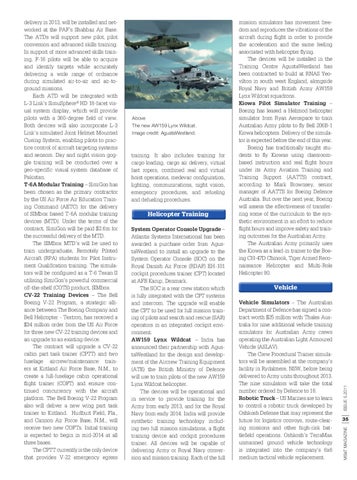
The new AW159 Lynx Wildcat. Image credit: AgustaWestland.
training. It also includes training for cargo loading, cargo air delivery, virtual fast ropers, combined real and virtual hoist operations, medevac configuration, lighting, communications, night vision, emergency procedures, and refueling and defueling procedures.
Helicopter Training System Operator Console Upgrade – Atlantis Systems International has been awarded a purchase order from AgustaWestland to install an upgrade to the System Operator Console (SOC) on the Royal Danish Air Force (RDAF) EH-101 cockpit procedures trainer (CPT) located at AFB Karup, Denmark. The SOC is a rear crew station which is fully integrated with the CPT systems and intercom. The upgrade will enable the CPT to be used for full mission training of pilots and search and rescue (SAR) operators in an integrated cockpit environment. AW159 Lynx Wildcat – Indra has announced their partnership with AgustaWestland for the design and development of the Aircrew Training Equipment (ATE) the British Ministry of Defence will use to train pilots of the new AW159 Lynx Wildcat helicopter. The devices will be operational and in service to provide training for the Army from early 2013, and for the Royal Navy from early 2014. Indra will provide synthetic training technology including two full mission simulations, a flight training device and cockpit procedures trainer. All devices will be capable of delivering Army or Royal Navy conversion and mission training. Each of the full
Vehicle Vehicle Simulators – The Australian Department of Defence has signed a contract worth $25 million with Thales Australia for nine additional vehicle training simulators for Australian Army crews operating the Australian Light Armoured Vehicle (ASLAV). The Crew Procedural Trainer simulators will be assembled at the company's facility in Rydalmere, NSW, before being delivered to Army units throughout 2013. The nine simulators will take the total number ordered by Defence to 18. Robotic Truck – US Marines are to learn to control a robotic truck developed by Oshkosh Defense that may represent the future for logistics convoys, route-clearing missions and other high-risk battlefield operations. Oshkosh’s TerraMax unmanned ground vehicle technology is integrated into the company’s 6x6 medium tactical vehicle replacement.
ISSUE 5.2011
Above
mission simulators has movement freedom and reproduces the vibrations of the aircraft during flight in order to provide the acceleration and the same feeling associated with helicopter flying. The devices will be installed in the Training Centre AgustaWestland has been contracted to build at RNAS Yeovilton in south west England, alongside Royal Navy and British Army AW159 Lynx Wildcat squadrons. Kiowa Pilot Simulator Training – Boeing has leased a Helimod helicopter simulator from Ryan Aerospace to train Australian Army pilots to fly Bell 206B-1 Kiowa helicopters. Delivery of the simulator is expected before the end of this year. Boeing has traditionally taught students to fly Kiowas using classroombased instruction and real flight hours under its Army Aviation Training and Training Support (AATTS) contract, according to Mark Brownsey, senior manager of AATTS for Boeing Defence Australia. But over the next year, Boeing will assess the effectiveness of transferring some of the curriculum to the synthetic environment in an effort to reduce flight hours and improve safety and training outcomes for the Australian Army. The Australian Army primarily uses the Kiowa as a lead-in trainer to the Boeing CH-47D Chinook, Tiger Armed Reconaissance Helicopter and Multi-Role Helicopter 90.
35 MS&T MAGAZINE
delivery in 2013, will be installed and networked at the PAF's Shahbaz Air Base. The ATDs will support new pilot, pilot conversion and advanced skills training. In support of more advanced skills training, F-16 pilots will be able to acquire and identify targets while accurately delivering a wide range of ordnance during simulated air-to-air and air-toground missions. Each ATD will be integrated with L-3 Link's SimuSphere® HD 18-facet visual system display, which will provide pilots with a 360-degree field of view. Both devices will also incorporate L-3 Link's simulated Joint Helmet Mounted Cueing System, enabling pilots to practice control of aircraft targeting systems and sensors. Day and night vision goggle training will be conducted over a geo-specific visual system database of Pakistan. T-6A Modular Training – SimiGon has been chosen as the primary contractor by the US Air Force Air Education Training Command (AETC) for the delivery of SIMbox based T-6A modular training devices (MTD). Under the terms of the contract, SimiGon will be paid $2.6m for the successful delivery of the MTD. The SIMbox MTD’s will be used to train undergraduate, Remotely Piloted Aircraft (RPA) students for Pilot Instrument Qualification training. The simulators will be configured as a T-6 Texan II utilising SimiGon's powerful commercial off-the-shelf (COTS) product, SIMbox. CV-22 Training Devices – The Bell Boeing V-22 Program, a strategic alliance between The Boeing Company and Bell Helicopter - Textron, has received a $34 million order from the US Air Force for three new CV-22 training devices and an upgrade to an existing device. The contract will upgrade a CV-22 cabin part task trainer (CPTT) and two fuselage aircrew/maintenance trainers at Kirtland Air Force Base, N.M., to create a full-fuselage cabin operational flight trainer (COFT) and ensure continued concurrency with the aircraft platform. The Bell Boeing V-22 Program also will deliver a new wing part task trainer to Kirtland. Hurlburt Field, Fla., and Cannon Air Force Base, N.M., will receive two new COFTs. Initial training is expected to begin in mid-2014 at all three bases. The CPTT currently is the only device that provides V-22 emergency egress