that become hot priorities too late in the game (such as after the release of the RFP) have a low likelihood of success. It is challenging to accomplish the work needed to capture new business within a short timeframe. It doesn’t need to be said that the wasted time and cost on the entire organization when pursuing business that does not have a high probability of success can be significant. So the impact of the up-front business development work is large – it’s best to ensure that the work is done thoroughly and with rigour.
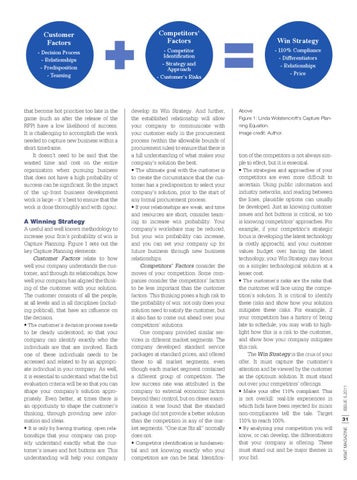
A Winning Strategy A useful and well known methodology to increase your firm’s probability of win is Capture Planning. Figure 1 sets out the key Capture Planning elements: Customer Factors relate to how well your company understands the customer, and through its relationships, how well your company has aligned the thinking of the customer with your solution. The customer consists of all the people, at all levels and in all disciplines (including political), that have an influence on the decision. • The customer’s decision process needs to be clearly understood, so that your company can identify exactly who the individuals are that are involved. Each one of these individuals needs to be accessed and related to by an appropriate individual in your company. As well, it is essential to understand what the bid evaluation criteria will be so that you can shape your company’s solution appropriately. Even better, at times there is an opportunity to shape the customer’s thinking, through providing new information and ideas. • It is only by having trusting, open relationships that your company can properly understand exactly what the customer’s issues and hot buttons are. This understanding will help your company
Win Strategy
- 110% Compliance - Differentiators - Relationships - Price
- Competitor Identification - Strategy and Approach - Customer's Risks
develop its Win Strategy. And further, the established relationship will allow your company to communicate with your customer early in the procurement process (within the allowable bounds of procurement rules) to ensure that there is a full understanding of what makes your company’s solution the best. • The ultimate goal with the customer is to create the circumstance that the customer has a predisposition to select your company’s solution, prior to the start of any formal procurement process. • If your relationships are weak, and time and resources are short, consider teaming to increase win probability. Your company’s workshare may be reduced, but your win probability can increase, and you can set your company up for future business through new business relationships. Competitors’ Factors consider the moves of your competition. Some companies consider the competitors’ factors to be less important than the customer factors. This thinking poses a high risk to the probability of win: not only does your solution need to satisfy the customer, but it also has to come out ahead over your competitors’ solutions. One company provided similar services in different market segments. The company developed standard service packages at standard prices, and offered these to all market segments, even though each market segment contained a different group of competitors. The low success rate was attributed in the company to external economic factors beyond their control, but on closer examination it was found that the standard package did not provide a better solution than the competition in any of the market segments. “One size fits all” normally does not. • Competitor identification is fundamental and not knowing exactly who your competitors are can be fatal. Identifica-
Above Figure 1: Linda Wolstencroft's Capture Planning Equation. Image credit: Author.
tion of the competitors is not always simple to effect, but it is essential. • The strategies and approaches of your competitors are even more difficult to ascertain. Using public information and industry networks, and reading between the lines, plausible options can usually be developed. Just as knowing customer issues and hot buttons is critical, so too is knowing competitors’ approaches. For example, if your competitor’s strategic focus is developing the latest technology (a costly approach), and your customer values budget over having the latest technology, your Win Strategy may focus on a simpler technological solution at a lesser cost. • The customer’s risks are the risks that the customer will face using the competition’s solution. It is critical to identify these risks and show how your solution mitigates these risks. For example, if your competition has a history of being late to schedule, you may wish to highlight how this is a risk to the customer, and show how your company mitigates this risk. The Win Strategy is the crux of your offer. It must capture the customer’s attention and be viewed by the customer as the optimum solution. It must stand out over your competitors’ offerings. • Make your offer 110% compliant. This is not overkill: real-life experiences in which bids have been rejected for minor non-compliances tell the tale. Target 110% to reach 100%. • By analyzing your competition you will know, or can develop, the differentiators that your company is offering. These must stand out and be major themes in your bid.
ISSUE 5.2011
- Decision Process - Relationships - Predisposition - Teaming
Competitors' Factors
31 MS&T MAGAZINE
Customer Factors