National Focus ISSUE 5.2011 MS&T MAGAZINE
28
highest priority to address as far as the need for improved language and cultural awareness training? NW: Our complex, dynamic world presents ambiguous problems that challenge our Nation’s national security and interests. Guidance concerning regions of importance is contained in national and departmental strategic guidance and policy documents. The Defense Language Program aligns its language and cultural training priorities with these documents. MS&T: What are the details for a standardized DoD-wide prioritization process? NW: The DoD is conducting a capabilities based requirement identification process (CBRIP) among the Geographic Combatant Commands to identify priority language and culture needs. These prioritized requirements are validated by the Joint Staff and issued through the Joint Requirements Oversight Council to the Services to source the requirements. The implementation plan advances the expansion of the CBRIP approach to the Services and DoD Agencies once lessons learned are addressed from processing the Geographic Combatant Commands requirements. MS&T: Will there be milestones for achieving goals in the implementation plan? NW: Performance measures based on goals will be captured in the implementation plan. DoD components will identify milestones to ensure these goals are achieved. MS&T: How would a proficiency measure of skills be established, or in other words, what level of proficiency in what length of time for various training programs? NW: The Interagency Language Roundtable guidelines are used as a basis to assess and rate language proficiency. This standardizes the assessment, or measuring, of language capability. Experience has provided approximate timelines for achieving a given level of proficiency, but these vary with the difficulty of the language, aptitude of the student, and amount of immersion. MS&T: What learning methodology currently seems to be the most effective in lending itself to language and cultural training, and how might that play a role in the implementation plan? NW: The culturally-based language instruction delivered at the Defense Language Institute Foreign Language
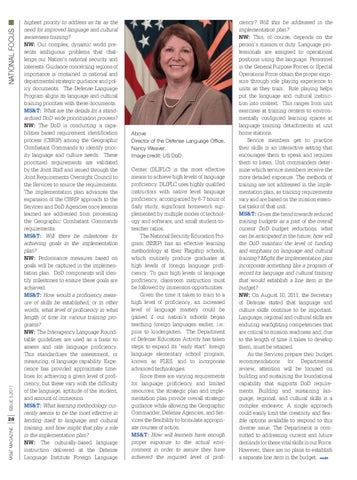
Above Director of the Defense Language Office, Nancy Weaver. Image credit: US DoD. Center (DLIFLC) is the most effective means to achieve high levels of language proficiency. DLIFLC uses highly qualified instructors with native level language proficiency, accompanied by 6-7 hours of daily study, significant homework supplemented by multiple modes of technology and software, and small student-toteacher ratios. The National Security Education Program (NSEP) has an effective learning methodology at their Flagship schools, which routinely produce graduates at high levels of foreign language proficiency. To gain high levels of language proficiency, classroom instruction must be followed by immersion opportunities. Given the time it takes to train to a high level of proficiency, an increased level of language mastery could be gained if our nation's schools began teaching foreign languages earlier, i.e.: prior to kindergarten. The Department of Defense Education Activity has taken steps to expand its "early start" foreign language elementary school program, known as FLES, and to incorporate advanced technologies. Since there are varying requirements for language proficiency and limited resources, the strategic plan and implementation plan provide overall strategic guidance while allowing the Geographic Commander, Defense Agencies, and Services the flexibility to formulate appropriate courses of action. MS&T: How will learners have enough proper exposure to the actual environment in order to assure they have achieved the required level of profi-
ciency? Will this be addressed in the implementation plan? NW: This, of course, depends on the person’s mission or duty. Language professionals are assigned to operational positions using the language. Personnel in the General Purpose Forces or Special Operations Force obtain the proper exposure through role playing experience to units as they train. Role playing helps put the language and cultural instruction into context. This ranges from unit exercises at training centers to environmentally configured learning spaces at language training detachments at unit home stations. Service members get to practice their skills in an interactive setting that encourages them to speak and requires them to listen. Unit commanders determine which service members receive the more detailed exposure. The methods of training are not addressed in the implementation plan, as training requirements vary and are based on the mission essential tasks of that unit. MS&T: Given the trend towards reduced training budgets as a part of the overall current DoD budget reductions, what can be anticipated in the future; how will the DoD maintain the level of funding and emphasis on language and cultural training? Might the implementation plan incorporate something like a program of record for language and cultural training that would establish a line item in the budget? NW: On August 10, 2011, the Secretary of Defense stated that language and culture skills continue to be important. Language, regional and cultural skills are enduring warfighting competencies that are critical to mission readiness and, due to the length of time it takes to develop them, must be retained. As the Services prepare their budget recommendations for Departmental review, attention will be focused on building and sustaining the foundational capability that supports DoD requirements. Building and sustaining language, regional, and cultural skills is a complex endeavor. A single approach could easily limit the creativity and flexible options available to respond to this diverse issue. The Department is committed to addressing current and future demands for these vital skills in our Force. However, there are no plans to establish a separate line item in the budget. ms&t