National Focus
Closing the Gap From strategy to implementation; MS&T’s Chuck Weirauch spoke with the director of the Defense Language Office, Nancy Weaver, about the implementation of the strategic plan to close the language and cultural capability gaps.
ISSUE 5.2011
I
MS&T MAGAZINE
26
n February of this year, the US Department of Defense (DoD) released its Strategic Plan for Language Skills, Regional Expertise and Cultural Capabilities 2011-2016 document, a follow-on to the 2005 Defense Language Transformation Roadmap. This strategic plan is significant in that it was called for in numerous documents, including Quadrennial Defense Review Reports, Government Accountability Office (GAO) reports, House Armed Services Subcommittee studies and others that cited deficiencies in the DoD and Armed Service language and cultural training effort. All of these documents recommended the strategic plan as a way to move forward and resolve those deficiencies. According to Clifford Stanley, Under Secretary of Defense for Personnel and Readiness, the plan "provides a focused and systematic strategy to guide through 2016 the transformation in providing our warfighters, international partners and allies with the language skills, regional expertise, and cultural capabilities needed to meet the diverse operational needs of the 21st century."
To put the strategic plan into effect, Stanley's office and the Defense Language Office are developing an implementation plan that will "identify effective solutions to build, enhance and sustain these (language and cultural) capabilities," along with more efficient and cost-effective means of doing so, according to Stanley. To get a better handle on just what this all means, MS&T asked for some clarification from Nancy Weaver, who is the Director of the Defense Language Office and the DoD Senior Language Authority. As Director, Weaver advises the Deputy Assistant Secretary of Defense for Personnel and Readiness on all matters related to foreign language skills, cultural proficiency and regional expertise in the DoD. She also develops plans and programs and evaluates changes in legislation, policies, regulations, directives and funding to assess the impact on language, cultural, and regional capabilities within the Department for Active Duty, National Guard and Reserve military personnel, civilians, and contractors.
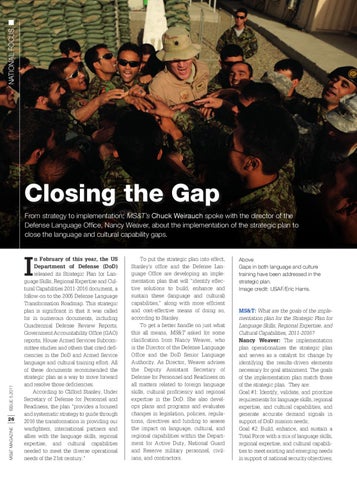
Above Gaps in both language and culture training have been addressed in the strategic plan. Image credit: USAF/Eric Harris.
MS&T: What are the goals of the implementation plan for the Strategic Plan for Language Skills, Regional Expertise, and Cultural Capabilities, 2011-2016? Nancy Weaver: The implementation plan operationalizes the strategic plan and serves as a catalyst for change by identifying the results-driven elements necessary for goal attainment. The goals of the implementation plan match those of the strategic plan. They are: Goal #1: Identify, validate, and prioritize requirements for language skills, regional expertise, and cultural capabilities, and generate accurate demand signals in support of DoD mission needs; Goal #2: Build, enhance, and sustain a Total Force with a mix of language skills, regional expertise, and cultural capabilities to meet existing and emerging needs in support of national security objectives;