Left
Interview
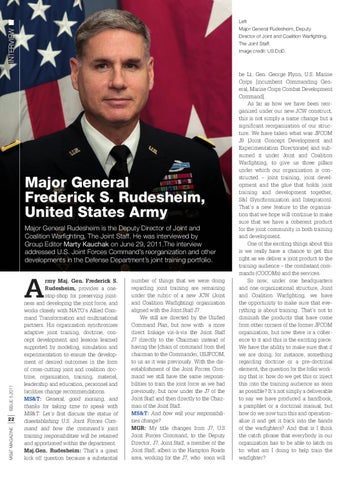
Major General Rudesheim, Deputy Director of Joint and Coalition Warfighting, The Joint Staff. Image credit: US DoD.
Major General Frederick S. Rudesheim, United States Army Major General Rudesheim is the Deputy Director of Joint and Coalition Warfighting, The Joint Staff. He was interviewed by Group Editor Marty Kauchak on June 29, 2011.The interview addressed U.S. Joint Forces Command’s reorganization and other developments in the Defense Department’s joint training portfolio.
ISSUE 5.2011
A
MS&T MAGAZINE
22
rmy Maj. Gen. Frederick S. Rudesheim, provides a onestop-shop for preserving jointness and developing the joint force, and works closely with NATO’s Allied Command Transformation and multinational partners. His organization synchronizes adaptive joint training, doctrine, concept development and lessons learned supported by modeling, simulation and experimentation to ensure the development of desired outcomes in the form of cross-cutting joint and coalition doctrine, organization, training, materiel, leadership and education, personnel and facilities change recommendations. MS&T: General, good morning, and thanks for taking time to speak with MS&T. Let’s first discuss the status of disestablishing U.S. Joint Forces Command and how the command’s joint training responsibilities will be retained and apportioned within the department. Maj.Gen. Rudesheim: That’s a great kick off question because a substantial
number of things that we were doing regarding joint training are remaining under the rubric of a new JCW (Joint and Coalition Warfighting) organization aligned with the Joint Staff J7. We still are directed by the Unified Command Plan, but now with a more direct linkage vis-à-vis the Joint Staff J7 directly to the Chairman instead of having the [chain of command from the] chairman to the Commander, USJFCOM, to us as it was previously. With the disestablishment of the Joint Forces Command we still have the same responsibilities to train the joint force as we had previously, but now under the J7 of the Joint Staff and then directly to the Chairman of the Joint Staff. MS&T: And how will your responsibilities change? MGR: My title changes from J7, U.S Joint Forces Command, to the Deputy Director, J7, Joint Staff, a member of the Joint Staff, albeit in the Hampton Roads area, working for the J7, who soon will
be Lt. Gen. George Flynn, U.S. Marine Corps [incumbent Commanding General, Marine Corps Combat Development Command]. As far as how we have been reorganized under our new JCW construct, this is not simply a name change but a significant reorganization of our structure. We have taken what was JFCOM J9 [Joint Concept Development and Experimentation Directorate] and subsumed it under Joint and Coalition Warfighting, to give us three pillars under which our organization is constructed – joint training, joint development and the glue that holds joint training and development together, S&I (Synchronization and Integration). That’s a new feature to the organization that we hope will continue to make sure that we have a coherent product for the joint community in both training and development. One of the exciting things about this is we really have a chance to get this right as we deliver a joint product to the training audience – the combatant commands (COCOMs) and the services. So now, under one headquarters and one organizational structure, Joint and Coalition Warfighting, we have the opportunity to make sure that everything is about training. That’s not to diminish the products that have come from other corners of the former JFCOM organization, but now there is a coherence to it and this is the exciting piece. We have the ability to make sure that if we are doing, for instance, something regarding doctrine or a pre-doctrinal element, the question for the folks working that is: how do we get this or inject this into the training audience as soon as possible? It’s not simply a deliverable to say we have produced a handbook, a pamphlet or a doctrinal manual, but how do we now turn this and operationalize it and get it back into the hands of the warfighters? And that is I think the catch phrase that everybody in our organization has to be able to latch on to: what am I doing to help train the warfighter?