Leadership
Auftragstaktik – Is It Relevant? Usually translated into English as “mission-type orders” or directive control”, it has been a cornerstone of leadership doctrine in the Prussian-German armed forces since the 19th century. Marco Sigg explains.
ISSUE 5.2011
A
MS&T MAGAZINE
18
uftragstaktik has even been considered the “secret of victory” for the tactical-operational capability of the German troops in the German wars of unification 18641866, as well as in the First and Second World War. But what do we mean by Auftragstaktik? The process of Auftragstaktik is usually described as follows: The superior gives his subordinate a mission in which the objective is defined; the superior only tells his subordinate what to do but not how to reach the defined objective. But Auftragstaktik is much more than that. It comprises also additional aspects such as decisive action, taking the initiative at all levels, flexibility, sense of responsibility and duty as well as mutual trust. It is not only the mission that defines the guidelines for the action; even more important are the commander’s intent and the situation. Auftragstaktik basically means on the one hand carrying out a mission and taking into account what the superior
wanted to achieve (intent) and, on the other hand, analyzing how the mission can be accomplished with regard to the local and geographical conditions on the ground (situation). In an extreme case this could mean for a subordinate to act without mission or to deviate from it. The only guideline that remains is the intent by which the concept of the operation, its end and the interaction of the weapons are defined.
The Roots In order to fully understand the meaning of Auftragstaktik and the underlying idea it is necessary to go back to the roots of this leadership principle: 1) Complexity of modern combat. In the first half of the 19th century, the conditions of modern warfare changed fundamentally. Technological and sociocultural innovations led to a revolution on the battlefield. The enhanced effects of the weapons meant that combats were increasingly fought in looser forma-
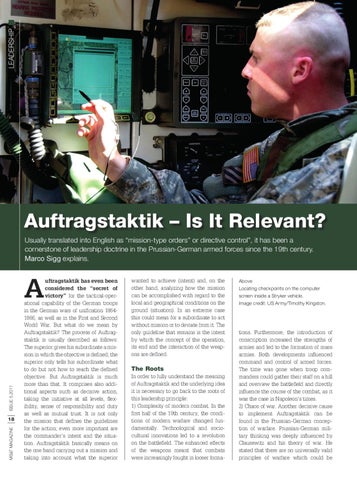
Above Locating checkpoints on the computer screen inside a Stryker vehicle. Image credit: US Army/Timothy Kingston.
tions. Furthermore, the introduction of conscription increased the strengths of armies and led to the formation of mass armies. Both developments influenced command and control of armed forces. The time was gone when troop commanders could gather their staff on a hill and overview the battlefield and directly influence the course of the combat, as it was the case in Napoleon’s times. 2) Chaos of war. Another decisive cause to implement Auftragstaktik can be found in the Prussian-German conception of warfare. Prussian-German military thinking was deeply influenced by Clausewitz and his theory of war. He stated that there are no universally valid principles of warfare which could be