Training Technology
Exploiting Synthetic Environments Like most armies, the UK Army depends on synthetic environments to prepare for operations. MS&T’s Dim Jones reports from the Salisbury Plain.
ISSUE 5.2011
O
MS&T MAGAZINE
14
ver the past 25 years, the focus of UK Army operations has evolved from a clearly-defined Cold War posture through 2 Gulf Wars, peacekeeping in the Balkans and elsewhere, to counter-insurgency in Iraq and Afghanistan. The consecutive or concurrent requirements of these operations, in a climate of increasing pressure on manpower, has resulted in the development of a 30-month cycle of events leading up to, including, and following the 6-month deployment to theatre. This cycle comprises Hybrid Foundation Training, Mission-Specific Training, Immediate Preparation, Operations and Recovery. HFT is not theatre-specific and is generally tailored to battlegroup level; MST, as the name implies, is theatreand task-specific. The training in each phase is varied and, of course, includes live training. However, a battlegroup FTX requires months of planning, hundreds of support personnel, and large tracts of real estate; it also incurs significant environmental impact and high
cost. Synthetic training is a necessity, but it has to be realistic and a coherent part of the overall package. A key element of both HFT and MST is the Combined Arms Tactical Trainer (CATT). CATT is a synthetic training facility developed, staffed and run jointly by the MoD, Lockheed Martin and BAE Systems. There are 2 sites, one at Sennelager in Germany, and the other at Warminster, on the western edge of the Salisbury Plain Training Area. CATT was originally designed as a battlefield high-intensity manoeuvre warfare trainer, but the changing face of the operational requirement since its inception has required a broadening and adaptation of its capabilities.
CATT Simulators The facility links 140 manned simulators and up to 450 participants, to provide a virtual battlefield in which all elements of the battlegroup can practise their individual and collective skills; indeed, there are scenarios which cannot be reproduced in live training. Current capacity
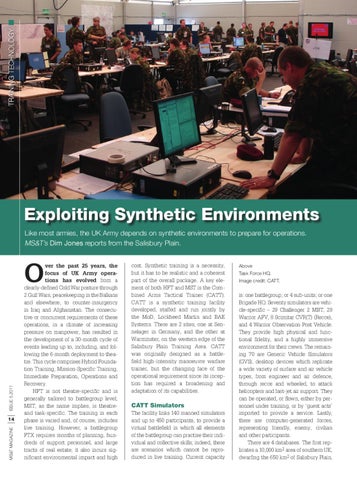
Above Task Force HQ. Image credit: CATT.
is: one battlegroup; or 4 sub-units; or one Brigade HQ. Seventy simulators are vehicle-specific – 29 Challenger 2 MBT, 29 Warrior AFV, 8 Scimitar CVR(T) (Recce), and 4 Warrior Observation Post Vehicle. They provide high physical and functional fidelity, and a highly immersive environment for their crews. The remaining 70 are Generic Vehicle Simulators (GVS), desktop devices which replicate a wide variety of surface and air vehicle types, from engineer and air defence, through recce and wheeled, to attack helicopters and fast-jet air support. They can be operated, or flown, either by personnel under training, or by ‘guest acts’ imported to provide a service. Lastly, there are computer-generated forces, representing friendly, enemy, civilian and other participants. There are 4 databases. The first replicates a 10,000 km2 area of southern UK, dwarfing the 650 km2 of Salisbury Plain,