Training Technology ISSUE 5.2011 MS&T MAGAZINE
12
"We're pulling in the best technology; that is a must for the Army." West said. "This kind of training just has not been there for the dismounted soldier, even though the tankers and the aviators have it. This capability is a huge step forward for the Army."
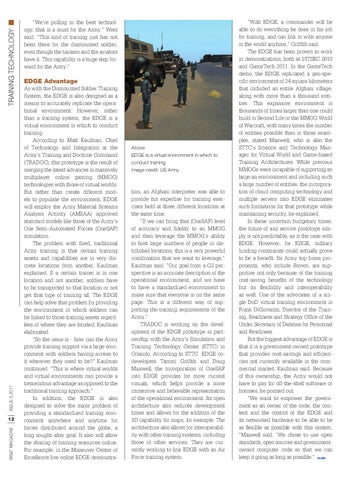
EDGE Advantage As with the Dismounted Soldier Training System, the EDGE is also designed as a means to accurately replicate the operational environment. However, rather than a training system, the EDGE is a virtual environment in which to conduct training. According to Matt Kaufman, Chief of Technology and Integration at the Army's Training and Doctrine Command (TRADOC), this prototype is the result of merging the latest advances in massively multiplayer online gaming (MMOG) technologies with those of virtual worlds. But rather than create different models to populate the environment, EDGE will employ the Army Material Systems Analysis Activity (AMSAA) approved standard models like those of the Army's One Semi-Automated Forces (OneSAF) simulation. The problem with fixed, traditional Army training is that certain training assets and capabilities are in very discrete locations from another, Kaufman explained. If a certain trainer is in one location and not another, soldiers have to be transported to that location or not get that type of training all. The EDGE can help solve that problem by providing the environment in which soldiers can be linked to those training assets regardless of where they are located, Kaufman elaborated. "So the issue is - how can the Army provide training support via a large environment with soldiers having access to it wherever they need to be?" Kaufman continued. "This is where virtual worlds and virtual environments can provide a tremendous advantage as opposed to the traditional training approach." In addition, the EDGE is also designed to solve the major problem of providing a standardized training environment anywhere and anytime for forces distributed around the globe, a long sought-after goal. It also will allow the sharing of training resources online. For example, in the Maneuver Center of Excellence live online EDGE demonstra-
Above EDGE is a virtual environment in which to conduct training Image credit: US Army.
tion, an Afghani interpreter was able to provide his expertise for training exercises held at three different locations at the same time. "If we can bring that (OneSAF) level of accuracy and fidelity to an MMOG and then leverage the MMOG's ability to host large numbers of people in distributed locations, this is a very powerful combination that we want to leverage," Kaufman said. "Our goal from a G2 perspective is an accurate description of the operational environment, and we have to have a standardized environment to make sure that everyone is on the same page. This is a different way of supporting the training requirements of the Army." TRADOC is working on the development of the EDGE prototype in partnership with the Army's Simulation and Training Technology Center (STTC) in Orlando. According to STTC EDGE codevelopers Tammi Griffith and Doug Maxwell, the incorporation of OneSAF into EDGE provides for more current visuals, which helps provide a more immersive and believable representation of the operational environment. Its open architecture also reduces development times and allows for the addition of the 3D capability for maps, for example. The architecture also allows for interoperability with other training systems, including those of other services. They are currently working to link EDGE with an Air Force training system.
"With EDGE, a commander will be able to do everything he does in his job for training, and can link in with anyone in the world anytime," Griffith said. The EDGE has been proven to work in demonstrations, both at I/ITSEC 2010 and GameTech 2011. In the GameTech demo, the EDGE replicated a geo-specific environment of 24 square kilometers that included an entire Afghani village, along with more than a thousand entities. This expansive environment is thousands of times larger than one could build in Second Life or the MMOG World of Warcraft, with many times the number of entities possible than in those examples, stated Maxwell, who is also the STTC's Science and Technology Manager for Virtual World and Game-based Training Architectures. While previous MMOGs were incapable of supporting so large an environment and including such a large number of entities, the incorporation of cloud computing technology and multiple servers into EDGE eliminates such limitations for that prototype while maintaining security, he explained. In these uncertain budgetary times, the future of any service prototype simply is not predictable, as is the case with EDGE. However, for EDGE, military funding constraints could actually prove to be a benefit. Its Army top brass proponents, who include Brown, are supportive not only because of the training cost-saving benefits of the technology but its flexibility and interoperability as well. One of the advocates of a single DoD virtual training environment is Frank DiGiovanni, Director of the Training, Readiness and Strategy Office of the Under Secretary of Defense for Personnel and Readiness. But the biggest advantage of EDGE is that it is a government-owned prototype that provides cost-savings and efficiencies not currently available in the commercial market, Kaufman said. Because of this ownership, the Army would not have to pay for off-the-shelf software or licenses, he pointed out. "We want to empower the government as an owner of the code, the content and the control of the EDGE and its networked hardware to be able to be as flexible as possible with this system, "Maxwell said. 'We chose to use open standards, open sources and governmentowned computer code so that we can keep it going as long as possible." ms&t
Raydo