CONFERENCE REPORT
Pain and bleeding disorders Suzanne O’Callaghan
Pain is a significant issue for many people with bleeding disorders. It can be pain related to a bleed or pain from complications, such as the haemophilic arthropathy or arthritis that results from repeated bleeding into a joint. Pain is not limited to older adults: people with bleeding disorders experience pain over their lifetime, from childhood through to old age. The session on pain at the recent Australian Conference was a great opportunity for presenters to explore issues around pain from different perspectives. This is a summary of the discussion, but if you are interested, some of the presentations are available online for you to watch in full. Visit www.haemophilia.org.au/conference21 for more information.
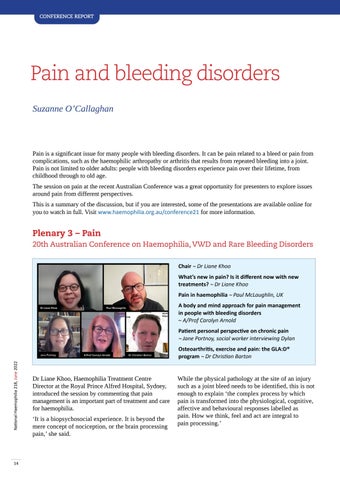
Plenary 3 – Pain 20th Australian Conference on Haemophilia, VWD and Rare Bleeding Disorders Chair ~ Dr Liane Khoo What’s new in pain? Is it different now with new treatments? ~ Dr Liane Khoo Pain in haemophilia ~ Paul McLaughlin, UK A body and mind approach for pain management in people with bleeding disorders ~ A/Prof Carolyn Arnold Patient personal perspective on chronic pain ~ Jane Portnoy, social worker interviewing Dylan
National Haemophilia 218, June 2022
Osteoarthritis, exercise and pain: the GLA:D® program ~ Dr Christian Barton
14
Dr Liane Khoo, Haemophilia Treatment Centre Director at the Royal Prince Alfred Hospital, Sydney, introduced the session by commenting that pain management is an important part of treatment and care for haemophilia. ‘It is a biopsychosocial experience. It is beyond the mere concept of nociception, or the brain processing pain,’ she said.
While the physical pathology at the site of an injury such as a joint bleed needs to be identified, this is not enough to explain ‘the complex process by which pain is transformed into the physiological, cognitive, affective and behavioural responses labelled as pain. How we think, feel and act are integral to pain processing.’


