WFH Summit feature >
Suzanne O’Callaghan is HFA Policy Research and Education Manager
IMPROVING CARE AND QUALITY OF LIFE FOR GIRLS AND WOMEN Suzanne O’Callaghan Over the last several years bleeding disorders in women and girls, treatment and care and improving quality of life have taken a front seat in international forums.
A PERSONAL EXPERIENCE
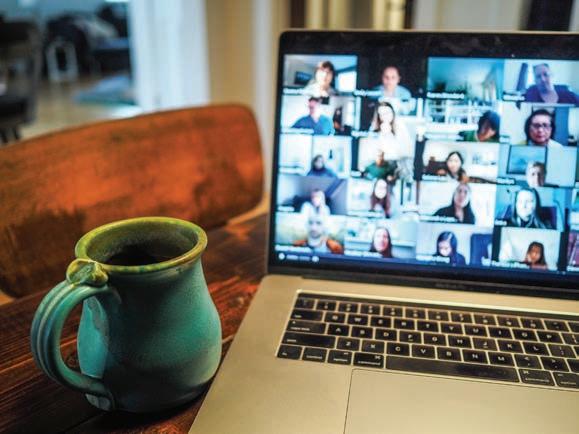
There was an impressive panel of key international experts speaking at the WFH Women & Girls Summit. Rather than delving deeply into recent research, they had been invited to give an overview of the current state of play with clinical practice and research and to lay the ground for future directions – although they did refer to some recent research studies to explain why practice is changing.
QUALITY OF LIFE (QOL) How bleeding disorders affect QoL of women and girls with bleeding disorders Chair: Prof Barbara Konkle, USA Physician perspective – Prof Anjali Pawar, USA Psychosocial perspective – Dr Sylvia von Mackensen Quality of life in girls and women with bleeding disorders has attracted increased interest internationally in recent years. This session focussed on three aspects: • What issues have been identified? • How can they be measured? • How can the quality of life of girls and women be improved?
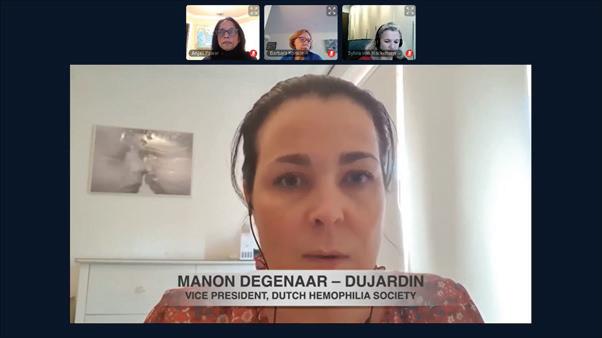
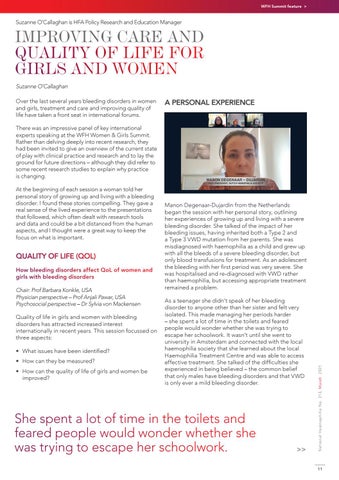
Manon Degenaar-Dujardin from the Netherlands began the session with her personal story, outlining her experiences of growing up and living with a severe bleeding disorder. She talked of the impact of her bleeding issues, having inherited both a Type 2 and a Type 3 VWD mutation from her parents. She was misdiagnosed with haemophilia as a child and grew up with all the bleeds of a severe bleeding disorder, but only blood transfusions for treatment. As an adolescent the bleeding with her first period was very severe. She was hospitalised and re-diagnosed with VWD rather than haemophilia, but accessing appropriate treatment remained a problem. As a teenager she didn’t speak of her bleeding disorder to anyone other than her sister and felt very isolated. This made managing her periods harder – she spent a lot of time in the toilets and feared people would wonder whether she was trying to escape her schoolwork. It wasn’t until she went to university in Amsterdam and connected with the local haemophilia society that she learned about the local Haemophilia Treatment Centre and was able to access effective treatment. She talked of the difficulties she experienced in being believed – the common belief that only males have bleeding disorders and that VWD is only ever a mild bleeding disorder.
She spent a lot of time in the toilets and feared people would wonder whether she was trying to escape her schoolwork.
>>
Nat i onal H aem ophi l ia No. 213 , March 20 21
At the beginning of each session a woman told her personal story of growing up and living with a bleeding disorder. I found these stories compelling. They gave a real sense of the lived experience to the presentations that followed, which often dealt with research tools and data and could be a bit distanced from the human aspects, and I thought were a great way to keep the focus on what is important.
11
210213 HFA_journal_march_21 Update_3.indd 11
15/3/21 10:02 am