




monday, april 7, 2014|
monday, april 7, 2014|
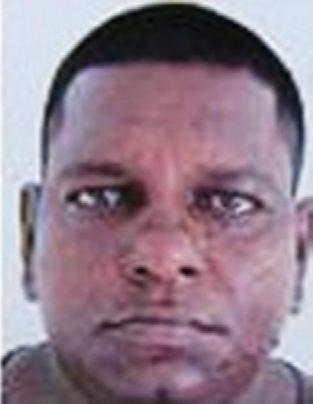
The Guyana Government has asked its Trinidad and Tobago (TT) counterparts to investigate the death of Guyanese tourist, Jeetindra “Ravi” Sookram who reportedly died after being turned away from receiving medical attention at the Dr Eric Williams Hospital, in Port of Spain, Trinidad and Tobago.
In a statement issued on Sunday, the Foreign Affairs Ministry here said it is “deeply concerned over the reported incident in which a Guyanese national was refused emergency medical attention at the Eric Williams Medical Sciences Complex and later succumbed while being taken to another medical institution”.
The Ministry said that its Honorary Consul General in TT Ernie Ross has requested Health Minister Fuad Khan to investigate the report.
“The Minister has assured that the matter is already under investigation and has reaffirmed the principle that no one should ever be refused emergency medical attention at any hospital,” the Foreign Affairs Ministry statement said.
It added that it will aggressively pursue the matter with the TT authorities.
In the meantime, the Foreign Affairs Ministry is requesting that the bereaved family members make contact with Ross at the Guyana Consulate at 16 Gray Street, St Clair, Port of Spain or on telephone
number 868-622-2913.
The dead man’s aunt Chandra Ramdani, with whom he lived for the past 25 years, stated that Sookram left for the twin island republic on Tuesday last with his wife to spend two weeks with his cousin.
The woman told Guyana Times from her Wakenaam home that on Thursday afternoon, the man’s wife telephone her, informing that her nephew was not feeling well, thus she gave him a glass of milk and two painkillers, thinking that he may have been tired from their travelling, but it did not help.
Ramdani added that after a while, she was told that Sookram started to cry out for pains in his stomach and requested to be taken to the hospital. Honouring his request, the man was reportedly taken to the Eric Williams Medical Sciences Complex where his wife and other relatives were told that treatment at the medical facility was expensive, and if they did not have the money, they should leave.
The relative at whose house the now dead man was staying reportedly pleaded to the staff at the hospital that whatever expenses are incurred, he will pay. After spending more than 15 minutes without any positive word from the hospital staff to look after Sookram, he was taken to another hospital.
It was while taking him to the other medical facility; an aggrieved Ramdani said her nephew took his last breath. Upon receiving the complaint,
the Chairman of the North Central Regional Health Authority (RHA), Shehenaz Mohammed, has since instructed Chief Executive Officer (CEO) Kumar Boodram of the medical facility to check the roster to identify which workers were on duty when the incident occurred.
Mohammed said on Friday that Sookram’s family has been asked to provide the RHA with details of the incident, as an investigation has been launched.
Meanwhile, the frustrated aunt said Sookram had moved in with her when he was a child after his mother left for Venezuela and never returned. In tears, the woman added that he was more like a son to her. Sookram and his wife, Vidya Baichu, were married for a number of years.
The 35-year-old man was

a well known ground provision planter and only recently he decided on the trip, claiming that he wanted sometime away from home. Ramdani also recalled that while growing up, Sookram or “Ravi” as he was commonly called, never suffered any illnesses and it was a shock to have heard that he died suddenly.
While initial reports gathered suggested that he might have suffered cardiac arrest, his aunt stated the Trinidadian authorities will be conducting the post-mortem examination today after which the family will make the necessary arrangements for the body to be flown to Guyana.
She described her nephew as a very kind and humble individual, who always put peoples interests above his own. The man leaves to mourn his two sisters and a brother.
The Trinidadian Guardian had reported that staffers at the Eric Williams Medical Sciences Complex (EWMSC) are once again under scrutiny after Sookram died of a suspected heart attack an hour after he was
denied treatment there, because he was not a TT citizen.
Sookram was then rushed to the Charlieville Medical Centre Limited for treatment, but died in the back seat of a Nissan Navara in the private clinic’s Caroni Savannah Road, Chaguanas car park on Thursday.
Symptoms
Doctors there said his symptoms suggested he suffered a massive heart attack, as he had complained about severe chest pains. “I think it is negligence that caused him to not have a chance. I can’t understand how tourists can come into this country and get treated like this,” Sookram’s wife, Vidya Baichu, told the TT Guardian.
Telling of the tragedy while waiting outside the San Fernando mortuary, Baichu said they were talking at Deosaran’s workplace around 07:30h when he complained of a slight pain. Deosaran had taken them there because she had to drop something off. Baichu, said she gave Sookram two painkillers, believing he may have been tired from their travel-
ling, but it did not help.
“He could not sit and he could not stand because the pain was getting to him more. It kept getting worse so we took him to the hospital (EWMSC),” Baichu said.
“When we got there, I went in with him and they took him straight to the place where they took blood and did tests. When I went to register him now, they asked for ID and I gave them his passport. They told me he is not a Trinidadian resident and so all the services, we would have to pay for it.
“We asked them how much was the cost, they said they were not able to say, but whatever service they do we would have to pay for it.” Baichu is now calling on the TT Government to probe the incident, saying if Sookram had received help at the hospital, he might still be alive. She said even while Sookram was grimacing from chest pains, EWMSC medical staff told him to take a seat while they tended to other patients. Baichu said Sookram had no known heart condition and never experienced chest pains before.
Home Affairs Minister Clement Rohee has announced that the Government will soon present its National Drug Strategy Master Plan (NDSMP) to the public.
The final draft of the plan was slated to be completed by the end of March since consultations were held with the various stakeholders, including law enforcement units and non-governmental organisations (NGOs) to have their input.
Minister Rohee stated that the five-year plan will be revealed to the public, detailing how the Government intends to tackle the drug trade.
Rohee made the comments at a graduation ceremony last Friday for 21 members of the Guyana Police Force and Customs Anti-Narcotics Unit (CANU), who were trained in the sharing of best practices for the establishment of an interdiction unit, review of computer data analysis methodologies, interviewing techniques, and the conduct of seizure operations.
He added that the formulation of such a plan required extensive consultations throughout the length and breadth of Guyana, noting that the course undertaken by the U.S. Government coincided with the Government’s policy.
The Minister added that the training programme is testimony of the Government of Guyana’s commitment to continuously train law enforcement officers to develop in a specialised area.
Rohee noted that the
training is necessary, given the nature of organised crime.
He said gangs are specialised in their respective field; hence, it is necessary for law enforcement officers to be up to speed and to be just as competent as their counterparts in other countries.
“We must be able to identify people who are engaging in illegal activities…”
He added that a large number of people congregate at various points of entry, but more specifically at airports, thus, the interdiction course will allow the ranks to be more vigilant and must be able to apply what they have learnt in an effective manner. He nevertheless stated that he was pleased with the timely training course.
The training programme was made possible through funding by the Caribbean Basin Security Initiative launched by U.S. President Barrack Obama at the Fifth Summit of the Americas in Trinidad and Tobago in April 2009. Working together, the U.S., Guyana and other Caribbean nations are combating the drug trade and other transnational crimes that threaten regional security.
Meanwhile, since the previous drug master plan expired in 2009, there has much talk about the crafting of a new plan.
Opposition Leader David Granger recently said the absence of a plan has created more avenues for drugs to enter and leave Guyana, making reference to an airstrip that
was built in the Corentyne with the intention of trafficking drugs several years ago. He said person who built the facility was walking freely, and reiterated that if the National Drug Strategy Master Plan was in effect, the culprit would have been brought before the courts.
In the recent National Drug Report for 2012, compiled by the Task Force on Narcotic Drugs and Illicit Weapons, it was stated that CANU had intercepted 103.66 kilograms of cocaine valued some $93 million, and 111.564kg of cannabis (ganja) valued in excess of $20 million.
During this period, 33 cases were made out and 36 persons charged. Further, the Guyana Revenue Authority’s enforcement unit seized 561.78kg of cocaine, valued $504.9 million, for which two cases were made out and two persons were charged.
In total, 151 people were charged for cocaine trafficking and/or consumption, in a total of 139 cases.

The Demerara Harbour Bridge will be closed to vehicular traffic on Monday, April 7 from 10:00h-11:30h
The Berbice River Bridge will be closed to vehicular traffic on Monday, April 7 from 09:05h-10:35h
The kidnappers of Rajendra “Sunil” Singh, a Foulis, East Coast Demerara (ECD) businessman, have reportedly shot him in the leg and have reduced their ransom demand from $50 million to $25 million.
Minutes after the 40-year-old was allegedly kidnapped by two men in front of his house, the kidnappers had requested $50 million for his safe return.







New information reaching this newspaper indicates that the kidnappers later telephoned the businessman’s wife requesting $25 million instead, after the initial amount could not
have been arranged.
Initially, the men had given the family up to midnight on Saturday to hand over the ransom, which they failed to do; hence the man was reportedly shot to his leg, according to reports circulating in the village when this newspaper visited the area.
Police, in a release, stated that they are investigating the reported kidnapping of the businessman which occurred about 18:45h on Saturday.
Investigations thus far revealed that Singh was in his motor car in front of his business place when his wife observed two men entering
the vehicle which then drove off. After a few minutes, the woman received a phone call demanding the sum of $50 million for the safe return of her husband.
The businessman’s car, PFF 982, was found by members of the Cummings Lodge Community Policing Group along the Goedverwagting Railway Embankment, ECD.
It has been handed over to the police at Sparendaam who have joined the search for the missing man.
When Guyana Times visited the man’s business place at Foulis, the gate was chained with and padlocked. In another attempt to get a
comment from relatives of the missing man, a visit was paid to the man’s house, at Enmore, but again the gates were locked.
After receiving information that the businessman’s wife might be at her father’s place at Mon Repos, ECD, this publication went to the home, but again, no one was in sight.
When contacted, a senior rank of the Guyana Police Force told Guyana Times that he will not comment on the issue, since “we are taking about a man’s life” and bashed the media for irresponsible journalism.
The Police Force is continuing its investigations.
Government will be reducing the number of scholarships for studies in medicine under the Cuban Scholarship Programme this year, Health Minister, Dr Bheri Ramsaran has said.
According to Ramsaran, Guyana’s health sector is now saturated with medical doctors, hence the scaling down of the programme. Many young potential Guyanese doctors between the ages of 16 and 25 may not get the opportunity to capitalise on the Government of Guyana/Cuba Scholarship Programme.
Each year, close to 500 students receive scholarships to study in Cuba; this year the figure will be reduced to about 250. When the programme first started, the health sector was understaffed with doctors and nurses, Ramsaran said “but now we have ample amount of specialised doctors in the health sector so there is not a need for so many scholarships this year”. He added that the main objective of the Ministry at the moment is to have these doctors specialise in specific fields such as kidney and heart trans-

plant, plastic surgery.
He further stated that the Ministry is working with the Foreign Affairs Ministry and Public Service Commission with Cuban cooperation to finalise this year’s agreement. In 2013, a number of Cuba-trained doctors returned home to serve. A majority of those doctors were dispatched to public health centres and hospitals across the country.
The Governments of Guyana/Cuba Specialist Awards Scholarship
Programme was established following a visit to the sister Caribbean state by then President Bharrat Jagdeo in 2001.
President Jagdeo secured the scholarships in various disciplines, after meeting with the then President Fidel Castro. The scholarships are offered in Medicine, Engineering, Technology, Telecommunications, Agriculture, Sport and Culture.
The Government feels that there is need to place
greater emphasis on specialised training in these areas, to enhance Guyana’s developmental thrust. The scholarships are advertised early in the year in the national newspapers and interested applicants are invited to submit completed application forms to the Office of the President.
The President had specified that every batch of students must include Amerindians, since the scholarships are for all Guyanese students who qualify. Under the scholarship programme, the students sent by the Government of Guyana are given a stipend of Cdn$50 per month.
They also have the guidance of a Students Affairs Officer in Cuba appointed by the Government. The students are expected to serve the Government for five years on their return.
Many young people have become qualified for scholarships given improved performances at both the Caribbean Secondary Education Certificate (CSEC) and the Caribbean Advanced Proficiency Examination (CAPE) level.



Editor: Nigel Williams
Tel: 225-5128, 231-0397, 226-9921, 226-2102, 223-7230 or 223-7231. Fax: 225-5134
Mailing address: 238 Camp & Quamina Streets, Georgetown
Email: news@guyanatimesgy.com, sales@guyanatimesgy.com
The 2014 budget debates are currently heating up in the National Assembly, and even though a few of the presentations lack substance as they only criticise rather than offer concrete recommendations as to what the authorities can do better, some are bringing out interesting perspectives which do contribute a great deal to the national discourse.
Lawmakers will be required to vote in favour or not, for the various allocations, including funding for major development projects, which are expected to further transform this country into a more modern, developed state where citizens can enjoy a better quality of life.
The Opposition parties are asking for the Government to provide the necessary details and justification for funding for these projects. Projects such as the Hydro Power, expansion of the Cheddi Jagan International Airport and the Specialty Hospital among others, will only come to fruition once the necessary monies are provided for their completion.
These are all crucial projects which must be supported across the political divide, as they will redound to the benefit of the entire nation, irrespective of race, class, political affiliation, or any other factor.
This newspaper had stressed the importance of these projects to national development and the significant contributions they would make to our economic and social well-being. In particular, the Specialty Hospital is an initiative aimed at improving the nation’s health in the most fundamental ways, and would allow health care of the highest quality to be afforded to persons of all walks of life.
The construction of the hospital is part of an agreement between the Governments of Guyana and India, for Guyana to use US$18 million through a line of credit to build the hospital. The hospital is being built to cater for complicated surgeries, ranging from heart operations, organ transplants to cosmetic surgery.
The right to proper, competent and modern medical care is regarded as a basic human right. Stakeholders ought to encourage, support, and even pressure the authorities to ensure that such facilities are available in the country at an affordable cost, especially to sections of the population who, because of their financial and economic standing, would otherwise be unable to go to a private facility or travel abroad for such treatment.
Government has made provision – $910 million – for the Specialty Hospital in this year’s budget. This particular project had previously incurred the wrath of the combined parliamentary Opposition. During the 2013 budget debate, the $1.25 billion allocation for the hospital was cut by the combined Opposition, using their one-seat majority in the House. Without giving any strong evidence, APNU had contended that the formulation of the project was not transparent. The Government, in response, had rejected this view.
In December last year when Health Minister, Dr Bheri Ramsaran, requested supplementary funding for the hospital, he did not receive the support of the Opposition, but the $34.4 million he was asking for was approved, after A Partnership for National Unity (APNU) Member of Parliament (MP) Volda Lawrence was absent from the House when a vote was taken on the matter.
Preparatory work on the construction of the multimilliondollar hospital has since commenced and from all indications, the administration wants to see the project completed in good time. We urge all stakeholders, especially civil society actors, to raise their voices in support of this project.
The matter should not be looked at from a purely political standpoint, but from a consumer or national perspective where every Guyanese would have access to modern, affordable and proper health care.
Like most other Guyanese, our hope is that the monies that are budgeted for in this year’s estimates for continuation of the work on the hospital will get the approval of both sides of the House. Politicians cannot – and should not –play politics when the nation’s health is at stake.


Dear Editor,
I believe that President Donald Ramotar spoke for us all when he expressed his utmost disappointment and dissatisfaction as it relates to the continuous delay of the four-lane expansion project of the East Coast and East Bank Demerara Highways, in addition to the poor quality of work being exhibited.
It appears as though road works in their entirety are being poorly constructed in Guyana. Potholes and
cracks across roads have become the norm in many areas. Moreover, many of the roads that have been repaired can be seen falling apart just after a short period of time.
Poor roads result in the development of potholes, which further cause water logging and the accumulation of slush, which can be most threatening to all road users. Additionally, it can contribute to the unnecessary wear and tear of vehicles.
Ideally, any task done should be done right the first time. The current work of our engineers is unacceptable, and whether contracted or not, they should be disciplined for their incompetence and their inability to deliver high-quality work.
I call for the implementation of speed bumps in smaller streets, in addition to the establishment of restrictions to prevent big vehicles from traversing such streets. This will minimise deterioration of the roads, thereby allow-
ing them to last longer. Whether our engineers require more training or their methods for road construction need improving, it is important that we address these matters immediately.
We cannot continue to waste taxpayers’ money and have the blame continuously placed on the Government for the incompetent performance of others.
Your faithfully, Haresh Gobin
Dear Editor,
Too often we read of how people lose control of their vehicles or motorcycles and it is imperative that we aim to address and further minimise this careless cause of death.
There are three main things that I have identified
that cause people to lose control of their vehicles. These include intoxication, speeding, and the sudden appearance of an obstacle in the path of a moving vehicle.
Evidently, speeding has been one of the leading causes of road fatalities in Guyana, particularly because it increases the level of injuries sustained upon impact. I urge the relevant authorities to implement better laws that will help to curb speeding.
encourage things like loud music systems and fast cars. These shows evidently defeat all campaigns put in place to curb road recklessness.
On another note, I am against the promoting of car and bike shows which
Sincerely, Zandra Cummings
Dear Editor,
It never ceases to amaze me – the rank injustice which attends certain aspects of national life. I am speaking specifically of the March 29-30 trials for selection to the Junior CARIFTA games scheduled for the Easter weekend in Guadeloupe.
The trials were held at the Police Sports Club with several youth clubs participating. The broad jump event on Saturday was won by Jabari Joseph of the Police Youth Club. On Sunday, he competed in the high jump event and won.
To my utter disbelief, I was confronted with the
announcement in the media that Kade Pearce who placed second in the high jump was selected to represent Guyana in that event at the games. If that is not rank favouritism, can somebody please tell me what is? I think that the Culture, Youth and Sport Ministry should inves-
tigate this matter in the interest of fair play. We need to send the message to our youth that they will be rewarded only through their best efforts and not as a result of any back room deals.
Sincerely, Name and address withheld by request
Dear Editor,
As a proud, patriotic Guyanese, I had hoped that the pandemonium in the House witnessed on April 4 was a thing of the past. I’ve seen men and women, whose aspirations to be leaders of this country in Government, behave like common thugs from the ghetto.
It was indeed a sad day for my country. But if one can take some solace from the bullyism of the joint Opposition led by PNC/APNU, it is simply this: the Guyanese people have been reminded that the old PNC is alive and kicking in the ominous alliance of the A Partnership of National Unity.
God help Guyana if a band of hooligans ever comes close to winning a national election. I know some will take offence to my choice of words in describing some members of the Opposition, but dressing up in decent clothes and looking like lawmakers does not change the person within... w we are who we are.
As Ministers of Government deliver their ministries’ budget, it became evident that not much could be found wanting in the 2014 National Budget that was designed to help the ordinary citizen.
Government has once again crafted a budget that puts Guyanese first. The opposition was left to find something, anything; that they could use to disrupt the proceedings. They found it in the
innocuous, off-hand comment of the Education Minister Priya Manickchand.
The heckle was not even loud enough to be considered disruptive, as it could hardly be heard in the recorded playback of the proceedings, and Speaker Trotman totally misconstrued to whom the Minister was referring, causing him to issue the gag order.
Credit must be given to the Speaker for having the courage to reverse his earlier gag order, allowing the Minister to present the $32.3 billion Education budget to the nation. But at last this was not to be, as members from both Opposition parties rudely and violently banged the furniture, making it impossible for the Minister to be heard through the PA system used.
The disruption was a well planned and executed strategy to prevent the Education Minister from presenting to the nation, the biggest and most comprehensive Education budget in the our history as opposed to just walking out, which would have allowed the Minister’s televised remarked to be heard in their absence.
Trotman must not be taken for granted, for he has demonstrated time and again, his willingness to enforce the rules of his Chamber despite criticism from his colleagues in the Opposition.
Members of APNU and AFC have openly defied the
Speaker’s ruling on several occasions when he invited the Minister to speak. They have disrespected the Speaker and his authority by contributing to the chaos, and allowing their members to do the same. I fully expect the joint Opposition to be asked to leave the Chamber if this defiant, lawless behaviour continues.
Listening to several concessionary speeches earlier by Government ministers, urging the Opposition to come on board, and work together with Government to develop Guyana, seemed to have fallen on deaf ears. Guyanese must now seriously consider the real obstructionist motives of the opposition, which is, I believe: to disrupt development at all cost under the PPP/C.
The supporters of the Alliance for Change must be feeling a deep sense of remorse for having voted for “change”, that is, from bad to worst. And I empathise with the people of Whim who must feel betrayed by the lies, deception and empty promises made by the AFC.
This is the party that promised to bring “change” and civility if elected. But now that they are in the Opposition, I don’t suppose anyone can hold them responsible for not keeping that promise.
It is indeed sad that after all the PPP/C has accomplished to transform an economy that has improved the lives of so many of our citizens, there are still those who are willing to take us back to the PNC era of lawlessness and segregation.
Maybe it is truly time to consider the call for snap election and trust the wisdom of the electorate to restore the PPP/C majority in Parliament.
Yours truly,
Harry Gill
Continued growth of Guyana’s economy reflective of leadership
Dear Editor, Guyana 2014 National Budget is definitely a people focused budget which is highly reflective of its theme “A better Guyana for all Guyanese”. The PPP/C administration is known to present people-centred budgets since 1993 anyway.
The Finance Minister, Dr Ashni Singh and his team ought to be congratulated for the preparation of Budget 2014 which realistically and in detail sets out the Government’s financial plans to achieve continued socio-economic growth for the year 2014.
Our country’s 2014 $220 million budget is there-
fore designed to ensure that Guyana’s economy grow by 5.6 per cent in 2014. But the continued growth of Guyana’s economy is highly reflective of excellent management by the Government under the leadership of President Donald Ramotar. I am impressed and satisfied with the budgeting allocation given to the various sectors of our country which will certainly enhance Guyana’s betterment. In fact, all Guyanese will benefit from Budget 2014 and what I am most happy about is that the parents of public school children will be receiving an annual allowance and our pensioners continue to
Dear Editor,
The Amerindian Action Movement of Guyana (TAAMOG) wishes to extend congratulations to Minister Pauline Sukhai, MP and Amerindian Affairs Minister for being conferred with the medal of merit by the Republic of Congo, the highest order within its category.
The Amerindian Affairs Minister was also confirmed as the Commander of the Indigenous people of Central Africa for the dynamic role she played in the International forum of Indigenous peoples with-
in Central Africa, (FIPAC3) and Guyana.
Pauline Sukhai, MP indeed deserves the Republic of Congo’s highest honour for the outstanding, inexhaustible, committed and ongoing contribution towards the social and economic development of Guyana’s Indigenous Peoples and her valuable contributions which she made at the International forum on Indigenous Peoples of Central Africa (FIPAC).
TAAMOG is extremely proud of Guyana’s Amerindian Affairs Minister Pauline Sukhai, who contin-
ues to energetically blaze the trail to victory and serve as an exemplary model for Guyana’s women and more particularly to our Indigenous women and men where success can only be achieved through commitment and determination.
TAAMOG salutes Pauline Sukhai, MP, the Commander of Guyana’s Indigenous Peoples and the Indigenous Peoples of Central Africa.
Yours faithfully, Peter Persaud
People have the right to practice their religion with due respect for others
Dear Editor,
Recently I had cause to be on national television to discuss noise nuisance. Then realising the importance of the topic as one who has been articulating on the subject for many years, and calls after the programme, I decided to pen a letter in the print media to appeal to the authorities.
And the people should take action against all noise makers, and people to develop bravado, and be fearless in making complaints and issuing statements for prosecution.
I spoke in the media about constant complaints from not only discos, dance halls, shows, but unfortunately from noisy dancing churches, with evangelists and pastors screaming, for which even Christians will say God does not need that.
Then complaints from members in communities with Mandirs and also some Muslim Masjids screaming the Adhaan (Azaan), at all kinds of hours disrupting people, creating shock, and
receive pension increases.
Finally, Guyana’s indigenous peoples as well continue to remain the focus of our Government where budgetary allocations will be channelled towards their social and economic empowerment.
In this regard, the information I am currently receiving from Amerindian communities is that budGet 2014 must be passed in Parliament without amendments that can affect negatively the Guyanese people. The parliamentary (PNC/ APNU and AFC) must take note.
Yours sincerely, Peter Persaud
affecting children, according to calls from people.
I wish to state that as a man of religion, and a Guyanese, and one in a level of leadership and multifaith respects and cooperation, I think we as a people need to stop being insular in our thinking capacities, and look only at our singular enjoyment for noise and maybe fanatical love of one’s religion, and look at the bigger picture, as people of maturity and with respects for all.
People must have the right to enjoy their faith and practice their religion with due respect for others. This is sacrosanct in the Guyanese constitution and the reality of our societies, as we are virtually a 100 per cent religious minded nation. I am proud of this.
But we cannot enjoy at the disturbance or destruction of others that become criminal, the use of noise for any purpose when it disturbs, according to the laws of Guyana, is criminal.
All I am saying is tone
the sound down, do not disrupt others who wish not to be disturbed, and let us live in harmony and love. I love my great world religion of Islam, but as one who studies comparative religions and cultures, I have learnt to love and respect all, which is the fundamental to wisdom and teachings of the religion of peace, the religion of Islam.
I have taken notice of a Christian modern day prophet who is advertising a healing service and evangelical meeting at the National Cultural Centre (if invited, I will attend for knowledge and human relations), where it is soundproof and will disturb no one. This is respect and shows maturity. CIOG held several symposiums right there, and the Islamic Trust held several there and at the Convention Centre. Respect fellow Guyanese, respect!
Sincerely, Roshan Khan


Grace shared a fun, loving relationship with her father, who often took her places like the park, but shortly after her 10th birthday, Grace’s parents separated, leaving the young girl distressed. As a result, Grace and her mother left the city for a quieter country life, just the two of them. Grace had to attend a new school, make new friends, and cope with not seeing and having fun time with her father on a regular basis. As the years went on and the relationship between her parents worsened, Grace found that her father’s visits became less frequent until one day he simply stopped showing up. Grace knew her father was not a bad man like her mother said he was. He was caring and generous and always put her first. The young girl believed that her mother was the reason her father stopped coming to visit, not because of her. She comforted herself with the thought that her father
would never stay away from her on purpose. By age 14, Grace couldn’t bear living with her mother any longer. Grace blamed her for not seeing her father in years. Didn’t she know how much she missed him? Didn’t she know how much a young girl needs a father in her life? Grace and her mother argued all the time; they fought about small things, big things. Grace could never do anything right. She loved her mother, but she was a very difficult person to get along with – she never listened! Whenever Grace mentioned her father, her mother would get angry, ‘Don’t mention that man in my house,’ she would say.
Despair
Grace began to distance herself from her friends at school, she couldn’t concentrate on her work and after a while, she did not cared about it either. How was she supposed to be happy in an unhappy home?
One day, Grace decided she

couldn’t do it anymore. Her father was gone and her mother practically ignored her, there was nothing else to live for she thought. She climbed to the top floor of the school building and attempted to jump off.
That day, a ChildLinK’s Counsellor was brought into Grace’s life. The young
moned. When safely in the Counsellor’s office, the young girl began to talk about her troubles. It became apparent that although Grace was having suicidal thoughts, what the girl really was crying out for was help, someone who would listen to her. Grace agreed to several sessions a week where she could

girl was helped down from the school railings by shocked teachers before she could jump, and the School Counsellor was sum-


come and be open with the Counsellor while at school. During these sessions, Grace described how worthless she felt, like her moth-
er didn’t love her and her father had just disappeared. She wanted to live with her father, and for her mother to be more accepting and caring of her. The counsellor explained to Grace that these things are not in her control; unfortunately, people cannot be changed unless they want to be changed. Together, the Counsellor and Grace came up with a plan to help her through the situation. Grace would continue to attend sessions every week where they would work on her self-esteem and behavioural issues. In addition, the Counsellor would communicate with both parents in order to discuss equal time being spent with their child, and the possibility of Grace moving to live with her father.
Both parents were incredibly upset to find out about their daughter‘s suicidal thoughts and felt deeply ashamed of their behav-

iour. Both agreed to attend Parenting Skills Education sessions with the Counsellor once a week, and for Grace to keep attending her sessions too. The Counsellor worked with the family in an attempt to solve their relationship differences and encourage them to be more open with each other. Grace’s parents were encouraged to talk through their issues, here they agreed to better communication and equal time with their daughter. Unfortunately, Grace’s father was not in a position financially to look after her full time; however, he agreed to have her every weekend. Grace’s mother began to listen more to her. She knew she had been bitter about the divorce and had been taking it out on her daughter, but with help from the Counsellor she began to deal with and overcome those issues which in turn allowed her to be more open, loving, and caring with her daughter. Grace’s home life improved, and, therefore, her school life and social life improved. She was a happy 14-year-old, and her parents immediately saw the difference in her behaviour. She now had the support and love of both of her parents. Grace knew that she would never be able to get her parents back together again, but she also knew that they both cared enough about her to make improvements to their own behaviours and their own problems in order to make her life better. Child protection is everyone’s business. Do not hesitate to report child abuse; you could be saving a life. Children deserve to grow in an environment safe from abuse. If you know a child that is being abused, please make urgent contact with the Child Care and Protection Agency on telephone numbers 2274082 or 2270976. Please contact us on telephone number 231-7174 or at programmes.childlink@networksgy.com for any support you may need on parenting and any other challenges that you may be experiencing with your children.
Every child needs a loving mother AND a loving father.
BY SVETLANA MARSHALL
An ambitious plan by Bosai Minerals
Group Guyana Incorporated (BMGGI) to invest approximately US$40 million to mine additional ore in an area called “Block 37” has been cancelled, with Government withdrawing the concession from the firm.
Natural Resources and Environment Minister Robert Persaud made this disclosure during his budget debate presentation in the National Assembly last week.
He told the National Assembly that both Bosai and the Bauxite Company of Guyana Inc (BCGI) have had cause to adjust their original multimillion-dollar original plans due to the challenges faced on the international scene.
Market conditions
He explained that the adjustments were dictated by the international market conditions.
Given the current situation on the international market, the Natural Resources and Environment Ministry has decided not to allocate the Block 37 Concession to Bosai.
That block is said to be rich in ore. BMGGI is now looking at other areas such as East Bank, Kara Kara, and on the West Bank of Linden. According to the Natural Resources Minister, these areas have a life span of approximately 20 years.
In March 2012, BMGGI announced that it would have soon undergone massive expansion which would have led to hundreds of persons being employed. The
bauxite company’s mega plans had included securing Block 37 and developing it at the cost of US$40 million. Additionally, the company had indicated that a third kiln would have been constructed at the cost of US$57 million; a total of US100 million. To date, the company has remained tight-lipped on the construction of the third kiln. It was BMGGI’s intention to expand its market to include two new products: multite and proppants; products which have the ability to increase the company’s revenues. Nevertheless, during his budget presentation on Friday, the Natural Resources Minister told the House that Bosai, despite challenges, remains committed to the local industry, arguing that the prospects for bauxite are good.
At BMGGI, a subsidiary of RUSAL, Persaud said significant work has been done at the new Kurubuka mining site. According to Persaud, within the next two months,
greater activities will unfold at the site, bringing the investment closer to realisation. Despite the situation on the global bauxite market, Bosai and BCGI invested close to US$17 million in the industry. As a roll over, the bauxite companies are poised to increase and diversify their production and export.
Nevertheless, Persaud said the natural resources sector continues to significantly contribute to economic growth and social stability amid challenges. Singling out gold, he reminded his colleagues on both sides that small and medium scale miners created history in Guyana; they collectively made a declaration of in excess of 481,000 ounces of gold.
On December 16, 2013, the record created by Omai was broken when small and medium scale miners declared 458,105 ounces of gold. This declaration had surpassed the previous highest level of 455,918 ounces which was achieved in 2001, with the combined efforts of Omai and small-scale operations.
Impacts of mining
Amid these successes, A Partnership for National Unity (APNU) Member of Parliament (MP), Dr Rupert Roopnaraine earlier in the budget debates, expressed concern about the steps taken to minimise the impacts of an expanding mining industry, in particular that of gold. In response, Persaud said a collective approach is needed as he stretched out a hand for cooperation to APNU and the Alliance For Change (AFC).
Organisation of American States
(OAS) Secretary General José Miguel Insulza said the confrontations in the streets, mutual insults and successive prosecutions and dismissals of members of the Opposition, which continue to occur in Venezuela “confirm once again the need for a comprehensive dialogue that includes the Government and all Opposition figures”.
He said the representatives of the major social organisations should be included as well, “in order to achieve common answers to the political, economic and social crisis in the South American nation”.
Secretary General Insulza said, “The conciliatory mission to be undertaken in the coming days by the Ministers of
UNASUR [Union of South American Nations] is a new opportunity for the parties in conflict to recognise the urgency of agreeing minimum points of understanding that will allow everyone to sit at the table in good faith, and with the confidence that this will not be a purely formal and empty encounter, but one that will address the substantive issues that divide Venezuelan society.”
Dialogue
The OAS leader also referred to what he considers “obstacles that exclude many people from taking part in this effort that should be overcome beforehand.”
“For the Government it does not make sense to talk with those who openly deny its legitimacy and
He made it clear; however, that the Natural Resources and Environment Ministry in conjunction with the Guyana Geology and Mines Commission (GGMC) has been leading the way in minimising the negative impacts of the thriving industry.
In October 2013, the Government of Guyana signed onto the Minamata Convention on Mercury during an international conference organised by the United Nations Environment Programme (UNEP) in Japan. Guyana signed onto the convention recognising the environmental and human health risks of mercury use.
It therefore supports the implementation of a legallybinding global instrument on mercury that will examine its supply and trade, mercury-added products, manufacturing products in which mercury compounds are used, artisanal and small-scale mining, emission, releases, storage and mercury wastes.
Guyana has set a 2022 deadline to completely phase out the use of mercury. As a result the country, Persaud said Guyana has already been investing in the use of mercury-free technology. Government and the GGMC have been providing incentives and assisting in the transfer of mercury-freetechnology and trade.
He boasted also of the generation of diamond which increased by 55 per cent in 2013. Quarry production is no exception, Persaud told the House, explaining that production increased by 40 per cent.
“This speaks not only to the public works projects that are taking place, but it also speaks to the dynamic thriving construction sector that is taken place in our economy.”
Muri Brasil
Persaud also used the budget debates to register his dissatisfaction over the failures of the Muri Brasil Ventures Incorporated exploration project orchestrated by Opposition forces. Muri Brasil had said although the process was legal and transparent, it decided to abandon its efforts due to misinformation, prejudice and hostility to the proposed survey by persons and agencies which fostered an adverse investment climate in Guyana.
Persaud was criticised and accused of withholding information regarding the issuing of a Permission of Geological and Geophysical Survey (PGGS) to Muri Brasil Ventures Inc on November 7, 2012, for several types of minerals in South East Berbice. The company
was reportedly encouraged to apply for the PGGS following the publication of an invitation for the exploration of rare earth elements in the area of Muri Mountain in March 20, 2012.
The PGGS had created avenues for the company to access at least 18 prospecting licenses. But in defence, said exploration activities cost millions of U.S. dollars, hence, guarantees are essential.
But the Natural Resources Minister told the House that diversification of the natural resources environment requires a collective resolve.
“Mr Speaker, the underlying objective of that and other efforts is for us to understand what is it we have. The resources that we have and the focus of that particular effort was for us to develop rear earth elements… very, very scarce commodity,” he argued.
According to Persaud, it was an honest attempt to further understand Guyana’s geological make up.
Giving his overarching view of the 2014 Budget, Persaud said Guyana has outpaced many countries in the Caribbean region, as it continues to experience consistent growth and development.
“It’s all about equity,” he stressed. This multibillion-dollar budget has been designed to further transform the country’s economy, Persaud argued, contending that it will help Guyana to be a resilient nation in the case of national or international circumstances. (svetlanam@guyanatimesgy.com)
pursue its overthrow. For the Opposition, however,it is impossible to do so while some of its leaders are arrested or have their rights ignored,” he said.
“Without recognition by the Opposition of the existing institutions, and by the Government of the legitimacy of the Opposition – of all the Opposition – the dialogue Venezuela needs today cannot be carried out,” said the Secretary General of the OAS, reiterating his call.
“Once again, to all authorities and Venezuelan political leaders to lay aside confrontation, to assume their responsibilities and seek together a solution that prevents continued deaths and violence, and takes up the hopes of the people of Venezuela who yearn for peace.”

The Human Services and Social Security Ministry has condemned the recent rise in violence against children.
In a statement issued to the press, the Ministry noted that recently the nation has been forced to come to terms with a series of child-related tragedies that have rocked the core of the Guyanese society, ranging from filicide (children murders in Port Kaituma and Mahaicony), to suicides and rape of the country’s innocent and vulnerable children.
The Ministry declared that the Government of Guyana will not and cannot condone the continued abuse and destruction of our most valuable resource by the few aberrant minds that mingle in the society at large. The statement read that the Ministry was equally disappointed with the irresponsible reporting on the issues which relate to children as it has zero tolerance for damaging media reports and images and is urging all media personnel to desist from

publishing images which are harmful to children and to, at all times, report in a responsible way.
In the recent suicide case of a 13-year-old who had reportedly hung himself with a sheet in his bedroom at his parents’ Enmore, East Coast Demerara home, an online news agency subsequently carried a picture of the
dead teen with the sheet tied around his neck.
“Children ought to feel safe with their families, in their communities and schools. It remains the responsibility of the adults who surround them to ensure that this right to safety and freedom from harm is maintained. The Ministry of Human Services and Social
Security has undertaken a number of responses to the need for child protection in Guyana,” the statement said.
Among these measures are the passage of the seven pieces of children protection legislation, the provision of a 24-hour hotline service and the expansions of counselling and psychological support in every region of the country. The Ministry’s release noted that though challenges exist in every society, the overall well-being of every individual is important.
“One cannot deny that we face many challenges on a daily basis in our lives. However, the overall well-being of each member of our society remains our Government’s top priority. This does not mean that the responsibility of citizens is trivialised. Citizens need to stand up, protect, and stop the abuse of vulnerable children who are dependent upon the love and support of all. We need to unite and to ensure that those who need assistance access the professional services available.
Everyone’s business
“ We must recognise the importance of being our brother and sister’s keeper and report every suspicion and incident of abuse, without fear or favour. Child protection is everyone’s business. We must stop this abuse, neglect and wanton destruction of young lives. We cannot afford to lose our children!” the Ministry stated.
The Minister and the Ministry is urging all faithbased and non-governmental organisation and civil society to join in its fight and efforts as partners as they seek to find solutions to ensure positive outcomes for the children of Guyana.
Within the past two months, tragedy has struck various families, with the first incident taking place in Port Kaituma when the now deceased Linus La Cruz reportedly set the family home on fire, causing his wife and four of his five children to burn to death. Weeks later, Awena Rutherford, a 21-year-old woman allegedly killed her one-year-old son and four-year-old daughter after giving them carbon tablets (rat poison) to consume.
During the course of last week, a six-year-old was reported to have been raped on her way to school by a labourer working in the Port Kaituma area, while a 10-year-old boy from Sophia attempted suicide by hanging.
He was discovered and rushed to the Georgetown Public Hospital where he was said to be in stable condition. Two days later, the 13-year-old teen mentioned, for reasons yet to be known, hanged himself in his bedroom.

... a Norton
Back in the days following the attempted army coup in his twin-island Republic, Eric Williams brought in Carl Hudson-Phillips to remove the rot that had overtaken the PNM and the Government. Carl moved with such vigour to clean house that, as the calypsonian Chalkdust crooned, even Eric became “’fraid ah Carl”. In the PNC which is APNU, it is very clear that Granger ‘fraid a Norton.
Your Eyewitness has pointed this out before...but it needs repeating now that the bell’s tolled once again. There’s been much ado made of the AFC poaching on PPP/C’s turf in Berbice and pilfering a couple of seats there to hurt the governing party. But since a seat is a seat no matter from whence it comes, APNU’s success in reducing both the PPP/C’s and AFC’s support in the mining community of Linden was just as critical to the “open seat majority” the combined Opposition holds in Parliament.
And no one, even Granger can dispute that the man responsible for that feat was Aubrey Norton. But when it came to handing out the parliamentary seats...in the immortal words of President Ramotar, Norton got “Larwaah”!!! That is, “wood”. Not “stick” – “wood”.
The youth wing that’s close to Norton took umbrage at the dissing of Norton’s feats on behalf of the party. And what did THEY get? The Norton “Larwaah” treatment, that’s what. Did you notice the new nonentities speaking for PNC youths? All modulated in the “master’s voice”. Granger could’ve made amends when replacing Backer...but he dissed Norton once more for a new face, Dr Cummings. There’s no question Cummings clearly is on top of health...but does this mean Dr George Norton, whose presentation she embellished, is being replaced? It makes no sense to gild the Health lily, when Foreign Affairs remains orphaned.
And now the cock has crowed thrice with the replacement of JFAP’s Jaipaul Sharma with another nonentity – this time a recycled one. Now the issue isn’t Norton per se. The latter’s bypassing is symptomatic of a dangerous development in the PNC by Granger. He’s filling the party with people having no independent support. Why? So these ciphers will be beholden to him and only him. We’ve seen him blanking the man who he fears more than Norton – Greenidge – from the secret poll designed to test his support against President Ramotar.
And this isn’t just a matter for the PNC to worry about. If Granger has only “yes men” around him, like his lackey Harmon, then we’re confirming another dictator in the image of Burnham.
So who from the PNC’s going to bell this cat?
...ah Hinds
Well, to give Jack his jacket, that inveterate scribbler Ms Maxwell has mustered the gumption to bell David Hinds for his recent effusion of racist incitement towards the PPP/C and the Police Force. At least this Opposition handmaiden recognises that if we have another racial conflagration in this land, there’ll be nothing left for whichever party inherits the Government.
But armchair generals like Hinds, who’s secure in his sinecure in an American university, don’t give a hoot if the country goes up in smoke. All he’s concerned about is getting his ego stoked as the local Malcolm X: burn baby, burn!!
Mark Benschop seems to have lost the appetite for the role now that he’s seeking elective office. (You’ve forgotten he’s running against Green for Mayor?) Your Eyewitness had already pointed out the fly in the ointment in Hinds’ thesis. It’s downright racially incendiary to claim that more African Guyanese youths are killed by police even though crimes are committed equally by Indian Guyanese.
...ah Trotman’s ploy
Some on the Government benches are taken by Trotman letting them win the BATTLE on Manickchand. They’ve forgotten that he’ll let the Opposition win the WAR on chopping the Budget.
Trotman’s hero is the chess-playing Burnham.
BY ANDREW CARMICHAEL
Following the presentation of the National Budget, the administrations of Regions Five and Six are hoping that the National Assembly gives favourable consideration to the projects proposed by Finance Minister, Dr Ashni Singh.
Region Five Chairman Bindraban Bisnauth told Guyana Times that education is priority and if the allocations approved, the region stands to benefit from improved facilities.
“I am happy that most of the programmes that the administration proposed to the Ministry of Local Government have been featured in the National Budget. We only hope that nationally the budget can be approved and we can move quickly to get our projects going.”
He said his administration is eagerly awaiting the outcome of the debates in the National Assembly.
“If approved, then the education sector will benefit tremendously. In this year’s budget, there are plans to further expand two secondary schools in the region in order to accommodate more students.”
In health, Bisnauth noted that both of the region’s hospitals will benefit immensely if the national budget is approved.
“At the Fort Wellington Hospital, we are having se-
riously difficult with electricity and we have proposed to re-wire the entire complex at Fort Wellington and at Mahaicony Hospital, our X-ray machine is down and we will be purchasing a new X-ray machine for the Mahaicony Diagnostic Centre. Those are about the two big things in addition to other projects at health centres in the region.”
Happy Meanwhile, Region Six
Chairman David Armogan is also happy that the most of the programmes of that region have been featured in the estimates. This year, $4.4 billion has been allocated to the Region Six administration with current expenditure accounting for $4 billion, and the bulk of it going to the health sector.
Capital expenditure in the region will be $425 million, which represents an increase of $383 million over 2013. In the delivery of education services, $2.3 million will be spent.
In health, over $1 billion is budgeted to be spent, while the budgetary allocations for agriculture is $611 million. The region has also been allocated the sum of $296 million for public works.
Armogan said under the health sector proposal, the Amerindian Hostel at Skeldon is slated to be extended to the tune of $11 million.
This, he noted is a vital
project because the demand for the facility has outgrown its present capacity.
“What we find is that more and more students from Orealla and Siparuta coming out with high marks from the CSEC examination and so they are finding places at secondary schools in Corriverton; not only that, the Corriverton Technical Institute is also having students coming from those two Amerindian communities and so we need to provide accommodation for them. Once the allocation is passed by the National Assembly, then the hostel will be extended to take care of those students.
Performing better
“What we find is that some of the Amerindian students are competing with the many of the students on the coastal communities and some of them are performing better that some of the coastal students.”
For education, the current work is $64.9 million, of which $45.5 million will be spent on construction and rehabilitation of sanitary blocks in schools.
“What we have found is that these sanitary blocks are damaged very quickly in a lot of these schools because you are dealing with children…. They are very destructive in some of these schools; especially the high schools and so very often we have to go back and do work there.”
He said at some schools where the population has increased, the sanitary block will have to be extended. He said sums have also been budgeted for furniture in schools.
“Every year, we get complaints from schools that there in not adequate furniture and students have to take furniture into these schools when they go into the school for the first time, we are trying to reduce that from happening.”
He said 19.4 million will be spent on that project. This will be in addition to what is received as an allocation from the Education Ministry.
For health services, $89.3 million will be spent and apart from improving the facilities at all health centres and hospitals in the region, Armogan said it is proposed that a motorcycle be pur-
chased for use in riverine areas.
“We have also asked for another ambulance for the New Amsterdam Hospital so we will be having a full complement of ambulances at all of the hospitals once we get this one.”
This, he added will take the fleet of ambulances at the New Amsterdam Hospital to three while Mibicuri, Port Mourant and Skeldon will have one each.
Armogan explained that at New Amsterdam, there is the need to have the vehicles available for trips to Georgetown.
“What we find too is that some of our drivers are not taking good care of the vehicles and use them in a reckless way. They hit animals on the roadway, so we have warned these drivers that if we find that it is their fault, we are insisting that they pay for the damages.”
Meanwhile, for agriculture, $105.5 million will go towards projects and of that sum, the bulk will be used up in the excavation of canals in agricultural areas and irrigation works as well as purchasing of tubes and wrenches for sluices. “We will also want to purchase a boat engine to inspect works...”
The public works budget for the region’s current work programme is $122.7 million. This will be mainly for the construction and reha-
bilitation of bridges and rehabilitations of community roads and also the upgrading of roads in newly-developed housing areas, Armogan said.
“When these housing areas started, some of the roads were built but because people were using the roads to build their homes, we find that some of those roads have deteriorated over a period of time and so this year we are going to go back into some of those schemes to do some work on those roads. If it is approved, we will be spending $72 million on those roads this year.”
Meanwhile, 150 roads are currently being rehabilitated across the region. Those projects started last year and are being undertaken by the Public Works Ministry. These projects, he said are awaiting the passage of the 2014 National Budget.
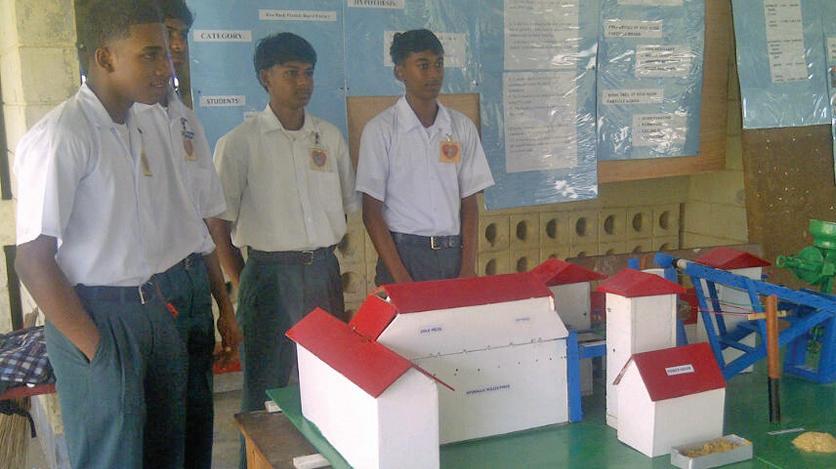
The Education Ministry in keeping with its drive to improve science and technology education has rolled out a packed agenda for the National Science Fair 2014, to be held this month-end in Region Two.
The fair Provides an opportunity for students to bring science out of the classroom as they are given a challenge this year to use Science, Technology, Engineering and Mathematics (STEM) to create solutions for a problem facing their school or community. This initiative was taken from the Sagicor Visionaries Challenge competition that was held last year in the Caribbean.
Theme
This year’s science fair will be held under the theme “Science, Mathematics and Technology: Providing Solutions for the 21st century” at the Anna Regina Multilateral Secondary School from April 22 to 25.
During the fair, there will be exciting and educational activities planned for the students and teachers who visiting the region. Tours will be arranged to
Charity, a coconut oil factory, the market area, the New Opportunity Corp and Lake Mainstay.
In addition, several workshops have been planned to cover various areas such as the use of the microscience kits; inquiry-based science and mathematics education for teachers and students, and mangrove awareness, which will be done in collaboration with the Guyana Mangrove Restoration Project.
The fair is organised to popularise science, mathematics and technology in schools and society while at the same time encouraging them to focus on solving regional-based prob-
lems.
It is also geared at building confidence in students to apply science and technology to bring about social and behavioural changes.
Further, the fair serves as a platform for students to discuss and display their exhibits as they work to foster regional integration.
A national committee was set up to oversee the
preparations for the fair, which is being coordinated through the office of the Assistant Chief Education Officer (Secondary).
Regional science fairs were held in all 11 educational districts, over the past few weeks and the schools with the most outstanding projects were selected from each region to be a part of the fair.
Additionally, 10 other agencies will also be par-
ticipating in the fair.
They are: the Guyana Police Force, the Region Two Department of Education, the Guyana Mangrove Restoration Project, the University of Guyana, Conservation International, Brass Aluminum and Cast Iron Foundry, the Geology and Mines Commission, the Environmental Protection Agency and the Health Ministry.

Today, Ernest Elliot will be sworn in as an A Partnership for National Unity (APNU) Member of Parliament (MP), replacing Jaipaul Sharma who resigned last week over remarks directed at his father.
Speaking with Guyana Times on Sunday, Elliot said “it feels good to be returning to the National Assembly for a second time”. He had served before during the Ninth Parliament as the Shadow Local Government Minister with responsibility also for public works. Additionally, he served on the Social Services Committee and the Public Accounts Committee (PAC). He was taken off of the APNU’s constituency list after serving as a Councillor on the Region Four, Regional Democratic Council (RDC) from 1985-2006.
As he bites into his share of this new dispensation, Elliot said he will be joining the fight to root out corruption. As a former Shadow Local Government Minister, Elliot said he will be putting pressure on President Donald Ramotar to assent to the outstanding Opposition bills.
President Ramotar has withheld assent to the Fiscal Management and Accountability (Amendment) Bill 2012; the Fiscal Management and Accountability (Amendment) Bill 2013; the Constitution (Amendment) Bill 2013 and the Local Government (Amendment) Bill 2012, contending that based on the advice of the Attorney General Anil Nandlall, the bills are unconstitutional. Meanwhile, attempts to contact Opposition Leader
David Granger on the appointment of Elliot as a MP proved futile. The Opposition was left with an MP short when Sharma resigned his post two days after being heckled by
Education Minister Priya Manickchand over rape allegations against his father, CN Sharma.
Sharma, who sat on the coalition as a Justice for All (JFA) member on Friday told Guyana Times that the party will no longer be part of APNU. According to Sharma, he is not prepared to put APNU’s integrity on the line over allegations pinned against his father, fearing that the People’s Progressive Party/ Civic (PPP/C) would have seized other opportunity to heckle of discuss the rape allegation.
Sharma’s replacement comes two months after Dr Karen Cummings took the oath, replacing the late Deputy Speaker Deborah Backer. Backer, an attorney-at-law, had resigned from the House on February 7 after falling ill.
The Health Ministry on Sunday concluded a two-day health fair at the Square of the Revolution in observance of World Autism Day and World Health Day. The fair was aimed at educating the public on healthy habits, and the importance of checking their health statuses.
On board were the Health Ministry’s Adolescent Services Unit, The Guyana Defence Force Medical Team, the Blood Bank, the Cheddi Jagan Dental School, The Georgetown Public Hospital’s Tuberculosis, Diabetes, and Hypertension and team, along with the Voluntary Counselling and Testing (VCT) team.
Visitors at the fair were
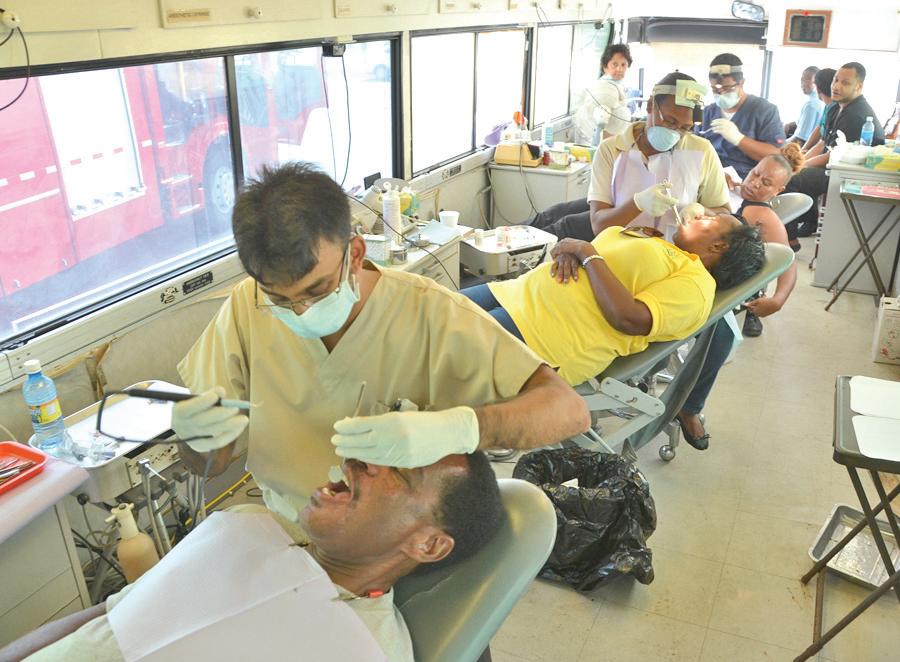

treated to dental check-ups, eye tests, blood sugar and blood pressure tests, diabetic foot screening, tuberculosis testing, voluntary counselling and testing, sexual reproductive health talks, and sessions of how to conduct breast examinations for breast cancer, among many others.
Speaking to the media at the event, Health Minister, Dr Bheri Ramsaran noted that the idea for the fair came as a result of the celebration of World Autism Day and World Health Day. This led to the Ministry launching a Health Week, which began on Saturday and ended on Sunday. He related that the fair fo-

AShort Man man get vex one night in Parliament and decide fuh stand down because no body ain’t stand up fuh he. He try to get hard wid Mannish Chand, but he couldn’ta stand up fuh he self. De man so short, that even when he try to stand up fuh he self, Mannish Chand couldn’t a see, hear or feel he.
Green Jah seh when people stand up fuh Short Man, he does look more short, so people does still can’t see he. But FLAPNU got plenty people who can’t stand up fuh dem self, much less stand up fuh other people.
Green Bridge got problems standin up, just like Green Jah and Short Man. Short Man father See-Hen woulda stand up better than he even in he old age. Yuh woulda just had to pass round by one a dem school, give he a sun shades, and he woulda see all dem Hens. People in de FLAPNU seh Green Jah don’t stand up fuh no body these days. So de Short Man ain’t alone. De old soldier runnin all over de country to see how good he can stand up. But nutten he try ain’t wukkin. Green Jah finally decide to check how he poll can stand up by callin other people name. But he realise that other people poll standin up higher. Bis Ram had done tell every body that Jagdeo and Ramotar standin up higher than Green Jah and Green Bridge.
Even when Green Jah join he poll wid other people poll, it ain’t standin up enough. De last time Green Jah and Poop Narine join up dem poll, it still wasn’t high like Ramotar and Big Sam poll.
Ting-a-ling-a-ling…friend tell friend…mattie tell mattie! Green Jah now tinkin bout joinin wid Rum Jhaat poll. But when a You-G man do de test, Rum Jhaat and Green Jah poll still ain't match Jagdeo and Ramotar. So Green Jah and Rum Jhaat got big problems wid dem poll, especially when dem have to stand up fuh people!
cused on chronic non-communicable diseases such as diabetes, hypertension and pulmonary diseases, with the hope that education can reduce the amount of cases which are reported and treated each year.
He disclosed that the highest number of deaths is still being recorded from these non-communicable diseases.
Healthy lifestyle practices
He emphasised the need for healthy lifestyle practices, especially healthy eating habits, exercise routines, the prevention of smoking and consumption of alcohol.
In addition, the Wellness Warriors Club, which consists of students from various schools across the country, was also launched at the event on Saturday.
The club was launched with the aim of promoting healthy lifestyles in various school environments, using the said students. They will act as health ambassadors in their respective schools.
Chief Medex at the Health Ministry, James (only name given) said the response from the public was overwhelming.
He related that doctors were on hand to address
cases of high blood pressure and sugar, dentists address ing dental health issues and volunteers and other staffers assisted in education. In serious cases, patients were given a referral to the hospital closest to them where they can access advanced medical care as early as possible.
“Many people came here and didn’t know they had high blood pressure or high blood pressure or even tuberculosis and so it is not just a health fair, but it brought to light some of the health issues many people face and because they do not have a regular check up, they remain unaware of it until it gets out of hand,” he noted.
The medex related that over the two days, the most common ailment which was found was high blood pressure and stressed the need for healthier eating habits, exercise and sleep, which are all reducing agents for the disease.
During the two-day health fair, some 500 persons were reported to have visited the booths with about 400 accessing the medical services which were available.

Leopards do not shed their spots. Dictators and bullies do not change their natural propensity to bully. This was in full display in the National Assembly during the budget debate last week. The display by the MPs from APNU brought vivid memories of the days before 1992 when the then PNC-led Government used the full might of dictatorship to deny freedom and bully people.
The behaviour of APNU in the National Assembly this past week must serve as a reminder of what this nation rejected in 1992. When APNU prevented Education Minister Priya Manickchand from exercising her legitimate right to speak on the budget, it demonstrated in all its ugly forms the disrespect APNU has for rights and laws and it exposed its natural dictatorship inclination.
The members were not even shy in bullying the Speaker of the National Assembly to adjourn the Parliament, without completing the day’s work. This is the DNA that APNU inherited from its parent, the PNC.
We watched in anguish the true form of APNU – it exposed itself, not only as a bully, but APNU reminded everyone in Guyana that it is totally in the true likeness of its dictatorial past.
Bullying tactics
This is what is likely if APNU succeeds in becoming the Government of Guyana. In this 10th Parliament, we have seen constant and consistent bullying tactics and reminders of the dictatorial heredity of APNU. Remember it was the parent PNC which prevented Dr Cheddi Jagan from speaking in Parliament for years; they actually banned Cheddi from speaking and fulfilling his duty to the people he represented in Parliament.
Recall too how Ronald Gajraj, the then Home Affairs Minister, could not speak in the Seventh Parliament because of the rowdy behaviour from the then PNC Parliamentarians. Early in the Ninth Parliament, Health Minister, Dr Leslie Ramsammy was subjected to the same kind of intimidation. Early in the 10th Parliament, Minister Clement Rohee was prevented from speaking because APNU’s MPs would bang the table. Now it’s Manickchand’s turn.
There are other examples of APNU’s bullying behaviour. On December 12 last year, APNU and
AFC combined to shut off the voice of more than 5000 Guyanese citizens who wanted to petition Parliamentarians to pass the cricket bill.
On November 7, 2013, the Private Sector Commission exercised its fundamental right to present a petition to the Parliament of Guyana, requesting MPs to promote the interest of the country by passing an amendment to the AntiMoney Laundering and Countering the Financing of Terrorism (AML/CFT) Bill. They were denied the right by the combined APNU-AFC wrecking band of politicians.
APNU has used its place in Parliament to sabotage and stall Guyana’s development. Whether blocking the AML/CFT Amendment Bill, delaying the Marriott, stopping the expansion and modernisation of the Cheddi Jagan International Airport, or driving away investors from the Amaila Falls Hydro Electricity Project, APNU, along with its spineless poodle, the AFC, continues to block development.
But it also consistently reminds us all of its DNA blueprint, a party that simply cannot disguise itself no matter how hard it tries to mask its true identity as a bully and dictator.
Times Notebook is proud that a young Guyanese woman is Guyana’s Education Minister. She not only speaks on behalf of the PPP/C, the largest mass-based political party in the history of Guyana, but she speaks for more than 180,000 children and their families and the thousands of teachers in Guyana.
Never again
She has a legal and a moral right to speak in the halls of the National Assembly. Those who seek to prevent her from speaking merely remind people of what we have rejected in free and fair elections and what we are determined never to allow again in Guyana.
It is a fundamental development and rights issue that was correctly raised by APNU’s Volda Lawrence –the issue of children and sexual assault. In her seat, Minister Manickchand asked the member about a case languishing in court. It’s a major deficiency of Guyana’s legal system that the Minister was highlighting in her off-the-cuff remarks. Under normal circumstances, a country should unite to end this travesty.
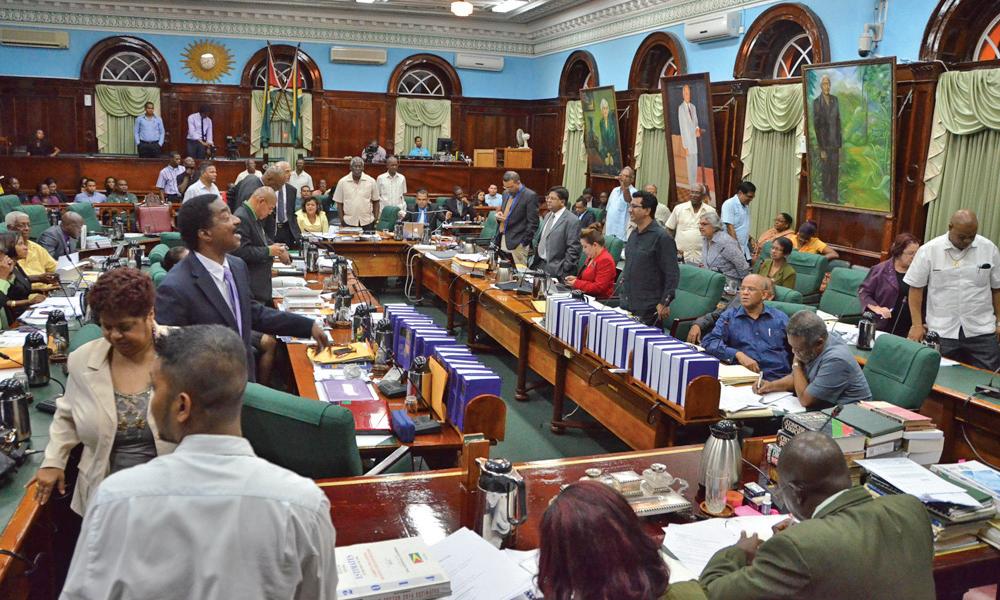
There was no reason for the ruckus that followed. But APNU and its sidekick, the AFC, continues to seek out any reason, good or bad, real or fabricated, to disrupt and to bully our Parliament. No one is spared, not even the Speaker.
Times Notebook thinks that our Parliament should be one where everyone sits quietly. But if we want to protest, we can leave the Chambers. Times Notebook says if you don’t want to listen to the Minister, leave the room. The nation is listening and watching. Readers are invited to send their comments by email or Facebook to times. notebook@gmail.com.

emittances remain
Rone of the largest cross-border flows to Latin American and Caribbean region, totalling more than US$60 billion annually. However, these resources still contribute little to formal household savings for poor and vulnerable households, highlighting the importance of banking remittance clients, the IDB, Multilateral Investment Fund (MIF) said in a report.
Remittances to Guyana were pegged at US$469.3 million in 2012, representing more than 10 per cent of the country’s Gross Domestic Product.
The study Economic Status and Remittance Behaviour among Latin American and Caribbean Migrants in the PostRecession Period was commissioned by the MIF, a member of the IDB Group, and carried out by the Inter-American Dialogue. It is based on a 2013 survey of 2000 migrants from countries in Latin America and the Caribbean, living in five major U.S. cities.
“Channelling more remittances into the formal financial system, including into savings accounts, would help poor and vulnerable households benefit more from these flows,” said MIF General Manager Nancy Lee.
“The MIF is working with remittance clients, particularly women who are important senders as well as recipients, to provide more opportunities to save in formal accounts so that they can invest in education, housing, business creation, and other needs.”
Women in the survey re-
ported increases in the average remittance amount sent and the number of transfers per year, while both the amount and frequency of transfers made by men remained stable.
Key findings of the report include: Remittances to the eight countries, included in this study (Colombia, Dominican Republic, El Salvador, Guatemala, Haiti, Honduras, Jamaica, and Mexico) have recovered by 12 per cent since 2009; two-thirds of migrants said they save money in some way, but the majority do so informally, which reduces their potential for building long-term wealth; while 60 per cent of migrants reported having a bank account in the U.S., only onethird of recipients in the region have bank accounts, according to their relatives in the U.S.
Still weak
The economic conditions of migrants from Latin America and the Caribbean have improved modestly since the 20082009 financial crisis, but migrants remain vulnerable in terms of income, savings, and debt levels.
Women, recent migrants, the undocumented, and those with low levels of education were found to be among those most economically vulnerable.
“Despite the economic recovery in the United States which has enabled migrants to send money in a slightly increased manner, migrants’ financial situation is still weak,” said Manuel Orozco, Senior Fellow at the InterAmerican Dialogue and au -
thor of the report.
“This vulnerability can be mitigated through savings mobilisation and increased access to other financial products and services.”
The MIF has studied migrant remittances for more than 10 years in order to raise awareness about the volume of these flows and to increase their development impact though financial inclusion.
The MIF’s Remittances and Savings Programme seeks to improve access to formal savings products among remittance, sending and receiving households in the region. The MIF, IDB, is funded by 39 donors and supports private sector-led development benefitting low-income populations and the poor -- their businesses, their farms, and their households.
A core MIF mission is to act as a development laboratory in order to build and support successful micro and Small Medium Size (SME) business models. The Inter-American Dialogue is the leading U.S. centre for policy analysis, exchange, and communication on issues in Western Hemisphere affairs.
The dialogue brings together public and private leaders from across the Americas to address hemispheric problems and opportunities. Dialogue activities are directed to generating new policy ideas and practical proposals for action, and getting these ideas and proposals to Government and private decision-makers.
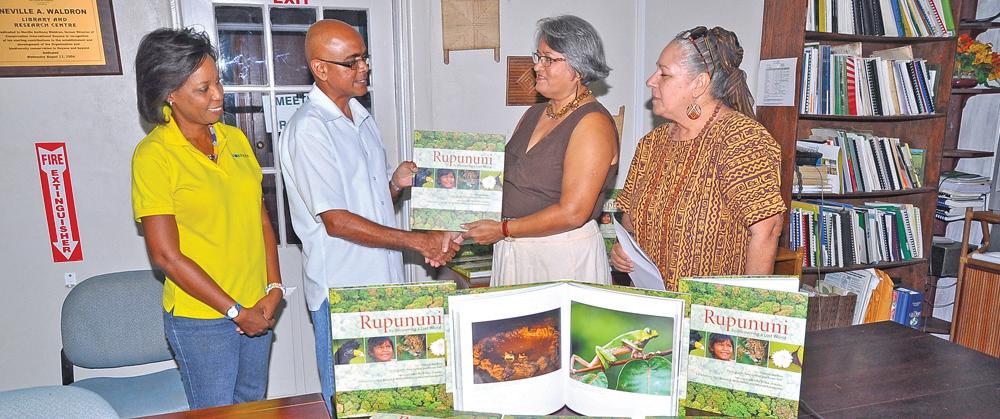
Conservation
International (CI), in collaboration with Iwokrama Rainforest, has partnered with the “Maira and the Jaguar People” Film Project with the aim of making it a reality.
The film, written by Dr Michael Gilkes, a leading Guyanese filmmaker, writer, playwright, director, actor and professor, will be filmed on location close to and involving the Surama community and other virgin forested locations within that region.
It is the story of Maira, a young girl who loves birdsong, and her brother, Mairun, who dreams of being a hunter. As a result of a terrifying encounter with a jaguar, they discover for themselves the practical wisdom behind the traditions and beliefs of their community and way of life.
They learn to listen to what the Shaman calls “the advice of the birds” and understand that the jaguar holds a special place in the interconnected web of life and death in the rainforest: that there is a kind of mutual respect between humans and jaguars, now a protected species in South America.
In this film, the rainforest will be more than just a beautiful backdrop. The music of its trees, waterfalls, rivers and birdsong will play a very important part in the story. Landscape is more
than land. It is the most valuable resource for living. The rainforests are the lungs of the globe. So will the musical language of the Makushi tribe (with subtitles) which will also be featured. The project will, therefore, also help to promote the restoration and preservation of their language and cultural heritage, already in grave danger of being lost through the pull of the urban communities on their young people.
Surama to benefit directly
The Makushi people of Surama will benefit directly from the making of this film, both in terms of their close involvement in the technical and casting areas of the production, but also because a replica of a Makushi village from the 1950s for the set for the film will be built and the structures will not be torn down after filming, but will remain in the care of the Makushi community. This was according to the Project Manager Gem MadhooNascimento.
A trail and bivouac for overnighting will be built at Kayanperu, to be developed as a heritage site. These structures could then be used as living or guest spaces for the community and their visitors, or serve as a museum site, for example. All these facilities will remain after the film team has left, for the use of the Makushi community.
Persons interested in helping this project can log onto http://igg.me/at/maira or go to www.indiegogo.com, click on films on the top right hand corner, then fill in the details on the left hand side – “Maira and The Jaguar People” to make donations, by means of credit cards. While making donations, persons would qualify for gifts from the project, according to their level of donation. These gifts will range from a picture of the tallest wooden building of the world – the St George’s Cathedral along with a poem on the cathedral by Dr Michaels Gilkes; a book by Graham Watkins on Rupununi - Rediscovering a Lost World; an embossed mug from Surama; Keithe Waite’s CD/collector items of videos of Caribbean eye, music of the rainforest, wide Sargasso sea, Carifesta in Barbados and Cuba, Carnival Mas, music score and script of “Maira and The Jaguar People”; a genuine Wapishiana hammock; tours to the Essequibo River and Hurakabra River Resort; two-night stay at Cara Lodge; and trips to Surama Eco Lodge and Iwokrama.
Persons who would like to make a contribution and do not have a credit card can contact the Project Manager Madhoo-Nascimento and make their donations directly by calling 225-3557 or 2260240.
The Food and Agriculture Organisation’s (FAO) Food Price Index rose sharply in March, up 4.8 points, or 2.3 per cent, to an average of 212.8, the highest level since May 2013.
“The Index was influenced, as expected, by unfavourable weather conditions in the U.S. and Brazil and geopolitical tensions in the Black Sea region,” said Abdolreza Abbassian, FAO Senior Economist.
These and other influences are reviewed in greater detail in the AMIS Market Monitor report, the monthly synopsis of the major food crops prepared by the G-20 Agricultural Market Information System (AMIS), which is hosted at FAO headquarters in Rome.
“The Food Price Index looks at March trends. Since then, the initial fear over disruptions in grain shipments
from Ukraine has subsided. Also, markets have started to discard any negative impacts that the current difficult domestic economic conditions may bear on plantings or harvests in 2014,” Abbassian said.
Abbassian pointed out that AMIS has an important role to play in reassuring international markets, by promoting close dialogue among its participating countries. The index, based on the prices of a basket of internationally-traded food commodities, saw prices increase in all groups except dairy, which fell for the first time in four months (-2.5 per cent).
The greatest gains were seen in sugar (+7.9 per cent) and cereals (+5.2 per cent).
The FAO Cereal Price Index averaged 205.8 points in March, up as much as 10
points from February. Wheat and maize prices surged and imports were strong amid concerns over the effects of dry weather conditions on winter wheat in the U.S., unfavourable weather in Brazil, and tensions in the Black Sea region.
While in March, the index rose to its highest value since August 2013, it remained well below (34.6 points or 14.4 per cent) its value in March 2013. Rice prices were generally stable.
The FAO Vegetable Oil Price Index averaged 204.8 points in March, up another seven points from February and the highest level seen in 18 months.
The rise in the index mainly reflected a surge in palm oil, on continued concerns over the impact of protracted dry weather in Southeast Asia.
The FAO Dairy Price Index averaged 268.5 points
in March, a fall of 6.9 points, as purchases by China declined, and amid uncertainty over trade with the Russian Federation. Good production in New Zealand and the northern hemisphere also influenced prices.
The FAO Meat Price Index averaged 185 points in March, up 2.7 points. Once again, weather came into play as higher beef prices were associated with dry weather conditions affecting production in both Australia and the U.S. Pork also rose, in part on concerns over the effect of the Porcine Epidemic Diarrhea virus on export supplies in the U.S.
The FAO Sugar Price Index averaged 253.9 points in March, up 18.5 points amid concerns of declining availability from Brazil and Thailand, due to drought and reduced sugarcane output, respectively. The expected, potential impact of
El Niño conditions later this year also contributed to the price surge.
The FAO also released its Cereal Supply and Demand Brief, with improved outlooks for global cereal supplies and expectations of record trade in the 2013/2014 marketing season.
Higher estimate
The brief also reported a higher estimate for world cereal production in 2013, which has been raised by six million tonnes to 2,521 million tonnes. The latest adjustments reflect higher estimates for production of coarse grains and rice in several countries. The FAO’s forecast for ending stocks has also been raised and world trade is set to increase by significantly more than earlier expected.
“It is still too early to make accurate production forecasts for cereals,
as many crops have yet to be planted and weather remains the key factor influencing harvests,” said FAO’s Abbassian. World wheat production in 2014 is forecast at 702 million tonnes, down two million tonnes from FAO’s first forecast published in March. This would be two per cent lower than last year’s record harvest.
FAO’s first forecast for global rice production in 2014, published a recent report, points to a modest 0.8 per cent increase, to 500.7 million tonnes (milled basis), as growth is likely to be dampened by falling world prices and fears of a recurring El Niño event.
Even though the outlook for rice is up slightly, increases might not be sufficient to match population growth. As a result, inventories in the next season could see a decline, albeit from very high levels.
BY VAHNU MANIKCHAND
The combined parliamentary Opposition will be holding firm to its position of not allowing Education Minister Priya Manickchand to speak unless she apologises to former A Partnership for National Unity (APNU) Member of Parliament (MP) Jaipaul Sharma for heckling comments she made during the budget debates last week.
And if they cannot get their way in the House, the parties said they will pursue of a path of active non-cooperation against the Minister.
APNU Chief Whip Amna Ally told Guyana Times that Minister Manickchand must apologise to Sharma whether he is a MP or not, otherwise the party will not allow her to speak as they did last Friday.
“She cannot be so arrogant and rude and as an MP, she should not have done that, it was wrong so we are not going to let her speak until she apologises,” Ally pointed out.
The APNU parliamentarian said there could very well be a repeat of Friday’s situation. Asked what will be the party’s next step if they are not allowed to disrupt the sitting, like they did last Friday, Ally said: “I don’t think the Speaker can stop us.”
The APNU Chief Whip said while they will be very concerned about the education sector being neglected during the debates because
of their position on the matter, she explained that this could be address simply with a simple apology from Manickchand.
Further asked if the party will take the same course as it did with Home Affairs Minister Clement Rohee, Ally said it will have to wait until today to decide on how they will proceed with this matter. “I really can’t say what we will do because it has to be a collective decision, I alone cannot decide,” she stated.
Meanwhile, Alliance For Change (AFC) Leader Khemraj Ramjattan, also expressed his desire for the Minister to extend an appropriate apology to the former MP.
He noted that if Manickchand fails to do so, his party members in the House will take action.
Walk out
“If she doesn’t apologise, then we will not be banging the tables, we will walk out of the National Assembly,” the AFC leader said. However, Ramjattan noted that with statements made by the Minister, it does not appear as though she will be offering an apology.
On Tuesday last, APNU parliamentarian, Volda Lawrence, during her budget presentation was saying that Government should be doing more to help sexually abused victims when Manickchand heckled “ask APNU member Sharma”.
This comment was

deemed distasteful by Speaker of the House, Raphael Trotman, who then informed her that until she apologises, she will not be allowed to speak during the debates. The Minister refused to do so, saying on her Facebook page that if she does, then she will be betraying the victims of rape and paedophilia. “I cannot abandon them, just to keep the National Assembly happy… Reprimanded I may be. Silenced, I am not,” she stated.
The following Thursday, Trotman informed the House that he had reviewed the footage from the incident and has concluded that Manickchand was not referring to Sharma in any way since he himself said that the statement was directed to his father and not him, and as such, there was no need for any apology to him and he lifted the ban.
APNU subsequently de-
In protest over moves to incorporate the controversial “New River Triangle” on Suriname’s map, Guyana has pulled out of the neighbouring country’s inaugural International Mining, Energy and Petroleum Conference and Exhibition (SURIMEP) set for June.
Natural Resources and Environment Minister Robert Persaud made the disclosure during Friday’s budget debate in the National Assembly. He explained that through the Foreign Affairs Ministry, Guyana withdrew its participation. “They were circulating the documents and as part of the Suriname map, they had the New River Triangle included,” Persaud pointed out.
“Mr Speaker, I point to that, because we have to
constantly and consistently and stridently take a unified stance on our territory, also the development of our natural resources.”
The first SURIMEP is set to take place from June 17-19 under the theme “Utilising Suriname’s natural resources to underpin a sustainable economy”. It is being organised by the Natural Resources Ministry of Suriname in association with AME Trade Ltd.
When Guyana gained its independence in 1966, it retained the same borders that the British had ruled over, but Suriname had claimed the forested region situated between the Kutari and New Rivers. To date the area remains disputed. The New River Triangle, as it is commonly known in Guyana, is about 6000 square miles.
Guyana is basing its
manded an apology from the Minister, saying that they will not allow her to speak.
However, the incident got worst after Sharma tendered his resignation the very day, saying that he does not want the situation to damage the party or cause it to lose votes. On Friday when the Minister attempted to deliver her presentation on the debates, she was disrupted by the Opposition, causing an adjournment of the session for the night.
The debates will continue today when Minister Manickchand is expected to deliver her speech.
Condemnation Government has since roundly condemned the treatment of the Minister. Government’s Chief Whip Gail Teixeira on Friday said an agreement had been reached with the two parliamentary parties. She said APNU has since reneged on the agreement and is intent on using the Government as a whipping boy. MP Teixeira insisted that this has been the role of the Opposition throughout the 10th Parliament.
Minister Manickchand herself expressed disappointment that one heckle

could have caused so much disruption. She reiterated that she thought the issue was resolved and had made it clear that her heckle had not targeted anyone. The Minister expressed shock that the Opposition would try to prevent her from representing her right to her constituents. She questioned what had happened between the time of the agreement and Friday night.
Leader of the House, Prime Minister Samuel Hinds also expressed astonishment and disappointment at the occurrences in the House. He noted that the message sent to the people of Guyana through the Opposition’s actions is that
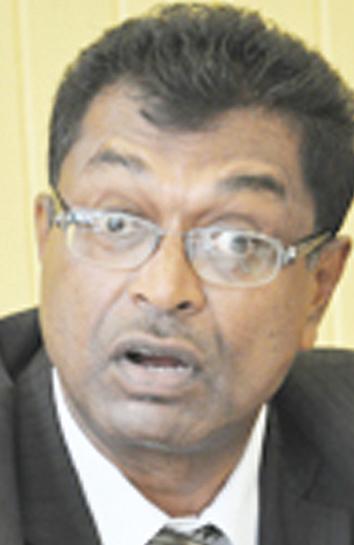
of their example of reneging on their agreements. Government MP Cornel Damon also made it clear that he was disappointed with the occurrences in the National Assembly on Friday night. He insisted that the Minister did not say anything wrong, and posited that the Opposition was feeling battered (in terms of the debate), and as such, reacted accordingly. Other Government MPs who also condemned the actions of the Opposition include Ministers Dr Ashni Singh, Jennifer Westford, Carolyn Rodrigues-Birkett, Juan Edghill, Dr Leslie Ramsammy and Irfaan Ali.
Alliance For Change (AFC) Leader Khemraj Ramjattan said his party will not be approving budgetary allocations proposed to several agencies and projects, since he believes the money could be directed to the development of key sectors.
claims on maps printed of British Guiana in 1913 and 1924 which placed the boundary between the two colonies along the deepest channel of the Corentyne River. In the early 1930s, this boundary was recognised by the Dutch.
On the flip side of the coin, Suriname is arguing that the Corentyne River is a national river. Back in 1967, the then Government of Suriname said in a treaty signed between the Dutch and British in 1799, all of the territory west of the Corentyne River was ceded to the colony of Berbice and the border was the left bank of the Corentyne river from its source mouth. The neighbouring country is maintaining that Corentyne is a national river which lies within its territory and not a boundary river.
Ramjattan told Guyana Times that the AFC will not be approving funds to the National Communications Network (NCN), the Government Information Agency (GINA) and Amaila Falls Hydro Project.
He also said the Cheddi Jagan International Airport Expansion Project will not be getting approval, except for the runway extension aspect.
“We believe that the runway needs to be expanded but I don’t see the need for all the exorbitant works,” he said.
The AFC leader explained that it was only four years ago that the country’s main port of entry underwent major rehabilitation works. He noted that the arrival terminal is not in a bad state that so much money needs to be plugged into a makeover. Ramjattan pointed out that most of the incoming passengers are
not tourists, but Guyanese who return for visits or other works and there are adequate accommodations in place to facilitate them. He continued that the money allocated to these agencies and projects would be better served if it is plugged into key productive sectors to keep them thriving.
The AFC leader said sectors such as rice, sugar and even irrigation are in much need of investments. He then directed his attention to the deplorable conditions of the roads and bridges specifically, naming the Demerara Harbour Bridge, which he said is in dire need to be built over.
Ramjattan explained that the money used to do all the regular repair works would be better invested to building a new bridge. He pointed out that persons travelling from West Demerara on a daily basis experience difficulties with the various inconveniences caused by the bridge.
The AFC leader also noted that access to several interior locations needs major works to be done and money that should be directed to fix these major problems is
wasted on unnecessary projects.
“Any foreign person comes and hangs money in the air to do something, the Government just jumps at it,” he said.
Ramjattan will be delivering his budget debate speech on Tuesday, which is expected to have more details on areas that his party thinks does not deserve any money.
Over the last two years, there have been major cuts by the combined Opposition to the national budget presented by Finance Minister, Dr Ashni Singh.
However, after the heavy cuts made to the 2012 Budget, Government moved to the High Court to have the cuts reversed, but the matter ran into 2013, which again saw more cuts by the Opposition.
Earlier this year, acting Chief Justice Ian Chang ruled that the cuts were unconstitutional, noting that the Opposition can only approve or disapprove of the budget. He also said any amendments to the budget must be made by the Finance Minister since it was given executive responsibility to prepare the budget.
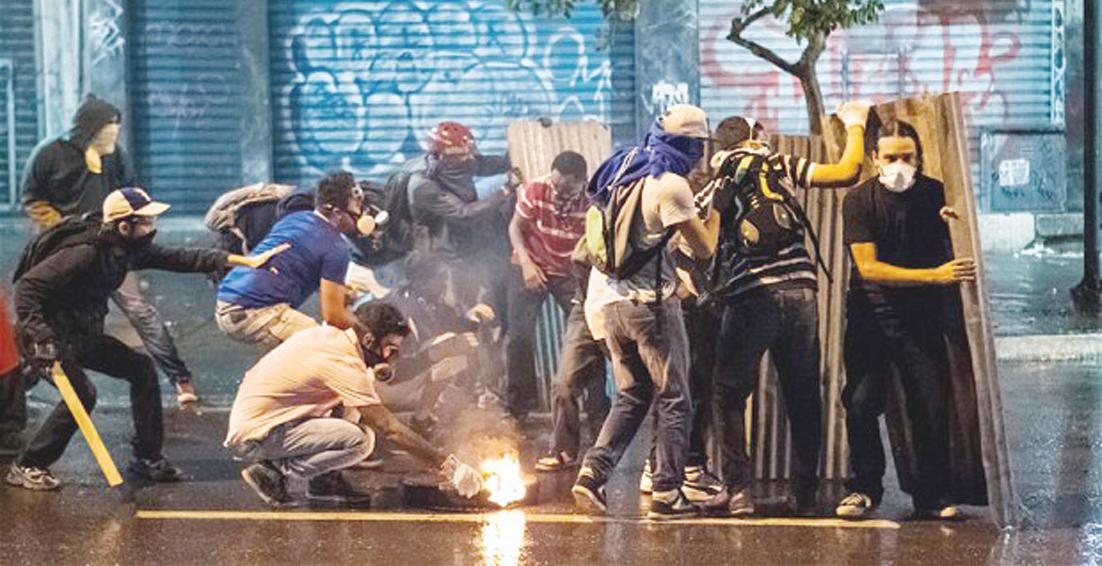
The instructions were straight from the pages of a thriller. We were to park our vehicle in an underground car park, leave behind our mobile phones to avoid tracking, walk through a shopping mall and make our way to another garage in the basement.
We followed the directions and were duly greeted by a flash of headlights.
The driver then screeched off a one-hour night-time dash through the protest-filled streets of Caracas, frequently doubling back and stopping to ensure that there was no tail, until we pulled up on a dimly lit suburban road.
A stocky bearded figure, baseball cap pulled low on his brow, hopped in to the front seat. “Good even-
ing,” he said in heavily accented English before giving the driver the address for a nearby safe-house.
The new passenger was Antonio Rivero, a former General who went into hiding in February to avoid arrest for his role in the protests that have rocked the Government of President Nicolas Maduro.
Moving into Spanish, he apologised for the subterfuge involved in our rendezvous.
“These are bad times for our country and we are having to take extraordinary measures,” he said in his first interview since going underground.
Outside, the sounds and smells of a deeply fractured land were inescapable.
Eye-stinging tear gas fired by security forces
Cuba said on Sunday the United States continues to use social media to “subvert” the island’s Government and that the revelation this week of a U.S.-created, Twitter-like service for Cuba was just one of several examples.
The U.S. Government has admitted it created a social media network called ZunZuneo, which takes its name from Cuban slang for the tweet of a hummingbird. It was revealed in a report by the Associated Press, which said ZunZuneo snared cell phone users to build a network whose goals included mobilising demonstrations.
The programme, built by the U.S. Agency for International Development (USAID) using shell companies to hide U.S. Government involvement, went dark in 2012 due to a lack of funds.
U.S. officials confirmed it on Thursday, calling ZunZuneo a “democracy promotion” programme that was neither “secret” nor “covert” under the U.S. government’s definitions of those terms.
“The surprising denunciations made recently in an investigation by the AP, about the existence for years

of a secret project of the U.S. Agency for International Development (USAID) to create a supposed Cuban Twitter ... are scarcely the tip of the iceberg of a gigantic subversive campaign against Cuba,” the Union of Young Communists’ newspaper, Juventud Rebelde, reported on Sunday.
U.S. officials said the programmes referred to by Juventud Rebelde had been publicly revealed since their inception and were merely an attempt to promote the free flow of information in a country where the state controls all the media. (Excerpt from Reuters)
mixed with smoke from the Molotov cocktails thrown by marchers, while the chants of protesters were punctured by supportive blasts from motorists’ horns.
The student-led unrest began in San Cristobal in Venezuela’s “wild west” near the Colombia border two months ago and has quickly spiralled into a nationwide movement during which at least 39 people have been killed.
The country is mired in a dangerous cycle of economic crisis and violent chaos, polarised between Government loyalists in areas heavily dependent on state support and protesters who have taken to the streets over soaring crime rates, surging inflation and shortages of basic goods.
(Excerpt from The Telegraph)
Trinidad Health Minister Dr Fuad Khan says the implementation of the National Health Card will clamp down on non-nationals seeking free medical attention at public health institutions. Khan said as far as he knows, the Ministry has no policy in place that restricts free healthcare to non-nationals. In the coming weeks, Khan said, Government will roll out the cards, which would generate a policy that would allow medical services to only nationals and some non-nationals who work here.
“They have been coming here (non-nationals) for a
12-year-old
long time. It creates an increased utilisation of the healthcare system. So that is why I am putting the health card in place so we could determine who are the beneficiaries for that system. But the emergency system will be a different thing. We can’t stop that...for people to get emergencies.” Khan said the card would generate its own policy to treat with national and non-nationals. “So if you don’t have a health card, you cannot get in.”
Khan’s comments came after the death of 35-yearold Guyanese national Jeetindra Sookram, who was denied medical attention at the Eric Williams
Medical Sciences Complex on Thursday because he was not a TT citizen. Khan said the Ministry would also put prices on the cost of medical procedures as well. “If I am going for a national health insurance system, I must be able to cost my procedures. Our people would get it for free. Non-nationals would have to pay for it.”
Khan also advised visitors entering TT’s shores to walk with their insurance. “Maybe we should set up a policy that before you come into the country let us see your medical insurance. Medical insurance is not expensive.” (Excerpt from Trinidad Guardian)
A12-year-old boy and a 28-year-old man were shot dead late Friday by gunmen who subjected residents of a section of West Kingston to a night of terror.
Ten other persons were injured in the brutal attack on a group of persons standing at the intersection of Chestnut Lane and Charles Street about 20:30h.
“Dem kill me son! Why dem tek way me baby?” cried Claudette Matthews, mother of Kawayne “Timo” McNuff, the 12-year-old victim who lived at Breadnut
Police in Colombia say they have arrested a man suspected of throwing acid at a woman’s face, in a case that has caused outrage in the country.
Jonathan Vega, 33, is accused of attacking Natalia Ponce de Leon outside her home in Bogota last week. He is said to be a former neighbour of hers.
On Thursday, President Juan Manuel Santos offered a reward for information leading to arrests in such cases.
More than 40 people are victims of acid attacks every year in Colombia.
The motivation for the attacks can be partner jealousy, personal vendettas or even disagreements with neighbours.
Police say that when he was arrested, Vega had small burns caused by the same acid used against his alleged victim.
Ponce, 33, suffered severe burns to 24 per cent of her body, including her face,
when she was attacked on March 27. She is still in hospital, where she has had undergone several reconstructive surgeries.
Her lawyer said that Vega was a former neighbour who had become obsessed with Ponce. He made death threats after she refused to begin a relationship, he told El Espectador newspaper.
A few days after that attack, another woman in Colombia had acid thrown at her by a female neighbour with whom she had previous disagreements.
The Colombian Institute of Legal Medicine registered 55 such attacks in 2010 and 42 in 2011. But support groups say the number is much higher – more than 100 per year.
By comparison, it is estimated that more than 150 women have acid thrown on them every year in Pakistan, whose population is nearly four times that of Colombia.
(Excerpt from BBC News)
Lane. His nine-year-old brother was also injured by the gunmen’s bullets.
The 28-year-old man who was killed was identified as Ricardo Lowe.
“The man dem just come inna the area an’ start fire shot at anybody dem see,” said one woman.
“Dem even kick down a three-year-old baby as dem attack the people dem,” said another woman.
On Saturday, Police Commissioner Owen Ellington, who visited the community, reacted with anger to the brutal attack.
“I am very angry for a number of reasons; one of them is that police and citizens have been working in recent times to restore peace in the area, but there are certain elements strongly opposed to the efforts,” Ellington said, adding that the police would be resolute in their response to the attack. Member of Parliament Desmond McKenzie, who also visited the community, urged police to leave no stone unturned in bringing the perpetrators of the crime to justice. (Excerpt from Jamaica Observer)
Costa Rica’s Solis running alone in presidential run-off
Costa Ricans are casting ballots in an unusual run-off presidential vote, with Luis Guillermo Solis the only candidate left in the race.
His opponent – governing party candidate Johnny Araya – dropped out after opinion polls suggested Solis had an unassailable lead.
Solis, a historian and former diplomat, has urged voters to give him a strong mandate. He has promised to tackle poverty in the Central American nation.
Solis, from the centre-left Citizen Action Party (PAC), finished less than one percentage point ahead of Araya in the first round, held on February 2.
He won 30.64 per cent of the vote while Araya of the conservative National Liberation Party (PLN) polled 29.71 per cent.
On March 5, an opinion poll suggested Solis had the support of 64 per cent of voters, with his rival lagging behind with 21 per cent.
This prompted Araya to give up his presidential bid. He said proceeding would be a waste of money.
However, Costa Rica’s Constitution does not allow candidates to pull out, so Araya’s name will still appear on the ballot.
Solis, 55, has criticised corruption in the Government of Laura Chinchilla, Costa Rica’s first female President. He has promised to introduce tax reforms to reduce poverty in Costa Rica, one of the most stable democracies and strongest economies in the region.
“It is only prudent not to spend millions on publicity, meetings and other events. We will respect the constitutional provisions, but I will refrain from any electoral activity,” he told reporters at the time.
(Excerpt from BBC News)

Ukraine’s act-
ing President Oleksander
Turchinov has called an emergency meeting with the heads of security services as pro-Russian protesters stormed Government buildings in a number of major cities in eastern part of the country, calling for referenda on joining Russia.
In Donetsk, 80 kilometres west of the Russian border, a group of 50 people, including many in masks
carrying sticks and stones, moved away from a crowd of 2000 rallying the main city square on Sunday and surged into the provincial Government building and smashed windows.
The security forces pulled a water cannon up to the 11-storey building, but did not use force against the protesters.
The activists issued an ultimatum demanding an emergency session of the regional council to start by
Nigerian gun attack:
midnight and threatening to otherwise replace it with a “people’s council”.
Later on Sunday, Interior Minister Arsen Avakov vowed to restore order in eastern Ukraine without using violence and also accused Ukraine’s ousted President Viktor Yanukovich, whose political base was in Donetsk, of conspiring with Putin to fuel tensions.
“The people who have gathered are not many but they are very aggressive,” Avakov said in a statement on his Facebook page.
“The situation will come back under control without bloodshed. That is the order to law enforcement officers, it’s true. But the truth is that no one will peacefully tolerate the lawlessness of provocateurs.”
In the eastern city of Lugansk, police were forced to fire tear gas at a few hundred protesters who tried to storm the local security service building in order to win the release of 15 pro-Russian activists arrested earlier in the week. (Excerpt from Al Jazeera)
Seventy-nine people are said to have been killed in northern Nigeria, in an attack blamed by police on gunmen from the Fulani community.
The attack targeted a meeting of community leaders and vigilante groups in Galadima village, Zamfara state, a police spokesman told AFP news agency.
The meeting was discussing action against rob-
bers and cattle rustlers.
Fulani herdsmen and farmers from other ethnic groups have frequently clashed in Nigeria over land and faith.
At least 100 villagers were killed in central Kaduna state last month in an attack that was also linked to a dispute between local farmers and the seminomadic Fulani herdsmen.
“The governor and oth-
er officials were today at Yar Galadima village where they participated in the burial of 79 people killed in the attack by cattle rustlers,” governor’s spokesman Nuhu Salihu Anka told AFP.
The unrest is not connected with the Islamist insurgency waged by the Boko Haram group, which wants to impose Sharia law in the north. (BBC News)

Chinese and Australian ships hunting for a missing Malaysia Airlines jetliner have picked up separate acoustic signals in different parts of a vast Indian Ocean search area and are trying to verify if one could be from the plane’s black box recorders. Australian search authorities said on Sunday a Chinese patrol vessel, the
Haixun 01, had picked up a fleeting “ping” signal twice in recent days in waters west of Perth, near where investigators believe Malaysia Airlines Flight MH370 went down on March 8.
More planes and ships were being sent to assist in that area. Meanwhile, Australia’s HMAS Ocean Shield had reported a separate “acoustic event” some
300 nautical miles away.
The Ocean Shield is carrying sophisticated U.S. Navy equipment designed to pick up signals sent from the black boxes, which may hold the key to why the aircraft ended up thousands of kilometres off course.
“We are treating each of them seriously. We need to ensure before we leave any of those areas that this does not have any connection with MH370,” Retired Air Chief Marshal Angus Houston, head of the Australian agency coordinating the operation, told a media conference in Perth.
A black box detector deployed by the Haixun 01 picked up the signal with a frequency of 37.5kHz per second – the same as emitted by flight recorders – at about 25 degrees south and 101 degrees east, Xinhua reported on Saturday. (Excerpt from Reuters)
Hungarians handed Prime Minister Viktor Orban another four years in power in a parliamentary election on Sunday, early results showed, while about one in every five voters backed a far-right opposition party accused of anti-Semitism.
Orban has clashed repeatedly with the European Union and foreign investors over his maverick policies, and after Sunday’s win, big businesses were bracing for another term of unpredictable and, for some of them, hostile measures.
But many Hungarians see Orban, a 50-year-old former dissident against
Communist rule, as a champion of national interests. They also like the fact that under his Government personal income tax and household power bills have fallen.
After 71 per cent of the ballots were counted, election officials projected Orban’s Fidesz party would win 135 of the 199 seats in Parliament – passing the two-thirds threshold needed for his party to unilaterally change the constitution.
The same projection gave the Socialist-led leftist alliance 39 seats, while Jobbik would take 25 seats.
“We can now say for certain that for the first time since the change of regime,
a centre-right government will govern for two successive terms,” said Fidesz lawmaker Gergely Gulyas, referring to the collapse of Communist rule in 1989.
The result for Jobbik will be watched closely for clues about how other nationalist right-wing parties, such as France’s Front National, will perform in European Parliament elections next month.
In terms of the share of the national vote on party lists, Jobbik won 21.25 per cent, against 24.9 for the second-placed leftists, according to the incomplete results. (Excerpt from Reuters)

Abigger-than-expected turnout in Afghanistan’s presidential election and the Taliban’s failure to derail the vote has raised questions about the capacity of the insurgents to tip the country back into chaos as foreign troops head home.
The Taliban claimed that they staged more than 1000 attacks and
killed dozens during Saturday’s election, which they have branded a U.S.-backed deception of the Afghan people, though security officials said it was a gross exaggeration.
There were dozens of minor roadside bombs, and attacks on polling stations, police and voters during the day. But the overall level of violence was much lower than the
Taliban had threatened to unleash on the country.
And, despite the dangers they faced at polling stations, nearly 60 per cent of the 12 million people eligible to vote turned out, a measure of the determination for a say in their country’s first-ever democratic transfer of power, as President Hamid Karzai prepares to stand down after 12 years in power.
“This is how people vote to say death to the Taliban,” said one Afghan on Twitter, posting a photograph that showed his friends holding up one finger – stained with ink to show they had voted – in a gesture of defiance.
There was a palpable sense in Kabul on Sunday that perhaps greater stability is within reach after 13 years of strife since the fall of the Taliban’s hardline Islamist regime in late 2001. The insurgency has claimed the lives of at least 16,000 Afghans civilians and thousands more soldiers. (Excerpt from Reuters)
India kicks off world’s
Indians start voting in the world’s biggest ever election today, with a Hindu nationalist Opposition party that has promised economic rejuvenation and jobs tipped to emerge as the clear leader but likely to fall short of an absolute majority.
The elections to choose members to the 543-seat Lok Sabha, or House of the People, will be spread over five weeks, kicking off in two small north-eastern states, then spreading to the northern Himalayan plateaus, western deserts
and tropical south before ending in the densely-populated northern plains. Results are due on May 16.
The Bharatiya Janata Party (BJP), led by Hindu nationalist Narendra Modi, and its allies are forecast to win the biggest chunk of seats but fall shy of a majority, according to a poll released this week by respected Indian pollsters CSDS. In such a situation, a coalition government led by the BJP is seen as the most likely outcome.
India’s 815 million voters are set to inflict a re-
sounding defeat on the ruling Congress party, led by the Nehru-Gandhi dynasty, surveys show, after the longest economic slowdown since the 1980s put the brakes on development and job creation in a country where half of the population is under 25 years old. But Modi is tainted by accusations that he failed to stop or even encouraged anti-Muslim riots in 2002 in the state of Gujarat, where he is Chief Minister. At least 1000 people died in the violence, most of them Muslims.
(Excerpt from Reuters)
monday, april 7, 2014|
Outgoing President of the Berbice Chamber of Commerce (BCC) Mark Roopnarine says that the smuggling of goods across the border is not only affecting Berbice business people but also “robbing” the economy of a whole lot of revenue.
He maintained that smuggling of goods should not only be a concern of the BCC but also of the wider community at large. While noting that he is satisfied with the work being done by the police and the antismuggling unit as the fight against smuggling intensifies in the ancient county, Roopnarine underscored the need for more work to be done in the fight against the illegal activity.
He opined that as long as there is development, there will also be an increase in illegal activities. This phenomenon, however, he noted, can be curbed with work from not only the police but also businesses. “Once people are secure, once businesses are secure, there will be growth and development” said Roopnarine as he urged the businesses to take adequate security measures in the protection of their establishments.
“It is not just the fight of the Guyana Police Force and Government of Guyana but also that of businessmen” the outgoing president of the BCC said. On that note, Roopnarine related that while there are reports that members of the business faction and the Police Force are aware of whom the offenders are in the instances of smuggling, this was not the case.

He maintained that the Police Force though it hierarchy in the Berbice division has continuously reaffirmed his commitment to the fight against smuggling. He further posited that it is not a case where the police officers are not willing to tackle the issue of smuggling in the ancient county but rather that they are inadequately resourced to tackle what has become a major problem for businesses in the area.
The President of the Chamber also related that communication between businesses and police officers is improving. He also maintained that contrary to reports, businessmen and police officers are not afraid to take action but rather they lack the resources to pursue the offenders in such cases.
“So much has to be done to fight crime” said Roopnarine. He further stated that the chamber of
commerce has held several meetings with the Berbice Divisional Commander Brian Joseph which has been successful in that they have made consistent headway in how they will go about tackling the issue and providing sufficient security for business establishments in the ancient county.
Officials at the Berbice Anti-Smuggling Squad (BASS) recently told Berbice Times that goods and other types of smuggling in the Upper Corentyne area are not as prevalent as before and they credited this drop in the illegal trade to greater cooperation from affected businesses. Courts Guyana Inc and several other Georgetown-based businesses were forced to close heir operations on the Corentyne Coast, owing to rampant smuggling of goods across the largely unmanned backtrack route to Suriname. However, in an exclusive interview with Berbice Times, an official attached to BASS speaking under the condition of anonymity had said that smuggling has decreased drastically in the region, although acknowledging that the issue will never die. He said, however, because of the avid interest of businesses in their welfare, they have taken stock of any illegal activity and have been reporting suspected cases to BASS. As such, the official said BASS has been able to respond and confiscate smuggled goods, as well as carry out raids. “When a businessman notices that his product is not selling as it used to and his colleague is selling the same for a lower price, then he
takes note and informs us. We then stake out and catch the culprit in the act, so because of businessmen input, we are now able to put pressure on smugglers and it is more manageable now,” the official asserted, while noting that although BASS has been making strides in relation to the interception of illegally imported goods, it would be impossible to curb smuggling due to the closeness of the Guyana/ Suriname border.
“Ports of entry are all along the sea shore, from Number Seven, Canje, Manchester, Number 43, name it, throughout Crabwood Creek, all of these are ports of entry for smuggled goods. It is impossible to stop it completely, and as long as a man can make a profit when he smuggles, he will continue to do so by both taking and bringing illegal goods,” the official explained.
He said that smuggling is a way of life for some people but noted that contrary to what some may say; smuggling is not as rampant as it was years ago. The major concern for BASS now, the official stated, is the smuggling of tobacco products, alcoholic beverages, pesticides, home appliances and fish and shrimp into Guyana from Suriname.
The official said that fishermen too are sometimes affected but regarding the issue of home appliances, residents are no longer purchasing them as they are sold without a receipt and this is very risky, since if stolen or broken, they are without any form of ownership.
The Canadian oil and gas exploration company (CGX) has said although the legal dispute between itself and rival oil company Repsol is ongoing, it feels strongly about the outcome of the case.
CGX General Counsel and Secretary Michael Galego told Guyana Times that the injunction against the company is still in place to prevent Repsol from farming out interest areas on the Georgetown/ Kanuku Block.
Late last year, the company sought the assistance of Pacific Rubiales Energy Corp to reinterpret seismic data to delineate a new prospect on the Corentyne Petroleum Prospecting Licence (PPL). Galego said the company is still on schedule.
However, he could not disclose when the process would be completed. Initially, the company had set an April 2014, deadline. In the short term, the company may likely require additional equity financing and may seek to widen its shareholder base with a view to longer farm out transactions to enhance shareholders value.
The company had also entered into a master data processing agreement with the Vector Seismic Data Processing for the reprocessing and merging of the seismic surveys relating to the Corentyne PPL. This exercise was also expected to be completed this month.
“With respect to the seismic reinterpretation on Corentyne, we are still on schedule and will have an update to the market as soon as it is complete,” Galego said. The company had also last year entered into a Memorandum of Understanding (MoU) with Suriname-based oil company Teikoku, for rig sharing in the Guyana-Suriname basin. The two parties agreed to form a
group with the objective of increasing negotiating power with a rig contractor.
Galego said: “As you can appreciate, the cost of drilling an offshore well is very expensive but with six to eight wells being drilled in the GuyanaSuriname Basin over the next two years, we are well positioned to have some savings due to our membership in this rig sharing group.” He said that the two bodies would likely finalise the definitive agreement this month or the next.
CGX Energy Inc had announced that its wholly-owned subsidiary, CGX Resources Inc, had obtained an injunction order from Guyana’s Commercial Court restraining Repsol Exploracion from proceeding with the 30 per cent farm-out of the Kanuku PPL to RWE Dea AG, pending the determination of arbitration proceedings.
The company announced the commencement of arbitration proceedings under the rules of the London Court of International Arbitration against Repsol in connection with the expiry of the PPL covering the Georgetown Block.
CGX and Repsol were part of an association that owned the Georgetown Block PPL, which was operated by Repsol. CGX publicly announced on December 23 that it was proceeding with the arbitration against Repsol with respect to the Kanuku licence offshore Guyana.
The company’s Chief Executive Officer Dewi Jones had announced last year that the company was pleased with the decision of the Commercial Court and had promised that it would continue to work towards protecting the interests of its shareholders by pursuing the claim against Repsol.
A16-year-old schoolboy of Vrymens Erven Secondary School in New Amsterdam was on last Wednesday morning chopped during a fight with another student.
Simeon Sandiford, a fifth from student who resides at Lot 131 Bermine Housing Scheme, New Amsterdam sustained a deep wound on his left shoulder and several other minor injuries about his body after becoming involved in an altercation with a fellow student. The wounds were allegedly inflected by a fourth form student of the same institution. The incident occurred at about 10:00h last Wednesday. Speaking to this publication, the injured student who is currently writing his end of term examinations recalled that he was on his way to the canteen to get a snack after he had finished his test when he saw two other students involved in a fist fight and upon glancing in their direction out of
curiosity, he became a target. “I see he slapping up a Indian boy and I watching the two of them and he turn to me and say, is wha you looking at, you want some too?” he stated, while noting that he politely said to the furious student “no boss” and went his way to the canteen.

The sixteen-year-old further said that after purchasing his snack and making his way back to his classroom, his attacker ran after him and issued several threats. “I asked him, is what happen with you, boy? and we start getting into a fight. He cuff me and I cuff he back, and he choke me and dig up me neck,” the injured youth said. He revealed that after a short scuffle had ensued between him and his attacker, he felt a burning pain in his shoulder and saw his accomplice swinging a ‘cutlass’ towards him. “He had a small shine cutlass and he fired a chop at me and then the other students started to shout that …’boy look he chop you, you gotta go to the hospital’,” he explained. He further pointed out
that after his attacker saw the blood flowing from his wounds he then hastily exited the building, jumped over the fence and disappeared.
Do something
Mother of the injured student Abigail Sandiford, 32, who is employed at a catering service in New Amsterdam opined that something drastic needs to be done by the relevant authorities as violence in schools is rapidly becoming a societal scourge and getting out of control. She said she was at work when she received a phone call from the school informing her that her son was injured. Upon reaching at the hospital she saw her son being treated by the doctors and seemed to be in much pain.
“Violence in schools is only an extreme manifestation of disciplinary problems in general; wherever discipline is poor, there is a greater likelihood of violence getting out of control,” the woman stated. “Weapons being carried
into schools are going unchecked and this scenario results in the loss of lives… something drastic needs to be done,” she said. The injured student was treated at the New Amsterdam Hospital, reportedly receiving approximately 14 stitches for the chop wound and additional medical attention for the other injuries he sustained. He was given an x-ray to determine whether he suffered any broken bones or other complications. He was then given the requisite medical treatment and sent home to return to the hospital for observation. Meanwhile, according to an official at the Department of Education in New Amsterdam, a full investigation will be launched shortly to determine the whereabouts of the teachers during this period of violence. “We visited the school and were informed by reliable sources that it was only when the teachers heard that someone had been chopped that they intervened,” the official said.
Autism and its effects were highlighted Sunday morning when President Donald Ramotar, First lady Deolatchmie Ramotar, Human Services and Social Security Minister Jenifer Webster and other Ministers joined hundreds of stakeholders in the annual autism walk in Georgetown.
Speaking at the culmination of the walk, which began at the Bank of Guyana and ended at the Children’s Monument in the National Park, President Ramotar said good health is important to the nation’s development, and as such, it is important to take away the stigma associated with autism.
“I believe that if these things are recognised and the earlier they are detected, the quicker it is and the better it is for treating them and helping them to live a more useful and healthier life, in many, many cases,” the President said.
Those who worked with children with disabilities were praised by the President.

“I don’t think any amount of money will be able to pay those who work with these children in particular, to try to help them to live a useful life. I want all of you to understand and give them the appreciation that they deserve.”
He also expressed his pleasure at the fact that Government is able to assist the Ptolemy Reid Rehabilitation Centre towards supporting those affected. Social sector spending is the largest in the national budget, as Government places a priority on human capital development. A better performing economy will see even more funds being allocated to address issues such as the one highlighted, Ramotar noted. Everyone must play their part, the President added, to raise awareness and minimise autism.
Eventually more facilities will be set up across
the country, in various communities to help those affected, said the President. The efforts of First Lady Deolatchmie Ramotar were lauded by Minister Webster.
“Our First Lady has taken the lead through her foundation, to set aside her time, to dedicate towards working to promote families and to make our populace more aware about what affect members of our society.”
Minister Webster said Guyana has come a long way with initiatives, as decades ago, autism was hardly known. “Our Government is committed to ensuring that all our citizens, all our children who have disabilities that we provide for them
the time has come for all to work harder at providing access for autistic children.
She also called on persons to offer support to those afflicted and the families of those affected, as she also pledged Government’s and the Human Service sMinistry’s assistance in doing the same.
“Ladies and gentlemen, as we celebrate Autism Awareness Month, let us through our acts, at least during April, look to see what programmes we can
capacitating, lifelong developmental disability, which usually appears during the first three years of a child’s life. It affects boys, four times more than girls, occurring in five out of every 10,000 births throughout the world, in all races and social backgrounds. In Guyana, assistance is available through the Step by Step School in Bagotstown, the Guyana Greenheart Autistic Society, the Ptolemy Reid

in a special way.”
Saying that she was impressed with the leadership of the Ptolemy Rehab Centre and the work being done by staff and children attending, Minister Webster said
Government Member of Parliament (MP) and General Secretary of the Rice Producers Association (RPA) Dharamkumar Seeraj said the rice industry will surpass its production target this year.
He made the comment during his budget debate presentation on Friday. Seeraj reiterated a position posited by Agriculture Minister, Dr Leslie Ramsammy in the House on Wednesday that the Finance Minister was conservative in the 2014 target for the industry.
“We going to lick it up, Mr Speaker... because the industry is on sound footing,” the MP said as he dismissed claims made during the debate, of the industry being short on policy. He questioned these claims on the basis of the increasing productivity.
Seeraj noted that the industry, which is supposedly ‘short of policy’, has been able to move from a production of three tonnes per hectare in 1990 to 5.2 tonnes last season.
Also increasing is the acreage, with a movement from 51,368 hectares in 1990 to 170,833 hectares in 2013.
“How can we say, we are short of policy? This shows clearly, Mr Speaker, that rice is on the upward movement. Since 2010, we been breaking records, and I want to join with Minister Ramsammy in telling Dr Ashni Singh his projection in the budget is very conservative,” he said.
He noted that the budget pro-
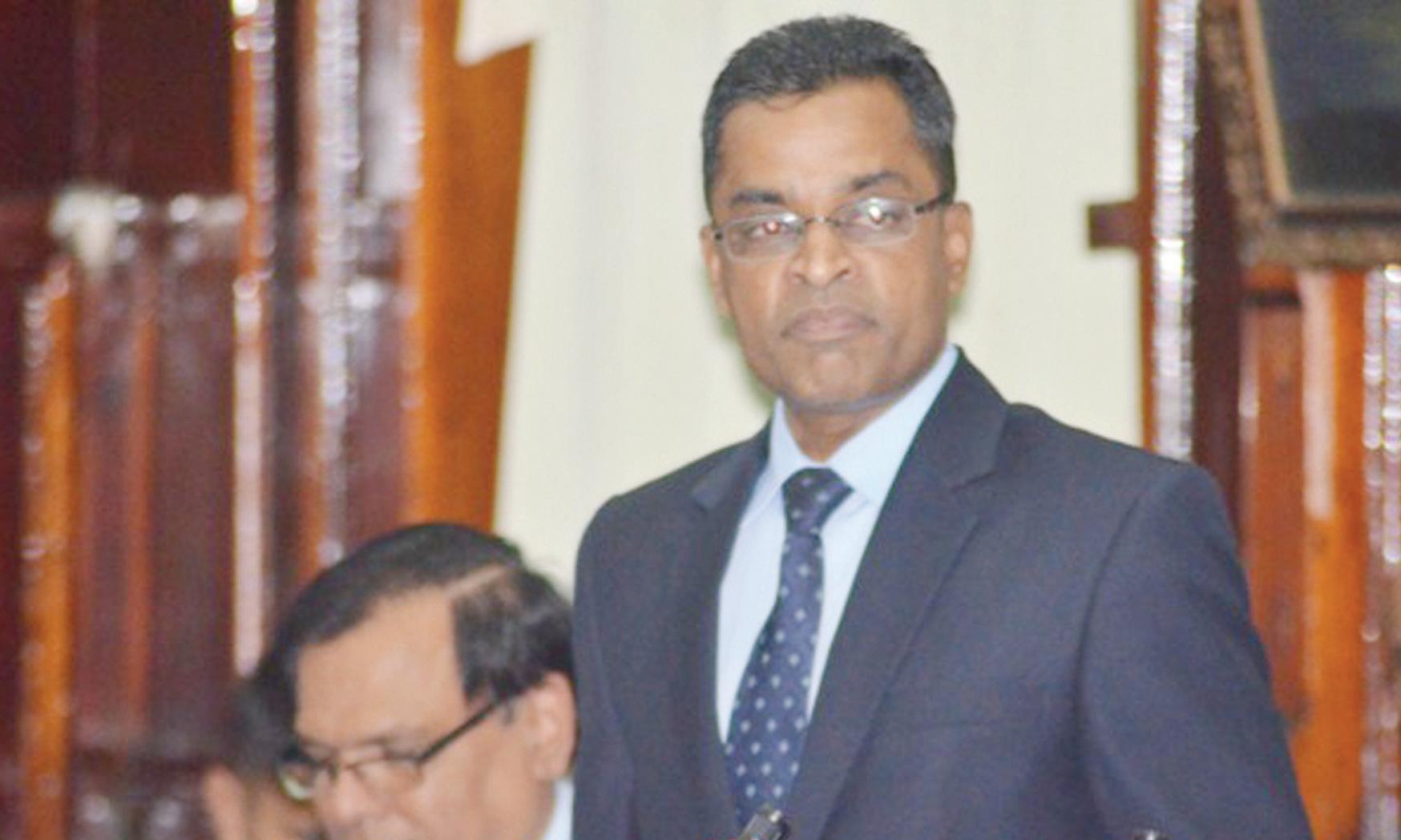
vision of $500 million for the industry, which was criticised by A Partnership For National Unity (APNU) MP Keith Scott, during his presentation, would go directly towards supporting the industry’s competitiveness and resilience.
According to Seeraj, Scott was a bit confused as his colleagues Jennifer Wade and John Adams in their presentations spoke about rice and expressed the need for Government to give more support to the industry.
“Obviously, Keith Scott, the Honourable Member, was not aware of the members’ intention,” Seeraj pointed out.
He noted that it appeared that Scott was not listening to his party leader David Granger when he too recently made a pronouncement that his party would give whatever support it can to the rice industry.
“Keith Scott should also join hands in ensuring that not only we concentrate on improving services for the urban dwellers, but also for the rural farmers, the farmers in Essequibo and in Black Bush Polder,” he said.
Meanwhile, Seeraj also joined in the call of Government MP Carnel Damon for the establishment of a rice milling facility in Region Two.
He said years ago, he had initiated talks with the farmers in that region with the intention to establish such a facility in Essequibo.
“We are prepared to work with you in a private-public partnership to ensure that this becomes a reality,” he said. Seeraj also supported calls made earlier in the week, during the course of the budget debate by APNU MP Volda Lawrence for a renewed fight against rape.
as an individual, undertake to support those persons and to continue the work to raise awareness throughout Guyana.”
Autism is a severely in-
Rehabilitation Centre, Gifted Hands in Parade Street, Kingston and the Human Services Ministry, the Government Information Agency (GINA) reported.
Commending the 2014 Budget, Government Member of Parliament (MP) Neil Kumar expressed pride to be on the side of the House which led Guyana into eight consecutive years of economic growth.
He described the budget as offering an abundance of opportunities to the people of Guyana.
Kumar lauded the rice and gold sectors for exceeding their respective production targets. He also pointed to the economic status of the country, adding that the bauxite sector has been strongly supported by the current administration. He observed during his presentation on Thursday, that the privatisation of the sector has proved profitable.
He accused the People’s National Congress Reform (PNCR) of being responsible for the destruction of several programmes in Linden, observing that the volume of support subsequently poured into the bauxite sector and Linden itself, enabled its recuperation.
Regionally, the Government MP lauded the resources given to the education and other sectors, noting the Government’s promise that ‘development will never end’.
Pointing to the building of sports facilities around the country, he mentioned Alliance For Change’s (AFC) MP Trevor Williams’ challenge to Culture, Youth and Sport Minister, Dr Frank Anthony about his leadership and vision. MP Kumar suggested that Williams had none of his own since he failed to offer an alternative.
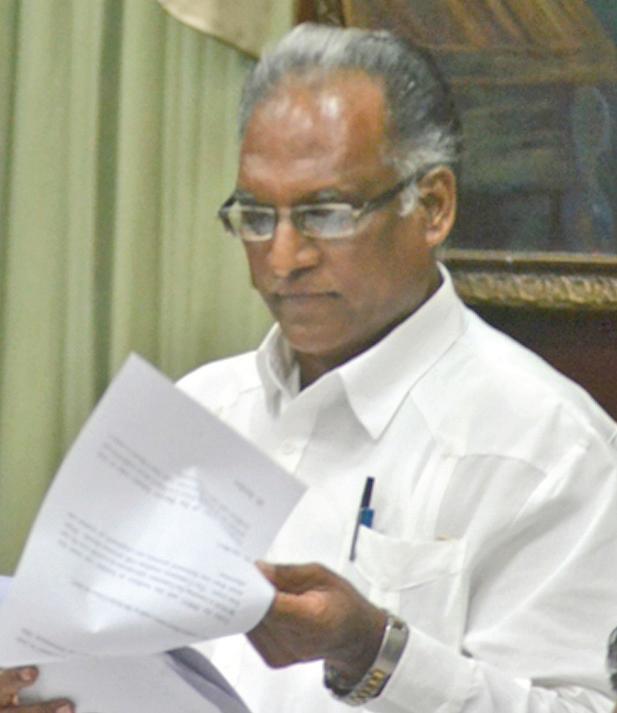
He pointed to the development of the various sport facilities around the country such as the Guyana National Stadium, the Synthetic Track, the Aquatic Pool, the Squash Court and lighting for the Albion Sports Ground.
MP Kumar pointed out that the investment in people, programmes and facilities does indeed display vision.
He also lauded the National Sports Research Centre, which is expected to provide information and guidance to athletes and other stakeholders. The Government MP noted that while it is easy to criticise, it is difficult to propose alternatives, and lauded the developments in the culture sector, the Government Information Agency (GINA) said.













Don’t let your emotions dictate your course. Acting on impulse will lead to trouble. Take your time, remain calm, and voice your opinions clearly, or someone will take offence.

Be proactive and offer positive suggestions for streamlining and making improvements to your workplace. You’ll be rewarded for helping a coworker solve a troubling problem. Be humble at all times.

Love is in the air. Improve your self-esteem by making time to indulge in a small pleasure. Prove to your partner that he or she is still first in your heart.

When an older relative or friend needs a hand, you must exhibit patience. Go the extra mile to help them out, and realise that besides needing physical assistance, they may also be feeling lonely.

A friend will be grateful for your empathy, and you will be able to offer helpful solutions. A key part of your popularity is your unselfish willingness to aid others.

Your work should be your top priority. Concentrate on finding the best possible way to complete your goals. Examine all your resources, even those you may have previously disregarded.
By Bernice Bede Osol

There is progress ahead if you assert yourself in the workplace. Show your employer how devoted and capable you are, and your efforts will be remembered when opportunities arise.

Be a leader, not a follower. You have unorthodox and original ideas that you should be sharing with others. People will be glad to come on board once your vision is presented.

You will gain respect if you share your good will with your family and colleagues. Many organisations rely on volunteers for assistance, so choose a cause you believe in and offer your services.

Stay in the background and don’t share your secrets. Someone may decide to stir up trouble by turning your words against you. A person you considered dependable will disappoint you.

Get active and shake up your routine by trying something new. Keep an open mind, gather with friends or family, and take part in a pastime that will stimulate your senses.

Someone close to you may need help. Be supportive and understanding, but don’t offer more time, effort or cash than you can afford. A financial gain is apparent.
monday, april 7, 2014


Dentures provided in 72 hours from as low as $4500. Contact Dr B Stuart, 209B Charlotte St, Lacytown. Tel: 2255034

Shalom
at Lot 2 Croal St,
Georgetown. Fee: $16,000. Also obtain an International Driver’s permit covering 123 countries.



Schoonord - $2M. Call: 6757292
Prescription Plus Pharmacy located at Lot E5 Hadfield Street, W/ville between Louisa Row and Winter place. Opening Monday to Saturdays 07:00- 20:00h; Sunday & Holidays 08:30-13:00h. Pharmacist always available. Phone: 227-2973
Courses in cookery & sewing; WCD. Call 276-4018, 693-6335
Private computer tutoring at your home for children ages 5-11 years. Call 644-5456/226-7935

Available: Fresh long-stemmed roses, fresh dried and silk floral arrangements, gift items, bridal boutiques and wreaths. Nesha’s Flowerland. 78 Church Street (opposite St George’s Cathedral). Tel: 227-3553/225-3315

Agricultural tractors and machinery; single

Property for sale at 48 Light Street, Alberttown (between third and fourth streets) Contact Ram on telephone: 619-4483 685-3568 and 226-6325.

Silva’s Optical. For Your Eyes Only, Look Better See Better. Phillip A Da Silva OD, Shannon L Da Silva
Linden: 444-6376, Corriverton: 339-3536, Meten-Meer-Zorg: 275-0322, Grand
engines for Lister, Pieter, Kobota, Perkins, Veutz, Fiat, John Deer, Case IH, Cummings, Bedford and Leyland Daf. Also all middles of diesel generators: super silence and open air from 3KVA600KVA. Contact Rams Auto Spares on telephone 226-6325, 227-1454, 6194483 and 685-3568 Cheap earth delivered to spot on ECD and EBD. Call 627-9977 &698-0182 Clean garden earth and builders waste; our services also includes Bobcat rental, excavating, clearing and leveling. Call 616-0617 or 663-3285
Sawmill complex designed to produce thousands of BM for export and local market, built on 25 acres of land. Phone: 684-5868.
USA refurbished laptops, Dell Latitude D620 & D630 for students, home or office use. Intel Core Duo 1.8.GHz, 24x CDRW/DVD, Dell Wireless 802.11 with Windows 7 for $39,000. We negotiate with students. Call 649-9941/2760574.

Holistic Centre offers clinical psychotherapy for suicidal thoughts, attempted suicides, depression, stress, mood disorders, psychotic disorders, homicidal thoughts, hallucinations, loneliness, conflicts, anger management, relationship & sexual problems, paranoia and much more. Call +592621-0552 and make that appointment now before it’s too late. 12:00PM –6:00PM. Mondays - Fridays. Email: healthworldhc@gmail.com




J Eastman & Associates. Taxation (VAT, income & Property), Cash Flow

Get your home or business spiritually clean to enhance good luck and prosperity. Telephone: 687-5653
Cleansing of spiritual problems of all kinds. Powerful Ifá protection against evil. Get help to overcome problems with love, relationships, legal, sexual, pregnancy, business, sickness, jobs, enemies, work, money. Call 592-690-1824 from 10:0016:00h Email:anew-life@live.com
Dutch spiritual healing in removing evil spirit, bad luck, evil sickness, spells, reuniting lovers and prosperity to businesses. Call: 612-6417, 220-0708, 687-5653.
Suriname Astrology Palmist and Djuka
Healing, the most powerful spiritualist in the world, are you suffering from the following problems (any religion) love, marriage, family, health business, husband and wife relationship, property, court, children, promotion, visa, pregnancy, education, depression, job, sexual, jealousy, enemy, money, drinking ? Also you can have all evil forces destroyed such as black magic, witchcraft, voodoo, obeyah etc and give powerful protection. We also do upliftment for clearing of land, dredging operations strictly in the interior. For private and confidential service call 674-2112.

(Between
Lights Sts) Tel: 225-1540, 622-8308, 655-3105. Email: balwantpersaud@yahoo.ca TO lET


JUST ARRIVED: TOP QUALITY RECONDITIONED VEHICLES; TOYOTA NOAH; TOYOTA VOXY; TOYOTA IST (NEW SHAPE); SUZUKI SWIFT; DAIHATSU MOVE (660CC); MERCEDES BENZ C200 KOMPRESSOR; COROLLA AE100 WAGON; HONDA CRV RD4; LAND CRUISER (FULLY LOADED); MAZDA PROCEED 4WD EXTRA-CAB PICK-UP; TOYOTA HILUX 4WD EXTRA CAB PICKUPS - 3RZ, 5L, 3L SOLID DEFFERNTIAL; MITSUBISHI CANTER TRUCKS 4 TONS FREEZER; 3 TONS OPEN TRAY; 2 TONS 4WD; 3 TONS DUMP TRUCK; NISSAN ATLAS 2 TONS OPEN TRAY TRUCK. PRE-ORDER YOUR UNITS EARLY AND GET THE BEST PRRICES. FULL AFTER SALES SERVICES AND FINANCING AVAILABLE. DEO MARAJ AUTO SALES, 2 CHIMNEY ROAD, CHATEAU MARGOT, ECD. 624-0762, 220-5177. A NAME AND SERVICE YOU CAN TRUST.
4x4 Nissan Titan fully powered Immaculate condition $3.5M. No reasonable offer refused. 622-7740
Toyota Raum (New Model) with CD, DVD, TV and navigation system. Call 218-4802, 610-3969, 655-2388.

A vacancy exists in a well-established vehicle/spare parts overseas based company to fill the position of Sales Representative at our Local office. Applicants must possess; Experience in sales and marketing; must be pleasant and must possess a good communication skills; must be computer literate and knowledgeable of Microsoft Office and Proficient in English language and a valid driver’s license. Good Salary & Commission offered. Apply Within to Human Resource Manager with two references to Nagoya Trading, 137 Grandsville Park, Beterverwagting, ECD. Phone: 220-2104, 656-9599

Lewis Hamilton beat Mercedes team-mate Nico Rosberg in a thrillingly close battle at the Bahrain Grand Prix.
With the pair in a league of their own, the battle became a 10-lap sprint after a late safety car period wiped out Hamilton’s 10-second advantage.
On the faster soft tyre, Rosberg had the advantage, but Hamilton held him off to the end with aggressive defence.
A frantic battle for third place was won by Force India’s Sergio Perez, from Red Bull’s Daniel Ricciardo.
The Australian was able to pass Perez’s team-mate Nico Hulkenberg, struggling with energy harvesting problems in his Mercedes power-unit, with four laps to go and close in on Perez, who did just enough to keep the Red Bull at bay.
Hulkenberg held off a train of cars including Sebastian Vettel’s Red Bull, the Williams drivers Felipe Massa and Valtteri Bottas, and the Ferrari pair Fernando Alonso and Kimi Raikkonen, who took the fi-

nal points positions. It was a sobering day for the Italian team and not just in terms of the results, as their world champion driver
pairing were literally powerless to beat drivers in teams with far fewer resources but powered by the dominant Mercedes engine.
LeBron James scored 38 points, Mario Chalmers added 15 and the Miami Heat survived a 3-point barrage from New York’s J.R. Smith on the way to dealing the Knicks’ playoff hopes a big blow with a 102-91 victory on Sunday.
Chris Bosh added 14 points and Ray Allen had 12 for the Heat, who remained atop the Eastern Conference standings.
Smith made a Knicksrecord 10 3-pointers, on an NBA-record 22 attempts, and finished with 32 points. Raymond Felton scored 14 for New York and Carmelo Anthony managed only 13, on 4 for 17 shooting.
Anthony had two points after halftime, while James had 22.
The Heat (53-23) ensured they would finish the day still ahead of Indiana atop the East standings. New York (33-45) has only four games left and will be either two or three losses behind Atlanta when Sunday ends, depending on the outcome of the later game between the Hawks and Pacers.
Miami’s lead was 15 with just under 9 minutes to go after a 3-pointer by Allen, before the Knicks

came up with one last rally and made it more than a little interesting. Iman Shumpert missed a wideopen 3 with 3:30 left that would have gotten New York within four. Instead, James had a layup at the other end and after Smith made his ninth 3 of the game, Chalmers answered with one of his own, making Miami’s lead 97-88.
So Smith made another, giving the Knicks life. And Miami again answered, this time Bosh doing the long-range honors and restoring the nine-point edge with 1:32 remaining. Smith missed two more 3s from there - his 20th and 21st attempts of the dayand that just about sealed things for the Knicks. (Yahoo! Sports)
West Indies coach Ottis Gibson has already trained his sights on next year’s 50over World Cup, in the wake of his side’s failed campaign at the World Twenty20 Championship.
Speaking as West Indies prepared to return to the Caribbean following their exit from the tournament here, Gibson said he was already putting plans in place so the Caribbean side could compete strongly for another global title.
The ICC World Cup is set to run from February 14 to March 29, in Australia.
Gibson said that with series against New Zealand, Bangladesh, India and South Africa preceding the World Cup, West Indies had the ideal chance to groom a core of players well in advance.
“I’ve been speaking to Richard Pybus (Director of Cricket) about getting together a core group of players to target the 50-over World Cup, getting some fitness done and making sure those guys are at the peak of their fitness,” Gibson explained.
“All those [series] are opportunities to start to formulate a team or a squad of players that will then become the basis of the team
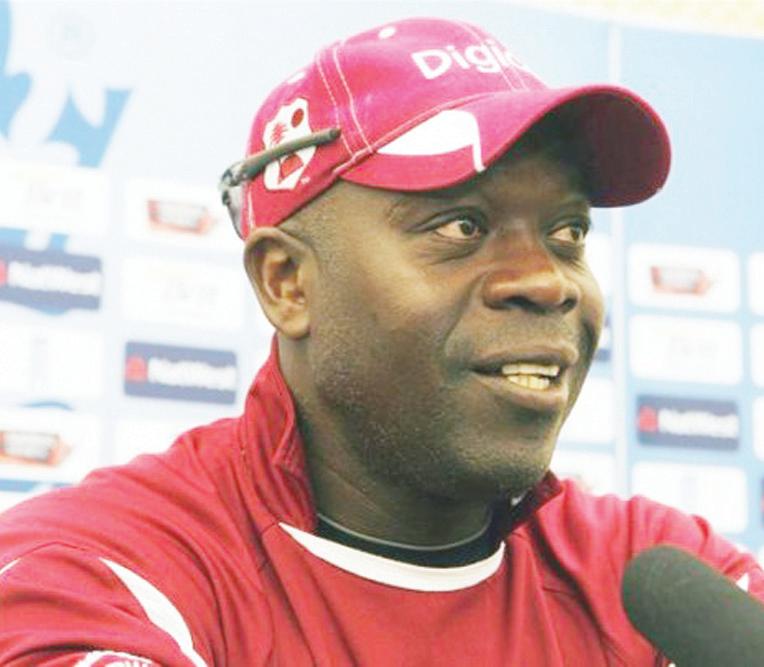
that is likely to play in the World Cup, and get those guys playing together as often as possible.
“It would give captain (Dwayne) Bravo an opportunity to work with this group of players and get a brand of cricket that he wants to play developed and strong, so that by the time we get to the World Cup next year, the guys are ready to peak again and have a real good go at winning a world title.”
Gibson said it was important that a strategic approach be taken, in order to select the best squad for the Australia trip. He pointed out that though a 30-man squad would likely be cho-
sen, it was crucial that players who were ideally suited for the conditions Down Under be identified and groomed.
“You have to look at where we are going and then you look at the people that we have in the Caribbean that are likely to succeed in those conditions and give them the opportunity to play,” Gibson explained.
“You will have a World Cup 30-man squad but by now there will be a core group of 15, 20 players that you will be looking to choose from and give opportunities to, and whittle it down to get to a 15-man squad as
soon as possible. [You have to] get that 15-man squad playing as much cricket together as possible and start to develop some cohesiveness.”
West Indies have emerged as a formidable side in the game’s shortest format, winning the 2012 Twenty20 World Cup in Sri Lanka, and reaching the semi-finals here last week in the defence of that title.
However, their 50-over form has lagged behind, and West Indies have not won the World Cup since the first two tournaments were held back in 1975 and 1979.
They bowed out at the quarter-final stage in India three years ago, reach the Super Eights in the Caribbean back in 2007 and could not get out of the first round in South Africa in 2003.
However, Gibson said the T20 World Cup triumph had created a hunger inside the team.
“I think the taste of winning a world title in Sri Lanka has given everybody a fantastic appetite for it (winning titles). We know what it takes, we know it’s going to take a lot of hard work and commitment to the cause and that’s what we are starting to see now.”
(Windiescricket)
After a slow start, India had recovered to 93 for 2 in 14 overs, and with an in-form Virat Kohli looking good, they were set for a final flourish. That flourish never arrived as Yuvraj Singh struggled to a painful 21-ball 11, starving Kohli of the strike. It resulted in only 19 runs coming off the final four overs.
“I think in the middle overs,” MS Dhoni said when asked when the game slipped away. “Our batsmen tried their best to get going but it was one of those days when we couldn’t convert our starts. Virat was the only one out there who looked fluent.
India ended on 130, a total Dhoni felt was a touch light. “I think we could have got another 10-15 runs. T20 cricket is always about that extra 15 runs.”
He also felt that the showers just before the start of the game made the ball stop early on when coming off the pitch, which hampered run-scoring.
While asking for more from his batsmen, Dhoni

also praised Sri Lanka’s pinpoint bowling at the death. “The last four overs is a place where we really want to score as many as you can and that was an area where we couldn’t capitalise. At the same time you have to give credit to the Sri Lankan bowlers. I think they executed their plans brilliantly. They were looking for wide yorkers and all the balls were perfect wide yorkers. I think they only bowled one wide or something. Other than that they were right on the mark, which made it further more difficult for our batsmen to score freely.”
India have been one of the better teams when it comes to dealing with the unorthodox threat of Lasith Malinga, but Dhoni said Malinga troubled his batsmen in the final. “Malinga has that slingy action, not coming from a great height, [it] becomes very difficult to get underneath the ball. It was a perfect game for the Sri Lankan team, they bowled yorkers to both right-handers and left-handers.” (Cricinfo)

Roger Federer sealed Switzerland’s place in the Davis Cup semi-finals as they avoided an upset by beating Kazakhstan 3-2 in Geneva.
The hosts had trailed 2-1 after doubles defeat for Federer and Stanislas Wawrinka, but Federer beat Andrey Golubev 7-6 (7-0) 6-2 6-3 after his teammate overcame Mikhail Kukushkin.
The Swiss face Italy in the last four after the
Italians beat Great Britain. Elsewhere, France came back from 2-1 down to beat Germany 3-2.
France’s top singles player Jo-Wilfried Tsonga overcame world number 96 Tobias Kamke in straight sets, before Gael Monfils won in similarly swift style against Peter Gojowczyk.
The Czech Republic will be their next opposition after they completed a 5-0 whitewash of Japan in Tokyo. (BBC Sport)

Steven Gerrard scored two penalties as Liverpool regained the Premier League leadership with an incident-packed victory at West Ham.
The club captain put his team in front after James Tomkins handled.
But Guy Demel tapped in from three yards in first-half stoppage time as Liverpool appealed that Andy Carroll had fouled keeper Simon Mignolet.
Steven Gerrard’s two penalties have taken his Reds goal tally to 173 - putting him sixth in the club’s
all-time scoring list, one ahead of Kenny Dalglish Carroll hit the bar with a second-half header, before Gerrard struck again after Adrian brought down Jon Flanagan.
Luis Suarez struck the bar twice for Liverpool, who move two points ahead of second-placed Chelsea with a ninth successive league victory.
Suarez, who is the Premier League’s leading scorer, was unable to add to his season’s tally of 29, although he went close twice in the opening 20 minutes.
(BBC Sport)
Kumar Sangakkara guided Sri Lanka to a six-wicket victory over India to win the World Twenty20 in Mirpur and end a run of four defeats in global finals.
Sangakkara, playing his final Twenty20 international, scored 52 not out as Sri Lanka chased down 131 in 17.5 overs.
Tight Sri Lanka bowling had limited India to 130-4 despite Virat Kohli’s sublime 77 off 58 balls.
Sri Lanka were beaten in the 2007 and 2011 World Cup finals and the 2009 and 2012 World T20 finals.
“India had been flawless throughout the tournament but they mucked it up today. Sri Lanka - almost everyone’s second favourite team - bring joy to almost everyone at the end of what has been a great tournament. The players have enjoyed what is a brilliant format.”
Sangakkara and veteran team-mate Mahela Jayawardene were involved in all four of those disappointments, and this was a fitting way for both to bow out of international T20 cricket.
Victory was particularly sweet for Sangakkara, who had scored only 19 runs in his previous five innings in the tournament but oversaw a patient run chase that was finished off in style when Thisara Perera clubbed Ravichandran Ashwin for his third six.
World Cup and Champions Trophy winners India were hoping to become the first team to hold all three limited-overs trophies.
But their quest was undermined by a disappointing batting performance that stalled badly after Rohit Sharma drove to short extra cover in the 11th over for 29 to break a secondwicket partnership of 60 with Kohli.
Yuvraj Singh, so often a destructive batsman in the shorter forms of the game, looked horribly out of touch as he scratched around for 11 off 21 balls.
With Kohli starved of the strike, the innings lost all momentum and even Mahendra Dhoni could add only four from seven balls after Yuvraj’s tame lob to long-off finally brought the captain to the crease in the penultimate over.
The final four overs, in which Kohli faced eight balls, yielded just 19 runs before the tournament’s leading run-scorer was run out trying to force a second from the last ball of the innings.

winning
There was a wicket apiece for Nuwan Kulasekara, Angelo Mathews and Rangana Herath as not one of Sri Lanka’s five bowlers conceded more than 29 runs from four overs.
India took wickets with enough regularity to keep the match alive and evoke memories of the 2012 final, when Sri Lanka were bowled out for 101 in pursuit of West Indies’ modest 137-6.
Kusal Perera sliced Mohit Sharma to midoff in the second over and Tillakaratne Dilshan holed out to Kohli at deep square leg for 18.
Jayawardene swiped
India innings (20 overs maximum)
RG Sharma c Senanayake
b Herath 29
AM Rahane b Mathews 3
V Kohli run out (Senanayake) 77 Yuvraj Singh c NLTC Perera
b Kulasekara 11
MS Dhoni*† not out 4
Extras (b 2, lb 2, w 2) 6
Total (4 wickets; 20 overs) 130
Did not bat: SK Raina, R Ashwin, RA Jadeja, A Mishra, B Kumar, MM Sharma
Fall of wickets 1-4 (Rahane, 1.3 ov), 2-64 (RG Sharma, 10.3 ov), 3-119 (Yuvraj Singh, 18.1 ov), 4-130 (Kohli, 19.6 ov)
Bowling: KMDN Kulasekara
4-0-29-1, AD Mathews 4-025-1, SMSM Senanayake 4-022-0, SL Malinga 4-0-27-0, HMRKB Herath 4-0-23-1

Australia thrashed England by six wickets to win a third successive Women’s World Twenty20 title.
England collapsed from 55-1 to post a modest 1058 after losing the toss in Mirpur, with Heather Knight’s 29 the highest score as Sarah Coyte took 3-16 and Ellyse Perry 2-13.
Suresh Raina to midwicket to depart for 24 and, when Lahiru Thirimanne nicked Amit Mishra to wicketkeeper Dhoni, Sri Lanka were wobbling on 78-4.
But Perera announced his intent by hitting Mishra over long-on for a huge six and followed up with another maximum in the leg-spinner’s next over.
Sangakkara thrashed consecutive fours off Ashwin to reach his half-century and take Sri Lanka to within four runs of the title.
Perera danced down the track to apply the perfect finish and spark jubilant scenes among the Sri Lanka players and fans. (BBC Sport)
Sri Lanka innings (target: 131 runs from 20 overs)
MDKJ Perera c Jadeja b MM Sharma 5
TM Dilshan c Kohli b Ashwin 18
DPMD Jayawardene c Ashwin
b Raina 24
KC Sangakkara† not out 52
HDRL Thirimanne c †Dhoni b Mishra 7
NLTC Perera not out 23
Extras (lb 2, w 3) 5
Total (4 wickets; 17.5 overs) 134
Did not bat: AD Mathews, KMDN Kulasekara, SMSM Senanayake, HMRKB Herath, SL Malinga*
Fall of wickets 1-5 (MDKJ Perera, 1.1 ov), 2-41 (Dilshan, 5.5 ov), 3-65 (Jayawardene, 9.5 ov), 4-78 (Thirimanne, 12.3 ov)
Bowling: B Kumar 3-0-180, MM Sharma 2-0-18-1, R Ashwin 3.5-0-29-1, A Mishra 4-0-32-1, SK Raina 4-0-241, RA Jadeja 1-0-11-0
Captain Meg Lanning’s 44 off 30 balls hurried Australia to a comprehensive victory with 4.5 overs to spare.
“We were completely outplayed,” said England captain Charlotte Edwards.
“We weren’t good enough - 105 was never going to be good enough in a World Cup final.”
If the 2012 final between these sides was a close affair - Australia won by four runs - the latest meeting was anything but.
England laboured with the bat on a blameless pitch, and the result was never in doubt once Australia raced to 43-1 after the first sixover powerplay.
Jess Jonassen provid-
England Women innings (20 overs maximum) SJ Taylor† lbw b Coyte 18 CM Edwards* c Cameron b Coyte 13
HC Knight c Perry b Osborne 29
LS Greenway c †Healy b Perry 2
NR Sciver b Farrell 9
AE Jones lbw b Perry 12
TT Beaumont b Coyte 6
JL Gunn not out 7
D Hazell c Osborne b Farrell 4
A Shrubsole not out 1
Extras (w 3, nb 1) 4
Total (8 wickets; 20 overs) 105
Did not bat: RL Grundy Fall of wickets 1-23 (Edwards, 5.4 ov), 2-55 (Taylor, 9.5 ov), 3-58 (Greenway, 10.5 ov), 4-67 (Knight, 12.5 ov), 5-85 (Sciver, 15.5 ov), 6-93 (Beaumont, 16.3 ov), 7-95 (Jones, 17.2 ov), 8-101 (Hazell, 19.3 ov)
Bowling: RM Farrell 4-027-2, JL Jonassen 4-0-16-0, EA Perry 4-0-13-2, SJ Coyte 4-0-16-3, EA Osborne 3-024-1, JL Hunter 1-0-9-0
Australia Women innings (target: 106 runs from 20 overs) EJ Villani c Edwards b Gunn 12 JL Jonassen c Jones b Shrubsole 15 MM Lanning* c Knight b Sciver 44
EA Perry not out 31 AJ Blackwell lbw b Sciver 0 JE Cameron not out 0
Extras (lb 1, w 2, nb 1) 4 Total (4 wickets; 15.1 overs) 106 Did not bat: AJ Healy†, EA Osborne, SJ Coyte, RM Farrell, JL Hunter Fall of wickets 1-17 (Jonassen, 2.4 ov), 2-44 (Villani, 6.2 ov), 3-104 (Lanning, 14.4 ov), 4-105 (Blackwell, 14.6 ov) Bowling: A Shrubsole 4-029-1, D Hazell 3.1-0-29-0, RL Grundy 4-0-22-0, JL Gunn 2-013-1, NR Sciver 2-0-12-2
‘Been a long time coming’ – Sangakkara
Kumar Sangakkara and Mahela
Jayawardene were overwhelmed to be able to sign off their T20 careers with a long-awaited trophy after overcoming India in the World T20 final.
Sangakkara played the decisive hand in the final with an unbeaten 52 off 35 balls, his first significant contribution of the tournament after four previous innings had brought just 19 runs, and he was delighted to have been able to repay his teammates while also ending Sri Lanka’s time as bridesmaids in major events since 1996.
“It’s been a long time coming, I can’t be happier or prouder,” Sangakkara said. “I think the side carried
me so I was pretty happy I could give something back to them. It means a lot to all of us; to me, to our families, to everyone back home.”
Jayawardene, who made 24 before finding midwicket which appeared to give India an opening, admitted there had been added emotions around this match
“We finally managed to break the jinx,” he said. “Thanks so much to family and friends but this one is for Sri Lanka fans who have been waiting since 1996. It wasn’t a normal match. There were a lot of emotions as this was the last T20. It hasn’t sunk in yet and it will take a couple of days to get the feeling.”
Lasith Malinga, Sri Lanka’s captain for the final
three matches of the tournament following Dinesh Chandimal’s suspension and then his omission, said the team were desperate to give Sangakkara and Jayawardene a victorious send-off from the format.
“I was really lucky to captain in the last three games. Today, we thought it was Sanga and Mahela’s farewell match, the boys thought we needed to do it for them. Last few overs we bowled really well. Mahela and Sanga are world-class batsmen and it was a good opportunity for us to be able to play with them. They are still playing Tests and ODIs and the younger players need to pick all that they can from the two.” (Cricinfo)

By Treiston Joseph
Asmooth curve and strong finish have made talented sprinter Jevina Sampson a strong medal favourite at the CARIFTA Games after her performance at the National Youth and Junior Championships held on Sunday at the Police Sports Club ground, Eve Leary.
Sampson exploded out of the blocks to take command of the race curve before finishing strong to record an impressive time of 24.6s in the female under-18 200 metres.
Club mate Avon Samuels was dipping under the 25s barrier with 24.9s, while Ruth Sanmoogan was third in 25.90s.
Sampson also double in the female under-18 400 metres, clocking 58.10s, while Samuels again took second in 58.30s and Natricia Hooper finished third in 58.90s.
CARIFTA bronze medallist Jason Yaw fell off a bit from his impressive showing at the CARIFTA trials two weeks ago to clock a time of 51.00s in the male under-18 400 metres; he however outran Kwesi Blair, who clocked 53.60s. Yaw was also the winner of the male 200 metres with a time of 21.60s while Linton Mentis was second in 22.20s. Akeem Johnson was third with 22.80s.
Ramblings will occur after a disappointing showing by CARIFTA selectee Kade

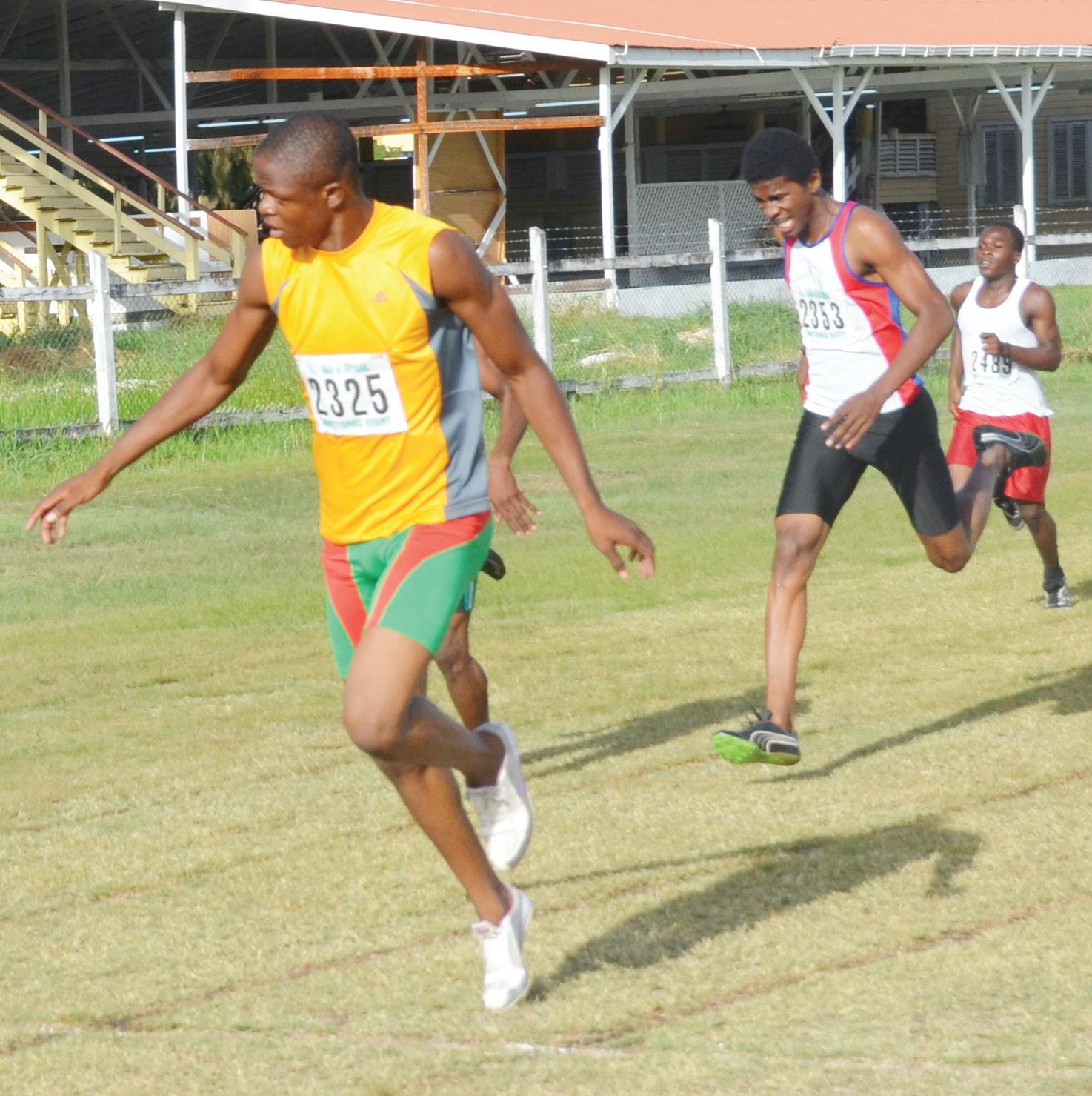

By Treiston Joseph
Lodge Secondary School dethroned defending champions
St. George’s High School with a 1-nil victory in a pulsating final that culminated on Saturday evening at the Ministry of Education ground.
St. George’s started off on the attack and created chance after chance, but simply did not have the finishing touch in the first half to put them ahead, as Lodge
struck with a deadly blow in the 36th minute with a goal from Ryan Hackett. With the score at 1-0 on the resumption of the second half, St. Georges attacked with ferocity, missing four great chances only to be stopped by the defence of the Lodge players or the wayward kicks by the strikers of St. George’s. Lodge on the other hand kept their nerves and showed great maturity in holding onto the 1-0 lead, by defending with vigour and
only attacking with the use of counter attacks.
Coach of the Lodge team who was adjudged the best coach in the tournament was pleased with the tournament and noted that his players “worked hard” for the victory and that it was a great “accomplishment” for the team and the school.
The Most Valuable Player of the tournament who also came from Lodge was defender Jamaal Scoot, which showed how important the team’s defence was
to their overall survival in the tournament.
Meanwhile, Dolphin Secondary took down Christ Church Secondary 2-0 for the third position with Dakshawn Matthews lodging all two goals in the 23rd and 47th minutes, respectively.
Director of the Petra Organization, Troy Mendonca, was pleased with the tournament but believes that in the next two years the standard of football will vastly improve.
Pearce, who not only failed to win the triple jump he was selected for but fell to third place.
Damon Williams not only defeated Pearce, but won the event in a better distance than that which Pearce qualified for the games with. Williams jumped 12.94 metres to win the event, while Clarence Green was second with 12.52 metres. Pearce was way off his CARIFTA performance of 12.87s metres jumping 12.07 metres for third at the junior championships.
Junior sprinter Kevin Abbensetts continued to rule the roost, winning both the male under-20 100 and 200 metres. He clocked 10.7s to win the 100 metres, which was slower than
his CARIFTA trials time of 10.4s, while clocking 21.8s which was also slower his CARIFTA performance of 21.5s.
CARIFTA selectee Natricia Hooper continued her dominance in the triple jump, winning the event in a distance of 10.96 metres to outjump Kalanie Griffith who jumped 9.66 metres. Shannon Griffith also dominated, winning four events in the female under-20 category. Griffith won the female 100 metres in 12.30s, while winning the 200 in 25.70s.
The talented Lindener also won the long jump in 4.54 metres while going on to win the triple jump in 10.17 metres.


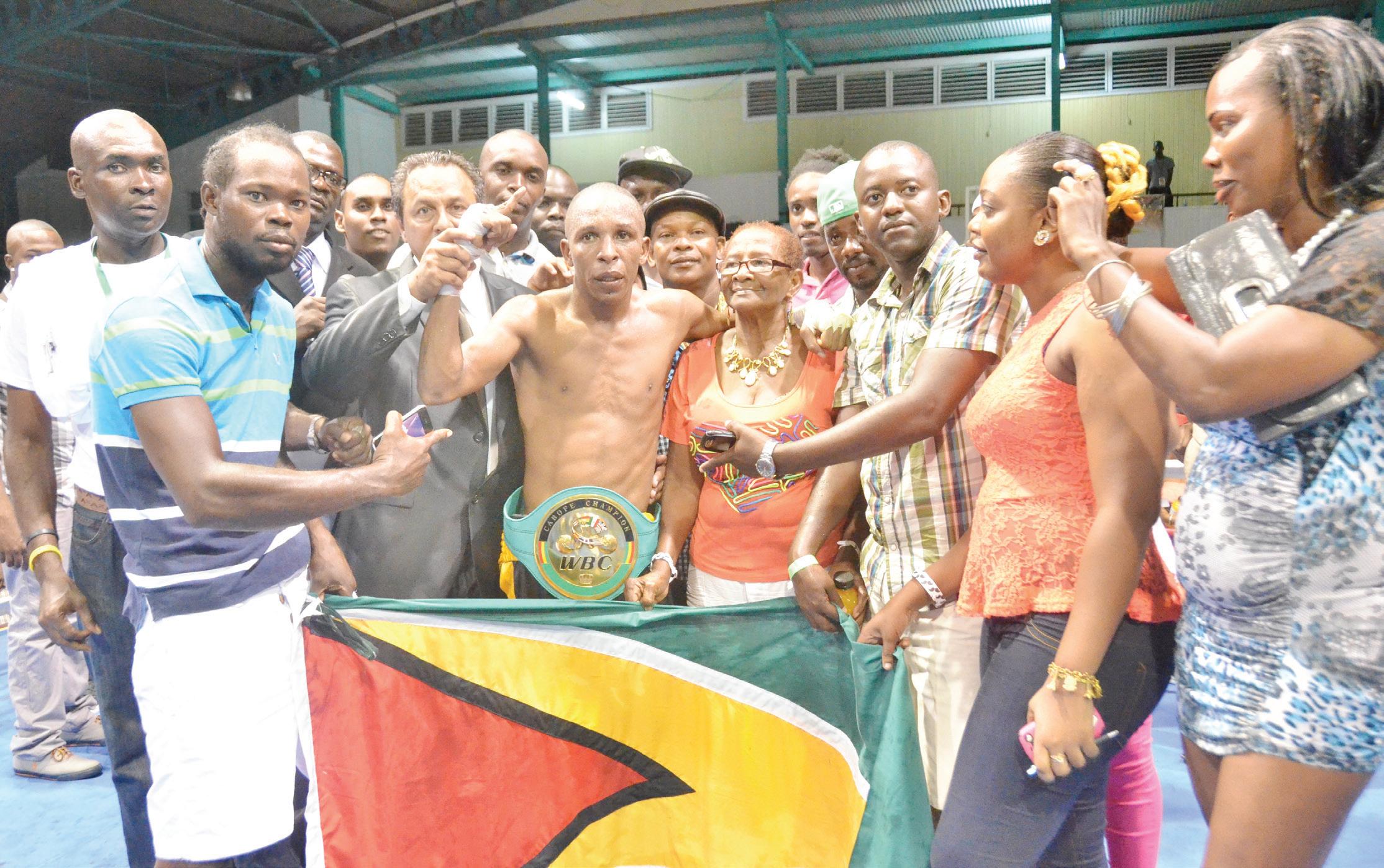
By Avenash Ramzan
Cheered on by a partisan home crowd, Dexter “The Kid” Marques turned out a clinical performance to oust Jamaican Rudolph “Cutting Edge” Hedge and retain his WBC/CABOFE Flyweight belt on the “Jamaican Invasion” boxing card on Saturday evening at the Cliff Anderson Sports Hall.
While Marques would have no doubt welcomed the support offered by the boisterous crowd, he would argue he needn’t
any as his superb boxing skills put paid to any chances Hedge had of wresting the coveted belt from him.
The fact that Hedge required the intervention of the medical team- in rounds eight and 10- provided a clear indication of Marques’s dominance over the challenger. With blood oozing from the nose in round eight, followed by a cut above the left eye two rounds later, Hedge was a battered man as Marques continued to deliver punches with expert precision.
The judges scored the contest 119-101, 117-111, 117-111, all in favour of Marques, who remains in power as the Flyweight champion.
In the other fights, Jamaica’s Devon “Concrete” Moncrieffe emerged with a unanimous decision win over Guyanese Mark Austin in a Light Middleweight bout.
The scores read 79-82, 80-72, 79-73 in favour of Moncrieffe.
In an all-Guyanese Super Featherweight clash, Richard Williamson
knocked out David Thomas 1:32 in the fourth and final round, while in a lightweight contest Guyanese Quincy Gomes prevailed over fellow debutant Toriano Nicholas via a majority decision.
Jamaican Kemahl Russell was so dominant in his contest against Guyanese Romeo Norville, that the latter refused to return to the centre at the end of round two, thereby handing victory to Russell.
The card was the Guyana Boxing Board of Control’s first event for 2014.
The Demerara Cricket Board (DCB) Under-19 Inter-Zone
50-Over Competition sponsored by Demerara Fire and General Insurance, will bowl off on Tuesday April 8, 2014.
In the First Round, East Coast will go up against West Demerara at the Georgetown Cricket Club, and Georgetown will take on East Bank at Demerara Cricket Club.
In the second round on Thursday April 10, 2014, East Coast and East Bank will battle at the Enmore Community Centre ground, while Georgetown and West Demerara will lock horns at the Wales Community Centre ground.
And in the Third and Final Round on April 12, 2014, West Demerara and East Bank will clh at Wales community Centre ground, and east Coast and Georgetown will be in contest at Everest Cricket Club ground.
The teams are as follows:
East Bank Demerara : Daniel Barker, DeonarineSeegobin, Ryan Shun, Shelon Chapman, Asif Alli,
Michael Sultan, Andrew Chung, SurajSankar, VineshRampersaud, Ricky Debidial, Daren John, AirshadAlli, DelonPeroune, Abdel Bacchus, Stephon Browne, Julian fortune. The Manager is Johnny Azeez and the Coach is Godfrey Edwards. Georgetown: Michael Shalin, Sunil Singh, Sherfane Rutherford, TivenImlach, Clitus Johnson, Cleon McEwan, Hakeem Davi, Keon Morris, Yekini Favourite, Carlton Jacques, RajendraDanraj, Steven Sankar, Kemal Savoury, Tariq Dharamlall. The manager is Robert Adonis and the coach is Quason Nedd.
West Demerara: Travis Persaud, Ronaldo Renee, Kevin Paul, Malcom Hubbard, Kelvin Sewpersaud, RichieLooknauth, Narendra Persaud, Avenash Dhaniram, Keshram Seyhodan, Vickram Talmkund, Ewart Samuels, ChaitnarinePooran, Rabindra Rooplall, Nicoli Reddy. The manager is Omar Hussain and the coach is Dhanpaul.
Athrilling game between Guyana’s top club Slingerz Football Club and Brazil’s own Soa Raimundo ended in a 0-0 stalemate on Saturday evening at the Georgetown Football Club ground.
Soa Raimundo displayed great speed and had a lot of chances in front of the goal, but failed to capitalize, with wayward kicks that were too powerful or rocked the crossbars of the goal.
Slingerz on the other hand, who spent a lot of the time defending their goal had a few chances, especially in the first half but could not capitalize on the opportunities afforded.
However, both teams played great football and displayed tremendous speed and tenacity during the game, especially with their intention of scoring

the winning goal.
Further, the game ended with handshakes as both teams came out looking strong and on the same level with the 0-0 draw.
Meanwhile, Western Tigers defeated Santos Football Club 1-0 in the pre-game encounter to boast of the victory.
The first half was a bit tense as both teams searched for the opening goal,but to no avail with the first half ending nil all.
Five minutes into the second half Western Tigers had reason to celebrate with a goal from Marvin Joseph in the 50th minute that proved to be the winning goal.
The C&R promotional group was thankful for an injury- free event and thanked all their sponsors for contributing to the successful hosting of the event.



The Sri Lankan players celebrate with the world T20


Linden’s pride and joy, Orville Hinds, continued his fine form in 2014 by copping top honours in the Open category of the third annual Powerade 50-mile road race on the West Demerara roadways on Sunday.
The talented young man clocked one hour, 56 minutes, 55 seconds (01h, 56m, 55s) to win ahead of Paul deNobrega in second position.
The race started in front of the Wales police station, proceeded to Bushy Park, Parika, before returning to the Demerara Harbour Bridge for the finish, covering 50 miles.
Linden’s Rastaff
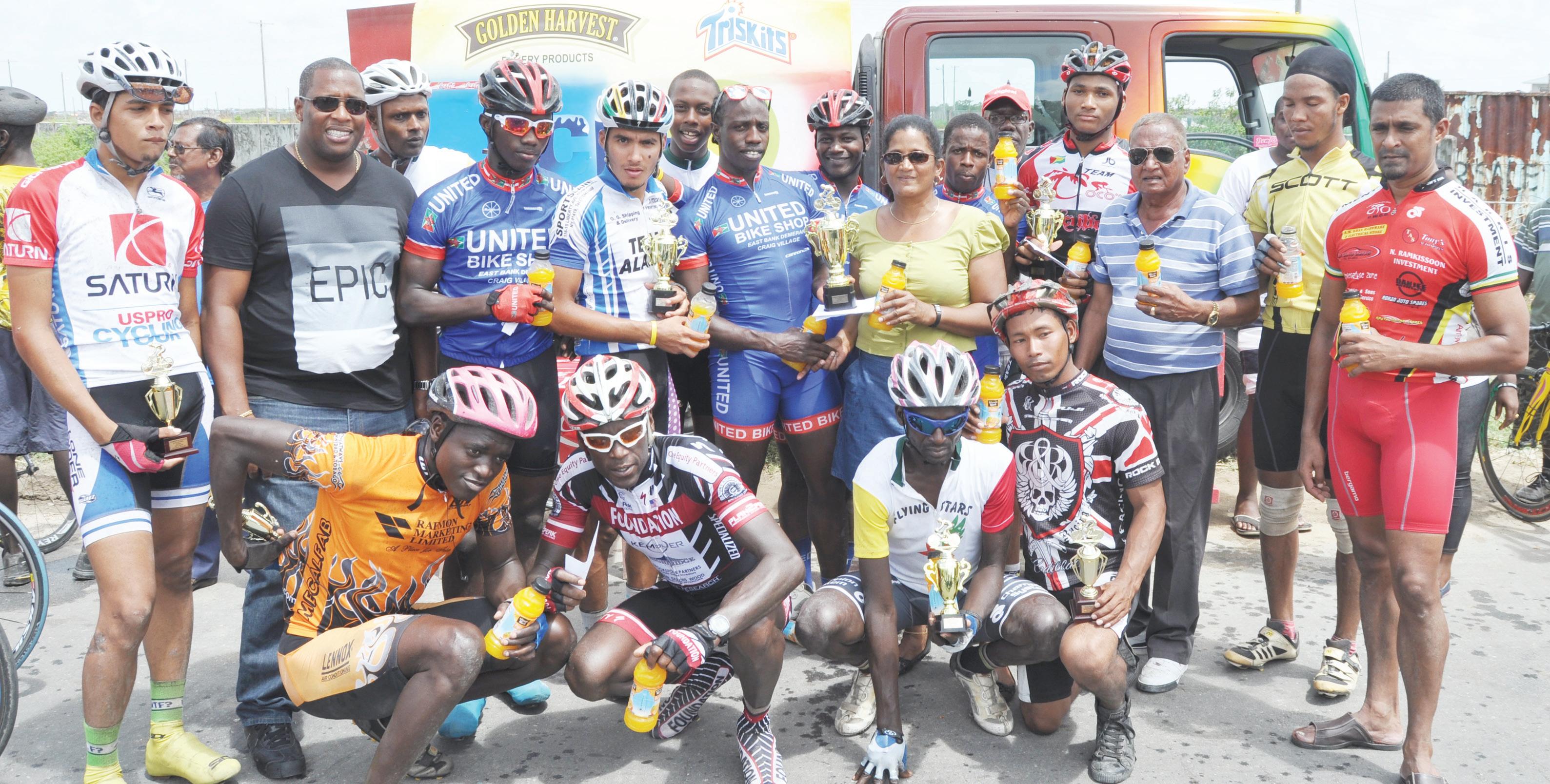
O’Selmo made a welcome return to form, finishing third, while defending champion Robin Persaud ended fourth.
Albert Philander and Godfrey Pollydore copped the fifth and sixth positions respectively.
Michael Anthony, Alonzo Ambrose and Raul Leal were 1-2-3 in the junior division, while Talim Shaw won the veterans’ race ahead of Ian Jackson and Devendra Ramnarine in that order.
Officials of Banks DIH Limited and organiser Hassan Mohamed assisted in the presentation of prizes at the conclusion.