Page 6
Kaieteur News
Thursday May 29, 2014
Caribbean Airlines plane crash at CJIA…
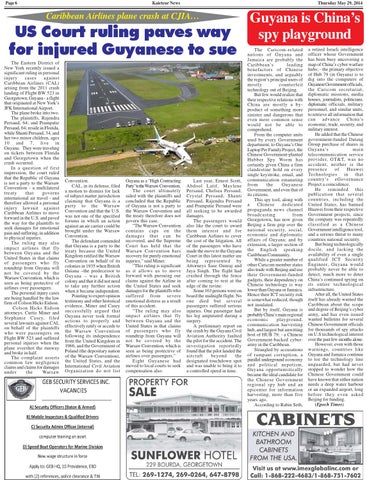
US Court ruling paves way for injured Guyanese to sue The Eastern District of New York recently issued a significant ruling in personal injury cases against Caribbean Airlines (CAL) arising from the 2011 crash landing of Flight BW 523 in Georgetown, Guyana - a flight that originated at New York’s JFK International Airport. The plane broke into two. The plaintiffs, Rajendra Persaud, 64; and Prampatie Persaud, 64; reside in Florida, while Shanti Persaud, 34, and her two minor children, ages 10 and 7, live in Guyana. They were traveling on tickets between Florida and Georgetown when the crash occurred. In a question of first impression, the court ruled that the Republic of Guyana is not a party to the Warsaw Convention - a multilateral treaty that governs international air travel - and therefore allowed a personal injury lawsuit against Caribbean Airlines to move forward in the U.S. and paved the way for the plaintiffs to seek damages for emotional pain and suffering, in addition to physical injuries. The ruling may also impact airlines that fly between Guyana and the United States in that claims of passengers who fly roundtrip from Guyana will not be covered by the Warsaw Convention, which is seen as being protective of airlines over passengers. The personal injury cases are being handled by the law firm of Colson Hicks Eidson. Colson Hicks Eidson attorneys, Curtis Miner and Stephanie Casey, filed several lawsuits against CAL on behalf of the plaintiffs who were passengers on Flight BW 523 and suffered personal injuries when the plane overshot the runway and broke in half. The complaint asserts common law negligence claims and claims for damages under the Warsaw
Convention. CAL, in its defense, filed a motion to dismiss for lack of subject matter jurisdiction claiming that Guyana is a party to the Warsaw Convention and that the U.S. was not one of the specified forums in which an action against an air carrier could be brought under the Warsaw Convention. The defendant contended that Guyana is a party to the treaty because the United Kingdom ratified the Warsaw Convention on behalf of its colonies in 1935 when British Guiana –the predecessor to Guyana – was a British colony and that it did not need to take any further action when it became independent. Pointing to expert opinion testimony and other historical evidence, Miner and Casey successfully argued that Guyana never took formal actions to properly and effectively ratify or accede to the Warsaw Convention following its independence from the United Kingdom in 1966, and the Government of Poland (the depositary nation of the Warsaw Convention), the United States, and the International Civil Aviation Organization do not list
Guyana as a “High Contracting Party”tothe Warsaw Convention. The court ultimately sided with the plaintiffs and concluded that the Republic of Guyana is not a party to the Warsaw Convention and the treaty therefore does not govern this case. “The Warsaw Convention contains caps on the damages that can be recovered, and the Supreme Court has held that the Warsaw Convention bars recovery for purely emotional injuries,” said Miner. “This ruling is significant as it allows us to move forward with pursuing our claims against the Airline in the United States and seek damages for the plaintiffs who suffered from severe emotional distress as a result of this accident. “The ruling may also impact airlines that fly between Guyana and the United States in that claims of passengers who fly roundtrip from Guyana will not be covered by the Warsaw Convention, which is seen as being protective of airlines over passengers.” Eight Guyanese had moved to local courts to seek compensation also.
Last year, Ernest Scott, Abdool Latif, Maylene Persaud, Chelsea Persaud, Crystal Persaud, Shanti Persaud, Rajendra Persaud and Prampatie Persaud were all seeking to be awarded damages. The passengers would also like the court to award them interest and for Caribbean Airlines to cover the cost of the litigation. All of the passengers who have made the move to the Guyana Court in this latest matter are being represented by Attorneys Sase Gunraj and Jaya Singh. The flight had crashed through the fence after coming to rest at the edge of the ravine. Some 163 persons were on board the midnight flight. No one died but several passengers suffered serious injuries. One passenger had his leg amputated during a surgery. A preliminary report on the crash by the Guyana Civil Aviation Authority faulted the pilot for the accident. The investigation reportedly found that the pilot landed the aircraft beyond the designated touchdown spot and was unable to bring it to a controlled speed in time.
Guyana is China’s spy playground The Caricom-related nations of Guyana and Jamaica are probably the Caribbean’s leading benefactors of Chinese investments, and arguably the region’s principal users of mostly counterfeit technology out of Beijing. But few would realize that their respective relations with China are mostly a byproduct of something more sinister and dangerous that even mere common sense would not be able to comprehend. From the computer units used by every Government department, to Guyana’s One Laptop Per Family Project, the Chinese Government-planted Hubber Spy Worm has certainly given China a firm clandestine hold on every single keystroke, email, and communication emanating from the Guyanese Government, and even that of its citizens. This spy tool, along with a Chinese dedicated propaganda news channel broadcasting from Georgetown, has now given Beijing a firm grip over the national security, social, economic and diplomatic affairs of Guyana; and by extension, a larger section of the English speaking Caribbean Community. While a greater number of other Caricom member states also trade with Beijing and use their Government-funded gadgets, their dependency on Chinese technology is way lower than Guyana or Jamaica. Hence their ICT security risk is somewhat reduced, though not insulated. But by itself, Guyana is probably China’s main regional economic playground, communication harvesting hub, and largest but unwitting host of HUB 79; - a Chinese Government-backed cyberarmy in the Caribbean. Strangled by accusations of rampant corruption, a parallel underground economy and political nepotism, Guyana opportunistically became the ideal candidate for the Chinese Government regional spy hub and an epicenter for information harvesting, more than five years ago. According to Rabin Seth,
a retired Israeli intelligence officer whose Government has been busy uncovering a map of China’s cyber warfare hubs; - the primary objective of Hub 79 (in Guyana) is to dig into the computers of Guyanese Government officials, the Caricom secretariat, diplomatic missions, media houses, journalists, politicians, diplomatic officials, military personnel, and similar units, to retrieve all information that can advance China’s economic, trade, security, and military interest. He added that the Chinese government-funded Datang Group purchase of shares in Guyana’s main telecommunication service provider, GT&T, was no accident, neither is the presence of Huawei Technologies in that country’s eGovernance Project a coincidence. He reminded this publication that several countries, including the United States, has banned Huawei from their respective Government projects, since the company was repeatedly classified as a Chinese Government intelligence tool, and a serious threat to many countries national security. But being technologically docile, and lacking the availability of even a single qualified ICT Security Engineer, Guyana would probably never be able to detect, much more to deter China’s continued spying on its entire technological infrastructure. After all, the United States itself has already warned the Caribbean about the scope and degree of Beijing’s cyber army, and has even issued wanted bulletins for several Chinese Government officials for thousands of spy attacks on U.S technological interest over the past few months alone. However, even with those warnings, countries like Guyana and Jamaica continue to toe the technology line unguarded, but had never stopped to wonder how the Chinese Government could have known that either nation needs a deep water harbour or an expanded airport, long before they even asked Beijing for funding. (Epoch Times)