Kaieteur News
PAGE 46
Sunday May 03, 2020
Musical extraordinaire,
David Martins... From page 14 injection from which I have never fully recovered.” “I learned a lot from listening to the approaches of the Trinis, particularly S p a r r o w, a n d L o r d Kitchener, but I was also a big fan of Lord Blakie, the man with the ribald infectious laugh, and Andre Tanker with his clever lyrics. It was then, and remains now, a treasure trove for me,” Mr. Martins recounted. Over all, I had begun to take notice of the devices various North American song writers were using to come up with an approach to a song subject that had not been used before. Songs like MacArthur Park and Imagine were showing me how wide the canvas could be. I took note.” But as a youngster his interest in pop music of the day never dwindled; Martins was into classical music as well as the folk music from countries around the world, including especially Africa, India and Israel. “I also was drawn to the very imaginative writing that is a feature of country music and Broadway show tunes – I saw how wide the canvas could be for songs – but in particular I was captivated by the Trinidad calypso genre – I saw a niche there I felt I could get into,” he said. After graduating from St. Stanislaus College, the young Martins secured a job as a Flight Clerk at British Guiana Airways, first at the Ruimveldt Ramp with the sea planes and shortly thereafter with that company's Atkinson Field office. He explained that jobs were few but his sister Imelda was a secretary at Bookers Shipping head office in Georgetown. It was through her, he got a job. Martins stressed nonetheless that there was no allure for him. He had begun learning to play the guitar with music friends, Joe and Jack Henry, in Vreed-enHoop and Gerry Martins (no relation) in Pouderoyen. The musicians eventually formed a small group, with Doolie Chung and Billy Stephenson on percussion, playing pop songs and the Latin tunes of that time. “ We w o u l d p l a y evenings for our friends in various residences in that area, and even made some trips up the East Coast, but I was about 17 years old and a music career never entered my mind although I was very
interested in pop music generally,” Mr. Martins noted. CANADA Martins continued to play with the group until his m i g r a t i o n t o To r o n t o , Canada where he lived with his uncle Joe Barcellos and his family. As a young artiste, Mr. Martins said that Canada opened the possibility of earning a living as a musician. “It was a turn of the tides for me because in Toronto I saw the various small combos playing in bars and hotels – this included some Caribbean bands – and it was there that I saw the possibility of earning a living from music -something very rare in Guyana. Also, my inclination to write songs had started in my time playing in Guyana and I
gigs from the start, because o f o u r We s t I n d i a n following, but I soon saw the wider pop music market potential in Toronto and switched over to that genre, renaming the group --The Debonairs.” The band added an accordion player and signed with a music agency which secured gigs for them across Ontario and even into Quebec.” However, after a year or two of that, the emergence of small combos in the Caribbean, as opposed to the big bands caught his attention. This coupled with his own growing preference for Caribbean music, led Martins to break up the Debonairs in early 1966 and form the Caribbean Trade Winds with three Trinis, Joe Brown (bass) Glen Sorzano (guitar) and Kelvin Ceballo (drums). Dave Martins and his beloved guitar
now took the opportunity. I had a day job running a lithographic printing machine to do a night course in music notation and composition at the United Music Center in the city and began giving thought to forming a group to cater to Caribbean migrants in the city,” he recounted. Given the number of Latin songs popular in Guyanese music at that time, Martins named the group – The Latins. With a mixture of drums and two guitars, the group played a mix of some pop, some Latin, and some Trinidad calypsos. “We were getting regular
There, he began writing songs influenced by his Caribbean roots. With the band formed and getting a steady gig at the Bermuda Tavern, downtown Toronto, Martins went into the studio and recorded four songs. It was the only place in town with Caribbean music every night and the Caribbean people responded well. “We would leave only to go away for Trinidad Carnival, and every year we would return from that jaunt to three or four islands, with a big welcome dance at a dancehall in the Toronto suburbs which would be
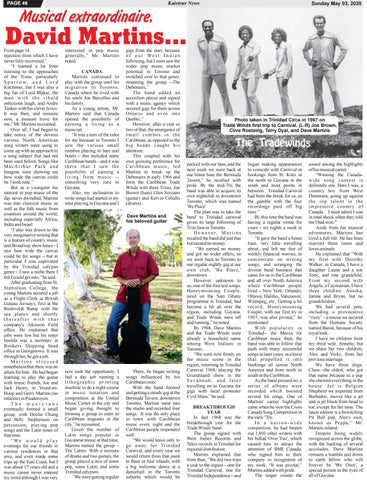
Photo taken in Trinidad Circa in 1967 on Trade Winds first trip to Carnival. (L-R) Joe Brown, Clive Rosteing, Terry Dyal, and Dave Martins
packed with our fans, and the next week we were back at our home base the Bermuda Tavern,” he recalled with pride. By the mid-70s the band was able to acquire its own nightclub in downtown Toronto, which was named 'We Place'. The plan was to take the band to Trinidad carnival given its large following of Trini fans in Toronto. H o w e v e r, M a r t i n s recalled the band did just that but earned no money. “We earned no money and got no wider offers, so we went back to Toronto to our regular nightly gig at our own club, 'We Place,' downtown. However, unknown to us, one of the four test songs, Honeymooning Couple, aired on the Sam Ghany programme in Trinidad, had become a hit all over the region, including Guyana, and Trade Winds were off and running,” he noted. By 1968, Dave Martins and the Trade Winds were already a household name among West Indians in Toronto. “We were now firmly on the music scene in the region, returning to Trinidad Carnival 1968, playing the Grandstand show in the Savannah, and later travelling on to Guyana for gigs with local promoter Cyril Shaw,” he said. BREAKTHROUGH YEAR In fact 1968 was the breakthrough year for the Trade Winds' band. The group signed with West Indies Records and Telco records in Trinidad for regional distribution. Martins explained that from then, “We did two trips a year to the region – one for Trinidad Carnival, one for Trinidad Independence – and
began making appearances to coincide with Carnival in bookings from St. Kitts in the north to Guyana in the south and most points in between. Trinidad Carnival had been the break for us, as the gamble with the four recordings paid off big time.” By this time the band was having a regular venue for years – six nights a week in Toronto. “It gave the band a home base, very little travelling about, and left me free of weekly financial worries, to concentrate on writing songs, and arranging the diverse band business that came for us in the Caribbean and all over North America where Caribbean people lived – New York; Orlando; Ottawa; Halifax, Vancouver, Winnipeg, etc Getting a hit record, Honeymooning Couple, with our first try in 1967, was also pivotal,” he mentioned. Wi t h p o p u l a r i t y i n Trinidad-- the Mecca for Caribbean music then, the band was able to follow that push with many successful songs in later years, in a burst that propelled it into bookings all across North America and from north to south in the Caribbean. As the band pressed on, a series of albums were recorded which boosted several hit songs. One of Martins' career highlights came when he won the Cross Canada Song Competition in the early '70s. In a nation-wide competition, he had beaten out 1,800 other writers with his ballad 'Over You', which caused him to attract the attention of BMI Canada, who signed him to their company in recognition of my work. “It was pivotal,” Martins added with pride. The singer counts the
award among the highlights of his musical career. “Winning the Canadawide song contest is definitely one. Here I was, a country boy from West Demerara, going up against the top talent in the impressive country of Canada. I must admit I was in total shock when they told me I had won.” Aside from his musical adventures, Martins has lived a full life. He has been married three times and loves animals. He explained that “With my first wife Dorothy Walker, in Canada, I have a daughter Luana and a son Tony, and one grandchild. From my second wife Angela, a Caymanian, I have three children: Annika, Janine and Bryan, but no grandchildren. We had several pets, including a provocative “ricey” - a rescue we secured from the Humane Society named Baron, because of his royal look. I have no children from my third wife, Annette, but we share her two children, Alex and Vicky, from her previous marriage. We have three dogs. Choo---the oldest, who got that name because as a pup she chewed everything in the house. Jet is Belgian Shepherd we imported from Barbados, moves like a jet and is jet black from head to toe, except for her nose. The latest edition is a bewitching Pit Bull pup, Alex's own, known as Peppa,” Mr. Martins related. Despite being widely recognized across the globe, with the backing of several accolades, Dave Martins remains a humble and down to earth fellow who will forever be 'We Own', a special person in the eyes of all of Guyana.