Sunday March 31, 2019
Kaieteur News
PAGE 59
Artist, lecturer and conservator,
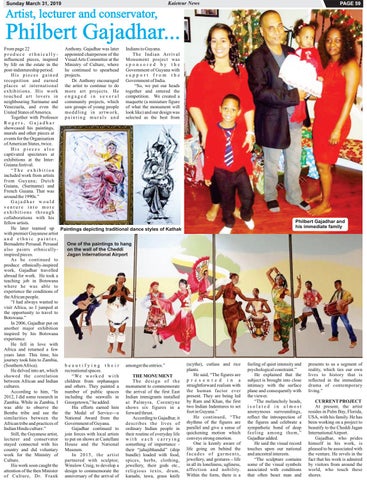
Philbert Gajadhar... Anthony. Gajadhar was later Indians to Guyana. From page 22 The Indian Arrival p r o d u c e e t h n i c a l l y - appointed chairperson of the influenced pieces, inspired Visual Arts Committee at the Monument project was by life on the estate in the Ministry of Culture, where s p o n s o r e d b y t h e he continued to spearhead Government of Guyana with post-indentureship period. support from the H i s p i e c e s g a i n e d projects. Dr. Anthony encouraged Government of India. recognition and earned “So, we put our heads places at international the artist to continue to do exhibitions. His work more art projects. He together and entered the touched art lovers in e n g a g e d i n s e v e r a l competition. We created a neighbouring Suriname and community projects, which maquette (a miniature figure Venezuela, and even the saw groups of young people of what the monument will m e d d l i n g i n a r t w o r k , look like) and our design was United States of America. Together with Professor p a i n t i n g m u r a l s a n d selected as the best from Rogers, Gajadhar showcased his paintings, murals and other pieces at events for the Organisation of American States, twice. His pieces also captivated spectators at exhibitions at the InterGuiana festival. “The exhibition included work from artists from Guyana; Dutch Guiana, (Suriname) and French Guiana. That was around the 1990s.” Gajadhar would venture into more exhibitions through collaborations with his fellow artists. He later teamed up Paintings depicting traditional dance styles of Kathak with premier Guyanese artist and ethnic painter, Bernadette Persaud. Persaud One of the paintings to hang also paints ethnicallyon the wall of the Cheddi inspired pieces. Jagan International Airport As he continued to produce ethnically-inspired work, Gajadhar travelled abroad for work. He took a teaching job in Botswana where he was able to experience the conditions of the African people. “I had always wanted to visit Africa, so I jumped at the opportunity to travel to Botswana.” In 2006, Gajadhar put on another major exhibition inspired by his Botswana experience. He fell in love with Africa and returned a few years later. This time, his journey took him to Zambia, b e a u t i f y i n g t h e i r amongst the entries.” (Southern Africa). He delved into art, which recreational spaces. THE MONUMENT “ We w o r k e d w i t h showed the correlation The design of the between African and Indian children from orphanages and others. They painted a monument to commemorate cultures. According to him, “In number of public spaces the arrival of the first East 2012, I did some research in including the seawalls in Indian immigrants installed at Palmyra, Corentyne Zambia. While in Zambia, I Georgetown,” he added. His efforts earned him shows six figures in a was able to observe the Bemba tribe and see the the Medal of Service---a forward thrust. According to Gajadhar, it similarities between the National Award from the describes the lives of African tribe and practices of Government of Guyana. Gajadhar continued to ordinary Indian people in Indian Hindu culture.” Still, the Guyanese artist, join forces with local artists their routine of everyday life lecturer and conservator to put on shows at Castellani w i t h e a c h c a r r y i n g stayed connected with his House and the National something of importance their “jahajibhandal” (ship country and did voluntary Museum. In 2015, the artist bundle) loaded with food, work for the Ministry of partnered with sculptor, spices, herbs, clothing, Culture. His work soon caught the Winslow Craig, to develop a jewellery, their gods etc., attention of the then Minister design to commemorate the religious texts, drum, of Culture, Dr. Frank anniversary of the arrival of karaahi, tawa, grass knife
Philbert Gajadhar and his immediate family
(scythe), cutlass and rice plants. He said, “The figures are p r e s e n t e d i n a straightforward realism with the human factor ever present. They are being led by Ram and Khan, the first two Indian Indentures to set foot in Guyana.” He continued, “The rhythms of the figures are parallel and give a sense of quickening motion which conveys strong emotion. One is keenly aware of life going on behind the facades of garments, jewellery, and gestures – life in all its loneliness, ugliness, affection and nobility. Within the form, there is a
feeling of quiet intensity and psychological constraint.” He explained that the subject is brought into close intimacy with the surface plane and consequently with the viewer. “The melancholy heads, isolated in almost anonymous surroundings, reflect the introspection of the figures and celebrate a sympathetic bond of deep feeling among them,” Gajadhar added. He said the visual record touches upon our national and ancestral interests. “The sculpture contains some of the visual symbols associated with conditions that often beset man and
presents to us a segment of reality, which ties our own lives to history that is reflected in the immediate drama of contemporary living.” CURRENT PROJECT At present, the artist resides in Palm Bay, Florida, USA, with his family. He has been working on a project to beautify to the Cheddi Jagan International Airport. Gajadhar, who prides himself in his work, is pleased to be associated with the venture. He revels in the fact that his work is admired by visitors from around the world, who touch these shores.