Page 24
Kaieteur News
Sunday December 16, 2012
Russia opposition leaders held as protesters defy police MOSCOW (Reuters) Russian riot police detained four opposition leaders and broke up a crowd of about 2,000 people who went ahead with a banned rally yesterday to demand an end to Vladimir Putin’s 13-year rule. The opposition chose a symbolic location, in front of the Soviet KGB security police’s former headquarters, for the rally marking a year of protests against Putin, and said the police intervention showed the limits on dissent under the president. Police were out in force and helicopters buzzed overhead as protesters, wrapped in scarves and fur hats because of the extreme cold, chanted “Free political prisoners”, “Down with the police state” and “Russia without Putin” on the vast Lubyanka Square in central Moscow. One unfurled a banner saying “crooks and thieves” - the popular name used to describe the Russian leadership. But the police eventually lost patience with the rally, which had been banned by Moscow city authorities, and strode across the square in helmets and flak jackets after about two hours, hauling protesters away one by one and locking elbows to push others away until no one was left. About 40 people were detained, a police spokesman said, and there were minor scuffles. Leftist leader Sergei Udaltsov and anti-corruption blogger Alexei Navalny were detained at the start of the rally and two fellow protest leaders, Ilya Yashin and Ksenia Sobchak, were detained on their way to the protest. “I don’t know how many people are here but I am proud of each and every one of those who came here. The main thing is that people are here, that they are expressing their view and showing that they exist,” Navalny said before he was detained.
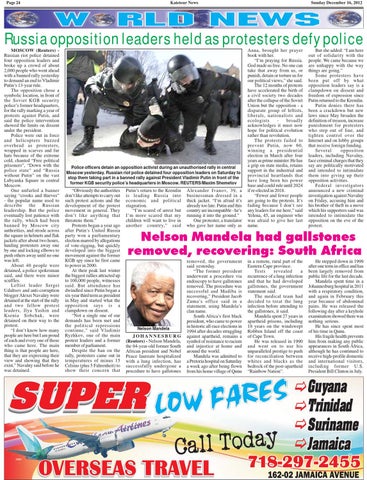
Police officers detain an opposition activist during an unauthorised rally in central Moscow yesterday. Russian riot police detained four opposition leaders on Saturday to stop them taking part in a banned rally against President Vladimir Putin in front of the former KGB security police’s headquarters in Moscow. REUTERS/Maxim Shemetov
“Obviously the authorities don’t like attempts to carry out such protest actions and the development of the protest movement in general. They don’t like anything that threatens them.” Protests began a year ago after Putin’s United Russia party won a parliamentary election marred by allegations of vote-rigging, but quickly developed into the biggest movement against the former KGB spy since he first came to power in 2000. At their peak last winter the biggest rallies attracted up to 100,000 people, witnesses said. But attendance has dwindled since Putin began a six-year third term as president in May and started what the opposition says is a clampdown on dissent. “Not a single one of our demands has been met and the political repressions continue,” said Vladimir Ryzhkov, one of the main protest leaders and a former member of parliament. Despite the ban on the rally, protesters came out in temperatures of minus 15 Celsius (plus 5 Fahrenheit) to show their concern that
Putin’s return to the Kremlin is leading Russia into economic and political stagnation. “I’m scared of arrest but I’m more scared that my children will want to live in another country,” said
Alexander Ivanov, 39, a businessman dressed in a thick jacket. “I’m afraid it’s already too late. Putin and this country are incompatible - he’s running it into the ground.” One protester, a translator who gave her name only as
Anna, brought her prayer book with her. “I’m praying for Russia. God made us free. No one can take that away from us, or punish, detain or torture us for our political views,” she said. The 12 months of protests have accelerated the birth of a civil society two decades after the collapse of the Soviet Union but the opposition - a disparate group of leftists, liberals, nationalists and ecologists broadly acknowledges it must now hope for political evolution rather than revolution. The protests failed to prevent Putin, now 60, winning a presidential election in March after four years as prime minister. He has a grip on state media, retains support in the industrial and provincial heartlands that have long been his power base and could rule until 2024 if re-elected in 2018. “Fewer and fewer people are going to the protests. It’s fading because I don’t see any leaders for me here,” said Yelena, 45, an engineer who was afraid to give her last name.
But she added: “I am here out of solidarity with the people. We came because we are unhappy with the way things are going.” Some protesters have been put off by what opposition leaders say is a clampdown on dissent and freedom of expression since Putin returned to the Kremlin. Putin denies there has been a crackdown but new laws since May broaden the definition of treason, increase punishment for protesters who step out of line, and tighten control over the Internet and on lobby groups that receive foreign funding. Several opposition leaders, including Navalny, face criminal charges that they say are politically motivated and intended to intimidate them into giving up their opposition activities. Federal investigators announced a new criminal investigation against Navalny on Friday, accusing him and his brother of theft in a move which his supporters said was intended to intimidate the opposition on the eve of the protest.
Nelson Mandela had gallstones removed, recovering: South Africa
Nelson Mandela
JOHANNESBURG (Reuters) - Nelson Mandela, the 94-year-old former South African president and Nobel Peace laureate hospitalized with a lung infection, has successfully undergone a procedure to have gallstones
removed, the government said yesterday. “The former president underwent a procedure via endoscopy to have gallstones removed. The procedure was successful and Madiba is recovering,” President Jacob Zuma’s office said in a statement, using Mandela’s clan name. South Africa’s first black president, who came to power in historic all-race elections in 1994 after decades struggling against apartheid, remains a symbol of resistance to racism and injustice at home and around the world. Mandela was admitted to a Pretoria hospital on Saturday a week ago after being flown from his home village of Qunu
in a remote, rural part of the Eastern Cape province. Tests revealed a recurrence of a lung infection and that he had developed gallstones, the government statement said. The medical team had decided to treat the lung infection before attending to the gallstones, it said. Mandela spent 27 years in apartheid prisons, including 18 years on the windswept Robben Island off the coast of Cape Town. He was released in 1990 and went on to use his unparalleled prestige to push for reconciliation between whites and blacks as the bedrock of the post-apartheid “Rainbow Nation”.
He stepped down in 1999 after one term in office and has been largely removed from public life for the last decade. Mandela spent time in a Johannesburg hospital in 2011 with a respiratory condition, and again in February this year because of abdominal pains. He was released the following day after a keyhole examination showed there was nothing serious. He has since spent most of his time in Qunu. His fragile health prevents him from making any public appearances in South Africa, although he has continued to receive high-profile domestic and international visitors, including former U.S. President Bill Clinton in July.