A Circuitous Journey: 150 Years of GW Law | Student Life Through the Years THE GEORGE WASHINGTON UNIVERSITY LAW SCHOOL MAGAZINE FALL 2015
Years of Making History
contents
a magazine for alumni and friends EDITOR IN CHIEF: Jamie L. Freedman, MA ‘96 DEAN AND ROBERT KRAMER RESEARCH PROFESSOR OF LAW: Blake D. Morant DIRECTOR OF STRATEGIC COMMUNICATIONS AND MARKETING: Elizabeth H. Field DESIGN & PRODUCTION: Moiré Marketing Partners PHOTOGRAPHY: Chris Flynn GW LAW magazine was awarded the MarCom Platinum award from the Association of Marketing & Communication Professionals.
fall 2015
2
MESSAGE FROM THE DEAN
4
A CIRCUITOUS JOURNEY
9
GW LAW’S SUPREME CONNECTION
10
HISTORY IN THE MAKING
14
20
THE CHANGING FACE OF STUDENT LIFE
GW LAW MAGAZINE IS PUBLISHED BY: The George Washington University Law School 2000 H Street, N.W. Washington, D.C. 20052 202-994-6288 magazine@law.gwu.edu
COVER PHOTOGRAPHY BY CHRIS FLYNN
PLEASE SEND CHANGE OF ADDRESS NOTICES TO: Alumni Records 2100 M St., NW Suite 315 Washington, D.C. 20052 or alumrecs@gwu.edu
ALUMNI NEWSMAKERS
24
20th & H
5
16
20
GW Law magazine is mailed free of charge to GW Law alumni and friends of the university. Opinions expressed in these pages are those of the individuals and do not necessarily reflect official positions of the university. The George Washington University is an equal opportunity/affirmative action institution. © 2015 The George Washington University
24 FALL 2015 | www.law.gwu.edu
1
A MESSAGE FROM THE DEAN
Making History Together DEAR FRIENDS OF GW LAW,
THE LAW SCHOOL HAS CHANGED SINCE ITS EARLY DAYS AS A TINY, HOMOGENOUS INSTITUTION OFFERING A SPRINKLING OF CLASSES AT THE SITE OF THE OLD TRINITY CHURCH. TODAY, GW LAW CONSTITUTES ONE OF THE LARGEST, MOST RENOWNED, AND DIVERSE MEMBERS OF THE LEGAL ACADEMY.
2
GW LAW | FALL 2015
There is indeed much to celebrate as I enthusiastically begin my second year at the helm of this extraordinary law school. This month marks the 150th anniversary of GW Law’s founding in 1865. The law school has changed since its early days as a tiny, homogenous institution offering a sprinkling of classes at the site of the old Trinity Church. Today, GW Law constitutes one of the largest, most renowned, and diverse members of the legal academy. We have an exciting slate of activities planned to mark this remarkable milestone in GW Law’s history. The yearlong celebration kicks off during Law Alumni Weekend with a series of special events and receptions, including a champagne toast to our 150th entering class of law students. As part of the festivities, I am delighted to host and moderate a landmark Presidential Summit on the Challenges Facing Higher Education, featuring a panel of university presidents and other leading voices in the academy. You are cordially invited to attend this summit and join us throughout the year as we gather to commemorate our rich heritage and look ahead to the future. This special 150th anniversary issue of our award-winning magazine highlights the captivating history of the oldest law school in the District of Columbia. In “A Circuitous Journey,” you will read about the pivotal moments and key figures shaping GW Law’s storied past. “The Changing Face of Student Life” introduces us to the accomplished students who have passed through our classrooms over the generations—and how GW Law has transformed over the
years along with our diversifying student body. Rounding out this special issue is a treasure trove of photos depicting life at GW Law through the years. As the celebration of our sesquicentennial unfolds, we look forward with much anticipation to the next chapter in the life of GW Law. Thank you for what you have done thus far to build our history. I look forward to continuing our joint efforts to ensure the law school’s stellar future. Let the celebrations begin.
SINCERELY,
BLAKE D. MORANT Dean and Robert Kramer Research Professor of Law
FALL 2015 | www.law.gwu.edu
3
A CIRCUITOUS JOURNEY BY MARY DEMPSEY
years at GW Law The roster for the Class of 1867 was impressive: 60 men from 22 of the country’s then-37 states. For two years they took evening classes and listened to lectures by James M. Wayne, an associate justice of the United States Supreme Court. When they graduated, they held credentials from what is now the oldest law school in the nation’s capital. As the George Washington University Law School celebrates its 150th birthday, its first class—all male and all white—stands in contrast to what the school has become: a highly ranked institution with exemplary programs in cuttingedge disciplines, a Who’s Who list of alumni, and a diverse law faculty and student body.
4
GW LAW | FALL 2015
In the beginning, however, the endeavor was far from solid. “ONE OF THE SURPRISES WAS THAT THE LAW school’s existence was not always assured,” says former Dean Jerome Barron, who has written a book, A Short History of the George Washington University Law School, to coincide with the sesquicentennial. “They had outstanding people teaching, and some alumni went on to great careers, but the economic wherewithal to keep the place going was often in doubt.” Indeed, what evolved into GW Law was actually a second attempt at a law school. Columbian College (which would later change its name to the George Washington University) was barely a year old when its trustees, in a special Feb. 3, 1826, session, identified two professors to teach a new law program: William Cranch, who was chief justice of the District of Columbia Circuit Court, and William Thomas Carroll, clerk of the U.S. Supreme Court. Four months later, with President John Quincy Adams in attendance, Justice Cranch delivered his first law lecture in the City Hall’s courtroom. Within in a year, however, the school had no funds left to pay its faculty and the program was shuttered. It was 39 years before another law school attempt was made. In 1865, Columbian College of Law, which in 1904 would become the GW Law School, opened as a part-time, night-class program. Its students met on Fifth Street, NW in the Old Trinity Episcopal Church building, which was rehabbed and renamed the Columbian Law Building. In the years that followed, the student enrollment—and faculty—grew. During the 45th anniversary of his Class of 1872, alumnus George S. King reminisced about his classes for the student publication Res Gestae. Mr. King said Professor John C. Kennedy read his lectures from a formal “manuscript” while Professor Samuel Taylor interspersed commentary from his notes with freewheeling anecdotes. Mr. King said students used applause to encourage
LEFT: A group of men and women from the law school’s Class of 1924 stop for a photo outside the U.S. Capitol. BELOW: GW Law’s Class of 1891 gathered on the steps of the law school for a portrait with U.S. Supreme Court Justices and faculty members John M. Harlan and David J. Brewer (seated, top far left) and Dean Walter S. Cox (seated, middle row, third from the right).
FALL 2015 | www.law.gwu.edu
5
LEFT: GW Law’s first dean, Walter S. Cox, also served as associate justice of the Supreme Court of the District of Columbia. He presided over the trial of President Warren G. Harding’s murderer in the first case to use the insanity plea. SECOND: William C. Van Vleck was GW Law’s longestserving 20th century dean, overseeing the law school from 1924-1948. RIGHT: GW Law’s first home (1865-1884), the Columbian Law Building, was at the site of the Old Trinity Church on Fifth Street. FAR RIGHT: The Fall 1888 Law School Register of Students features class members from across the country.
6
Professor Kennedy “to go on with his reminiscences to a much greater length than he had originally intended, thus cutting off the length of the quiz…” Even in its earliest years, the school was grabbing attention. The first woman to argue before the U.S. Supreme Court, Belva Lockwood, obtained her law credentials in 1873 from National University, which was later absorbed by GW. Although considered a GW Law grad, Ms. Lockwood preceded the law school’s official admission of female students. That happened in 1900. Two years later, the first Master of Laws graduates included Emma Reba Bailey. African-American students had to wait much longer. In 1884, Samuel Laing Williams became the first African-American to earn a law degree from the school. He followed that achievement with an LLM in 1885 and went on to an exceptional career as a lawyer and orator in Chicago. But The George Washington University later barred black students, and it wasn’t until 1954 that race restrictions were lifted, largely as a result of campus protests fueled by actress Ingrid Bergman, who balked at performing in a segregated Lisner Auditorium.
civil lawsuit against Vice President Spiro Agnew in connection with bribery accusations, winning a $270,000 settlement for Maryland’s treasury. The nation’s first patent law program began in the school in 1891 and, four years later, a Master’s of Patent Law degree was unveiled, providing the U.S. Patent and Trademark Office with an employment pool. Before the turn of the century, alumni had written hundreds of patent applications, including those for Alexander Graham Bell’s telephone, Ottmar Mergenthaler’s linotype machine, and George Eastman’s roll-film camera. The May 22, 1906, patent for the Wright brothers’ flying machine sprang from the efforts of 1882 graduate Harry Aubrey Toulmin. GW Law still excels in patent and intellectual property law. And several other high-profile programs have followed, including international and comparative law in 1965, the community legal clinics in 1970, environmental law in 1970, and government contracts in 1984. The nation’s only Vaccine Injury Clinic was set up at GW Law in 1994, part of a legal clinic tradition that provides GW Law students with real experience on cases involving issues such as poverty, prisoner rights, and domestic violence.
At the Frontline of History
The Difference Between Day and Night
ITS LOCATION IN THE NATION’S CAPITAL HAS MADE GW Law a perennial newsmaker. U.S. Supreme Court justices have lectured the law school’s students and served as judges in its moot courts. During the Vietnam War, GW Law Professor Monroe Freedman burned his draft card behind Lisner to the cheers of anti-war demonstrators. And GW Law students helped file a 1976
AMID GENERATIONS OF ADVANCES, THERE EMERGED one controversy that shook the school to its roots: whether to discontinue the night-school program. The law school had started as an evening program populated by D.C.-area professionals who worked by day, often for the government, then took night classes. By the mid-1980s, GW Law had
GW LAW | FALL 2015
established a national reputation for its day program and a local reputation for its night program. Eager to build on that national fame, faculty pushed to eliminate the night program. Dean Barron supported the proposal. The backlash was loud and fierce. “In retrospect, it was understandable,” says Dean Barron. “So many of our distinguished alumni in the first half of the 20th century were graduates of the evening program. And many felt that the parttime program was part of the soul of the school.” Even U.S. Supreme Court Chief Justice Warren Burger weighed in, joining the public call to “save the GW night school” in 1984. The chief justice, who earned his law degree at night in Minnesota, was an outspoken advocate for such programs. When former Dean Jack Friedenthal arrived at his new job at GW in 1988, the day-night drama was still in play. “I didn’t know anything about this controversy, and one of the first weekends when I was here … I was invited downtown to meet the judges who were GW graduates and their clerks, many of them who were also young GW graduates,” he recalls. “They greeted me at lunch and the first question they asked was ‘What are you going to do about the evening program?’ “I replied, ‘Oh, do we have an evening program?’” Dean Friedenthal says he can still see the 15 or so people at the lunch rising in unison. “I thought it was going to end my career right there,” he says. In a decision that Dean Blake D. Morant today says preserved “GW Law’s legacy,” the school retained both programs, but with a single admissions policy. “This law school started as a part-time program for individuals
who had full-time jobs and wanted to become lawyers. One of the things that is unique—even though the full-time day JD program has become the dominant marker for the school—is that GW Law never left its moorings,” says Dean Morant. “It has continued to ensure that individuals, regardless of their professional constraints, have an opportunity to gain.”
Growing Pains THE LAW SCHOOL—LIKE THE UNIVERSITY ITSELF— changed addresses as it grew, relocating multiple times before it claimed a permanent place on campus in 1925. A dearth of space, which long had been a problem, grew more intense in 1954 when GW Law absorbed the National University School of Law in D.C. “That merger was a significant one,” says Associate Dean and Director of the Law Library Scott Pagel, who is well versed in the school’s long history. “We greatly expanded the faculty and the academic credentials of the students.” Former Dean Barron, who led the school from 1979 to 1988, also oversaw a stretch of growth, this time owing to an enrollment boom. “We had many, many applicants who sought admission, and I was concerned that even though we had a good name and good reputation that wouldn’t continue unless we got good facilities,” he says. “My immediate task as dean was to get some new buildings and get them fast.” The turning point came with a $1 million gift from 1950 graduate Theodore Lerner and his wife, Annette. A new state-of-the-art classroom building, Lerner Hall, opened in 1984. Then a $500,000 gift from longtime benefactor Jacob Burns, who graduated from FALL 2015 | www.law.gwu.edu
7
Many GW Law alumni have graced the covers of Time magazine, including (left to right) Syngman Rhee, Hon LLD ’54, John Foster Dulles, LLB ’12, Leon Jaworski, LLM ’26, William J. Fulbright, LLB ‘34, and J. Edgar Hoover, LLB ’16, LLM ’17.
the law school in 1924, allowed expansion of the law library and the creation of the moot court that bears his name. But the need for space continued. Former Dean Friedenthal, who succeeded Dean Barron, says the dearth of space threatened his ability to attract top teaching talent. “A top-flight professor was not going to come from another school to ours if he was going to be put in a non-window cubbyhole,” he says. More challenging, however, was a new funding formula that let the school keep its enrollment monies but channeled other funds to the university’s central administration. Dean Friedenthal says that formula left GW Law “woefully” underfunded, and it was revised following “a series of negotiations, arguments, help from the American Bar Association Committee on Law Schools, and support from a number of my colleagues, particularly Professor Roger Trangsrud and the late [Associate] Dean John Jenkins.” He viewed the restructuring of the financial arrangement between the law school and the university as his greatest accomplishment as dean, not least of all because it revived donor and alumni interest in supporting the school.
The famous — and the infamous TODAY GW LAW HAS SOME 25,000 LIVING ALUMNI, among them past and present members of Congress, judges, cabinet officials, and foreign government officials. J. Edgar Hoover, LLB ’16, LLM ’17, the first director of the FBI, graduated from GW Law, as did former Georgian President Mikheil Saakashvili, JD ’96. John Foster Dulles, LLB ’12, J. William Fulbright, LLB ’34, and U.S. Sen. Daniel K. Inouye, JD ’52, were alumni. U.S. Sen. Harry Reid earned his JD in 1964 while working nights for the United States Capitol Police. Harold H. Greene, a 1954 graduate and former judge of the U.S. District Court for the District of Columbia, presided over the lawsuit that broke up AT&T, and Ike Sorkin, JD ’68, was lead attorney for Bernard Madoff. Sarah Hughes, JD ’22, was the first female judge seated in Texas and the only woman to administer the oath of office to a U.S. president. She swore in Lyndon Baines Johnson aboard Air Force One at Dallas’ Love Field. Figures from both sides of the Watergate scandal also claimed GW Law pedigree: Special Prosecutor Leon Jaworski, LLM ’26; Acting FBI Director L. Patrick Gray, JD ’49; and Nixon administration special counsel Charles Colson Jr., JD ’59. Some distinguished alumni brought their talent to the school’s 8
GW LAW | FALL 2015
U.S. Supreme Court Chief Justice Earl Warren (center) attended the official dedication of the Jacob Burns Law Library in 1967, along with (left to right) GW President Lloyd Elliott, Judge Sterry R. Waterman, Jacob Burns, LLB ’24, and GW Law Dean Robert Kramer.
faculty. Dean Barron is proud of his hiring of Patricia Roberts Harris. “I was just struck by how brilliant she was,” he says. Ms. Harris, who graduated first in her class at GW Law in 1960, led the departments of Housing and Urban Development and Health, Education, and Welfare under the Carter Administration, served as U.S. ambassador to Luxembourg, and became dean of Howard University’s School of Law before joining the GW faculty in 1982. She taught full-time until her death two years later. The legacy of GW Law is measured by time and marked by its geographic location, but Dean Morant says it is also defined by its people. The diversity of its faculty, staff, administration, and alumni—a far cry from the first class 150 years ago—provides the school with a rich pool of ideas and perspectives. “This is a top law school that not only captures the advantages of the capital city, but also preserves a rarified sense of community,” says Dean Morant. “The remarkable ethos that defines GW Law relates to the holistic educational experience you get here. “Many law schools offer academic excellence, but seldom instill in students an equally important sense of professionalism,” he adds. “After 150 years of evolution, GW Law combines the two, and our graduates become major players in a global and diverse marketplace.”
GW LAW’S SUPREME CONNECTION U. S. Supreme Court Justices have frequented GW Law’s classrooms and stages throughout the law school’s 150-year history. The historic relationship extends back to the 19th century, when Justices John M. Harlan and David J. Brewer were members of the faculty for 20 years. Today, Justice Clarence Thomas co-teaches a weekly constitutional law seminar at GW Law and his Supreme Court colleagues regularly judge GW Law moot court competitions and speak at law school events.
TOP LEFT: U.S. Supreme Court Justices David J. Brewer (left) and John M. Harlan taught fulltime course loads at GW from 1889-1910 while serving on the Court. TOP RIGHT: This semester, Justice Clarence Thomas is co-teaching his weekly constitutional law seminar for the third time at GW. RIGHT: Last year, Justice Sonia Sotomayor cut the ribbon at the dedication of the renovated Jacob Burns Community Legal Clinics and anchored the bench at the Van Vleck finals. ABOVE: Justice Steven G. Breyer was the featured speaker at the kickoff event of the GW Law Review’s 2014 Symposium.
FALL 2015 | www.law.gwu.edu
9
1865-1939
HISTORY IN THE MAKING 1899
Law classes move to the Columbian Building at 1420 H Street, NW.
1865
The Department of Law is established, offering a two-year law program with classes in the Old Trinity Episcopal Church.
1895
1870
Walter S. Cox becomes first dean of the law school.
National University Law School opens.
1860
1870
1880
1890
1895
1873
Bachelor’s degree in law (LLB) is extended from two years to three.
Lydia S. Hall and Belva Lockwood become the first female graduates of National University Law School.
1867
1891
The first law class—with 60 students—graduates.
The Patent Law Program begins.
1884
Samuel Laing Williams is the first African-American to earn a law degree from GW. The university later bars black students.
10
GW LAW | FALL 2015
1934
1910
The Student Bar Association forms.
The school moves to rented quarters in the Masonic Temple (now the National Museum of Women in the Arts).
1932
The George Washington Law Review launches.
1916
Marion Clark becomes the first woman to receive the LLB degree from GW Law.
1924
Stockton Hall is built for GW Law.
1900
1910
1920
1914
The Department of Law is renamed the Law School.
1930
1925
The law school relocates to GW’s campus.
1904
Morning classes start.
1924 1902
Emma Reba Bailey is the first woman to receive a Master of Laws degree.
William C. Van Vleck named dean of the law school (longest serving dean).
1936 1900
Female students are accepted into the Master of Laws program.
The law school becomes a graduate school offering a JD.
FALL 2015 | www.law.gwu.edu
11
1940-2015
HISTORY IN THE MAKING
1966
Studies in Law and Economic Development (later the George Washington International Law Review) is founded.
1963
Elyce Zenoff becomes the first woman to join the tenure-track faculty.
1940
1970
The Doctor of Juridical Science degree is offered.
Community Legal Clinics start operation.
1960
Professor Ralph C. Nash Jr. joins the faculty and, with John Cibinic Jr. (joins in 1962) establishes what ultimately becomes the nation’s first Government Procurement Law Program.
1954
National University Law School and GW merge. The university ends its policy barring black students.
1940
1950
1960
1970
1954
Leah Brook McCartney is believed to be the first African-American female graduate of the law school.
1970
1959
The school is reestablished as the National Law Center.
1946
Graduates from non-U.S. schools are accepted into certain programs.
1965
International and Comparative Law Program begins.
1967
Phase 1 of Jacob Burns Law Library is completed.
12
GW LAW | FALL 2015
Environmental Law Program is introduced.
1977
James Phillip Chandler becomes the first AfricanAmerican to join the tenure-track faculty.
1996 1982
Oxford Summer Program begins.
The National Law Center officially renamed The George Washington University Law School.
2009
Center for Law, Economics & Finance (C-LEAF) is launched. The LLM in business and finance law is launched.
1994
2006
AIPLA Quarterly Journal moves to GW.
1980
2010
Public Contract Law Journal moves to GW.
1990
George Washington Journal of Energy & Environmental Law begins.
2000
2010
2005
James F. Humphreys Complex Litigation Center is founded.
1984
Lerner Hall is completed, as is Phase 2 of the Jacob Burns Law Library.
2003
Munich Intellectual Property Law Center opens. The law school occupies E Building, Stuart Hall, and parts of Lisner Hall following renovations.
2013
Renovations of the Jacob Burns Community Legal Clinics are finished. The Law Learning Center is completed.
FALL 2015  |  www.law.gwu.edu
13
STUDENT LIFE THROUGH THE YEARS by Laura Hambleton
14
GW LAW | FALL 2015
As the dust of the Civil War began to settle in 1865, a small group of white, male aspiring attorneys gathered a few evenings a week at the Old Trinity Church on Judiciary Square in Washington, D.C., to learn what it meant to be a lawyer. The 60 students, who took classes in common law and criminal, commercial, and admiralty jurisprudence, did not need a high school diploma; they only had to show a desire to learn and pay tuition of a few dozen dollars.
THIS YEAR, AS THE GEORGE WASHINGTON UNIVERSITY Law School commemorates its 150th anniversary, the law school’s large and diverse student body reflects the astounding changes that both GW Law and the country have undergone since 1865: The law school now enrolls about 2,000 students—part-time and full-time, half of them women, hundreds of them minorities, all led by an African-American dean. These students can choose from a menu of 275 elective courses, held in seven different buildings, and study in a library among the largest and most well respected in the country. This year’s classes will participate in 62 clubs—from the Black Law Students Association to The Feminist Forum. Students edit eight academic journals and volunteer in 10 legal clinics. Many will study overseas during their three years at GW. And alumni have formed black, Latino, and Asian-American associations to stay connected after graduation. “The student body is incredibly diverse, with students from all over the world,” says Scott Pagel, associate dean for information services and director of the Jacob Burns Law Library. “These different students have changed the dynamics of the clubs and the class discussions. This is an exciting time.” To trace GW Law’s growth from a few classes in a church to a
world-renowned, robust, and diverse law school, historians, faculty members, and former students highlight three sweeping milestones in the school’s history—a dramatically changing physical plant, which today totals more than 328,000 square feet; the merger with National University School of Law, which in a stroke of a pen desegregated GW Law; and the success of female students. “The growth of the law school’s physical plant has changed student life,” Associate Dean Pagel says. “Twenty years ago, students were upset by the facilities. It was crowded. There was no lounge. Now, we’ve added a number of places for students to gather and student organizations to meet. The law school is a beehive of activity, and the physical plant has a lot to do with it.”
A Meaningful Merger IN THE EARLY YEARS, STUDENTS DIDN’T LINGER AT law school. They worked during the day and went to school at night. “The environment was very different,” Associate Dean Pagel says. Professors assigned readings from textbooks until the casebook method was introduced in 1870. By the late 1890s, the school sought more academic preparation FALL 2015 | www.law.gwu.edu
15
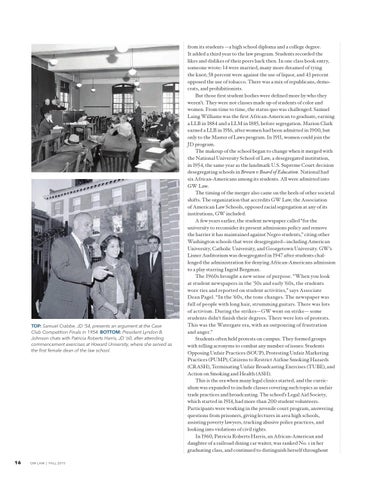
TOP: Samuel Crabbe, JD ‘54, presents an argument at the Case Club Competition Finals in 1954. BOTTOM: President Lyndon B. Johnson chats with Patricia Roberts Harris, JD ’60, after attending commencement exercises at Howard University, where she served as the first female dean of the law school.
16
GW LAW | FALL 2015
from its students —a high school diploma and a college degree. It added a third year to the law program. Students recorded the likes and dislikes of their peers back then. In one class book entry, someone wrote: 14 were married, many more dreamed of tying the knot; 58 percent were against the use of liquor, and 43 percent opposed the use of tobacco. There was a mix of republicans, democrats, and prohibitionists. But those first student bodies were defined more by who they weren’t. They were not classes made up of students of color and women. From time to time, the status quo was challenged. Samuel Laing Williams was the first African-American to graduate, earning a LLB in 1884 and a LLM in 1885, before segregation. Marion Clark earned a LLB in 1916, after women had been admitted in 1900, but only to the Master of Laws program. In 1911, women could join the JD program. The makeup of the school began to change when it merged with the National University School of Law, a desegregated institution, in 1954, the same year as the landmark U.S. Supreme Court decision desegregating schools in Brown v Board of Education. National had six African-Americans among its students. All were admitted into GW Law. The timing of the merger also came on the heels of other societal shifts. The organization that accredits GW Law, the Association of American Law Schools, opposed racial segregation at any of its institutions, GW included. A few years earlier, the student newspaper called “for the university to reconsider its present admissions policy and remove the barrier it has maintained against Negro students,” citing other Washington schools that were desegregated—including American University, Catholic University, and Georgetown University. GW’s Lisner Auditorium was desegregated in 1947 after students challenged the administration for denying African-Americans admission to a play starring Ingrid Bergman. The 1960s brought a new sense of purpose. “When you look at student newspapers in the ’50s and early ’60s, the students wore ties and reported on student activities,” says Associate Dean Pagel. “In the ’60s, the tone changes. The newspaper was full of people with long hair, strumming guitars. There was lots of activism. During the strikes—GW went on strike— some students didn’t finish their degrees. There were lots of protests. This was the Watergate era, with an outpouring of frustration and anger.” Students often held protests on campus. They formed groups with telling acronyms to combat any number of issues: Students Opposing Unfair Practices (SOUP), Protesting Unfair Marketing Practices (PUMP), Citizens to Restrict Airline Smoking Hazards (CRASH), Terminating Unfair Broadcasting Exercises (TUBE), and Action on Smoking and Health (ASH). This is the era when many legal clinics started, and the curriculum was expanded to include classes covering such topics as unfair trade practices and broadcasting. The school’s Legal Aid Society, which started in 1914, had more than 200 student volunteers. Participants were working in the juvenile court program, answering questions from prisoners, giving lectures in area high schools, assisting poverty lawyers, tracking abusive police practices, and looking into violations of civil rights. In 1960, Patricia Roberts Harris, an African-American and daughter of a railroad dining car waiter, was ranked No. 1 in her graduating class, and continued to distinguish herself throughout
Members of the Cy Pres Society at National University School of Law enjoying the annual Cy Pres banquet in 1928.
A variety of early 20th century GW Law publications
her career. After many years in public service and private practice, she taught at GW Law. Ms. Harris helped usher in a new era at GW. “The hallmark of GW during the last 20 years has been an extreme dedication to enrolling students of color,” says Renee DeVigne, associate dean for student academic development. Every year an African-American student is selected to receive the Black Law Student Association’s Patricia Roberts Harris Award for service. Mike Michel, JD ’15, was this past year’s recipient. Mr. Michel was president of the Black Law Student Association, worked in the Small Business and Community Economic Development Clinic, and was notes editor of the Federal Circuit Bar Journal. “Without BLSA and my friends, law school would have been an extremely difficult process,” says Mr. Michel, who is a fellow at D.C. Law Students in Court this year. “If you are an African-American student, you know the game. There aren’t usually many of us at law school. People question if you belong, if you are good enough. Many African-Americans don’t have the kind of structure or connections
other students have, with parents or friends of family being lawyers. Through the efforts of BLSA, professors, and alumni, AfricanAmerican students can overcome those limitations and hardships and be successful.” The Black Law Student Association and the Black Law Alumni Association are both dedicated to increasing the diversity of GW Law and supporting students already there. Alumni host an orientation for ILs every fall to introduce them to life as a law student, organizing networking events and mentoring them. “GW is a large law school, and law school is a terrifying experience,” says Rodney Pratt, JD ’01, vice president, general counsel, and corporate secretary at Converse. “No one knows the blueprint to success. BLSA helps a lot.” Mr. Pratt was the first African-American to win the moot court competition. “That was a big deal, an out-of-body experience,” he says. He was a Patricia Roberts Harris awardee and an intern in the Oval Office during the Clinton administration. “Nowhere else can you be in class in the morning and walk three blocks to the White House for an internship in the afternoon,” he says. Mr. Pratt stays involved with GW, “giving my time to BLAA when it makes sense,” he says. “I want to be a resource and a mentor.” Cherine Foty, JD ’10, is Egyptian and Palestinian. She grew up in Washington, D.C., speaking a mix of Arabic and English and hearing a lot of Spanish. She is now a lawyer for Jones Day in Paris. At GW, she was a member of the Black Law Student Association. “As an Arab, people asked ‘what are you doing at BLSA?’” she says. “In Egypt, we claim our African identity on the continent. I have always been involved in black organizations. I participated in the BLSA orientation and made some amazing connections and a group of friends. There was community. I felt supported by faculty members. It was quite a privilege to be in this group.”
International Connections GW LAW STARTED ACCEPTING INTERNATIONAL students into the LLM program in 1949. Since then, a distinguished FALL 2015 | www.law.gwu.edu
17
National University School of Law’s Class of 1926
cadre has attended. Clovis Maksoud, JD ’51, from Lebanon, was a classmate of Daniel Inouye, JD ’52, a Japanese-American from Hawaii and the second longest-serving member in the U.S. Senate. Mr. Maksoud was the chief representative of the League of Arab States in India from 1961 to 1966. He was appointed as the League of Arab States’ chief representative to the United States and the United Nations in 1979. “What they learn at GW is how to work in the U.S. legal environment and apply those principles back in their countries,” says Associate Dean Susan Karamanian, Burnett Family Professorial Lecturer in International and Comparative Law and Policy. Many have gone on to hold high office in their nations and earn distinguished awards. Among them, the Hon. Tshering Wangchuk, LLM ’03, is the chief justice of Bhutan. The King of Bhutan appointed him, as well as giving him an honorary title of Lyonpo and a traditional orange scarf in recognition of his services to the judiciary and the nation. Mr. Wangchuk is among more than a dozen Bhutanese judges who have studied at GW Law since 2000. The Hon. Chimediin Saikhanbileg, LLM ’02, was named prime minister of Mongolia in 2014, while Luís Diez Cansesco Nuñez, LLM ’88, was appointed to the court of justice of the Andean Community for the Republic of Peru. The Hon. Sarah Adwoa Safo, LLM ’05, a member of the Ghana parliament, was awarded the West African Nobles Forum Nobles International Award for her integrity in politics.
The Women’s Movement THE MERGER WITH NATIONAL UNIVERSITY brought a bounty of history, especially involving women students. National had several formidable female graduates, including Lydia S. Hall and Belva Lockwood, who had received degrees from National in 1873. In 1879, Ms. Lockwood was the first woman to argue a case before the Supreme Court. She ran for president twice as the Equal Rights Party candidate. She died in 1917, three years before women won the right to vote with the passage of the 19th amendment, but she left a lasting legacy at the university through the Belva Lockwood Society, a networking group for alumnae. 18
GW LAW | FALL 2015
Grace Kanode Llewe, JD ’31, was the first woman prosecutor before an international military tribunal. She was the assistant prosecutor for the Far East in Tokyo in 1946, helping try 28 Japanese for war crimes. Years later, during the 1960s and 1970s, the women’s and Civil Rights movements intertwined. The same year Patricia Roberts Harris graduated at the top of her class, Janet Kahn was the first woman to join the editorial board of the GW Law Review. And the number of female students began to grow, from 60 females and 986 men in 1964 to 224 females and 1,224 men in 1971, the same year another woman graduated first in her class. Teresa Schwartz, JD ’71, had been working to put her husband, Daniel Schwartz, JD ’69, through GW Law, when she decided she should go, too. For one year, they were both at GW—each on scholarships, each named to Law Review. “But there weren’t many facilities to accommodate women students,” she says. “The faculty lounge was made into the women’s student lounge.” After graduation, Ms. Schwartz worked as an attorney adviser to the Federal Trade Commission. The year she was hired as the second woman on the GW faculty in 1972, she became pregnant, giving birth to her daughter during winter break. “But I didn’t “dream of asking for time off,” she says. “I didn’t want to ask for special treatment.” Ms. Schwartz was ultimately named the first female dean of the law school, serving as the associate dean of students from 1981 to 1983 and associate dean for academic affairs from 1988 to 1993. She also was a White House Fellow and deputy director of the Federal Trade Commission’s Bureau of Consumer Protection. She is the J.B. and Maurice C. Shapiro Professor Emeritus of Public Interest Law. Her classmates have funny, yet poignant, stories to tell from that time at GW. Brenda Fox, JD ’71, remembers her first interview for a job after graduation at the Mayflower Hotel. “I was called up to the senior partner’s room,” she says. “He greeted me half dressed.” In another interview, a lawyer said “he’d love to hire me, but his wife would kill him. Being an editor of the Law Review and winner of the upper class moot court competition didn’t buy me a pass on possible discrimination.” Linda Dorian, JD ’72, said a dean interviewing her for admissions
noticed her wedding ring. “He said, ‘oh my god, you’re married; why are you taking up space in law school?’” she says. “I knew right then and there I was going to this law school and I was going to make this guy miserable.” These women started law school at the height of protests over the Vietnam War and the Civil Rights movement. “It was also a time when the President of Harvard said [because of the war] ‘we will be left with the blind, the lame, and the women,” Ms. Dorian says. “The women were actually more qualified than the guys in law school. Once the Civil Rights issues came to the fore, women saw a parallel.” They worked for change. Ms. Dorian wrote a column in the student newspaper and reported on sexist professors. “I had one professor who chased me around his office in Stockton Hall,” she says. “It was like a really bad movie, and I was in it. We worked on those professors; most were good. We saw things changing. Dean [Robert] Kramer allowed a course on women and the law.” These days, more women than men are applying to law school. “It’s really gratifying,” Ms. Dorian says. She worked for activist and member of congress Bella Abzug, was one of the founders of the Women’s Legal Defense Fund, worked for the Equal Employment Opportunity Commission, and was general counsel for the International Women’s Year. She was a deputy director of the Federal Trade Commission and vice president of the Corporation for Public Broadcasting.
GW Law Review ONE GW LAW INSTITUTION THAT HAS BEEN GOING strong for nearly a century is the George Washington Law Review. For years, the student-published scholarly journal operated from a G Street townhouse built in 1881. GW bought the historic building in 1967, letting it to a fraternity before the Law Review moved there in the 1980s. An intriguing tale occurred in the building in the early morning hours about eight years ago when Law Review editors, who are known to keep late hours, were working. “They saw a ghost dressed in white,” says Carolyn Jacobs Harris, the Law Review’s longtime office manager, whose bulletin board is packed with photographs of former editors-in-chief and their young families.
“They heard noises. No one lived next door. On the other side were parking lots.” What was it? One editor did some research and found an obituary for Elizabeth Victoria Robey Thomson, who had died in the house on March 5, 1915. Could it have been her? Ms. Harris laughed. “Maybe.” In preparation for the journal’s 100th anniversary in 2031, Ms. Harris is compiling a written history of the Law Review—from tales of the 2008 G Street townhouse, which was recently torn down, to notable contributions former student editors have made to the field of law.
Inns of Court HISTORY SHOWS THAT GW RESPONDS WELL TO societal upheavals and student requests, and today’s law school is no different. Now, the focus is on helping students find jobs and deepen the opportunities for all students after graduation in a tough market. The school initiated a program, Inns of Court Community, to better guide and prepare students for legal careers. It is practical, advising first-year students on how to conduct themselves in interviews, how to make contacts, and how to interact on a professional level. Another is Pathways to Practice. The program places recent graduates in fellowships with small law firms, government offices, judges’ chambers, and public interest organizations. During the fellowship, students build their legal skills and make contacts for future employment. These programs illustrate how GW Law is nimble, flexible, and responsive to a changing world and diversifying student body. Those young men 150 years ago in Trinity Church and their professors were prescient. As they learned the lessons of lawyering, they also were setting in motion and influencing an institution that would forever change the destiny of America’s capital and the students who have passed through its classrooms, library, and gathering places. The teachings cultivated through GW Law’s classrooms and student activities will stay with graduates for a lifetime, since the mission of GW “is to train the full lawyer,” Associate Dean Pagel says. FALL 2015 | www.law.gwu.edu
19
ALUMNI NEWSMAKERS GW Law counts among its alumni past and present members of Congress, the prime minister of Mongolia, the chief justice of Bhutan, cabinet officials, more than 150 judges, and many leaders in business, industry, and government. On these pages, we spotlight a sampling of notable alumni whose careers were shaped within our walls.
Legal Trailblazer
Belva Lockwood Belva Lockwood was a poster child for tenacity. A staunch women’s rights advocate, she was the first female attorney to argue before the U.S. Supreme Court and ran twice for the U.S. presidency, in 1884 and 1888, on the Equal Rights Party ticket. The 1873 graduate of National University Law School, which merged with GW in 1954, fought hard to receive her degree alongside her male classmates, says Associate Dean Scott Pagel, director of the GW Law Library. “When she completed her program, the university officials refused to give her the degree that would gain her admission to the bar,” he says. “They said young men would not want to walk across the stage with her at graduation.” Ms. Lockwood, no shrinking violet, wrote to President Ulysses S. Grant, who had been the university’s chancellor ex-officio. Within a week, the 43-year-old had her degree. Despite opposition, she was then admitted to the D.C. Bar, and she opened a small law office where she handled divorces, guardianships, pension claims, and petty offenses while learning judicial and administrative procedure. She represented women and working class people, building a reputation as an activist attorney in the District of Columbia courts. Gradually, serious criminal cases came her way. From 1874 through 1879, Ms. Lockwood lobbied the U.S. Congress in favor of an anti-discrimination bill that would expand the powers of women practicing law. Once Congress approved the measure, all qualified female lawyers could practice in any federal court, and Ms. Lockwood was sworn in as the first female member of the U.S. Supreme Court bar. A year later, 40 years before women gained the right to vote, she argued before the nation’s high court in Kaiser v. Stickney. She appeared before the U.S. high court again in 1906. This time she successfully argued on behalf of the Cherokee nation, winning a $5 million settlement in a case involving debt owed by the U.S. government. Nearly 100 years after her passing, her name lives on at GW Law through the annual Belva Lockwood Award and Luncheon honoring GW Law alumnae who are trailblazers in their fields.
20
GW LAW | FALL 2015
A Woman of Many Firsts
FBI Chief
J. Edgar Hoover J. Edgar Hoover, LLB ’16, LLM ‘17, the founding director and longtime head of the Federal Bureau of Investigation (FBI), was only 18 years old when he entered GW Law in 1913. During his law school days, he helped support his family by working as a clerk at the Library of Congress by day and attending classes at night. After earning his bachelor of laws degree in 1916, he remained at GW for an additional year to earn his master’s in law degree. He passed the bar exam on July 25, 1917, and began working at the U.S. Department of Justice the next day. After beginning in his career in the War Emergency Division, he was quickly appointed head of the department’s Alien Enemy Bureau. In 1919, at the age of 24, he was named chief of the new General Intelligence Division. He continued his rapid ascent, rising to deputy head of the Bureau of Investigation—the predecessor to the FBI—in 1921 and to director of the bureau in 1924. When Congress passed legislation creating the Federal Bureau of Investigation in 1935, Mr. Hoover was appointed director and remained at the FBI’s helm until his death in 1972.
Patricia Roberts Harris Patricia Roberts Harris, JD ’60, was one of GW Law’s most distinguished graduates. The daughter of a Pullman dining car waiter, she broke both racial and gender barriers to rise to the top in many fields. She entered GW Law at the age of 35, taking classes at night while working full-time at a demanding job. Despite juggling such a heavy workload, she graduated first in her class and was associate editor of the Law Review. After graduating, she worked for a short time as a trial attorney at the U.S. Department of Justice, where she became friends with Robert Kennedy, the new attorney general. Her public service career took off in 1963, when President John F. Kennedy appointed her co-chair of the National Women’s Committee for Civil Rights. Her storied career encompassed many firsts. She was the first African-American woman to be named to a presidential cabinet and the only woman to head three federal departments, serving as secretary of Housing and Urban Development; Health, Education, and Welfare; and Health and Human Services. She was the first African-American to head a U.S. Embassy, serving as ambassador to Luxembourg from 1965 to 1967. Ambassador Harris also served as the first female dean of Howard University School of Law, a partner in a prominent Washington law firm, and, in the final years of her life, a GW Law professor. At the conclusion of each academic year, GW Law’s Black Law Student Association hosts the Patricia Roberts Harris Banquet, ensuring that her legacy lives on at her alma mater. FALL 2015 | www.law.gwu.edu
21
Statesman and Scholar
J. William Fulbright Long before Fulbright was a household name, Sen. J. William Fulbright, LLB ’34, was a star student at GW Law, finishing second in his class. The longtime U.S. senator, who holds the record as the longest-serving chairman of the Senate Foreign Relations Committee, was the creator of the prestigious Fulbright international exchange program for scholars. Two years after his election to the U.S. senate in 1944, he promoted the passage of legislation that established the celebrated fellowship program that bears his name. One of the most prestigious scholarship programs worldwide, the Fulbright Program awards thousands of grants annually and operates in more than 155 countries around the globe. The Arkansas Democrat, who served three decades in the Senate, also gained acclaim for supporting the creation of the United Nations, opposing McCarthyism, and opposing American involvement in the Vietnam War. In 1993, he received the Presidential Medal of Freedom. Twenty years after his passing, his legacy lives on through the hundreds of thousands of Fulbright scholars throughout the world who have received the prized scholarships and made substantial contributions to their countries.
22
GW LAW | FALL 2015
A Capitol Career
Harry Reid “Play the game hard, but play by the rules,” U.S. Senator Harry Reid (D-Nev.), JD ’64, charged GW Law graduates during his 2005 Commencement address. Throughout his 33-year career on Capitol Hill, the Senate Democratic Leader has followed that mantra.
American Hero
Daniel Inouye Sen. Daniel K. Inouye, JD ’52, was the second longest-serving U.S. Senator in history and a highly decorated World War II veteran. The first Japanese-American elected to Congress, he represented the people of Hawaii for more than half a century on Capitol Hill. Sen. Inouye was an instrumental figure in shaping U.S. defense policy and a tireless proponent of civil rights and fairness for all Americans. He helped pass the Civil Rights Act of 1964, the Voting Rights Act of 1965, and the Americans with Disabilities Act of 1990, and chaired a number of committees. He also served as keynote speaker at the 1968 Democratic National Convention and on the Senate’s select committee on the Watergate scandal. A native of Honolulu, Sen. Inouye served with the famous “Go for Broke” U.S. Army regiment during World War II. He received the Congressional Medal of Honor for his heroic actions after losing an arm while leading an assault in San Terenzo, Italy in 1945. Sen. Inouye remained actively involved with his alma mater, serving on GW’s board of trustees from 1982 to 1992. He delivered the keynote address at the GW Law Diploma Ceremony in 2008, where he was awarded an honorary Doctor of Laws degree.
Sen. Reid’s road to Washington began in tiny Searchlight, Nev. A hard-rock miner’s son who was raised in a small cabin without indoor plumbing, he moved to the nation’s capital with his wife and young children in 1961 to attend GW Law. Working as a U.S. Capitol police officer throughout law school to support his growing family, he launched his political career as city attorney of Henderson, Nev., soon after graduating. He was elected to the Nevada State Assembly in 1968, and, two years later, at the age of 30, he was elected Nevada’s youngestever lieutenant governor. In 1977, he was appointed Chairman of the Nevada Gaming Commission, where for five years, he made headlines with his unrelenting fight to clean up Nevada’s gaming industry. He won his first of two terms in the U.S. House of Representatives in 1982, earning acclaim for introducing the landmark Taxpayer Bill of Rights. In 1986, Sen. Reid was elected to the U.S. Senate, where he quickly built a strong record of accomplishment and served as chairman of many important committees and subcommittees. Sen. Reid was unanimously elected Senate Democratic Leader in 2004. After serving as U.S. Senate Majority Leader for a decade, he is currently U.S. Senate Minority Leader following the Republicans’ recent assumption of majority control of the Senate. Sen. Reid is one of only three Senators ever to serve at least eight years as Majority Leader. In celebration of his exemplary career in public service, Sen. Reid will receive the George Washington University Law School Dean’s Medallion at the Dean’s Dinner Sept. 23 officially launching the law school’s 150th anniversary festivities. The Dean’s Medallion, recognizing GW Law’s most distinguished alumni and friends, is the highest honor presented by the law school.
FALL 2015 | www.law.gwu.edu
23
20th & H
HOMES OF GW LAW GW Law moved six times between 1865 and 1925, when Stockton Hall was constructed on Twentieth Street, NW, between G and H Streets. After 60 years of wandering, The George Washington University Law School finally had a permanent home where it remains today. The law school’s homes through the years included (counterclockwise from top right): The Masonic Temple at 13th and H Streets (19101921); the Law School Lecture Hall next door to the University Building on 15th and H (1899-1910); the old Trinity Episcopal Church on Fifth Street between D and E Streets (1865-1884); the University Building on 15th and H (1884-1899); and the former U.S. Department of Justice building at 1435 K Street near McPherson Square (1921-1925).
24
GW LAW | FALL 2015
The George Washington University Law School 2000 H Street, NW Washington, D.C. 20052 Change Service Requested
“
Scholarships Make the Difference! For those of us who’ve been fortunate enough to experience what GW Law has to offer, for those of us who are fortunate enough to be able to complete a law degree, we have something special and we need to recognize that other people may not have access to this experience. For this reason, I think, it’s incumbent upon us, if we can, to give back—to allow others to take that same path and to enjoy the same benefits that we’ve had. So I think it’s incredibly important for people to give back to The George Washington University Law School. BRUCE SEWELL JD ‘86 Senior Vice President and General Counsel Apple Computer
The D. Bruce Sewell, JD ’86, and Cynthia Gozigian Sewell, BA ’82, MBA ’87, Scholarship, is awarded to JD students concentrating their studies in the field of intellectual property law. Please join the Sewells in supporting GW Law scholarships during the law school’s 150th anniversary year.
”