Datwyler / Schott
Number of Particles >2mm per 10 cm2
7000
“Injections into the eye call for a high level of physician control in order to deliver precise doses to precise locations.9 It is therefore desirable for any syringe system used for ocular injections to have a smooth delivery force profile as the drug is being dispensed”
6000 5000 4000 3000 2000 1000 0 Siliconised
Omniflex coated
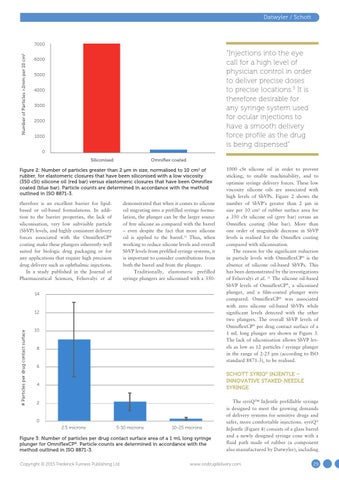
Figure 2: Number of particles greater than 2 µm in size, normalised to 10 cm2 of rubber, for elastomeric closures that have been siliconised with a low viscosity (350 cSt) silicone oil (red bar) versus elastomeric closures that have been Omniflex coated (blue bar). Particle counts are determined in accordance with the method outlined in ISO 8871-3. therefore is an excellent barrier for lipidbased or oil-based formulations. In addition to the barrier properties, the lack of siliconisation, very low subvisible particle (SbVP) levels, and highly consistent delivery forces associated with the OmniflexCP® coating make these plungers inherently well suited for biologic drug packaging or for any applications that require high precision drug delivery such as ophthalmic injections. In a study published in the Journal of Pharmaceutical Sciences, Felsovalyi et al
demonstrated that when it comes to silicone oil migrating into a prefilled syringe formulation, the plunger can be the larger source of free silicone as compared with the barrel – even despite the fact that more silicone oil is applied to the barrel.11 Thus, when working to reduce silicone levels and overall SbVP levels from prefilled syringe systems, it is important to consider contributions from both the barrel and from the plunger. Traditionally, elastomeric prefilled syringe plungers are siliconised with a 350-
14
# Particles per drug contact surface
12
10
8
1000 cSt silicone oil in order to prevent sticking, to enable machinability, and to optimise syringe delivery forces. These low viscosity silicone oils are associated with high levels of SbVPs. Figure 2 shows the number of SbVP’s greater than 2 µm in size per 10 cm2 of rubber surface area for a 350 cSt silicone oil (grey bar) versus an Omniflex coating (blue bar). More than one order of magnitude decrease in SbVP levels is realised for the Omniflex coating compared with siliconisation. The reason for the significant reduction in particle levels with OmniflexCP® is the absence of silicone oil-based SbVPs. This has been demonstrated by the investigations of Felsovalyi et al. 11 The silicone oil-based SbVP levels of OmniflexCP®, a siliconised plunger, and a film-coated plunger were compared. OmniflexCP® was associated with zero silicone oil-based SbVPs while significant levels detected with the other two plungers. The overall SbVP levels of OmniflexCP® per drug contact surface of a 1 mL long plunger are shown in Figure 3. The lack of siliconisation allows SbVP levels as low as 12 particles / syringe plunger in the range of 2-25 µm (according to ISO standard 8871-3), to be realised.
6
SCHOTT SYRIQ® INJENTLE – INNOVATIVE STAKED-NEEDLE SYRINGE
4
2
0 2.5 microns
5-10 microns
10-25 microns
Figure 3: Number of particles per drug contact surface area of a 1 mL long syringe plunger for OmniflexCP®. Particle counts are determined in accordance with the method outlined in ISO 8871-3. Copyright © 2015 Frederick Furness Publishing Ltd
The syriQ™ InJentle prefillable syringe is designed to meet the growing demands of delivery systems for sensitive drugs and safer, more comfortable injections. syriQ® InJentle (Figure 4) consists of a glass barrel and a newly designed syringe cone with a fluid path made of rubber (a component also manufactured by Datwyler), including
www.ondrugdelivery.com
29