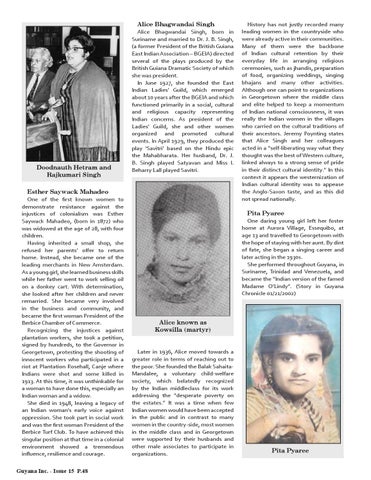
Alice Bhagwandai Singh Alice Bhagwandai Singh, born in Suriname and married to Dr. J. B. Singh, (a former President of the British Guiana East Indian Association – BGEIA) directed several of the plays produced by the British Guiana Dramatic Society of which she was president. In June 1927, she founded the East Indian Ladies’ Guild, which emerged about 10 years after the BGEIA and which functioned primarily in a social, cultural and religious capacity representing Indian concerns. As president of the Ladies’ Guild, she and other women organized and promoted cultural events. In April 1929, they produced the play ‘Savitri’ based on the Hindu epic the Mahabharata. Her husband, Dr. J. B. Singh played Satyavan and Miss I. Beharry Lall played Savitri.
Esther Saywack Mahadeo One of the first known women to demonstrate resistance against the injustices of colonialism was Esther Saywack Mahadeo, (born in 1872) who was widowed at the age of 28, with four children. Having inherited a small shop, she refused her parents’ offer to return home. Instead, she became one of the leading merchants in New Amsterdam. As a young girl, she learned business skills while her father went to work selling oil on a donkey cart. With determination, she looked after her children and never remarried. She became very involved in the business and community, and became the first woman President of the Berbice Chamber of Commerce. Recognizing the injustices against plantation workers, she took a petition, signed by hundreds, to the Governor in Georgetown, protesting the shooting of innocent workers who participated in a riot at Plantation Rosehall, Canje where Indians were shot and some killed in 1913. At this time, it was unthinkable for a woman to have done this, especially an Indian woman and a widow. She died in 1948, leaving a legacy of an Indian woman’s early voice against oppression. She took part in social work and was the first woman President of the Berbice Turf Club. To have achieved this singular position at that time in a colonial environment showed a tremendous influence, resilience and courage. Guyana Inc. - Issue 15 P.48
History has not justly recorded many leading women in the countryside who were already active in their communities. Many of them were the backbone of Indian cultural retention by their everyday life in arranging religious ceremonies, such as jhandis, preparation of food, organizing weddings, singing bhajans and many other activities. Although one can point to organizations in Georgetown where the middle class and elite helped to keep a momentum of Indian national consciousness, it was really the Indian women in the villages who carried on the cultural traditions of their ancestors. Jeremy Poynting states that Alice Singh and her colleagues acted in a “self-liberating way what they thought was the best of Western culture, linked always to a strong sense of pride in their distinct cultural identity.” In this context it appears the westernization of Indian cultural identity was to appease the Anglo-Saxon taste, and as this did not spread nationally. Pita Pyaree One daring young girl left her foster home at Aurora Village, Essequibo, at age 13 and travelled to Georgetown with the hope of staying with her aunt. By dint of fate, she began a singing career and later acting in the 1930s. She performed throughout Guyana, in Suriname, Trinidad and Venezuela, and became the “Indian version of the famed Madame O’Lindy”. (Story in Guyana Chronicle 01/21/2002)
Later in 1936, Alice moved towards a greater role in terms of reaching out to the poor. She founded the Balak SahaitaMandalee, a voluntary child-welfare society, which belatedly recognized by the Indian middleclass for its work addressing the “desperate poverty on the estates.” It was a time when few Indian women would have been accepted in the public and in contrast to many women in the country-side, most women in the middle class and in Georgetown were supported by their husbands and other male associates to participate in organizations.