Gundlach (punk rock band, alleged drug use), Minerd’s journey to his current position was equally nonlinear. “Retirement was great for six months,” Minerd said when we met for lunch a few hours after his morning performance. The 53-year old, it turns out, had retired in the late 1990s after a relatively short 15-year career on Wall Street. He then moved to Venice Beach, California, to pursue an enduring passion: bodybuilding— which is why we were having lunch on the patio of The Firehouse, known within this community as the go-to restaurant for the world’s most muscular men. “I was burned out on Wall Street,” he said. “I didn’t need 10 houses and 25 automobiles. Wall Street is a grind. It sucks the life out of you if you let it. I didn’t want to go back, so I quit. I travelled.” But he soon tired of retirement—as any 39-year-old retiree might. “A year after I moved out here a friend and I had dinner. We talked about a deal he was working on. I had been lifting, playing volleyball, but it turned out I was dying to do the deal he was working on. I missed it.” Luckily, people remembered Minerd—which isn’t surprising, considering that his lifelong obsession with bodybuilding has left him with, well, a bodybuilder’s body. “I had helped Mark Walter”—the founder and CEO of Guggenheim Partners— “finance a company once. He had tried to hire me earlier. I was frustrated and it hit me during my time off that I wasn’t done working—so I called him. I proposed opening a Los Angeles office of Liberty Hampshire.” Minerd became employee #14 of the burgeoning firm, which eventually became what is now Guggenheim Partners and manages upward of $160 billion in client capital, largely in the insurance sector but with a growing pension and endowment and foundation base. The move into pension assets specifically makes sense, Minerd thinks. “Insurance assets are regulated to manage to a liability,” he said as the waiter, who clearly had served Minerd before, took our order. “You can’t mismatch. As pension funds become more cognizant of this, the insurance model is a better fit.” Guggenheim, however, is only now truly ramping up its institutional business. While Minerd’s record speaks volumes about his ability in asset management, the firm’s ability to asset gather is less clear. “Mark Walter likes to say we have four things that matter: ‘Performance, performance, performance, and risk management.’ Asset gathering, really, hasn’t been a primary focus. We have never focused much on the consultant world. We only really started marketing in 2006, but still our main focus continued to be on performance.” This is changing—not least because of Minerd’s, and the firm’s, phenomenal crisis. As he had said in the morning meeting, people had labeled him crazy when he predicted a financial crisis, but he stuck to his guns, and it paid off. Asset growth accelerated through the crisis (going from $35 billion to $131 billion from 2007 to 2012) as Minerd kept a cool head. “The key was to identify the big macro drivers. As the world was crumbling, I looked at the data. History shows us that 18 months after the Federal Reserve
REPRINTED FROM aiCIO December 2012
intervenes a recession is usually over. People thought I was crazy, but it was right.” “In an avalanche, they say to do one thing first,” Minerd said, squinting in the California sun. “What is it? Spit, so you know which way is down. Otherwise you end up digging in the wrong direction. It’s important for asset managers to spit once in awhile.”
A
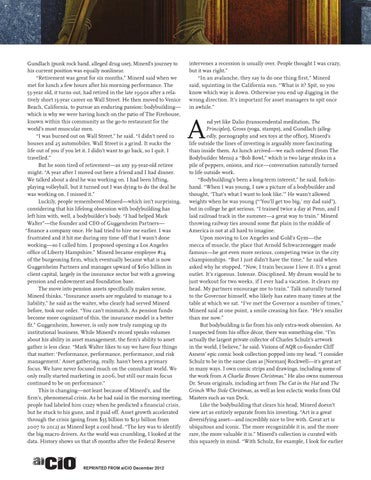
nd yet like Dalio (transcendental meditation, The Principles), Gross (yoga, stamps), and Gundlach (allegedly, pornography and sex toys at the office), Minerd’s life outside the lines of investing is arguably more fascinating than inside them. As lunch arrived—we each ordered (from The Bodybuilder Menu) a “Bob Bowl,” which is two large steaks in a pile of peppers, onions, and rice—conversation naturally turned to life outside work. “Bodybuilding’s been a long-term interest,” he said, fork-inhand. “When I was young, I saw a picture of a bodybuilder and thought, ‘That’s what I want to look like.’” He wasn’t allowed weights when he was young (“‘You’ll get too big,’ my dad said”), but in college he got serious. “I trained twice a day at Penn, and I laid railroad track in the summer—a great way to train.” Minerd throwing railway ties around some flat plain in the middle of America is not at all hard to imagine. Upon moving to Los Angeles and Gold’s Gym—the mecca of muscle, the place that Arnold Schwarzenegger made famous—he got even more serious, competing twice in the city championships. “But I just didn’t have the time,” he said when asked why he stopped. “Now, I train because I love it. It’s a great outlet. It’s rigorous. Intense. Disciplined. My dream would be to just workout for two weeks, if I ever had a vacation. It clears my head. My partners encourage me to train.” Talk naturally turned to the Governor himself, who likely has eaten many times at the table at which we sat. “I’ve met the Governor a number of times,” Minerd said at one point, a smile creasing his face. “He’s smaller than me now.” But bodybuilding is far from his only extra-work obsession. As I suspected from his office décor, there was something else. “I’m actually the largest private collector of Charles Schulz’s artwork in the world, I believe,” he said. Visions of AQR co-founder Cliff Asness’ epic comic book collection popped into my head. “I consider Schulz to be in the same class as [Norman] Rockwell—it’s great art in many ways. I own comic strips and drawings, including some of the work from A Charlie Brown Christmas.” He also owns numerous Dr. Seuss originals, including art from The Cat in the Hat and The Grinch Who Stole Christmas, as well as less eclectic works from Old Masters such as van Dyck. Like the bodybuilding that clears his head, Minerd doesn’t view art as entirely separate from his investing. “Art is a great diversifying asset—and incredibly nice to live with. Great art is ubiquitous and iconic. The more recognizable it is, and the more rare, the more valuable it is.” Minerd’s collection is curated with this squarely in mind. “With Schulz, for example, I look for earlier