recorded track resulting in two separate musical lines to then be mixed together onto a new track. Although the guitar is in and of itself a polyphonic instrument, this invention let Paul further exploit his own talents as a performer, arranger, and sound engineer by creating a level of depth not yet achieved by a single musician in the history of recorded sound. Paul went one step further in the name of innovation and even built his own disc-cutter assembly based on parts from a Cadillac car. In the early days he used the acetate-disk setup to record at different speeds and with delay, which resulted in his signature sound complete with echoes and birdsong-like riffs on guitar. Later on Les was able to transition to magnetic tape, which afforded him the ability to take his recording rig on tour and even prerecord episodes of his radio show from the comforts of his hotel room. Further down the line in the late 1950s, Paul worked with Ampex on the design of the first eight-track recording deck, also utilized in Les’ home recording studio. Famously designed by Les Paul, the eight-track tape recorder swung open the door for modern music recording as we know it today. He commissioned Ampex to build the first of its kind and took delivery of serial no. 1 in 1956. It featured a head designed by Paul that could record or play back tracks. Although he had pioneered the sound-on-sound recording technique as early as 1949, Paul’s initial method of achieving what could only be described as “self-harmonization” was risky in its infant form. Working alongside Ross Snyder (Ampex Manager of Special Products, 1952-60), Les’ new idea to stack all eight
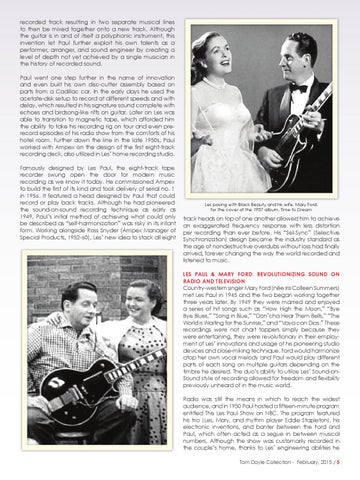
Les posing with Black Beauty and his wife, Mary Ford, for the cover of the 1957 album, Time to Dream
track heads on top of one another allowed him to achieve an exaggerated frequency response with less distortion per recording than ever before. His “Sel-Sync” (Selective Synchronization) design became the industry standard as the age of nondestructive overdubs without loss had finally arrived, forever changing the way the world recorded and listened to music. LES PAUL & MARY FORD: REVOLUTIONIZING SOUND ON RADIO AND TELEVISION Country-western singer Mary Ford (née Iris Colleen Summers) met Les Paul in 1945 and the two began working together three years later. By 1949 they were married and enjoyed a series of hit songs such as “How High the Moon,” “Bye Bye Blues,” “Song in Blue,” “Don’cha Hear Them Bells,” “The World is Waiting for the Sunrise,” and “Vaya con Dios.” These recordings were not chart toppers simply because they were entertaining, they were revolutionary in their employment of Les’ innovations and usage of his pioneering studio devices and close-miking technique. Ford would harmonize atop her own vocal melody and Paul would play different parts of each song on multiple guitars depending on the timbre he desired. The duo’s ability to utilize Les’ Sound-onSound style of recording allowed for freedom and flexibility previously unheard of in the music world. Radio was still the means in which to reach the widest audience, and in 1950 Paul hosted a fifteen-minute program entitled The Les Paul Show on NBC. The program featured his trio (Les, Mary, and rhythm player Eddie Stapleton), his electronic inventions, and banter between the Ford and Paul, which often acted as a segue in between musical numbers. Although the show was customarily recorded in the couple’s home, thanks to Les’ engineering abilities he Tom Doyle Collection - February, 2015 / 5