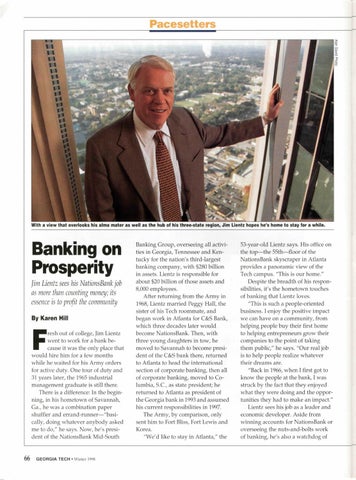
With a view that overlooks his alma mater as well as the hub of his three-state region, Jim Lientz hopes he's home to stay for a while.
Banking on Prosperity Jim Lientz sees his NationsBank job as more than counting money; its essence is to profit the community By Karen Hill
F
resh out of college, Jim Lientz went to work for a bank because it was the only place that would hire him for a few months while he waited for his Army orders for active duty. One tour of duty and 31 years later, the 1965 industrial management graduate is still there. There is a difference: In the beginning, in his hometown of Savannah, Ga., he was a combination paper shuffler and errand-runner—"basically, doing whatever anybody asked me to do," he says. Now, he's president of the NationsBank Mid-South
66
GEORGIA TECH • Winter 1998
Banking Group, overseeing all activities in Georgia, Tennessee and Kentucky for the nation's third-largest banking company, with $280 billion in assets. Lientz is responsible for about $20 billion of those assets and 8,000 employees. After returning from the Army in 1968, Lientz married Peggy Hall, the sister of his Tech roommate, and began work in Atlanta for C&S Bank, which three decades later would become NationsBank. Then, with three young daughters in tow, he moved to Savannah to become president of the C&S bank there, returned to Atlanta to head the international section of corporate banking, then all of corporate banking, moved to Columbia, S.C., as state president; he returned to Atlanta as president of the Georgia bank in 1993 and assumed his current responsibilities in 1997. The Army, by comparison, only sent him to Fort Bliss, Fort Lewis and Korea. "We'd like to stay in Atlanta," the
53-year-old Lientz says. His office on the top—the 55th—floor of the NationsBank skyscraper in Atlanta provides a panoramic view of the Tech campus. "This is our home." Despite the breadth of his responsibilities, it's the hometown touches of banking that Lientz loves. "This is such a people-oriented business. I enjoy the positive impact we can have on a community, from helping people buy their first home to helping entrepreneurs grow their companies to the point of taking them public," he says. "Our real job is to help people realize whatever their dreams are. "Back in 1966, when 1 first got to know the people at the bank, I was struck by the fact that they enjoyed what they were doing and the opportunities they had to make an impact." Lientz sees his job as a leader and economic developer. Aside from winning accounts for NationsBank or overseeing the nuts-and-bolts work of banking, he's also a watchdog of