Professor Malcolm Polk leads an effort to develop an economical process for turning waste-nyloncarpet fiber into new carpet. would solve a waste disposal problem for the industry and help improve the durability of the highway system." More than 20 years of construction and evaluation have shown the value of fiberreinforced concrete, but it is not widely used today because commercially produced reinforcement fiber makes the cost too high for many applications. Wang believes the availability of inexpensive carpet waste fiber could allow more widespread use of fiber-reinforced concrete. "Putting a small amount of carpet fiber into concrete converts it into a ductile material, and that's very important to a highway engineer or architect," he adds. Wang has worked with Shaw Industries, the world's largest carpet manufacturer, to successfully use about 40,000 pounds of carpet waste to reinforce concrete in the company's new 117,000-square-foot research and development center.
use a portion of the estimated one billion pounds of used carpet discarded each year.
hri Ultimate Solution
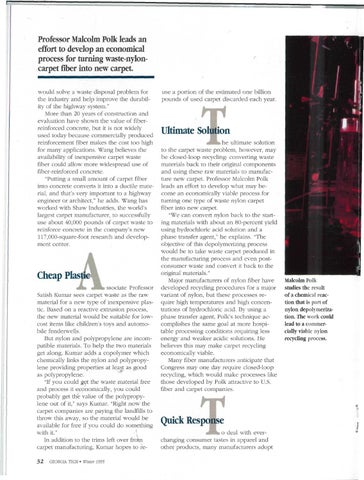
ÂŤ f l L he ultimate solution to the carpet waste problem, however, may be closed-loop recycling: converting waste materials back to their original components and using these raw materials to manufacture new carpet. Professor Malcolm Polk leads an effort to develop what may become an economically viable process for turning one type of waste nylon carpet fiber into new carpet. "We can convert nylon back to the starting materials with about an 80-percent yield using hydrochloric acid solution and a phase transfer agent," he explains. "The objective of this depolymerizing process would be to take waste carpet produced in the manufacturing process and even postconsumer waste and convert it back to the original materials." Major manufacturers of nylon fiber have J k i JKkm ssociate Professor developed recycling procedures for a major Satish Kumar sees carpet waste as the raw variant of nylon, but these processes rematerial for a new type of inexpensive plas- quire high temperatures and high concentic. Based on a reactive extrusion process, trations of hydrochloric acid. By using a the new material would be suitable for low- phase transfer agent, Polk's technique accost items like children's toys and automocomplishes the same goal at more hospibile fenderwells. table processing conditions requiring less But nylon and polypropylene are incom- energy and weaker acidic solutions. He believes this may make carpet recycling patible materials. To help the two materials economically viable. get along, Kumar adds a copolymer which chemically links the nylon and polypropyMany fiber manufacturers anticipate that lene providing properties at least as good Congress may one day require closed-loop as polypropylene. recycling, which would make processes like "If you could get the waste material free those developed by Polk attractive to U.S. and process it economically, you could fiber and carpet companies. probably get the value of the polypropylene out of it," says Kumar. "Right now the carpet companies are paying the landfills to throw this away, so the material would be available for free if you could do something with it." ÂŤ4HL o deal with everIn addition to the trims left over from changing consumer tastes in apparel and carpet manufacturing, Kumar hopes to reother products, many manufacturers adopt
Cheap Plastic
T
Quick Response
32
GEORGIA TECH • Winter 1995
Malcolm Polk studies the result of a chemical reaction that is part of nylon depolymerization. The work could lead to a commercially viable nylon recycling process.